Home Blog

GISS welding student places fifth at national competition

SUBMITTED ARTICLE

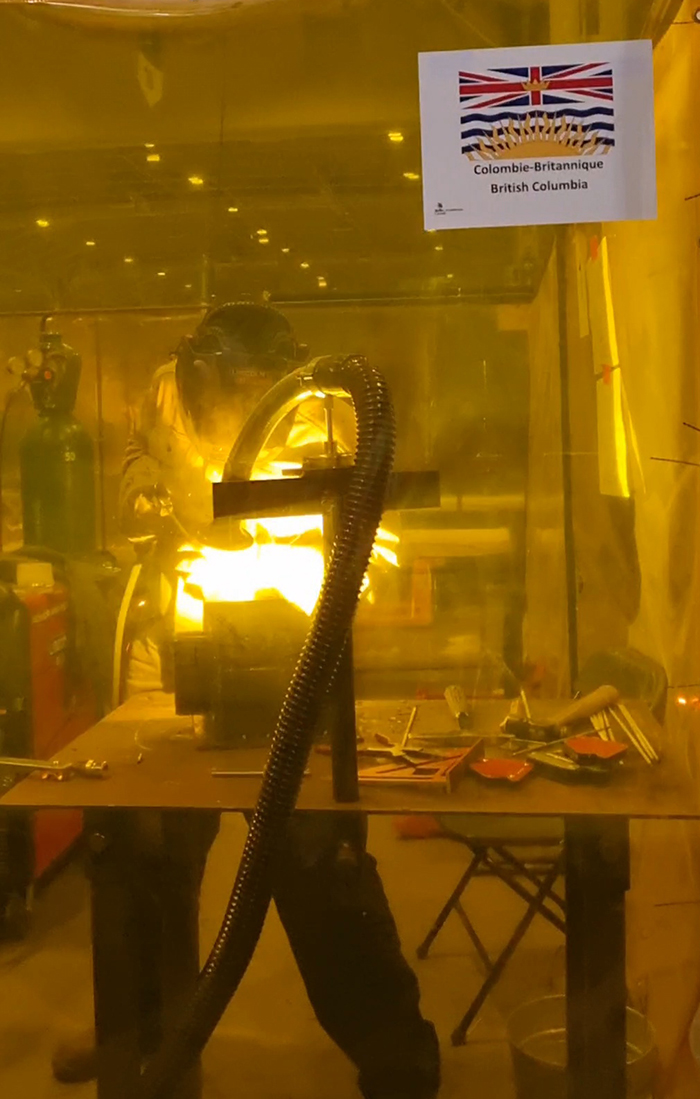
After two gruelling six-hour days in a small welding bay, completing two different steel structures, we knew Antoine Gonzalez’s projects would hold up to the judges’ industry standards at the Skills Canada National Competition (SCNC) held in Toronto May 27-30.

The energy was high, waiting for the results to be announced at the closing ceremonies. Competing side by side with the top welding student from each of Canada’s provinces and territories, it was clear that Gulf Islands Secondary School (GISS) student Gonzalez, who is also an apprentice at Island Marine Construction, was in the game. He kept up the pace, completing each project on time, even with a recent collarbone surgery that reduced the strength of his left arm.

When asked, “How did you do?” Gonzalez gives you a humble smile and says, “I did okay. It was pretty fun.” The young man’s calm demeanor and positive outlook is what has helped him to excel at welding training in the GISS youth apprenticeship program under Island Marine Construction, and earn fifth place at the SCNC.

Gonzalez finished top of his class in the Welding Foundation Program at Camosun College as a dual credit Grade 12 student, which led to competing at the Regional Skills Canada competition in early March. Encouraged by GISS apprenticeship program teacher Shari Hambrook and the instructors at Camosun, Gonzalez put in extra hours of training for the regionals, which locked in the first-place win. Working full time welding at Island Marine Construction kept him busy before the provincial championships on April 14-15. Gonzalez didn’t think he would be in the top three, so left the Tradex in Abbotsford before the closing ceremonies to catch the ferry back to Salt Spring and work the next day. It was over the live YouTube feed that he heard his name announced as the provincial gold medalist for secondary school welding.

Accepting a seat on the Skills BC team was a big commitment, and Gonzalez was ready. But his practice time was cut short when he broke his collarbone and had surgery three weeks before the competition. Gonzalez’s determination and the support of everyone around him propelled him along, but he missed weeks of hands-on training.

When asked what helped him prepare, Gonzalez said, “Working in the shop and going to the [Camosun dual credit] welding program prepared me really well. I couldn’t have done it without a good team behind me in the shop during the competition.”

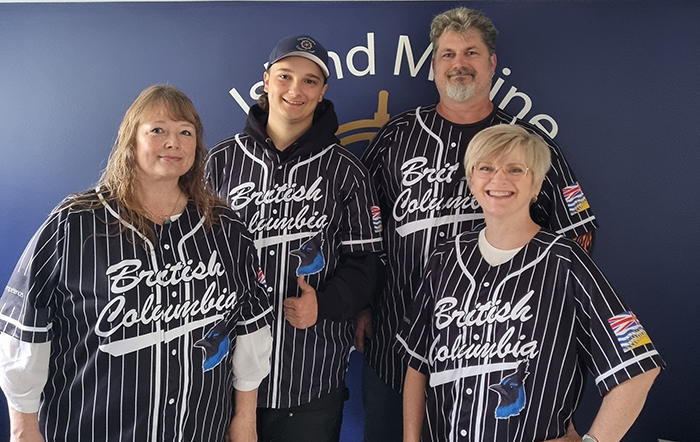
Thanks to many generous donations from local trades businesses, the Salt Spring Legion and community members, Gonzalez reached the goal of $15,000 to pay for himself and his delegation, including his mom Jodi French, GISS apprenticeship program teacher Shari Hambrook, and his secret weapon, Kevin Huebert, lead welder and apprenticeship sponsor from Island Marine Construction. Huebert has trained at least 10 youth welders through the GISS trades program and his positive presence, coaching and advice during the gruelling competition days kept us all calm and Gonzalez focused.

Huebert was impressed by the size of the event.

“The competition was eye-opening for me,” he said. “Being in Toronto at such a big event was definitely out of my comfort zone, but I soaked it up, visited all the trades booths, watched the other competitors and supported Antoine. I know it is for a bigger cause.”

Skills Canada Nationals brings together Canada’s top 500 youth workers in over 40 trades and technology occupations. To reach nationals, youth compete at regionals and provincials in either secondary or post-secondary divisions. Team BC, in their coveted provincial jerseys, sent 60 competitors and their delegates and brought home 25 medals (nine gold, nine silver and seven bronze). Spread out over the floor of the Enercare Centre were competitions representing six sectors: construction, employment, information technology, manufacturing and engineering, services and transportation. Thousands of people from school groups, industry and the public watched the competitions and were inspired by trades.

French posted after the event: “There was very steep competition and while he didn’t make it to this podium, he did an excellent job on his two competition projects, but more importantly, he competed (two weeks post-surgery) with integrity, grit and grace under literal fire. Two-time gold and a top youth welder in our country will do for now.”

In the end, it was an 85-pound juggle, but the two welding projects were shipped home via courier and will be shown off at GISS and Island Marine Construction.

“After witnessing the trades competitions, it is clear to me that trades students from GISS are already performing at a national level,” said Hambrook. “Our programs, supported by the elite-level local tradespeople in the Gulf Islands, produce highly skilled apprentices. Like Antoine, apprentices are often too focused on their responsibilities at work to take time for these competitions! I am so grateful that Antoine took the chance and I look forward to showing off his projects and encouraging GISS students to compete next year.”

SCNC 2027 will be held in Calgary, Alta. at the BMO Centre at Stampede Park. Regional competitions in all trade areas will be on Feb. 5, 2027 at Camosun College. The competition is open to apprentices and youth in trades training who are under the age of 23.

The complete list of results is available on the skillscompetencescanada.com website. For more information, contact Hambrook at shambrook@sd64.org.
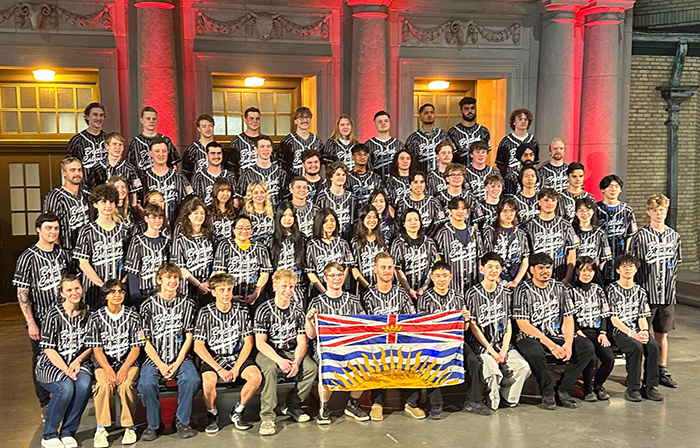
Team BC at the national skills comp in Toronto.
Adrian Gonzalez in the welding booth at the Skills Canada National Competition.
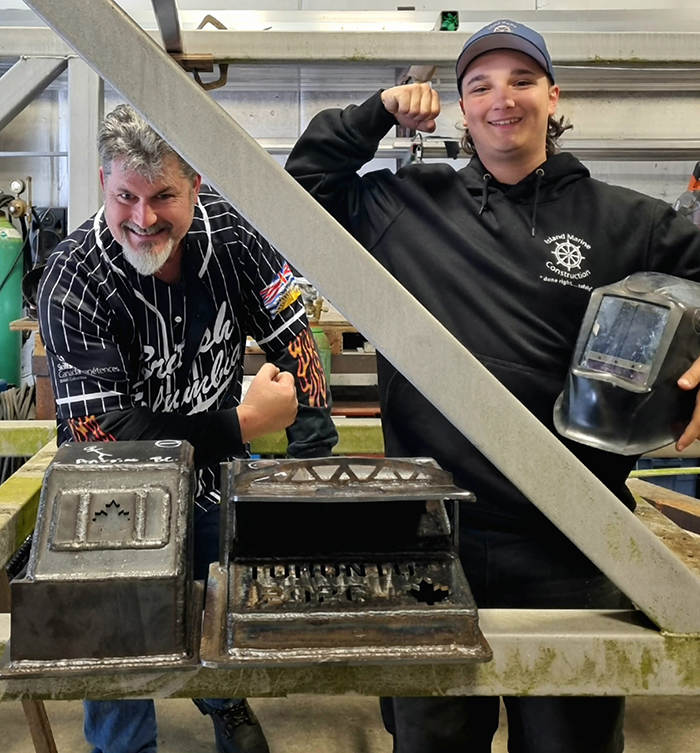
Kevin Huebert and Adrian Gonzalez with projects at Island Marine Construction.

180 homes planned on Ganges Hill

0

A proposal to include property into the Ganges Sewer District has given the public its first glimpse of plans for as many as 180 new units of housing, intended to be built in the most densely populated — and arguably well-serviced — part of Salt Spring Island.

The new development would span three parcels on Ganges Hill — totalling more than three acres — at and adjacent to 231 Fulford-Ganges Road, across from Drake Road at the southern entrance to the village. 

According to a letter to the sewer district from the Ganges Hill Development Company’s planning consultant, the first of two 90-unit phases would be comprised of “multiple structures varying in height,” with an estimated total floor space of more than 100,000 square feet — and, most relevant to the sewer district, a population estimate for that first phase of about 243 people potentially utilizing the waste system.

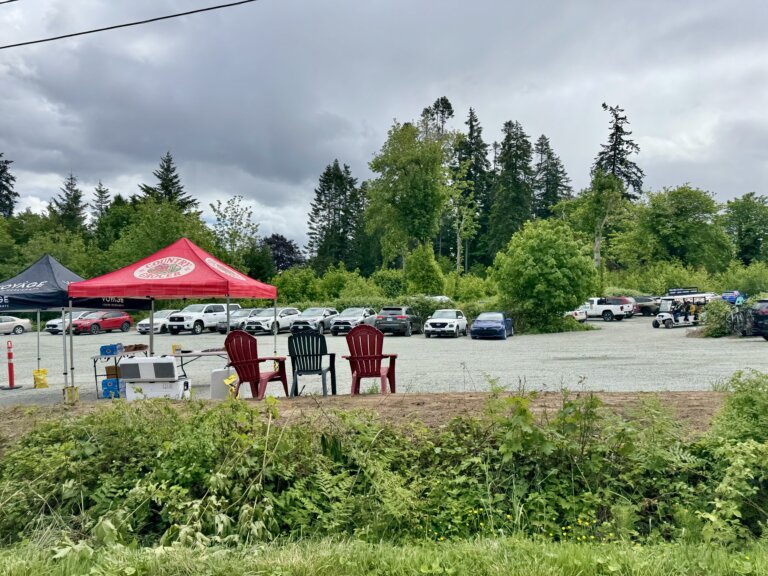
For almost two years, the property had been home to vehicle and material staging during the lengthy Ganges Hill road improvement project. 

Since May 16, Salt Spring’s Ganges Village Marketplace (GVM) has offered paid Saturday off-site parking for its stores and the Saturday Market at the site, splitting the $10 per car fee with a rotating list of island nonprofits and charities who in exchange have volunteered to help run the lot. 

Engineering estimates brought before the Ganges Sewer Local Service Commission’s annual general meeting Thursday, June 4 envisioned several three-storey structures, noting repeatedly the project was still in its early planning stages. 

Attending to represent Ganges Hill Development Company, Highbury Asset Management’s Mark Grey-Dreaper told commissioners their preliminary drawings had suggested four buildings with 10,000-square-foot footprints were most suitable along the back of the property for the first phase, with parking available on the Fulford-Ganges Road side to best preserve drivers’ sightlines.

Pressed for details by curious commissioners, Grey-Dreaper said the company prized the location’s proximity to the village core, its likely straightforward downhill integration into the existing sewer system and the property’s walkability for potential future residents.

“Collectively, I mean we’ve got 250 employees on the island,” said Grey-Dreaper, referring to Salt Spring’s Country Grocer and other endeavours at GVM.

“We’ve found ways to house about 50 of them in various forms of houses and trailers and things like that,” he added. 

“So certainly affordable housing is close to our hearts, in terms of desires of what we would like to be able to see developed on the island.”

In response to further questions from commissioners, Grey-Dreaper said the project had not yet applied for water service from the North Salt Spring Waterworks District (NSSWD), nor had it begun a rezoning process with the Islands Trust; Salt Spring’s Capital Regional District director Gary Holman, who sits on the commission, noted there may be requirements about unit affordability in whatever housing agreements the developer comes to with local government.

“Our urgency is to be able to provide housing that is needed in the community,” said Grey-Dreaper. 

“And affordable housing is a component to that, for sure.”

As the project progresses, according to a staff report, there may be financial implications for the sewer district; in addition to the $2,100 application fee already received, if the development proceeds it will be obligated to pay nearly $2,500 to the commission for each multi-family residential unit connected. 

Relatedly, should the development proceed with seeking water connections through the NSSWD, it would face a one-time levy in the form of a Capital Expenditure Charge, according to district bylaws, which would cost between roughly $10,000 and $13,000 per unit, depending on each unit’s size. Last March, the NSSWD board partially lifted what had been a decade-long moratorium on new water connections, making available the demand equivalent of 300 multi-unit dwellings for properties seeking water on the Maxwell Lake side of the district’s system. 

The Driftwood confirmed the water district had not recently received any large requests for connections, and that the Ganges Hill parcels do indeed lie within the area permitted for new taps.

Commissioners Thursday voted to grant permission for the proponents to proceed with their application to be included in the Ganges Sewer Local Service Area. That advances the process but doesn’t guarantee a connection, according to staff, who said they would complete a capacity analysis and bring a draft bylaw back to commissioners for their approval.

New home for Indigenous Peoples’ Weekend

BY KAEN VALOISE

Boozhoo! Kaen nindizhinikaaz. 

That means “Hello! My name is Kaen” in Ojibwe, the First Nation culture I inherited from my father. I’ve been on gorgeous Salt Spring Island for a year now! From Montreal originally, I’ve spent the last 30 years in beautiful Vancouver working festivals and events. The plan was to come to Salt Spring Island to take it easy and ease into my mellow years, but to quote Michael Corleone, “just when I think I’m out, they pull me back in!” No – I kid. In reality, I couldn’t be more thrilled or honoured about joining the organizing committee of the Indigenous Peoples Weekend.

Indigenous Peoples Day happens every June 21, but we have such a rich diversity of Indigenous culture on Salt Spring Island that we take a whole weekend to celebrate it! While it is very important to remember, recognize and honour some of the more challenging aspects of our collective past, and there will be opportunities for learning and reconciliation throughout the weekend, Indigenous Peoples Weekend is a chance to celebrate the joy and beauty of our cultures.

I’m not the only thing that’s new this year – we also have a new venue! The Farmers Institute has generously provided a new home for our event, and we’ve been working hard to bring together an exciting assortment of entertainment and activities so you can come, park, and make a day of it!  

This year’s weekend is extra long, starting on Thursday June 18 when we welcome the Quw’utstun Cultural Connections Society. They’ll be presenting their deeply impactful and inspiring Journey of our Generation workshop. We hope you’ll join us as Quw’utsun Elders share stories of village life before settlers arrived, and the transformation after colonization. Quw’utsun Elders remind us “the longest journey is from our head to our hearts. We each have much to learn along the way as we learn forgiveness, and practice the values found in kindness, expressed through love and guided by respect.”

Tickets are on sale now. $75 includes lunch, snacks and tea, but no one will be turned away due to insufficient funds. You can read more on the Quw’utsun Cultural Connections website, the Facebook event page, or on our socials, @indigenouspeoplesweekend.

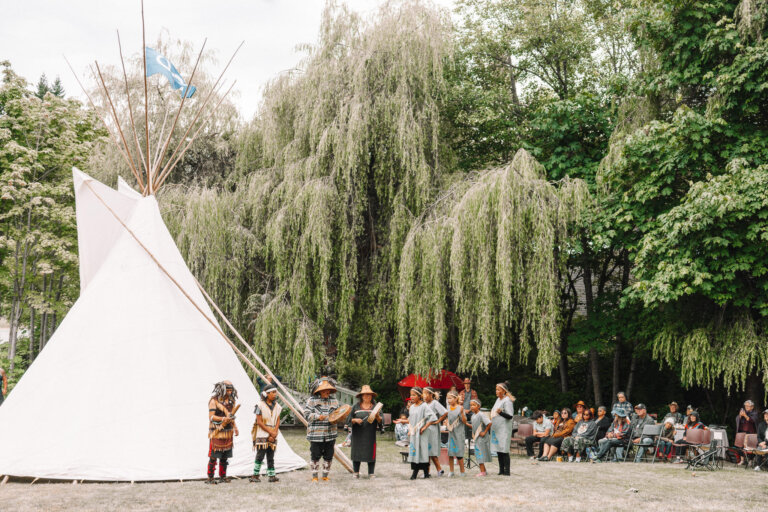
On Friday June 19, Quw’utsun Elder Qwiyawultu-hw will welcome us and share some wisdom. Then the community will come together to raise our magnificent tipi while Indigenous guests share their culture through stories, knowledge-sharing, and dance. Throughout the weekend, the tipi will be a gathering place where guests can hear stories, see puppet shows, and gather in conversation with Elders. 

Inside the Hall, Stz’minus artist, historian, medicine man, and cultural practitioner Daniel Elliott will offer a free movement workshop. The workshop and tipi-raising will be followed by a large community potluck where we’ll serve salmon and Bannock alongside your offerings. This feast is an opportunity to honour our Elders, and gather to build relationships. After the feast, we’ll dance into the evening with Local Motion, featuring Métis singers (including our magnificent and wonderfully talented Artistic Director Sherry Williams). 

On Saturday, the main stage will offer a dazzling array of performers, including Ed Peekakoot, Wesley Hardisty and the Edgar Hann Band. And perhaps a special surprise – be sure to keep an eye on our socials and website (indigenouspeoplesweekend.ca) for announcements! Sunday’s main stage will feature a stellar lineup of local talent and a few special guests, like Danielle Enblom’s Métis jigging!

Inside the Hall, we’ll be presenting a range of workshops, including a hula-and-history presentation by our Kanaka (Hawaiian) Salt Springers, and craft workshops for the whole family. The Hall will also house the Quw’utstun Cultural Connections’ amazing immersive exhibit Thu-it (pronounced tah-EET), which gives a walk-through experience of Quw’utsun history, a display on the history of the fur trade, and a silent auction to support the Q’ushin’tul’ (Walking Together) Ancestors Walk event.

In addition to the many events throughout the weekend at the Farmers Institute, there will be an Indigenous Art Show at ArtSpring (now accepting applications), Indigenous artist demos at Mahon Hall put on by the Arts Council, a talk on the BC Government and Indigenous Rights by former MLA and current W̱JOȽEȽP (Tsartlip) Lead Negotiator Adam Olsen offered by the Salt Spring Forum at ArtSpring, and many other events in planning stages. If you are Indigenous, or have an Indigenous partner, we would love you to put on an event that we can add to our calendar! 

Our schedule is still evolving, but you can keep up to date on our socials, or on our new website, which includes registration links for Journey of Our Generation and the Indigenous Art Show, and where you can find my contact info should you have any thoughts, suggestions or questions: www.indigenouspeoplesweekend.ca.

If you have a business and would like to support us, please contact me and we can discuss the best way to get you involved! If you’d like to donate, you can e-transfer to the Farmland Trust at ipw@ssifarmlandtrust.org. Every donation of any size is very much needed and appreciated!

And volunteers! As a volunteer-run event, we rely on the support of the community to make this incredible event happen. Whether you’re motivated by community, reconciliation, or philanthropy, please visit the Supporters page on our website to find out how you can help.

 Miigwech! HÍSW̱KE! Huy ch q’u! Maarsi! Mahalo! Thank you for joining our celebration!

Islander pens Southern Michif children’s book

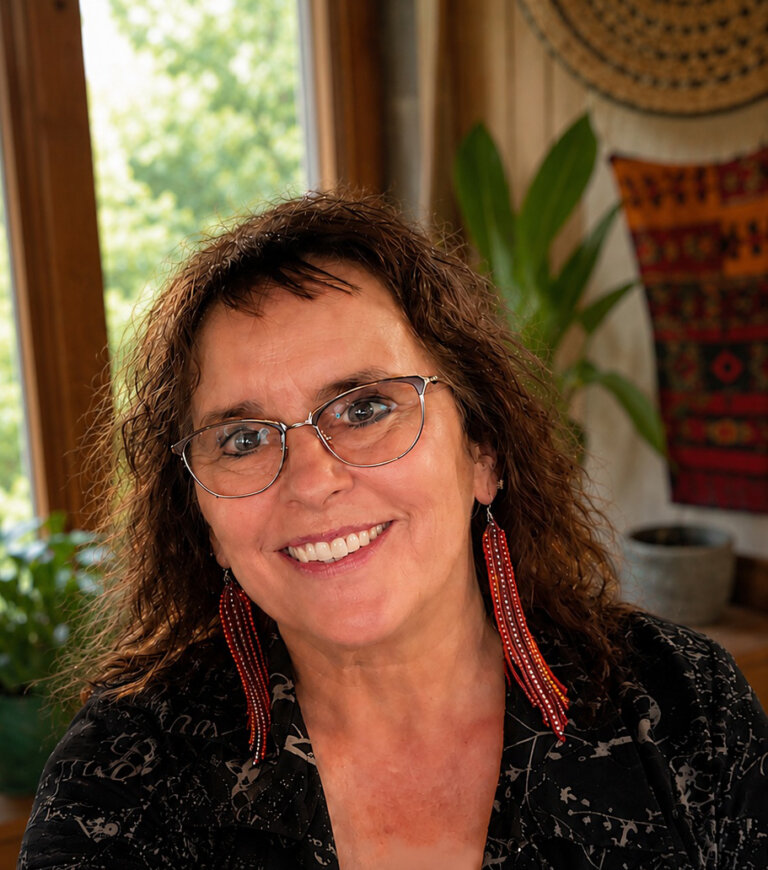
Salt Spring Island Métis Cree artist and author Sherry Leigh Williams will launch her debut children’s book, Papaashi Bufloo: The Buffalo Who Raced Horses at Indigenous Peoples Weekend 2026 on Sunday, June 21 — National Indigenous Peoples Day — at 1 p.m. at the Farmers’ Institute on Salt Spring Island. The event is free and open to the public.

Illustrated with original acrylic paintings by Williams, the 32-page book tells the story of her great-grandmother Mary Anne Deschamps Rabaska, born in 1875 near Pigeon Lake, Alberta. As a young girl, Mary Anne finds a buffalo calf alone near an old cabin and names him Toneur — Thunder in Southern Michif. They grow up together, and when her Mooshoom enters Toneur in a town horse race, Mary Anne places her Koohkoom’s beaded tuppie on his back. Together, they win.

The book introduces young readers to Southern Michif, the traditional language of the Métis people, and includes a Michif glossary, cultural pages about Métis beadwork, and the history of the Deschamps dit Rabasca family and the Papaschase Cree. The Michif language content has been verified by Elder Bruce Dumont, Former President of Métis Nation BC, and reviewed by Métis Nation BC.

Williams is also a songwriter and community organizer, president of Sweetgrass Arts and Music Society of Salt Spring Island and founder of Salt Spring Music Events. Celtic ancestry on her maternal side and Papaschase/Red River Mètis ancestry, Williams’s work honours her family’s history and the Métis tradition of storytelling through art. “Papaashi Bufloo: The Buffalo Who Raced Horses” is her first book.

“My great-grandmother Mary Anne was a remarkable woman, and I have carried her story with me my whole life,” said Williams. Her home, the cabin they lived in, still stands today as part of John Walter Museum in Edmonton. 

“This book is for the children — so they can hear her name, learn words in our language, and know that our Métis stories belong on the shelf beside every other story. When a child reads ‘Toneur’ out loud for the first time, that is our language living.”

Indigenous Peoples Weekend 2026 runs June 18–21 and features music, ceremony, workshops and cultural exhibits. The festival is presented by Sweetgrass Arts and Music Society and is supported by the Canadian Arts Presentation Fund, Salt Spring Island Foundation and the Capital Regional District. A reading at the library is also planned for fall 2026.

Bicycle Bob’s legacy rides on

0

By Robin Jenkinson

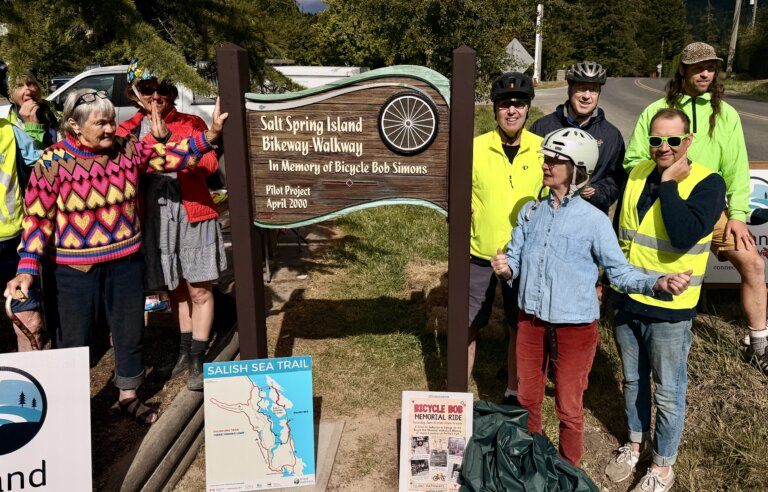
Bicycle bells rang Saturday, June 6 as family and friends gathered for the Bicycle Bob Simons Memorial Ride and sign re-installation, celebrating one of Salt Spring’s most colourful cycling advocates.

Simons, owner of Western Cyclogical for more than 20 years, was known as much for his generosity and ingenuity as for his love of bicycles.

“Nothing stopped Bob,” recalled longtime friend Henry Baade. “He had a flat tire one time and no pump, so he stuffed the tube with grass to keep it rolling until he reached a gas station where he could repair it.”

Baade laughed as he remembered Simons returning from the annual Norco garage sale with several bicycles strapped to the back of his own bike, tuning them up as he rode home.

Others remembered Simons’ humour and generosity.

“He’d fix your bike and install new parts and then turn to you and ask, ‘Would ten dollars be too much?’” recalled Simon Rompré.

For David Campbell, Simons’ adventurous spirit stood out. 

“The Kinetic Sculpture Race in Port Townsend was his Mecca,” he said. “We took the Coho Ferry with Bob’s rideable sculpture and biked there with Jeremy in the baby seat.”

Jeremy Simons, who joined Saturday’s ride with his own daughter Soleil in a rear child seat, said his father would be happy to see bicycle and walking trails expand here. 

“He rode across Canada with his dad, Art Simons, and around the world,” he said. “He definitely instilled a love of cycling in me.”

Before the ride, Island Pathways director Wendy Webb unveiled the “Bicycle Bob Simons Memorial Walkway-Bikeway” sign, restored and mounted by Larry Bishop with donated materials by Windsor Plywood. It commemorates the 300-metre widened road shoulder all along Portlock Park that was paved in 2000, just after Simons passed away. This segment now coincides with Island Pathways and Capital Regional District efforts to construct a multi-use pathway westward from Central to Mobrae and, ultimately, to Vesuvius.

Organizers hope to continue this annual tradition, celebrating Bicycle Bob’s legacy while inspiring future generations to enjoy a safer, creatively-inspired and bicycle-friendly island.

Those wishing to support the expansion of walking and cycling infrastructure on Salt Spring can visit islandpathways.ca or donate through the Salt Spring Island Foundation’s Multi-Use Pathway Fund.

Responders train for newborn emergencies

0

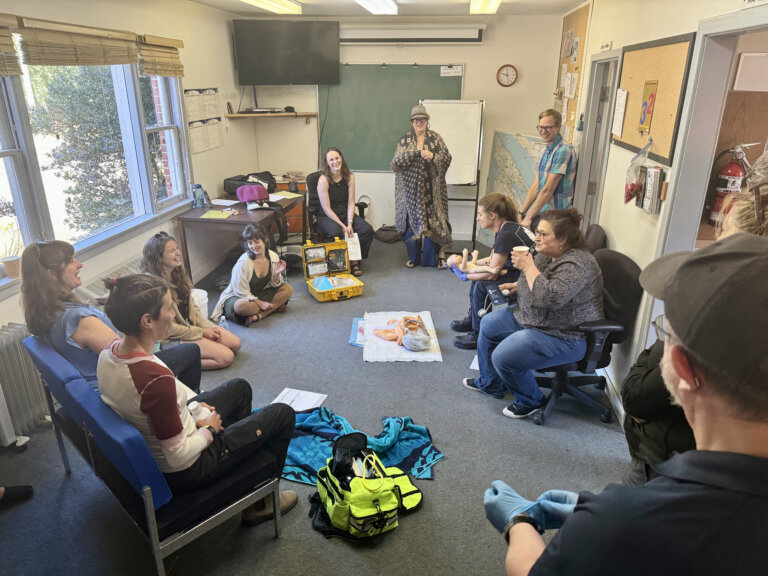
Salt Spring’s emergency responders worked toward a rather specialized sense of shared confidence and community this month, as fire and rescue teams joined island paramedics, midwives and doulas to practise newborn “stabilization and transfer” scenarios Thursday, June 4.

The drills were cooked up and “performed” with collaboration from the Salt Spring midwives and doulas, who set scenes for search and rescue, fire and ambulance teams — any one of which might find themselves first through the door during a birth emergency. Ali Lopez is the Rural Obstetrics and Maternity Sustainability Program (ROAM) coordinator for Salt Spring Island, and said these program-funded training sessions help get first responders comfortable with the possibility they very well might be the one supporting a baby and family when things don’t go as planned. 

Last year there were 22 births on Salt Spring, according to data from the Rural Coordination Centre of B.C., and given the island’s unique rural realities just eight of those took place at Lady Minto Hospital. Coupled with the knowledge there were nearly 90 pregnant families on-island in the care of a midwife last year, health officials recognized it was an excellent use of resources to “train up” everyone they could, from Salt Spring Island Search and Rescue (SSISAR) to the Coast Guard, to be ready to walk into anything.

“A lot of people don’t even know that births still take place on the island,” said Lopez. “On Salt Spring much of the time, it’s a home birth — and you never know it’s an emergency until it is, so our fire and ambulance crews might be the first ones there.”

Thursday’s event took place in the deliberately cramped quarters of SSISAR’s building on Fulford-Ganges Road; home births happen is all sorts of homes, and there’s no guarantee there will be plenty of room. During the scenarios, surprise curve balls — like the possibility of a second family member having their own medical emergency during the birth — brought a little measured chaos to the training, as first responders stepped over and around one another to deliver care — and just as importantly, comfort. 

“We’re really building community by working together, knowing each other and their style of work,” said Lopez. “Being familiar with other professionals you might work with, it makes a stressful situation less uncomfortable knowing we’re all one team.”

The approach of the ROAM program is to develop community-specific plans that focus on team building and an all-community response; with two ambulances to cover the length and breadth of Salt Spring, it’s not difficult to imagine a situation where they’d be tied up elsewhere. In one of the day’s scenarios, Salt Spring Island Fire Rescue firefighters were first to an improvised scene, where the expectant mother found herself going into labour just as her partner’s mother seemed to be at increasing risk of a heart attack. Sarah Carey is the program’s clinical lead and has been a midwife for more than 20 years; she said as a coordinator it’s sometimes hard to come up with scenarios that can really compare to the unique birth experiences that happen on the island.

“You talk to a midwife — or any first responder — and we all have stories of things other people would not believe,” said Carey, who also teaches neonatal resuscitations. “Because we have such a high proportion of home births here on Salt Spring — somewhere between 50 and 80 per cent, and some months it’s 100 per cent — fire and ambulance and our whole community, they are all a part of it.”

After each scenario, the group debriefed; in addition to skills training on particular medical conditions to be aware of for expectant and brand-new mothers and their babies, the doula “actors” brought feedback and reflection on how they felt cared for. 

“It’s been really beneficial with the state of births on the island,” said Lopez. “The better they’re prepared to handle whatever they walk into, the more ideal for everyone involved.”

Island doctor honoured for life’s work

0

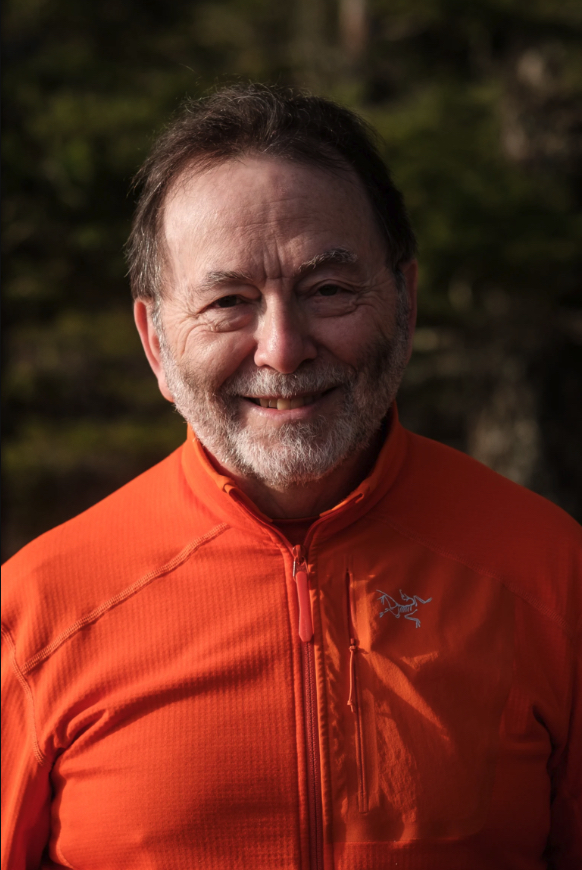
A long-serving physician was awarded a 2026 Lifetime Achievement Award of Excellence in Rural Medicine according to an announcement Monday, June 1 — and colleagues lined up to offer words of praise to Salt Spring’s Dr. Ronald Reznick.

Each year, the BC Rural Health Awards recognizes individuals and communities whose leadership and dedication are strengthening healthcare in rural remote, and Indigenous communities across British Columbia. Presented by the Rural Coordination Centre of B.C., the awards celebrate the people and partnerships who are improving access to care, advancing innovative solutions, supporting workforce sustainability and helping communities thrive. They recognize the broad range of contributions that sustain rural health systems, from frontline clinical care and mentorship to collaboration, advocacy and community-led leadership. 

Arriving on Salt Spring Island in 1984, Dr. Reznick quickly immersed himself into island life, becoming a community fixture in and out of the clinic. Known for his kindness, sense of humour and abundance of warmth to his patients and neighbours, he continues to keep clinic hours showing little sign of slowing down. Described by his colleagues as a uniquely dedicated personality with no concept of the 40-hour week, Dr. Reznick has spent 40 years in service to his community in his clinic, at Lady Minto Hospital, with late night calls and doing house calls on horseback all while embodying full service longitudinal care.

“He has long carried the largest patient load of any of the physicians in the community,” said Dr. Kevin Patterson, “even as the population of unattached patients has grown dramatically.”

In the clinic, at the hospital, or in their home, patients connect with his humour and empathy, often feeling like they are the first, and most important, patient he will see on any given day. 

“Ron is a friend and ally to all,” said Dr. David Brook. ”He is a true physician: able, available (like few others) and always affable.”

Colleague Dr. David Goranson said that over Dr. Reznick’s long career — doing emergency, inpatient, clinic and home visits — he has done the “full range of full service, rural general family practice” and everything that entails 

“Over the years, he would have been involved in an uncounted number of tense and difficult situations where life and limb were threatened,” said Dr. Goranson. “But he chooses to see the joy, courage, dignity and magnificence of the players and the people.”

With four decades of stories from Salt Spring Island and a variety of rural locums, Dr. Reznick is quick to share his good humour and a laugh. 

“I think that humour has been a huge part to help,” said Dr. Reznick. “I think humor for me has really carried me through this practice, and it continues to. Hopefully the patients aren’t too sick of my jokes at this point, but they still seem to enjoy some of them.”

Dr. Reznick often has difficulty saying no to his patients when they are in need and credits his Medical Office Assistant Gene for keeping him and his office functioning in the face of growing needs.

“Community is so important,” he said. “It’s so important that we all feel that we have something to do in the community; it gives us passion, it gives us support. It gives us the ability to help each other. If there’s a sick child on Salt Spring, everybody on Salt Spring is interested in helping that person.”

On reflection of his life and practice on Salt Spring Island, Dr. Reznick was quick to offer gratitude for what the community has offered him and his family. 

“I am extremely fortunate to have been able to do a career that’s all I really wanted to do,” he said, “and that I’ve been doing it in a place as wonderful as Salt Spring Island. And if I were to do it again, I would just do it — I would not hesitate to repeat this, what I’ve had here.”

Viewpoint: When we walk together

By Darlene Gage

I recently joined more than 100 people on the Q’ushin’tul’ Ancestor’s Walk across Salt Spring Island alongside Coast Salish Elders, youth, families and settlers. Q’ushin’tul’ means “walking with one another” in Hul’q’umi’num’, the language of the Quw’utsun people, and after four days together, I believe most of the walkers felt that strong sense of connection and understanding — even though we came from different types of communities.

We climbed up and down Hwmet’utsun (Mt. Maxwell), shared meals and ceremony at the Farmers’ Institute in Shiya’hwt (Ganges) and visited elder care homes to sing and drum with Elders here on Salt Spring. But what stayed with me most were the quieter moments along the way.

I kept noticing the mothers carrying babies on their backs over steep trails and long distances. Several talked about how different it felt to raise children in a setting where care was naturally shared by everyone around them. Offers like “Can I carry your child for a while?” “Do you need help with that bag?” or “Have you eaten?” were constant and natural.

The Elders were also at the centre of community life throughout the walk. Decisions happened with them, not separately from them. Whenever a question came up about how we should proceed, they were the first people consulted. There was something powerful about seeing wisdom and lived experience treated as essential rather than symbolic.

I also noticed how rare it was for anyone to be left alone unless they wanted solitude. In modern life, many of us quietly carry loneliness and disconnection as though it is normal. During those four days, I experienced something different: community not as an idea or slogan, but as a daily practice of paying attention to one another.

I came away feeling emotional, but also energized. The walk made me realize how hungry many of us are for deeper connection, belonging and ways of living that feel more grounded in care and reciprocity.

These gatherings tend to ask something different of us settlers than what we might be used to. They’re not an invitation to adopt or absorb what isn’t ours, but to show up with curiosity and respect, and let that be the spark. 

I feel so grateful to the Indigenous friends and neighbours who generously shared so much with all of us on the Walk. That is why I am especially excited about upcoming opportunities for the wider community to participate in Indigenous People’s Weekend June 18-21 at the Farmer’s Institute. Learn more about it online at indigenouspeoplesweekend.ca/program.

I’m also beyond thrilled to hear that the SȾÁUTW are returning to their traditional territories in very active ways at their Tsawout Reserve in the South End. Their plans to install a Long House and have more active cultural activities will bring more chances to learn and, more importantly, build stronger relationships and unity with one another. 

I hope the Salt Spring community will actively support their efforts to return home.

Darlene Gage is the executive director of Transition Salt Spring.

Editorial: Giving birth

0

Hearing as often as we do about Salt Spring Island’s inexorable demographic waltz toward our Golden Years, it’s little wonder we rarely think of babies being born here.

In a province that notably has the smallest percentage of its population yet to celebrate a first birthday, we still manage to stand out; our island only narrowly edges out the lower fertility rates of countries like Hong Kong and South Korea.

But every year, several dozen tiny, brand-new islanders do their small part to push down our average age, many of them having even taken their first breath surrounded by our shoreline. 

That latter group — to say nothing of their mothers and families — have a very early opportunity to experience the challenges that come with choosing to make a life here. When the medical risks are high enough, there are few options for expecting parents beyond leaving Salt Spring to deliver in hospitals in Duncan, Victoria or even Nanaimo, often requiring weeks of relocation, disruption and financial strain during a time that’s already stressful enough.

But with the support of Salt Spring’s doulas, midwives, nurses and doctors, most mothers continue on to have the birth experience they expect. And fortunately for those who don’t, those tiny, brand-new islanders may also experience their first moments surrounded by an expanded and earnest community of care.

Those caregivers, should they be called upon, will have been planning for baby’s arrival well in advance, possibly even before the family. A story in this issue highlights the efforts of our varied emergency services in practising specifically how to respond to birth emergencies — our search and rescue volunteers, firefighters, paramedics and even the Coast Guard training together and supported by the Rural Obstetrics & Maternity Sustainability Program. Those individuals and groups have been strengthening their professional and personal relationships, sharing skills and building a team of caregivers that reflects well upon our island community.

These local professionals, individually and as a group, are Salt Spring’s wide embracing spirit made manifest, a preview for those newborns — and for their families — of the collaborative, welcoming future we wish for every islander. 

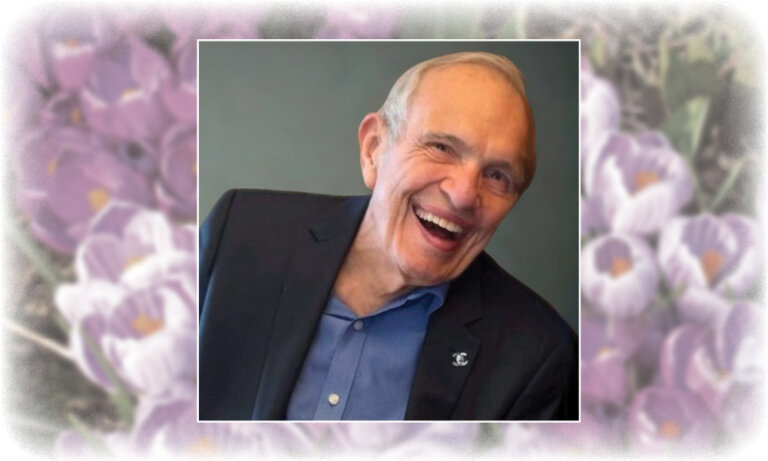
COOKE, Rev. Dr. Barry FH

May 18, 1932 – May 29, 2026

Reverend Doctor Barry FH Cooke, known to all as Barry, was born on May 18, 1932, in Kirkland Lake, Ontario, and passed away on May 29, 2026 in Vancouver, British Columbia. He lived a life of faithful service marked by the quiet yet powerful work of helping others find healing, purpose and hope.

From 1989 – 98, in partnership with his wife, Rev. Sharon Cooke, Barry was minister at Salt Spring Island United Church. Here Barry and Sharon combined theology and psychology in a way that was rare and deeply appreciated, believing that the healing of the mind and the care of the spirit belonged together in the service of God’s people.

He was predeceased by Sharon, and by his brother Denis Cooke. He is lovingly remembered by his family, including his sister Grace Reaney, his daughters Shary Bartlett (Daniel Savas), Jennifer Griffin (Gary Hertz), and Jill Bartlett (Mike Hancock). He leaves behind his grandchildren, Michael Griffin (Angelique Kendall), Niko Savas and Claire Savas, as well as his great-grandchild, Robin Griffin. His family was part of the story of his life, and his love for them was woven into the larger fabric of his vocation and witness.

Barry Cooke’s life was a testimony to the truth that a faithful person can leave a lasting mark not only through titles and accomplishments, but through kindness, wisdom and steadfast service. Now that he has “graduated to Grade Two” (as he always referred to the afterlife), may he find as much joy in that new place as he brought to those whose lives he touched here on Salt Spring Island.

A celebration of life will be held at Pacific Spirit United Church in Vancouver at 11:00 am July 18th at 2195 W 45th Ave, Vancouver, BC.

Livestream available at: www.youtube.com/live/BjgkrlAqGh4.

Donations may be made to Barry and Sharon Cooke Legacy Fund, Vancouver School of Theology. www.vst.edu/donate.