
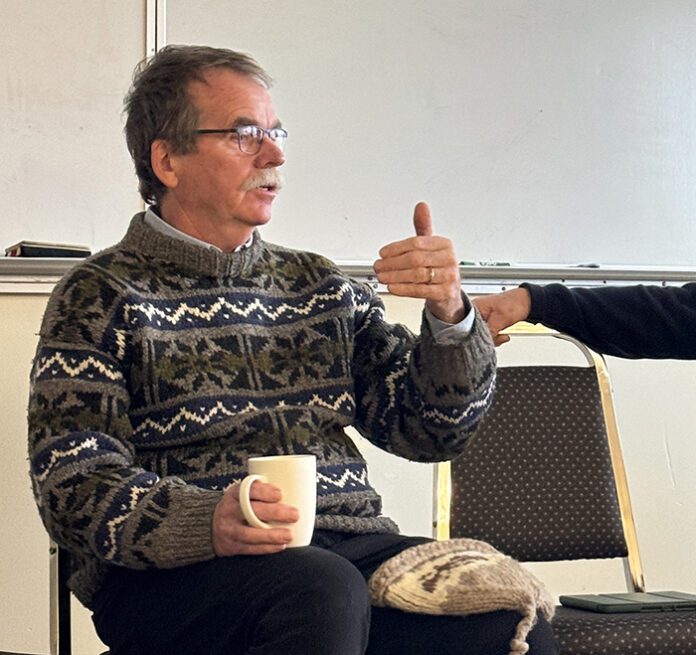
Salt Spring welcomed newly minted MLA for Saanich North and the Islands Rob Botterell Friday, Feb. 7, as he seemed comfortable ticking off one campaign promise almost right away: to participate in an ASK Salt Spring circle.
Botterell held the contested seat for the BC Greens in the October 2024 election, after incumbent Adam Olsen’s June announcement that he would not be seeking re-election.
“And I thank you for your support,” Botterell told attendees at the Salt Spring Island Multi Space Friday, “and if you didn’t vote for me, thank you for voting. I want to work with everybody.”
With just two party members in the legislature, the BC Greens are nonetheless positioned to have an arguably outsized influence on provincial politics. While the BC Greens don’t technically hold the balance of power, they are “quite close,” as Botterell put it; and as a practical matter, he said, the provincial NDP government needs the support of both himself and fellow caucus member Jeremy Valeriote, who represents the West Vancouver-Sea to Sky riding, “to get things done.”
“So we have this accord reached in December,” Botterell explained, “saying we will vote for the NDP budget and against non-confidence motions brought forward by the Conservatives for one year.”
That agreement between the BC Green Party caucus and the BC NDP caucus can be renewed annually, he added, but for at least the next 10 months they will all be largely working together. That means even in areas not covered explicitly by the accord, BC Greens are able to advocate perhaps more strongly than expected.
“There’s never any guarantees in life,” said Botterell, “but I happen to think I’m well-positioned to advocate very strongly for key priorities for Salt Spring –– and other parts of the riding.”
Botterell said his personal priorities run parallel to much that was in the accord, and include improving access to primary care via the community health centre model; a substantial investment in non-market housing, with a target of 7,500 units this year; and a commitment to work collaboratively to “permanently protect” the Fairy Creek watershed –– something he was already actively working on, he added.
“I’m actually going to be in Pacheedaht territory on Monday,” he said, “to help facilitate getting that discussion going. We want an agreement that everybody can support.”
Botterell said he was particularly eager to work on electoral reform. The accord lays out a framework for the two caucuses to create a special legislative committee to tackle the issue this summer.
“We are going to be looking at problems with the current approach, like polarization and low voter turnout,” said Botterell, “a variety of things that put democracy in this province at risk. I’m passionate about proportional representation, but the plan is to define the scope of the problem and then work down towards some options. I don’t have a monopoly on good ideas.”
On the evergreen question of improving Salt Spring’s roads, Botterell said that while there were again “no guarantees,” he felt the path forward for the island likely lay through his developing familiarity with the current Minister of Transportation and Transit.
“I’m the [Green] house leader, which means that I’m talking almost daily with the house leader for the NDP, who happens to be Mike Farnworth,” said Botterell. “But I don’t want to sugar coat this or make promises I can’t deliver on. The fact of the matter is that the whole tariff thing with the U.S. is going to have a very significant impact on capacity, and I know that’s going to play out this spring.”
Botterell pointed out that the accord with the NDP included a complete review of the CleanBC program –– this year, rather than the scheduled 2026 review –– and a commitment to contribute $50 million annually toward making electric heat pumps accessible to low- and moderate-income households. In the rush to deal with the potential for tariffs coming from the U.S., Botterell worried the province was in danger of “going back to the old playbook.”
“That old playbook is raw resource exports, expand LNG and all that stuff,” said Botterell. “We have an opportunity to reset the economy and have one that faces towards 2037, rather than 1957.”
Botterell suggested that B.C.’s “economy of the future” should emphasize a knowledge economy and foster innovation to get away from raw natural resource exports and move toward value-added products.
“Ultimately, given the expenditures we should be making –– on the most vulnerable, or on creating a growing and resilient economy –– we need the higher returns that come with value-added,” said Botterell. “We support the need to deal with tariffs, but we don’t support the solution of just going back to the old ways.”