
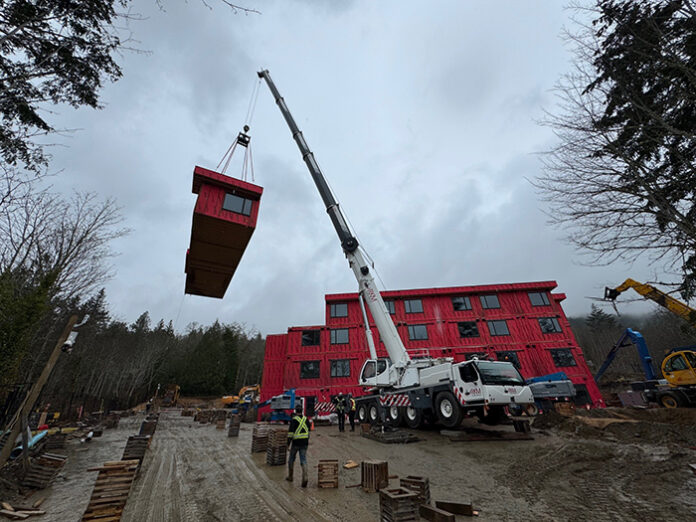
A long-awaited supportive housing project finally under construction on Salt Spring has also unexpectedly become the island’s first four-storey structure, alarming fire officials who worry that in an emergency, their equipment simply won’t reach.
First announced by the province in 2022, the modular units comprising BC Housing’s Drake Road project were trucked in and set into place last month, stacking up what will soon become 32 units of supportive housing –– as well as four additional affordable rental units –– at 161 Drake Rd. Part of the project’s “fast track” included a statutory immunity plan, meant to sidestep local regulations in the name of speed as the province acknowledged the affordable housing crisis in B.C. communities.
As a result, BC Housing was not required to obtain zoning or building approvals from neither the Islands Trust nor the Capital Regional District, under the province’s authority exercising its power of paramountcy. Relevantly, Fire Chief Jamie Holmes told trustees for the Salt Spring Fire Protection District Monday, March 17, that meant they weren’t bound by the island’s land use rules –– including one about limiting height.
Salt Spring’s Land Use Bylaw prescribes a two-storey building limit, although it does specify the counting may begin atop a basement –– and since the language defines a basement such that it need only be “partly underground,” historically three-storey buildings on even gentle slopes have been permitted, so long as three storeys are above-grade on one side and just two on the other.
The new supportive housing structure, however, has three storeys above grade on the north side and four storeys on the south.
In response to questions, Holmes told trustees he had raised concerns to BC Housing about the height being over the Islands Trust’s limits –– which were in place partly, he pointed out, “because that’s what our ladders can safely reach.”
“Our concern really is that if a fire happens and the hallway [exit] is compromised, we do not have a ladder capable of doing a rescue from the south side of that building,” said Holmes.
“We will not be able to ladder any of the windows on the fourth storey.”
Adding an “elevating device” –– firefighter parlance for an aerial ladder or platform mounted on a truck –– to the district’s fleet that is capable of reaching the fourth storey is an expensive proposition, Holmes warned, with a suitable apparatus likely in the $2- million range, and difficult to source quickly even were the funding available.
Holmes said the project’s architects and engineers told local firefighters they were confident the extensive sprinkler system in the building would protect the occupants.
“I raised the question of what happens if the occupants override the building’s systems,” said Holmes, “and they said they would be aware if that happened because there will be monitors, and staff on the site.”
In response to questions from the Driftwood, BC Housing confirmed the building had been designed to “meet or exceed” the applicable BC Building Code, including life and safety requirements, noting both upper and lower parking lots –– the north and south sides of the building –– were “fire truck accessible.”
“The building is fully sprinklered, individual units and common areas are equipped with combined heat/smoke detectors, and there is a two-stage fire alarm system,” according to BC Housing’s response. “The building has been designed to take advantage of the site’s significant slope and has three stories at-grade and four ground-oriented affordable rental units below-grade.”
The four affordable homes, they clarified, are for individuals who can live independently without additional services.
BC Housing also said the organization was in the process of selecting a qualified non-profit operator to provide 24/7 staffing and support services to the supportive housing residents –– including two meals a day, laundry services and connections to wellness and health supports –– and that the selected operator will be announced once confirmed.
Holmes told the board his understanding was that BC Housing was adding a fire hydrant on-site and upgrading the water line there for emergency use and to support that sprinkler system. Local officials have said the project’s domestic water needs will be met through wells drilled at the property.
The fire board referred the issue to its communications committee, who will likely continue to look for help –– financial and otherwise –– from senior government.