
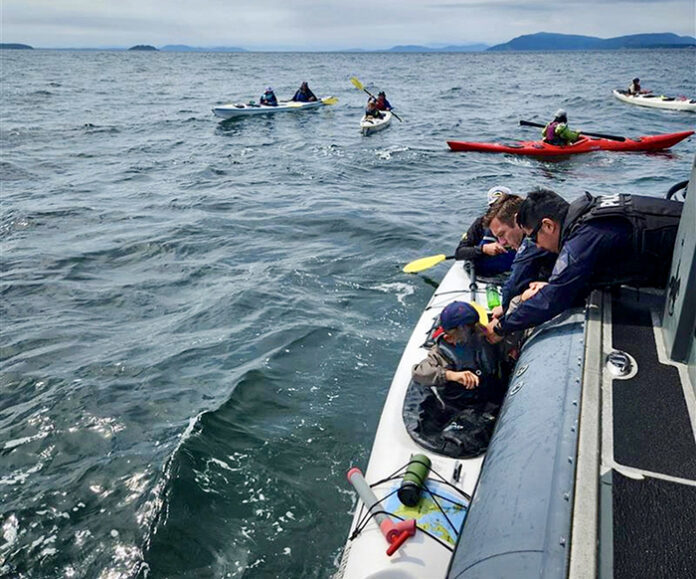
A special cross-border team of RCMP officers were a welcome if unfamiliar sight for a U.S.-based tour group last week, as a dozen kayakers — half of which were children — were rescued with help from Canadian law enforcement.
During rougher weather Thursday, Aug. 14, the U.S. Coast Guard (USCG) broadcasted that six kayaks carrying 12 people were in distress on the U.S. side of the border — well off the tip of Saturna Island, between Washington state’s Patos and Sucia islands. The RCMP’s Federal Policing-Pacific Region Integrated Cross-Border Maritime Law Enforcement Operations team — commonly referred to as “Shiprider” — responded just before 2 p.m., according to RCMP, as they were already patrolling nearby waters.
The kayakers were quickly found by the RCMP vessel, and working with Washington State Park authorities and the USCG Station Bellingham 29-foot response boat crew all 12 paddlers were taken aboard and their kayaks put under tow.
Officers learned that two families had gone out on an overnight guided kayaking tour and were on their way back to Orcas Island when they encountered challenging conditions. Realizing the conditions had surpassed their capabilities to safely continue the trip, according to RCMP, they made the prudent decision to call for help before the situation worsened.
The kayakers were safely transported back to Orcas Island, and no injuries were reported, according to RCMP Inspector Jim Leonard, who said the incident highlighted the professional level of teamwork between highly-trained officers on both sides of the border.
“While rescue operations are not typically our primary role, our presence on the water allows us to respond when emergencies arise,” said Leonard, “reflecting our shared commitment to public safety.”
The Shiprider program involves vessels jointly crewed by specially trained and designated officers who are authorized to enforce the law on both sides of the international boundary line. Working together, armed officers can transit back and forth across the border to help secure it from threats to national security, as well as prevent cross-border smuggling and trafficking.
Enforcement activities typically consist of detecting, monitoring and sometimes boarding vessels in either Canadian or American waters. Operations are conducted under the direction and control of law enforcement officers of the “host” country, assisted by officers from the “visiting” country.
“A VHF marine radio is a mariner’s lifeline when there is no cell phone service,” said Capt. Michael Hunt, deputy commander, Coast Guard Sector Puget Sound. “It proved its worth by helping save lives in the San Juan Islands.”