
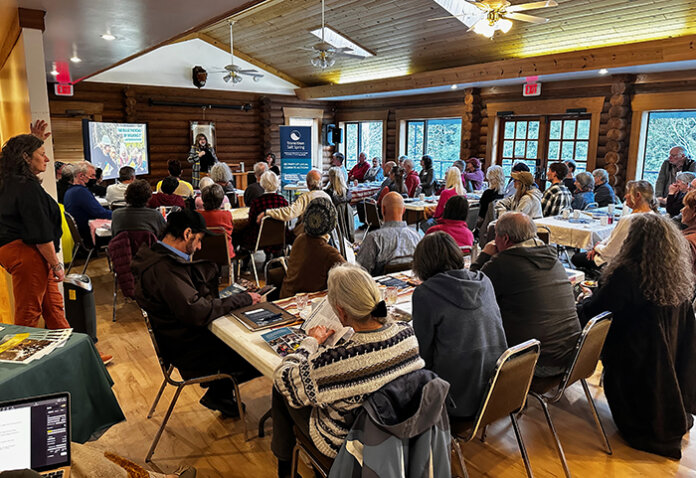
Transition Salt Spring (TSS) Society members, board and staff gathered at Lions Hall on Thursday, April 2 for an annual general meeting that served up hope, inspiration, celebration and a yummy potluck supper.
The event heard reports from all programs, circles and working groups, illuminating a year of accomplishments and change. TSS also received words of appreciation from MP Elizabeth May, who dropped in at the beginning of the evening.
“Looking through the annual report is pretty stunning,” May said to the full house. “It’s significant work. You’re doing the work, and you do it really well, and you also know how to have fun.”
TSS executive director Darlene Gage stressed the need to build relationships, referencing climate activist and author Bill McKibben, who has been quoted as saying that the best thing individuals can do to make a difference in the world is “to stop being an individual.”
“It means engaging people at every level, from the individual choices we make in our homes to the policies that shape our land and water for generations,” said Gage. “It means aligning with partners, because no single organization and no single person can do this alone. And it means staying responsive, adapting as we learn, because the challenges we face won’t stand still, and neither can we.”
Repair Cafés and toy and clothing swaps have become one of the main faces of TSS in recent years, bringing together sharing community members and reducing the island’s waste stream. In 2025, more than 400 items were fixed at four Repair Café events; 3,120 pounds of clothing were redistributed at the October clothing swap and 3,000 pounds of toys changed hands at the pre-Christmas toy swap. The TSS Coach Circle published 36 educational articles, attracted 377 new Lighter Living email newsletter subscribers and distributed $42,200 in rainwater catchment system rebates. More than 900 people attended an online TSS gardening workshop with Linda Gilkeson and more than 225,000 watched a Repair Cafe video that prompted 700-plus social media comments.
In terms of official AGM business, Rebecca Bloch was elected to join current board members Tisha Boulter (chair), Kelda Logan, Anne McKague and past chair Bryan Young.
In his closing remarks, Young emphasized the need for stable funding, ideally from monthly donors, as government sources contract in the current climate of economic uncertainty. The organization reported revenue of $510,998 for 2025, coming primarily from grants and donations; expenses were $478,637.
“I think we have something special going on here with all of you,” he said to the members. “You’re willing to engage, to listen, to wrestle with tough topics, and we’re in an organization that’s trying, sometimes imperfectly, but earnestly, to hold space, to resist polarization, to build common understanding and to move us together towards decisions that honour both people and the land. We want to thank you from our hearts for being a part of that, and thank you for helping carry this work forward.”
Young also shared some big news for one of its programs: the Climate Adaptation Research Lab (CARL), which has operated for five years under leadership from scientist Ruth Waldick, has “taken flight” and is now its own incorporated non-profit entity. Waldick reported on a busy year of continuing activities, partnerships and research to create healthy forests and watersheds and reduce wildfire risk in those areas.
Transition Salt Spring was born in 2010 in response to a locally created Climate Action Plan that included some 250 recommended actions to combat climate change and needed a group to take them on. It was then one of 323 Transition communities worldwide and one of 17 in Canada, with the first one set up in Totnes, Devon, U.K. in 2006. Today, 959 communities are part of the Transition International Network.