
Predictions for a hot, dry summer for the Southern Gulf Islands are beginning to materialize, as federal and provincial agencies sharpen their warnings — and island water districts move into seasonal restrictions.
Dry conditions prompted B.C.’s Ministry of Water, Land and Resource Stewardship to declare a Level 4 drought Thursday, May 28 for the region that includes eastern Vancouver Island and every Gulf Island; last year, the region escalated to Level 4 in August, and in the previous year on July 18.
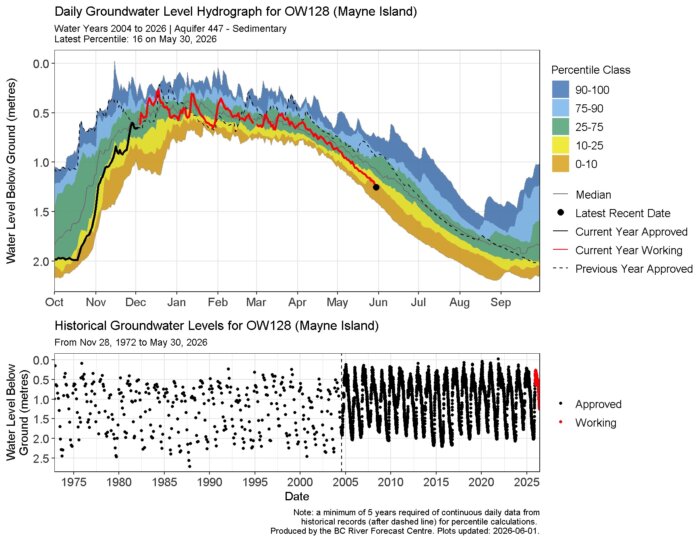
The province uses a six-level classification system to assess drought conditions, with no drought occurring at Level 0 and an increasingly common severe drought at Level 5. Data for that assessment are mainly gathered from stream gauges and a network of groundwater observation wells that monitor what the province calls “priority aquifers” — and as of the end of May, about 23 per cent of those wells are measuring below normal, three per cent more than at the same time last year.
That percentage, representing sufficiently monitored wells sitting below normal for at least two weeks, includes one of three data-rich wells on Salt Spring Island and the only such wells on both Mayne and Saturna islands.
On Salt Spring, about half of the island’s drinking water is supplied from St. Mary and Maxwell lakes, and water restrictions are triggered largely by lake levels — as with the North Salt Spring Waterworks District’s Level 3 measures enacted June 1. The latest data graphs from that district show lake levels tracking alongside the lowest “curves” since 2009.
But residents on smaller well-fed systems — and individual well users on every Gulf Island — are watching the aquifers closely. Robin Walsh sits on the board of the Mayne Island Water Systems Society, an umbrella organization for the 10 water districts on the island. Walsh said Mayne Island’s districts are promoting conservation and water use restrictions with signs, local publications and on social media.
“Mayne doesn’t have lakes or reservoirs,” said Walsh. “We rely completely on groundwater from our aquifers — five of them — which are replenished by rain.”
In April, according to monitoring from Agriculture and Agri-Food Canada, most of B.C. saw below-normal precipitation, with much of the province receiving under 60 per cent of normal. In the Vancouver Island region, the agency’s “Abnormally Dry” classification for the area expanded due to “continued multi‑month deficits” in rainfall.
Meanwhile, three-month modelling for the region updated Monday, June 1 by Environment Canada now predicts a 96 to 98 per cent likelihood of above-normal temperatures this summer, with likely normal rainfall amounts that typically show little precipitation until September.