
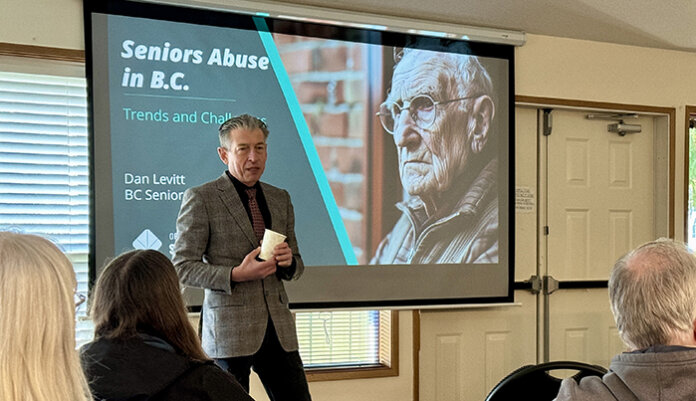
In the face of a marked uptick in incidents of scams and abuse, local seniors and caregivers last week heard they have ways to fight back — and that on Salt Spring, local government should be stepping up as the island’s demographics shift.
About 30 people attended a discussion led by Dan Levitt at the Salt Spring Seniors Centre Tuesday, Jan. 20. Levitt heads the Office of the Seniors Advocate, an independent agency in the B.C. provincial government, which acts in the interest of seniors and their caregivers.
Levitt’s office monitors and analyzes seniors’ services and makes recommendations to government and service providers to address systemic issues. He gave a preview of an annual report on elder abuse being released later this year, and said given the aging population in B.C. — and indeed on Salt Spring Island — the trends are worrying.
“Over the past five years, we’ve seen 28 per cent more calls to the Senior Abuse Information Line,” said Levitt. “Victims of violent offences reported to the RCMP are up 18 per cent, financial abuse reported to the Vancouver Police Department is up 68 per cent; trends are going in the wrong direction.”
And much senior abuse goes unreported. Levitt said victims often feel ashamed, or worry reporting would make things worse. Friends and family can watch for signs of abuse — different behaviours, he said, like if someone seems more generally anxious or depressed, or physical signs things aren’t going as usual.
“When I worked in care homes, we were always concerned about bruising — and that’s a tricky one, because many seniors are more likely to bruise because of a blood condition,” said Levitt. “But someone might have poor hygiene, dehydration or poor nutrition; they might be going through their medications faster than usual. Or they might seem more isolated, withdrawing from social situations.”
Levitt said that isolation was a technique perpetrators of financial abuse in particular use — trying to isolate a senior so the grift is less likely to be noticed. Things to watch out for include the appearance of new legal documents, like a will or power of attorney, or changes in banking.
“They could have less money available all of a sudden,” he said, “or suddenly be more reluctant to speak about their financial situation.”
The days of one-off, small-scale scammers seem to be over. At last Tuesday’s event, island social worker Ellie Parks said she and her colleagues see a perhaps surprising number of people on Salt Spring being swindled, with the cons having an increasing level of sophistication — and tempo.
“Now it is organized crime, thousands of people,” said Parks. “This is their job, all day long: to scam people. And it’s very sophisticated.”
Levitt agreed there were good habits to get into, like avoiding unknown phone numbers, or regularly checking banking statements for irregularities. Parks said anyone concerned about themselves or someone else should reach out to Island Health for support, particularly if that kind of “outside expert” advice might be more convincing than hearing it from a family member.
“And if you meet someone new on social media, be very wary,” said Parks. “Particularly if they want you to go to another platform. Salt Spring is a place where we have a high degree of trust, because we have such a strong community — but you have to be more on your guard now.”
Local government has a role to play, Levitt said. He regularly encourages communities to develop a “seniors plan” — something which would be undertaken by entities like Salt Spring’s Local Community Commission or the broader Islands Trust — to map out future needs as the community’s population ages.
“If you had a seniors plan for Salt Spring, then you might be thinking about things like transportation services for seniors, how many long-term care beds do you need, how many retirement homes — and how do you organize that?” said Levitt. “It’s a bit of a vision, some things will take a long time to get, but it’s worthwhile getting that plan so you know where you are going.”
In addition to Island Health, Levitt said anyone concerned they or someone they know is a victim of abuse could reach out to Seniors First BC’s Seniors Abuse and Information Line (1-866-437-1940), local RCMP (250-537-5555) and the Seniors Advocate Line (1-877-952-3181).
For more information on services from the Seniors Advocate office, visit seniorsadvocatebc.ca.