
Home Blog Page 102

NSSWD responds to moratorium concerns

0

BY BRIAN PYPER

The North Salt Spring Waterworks District (NSSWD) is receiving feedback regarding our moratorium review, and I’d like to respond to some questions that have emerged from our month-long public engagement. I want ratepayers and the community at large to know that we actively encourage their input and strive to provide full transparency regarding this work. Among current staff and trustees, our efforts are driven by concern for our future water supply and health of the Maxwell Lake and St. Mary Lake watersheds.

First, concerns regarding “mixing” water between systems (e.g., invasive species) suggest that somewhere in our public communications or consultant’s report (“St. Mary Lake and Maxwell Lake Reliability Assessment” by KWL Engineering), it was implied that raw water would be moved from one lake to another. That is not the case. The proposed combining of the systems refers exclusively to the distribution of treated water. For historical reasons, water service for the two systems has been kept separate in terms of connections, except in emergency conditions. Once the Maxwell treatment plant is completed, and hence water quality is similar between the systems, we can service connections within either system from either lake where pressure allows. There is zero concern here regarding mixing pathogens, invasive species, etc., between the two systems. Instead, there is a big opportunity to benefit water supply, as I note below.

Second, we expect that Rippon Creek diversions will have little impact on overall watershed health. We are licensed to divert 100 per cent of that water into Maxwell Lake, but only from Nov. 1 through March 31 (the rainy and cool “winter” season). No diversion occurs from April through October. During the winter diversion period, the vast majority of diverted water would end up in the ocean. However, we’ve rarely been able to divert more than 50 per cent of Rippon Creek water (closer to five per cent in recent years) due to high turbidity and phosphorus concerns. We’re addressing these concerns in two ways: (1) reducing road run-off as part of the CARL project (a key initiative we’re supporting for ecosystem integrity and fire reduction in the Maxwell watershed through Ruth Waldick and Transition Salt Spring); and (2) designing the future Maxwell treatment plant so that all diverted water enters the plant and not the lake.

Regarding climate projections, this modelling work will always have a wide range of uncertainty (and criticism). Compared to previous KWL reports, the current analysis is much improved because it provides results based on monthly temperature and precipitation projections across a range of climate models that are recommended by the Pacific Climate Impacts Consortium from the University of Victoria. We have also tried to ensure that the recent KWL report (a) displays results to clearly characterize the high variability (uncertainty) in model outcomes, (b) acknowledges the key assumptions underlying the hydrological models, and (c) limits recommendations to the hydrology assumptions and not to potential water availability (that’s the job of NSSWD staff and board).

So we are now at the decision-making stage, working with the following findings from Phase 1 and 2 of our work. (1) There is available water supply at Maxwell, now and 60 years from now, to reliably support additional connections. The moratorium in 2015 was extended to Maxwell Lake because of concerns over recharge, but results of the hydrology modelling clearly indicate that there is available supply. (2) The St. Mary side does not have available supply, and will be worse off in a warmer future, which is not a surprise. In most summers, the lake is drawn down close to our provincial limit due to demand and evaporation (St. Mary has a much larger surface area than Maxwell). (3) An opportunity to improve both systems: raising the weir at St. Mary Lake and building the Maxwell treatment plant to handle full-system operation and receive direct Rippon Creek inflows. (4) A recommendation to combine the two distribution systems so Maxwell can support the St. Mary side during the critical summer period, and St. Mary can assist Maxwell refill during the winter period (when in most years a huge volume of water is leaving St. Mary via Duck Creek to the ocean). These are first steps for developing a long-term vision for a reliable water supply. The planned system improvements will also include a new water conservation and demand management strategy planned for 2025.

Ultimately, this decision-making process will be sufficiently formalized and documented to be transparent to ratepayers and hopefully establish strong guidance for future boards. The proposed partial lifting of the moratorium was not an easy decision and not taken lightly, and certainly not due to any development interests. We want the best available science guiding this process, recognizing that there is only so much a relatively small agency can spend to refine that science.

We greatly appreciate the feedback received from residents in October to help the board with our decision-making process. We will review the comments received at our November and December meetings, and your feedback will be welcome at these meetings as well.

The writer is chair of the North Salt Spring Waterworks District board of trustees.

Viewpoint: NSSWD’s Move Towards Building Resilience Risks Backfiring

0

By DAVID J. RAPPORT

In its laudable effort to “build resilience” in our community, North Salt Spring Waterworks District (NSSWD) seems to have taken a wrong turn. It is considering a partial easing of its moratorium on new hookups based on a report by hydrological engineering consultants, which projects water balances for Maxwell Lake (ML) and St. Mary Lake (SML) monthly to the end of this century. As I first argued in the Driftwood on Oct. 16, in my view, the report’s projections are not solidly grounded. Here I expand on my concerns.

The model in the consultant’s report uses historic climate data to project likely future scenarios. This assumes that our current climate regime is much like that which prevailed between 1950 and 2020. Quite the opposite: the impacts of climate change are increasingly unpredictable — what with previously unheard-of phenomena such as atmospheric rivers, heat domes and fire infernos generating their own unique weather systems — and that means we are living in a world of growing uncertainty.

The moratorium NSSWD imposed in 2014 reflected a precautionary approach to water management in the context of uncertain future water availability. Considering that the more extreme climate impacts we are witnessing worldwide have dramatically increased the level of uncertainty, one would expect an even more strongly precautionary approach today, rather than, paradoxically, a propensity to ease the moratorium.

Furthermore, the model used for the report’s projections is not based on “worst-case” scenarios, which in my opinion makes it singularly ill-suited to examine a world of increasing uncertainty. According to the worst-case scenario in the most recent assessments by the Intergovernmental Panel on Climate Change, by 2100 the average temperature of the earth’s surface might have risen by 5.7 C degrees above the pre-industrial average. Given what we are already experiencing, with an average temperature increase in the order of 1.1 to 1.3 C degrees, it is unimaginable what an increase to 5.7 C would mean for water bodies here and around the world – including whether they might vanish altogether. Far better for the purposes at hand would be to adopt a game-theoretic approach, in which the goal is to avoid the worst possible outcomes.

Importantly, the lack of solid grounding in climatology is not, in my view, the only fault in this report. Reliable estimates of future water availability for ML and SML require major input from stress ecologists, as what happens with the health of our watersheds crucially affects the quantity and quality of available water.

Finally, should the partial lifting of the moratorium make it possible for 300 additional family dwellings to be connected to ML water, that alone might result in an increase of our island’s population by nearly 10 per cent (with four-member families). At a time when watersheds are already in declining health due to local anthropogenic stress, this additional population growth would only make matters significantly worse.

In my opinion, for NSSWD to continue along this path risks increasing the uncertainty of future water availability and is likely to undermine, rather than build, our island’s resilience.

The writer served as senior scientist and science advisor to Statistics Canada and co-authored Canada’s First State of Environment Report.

Daffodil Point trail reopens

0

 A weeks-long public safety closure of a popular Salt Spring Island trail has been lifted, according to officials, who have re-opened the Daffodil Point area of Burgoyne Bay Provincial Park to visitors. 

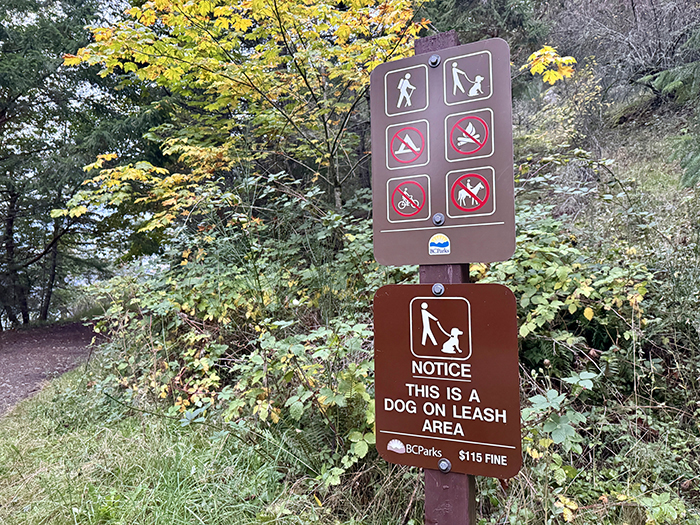
A trail there had been subject to a BC Parks closure notice since Oct. 11, after reports of off-leash dogs sent bylaw, parks and RCMP officers to the area in search of a pack of at least five animals reportedly being aggressive toward hikers and dog-walkers.  

Mark Groulx, chief bylaw officer for the Capital Regional District’s (CRD) Bylaw and Animal Care Services, said over the weekend that while three dogs were collected by responding officers and brought to the CRD’s animal shelter, the rest of the five had not been seen again since the initial encounter. 

“Regrettably we have not been able to locate them,” said Groulx. “To date, we have not received any new calls regarding ‘dogs at large’ that may be associated with this initial incident.” 

Several islanders had taken to social media as early as Oct. 4 warning of a dog pack running freely around Burgoyne Bay Provincial Park, intimidating or attacking both humans and their pets.

Dogs are required to be always leashed at Burgoyne Bay, according to BC Parks –– as well as at other Salt Spring Island provincial parks, including Ruckle, Mount Maxwell and Mount Erskine parks. A separate standard for CRD’s regional parks requires dogs merely always be “under control,” although that bylaw specifically calls for owners to be in clear line of sight of the owner and return when called. 

Groulx said they were continuing their efforts to locate the remaining dogs; BC Parks meanwhile lifted the safety closure for the Daffodil Point trail in time for the weekend. CRD senior corporate communications manager Andy Orr encouraged anyone observing unattended dogs to contact the CRD either by email at animalservices@crd.bc.ca or by calling 1-800-665-7899.

Beethoven’s Nine: Ode to Humanity on tap

By STEVE MARTINDALE

For SS Film Festival Society

The Salt Spring Film Festival’s annual “Best of the Fests” series begins with a remarkably powerful film about how people around the world continue to be deeply inspired by Beethoven’s Ninth Symphony, featuring a live performance of Ode to Joy by Cicela Månsson and Don Conley.

Screening at ArtSpring at 7:30 p.m. on Wednesday, Nov. 13, Beethoven’s Nine: Ode to Humanity is considered one of the best of 300 films previewed by the festival’s screening committee. You don’t have to love classical music to thoroughly enjoy this globe-trotting documentary by award-winning Canadian filmmaker Larry Weinstein.

Beethoven’s Ninth was the first symphony to be accompanied by words — words about love and freedom, hope and peace — created both as a love letter to the world and as a powerful piece of protest music.

A joyful celebration of Beethoven’s music, but also a gripping exploration of war and resiliency, Beethoven’s Nine follows nine individuals as they struggle to fully appreciate the legacy of Beethoven’s genius, the deaf composer’s personal challenges and how humanity continues to look for hope even in the darkest of times.

From a stirring performance by the Ukrainian Freedom Orchestra, which comprises musicians fleeing the war in Ukraine; to legendary American conductor Leonard Bernstein, who famously performed the Ninth Symphony after the fall of the Berlin Wall; to beloved cartoonist Charles M. Schulz, who introduced generations of children to Beethoven via his “Peanuts” comic strip, Weinstein travels around the world to meet people whose lives and perspectives have been enriched by the German composer and the world-famous symphony he wrote over 200 years ago.

Global events unexpectedly pull the filmmaker into the story in heart-wrenching ways, shining a light on the impossibility of separating art from life, and making Beethoven’s hope for humanity a personal quest for Weinstein himself.

If the horrific and enraging news of the day leaves you wondering why so many people seem so intent on causing one another harm, this uplifting and profoundly moving reminder of our shared humanity will convince you that only music and art can save us from ourselves.

All screenings in the “Best of the Fests” series are at ArtSpring on Wednesdays at 7:30 p.m., including two films in December (Any Other Way: The Jackie Shane Story, the astonishing profile of a largely forgotten blues singer, on Dec. 4; and Us, Our Pets and the War, featuring courageous Ukrainians evacuating animals from the war zone, on Dec. 11).

Tickets are $14 each and are available online at artspring.ca; in advance by phone (250-537-2102) or in person when the ArtSpring box office is open (Tuesday to Friday from 10 a.m. to 2 p.m.); or at the door starting an hour before each film.

Lots of laughs promised at Sutureself shows

Sid Filkow may be most familiar to Salt Spring theatre-goers as one of The Geezers, who along with his late friend Arvid Chalmers mounted several shows that included appearances by the beloved old goofs.

But the actor who has had numerous other acting roles — and was a member of the legendary Salt Spring Hysterical Society — has increasingly immersed himself in writing plays.

Next Friday and Saturday, Nov. 8 and 9, audiences can see four 10-minute one-act plays written by Filkow, including a first-prize winner at the King’s Shorts international one-act playwriting competition in Nova Scotia in 2018, and some hot-off-the-press comedy sketches in an evening called Sutureself.

The idea for an evening of Filkow-esque drama was born on the dance floor of the Legion during a Wednesday night swing dance session about five years ago, recalls Sutureself co-director Steve Coopman.

“We just started talking about shows and about material. Sid showed me one of the scripts, which is the one-act play that won at the King’s Shorts — Hints and Allegations — and I thought, ‘Oh, this is good!’ But then we got sidetracked, and we did the Tom Thumb radio play instead.”

Filkow also wrote The Adventures of Tom Thumb, which royally entertained audiences at ArtSpring in July of 2023.

Other one-act plays included in Sutureself are A Bit of a Breakdown, which made the top-eight list at a subsequent King’s Short festival, and As Above, So Below, which made the first round of cuts; and a sequel to Hints and Allegations. Actors include Suzanne Rouger, Megan Colgan, Patrick Cassidy, Wyatt Floercke, Eric Pollins, Stewart Katz, Maggie O’Scalleigh, Drew Underwood and Rosita Larrain.

“They are seasoned actors who are having great fun with the material. There’s lots of laughs,” said Filkow.

Coopman, who directed numerous one-act plays as artistic director of Solar Stage theatre in Toronto, said the one-act play is challenging, “because you have to establish those characters, that situation, the whole plot, and engage your audience from the first moment because you’ve only got 10, 12, 15 minutes.”

A handful of comedy sketches, with a humour style they describe as being “somewhere between Mel Brooks and Monty Python,” are also on the menu, and he warns that some Salt Springers will recognize themselves in a final piece on a theme of “relationship recycling.”

“Any resemblance between what’s on stage and you is purely intentional,” joked Filkow.

The evening is also interspersed with historical answering machine messages “that would have changed the course of history if they had been heard,” said Filkow.

Even the scene changes promise to be entertaining, with two clown actors tasked with the job.

“There’s Furtive and Flourish,” explained Coopman. “One wants to be seen. One doesn’t. And they do the scene changes.”

“So there’s never a dull moment,” added Filkow.

Coopman and Filkow are grateful to Christina Penhale’s help in producing the show.

“She is just awesome,” said Filkow, commenting on Penhale’s technological wizardry and ability to put together a great production team and get things done.

Coopman is also proud of the programs.

“I’m hoping that people will take the programs home. They’ll find them so amusing.”

Tickets for Sutureself, which begins at 7:30 p.m. both nights, are available through ArtSpring.

ICS puts membership approval on back burner before Nov. 14 AGM

0

Island Community Services (ICS) says it has been inundated with membership applications in recent weeks, but is unable to process them in advance of its governing society’s annual general meeting, which has been set for Thursday, Nov. 14 at 6 p.m. via Zoom.

ICS communications and operations manager Rob Wiltzen said on Monday that people who have applied to be members of the Salt Spring and Southern Gulf Islands Community Services Society (SSSGICSS) were set to receive an email that day advising that their applications had been received and inviting them to attend the AGM, but not as society members. Even if an application had been approved, that individual would not be able to vote at the AGM, as the society’s bylaws state that people must be members at least 30 days prior to an AGM in order to vote.

Wiltzen said society board members feel they need to step back and take time to consider how they will handle the sudden wave of interest in the society, ensuring best governance, legal policies and procedures. He points out that director approval of memberships is a standard bylaw practice in non-profit societies. 

Community members had last week reported varying experiences when applying for membership, and none had been informed if they are society members.

Local Community Commission (LCC) member Gayle Baker said she submitted her membership application and the $1 fee at the ICS office on Sept. 18. She also brought 32 applications to the office on Oct. 16 and insisted that the $1 fees for each person be accepted, while others have been told that the dollar would not be accepted until the membership had been approved by the board. Wiltzen said fees were not supposed to be accepted, but ICS has kept track of who paid their dollar.

SSSGICSS bylaws were changed in July to give discretion to the board to decide who will or will not be accepted as a society member, although no criteria for making a decision was included. Previously the only requirement was that an individual be 19 years of age with six months of residency in the Gulf Islands.

Concerns that the society, which has been publicly criticized recently, is trying to prevent involvement from the wider community has prompted a Change.org petition that had 98 signatures as of Monday at 2 p.m.

Christian Tatonetti, a past ICS employee, has started a Change.org petition titled Demand Fair, Transparent, and Inclusive Membership for Island Community Services. It demands that ICS:

1. Publish clear, accessible criteria for membership approval so all eligible residents know precisely what is required.

2. Make the board’s policy handbook and complaint process public to ensure transparency in governance and accountability for all members.

3. Remove arbitrary discretion in the membership process to create a fair, open path to participation that honours Salt Spring Island’s inclusive community values.

The petition states: “Despite ICS bylaws stating that membership is open to any resident over 19 who has lived in the Southern Gulf Islands for at least six months, the addition of vague, undefined criteria has made it unclear who qualifies for membership. The board of directors now has sole discretion to accept or reject applications without clearly stated guidelines, creating an arbitrary selection process that may discriminate based on personal judgment or bias.”

Members of the public can attend the society’s AGM. People should RSVP to connect@ssics.ca to get the meeting link.

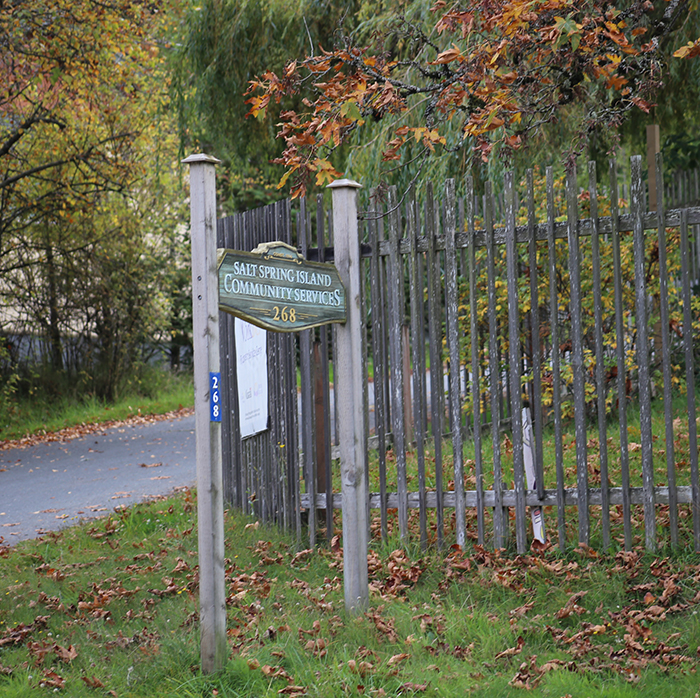
SSSGICSS membership applications can be downloaded from the ssics.ca website and either submitted online or printed off and brought to the ICS office at 268 Fulford-Ganges Rd.

Baker Beach foreshore plan raises concerns

0

An erosion protection plan for homes fronting a Salt Spring beach is drawing skepticism from some islanders, while organizers of a petition seeking to postpone approval said landowners told them they were open to changes. 

Comments are being accepted until Nov. 13 with the Ministry of Water, Land and Resource Stewardship, who are considering an application to modify a 560-metre strip of provincial Crown land fronting six Booth Bay waterfront parcels, between Quarry Drive and Baker Road.    

Several property owners have applied together, hoping to install the erosion protection above Baker Road Beach using principles from the Stewardship Centre for B.C.’s pilot Green Shores program, according to submitted documents –– a “nature-based” climate adaptation design standard encouraged by Salt Spring’s official community plan that minimizes hard armour seawalls in favour of non-uniform rock clusters, vegetation enhancement and “beach nourishment.”  

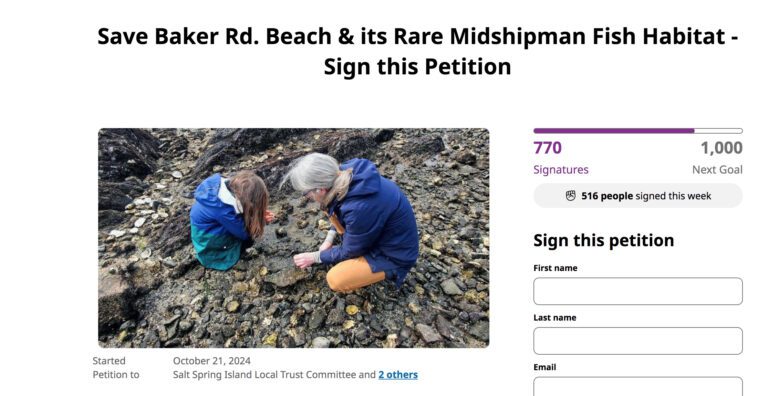
That “nourishment” –– sand and gravel placed at the toe of an eroding slope –– worried resident and naturalist Diana Thompson, who said she and more than 700 people who signed an online petition to slow the application were concerned about the potential for coarse gravel and large rocks to subside, impacting nearby eelgrass beds –– and possibly spawning grounds for several fish species, including plainfin midshipmen fish nests she said have been there for “centuries.” 

“My sister is a snorkeler and saw creatures in the eelgrass that are too numerous to list,” Thompson said. “The ocean washes the gravel away; where does it settle?” 

The popular beach is accessed by two Capital Regional District-maintained staircases nearby for public access –– both armoured with concrete and boulders.  

Thompson said after some “harsh and ill-founded” comments were posted on social media, a landowner reached out to tell her they were “open to adjusting the proposal when different departments and groups bring up concerns.” Identifying herself as one of the applicants on social media, Heidi Kuhrt said they had reached out to First Nations identified as having interests in the location more than a year ago, and again more recently. 

“One of the criteria for approval is that we don’t impact the public’s use significantly,” Kuhrt posted. “I like walking the shore and swimming too.” Noting the petition language was a group effort, Thompson said “everyone cares for the beach in different ways and we put our heads together.” “One woman wanted to start a petition, so I took that on,” she said. The online petition asks for independent professional review of the application, with findings published “in such a way as to be easily accessible by all the residents of Salt Spring Island” as well as a public response from “all concerned First Nations” before the application proceeds.  It also asks for “public forums involving the Islands Trust, the CRD and islanders, to ensure a favourite swimming, socializing, walking, exploring, bird-watching and recreation site for everyone will not be degraded, blocked or impeded.” 

Trust regional planning manager Chris Hutton told Salt Spring’s Local Trust Committee on Oct. 10 the Islands Trust was in receipt of a Crown lease referral for the four properties, which were under a delegated development permit process. The draft recommendation at that time was for the development permit to be approved.

While the process does not require trustees to conduct public comment sessions, trustee Laura Patrick suggested it may be an “opportunity to communicate and educate.” 

“I’m sure there are some people looking at this going, ‘I want to do this now,’ or something of that nature,” said Patrick at the Oct. 10 meeting. “So I think we should be looking for these opportunities to communicate that there is some joint effort occurring out there.” 

For information about the application or to comment, visit comment.nrs.gov.bc.ca/applications?clidDtid=1415573. The petition is at change.org/p/save-baker-rd-beach-its-rare-midshipman-fish-habitat-sign-this-petition

Impressive and expressive guitarists on tap


Guitar virtuoso Don Ross arrives on Salt Spring Island for the first time for a concert on Wednesday, Nov 6. at ArtSpring. 

Appearing with Ross will be very special guest Jule Malischke, a renowned German guitarist and songwriter. They will each perform a solo set followed by a collaborative set that will reveal their unique chemistry as they push the boundaries of the genre and deliver an experience that is both technically impressive and deeply expressive. 

According to Nick Lyons of Analogue Magazine, “Don and Jule’s collaboration is a masterclass in guitar artistry. Their interplay of intricate melodies and emotional expression creates a musical experience that is nothing short of extraordinary.”

After collaborating at a guitar festival in Europe, Ross and Malischke uncovered a sound that was too exceptional to overlook. Malischke is one of Europe’s most treasured guitarists, known for her captivating performances that masterfully navigate various guitar styles, blending virtuosity with exceptional songwriting. 

Ross is an acclaimed and pioneering figure whose innovations have shaped an entire generation of acoustic guitarists. He is the only two-time U.S. national finger-style guitar champion, and his unique style of playing is celebrated by fans worldwide. Over the span of his career Ross has amassed millions of YouTube views, won multiple Canadian Folk Music Awards, is Juno nominated, was awarded Guitar Player Magazine’s Best New Talent, collaborated with Bruce Cockburn on his 2023 release Water and was awarded the prestigious Walter Carlton Prize for Excellence in Performing Arts by the Canada Council for the Arts. 

Next Wednesday’s concert begins at 7 p.m. (Note the slightly earlier than usual time for ArtSpring concerts.)

Tickets are available through ArtSpring, online and at the box office.

International Bat Week puts focus on important animals

CONTRIBUTED ARTICLE

Halloween images of spooky bats and blood-sucking vampires are classically fun.

However, they have also created fear and misconceptions about these important animals. International Bat Week is from Oct. 24 to 31, and it’s a great time to bust some myths.

The Community Bat Program of B.C. organization — also known as BC Bats — is encouraging everyone to learn a fact or two about the 15 species of bats that live in British Columbia. Bats in B.C. are major predators of insects, devouring many insects that are considered pests to our forestry and agricultural industries. This makes them an important part of our economy as they provide millions of dollars worth of natural pest control.

Most B.C. bats only have one pup per female in the summer and they face many threats to survive. White-nose syndrome is a disease that has killed millions of bats in eastern North America. It is caused by a fungus that attacks them in winter when they are hibernating. It does not affect people or other animals.

“People can help us monitor bat populations by keeping an eye out for winter bat activity or dead bats. If you find one, report it,” said BC Bats program coordinator Paula Rodriguez de la Vega, who also cautions to never touch a bat with bare hands or allow your pets to contact it.

The Salt Spring Community Bat Program is working with B.C. government biologists to collect and test dead bats in order to detect white-nose syndrome. It has not been found in B.C. yet, but it is in Alberta and just south of B.C. in the Seattle area. People are asked to report the finding of dead bats online at bcbats.ca, call 1-855-922-2287, or email BCBats at info@bcbats.ca.

Bat Week also marks the time of year when bats disappear from our neighbourhoods, until the return of warmer weather in spring. As insect-eaters, our B.C. bats must leave their summer roost sites and migrate or hibernate to survive the winter. This absence means that this is the time of year to do home renovations that you have delayed due to bat presence. You can clean out and repair a bat box, or do bat-friendly exclusion work, without disturbing or injuring bats.

The BC Bats organization provides information and promotes stewardship and citizen science in partnership with the B.C. Ministry of Environment, and funded by the Habitat Conservation Trust Foundation, Forest Enhancement Society of B.C. and the Habitat Stewardship Program.

For more information about bats and how to help them, visit bcbats.ca.

Ways to keep Remembrance alive on Salt Spring

BY KEN JACKSON

SPECIAL TO THE DRIFTWOOD

I was taken aback last week to be reminded it’s been 10 years since Corp. Nathan Cirillo was senselessly killed while performing honorary guard duty at Canada’s National War Memorial in Ottawa.

When I first heard the story, I remember my horror and disbelief that this volunteer reservist had been gunned down by a stranger with mental health issues for reasons unknown. As I was also a volunteer reservist, I could only imagine how proud Nathan, his family and his regiment were to have that opportunity to serve the country he loved. In his honour, it was the first year I marched with the Salt Spring veterans in our local parade.

Having the opportunity over the years since then to broaden my participation in Remembrance- related activities here on the island, I’ve led past poppy campaigns, organized Remembrance Day activities and veterans luncheons, attended the extraordinarily special services at Gulf Islands Secondary School and been a welcome observer to the efforts of the Ganges Community Cemetery board with their No Stone Left Alone and Last Post projects at the cemetery beside The Fritz theatre.

Last year’s efforts took a heavy mental and physical toll on me, though I was buoyed by the community’s phenomenal support in making those efforts some of the island’s best. I have been humbled by the stories that have been shared with me, and the appreciation for my efforts that’s been expressed to me by so many. I commend this year’s volunteers for continuing and, in some cases, rebuilding the complex web of so many important activities. I know that despite how much was done, I always regretted not doing more.

The good side of that is knowing there’s always another year and, with that, unlimited opportunity to get involved to help or create new projects and gestures of Remembrance, at the least by participating in the opportunities that exist here on Salt Spring this year.

Here are some of the ways for everyone to demonstrate their sense of Remembrance:

Wear Your Poppy: This simple act tells those around you that you remember. A donation is welcome, but I believe it is a much more important statement to be seen in the community wearing one.

Attend Remembrance Day Service: Salt Spring has proven to me that, rain or shine, there is a proud showing of all ages in the community. That’s an incredibly powerful message of support to the diminishing number of veterans we see marching, the families of those veterans and those no longer with us. And to Canada’s more recent veterans who are less visible living here on the island with us, don’t forget the Legion’s open house afterwards.

Visit the Ganges Community Cemetery: From Nov. 1st through at least the 11th, special veterans markers will again be placed by the island’s Pathfinders on the growing number of grave sites identified as belonging to veterans buried there. It is a truly humbling sight to behold – simple and poignant and a powerful statement of Remembrance to “ours.” Clusters of white markers across the lawn evoke images of veteran cemeteries abroad for the many who did not return.

Visit the What These Eyes Have Seen – Witness to War Exhibition at ArtSpring: The exhibition runs from Wednesday, Nov. 6 through Tuesday, Nov. 12, from 10 a.m. to 4 p.m. daily. Free admission. This Salt Spring-based photo exhibition is a collection of 27 veteran portraits taken by local photographer Alan Bibby over the past 13 years, many at our island’s Remembrance services. These and other powerful donated images of the island’s veterans will be on display with precious local memorabilia loaned by the Salt Spring Archives, Salt Spring Museum and others in the community. Come and see it, and add to the collection of living memories that will help keep our community’s commitment to Remembrance alive.

Share a memory: Something everyone can do. Share your memory or story about a veteran in your life to keep their memory alive. Be proud to share and take time to listen to someone sharing with you to honour their memory. Find comfort in sharing.

Lest we forget. Lest we forget.