
Home Blog Page 104

Viewpoint: From Phoenix to the Hearth

0

By KAJIN GOH

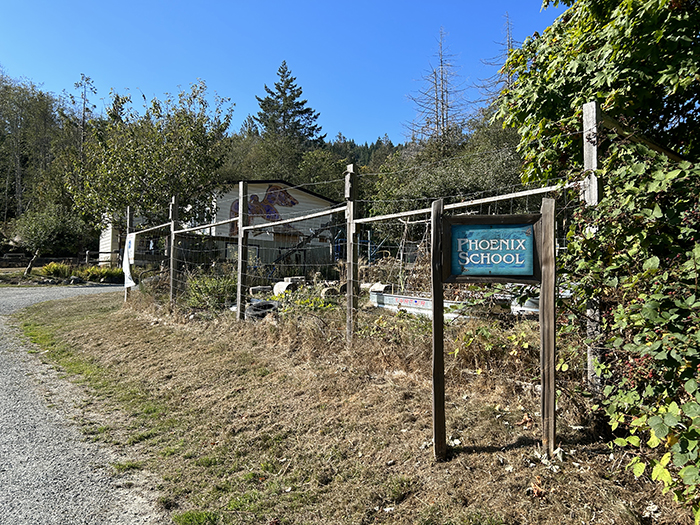
In the Oct. 2 edition of the Driftwood, the Chuan Society commented on our ongoing efforts to negotiate a provisional arrangement with the CRD for the temporary use of the now-decommissioned Phoenix School.

The proposal was twofold: one was for a potential winter warming space, and the other was to operate a community space/neighbourhood house which would also serve as a much-needed daytime warming centre if needed during the winter months.

Negotiations have been ongoing since then, and at the most recent LCC meeting on Oct. 17 we received news that the former Phoenix School site was off the table for the immediate future; it was decided instead to offer the Chuan Society access to a room at the currently CRD-operated SIMS building.

Though we would have appreciated the greater capacity the Phoenix site would have afforded us, if the SIMS offer is confirmed then the island has at least potentially gained a forward advance in having a winter daytime drop-in and resource centre for a number of community members during our most challenging months. While this is still a yet-to-be finalized process, the prospects are looking a little more promising for the oncoming season.

The proposed operative name for this space is the Hearth. A “hearth” is defined as:

1: a brick, stone, or concrete area in front of a fireplace; 2: home (“they longed for the comforts of hearth and home”) and 3: a vital or creative centre.

For those without access to resources that some might take for granted — namely warmth and a dry space to shelter and connect with others — the Hearth aims to address these needs and also operate as a point of contact for the redistribution of much-needed resources (food, clothing, and other materials), as well as serve an expanded function as a place of activities and culture, where art-making, serving food, and hosting talking circles, film screenings and community discussions can all flourish under one roof.

It is hoped that by the end of winter next year this process can continue and be expanded at the soon-to-be-reactivated former Phoenix School. But until then we will wait for the RFPs to be called for and submitted for review, in a process that is public and transparent.

At the same time we cannot help but underscore that many of us feel — whatever is finally decided for the site — that the former Phoenix School would best serve as a continuing community resource, a hub that has the potential to deepen relationships and connect islanders in a way that is needed now — more than ever — at a time when the market increasingly constricts the availability and access to prospective community-enriching spaces and resources.

Until then, the Chuan Society will invite community engagement and support in the running of the Hearth when we confirm an agreement with the CRD for the proposed space at SIMS. As with our other projects, we welcome the community to join us as partners and co-creators in our project, to actively make change (and make friends) while exploring opportunities for social transformation from the ground up.

Upon confirmation of the space we will also begin fundraising to cover the operational and personnel costs of the Hearth. For this and other inquiries we can be reached at chuansociety@gmail.com. To speak more directly about becoming involved please reach out to me at kajin.goh@gmail.com.


Duo Cordelia takes audience on exciting journey

By KIRSTEN BOLTON

For ArtSpring

After a string of sold-out performances in October for ArtSpring’s 2024/25 season, November’s offerings continue to push boundaries and bend genres.

Such is the case on Saturday, Nov. 2, when Montréal-based Duo Cordelia’s exquisite violinist and composer Vanessa Marcoux and pianist Marie-Christine Poirier challenge the very premise of the classical music concert by boldly turning it on its head.

In their program called “Visions from the Other Side,” they offer listeners a distinctly different path to experience chamber music by introducing improvisation and bridging musical universes that would otherwise be dissociated.

With contemplation, humour and delight, the duo curate an array of exciting repertoire works from 20th- and 21st-century revolutionary artists and combine arrangements of traditional melodies with original compositions, including from Marcoux. From Shostakovich to Philip Glass, the result is a touching and unique concert experience, which goes straight to the heart of our deep connection with music.

Duo Cordelia formed in 2016, with both founders sharing masters degrees in violin and piano performance respectively from Université de Montréal and Conservatory training in France. Collectively, they have performed and won recognition across North America, Europe, Asia and Africa, been spotlight chamber performers with acclaimed orchestras, while also touring with jazz and world music ensembles such as klezmer band Oktopus, who performed at ArtSpring last season.

Tickets for the show are available online at artspring.ca and through the box office.

CRD considers expanding Canada geese cull

1

Regional officials are recommending more funding to expand efforts to contain the area’s rapidly growing Canada goose population –– nearly one-third of which have taken up residence on fields and beaches in the Southern Gulf Islands. 

Counts completed in the Capital Regional District (CRD)’s 2024 Regional Canada Goose Moult Survey indicated a population of approximately 6,669 resident geese, which is two to four times higher than estimated by previous surveys, and likely to be a considerable undercount, according to CRD senior environmental protection manager Glenn Harris. 

Harris told the Environmental Services Committee Wednesday, Oct. 16 that current efforts were at best keeping pace with the birds’ growing numbers, and that a new survey indicated those on the Southern Gulf Islands represented 30 per cent of the total population in the capital region –– mostly at the north end of Salt Spring Island, but also on Pender and Mayne islands. 

“The current resources in the service appear sufficient to maintain the population at its current levels,” said Harris. “But additional resources would be required to reduce the regional population to a level that meets economic, social and environmental objectives.” 

Those economic objectives are in sharp focus for regional hay, grain and vegetable farmers whose livelihoods face “severe” impacts, according to Robin Tunnicliffe, who chairs the Peninsula and Area Agriculture Commission. Tunnicliffe told committee members more action from the CRD was needed to prevent crop losses. 

“We’re asking for a major goose cull in 2025,” said Tunnicliffe, who said even the use of propane-air cannons hadn’t deterred the geese. “With Canada’s food safety standards, a lot of crops have to be abandoned –– and there’s no crop insurance that covers wildlife damage.” 

According to the CRD, the only Canada geese historically found in the area around Vancouver Island were the occasional migratory visitors over the autumn and winter months. Numerous introduction programs were implemented by the Canadian Wildlife Service and BC Fish and Wildlife Branch in the 1960s and 1970s, meant to increase wildlife viewing and hunting opportunities.  

But the introduced birds –– from numerous subspecies –– were unable to learn migrating behaviour patterns from their parents, interbreeding and eventually creating a hybrid population of non-migratory residents not native to the region. 

“The exponential growth of the regional [Canada goose] population is degrading coastal ecosystems and waterways by over-grazing, trampling vegetation, soil erosion and the spread of invasive species,” according to a CRD report. “These areas include endangered Garry oak ecosystems, nearshore islands in ecological reserves and estuaries that are critical habitats for young salmon.” 

CRD staff also pointed to public health concerns at recreational sites due to high densities of fecal matter, and the increased risk to poultry farms from Highly Pathogenic Avian Influenza spreading with geese as vectors. 

“Flocks of over 500 birds are regularly landing in fields and ponds,” said Tunnicliffe. “The farmers stand to lose up to $1 million if avian flu were to strike at certain points in their growing cycle –– and vegetable farmers live in fear of E. coli contamination that’s introduced from Canada geese infestations.” 

Harris said multiple First Nations representatives had expressed interest in participating in both the nest addling and harvest of birds. Future management efforts, according to CRD staff, should be expanded to include regions where no egg addling or First Nation harvests are known to occur –– including Salt Spring, which the recent survey found had a larger resident population of adult and juvenile Canada geese than Pender and Mayne islands combined. 

“Perhaps the Gulf Islands are key areas of ‘hot spots’ for harvest potential,” said Harris. “We know there’s interest. What’s needed is resources to carry that out.” 

The current service budget is currently $237,000, which last year supported the new survey, a part-time coordinator, an egg addling program that included hiring a six-week assistant goose management technician, and one harvest. The committee voted to recommend the CRD Board direct development of an increase in the service levels at its next meeting on Wednesday, Oct. 30. 

Proposals sought for use of former school property

0

Salt Spring’s elected officials will seek expressions of interest for longer-term use of the property formerly occupied by Phoenix School, and in the short term voted to offer one local nonprofit an available studio elsewhere “as soon as possible.” 

Local Community Commission (LCC) members unanimously agreed to offer a temporary booking of the “upstairs lookout” studio at the Salt Spring Island Multi Space (SIMS) facility to the Chuan Society, who had made two earlier proposals for use of the former Phoenix Property as a community hub –– not a “warming space” in name — although the urgency to get something going before the winter made clear at least part of the hope is to make space for people to get warm during inclement weather. 

Using the former Phoenix School property –– even the portion not temporarily slated for parks maintenance to use during their new facility’s construction –– was off the table in the immediate term, largely due to budget constraints related to booking and operating the newly leased building. 

“The reality is that for any user group –– you know, even our sewers and weavers –– we have to have staff to support that use,” said Capital Regional District (CRD) acting senior manager Dan Ovington, outlining options for the LCC Thursday, Oct. 17. “That means we open and close the building; we ensure people aren’t staying there overnight; we ensure that hot plates or glue guns or [other] things are turned off.” 

Staff are budgeted and available to do that at SIMS, Ovington said, but not elsewhere. LCC members agreed that for now, that made the SIMS space the best option to be ready in time for winter. 

“Though we would have appreciated the greater capacity the Phoenix site would have afforded us,” said Chuan Society chair Kajin Goh, “if the SIMS offer is confirmed, then the island has at least potentially gained a forward advance in having a winter daytime drop-in and resource centre for a number of community members during our most challenging months. While this is still a yet-to-be finalized process, the prospects are looking a little more promising for the oncoming season.”

The Gulf Islands School District still owns the former Phoenix School property, and has agreed to lease it to the CRD. 

CRD director and LCC member Gary Holman said he hasn’t necessarily “given up” on the former Phoenix School site as a possibility for Chuan in the future, but he agreed it was unlikely it could happen quickly enough to beat the winter –– and that the SIMS studio space would provide a short-term opportunity for the society when cold weather arises. 

“It’s also an opportunity to develop a relationship,” said Holman, calling earlier manifestations of warming spaces on Salt Spring “guerrilla actions” born out of a frustration that no properties were being offered. 

“There’s a need to establish a working relationship,” said Holman, “for both parties to demonstrate that this might be able to work out –– and if we can work it out in the short term [at SIMS], maybe it paves the way to work out arrangements in other locations.” 

The LCC noted multiple conditions for Chuan to use the space at SIMS, largely consistent with other rental agreements; booking would be offered until March 31 and limited to regular building hours, with staff verifying liability insurance, supervision and an activity schedule. A space of the size being offered will likely run $375 per month, Ovington said. 

“It’s less space than they really would like,” said LCC commissioner Brian Webster. “Their ability to do stuff will be somewhat constrained by that. For our staff, it’s a shift in accommodating activities that they weren’t anticipating to have in the building. So there’s some mutual give and take here; I’m confident, based on the conversations that I had with the proponent, that that they are adaptable and that they can make this work.” 

Métis story presented by Axis Theatre

By KIRSTEN BOLTON

For ArtSpring

For two daytime performances on Tuesday, Oct. 29, ArtSpring hosts acclaimed Vancouver-based youth theatre company Axis Theatre and its production of Where Have All the Buffalo Gone? For the young and young at heart, the play is especially suited to engage youth in grades four through 11.

The story follows two Métis souls through seven different periods of Métis history. Audiences journey through the emergence of the Métis nations across the plains, the fur trade, the Riel Rebellion, the disappearance of the buffalo, World War I and residential schools, the Great Depression and the Indian Act. The story begins during creation amongst the stars and ends in present day.

The colourful production shares scenarios from the Callihoo family’s stories, incorporating fiddle music, jigging and a mesmerizing life-size buffalo puppet. Inspired by historical events of the Métis people of Canada, this original play for young audiences explores the loves, losses and fight of Treaty 6 Métis people — and their love and kinship with the buffalo.

Incorporating combinations of clown, mime, movement, mask work, puppetry and improvisation, Axis’ productions are performed in theatres and schools, enriching curriculum, drawing children into stories and giving them access to ideas in new ways. Their 59 original works have earned 21 Jessie Richardson Awards, A Betty Mitchell Award and a Drama Desk Nomination for Unique Theatrical Experience.

There are two showings: one at 11:10 a.m. reserved for teachers and school groups and one at 1 p.m. for the general public and as an optional time for older students or those outside the public school system.

Tickets are available online for the 1 p.m. show, or contact the box office to make arrangements for the morning show or to bring groups.

The play is 50 minutes long with a 15-minute talkback. Learning materials available upon request.

Regional trail opens on Mayne Island

0

Mayne Island is celebrating completion of a $4.5-million pathway linking Miners Bay and the Village Bay ferry terminal. 

The Mayne Island Regional Trail officially opened to the public Wednesday, Oct. 16, after two years of construction to create 2.3 kilometres of two-way gravel surfaced trail for pedestrians and bicycles. 

“I am thrilled about the opening,” said Capital Regional District (CRD) Board chair Colin Plant. “Projects like these not only contribute to the safety and wellbeing of residents and visitors in the region but they also help to contribute to local and national climate action targets by giving people a greener way to travel around the places they live and visit.” 

Mayne Island’s trail was selected as the first phase of the multi-year Gulf Islands Regional Trails Plan, approved by the CRD Board in 2018. Officials have said the project was a “pilot” to learn more about future regional trail development within the Gulf Islands. 

Paul Brent, Southern Gulf Islands Electoral Area director, called such routes key to supporting resident and visitor needs –– and economic development. 

“I am thrilled this project is complete,” said Brent, “and I look forward to what the future phases of the Gulf Islands Regional Trails Plan hold for these communities.” 

The CRD’s regional parks service directly funded a portion of the project, with support from a $2.8-million grant from the Investing in Canada Infrastructure Program and $500,000 in project funds from B.C.’s Active Transportation Infrastructure Grants Program.

Island man on Top Chef Canada

0

Haan Palcu-Chang’s jump to the small screen has Salt Spring Island’s food lovers cheering at their televisions, as the local chef is appearing on the now-airing latest season of Food Network’s Top Chef Canada.  

Reached at home on-island, Palcu-Chang was appropriately coy about the remaining episodes. The first aired last week, and he said –– without giving anything away –– he was confident he “did the island proud.” 

“It was really intense,” said Palcu-Chang, “but really gratifying. I’m super glad I did it.” 

The Toronto-born Taiwanese-Romanian chef said he brought his best effort to the program, which again this year gathered 10 of Canada’s top culinary talents from Tofino to Halifax under bright television lights and the pressure pot of competition.  

The Michelin-star trained Palcu-Chang came to the show –– as he did to Salt Spring –– from a background cooking in some of the most celebrated kitchens around the globe. And despite a shift to island life, where he mostly consults and caters –– and holds one of the most in-demand culinary workshops to ever fold dumplings at the SIMS kitchen –– the call of the Top Chef challenge was impossible to ignore. 

“I’d never done TV before,” said Palcu-Chang, “and I thought the worst that could happen is I get to see the ‘TV cooking’ side of the industry.” 

With his experience, and his breakout success on social media, Palcu-Chang said he felt prepared for the professional side of the show. Leveraging his skills to showcase a repertoire of flavours from Romania and Taiwan, he said he was comfortable around his competitors. They’re a high-talent group, he admitted, but pretty agreeable. In fact, he said, the production team told them they were probably the friendliest season of the show since its inception, and Palcu-Chang agreed it felt like everyone was competing against themselves more than each other.  

Then the cameras turned on, and taping began.  

“It’s a serious production,” said Palcu-Chang. “And then you’re seeing all these people that you see on TV in person. It’s odd for sure.” 

Palcu-Chang said there were easily more than 100 crew members making things happen on-set; he quickly adapted to the routine, he said, thinking on the fly and developing a plan in the moment for each challenge. 

“You figure out what you’re going to do about five minutes before,” he said. “And you have no team to back you up like you would in a professional kitchen. I just kind of had the mentality of, you know, it’s a once-in-a-lifetime opportunity –– you’ve got to just roll with the punches and figure stuff out.” 

The most pleasant surprise, he said, was that the drama he’d seen on the show before arriving was “real” –– that is, driven by the competition itself, not manufactured for its own sake or from behind-the-scenes personality conflicts. 

“Yeah, it’s just legitimately hard,” laughed Palcu-Chang. “The drama really is in the cooking; it’s so intense that you didn’t really need anything extra.” 

Despite a slight concern he might regret saying “yes” to the show –– or “make a complete ass of myself on national television” –– Palcu-Chang said the experience was a good one, and he enjoyed making new connections with professionals from across Canada. 

“Everybody there was highly competitive in their own ways, but I don’t feel like it came out in a way that was super combative with the other contestants,” said Palcu-Chang. “We all got along really well. And I decided I would just be myself and not try to be anything else, because that’s worked for me.” 

Top Chef Canada’s remaining episodes air Mondays on Food Network Canada. To keep up with Palcu-Chang’s culinary journey and find upcoming workshops on Salt Spring, visit him on Instagram (@haanpc) and at haanpc.com.

Burgoyne trail closed due to aggressive dogs

0

A popular Salt Spring Island trail remains closed to the public after reports of aggressive off-leash dogs brought bylaw, BC Parks and RCMP officers to Burgoyne Bay Provincial Park’s Daffodil Point trail. 

BC Parks closed that trail Friday, Oct. 11, and parks staff are unable to provide an estimate for when it would be safe to re-open. The closure notice indicated the agency closed the trail “to ensure public safety in the area,” although Capital Regional District (CRD) staff explained the closure was related to a pack of at least five dogs seen running at large in the area.  

According to CRD senior corporate communications manager Andy Orr, the trail was still closed as of Monday, Oct. 21 and was being monitored closely by CRD staff.

Orr said bylaw officers responded after receiving a complaint about the dogs “acting aggressively” toward people in the Daffodil Point area. Several islanders took to social media as early as Oct. 4 to report a dog pack running freely around the park, attacking both humans and their leashed pets. 

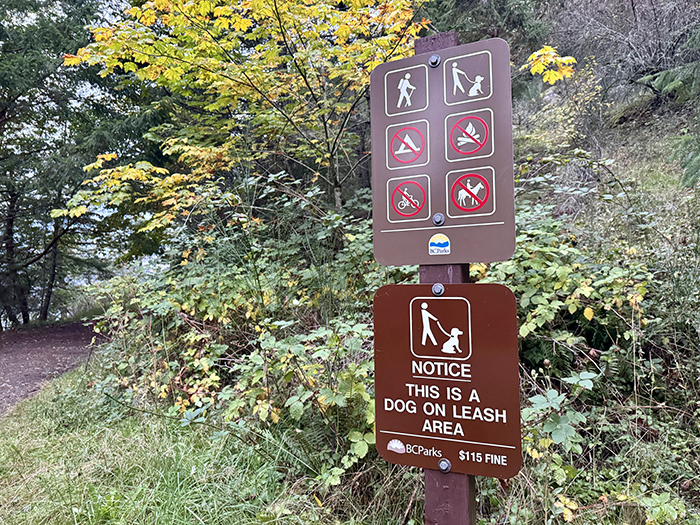
Pets are required to be leashed at all times at Burgoyne Bay, according to BC Parks –– as well as at other Salt Spring Island provincial parks, including Ruckle, Mount Maxwell and Mount Erskine parks. A separate standard for the CRD’s regional parks requires dogs merely always be “under control,” although that bylaw specifically calls for dogs to be in clear line of sight of the owner and return when called. 

“Officers were dispatched to this location,” said Orr, “and with the assistance of both the RCMP and officers from BC Parks observed five dogs.” 

Officers were able to retrieve three of the five, according to Orr, and relocated those animals to the CRD’s animal shelter. 

Orr encouraged anyone observing unattended dogs to contact the CRD either by email at animalservices@crd.bc.ca or by calling 1-800-665-7899. Orr said efforts would be made to retrieve the animals.

Lighter Living: Community farm acreage available for affordable rent

Part of Transition Salt Spring’s Lighter Living Series

As concerns about food security and local agriculture grow, farmers are retiring and fewer young people can get in the business. The skyrocketing cost of farmland and limited access to start-up capital have left many aspiring farmers with plenty of work experience, but as they come from non-farming backgrounds, they are struggling to realize their dreams. For those with a passion for sustainable farming, a unique opportunity has emerged on Salt Spring Island that could change the course of their future — and be an asset to the community at the same time.

The number-one challenge for new farmers in Canada is gaining access to affordable farmland. In British Columbia, where the cost of agricultural land is among the highest in the country, the challenge is even more pronounced. The average price per acre of farmland is nearly $11,000, and in popular farming regions like the Okanagan, it can soar to $32,000 or more per acre. On Salt Spring Island, where local food production is critical but currently accounts for less than 10 per cent of consumption, farmland is often out of reach for young, motivated farmers.

This is where the Salt Spring Island Farmland Trust (SSIFT) comes in. Established in 2009, the Farmland Trust is dedicated to preserving and revitalizing local agriculture by making farmland available to those who need it most. Through donations and bequests, the Trust has acquired parcels of Agricultural Land Reserve (ALR) land, which is rented at affordable rates to help launch sustainable farm businesses. Located on 60 acres of Salt Spring Island’s best agricultural land, the SSIFT’s Burgoyne Valley Community Farm is home to four farm businesses, Salt Spring Island Community Services’ Harvest Farm program and 90 families who tend to 1,000-square-foot garden plots. It is also the site of the community composter, which is not yet operational, and where educational programs are held.

For the right person or team, the Farmland Trust is now offering a 4.5-acre plot at Burgoyne Valley Community Farm for rent at an annual cost of just $1,000. This drastically reduces the financial burden for new farmers, providing them with an affordable way to start or expand a farm business without the high cost of land ownership.

The Farmland Trust is looking for the right farmer or team to take on this opportunity. Ideal candidates will have solid farming experience, a business plan, and a vision for bringing the land into full production. While the land was previously used for fruit and vegetable production, the Trust is open to other types of sustainable farming, including livestock, flowers and mixed farms.

If you are ready to start or expand your farm business and want to be part of Salt Spring Island’s growing food movement, this is an opportunity you can’t afford to miss. With affordable land and a community of support behind you, the dream of running your own farm is closer than you think. To learn more contact info@ssifarmlandtrust.org, or apply to kiyomi@youngagrarians.org.

Farming on Salt Spring Island is more than a business opportunity. It’s a chance to be part of a community that values collaboration, sustainability and local food production.

Transition Salt Spring invites you to explore more Lighter Living content by signing up to tinyurl.com/Lighter-Living and discover how you can make a difference for our community and for the environment.

UPDATED: Greens hold Saanich North and the Islands

0

Saanich North and the Islands (SNI) voters chose a Green candidate for the third straight provincial election, as Rob Botterell of Pender Island got the nod from 36 per cent of the electorate in preliminary results.

“It’s a great night,” said Botterell on Saturday night when only a couple of polls remained to be counted but he had a four per cent lead over the NDP’s Sarah Riddell. “It’s a real honour to be elected as the Green MLA for Saanich North and the Islands.”

Preliminary SNI results were:

• Rob Botterell, Green: 11,858 votes (36.05 per cent);

• Sarah Riddell, NDP: 10,540 votes (32.04 per cent);

• David Busch, Conservative: 9,876 votes (30.02 per cent);

• Amy Haysom, independent: 623 votes (1.89 per cent).

At the end of counting on Saturday night, the NDP were elected or leading in 46 seats province-wide, the Conservatives in 45 seats and the Greens two. Some “out of district” ballots had not yet been included in tabulations, and recounts will be done in two ridings where the vote difference is less than 100 votes: Juan de Fuca-Malahat and Surrey City Centre, where the NDP candidates are slightly ahead of the Conservatives. Elections BC says a final count will take place between Oct. 26 and 28. Judicial recounts may then occur “if the difference between the top two candidates is less than 1/500th of the total ballots considered.”

While Green Party of BC leader Sonia Furstenau was not elected in Victoria-Beacon Hill, the West Vancouver-Sea to Sky riding also went Green with candidate Jeremy Valeriote, so the Greens will have official party status in the BC Legislature — and quite possibly the balance of power.

Botterell said Furstenau’s loss was very disappointing, but she and past MLA Adam Olsen will still be politically involved.

“It’s going to be great to be able to have that wisdom and work with them,” he said.

Botterell also added: “I really want to make a point of giving a big shout out and congratulations to the other candidates . . . I think we’ve all run really proper campaigns and this is what democracy is all about.”

Botterell thanked all of his volunteers, including those on Salt Spring who “have worked tirelessly over the last couple of months to introduce me to the community and give me an opportunity to make the case for voting for me.”

One of those volunteers is longtime Green party member Tom Mitchell.

Mitchell said, “Joy was in the air” on Saturday night, with the strong victory being “a tribute to the groundwork laid by the retiring Adam Olsen and the hard work put in by Rob himself, plus all the volunteers on the islands and in Saanich, especially considering that Rob was a relatively new face on the scene with little time to get known.”

The three other candidates also gave warm thanks to their volunteers and congratulations to Botterell.

“My heart is full of gratitude,” said Riddell. “While last night wasn’t the result we hoped for, I’m so proud of the work we did together. We ran a positive local campaign that centred community and made up ground in a tough riding.”

“Congratulations to Rob Botterell on your win,” she added. “I look forward to working together in service to our community.”

Busch noted that the local Conservative riding association was only founded on Aug. 17.

“In two months we grew, activating hundreds of volunteers and raising the funds to get our word out. Case in point, we ran out of lawn signs, twice! While it has been an exhausting couple of months, I’m happy that we ran an upbeat, cheerful and introspective campaign where we led the way identifying important local issues with common sense solutions,” he said.

He added that he enjoyed working with his opponents in this election, “in particular Amy Haysom, whose tenacity and warmth was noticed by all. Congratulations to Rob Botterell, our new MLA for Saanich North and the Islands. My door is always open to discuss local issues and help improve the lives of our constituents.”

Independent candidate and Salt Springer Haysom said, “It’s a tough run as an independent as without proportional representation, people tend to vote within party boundaries with a fear of ‘splitting the vote,’” and noted that Botterell had been an independent MLA candidate in 2001.

“I am so very grateful for an amazing campaign team, and that people were keen to hear of a new independent political approach, focused on transparency and accountability, and commitment to constituents first and foremost. It may be a longer journey to get there, but I’m committed to the long haul.”

The SNI riding saw the highest number of advance poll voters in the province, at 18,277, from a total of 48,787 voters registered as of Oct. 7. Final local turnout numbers were not yet available.

Preliminary voter turnout province-wide was 57.43 per cent.