Home Blog Page 107

Further CRD budget shaving requested by director

0

Salt Spring taxpayers can expect a double-digit increase over last year, as the island’s voice at the regional table argued for one more try at trimming costs in the 2025 Capital Regional District (CRD) budget. 

When the CRD’s governance committee met Wednesday, Oct. 2, members voted in favour of a motion from electoral area director Gary Holman for a final, not-quite-last-minute pass at the provisional numbers, in advance of the CRD’s Committee of the Whole (COW) budget meeting at the end of the month. Holman noted the briefing he’d received from staff indicated an increase of “12 or 13 per cent” for most on Salt Spring Island. 

That contribution would be another significant escalation from increases in earlier years; Salt Spring’s 2024 contributions rose 9.6 per cent over 2023, after a 5.6 per cent bump the previous year; the average increase in years preceding had been 3.9 per cent. 

“If we ask the question on Oct. 30, that’s a bit late in the day to do that,” said Holman. “The intent is to give staff a heads-up, to see if there’s any way that the pencils could be sharpened a little further.” 

The motion specifically recommended the broader CRD Board task staff with a report to present to the COW’s Oct. 3 meeting, regarding “possible cost saving” in the 2025 provisional budget –– showing not only where money could be saved but also what the implications of those savings might be.  

“In the end, it may come to a choice,” Holman said, “where there’s an objective the board wants to pursue that’s inconsistent with shaving the cost here or there. But I think this sends a signal to taxpayers that we’re doing our best to achieve cost savings wherever possible.” 

Provisional budgets have in recent years been approved and presented to the public in October, with financial plans for both the CRD and the Capital Regional Hospital District approved by their respective boards in March. Last year’s consolidated budget topped $777 million; Salt Spring’s portion was $8.37 million. 

Opinion: The next four years: Let’s continue progress made by NDP

0

BY CONSTANCE GIBBS

On Oct. 20 we will wake up to a newly elected premier of our province. It will be either Premier David Eby again, or Premier John Rustad. Perhaps it will be a minority or majority Conservative or NDP government. If it’s Premier Rustad in the leader’s seat, I doubt there will be any common ground between him and Green MLAs. He will see no reason to pay any attention to them. This is the risk voters who mark their ballot for the Green Party are taking, and it’s a big one. The same is true for any independent candidates. Vote splitting between the NDP and the Green and independent candidates could deliver this election to Conservative leader John Rustad.

When I realized that Eby and Rustad were running neck and neck, I spent a few minutes reading the Conservative platform to check their direction for B.C. (After I got rid of the mental image of the two men’s heads on top of two sweaty, galloping horses tearing around the track to a photo finish.)

There is no mention on the Conservative website of protecting old-growth forests. (conservativebc.ca) There is not a single word about protecting the environment. There is no mention of climate change. Because John Rustad doesn’t believe it’s a big deal.

What is the NDP’s record on the environment?

The Ancient Forest Alliance (AFA)published their Annual Report for 2023 recently. (ancientforestalliance.org) Here’s what they had to say:

“Since the inception of the Ancient Forest Alliance in 2010, there hasn’t been a year that has seen more progress toward protecting old-growth forests in B.C. than 2023.”

The AFA rightly criticized the NDP for not doing enough when they first came to power. Under David Eby, that changed. The NDP has been making important and measurable progress on protecting the environment in recent years. They’re working with First Nations on exciting stewardship and conservation projects. At last, there is movement towards reconciliation and respect.

Similarly, the NDP have taken action to address the monster healthcare crisis. They listened and responded to family doctors who had been complaining about their fee schedule for many years. B.C. now has the best compensation plan for family doctors in Canada. This is a valuable incentive in recruiting more doctors. Sarah Riddell, the NDP candidate for our riding, was a key member of the team that made this crucial change.

The Canadian Institute for Health Information reports that surgical wait times in B.C. have improved since 2020. BC ranks #1 among all the other provinces for shortest wait times for cataracts, and #2 for joint replacements. This is real progress.

I volunteer at Lady Minto Hospital. Every week I see administrators, doctors, nurses, technicians, cleaners, healthcare assistants and other staff working flat out to care for vulnerable residents and patients. It’s the same at Greenwoods.

Healthcare assistants are key staff at Lady Minto and Greenwoods. They don’t earn a lot for all the heavy lifting and essential intimate personal care they do. People aren’t beating down the door to do this hard work. Recruitment is never-ending, as it is for all positions in healthcare.

The NDP brought in a new program, the Health Career Access Program, that gives recruiters a powerful tool. The Healthcare Assistant Certificate Program, an entry-level healthcare training program, is now free. This change removed a huge financial barrier. Before the NDP brought in this program, students without family financial resources had to go into debt to train for this basic healthcare certificate. Now they don’t. That’s a big step forward. I worked for 35 years as a student financial aid advisor in B.C. I know that removing barriers to all healthcare training is a key part of the solution to the healthcare staffing crisis.

We’re living in a time of crisis. People are frustrated that not enough progress is being made to fix the problems with affordable housing, the environment, healthcare, mental health and addiction, cost of living, deficit budgets, small business. Frustrated voters can be tempted to take out their anger in the voting booth and not recognize the progress that’s been made. Just something to think about when you’re at the polling station Oct. 19.

For me, the way forward is to choose the candidate and party that best aligns with my values and who can actually get things done. I ask myself: Does this candidate AND their party share my values? Can they take the necessary action that supports my values?

I’m looking at what direction the three parties are charting for B.C. for the next four years and beyond. It’s about direction and progress because there are no quick fixes to any of these problems. They’ve been decades in the making. I’m voting for Sarah Riddell, NDP, to represent our riding. As a potential member of Team Eby, she can bring new energy and a great track record to continue the progress that is finally happening.

Let’s not slide back or veer so far right, we end up in a ditch. Let’s keep moving forward.

The writer is a Salt Spring resident who volunteers in the island’s healthcare sector.

Volunteers needed for nest box maintenance

BY SSI CONSERVANCY

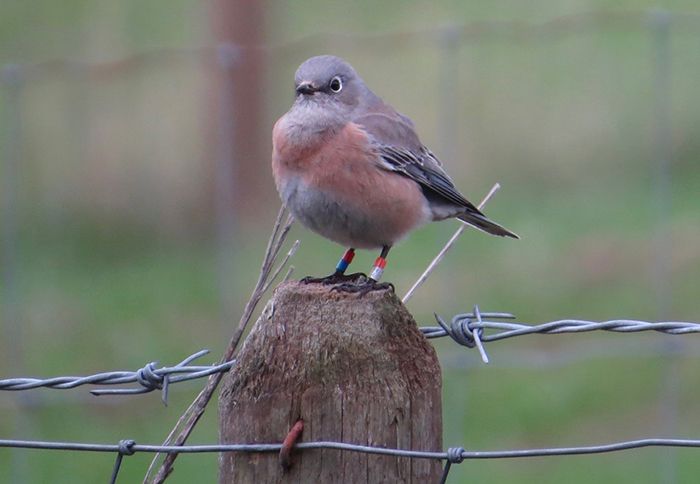
Old-timers on Salt Spring may remember the western bluebird, once a common breeding bird in southwestern British Columbia.

Populations began declining in the 1950s and they disappeared from Vancouver Island and the Gulf Islands in the early 1990s. Experts suspect that loss of Garry oak meadows, cutting down of old trees used for nesting, climate change, declines in their insect prey due to pesticides and competition for nest holes with the introduced house sparrow and European starlings all contributed to the declines.

Seventeen years ago, western bluebirds were reintroduced onto San Juan Island, and 10 years ago, several more were released in and around the Cowichan Garry Oak Preserve near Maple Bay. Since then, small breeding populations have established. However, it was not until late October last year that western bluebirds were seen again on Salt Spring. A group of seven individuals, that were colour-banded near Maple Bay, was spotted foraging in farmland and investigating some nest boxes. This is exciting news that bodes well for the recovery of the species on our island.

The Salt Spring Island Conservancy works to conserve many of our declining bird species. In 2009, the conservancy started erecting nest boxes throughout the southern part of the island in Garry oak and farmland habitats, in recognition that adding nest boxes has reversed some bluebird population declines in Oregon, Washington and the interior of B.C. Our primary goal was to provide nest boxes for bluebirds that might disperse here from reintroduced populations. Our secondary goal was to provide boxes for other native species such as violet-green swallows, tree swallows and house wrens. All these species use cavities in trees, created by woodpeckers, to nest, but will nest readily in boxes. Swallows, which take their insect prey on the wing, are part of a group of birds called aerial insectivores. This group declined by 59 per cent between 1970 and 2016 in Canada.

Volunteers now monitor over 200 nest boxes on private land and in conservation areas from the slopes of Mount Tuam and Mount Maxwell to the Fulford and Beaver Point valleys. So far, we have not had any bluebirds nesting in them. The boxes are used primarily by violet-green and tree swallows and house wrens.

Unfortunately, we have observed some disturbing long-term trends that reflect the noted widespread decline in aerial insectivores: the occupancy of our nest boxes by swallows declined from 42 per cent in 2009 to 25 per cent in 2022. In addition, during the heat dome in late June of 2021, breeding success plummeted from an average of 66 per cent of nests fledging young, to only 49 per cent. Many of the chicks overheated and died in the nest. SSIC is researching methods to help nest boxes stay cooler, such as reorienting the direction the box faces, painting the box white or shading the box with a larger lid.

We are looking for volunteers to assist in monitoring and cleaning nest boxes. This is done in the fall and volunteers must be fit (some boxes are on steep slopes) and interested in a long-term commitment. If you are interested, please contact Debra Cobon at debra@saltspringconservancy.ca.

Opinion: Everyone deserves healthcare now

0

By CURT FIRESTONE

When a family moves to Salt Spring Island or any place in Canada for that matter, they automatically place their children into the public school. There are no waiting lists. Yet that same family must start living without a primary healthcare provider.

Schools are available for every child, primary healthcare is not. There is an elected school board to make the system work. This is not the case for healthcare.

British Columbia is dealing with a shortage of family and specialized medical practitioners, nurses, nurse practitioners, healthcare staff, physical facilities and specialized technical equipment. A series of governments have failed by not expanding healthcare services at the same rate as population growth.

We did have one federal minister of health who understood that the whole healthcare system needs modernization. Jane Philpott, MD, recognized that team-based care through non-profit community health centres is the answer.

The BC Greens have a similar plan. They want every riding to have at least one non-profit community health centre. MLA candidate Rob Botterell recognizes that we have a geographical issue created by the Salish Sea. There are community-operated health centres already established on Pender, Mayne and Galiano islands. Saanich Peninsula has the Shoreline Medical Society. Rob says that it is time to bring Salt Spring Island’s community and healthcare providers together to create a community health centre.

The BC Greens also recognize that our healthcare authorities have evolved into cumbersome large bureaucracies that need streamlining. There are funds sitting there that should be re-directed to providing direct healthcare services.

What will a community health centre do for Salt Spring? It will provide team-based care with a combination of family doctors, nurse practitioners and other healthcare professionals all cooperating in one location. Everyone will have equal access to a team of professionals. Our healthcare providers will no longer have to be burdened with administrative work. A local community non-profit board with administrative responsibility will govern.

One of the determinants of health is our physical environment. The Green Party’s top priority is the return of our planet to its natural environmental state by reducing climate change and protecting our future.

Both of the other political parties want to eliminate (Conservative) or reduce (NDP) the carbon tax, which is one key to winning the environmental battle. How many un-natural climate disasters can we endure?

I am voting for Rob Botterell because I believe that he and the BC Greens will work to modernize our healthcare system and work for a clean environment. It is time to fully and completely enter the 21st century with approaches that facilitate the 22nd century.

CONLON, Robert “Bob” Edwin

Robert “Bob” Edwin Conlon, 81, passed away peacefully at Greenwoods Eldercare, attended by his close friend Donna, on September 16th, 2024.

Bob was born on May 5th, 1943 to parents Nellie (Bawden) and Thomas Bede Conlon in Perth, Australia.

As an adventurous young man, Bob travelled by ship to the west coast of Canada in the late 1960’s “to see what is was like over there”. Here, he met and married his love, Joan (Kay), who had also immigrated to Canada from England. They shared a deep love. Together they enjoyed skiing at Mount Baker, and travelling to various other countries. A talented professional upholsterer, Bob artistically upholstered all the chairs and sofas in their home.

He was an enthusiastic player of golf, cricket (for which he won awards), and darts at the Salt Spring Legion. He loved jokes and comic banter, and liked to make people laugh.

Bob leaves behind his loving sister, Julie Bechelli. He is predeceased by his wife Joan (2015), his brothers, Peter and Tom, and their parents, Nellie and Thomas.

Heartfelt thanks to the staff of Greenwoods Eldercare for their understanding, compassionate care. Deep gratitude also to the kind staff of Heritage Place, and also to the doctors and nurses of Salt Spring.

In lieu of flowers, donations can be made to Greenwoods Eldercare.

In spite of his health challenges, Bob lived his life on his own terms, always. He will be missed.

“See you on the flipside!”

CRICKMORE, Elspeth

It is with love and sadness to announce the passing of Elspeth Crickmore, resident of Tsawwassen, at the age of 66 yrs old after a long-fought battle with cancer. Elspeth grew up in West Vancouver with her mother Mary, father Eric, sister Jane and brother Gavin. After working as a legal assistant, Elspeth entered the BCIT RN Nursing program in 1981. After graduating in 1983, Elspeth worked in Penticton, New Westminster, and on the cruise-ships travelling to the Caribbean and Alaska. Elspeth finished her career by retiring after working for 30 years at St. Paul’s Hospital ER.

Elspeth had a zest for life. She had many passions including: curling, kayaking, cooking, baking, gardening, traveling, hiking, walking and spending time with her friends. In retirement, Elspeth lovingly cared for her mother Mary until she passed away on May 25, 2024.

Elspeth’s absence will leave a profound void in the hearts of those who knew her. Yet, her memory will continue to inspire and guide them. The world isn’t a little dimmer now, it’s brighter with whom she touched while she was here.

A burial service was held on August 28, 2024, at the Salt Spring Island Natural Cemetery. A recognition of Elspeth will be held at the Salt Spring Island Natural Cemetery, 2100 Fulford-Ganges Road, SSI, BC V8K1Z7 on October 19, 2024, at 2 pm. In lieu of flowers, donations can be made to the Canadian Cancer Society.

Opinion: Trust has failed to fulfil mandate

0

By STEVE WRIGHT

After five decades of operating under the banner of “preserve and protect” and millions of dollars spent to keep the organization alive, it is obvious to anyone who has lived in the Trust Area for any length of time that the Islands Trust has not fulfilled its mandate. Not by a long shot.

Granted, there have been some successes in setting land aside, but that is a credit to the Trust Conservancy, provincial and federal parks. What began as an unprecedented and visionary piece of legislation, to “preserve and protect” the rural and natural character of the islands, and the fragile and unique ecology of the terrestrial and marine environments within the Trust Area, has devolved into a mediocre attempt by those who did not have the skill set, or those not suitably trained or qualified, to do the job.

In spite of pronouncements from the provincial government about the importance of this area for all residents of B.C. and, in particular, future generations, there was no thought to change the way these islands were to be developed any differently than anywhere else in the country.

Regulations regarding the scale and style of development to “preserve” the rural character were not implemented. No consideration was given to new subdivisions where lot configuration continued to be based on minimum parcel size rather than on the topography of the land to limit disturbance to ecosystems and groundwater. No examination was undertaken on private properties, prior to subdivision applications or construction, to determine whether endangered or at-risk species needed protection. Planning staff and trustees failed to recognize the changing trends in real estate and tourism which might have slowed growth to manageable levels instead of being overwhelmed by it.

More importantly, there was an absence of information by the Islands Trust and the province to inform the public about the ideals and purpose of the Trust Act. That alone would have provided an understanding of the difference between the conservationist approach of the Islands Trust and that of local governments geared for “urban” development.

Over the years, Trust Council has shown it is unable or unwilling to challenge the status quo and it is afraid to stand up to criticism, which continues to compromise the mandate in favour of development. Without the imagination to create a model for sustainable development which “preserved” the rural character and “protected” native ecosystems and resources, successive councils followed a well-trodden path towards urbanization, with no clue or care where it would end up. Several warning voices were ignored, leading us to this place of chaos and confusion about what the Trust is and what it stands for.

Provincial governments, responsible for its legislation, cast the Trust aside as though giving birth was the totality of provincial responsibility. Council often complained it did not have the “tools” or the “authority” or the “funding,” but it had enough to do far more than it did. What it lacked was a commitment to the principles of the mandate and the guts to carry them out. Council has managed to find any number of reasons why it couldn’t act, but never finds the single reason of why it should.

The question now is whether it is too late. Public attitudes are changing. The environment seems not as important a value as the notion of property rights, even in the face of climate change. Current political views are leaning towards more conservative, libertarian and populist thinking. There is a greater desire for wealth and an expectation that we deserve whatever we want. And that is more: more space, more comfort, more services, more stuff and more younger people to do the work we prefer not to do ourselves.

The Trust has had countless opportunities to alter this course. Its job was relatively simple; to ensure these islands maintained their rural character, where the charm, resilience and independence of small communities and their way of life evolved from their natural environment. Where a simple life was not only feasible, but desirable. For the Islands Trust, irrelevancy and failure is not a legacy it can be proud of. Nor should we be.

The writer is a long-time resident of South Pender and served several terms as trustee beginning in the early 1980s.

Youth basketball camps set

Basketball camps have returned to Salt Spring, as has head coach Yoni Marmorstein, who brings a program designed to improve skills both on and off the court. 

The InVision basketball camps this year are similar to several Marmorstein organized on the island before Covid, with monthly weekend sessions for grades 6 to 12. He hopes the skills training he and his coaching team offer will help grow the game on Salt Spring –– and through a goal-setting segment, grow the players. 

“The idea is that you can put your goals into your vision for what you want to do,” said Marmorstein. “For example, if your goal is to play basketball in college, we can set out a schedule –– what you have to work on, when you’ll have to do it during each day of the week. You can learn how to hold yourself accountable.” 

Marmorstein said basketball plans can become a framework, an age-appropriate, relatable way to look at goals; kids might not know what they want to do with the rest of their life, he said, but many times they know what they want to do with basketball. 

“A basketball goal is pretty straightforward,” he said. “You decide, ‘I want to be a starter on my high school team next year,’ or ‘I want to make seven out of 10 jump shots when I shoot.’ When you get out in the world and do something other than basketball, you can translate that skillset.” 

Marmorstein speaks from experience. He grew up on Salt Spring, and has been coaching and training basketball players for the last decade, after a transformative –– if brief –– career as a player that took off later in life than he’d originally planned.  

“When I was 18, I had no idea how to get to the college level of basketball,” laughed Marmorstein. “I knew that’s what I wanted to do with my life, but I was so afraid to even tell friends and family about it –– because I thought it was kind of a ridiculous goal.” 

At a self-assessed “five-foot-nine, on a good day,” Marmorstein said it was difficult to get noticed by coaches as a youth; at 25, he returned to the game he knew he loved, and sought out training on his own. 

“Once I was getting mentored, I started improving quickly,” he said. “I was able to walk on at Capilano University as a red shirt, and kept improving.” 

Eventually Marmorstein was able to walk on with the Vancouver Knights at age 29, and was offered some play with the Vancouver Dragons. 

“It wasn’t always glamorous,” he laughed, “but it was a lot more than I thought I would be in, and a lot more than a lot of people thought I would do. I felt like it showed me you could achieve a lot with the right approach –– setting a goal, and planning how to get there –– and that players could achieve more than I did if they start that approach earlier.” 

Marmorstein said the next camp is forming for Oct. 26 and 27. For more information or to be notified when signups are posted, visit coachyoni.com/saltspringisland

CRD keeps options open for more Drake housing

0

As Salt Spring Island looks toward a future that may include more piped water connections, regional officials are hedging their bets at one property –– and hope future public housing efforts aren’t left high and dry. 

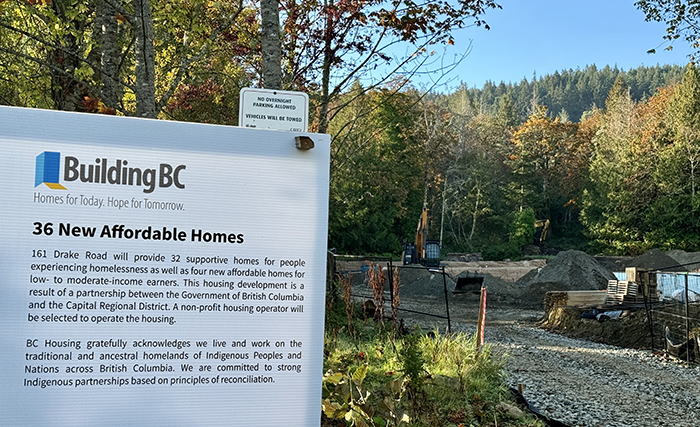
After years of delay, construction at 161 Drake Road has finally begun, with foundations being prepared for what BC Housing has said will be 32 units of supportive housing, as well as four additional affordable rental units to be made available for people with low to moderate incomes.  

As the timeline for that project becomes clearer –– BC Housing now predicts residents will move into the modular-construction units by this coming summer –– the downstream effect of the North Salt Spring Waterworks District’s (NSSWD) announcement it may ease its 10-year-old moratorium on new water connections is less certain. 

In August, NSSWD officials said the district will propose adding the water-draw equivalent of as many as 300 multi-family dwelling connections, just on one side of its system –– where water is drawn from Maxwell Lake. 

“That could –– and probably will –– include Drake Road,” said Salt Spring Island CRD director Gary Holman, speaking at the regional district’s Housing and Hospital Committee meeting Wednesday, Oct. 2. “But there’s only so much water available.” 

The land is owned by the CRD, but leased in its entirety by BC Housing, a 60-year agreement that so far has seen work only in the portion fronting Drake Road. The regional district has had plans to utilize the entire 5.5-acre parcel for affordable housing before –– 80 units were proposed in 2013 –– but they were halted as the water connection moratorium began.  

Well drilling results at the time were “poor,” according to a contemporary Islands Trust staff report, and unlikely to support that density. 

But tucked into the CRD’s Regional Housing operating and capital budget for 2025 is a $300,000 allocation for “additional” drilling work at 161 Drake Road.

Last November, CRD’s general manager of planning and protective services Kevin Lorette told the Electoral Areas Committee that CRD staff and a consulting hydrogeologist had been prepping for a groundwater exploration there, meant to inform the CRD board for future development on the site. 

And at the Oct. 2 meeting, Lorette said there may yet be “further opportunities” for the CRD at the site, adding that while the lifting of the water connection moratorium may negate the need, the one-time operational expense for drilling — to be funded through the Community Works Fund –– should remain in the budget. 

Holman said his concern was that if development on the rest of the Drake Road site was delayed, publicly funded affordable housing could lose its place in line; new connections to the NSSWD system may simply be allocated on a first-come, first-serve basis. 

“The limited number of densities that that partial lifting would allow could be taken up by other projects,” Holman warned, “both for-profit and non-profit.” 

CRD staff said they would continue regular reporting on Drake Road to directors; meanwhile, the first of two open house events on the water moratorium review, hosted by NSSWD at the Legion’s Meaden Hall, takes place from 2 to 7 p.m. on Tuesday, Oct. 22.  

Junior sailors compete at Victoria Fall Dinghies event

BY SSI JUNIOR SAILING TEAM

A record number of Salt Spring Sailing Club junior sailors attended the Fall Dinghies regatta, recently held at Royal Victoria Yacht Club.

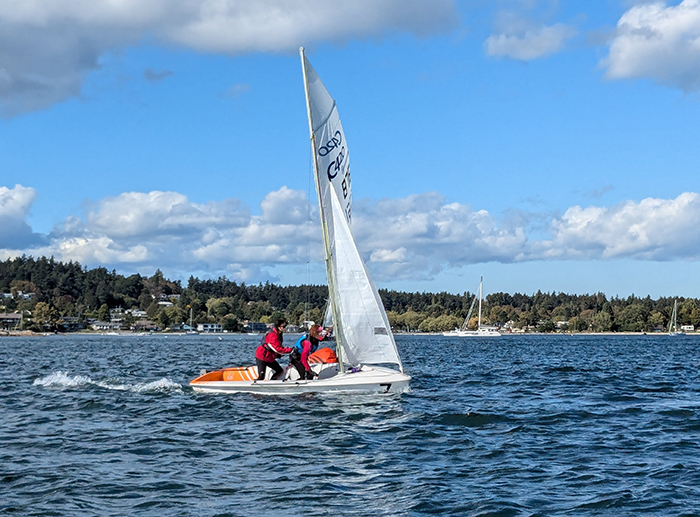
With stronger winds than many of the sailors had previously experienced, spectators on shore saw lots of brave work for the boats to stay upright, along with a couple of spectacular capsizes.

Louis Demandre, Phil Pugh Aucoin and Lochlan O’Dwyer had their first regatta experience in the Opti Green fleet, a group for first-time racers. Each sailor put in a consistent effort on the first day of sailing, where they raced multiple heats over a modified version of the competitive course. On the second day, high winds forced the Green fleet further into the more sheltered waters of Cadboro Bay.

Meanwhile, Luci Pugh Aucoin and Aoi Otsu raced in the Opti Championship fleet. Both had several good races against 47 other boats, and each showed confidence and improvement from previous regattas. The high winds and large number of competitors created challenging conditions. Luci Pugh Aucoin had a personal best, coming in 11th place in her second race of the regatta.

In the Club 420 class, Malikaa Clement and Maeve FitzZaland had a great first day on the Saturday, with consistent finishes in the top three out of a field of 17 boats. The other 420 team of Izzi Pugh Aucoin and Reuben Sol were sailing well, but an unfortunate disqualification in one race left them needing to have a strong second day of racing. On Sunday, in very high winds, Pugh Aucoin and Sol managed first and second place finishes in every race, and ultimately won the regatta for the second year running. Clement and FitzZaland suffered a collision and capsized in their final race, leaving them in fourth place overall.

After the awards ceremony, the 420 sailors expressed their appreciation for their coach, John Hillier, along with guest coaches Douglas Woolcock and Stephane Aucoin. The Opti racers received support preparing for the regatta from junior coaches Izzi Pugh Aucoin and Reuben Sol, and the whole junior team has benefitted from the ongoing support of the Salt Spring Island Sailing Club.

Next up for the 420 teams is the Pumpkin Bowl at the end of October, in the frigid waters of the Salish Sea.