Home Blog Page 111

Burning still banned on Salt Spring

0

Salt Spring Island’s fire restrictions will not be following regional officials’ lead for now, according to the local district, saying it will be at least Oct. 1 before the ban on non-recreational burning will be lifted. 

The Category 2 and Category 3 open fire prohibition within the Coastal Fire Centre (CFC) was indeed officially lifted at noon Wednesday, Sept. 18, meaning along with campfires – which had been allowed again since Aug. 28 – burning in barrels, cages or piles for reasons other than recreation are permitted within CFC boundaries –– but not within the Salt Spring Island Fire Protection District, which is choosing to keep the ban on all but campfires in place.

Fire danger rating for Salt Spring has alternated between “moderate” and “low” at different points in the last week, according to the B.C. Wildfire Service (BCWS). 

“Although fire danger ratings have declined in the region due to recent rainfall and cooler temperatures, the public is strongly encouraged to continue exercising extreme caution with any campfire,” according to a notice from BCWS. “It is the responsibility of the individual to ensure that burning is done in a safe and responsible manner and in accordance with regulations.” 

Local governments and improvement districts have the authority to put conditions and restrictions on burning within their boundaries; for the latest fire information visit saltspringfire.com

Saying HÍSWKE SIEM to Adam: warm words and photos

0

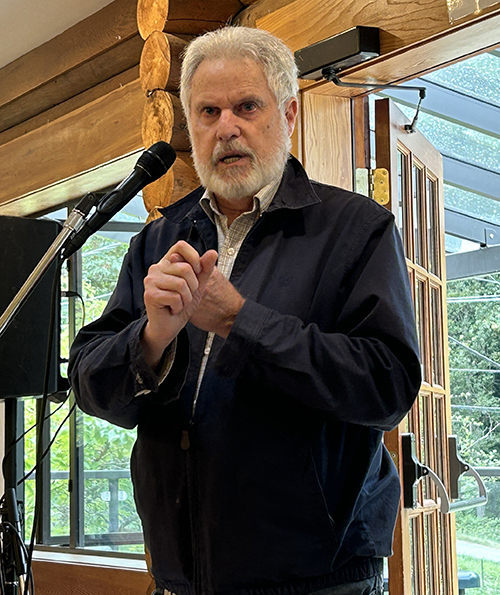
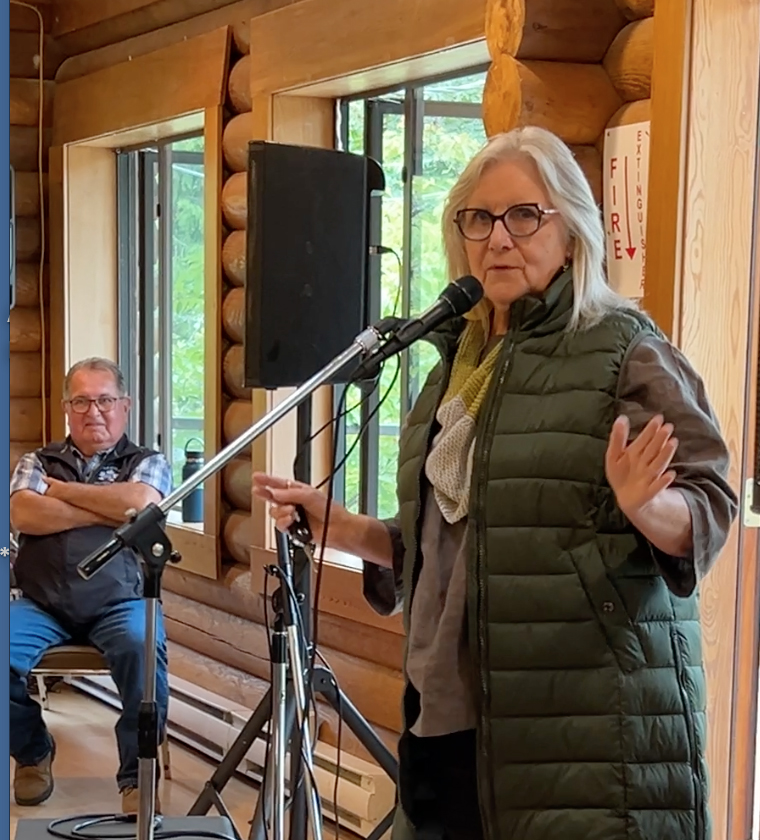
Salt Spring Islanders and members of local MLA Adam Olsen’s family and staff enjoyed a two-hour gathering and tribute to Olsen, who is not pursuing a third term as the Saanich North and the Islands Green Party of BC rep, at Lions Hall on Sept. 13.

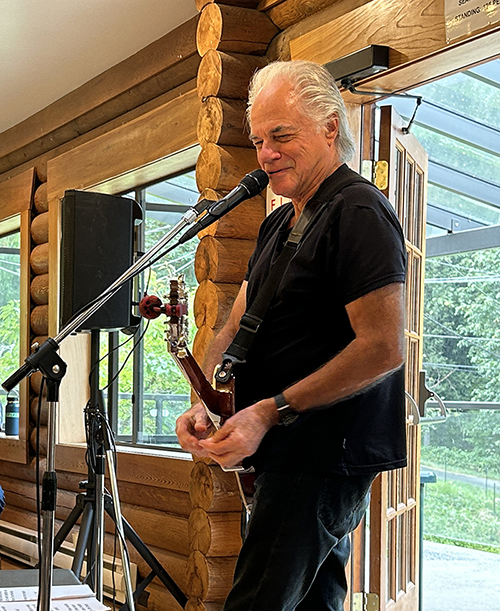
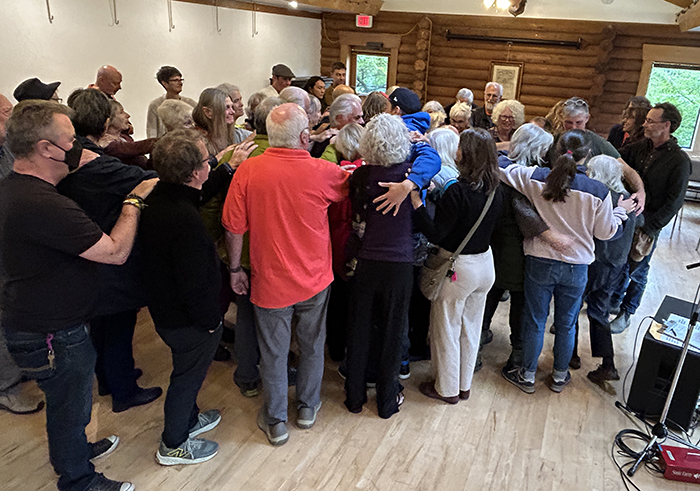
The event saw numerous people speak, everyone in the crowd sharing a word or thoughts about Olsen (with some written on maple leaves for Olsen to take with him in a gift basket), two songs from Bill Henderson, a giant “group hug,” cake and finger foods to share.

Olsen is the Greens’ campaign chair for the upcoming provincial election.

Following are photos from the Sept. 13 event and some excerpts from speakers.

A video of Olsen’s address to the crowd can be viewed here.

Briony Penn: “I really suggest everyone do this: Go to Adam’s blog and go to his “response to bills.” If I feel depressed, I just go to Adam’s response to bills. I look at it and it just makes me feel better, because it’s just like someone is out there . . . .”

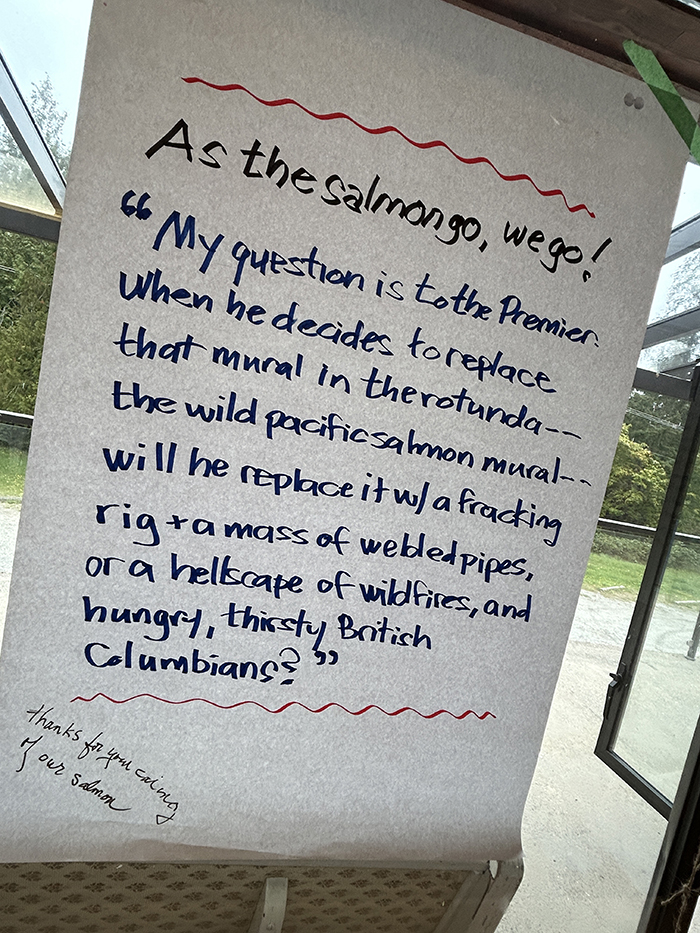
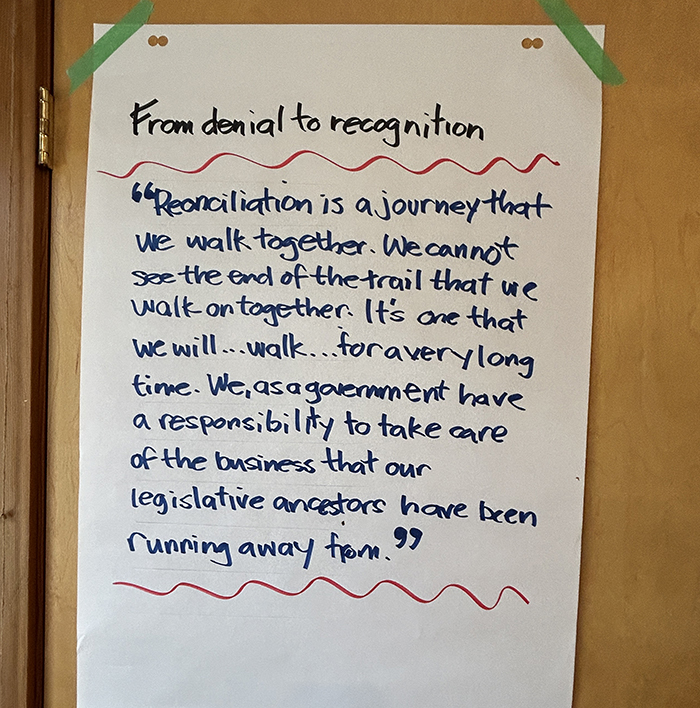
Penn had picked five quotes from Olsen’s blog for posting on the wall at Lions Hall, including these two:

A quote from Adam Olsen that Briony Penn referenced in her “land destruction acknowledgement” and tribute to Olsen.
Adam Olsen speech excerpt re reconciliation with First Nations.

Laura Patrick: “As Briony pointed out, read his blog. Read those speeches; the thought, the care, the effort . . . every speech that he’s delivered in the House is amazing.

“We owe it to Adam to be better citizens, to listen to each other. We need to learn from the past; we have to open our hearts and minds to the future so that we can be prepared for what’s coming. Thank you, Adam, for serving as our MLA of Saanich North and the Islands. You are going to be dearly missed.”

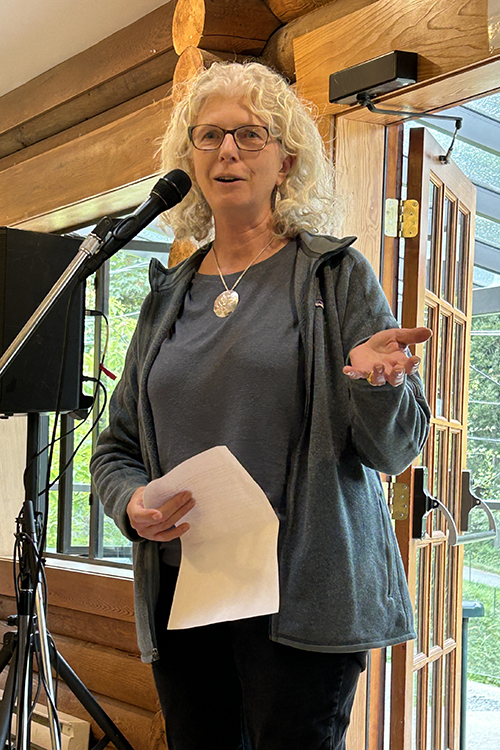
Salt Spring Islands Trust trustee Laura Patrick thanks Adam Olsen for his seven and a half years of service as local MLA.

Gary Holman, speaking on Olsen’s collaborative nature: “It’s not just a skill, it’s who he, it’s the nature of bringing people together. On so many fronts — the Salish Sea trail, the Southern Gulf Islands Forum, you were one of the initial advocates for the ASK Salt Spring institution that Gayle Baker runs now — it’s become, you know, like this, where people can reach out to their elected officials and have a good conversation. That’s just by your nature, but also by your First Nations background. That’s what you do.”

Salt Spring CRD director Gary Holman, who Adam Olsen unseated in the 2017 MLA contest, gives appreciation to his colleague.

Sylvia Olsen: “There was no surprise in our family that Adam should end up being a politician. There is not a microphone or a stage that Adam has not loved, or a tiny space in a conversation that Adam has not been able to fill.”

“When he went into politics, people said, ‘Oh, Sylvia, politics is really going to change your son.’ And I said, ‘No, it’s not’ — you know what I’m going to say — ‘My son is going to change politics.’ I think he did.”

“What do you want for a son that is smart and big — short and big? You want the world to challenge him. You really do. You don’t want him to just walk through the world. You want it to beat him up, and you want him to be proud of who he is, and you want him to be able to be wrong. All those things came in his experience. So his experience being in politics was really, really good for him.

“And the last thing I want to say, and it’s because of people like you, because while [however] dark and cynical and nasty the world is, it isn’t as well. It really isn’t, because Adam has had the support of the most amazing people, like Tom [Mitchell], who’s there for him all the time . . . all of you people I’ve seen over the years that are there for him, to soften the blow for him. And so he isn’t cynical, he isn’t angry, he isn’t all those things. He is in love with his people, and that’s you, and that’s because you have been in love with him, and honestly, there’s nothing better than that. Thank you all for taking care of my crazy ass son.”

Adam Olsen’s mother Sylvia shares things “only a mother would know” about her son in a warm and humorous talk, with Adam’s father Carl seated to the left.

Robin Jenkinson, of Island Pathways: “One of the ways that Adam has contributed to this island is helping us all be able to move closer to being able to walk and ride our bicycle safely from one end to the other, and holding this vision of the Salish Sea trail loop, a network that can connect many communities . . . Adam’s been holding meetings to advance this walking and cycling trail for almost three years every month. He is consistently there and consistently showing up on your bicycle or right across the island and meet us all. So Island Pathways wanted to present you with the most important safety equipment out there, which is a rear view mirror, so you can look back on your time here.”

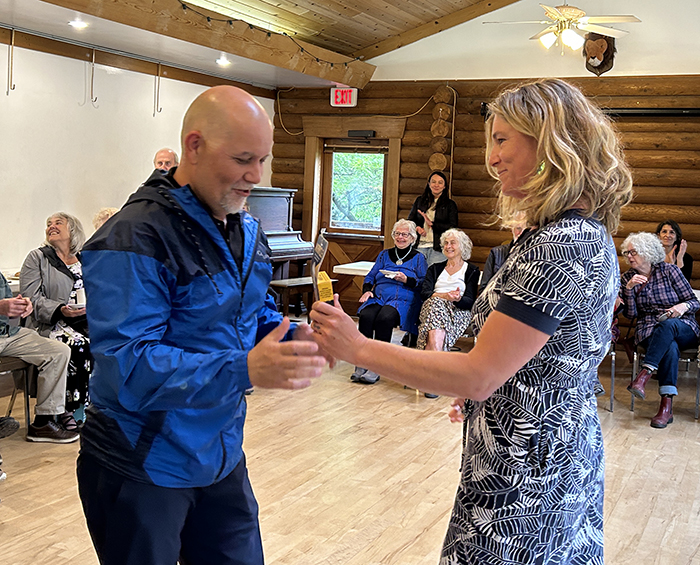
Island Pathways rep Robin Jenkinson gives Olsen a rear-view mirror for his bicycle as a gift of appreciation for all his hard work on the active transportation file during his eight years in the MLA seat.

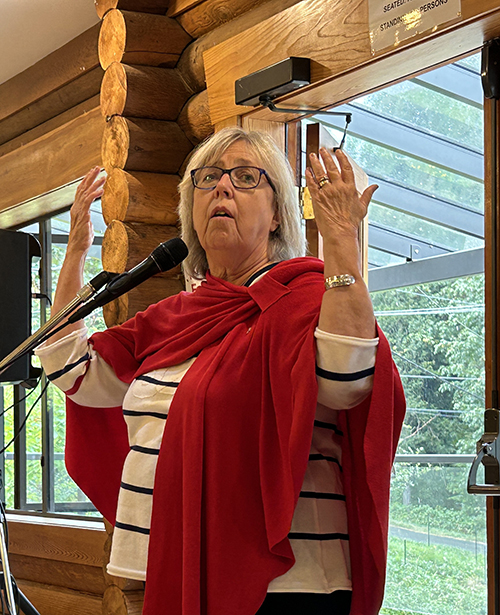
Elizabeth May: “The word colleague is really important. Adam innovated something so cool: people might not know about the Southern Gulf Islands Forum. Adam’s idea was that we would get together, without any regard to jurisdictional barriers, at least once a month — your MLA, your MP, islands trustees, CRD and other forms of local government, Indigenous leadership — and meet around the table to figure out, if we’ve got a shared problem, “Has anyone heard of a new program?” We’ve got a shared problem, we write a joint letter to the people who are the decision makers on this shared problem. We are committed, and we had a meeting recently at the forum where there were people literally very close to tears over knowing that this was Adam’s last meeting, but all of us, regardless of where we sit on a jurisdictional basis, are saying we’re committed to keeping this going, whoever the next MLA is and regardless of the party. The Southern Gulf Islands Forum will continue, because we get more done when we don’t care who gets the credit, and we pull down those silos.

“I love you so much, Adam. I’m going to miss you more than you can imagine. I know you’re not going far, but we’ve been privileged as a group of citizens in Saanich North and the Islands to have you being our MLA. To say you’ve done us proud is an understatement.

“HÍSWKE SIEM. Forever and forever and forever we are in your debt, and we hold you in a place in our hearts, close and tight, and know that whatever you do next will be the right thing.”

Saanich-Gulf Islands Green MP Elizabeth May says HÍSWKE (thank you) following heartfelt words expressed to Adam Olsen.
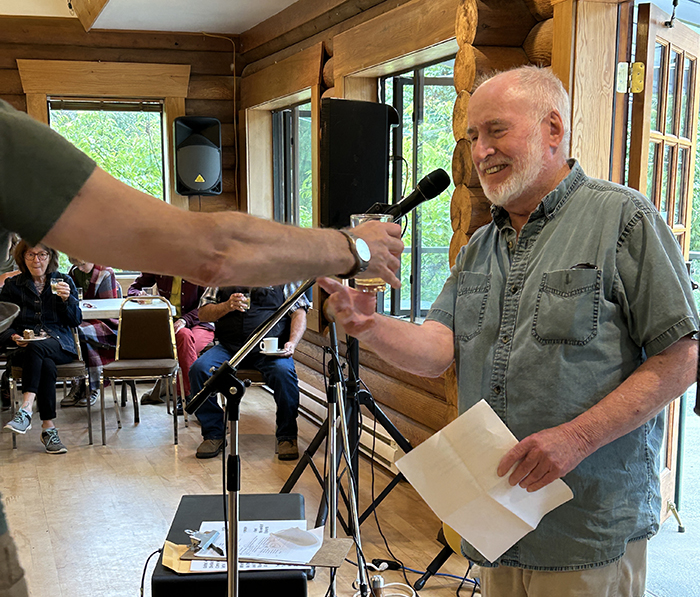
Long-time Green party member and organizer Tom Mitchell accepts a glass of sparkling apple juice from event MC Bryan
Young before giving a toast to Adam Olsen.
Bill Henderson gets set to play a blues number and his own Take Back This Land, which he wrote in 2015 in response to the federal government’s promotion of the Kinder-Morgan oil pipeline project.
A “group hug” of sorts is given to outgoing MLA Adam Olsen at the Sept. 13 event.

Opinion: Galiano market table denial rankles

1

BY JENNIFER MARGISON

After a three-month attempt to resolve an issue directly with the individuals involved on Galiano Island, I am reluctantly writing on behalf of Friends of the Gulf Islands Society, to highlight what we see as unnecessary, unfair and harmful censorship by the Galiano Saturday Market Board. 

In early June, the Friends of the Gulf Islands Society applied to have a table at a mid-July Saturday market on Galiano. The market is held weekly in the expansive Lions field and space is not an issue. 

Friends of the Gulf Islands is a B.C. registered society focused on the protection of the natural environment and rural character of the islands in the Islands Trust Area. We monitor Trust meetings and decisions for compliance with the Islands Trust mandate or object to “preserve and protect the unique amenities and environment” of the Trust Area. 

Our interest in having a table at island markets is to provide information to residents and visitors about what it means to live in a Trust Area, and to alert people to the fact that the Trust Policy Statement — the governing document that official community plans and bylaws must comply with — is being reviewed and a new draft has been released. 

Many of the islands have very limited media and local markets offer vital opportunities to connect with people. Friends of the Gulf Islands has been welcomed at both the Mayne and Pender Island markets this summer. 

However, on Galiano, though Friends had a table several years ago at the market, our request went unanswered for a month. Then we were told that the board had voted against allowing us to attend. No reason was given in spite of several requests and offers to speak to the board about our group. We provided the market board with a link to our website and a copy of our brochure. 

Over two months later, we were finally provided with a copy of the Galiano Market Policies and Vendor Agreement, but still no reason was given for the denial of our request. It was only after several requests to speak to someone that a conversation occurred with the market director, where we were able to ask if specific wording in the agreement was being used to deny our organization space. 

This wording states that “Community groups and organizations may set up information tables at the market free of charge, provided they restrict their activities to their stall, avoid provoking controversy and do not otherwise interfere with the primary purpose of the market . . . Proselytizing of vendors or customers is prohibited as is engaging in topics of discussion that have historically been divisive within the community.”

“Provoking controversy” and “engaging in topics of discussion that have been historically divisive within the community” are extremely subjective concepts. We would not consider our members sitting at a table distributing a brochure and answering questions about the Islands Trust to be “proselytizing” and do not see how our presence would in any way interfere with the market. Anyone who has lived on one of our small islands knows that there are many issues that “provoke controversy” in our communities or have been “historically divisive.” On Galiano, this has ranged from rezoning of land, to public shore accesses, to tax referenda, to building our library, to site locations for affordable housing. Community members do not all think alike and differences of opinion are to be expected. 

The Galiano Market welcomes groups such as the island’s housing societies, the conservancy association and the human composting group — promoting a petition for legislation to allow a facility to compost human bodies — and political figures such as Green Party leader Elizabeth May. Having various groups at island markets provides opportunities to ask questions, discuss issues and engage with neighbours, all part of being informed community members. 

We question a market’s vendor agreement being used to selectively deny an environmental group such as Friends of the Gulf Islands a presence and a voice in our community. This is dangerous and unnecessary overreach. What will this small group next decide is too “controversial” for our community to hear?

Editorial: Be-calmed traffic

2

There’s a proper traffic jam out front, and without a single sheep in sight. 

For readers fortunate enough not to have noticed, construction on Fulford-Ganges Road between Cranberry Road and Seaview Avenue has officially entered its alternating-one-lane-traffic stage, and — at least between 9 a.m. and 3 p.m. in the first week — it’s led to a few frustrations. 

From our vantage point on Fulford-Ganges Road, we’re among those with a front-row seat to the traffic back-ups, and we’re happy to credit both flaggers and drivers as we watched emergency vehicles pass by largely unhindered. 

For those without lights and a siren, however, it’s an exercise in patience. The delays can be long — reportedly adding as much as a half hour to some Salt Springers’ commutes — and just one person needing to turn left off the main road (or worse still, trying to turn left onto it) can make the backup longer still.  

While it looked a little better managed as we went to press Monday afternoon, we’re all going to have to try harder to not block driveways and side streets, or to at least pay close attention and leave enough room between vehicles to sort something out on the fly.  

But, as they say, we’re not really stuck in traffic — we are the traffic.  

It’s easier to believe there are truly thousands of cars using that road every day when a few moments’ pause backs them up to Beddis. Perhaps, living on a small island, we’ve been lulled by the relatively short distances into thinking a quick trip into town, no matter how often repeated, can’t possibly contribute to a traffic problem; perhaps our independent spirits have pushed things like carpooling too far from our minds. 

When construction is finished, we’ll have fresh surfaces, excellent drainage and shoulders wide enough for bicycles and pedestrians to feel a little more confident about their safety. For drivers, at least for the foreseeable future, there’s literally no getting around the road work. Those with flexible plans would be most helpful in exercising a choice to consolidate trips to town and people in vehicle seats, using transit, walking or cycling — the latter with extreme care, of course — until the project is hopefully completed next year. 

Sunday pool hours back in 2025

0

Budget wrangling for the coming year is wrapping up, and users of Salt Spring’s second most popular public amenity will be happy to hear the Rainbow Recreation Centre’s pool will be returning to a seven-days-a-week schedule in 2025. 

Among dozens of preliminary budget tweaks worked out over a marathon session for Salt Spring’s Local Community Commission (LCC) Thursday, Sept. 12 was a funding bump that will re-open the pool on Sundays — mostly likely with staffing in place to permit swimming from 1 to 5:30 p.m., according to acting Capital Regional District (CRD) senior manager Dan Ovington. 

Calling the pool “a hole into which we pour money,” LCC member and CRD director Gary Holman agreed more islanders use the pool than any other amenity apart from the library — and voters approved both. 

“There are still things we’re not able to do,” said Holman. “The service level at the pool is lower than it was a few years ago. But our single largest requisition cost is that one facility.” 

Ovington said Sundays were historically popular days for swimming, often seeing more than 100 visitors even with shortened hours. 

“We hear it a lot now, ‘why aren’t you open on Sundays?’” he said. “It also opens up opportunities for birthday parties, and really something else for families to do on weekends in the winter.” 

In addition to the staffing increase, commissioners also approved a budget for a new safety improvement: surveillance cameras in public indoor areas at the recreation centre.

Ovington told LCC members there had been a number of recent safety incidents at the pool where some “younger, specifically female staff” felt unsafe — prompting a safety audit that brought forth several recommendations, including improvements in training and front desk arrangements and adding surveillance.  

“This would be similar to what we have at other CRD and greater Victoria facilities,” said Ovington, pointing to Panorama, Oak Bay and Saanich pools. “Cameras in the common areas, as well as out on the pool deck — but not the change rooms.” 

Ovington said there had also been multiple reports from parents — either to his office, he said, or often to police — of various kinds of inappropriate behaviour toward children, but it was often difficult to take action when one party denies doing anything wrong. 

“As an example, on the low end of what we’ve been experiencing there, we hear ‘an elderly man was licking his lips at me, it was inappropriate,’” said Ovington. “We approached the gentleman, he said ‘I didn’t do that.’ And it’s their word against a seven-year-old.” 

Ovington said staff in other CRD pools had found common-area cameras useful, and they were recommended by local RCMP — to help enforcement, he said, but also as a deterrent. 

LCC member Brian Webster said that while he was generally skeptical of public surveillance for its privacy implications, he was more agreeable to cameras inside a public facility than outdoors, where unknowing passers-by “could have their privacy invaded.” 

“I think this passes the test,” he said, “for something where the importance of ensuring the safety of staff outweighs my concerns around protection of privacy, particularly given that the only people affected would be people who chose to enter the facility.” 

A one-time expense for that project will be met by Community Works Funds, according to a staff report. 

Garden bench raffle supports Greenwoods

0

SUBMITTED BY GREENWOODS ELDERCARE

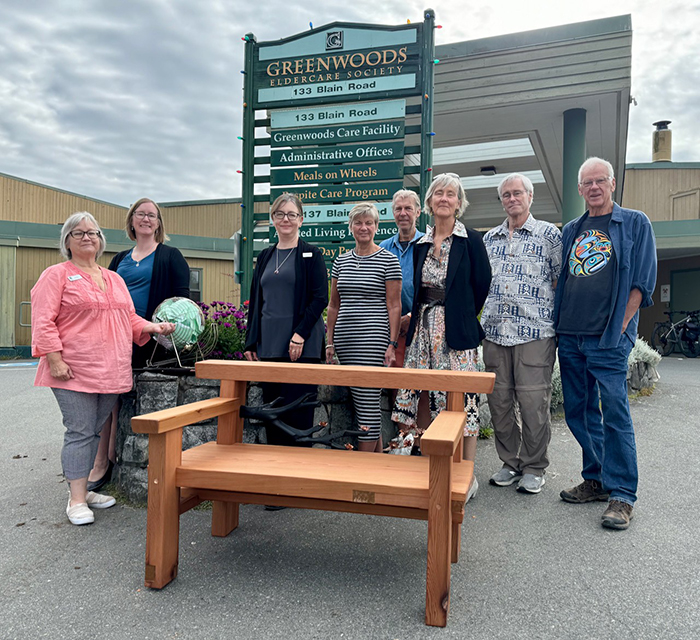
Monday, Sept. 9 saw the much-celebrated draw for the 26th garden bench raffle at Greenwoods, and the prize was won by Elena Smith for her mother Marlene Rista of Southey Point.

Greenwoods staff members Janice Benson and Trish Staicesku drew the lucky name, with executive director Aletha Humphreys, sponsor Robert Steinbach of Country Grocer and Greenwoods Eldercare board members on hand for the ceremony.

The 2024 bench was created by Salt Spring artisan Luke Hart-Weller of Copperwood Gallery, and is crafted from salvaged Gulf Islands cedar, embellished with charred cedar and copper flowers.

The annual fundraising raffle of a handcrafted garden bench to benefit Greenwoods Eldercare has been a tradition on Salt Spring since 1998. These coveted heirlooms now grace many special places around the island as landmarks of our community’s generosity.

Every year, the true winners of the annual garden bench raffle are the residents of Greenwoods and Braehaven, and those who benefit from Greenwoods community programs. This year the popular fundraiser brought in over $5,300 in ticket sales.

Greenwoods Eldercare is a not-for-profit, community-based organization that owns and operates Greenwoods long-term care and Braehaven assisted-living residences. In addition, it offers community programs like Meals on Wheels and an adult day program. Every dollar raised in the annual garden bench raffle goes directly to supporting the needs of the residents and clients that Greenwoods serves.

Under the local governance of a volunteer board of directors, Greenwoods’ operations are carried out by a highly trained staff of professionals in elder care. The organization receives operational grants for Greenwoods from Island Health under an affiliate agreement, as well as funding from BC Housing to help support Braehaven. However, direct fundraising in the community is vitally important to provide the high-quality living space, infrastructure and equipment that make Greenwoods and Braehaven the comfortable, welcoming homes residents deserve.

“The community’s support of Greenwoods is so appreciated,” said Greenwoods Eldercare director Paul Roberts, who organized this year’s event. “Our thanks go to our valued sponsors Country Grocer and Island Savings for their support of ticket sales, Luke Hart-Weller for his craftsmanship, our fundraising volunteers for their time and everyone who bought raffle tickets. You really make a difference.”

Education provides hope for girls and families

0

By MARILYN MCDOWELL

for SALT SPRING CFUW

Educate a young woman and you educate a whole family. So believes the Canadian Federation of University Women (CFUW).

The Salt Spring chapter of CFUW awards “second chance bursaries” to women in the Gulf Islands who are out of school for at least two years and wish to pursue education to improve a career choice, and in most cases support a family. Internationally, a project called HOPE sponsors girls in developing countries for secondary education by paying for school fees, books and uniforms.

Our HOPE project began in 2005 with three students and since has multiplied; a total of more than 250 teenaged girls have received sponsorships in 13 countries in Africa, Central America and the Caribbean, the Indian subcontinent and South East Asia, as well as Papua New Guinea, Fiji and the Solomon Islands. These 250 girls have been supported by Salt Springers.

As funding covers only school expenses, families make sacrifices when daughters choose school over work or early marriage. Each girl requires between $540 and $710 in Canadian dollars per year, some a bit less,  depending on the country.

The HOPE project is life changing. Letters from each girl and her headmistress are required for application, with progress reports required each year before continuation. These letters are compelling:

Clare in Nigeria “has a passion to look after patients, hopes to become a nurse,” states a report.

Rose Marie in Namibia said, “Both parents lost their jobs and father abandoned family of six. Commonwealth Girls Education Fund (CGEF) sponsorship enabled me to continue schooling toward becoming an accountant. During school holidays my job as a babysitter helps mother with expenses.”

Muknaan, who lives in Nigeria, said, “I want to be a lawyer, combat injustice and corruption in Nigeria and ensure all are treated equally and offenders punished! I also want to establish a school for girls at an affordable price.”

Katarina, of the diminishing Hadzbe hunter/gatherer tribe in Tanzania, said she “aims to become a civil engineer, to bring change and development in my community: houses, clinics, schools, roads, bridges.” Infrastructure is needed all over the less developed world.

Elizabeth in Tanzania, like others, identifies many problems in her home community. Elizabeth said she “stays at school during school holidays to avoid being pressed into early marriage.”

To educate a girl is to educate a family. Adelaide in Kenya points out, “Your intervention in my studies has been nothing short of life changing.”

A recent development has been formation of alumnae groups of young women who have embarked upon their careers. Feedback from Marion in Uganda includes gratitude for financial help throughout secondary school. Marion secured a government scholarship to study civil engineering at Makerere University and currently works as a civil engineer at a construction firm in Kampala. She endeavours “to reach out to as many young girls as I can through mentorship and career guidance as a way of carrying the kindness forward.”

These alumnae support each other and mentor their younger aspirants.

Our HOPE project works in partnership with the CGEF, founded in 1967 by a small group of women in England, including Lyndsay Mundy, who moved to Salt Spring and spearheaded the project dubbed HOPE, which works through CGEF.

This English charity is almost entirely volunteer run. CGEF assumes all administrative costs and provides local contacts for screening and monitoring. That means all donations made from Salt Spring are directed entirely to school fees, books and school uniforms. In addition to donations from the club and its individual members, support is invited from individuals and businesses of our community.

So far this year there are 55 potential candidates approved for funding, with 22 applications pending. If you would like to sponsor a girl (or two), or provide partial support, and receive a copy of their photo and letters of application and progress, please consider a donation — a meaningful gift for someone who has everything or someone who is receiving your help with their own education. It’s an inspiration to study diligently!

Even a portion of the $540 to $710 annual sponsorship amount would help enormously. In the poorest countries, $145 could sponsor one of four girls in Sierra Leone; $210 sponsors one in 10 girls in Malawi; or $260 allows one of the three girls in Namibia to continue her education.

Our CFUW Salt Spring branch has received an award for International Relations and Certificate of Merit for International Women’s Day for the HOPE project.

People who are interested in learning more about CFUW on Salt Spring, or would like to join our monthly get-togethers, are invited to contact Kay Woodhouse at 250-653-4927. For more information about the HOPE project, contact Sandra Hyslop at 250-537-4568.

LCC gets earful on farming issues

1

Salt Spring’s agricultural community crowded Lions Hall to press officials for change, in the wake of a courtroom decision that went against one island couple whose poultry-breeding activities were found to have violated local noise bylaws.  

Seating capacity at the town hall was reached and exceeded Monday, Sept. 9, and as members of Salt Spring’s Local Community Commission (LCC) listened, one islander after the next took the microphone largely to speak in favour of legal changes that could shield farming activities from neighbourhood complaints, irrespective of whether they were within Salt Spring’s Rural or Agriculture land-use zones. 

The community gathering was called in response to a provincial court judge fining Salt Spring resident Clinton McNichol for contravening Capital Regional District (CRD) noise bylaws due to keeping roosters on his Rural-zoned Woodland Drive property. That judge also ordered a prohibition on any roosters being kept there until Sept. 6, 2025. 

Addressing the LCC, Salt Spring Island Farmers Institute board of directors president Terry Clement and Agriculture Committee chair Kevin Chipperfield re-sounded that group’s alarm on the shrinking availability of farmland on the island, saying it seemed clear the local court case would ultimately have a wider reach. 

“This action far extends beyond Salt Spring Island,” said Clement, “because what it does is, it impacts the food security and the food sovereignty right across the province.” 

Clement said the Farmers Institute’s plan was to escalate its involvement, beginning with a suggested dispute resolution mechanism sent to the head of CRD’s bylaw enforcement and hopefully extending to input on new legislation in the longer term. 

“With this as a precedent set in the court,” said Clement, “it means that any new nuisance, noise type of issue — regardless of whether it’s agriculture, or whether somebody is setting up a scrap metal [operation] that has been zoned industrial and it is a permitted activity — can be prevented and dismissed as a result of a nuisance bylaw issue.” 

“If we cannot find common ground between small lot farmers and their neighbours, the situation could become untenable,” said Chipperfield, “with the legal profession as benefactors.” 

That particular sort of common ground would have to wait for another night. As the LCC heard one speaker after another expressing the need for more permissive or protective bylaws for farming activities — or for unsympathetic neighbours to simply “deal with a little cock-a-doodle-doo,” as one attendee put it — the increasingly enthusiastic applause made it clear the gathering was dominated by farming advocates. 

Noticeably absent was public comment from the “other side” of the debate, LCC member and CRD director Gary Holman noted, while expressing his disappointment that so many who spoke were unwilling to refrain from cheering for one another.

“So there were folks here who do have a different view than virtually everyone in this room, and they felt intimidated to express that view,” said Holman. “And I’m telling you that I feel honour-bound as an elected official to also listen to those views. I’m open to try to make changes to avoid this kind of circumstance in the future, but it’s going to be done by listening to everybody.” 

Holman proposed convening a working group of all stakeholders to craft a way forward, but next steps meanwhile for those feeling a greater sense of urgency are less clear.  

McNichol told supporters at the town hall there may yet be further legal appeals, although he noted he and spouse Alia Elaraj were left with “a very sizable debt and a ticking clock” to further contest the court decision. 

McNichol’s neighbour Isy Cohen — one of the CRD’s court witnesses who complained about noise — addressed Salt Spring’s Local Trust Committee Thursday, Sept. 12, suggesting trustees consider changing the zoning for parcels on Woodland Drive bounded on two sides by Mobrae Avenue from rural “R” to residential R1-R5 or R8, which would prohibit intensive agriculture.   

Salt Spring Island Poultry Club president Elsie Born submitted paperwork to speak before the Islands Trust Council during its next meeting set for Sept. 24 to 26. Born’s delegation request indicates she will bring several proposals, including policy revisions to protect farming practices on rural-zoned land.  

And, at the tail end of the LCC’s regular meeting Thursday, Sept. 12, chair Earl Rook brought a notice of motion — “basically to get the conversation started, but not committing us necessarily to any particular course of action,” he noted — that the LCC initiate a review of both the noise and animal control bylaws, “for the purpose of assessing the suitability of existing bylaw language for the community of Salt Spring Island, and recommending changes where appropriate to the CRD Board.” 

“The commissioners will work with staff to develop an open and transparent process,” Rook said, which would include “full public notification of the initiation of the review and the specific bylaws under review; public solicitation of input on the bylaws under review through multiple means, including written comments, public forums and meetings with stakeholders; and solicitation of legal opinion and guidance where necessary.” 

Upon a reminder that the LCC lacks the authority to make recommendations directly to the CRD Board, commissioners at the Sept. 12 meeting seemed resigned to the protocol of making recommendations to Holman, who — in his role as CRD director — could bring recommendations to the CRD’s Electoral Areas Committee (EAC). 

“Whatever the LCC recommends,” said Holman. “Even if I disagree with it, I will commit to making sure that the EAC sees that.” 

That motion is likely to be made during the LCC’s meeting in October, Rook said. 

CRD’s regional transportation service heads to AAP

0

Plans for a $20-million regional transportation service — and for the tax dollars supporting it — have been approved by the Capital Regional District (CRD) board, despite pleas from Salt Spring’s elected officials to not participate in a service they believe will provide no benefit to the island.   

The most populous Southern Gulf Island’s position was made clear months prior, according to electoral area director Gary Holman, who along with Local Community Commission (LCC) member Brian Webster travelled to Victoria to make their final case in multiple meetings Wednesday, Sept. 11. Holman and Webster reiterated that it made no sense for Salt Spring to participate in a regional service which they said was at best duplicative — and at worst, undemocratic.  

“I’m a big believer in region-wide initiatives,” Webster told the CRD transportation committee. “I lived for 17 years on probably the only street that had one block in Oak Bay, one block in Saanich and one in the City of Victoria.” 

But, he said, despite the initiative having merit generally, there were several reasons it simply didn’t make sense to include Salt Spring. 

“Our residents make quite limited use of the transportation infrastructure in other CRD jurisdictions,” he said. “Most of our connections that go off Salt Spring don’t even go to the CRD, they go to the Cowichan Valley Regional District.” 

Salt Spring’s population is also large enough, Webster pointed out, that a “high degree” of employment and services are on-island, and don’t necessarily require a ferry trip.  

“And most importantly, Salt Spring Island already has a CRD transportation service — a local service that’s been operating for a number of years,” said Webster. “It’s supported entirely by Salt Spring Island taxpayers, investing in active transportation and supporting our transit service.” 

But most CRD board members took a “rising tide will lift all ships” perspective; CRD director Jeremy Caradonna, councillor for Victoria, shared with the board what he felt was a relevant anecdote about a recent bicycle ride from his home in that city’s Fernwood neighbourhood to Salt Spring Island. 

“From my home all the way to Swartz Bay is on a protected bike lane, basically,” said Caradonna. “Then when you get off the ferry in Fulford, it’s a nightmare.” 

Caradonna argued it showed Salt Spring’s local transportation service as the “status quo” was not working. 

“Why are there no bike lanes on Salt Spring Island?” asked Caradonna. “Why is there no sidewalk along the Fulford-Ganges Road? Why is there no sidewalk in big portions of downtown Ganges? Why are there insufficient crosswalks that are from the 1980s?” 

“In part,” answered Holman, “because Salt Spring has invested millions of dollars in the existing regional trail system and received virtually nothing in return. Even with very explicit requests to include Salt Spring in [regional] trail borrowing, not only was that request rejected, it wasn’t even referred to the transportation committee.” 

And, Holman said, had he been CRD director for anywhere else but Salt Spring, he wouldn’t vote to advance Salt Spring projects either — because of the relatively small population, and because he said unconnected trails on a separate small island are hard to define as “regionally significant.”  

“It’s about bang for the buck,” said Holman. “If you’re sitting here with your regional hat on and looking at how best to spend tens of millions on active transportation, it wouldn’t be on Salt Spring — it would be in Greater Victoria, from an economic perspective.” 

With the CRD board’s vote, public approval of the new service will now be sought — through the Alternative Approval Process (AAP), where a measure succeeds by having fewer signatures from voters who are against it. In this case, the AAP allows the board to adopt the service-establishing bylaw if less than 10 per cent, or fewer than 33,191 electors, join the counter petition. 

Since there are just 9,500 registered voters on Salt Spring Island, Holman noted, even if all of them signed in opposition, the counter petition would fail anyway. 

“One could argue, ‘it’s going to voters, how democratic can you get?’” said Holman. “It’s not democratic; Salt Spring would be the tail wagging the dog.” 

The initial requisition of $10.3 million can max out at $20 million under the current authorization, according to a CRD staff report, although board members noted that number was linked to current property assessments and could rise further.  

Salt Spring’s contribution is estimated to initially total about $339,000 each year — significant for Salt Spring, Holman noted, although just 3.3 per cent of the total cost of the service, tracking with the island’s percentage of total converted real estate assessments in 2024.  

According to CRD staff estimates, an average residential tax bill on Salt Spring could increase by $48.15 annually on the island — about the same increase faced by an average residence in the municipality of Victoria, although the larger size of that municipality means it will ultimately contribute nearly 24 per cent of the total.   

At the full $20 million, those numbers for Salt Spring max out — again, tracked to current property values — at $658,000 per year or $99.27 per average residence, according to staff. 

“If Salt Spring Island ever wants to have a regional trail from Fulford Harbour to Vesuvius, which is envisioned, I believe it probably will be more likely to happen with a regional transportation service than being borne on the backs of Salt Spring Island residents hoping for grants from the provincial and federal government,” said CRD Board chair Colin Plant. “I think it is untenable, with all due respect to my colleague from Salt Spring Island, to have them not participate.” 

Holman was unconvinced.  

“It could be possible that if this regional service is established, maybe there might be an incremental benefit to Salt Spring,” said Holman. “To say, ‘have faith, eventually you will get a regional trail.’ Well, history over the past 15 years has clearly indicated that’s not the case. I’m not willing to support being drawn into a service where the historical experience has indicated we’ll get zero benefit.” 

The successful vote to advance the new service, where Holman was joined in opposition only by Juan de Fuca electoral area director Al Wickheim, was celebrated by remaining directors with a round of applause. 

“To be honest, I’m more concerned now than I was before,” Webster told fellow LCC members during their meeting the following day, noting board discussions about commuter rail from the West Shore area to downtown Victoria. “By the end of the meeting there, I thought the way the service is envisioned fit Salt Spring even less than I thought.” 

If the bylaw is adopted, the Southern Gulf Islands Electoral Area will contribute 2.6 per cent — an average of $39.11 per residence — and the Juan de Fuca Electoral Area will contribute 1.8 per cent, or $44.41 per average residence.


Proposed fire budget nudges 10%

0

People attending the Salt Spring fire district’s town hall meeting at the Ganges fire hall training room Sept. 9 heard a familiar refrain when it came to the subject of the draft 2025 budget.

Salt Spring Island Fire Protection District (SSIFPD) CAO Rodney Dieleman’s detailed presentation showed a proposed 9.88 per cent increase over last year, close to the 9.02 to 10.91 per cent annual increases seen since 2021. The projected 2025 budget is $5,649,934.

As heard for the past few years, high inflation and additional wage costs are the major contributing factors.

“We were trying to squeeze everything to make sure that the budget came in as low as possible,” said Fire Chief Jamie Holmes. “But even at nine per cent we are going to have challenges moving forward because all of our suppliers’ prices have gone up on everything. So we’re feeling constraints, just like everybody else.”

Raising compensation for paid-on-call (POC) members by a dollar an hour for training and five dollars for call-out time is in the plan. As well, another career position will be added to the current roster of 13, but essentially to cover other firefighters’ holiday or sick time and reduce the significant overtime costs incurred.

“That position is added not to add more staff, but to backfill,” explained Holmes. “Our overtime line items were getting higher than we would like to see, so we managed in the last round of collective bargaining to get language for, in essence, a staffing pool position that we can move around. They can work different shift patterns, and that will save us on the overtime line item.”

It will be the second “pool” position, he said, as one was added last year.

The new position, POC wage increases plus International Association of Fire Fighters (IAFF) collective agreement changes will result in wage and labour burden costs rising 7.14 per cent to $3,708,874 next year.

POC rates will rise by $4.75 an hour to $26.50 (with the B.C. average being $27.49) for call-outs and by $1 an hour (to $22.75) for training, the meeting heard.

Jeff Outerbridge, one of about a dozen members of the public attending the meeting, asked why POCs couldn’t be used for relief purposes. Holmes said POCs did sometimes provide the relief required, but the IAFF collective agreement states any overtime available must first be offered to union members. However, he added, there’s a recognition that working too much is not healthy, so an overtime cap was also negotiated along with the second flex position.

“Our approach was, ‘We’re looking out for your mental health and wellness, and part of that is also making sure you take time off.’”

Outerbridge also asked if there would ever be a cap on the number of career firefighter positions. It was acknowledged that the union will likely continue to push for increased paid staff, preferring to see three or four people per shift rather than the current two.

Some $1,094,125 of next year’s $5.65 million budget is for capital costs and reserve funds, including saving for new fire trucks, water supply infrastructure, building maintenance and work being done to build the new Ganges fire hall now. Dieleman said he would recommend always putting away about 20 per cent of the annual budget for capital purchases.

An update on the new fire hall project was also provided to the meeting, with the gist of it being that things are going well, with building inspection issues related to second-storey access and the hose tower resolved, and a number of contracts signed.

Holmes said contracts for civil, foundation, rebar, structural wood, structural steel and framing have all been signed. Electrical, mechanical, drywall, millwork, paint and landscaping services have not yet been determined.

When asked about local contractor involvement in the project, owner’s representative Hans Hazenboom explained that despite meeting with the island’s contractors’ association and encouraging members to submit bids, few have done so to date.

“I would say probably about 80 per cent of them have said they were not interested, or they were so busy themselves and they don’t have the manpower.”

It was noted that local company Charlie’s Excavating did get the site preparation contract.

Hazenboom said Ministry of Transportation and Infrastructure access permits are not yet in hand.

Dieleman also gave an update on the department’s five-year strategic plan. That plan and all other documents referenced in the town hall can be viewed on the saltspringfire.com website or accessed through the links in this story.