Home Blog Page 114

Max Kaye on Canadian street luge team

0

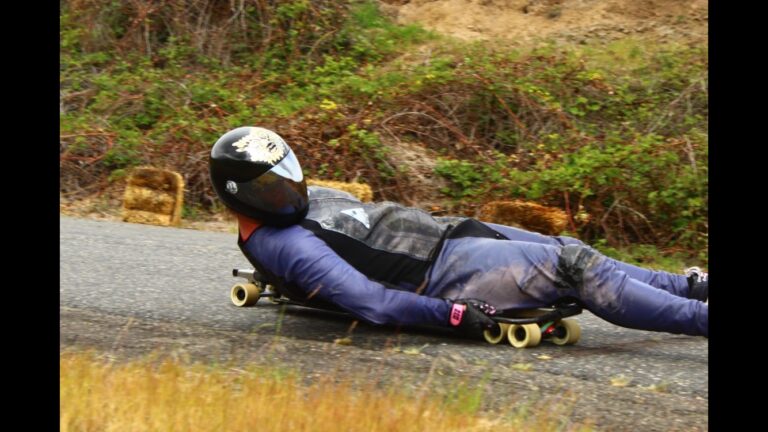
As the World Skate Games (WSG) makes its debut in Italy for 2024, a Salt Spring Island skateboarder will be representing Team Canada in the street luge event. 

Maxwell Kaye will join racers from 100 countries taking part in the multi-discipline “game of games” event; the Downhill Skateboarding and Street Luge World Championships portion will be held in Tortoreto, a coastal town in Italy’s Abruzzo region, with time trials on Friday, Sept. 20 and finals Saturday, Sept. 21, according to a World Skate bulletin. 

Kaye recently organized the 13th annual Salt Spring Slasher downhill skateboard event, which saw dozens of longboard skaters tackle the hill at Juniper Place over the Aug. 24-25 weekend. Kaye has joked that street luge is the “lowest form of racing” — with riders on their backs just centimetres off the pavement, at speeds in excess of 100 km/h. 

Reached by phone during training runs at the historic Maryhill Loops Road in Washington State, Kaye said he felt “blessed and honoured” he was getting the chance to compete in Italy, calling it a once-in-a-lifetime opportunity. 

“Honestly, I’m still kind of in awe that it’s happening,” said Kaye, who has been a longboard competitor for years and skated internationally.

After points were totalled from last year’s WSG in the Philippines, he said, and with how well Team Canada had done there, he received an early nod at the beginning of the year — but nothing official until this summer. 

“I was just kind of saving that money in case it actually was going to happen,” laughed Kaye, noting Team Canada does not contribute financially to help out the downhill skateboard racers — at least, not yet. 

But for this year there are four Canadian street lugers — one of whom, Kaye said, won the event in the Phillippines in 2023 — and a dozen downhill longboarders. And, he said, with Olympic committee members helping with the event, it bodes well for the sport. 

“It’s cool to have them working with it,” said Kaye, optimistically. “I mean, this is how street skating got into the Olympics.” 

Time zones notwithstanding, Kaye said the finals will likely be live-streamed.Visit worldskate.org to follow Team Canada at the event.  

Island man swims across Stuart Channel

0

If you’ve ever missed a ferry sailing from Vesuvius, you’ve probably thought about it, and wondered.  

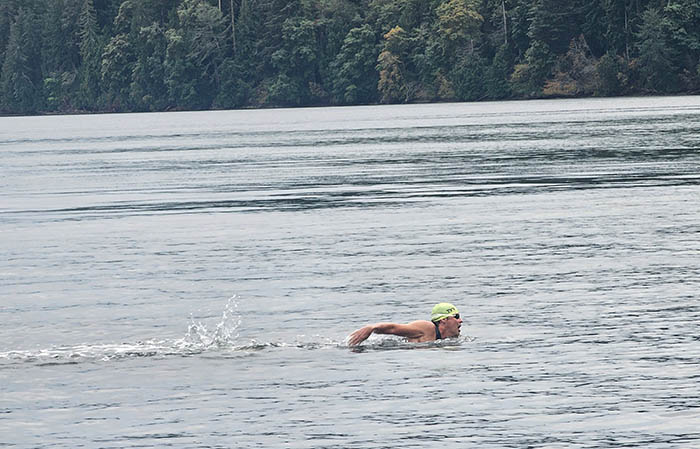
But on Saturday morning, Aug. 24, islander Chris Rowthorn skipped the lineup completely. Rowthorn, 58, walked into the ocean at Salt Spring Island’s Vesuvius Beach and started swimming a little before 8 a.m., emerging 90 minutes later at the shore of Osborne Bay Regional Park, south of the Crofton ferry terminal. 

It wasn’t a spur-of-the-moment decision, he said. Rowthorn had been making plans to swim from Salt Spring to Vancouver Island since well before he began earnestly training for the crossing back in March. A regular in the waters off Vesuvius Beach during spring and summer months, the former competitive swimmer said he had often paused on the rocky point and gazed across at the other side. 

“I thought that the nearest shore didn’t look all that far away,” he said, “and I became obsessed with swimming there one day.” 

Rowthorn’s workout routine this summer expanded to include daily one- to two-kilometre ocean swims, he said, and he consulted with fellow Vesuvius swimmer (and former sailing and sea kayaking instructor) Dave Garrett — a former kayak instructor and sailor — about the crossing. It looked doable, but there were unknowns. 

“I didn’t know how strong the currents would be, or how cold the water would be in the middle of the strait,” he said. “I also didn’t know what kind of waves I’d be facing.”  

When the day came, Rowthorn was supported in his 3.8-kilometre swim by friends Roland DeLuca, paddling alongside in a kayak, and Erich Billung-Meyer keeping pace in a powerboat. Rowthorn left just before the tide reached its high point, so most of the swim was done during the slack tide. And, he said, the otherwise gloomy weather fortunately featured “relatively warm” 17-degree water and calm winds.  

“I was prepared to take several breaks,” said Rowthorn, “and Roland was carrying a flask of hot tea for me. But I felt so good that I put my head down and just kept swimming.” 

In the first half of the crossing, Rowthorn said there were moments when it seemed like Vancouver Island wasn’t getting any closer; but once past the halfway mark, he found his stride. 

“I got into a really good rhythm,” said Rowthorn. “Roland and Erich’s boats were always in the corner of my eye, and I felt safe the whole way across.” 

Rowthorn said two boats crossed their paths during the swim, but gave the group a wide berth. Finally, a little before 9:30 a.m., DeLuca found a good spot for him to head to shore, and Rowthorn stepped out of the water and onto Vancouver Island. 

“It felt great to walk up onto the beach,” he said, crediting the support of his friends for a successful swim. “I wouldn’t even have attempted it without those guys.” 

At this point, Rowthorn said, he has no plans to repeat the crossing. 

“It’s a hell of a way to get to Crofton,” he laughed.

Record number of ArtSpring Presents shows on tap

Submitted by ARTSPRING

Addressing a keen audience last Thursday, executive and artistic director Howard Jang unveiled ArtSpring’s new 2024/25 season, a year he promises will be “one of the most culturally diverse, captivating and colourful yet” with a record 36 ArtSpring Presents performances from artists across B.C., Canada and the world.

Five luxurious Met Opera broadcasts, a few surprise concerts, and a never-before-seen exhibition of the private art and global artifact collection of Robert and Birgit Bateman round out this remarkably robust program.

Advance ticket sales got underway for members yesterday, with tickets going live online and to the general public Tuesday, Sept.10. ArtSpring welcomes back Island Savings Wealth Management as its season partner, with Country Grocer also receiving applause for its support of the $5 Youth Program, an initiative to help students and families with children access world-class performances more easily.

After a successful 25th-anniversary season, including the five-day community arts festival, a record-breaking Treasure Fair and ArtSpring achieving its million-dollar Endowment Fund goal in the 11th hour, the new season marks a fresh direction informed by community outreach.

“Last season, we consulted our patrons, our local artistic community, and the island population about our programming and our role,” said Jang. “We’ve been listening, engaging and looking to pilot some exciting new ideas, while continuing to celebrate the classic repertoire that has been our foundation.”

Choice and contrast was identified as the theme. A beautiful performance by young classical pianist/soprano Rachel Fenlon shares the season with Indigenous B.C. hip-hop sensation Snotty Nose Rez Kids. Shakespeare’s As You Like It gets a very radical retelling in the season opener, as does the fast-paced Juliet, A Revenge Comedy, yet string quartets Borealis and Penderecki keep music history and technique alive and well.

From presenting Dave Brubeck jazz to the Haitian afro-funk of Wesli, spoken word superstar Shane Koyczan to Ballet Victoria’s Frankenstein, stand-up comedian Julie Kim to the Banff Mountain Film Festival screening, ArtSpring is seeking to expand its genres and audience range.

“There is more for young people, more comedy and theatre, more fun,” said Kirsten Bolton, communications manager. “But in listening to older patrons’ concerns, we’ve also moved to many more afternoon concerts so that battling dark nights and bad weather isn’t an inhibitor to coming to a great show.”

ArtSpring’s Theatre Angel Program also received attention at the Aug. 29 launch event, with backers including Island Savings, Windsor Plywood, Salt Spring Foundation and individual donors being noted for their support. The stigma-free program puts 20 seats aside per ArtSpring Presents performance for only $15 to any community member facing economic barriers.

ArtSpring’s regular prices have not been increased.

Rooster noise nets $3,750 fine

0

A provincial court judge has fined Salt Spring resident Clinton McNichol $3,750 for contravening a Capital Regional District (CRD) noise bylaw due to keeping roosters on his Woodland Drive property.

Judge Christine Lowe set fines at $750 per offence in Aug. 30 sentencing — after determining in her judgement released the previous week that McNichol was guilty of the CRD noise bylaw infraction on five counts. Fines must be paid by Dec. 2. Lowe also ordered a one-year prohobition on roosters being kept on the property, beginning Sept. 6.

McNichol said Lowe commented that the fine was “intended to discourage other people in a similar situation.”

The bylaw in question requires animals be kept in a manner that does not disturb the  “quiet, peace, rest, enjoyment, comfort or convenience of other property owners in the vicinity.”

McNichol said he and his spouse Alia Elaraj used roosters for breeding heritage chickens, flock protection and other benefits.

According to redacted documents McNichol shared on social media in June of 2023, the CRD appeared willing to accept fines of $500 total for five offences, in exchange for McNichol agreeing not to keep roosters on the property. The case proceeded to court instead.

Since Lowe’s Aug. 22 judgement was released, next-door neighbour Isy Cohen, who was one of the witnesses in the CRD case who complained about rooster noise, has initiated a Change.org petition to gain support for a request for Islands Trust rezoning of Woodland Drive from Rural to Residential. Agricultural use is currently allowed on properties zoned Rural but not those with Residential zoning.

A GoFundMe page is still accepting donations to offset McNichol’s legal costs and now the fines.

Editorial: NSSWD decision provides balance

0

The board for Salt Spring’s largest water district might’ve just threaded several needles at once. 

There is an undeniable elegance on display as the North Salt Spring Waterworks District (NSSWD) begins the decision-making phase of what has been two years of moratorium review. First and obviously, the proposal to add hundreds of new connections to the Maxwell Lake side of its system over the next two years will certainly please anyone there who’s waiting on water to start building.  

The move will surely warm the hearts of those wanting to see more housing on the island, and the exhaustive nature of the supply studies involved should satisfy anyone worried there wasn’t enough water in the first place. 

But the district’s parallel monitor-and-report program — and a seeming willingness to throttle back new connections if data arises to support that action — should also soothe concerns from anyone thinking floodgates are being irrevocably opened.  

The plan to join the Maxwell Lake and St. Mary Lake sides of the system should delight those interested in redundancy and resilience. The completion of a new treatment plant at Maxwell Lake should gratify system users who prefer fewer trihalomethanes in their drinking water.  

And on that new plant, budget hawks bracing for their next tax levy can’t have missed that adding those 300 connections — at arguably five figures apiece, by the time all the pipes are hooked up — could have a helpful impact on how much ratepayers will wind up paying each year as they chip away at plant construction costs. 

Meanwhile, policy wonks who champion increasing density where it’s already dense should be happy to hear it’s the Ganges area where most new connections would be for now. And anyone who thinks there haven’t been enough studies is also in luck, because staff say more are being penciled in as we speak. 

You can’t please everyone, of course, but the impression we’re left with is one of district leadership working thoughtfully to balance the diverse, often-contradictory interests of our island community. That’s a superb place to start.  

Fulford-Ganges roadwork begins in earnest Monday

0

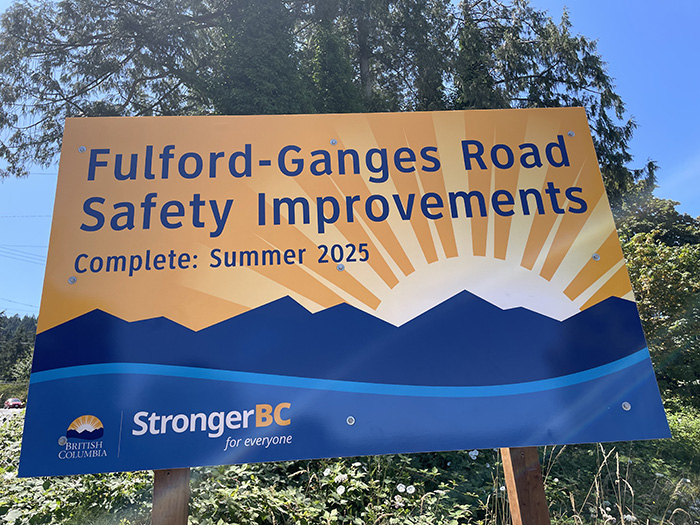
Crews set to start work on Salt Spring Island’s busiest route are already on-island, kicking off construction on Fulford-Ganges Road south of Ganges in earnest on Monday, Sept. 9. 

Environmental protection systems are being placed in advance of road work, according to Northridge Excavating Ltd. project manager Bob Mitchell, and drivers may have already seen some crew members out last week. Traffic control personnel will be on hand to guide alternating one-lane traffic on weekdays between 9 a.m. and 3 p.m., he added, after which Fulford-Ganges Road will largely be back to normal until work begins the next day. 

“You’ll see some road plates, there might be flashing barricades and in certain sections you’ll need to go slower,” said Mitchell. “But it’s all going to be well marked.” 

The 1.6-kilometre stretch of Fulford-Ganges Road from Seaview Avenue to Cranberry Road — known locally as Ganges Hill — will see both underground and surface work, expected to be completed by November 2025, according to a public notice from Northridge. Ministry of Transportation and Infrastructure (MoTI) officials have said the Vancouver Island-based contractors will be resurfacing and widening the road as part of the $22.9-million project, with improvements including paved shoulders for pedestrians and cyclists — a 1.2-metre-wide shoulder heading north (or downhill into Ganges) and 1.8 metres in the southbound direction, as well as pedestrian crossings and refuge areas. 

Mitchell said his team would work toward keeping traffic disruptions over the coming months well under the 20-minute delays ministry officials warned of early in project planning, and that they would be in close communication with people living along the route — particularly when there might be the potential for disruption on the roadway in front of them. 

“We’re going to be sensitive to people’s needs,” said Mitchell, “especially as everyone starts to get into the flow of things. We’ll be out visiting with people well in advance.” 

The company works on Salt Spring often, Mitchell said. A local excavator was out with his machine last week and Mitchell said they plan to continue to make use of local services. Planners have been in communication with groups such as BC Transit and emergency services, to ensure disruption for those users is minimal. Gulf Islands School District director of operations Colin Whyte said Northridge had been in “very recent” contact with the district, and given the planned road work hours he anticipated minimal delays for school buses. 

“We’re certainly watching it very closely,” said Whyte. “If we need to make adjustments, we’ll send out notices to parents and students, to make sure we are doing everything we can to get everybody to school — and home — on time.” 

Opinion: CRD bylaw changes could protect agriculture

1

NOTE: This article represents the personal opinions of Brian Webster and not those of Salt Spring Island’s Local Community Commission (of which he is a member) or the Capital Regional District.

By BRIAN WEBSTER

It’s not new to see conflict between agriculture and neighbours who want a rural lifestyle without the sounds and smells of farming. It’s happened on Salt Spring Island before and in other B.C. communities. It seems everyone wants farmers to farm, but some want it to happen only if it doesn’t disturb their peace and quiet.

Salt Spring is a rural community with a long history of farming. This is reflected in our official community plan, which recognizes “agriculture’s contribution to the island’s social, economic and environmental nature and appeal.” That plan’s objectives include retaining and building on the island’s agricultural base and supporting “farming as a social, cultural and economic priority.”

Our OCP sets out a policy that “farming activities and necessary structures should continue to be allowed by zoning . . . on all properties where they are currently allowed.” As a result, Salt Spring’s zoning regulations permit agriculture on properties in numerous zones, including those zoned Rural, Rural Upland, Rural Watershed and others, in addition to zones designated as Agricultural.

As of 2017, 2,855 hectares of Salt Spring (17 per cent of the island) was within the province’s Agricultural Land Reserve (ALR) and another 3,359 hectares outside the ALR were considered actual or potential farmland. Combined, these two areas include 36 per cent of Salt Spring.

There are zones on Salt Spring where agriculture as a principal use is not permitted, including most of those categorized as Residential. As a result, people who don’t want to live near farming have options. However, those who choose to live in zones where farming is permitted need to be prepared for the possibility that their neighbours will farm.

THE NATURE OF FARMING

While every farm is unique, most farming takes place outside and commonly involves the use of equipment and/or the keeping of animals, both of which may create sound, odours or other “nuisances.”

As urban growth encroached on farmland in many areas of B.C., especially during the latter half of the last century, some non-farmer residents in areas with agriculture pressed for their local governments to prohibit farm-related “nuisances.” This pressure led to concerns that the long-term survival of agriculture and local food was coming under threat, leading the province to bring in a law to protect farming.

B.C.’s RIGHT TO FARM ACT

The Farm Practices Protection (Right to Farm) Act took effect in 1996. It says that a farmer may not be prevented from carrying out “normal farm practices” as defined by the province.

However, the act has been applied unevenly. For farms located within the ALR, the act prevents anyone (individual or local government) from stopping normal farm practices. But if the farm is outside the ALR, the act only prevents individuals from suing a farmer for “nuisances” resulting from normal farming practices; it leaves local governments with discretion around their nuisance bylaws.

The result: farming on Salt Spring properties within the ALR is exempt from the CRD noise bylaw, but farms outside the ALR are not. For a community in the unusual position of having most of its potential farmland outside the ALR, this is a problem.

Salt Spring is further challenged by the small scale of local farming. For example, the average flock size of conventional poultry producers in B.C. is more than 22,000 hens. On Salt Spring, the vast majority of poultry farmers have fewer than 50 birds.

If we — and CRD bylaw enforcement — look to mainstream agriculture for our understanding of farming, we’re going to have trouble understanding the challenges of Salt Spring farming. Likewise, the tendency of some to dismiss small-scale agriculture as “hobby farms” undeserving of protection is particularly problematic on our island, as the vast majority of our island’s roughly 200 farms are part-time enterprises.

THE SALT SPRING NOISE AND ANIMAL CONTROL BYLAWS

CRD Bylaw No. 3384 covers Salt Spring. It prohibits “any noise or sound in the Electoral Area which creates a noise that disturbs or tends to disturb the quiet, peace, rest, enjoyment, comfort or convenience of the neighbourhood or of persons at or near the source of such noise or sound.”

The bylaw exempts certain activities, including “the noise associated with legitimate farm operations.” However, the exemption only applies if “all reasonable measures have been taken to abate noise.” This empowers CRD staff to determine what abatement measures are reasonable and to force farmers outside the ALR to implement them, even if they go against normal farm practices.

As a result, some small-scale poultry producers who live outside the ALR but still in areas where agriculture is permitted have been told to get rid of their roosters or face enforcement action.

Salt Spring is also covered by CRD Bylaw No. 1465, which prohibits keeping an animal that “disturbs or tends to disturb the quiet, peace, rest, enjoyment comfort or convenience of the neighbourhood . . . .” This provision has one exemption: “except in an Agricultural Zone.”

However, the bylaw does not define an “Agricultural Zone” and CRD staff have interpreted this to mean only lots zoned A1 or A2, even though properties in numerous other zones have the same ability to farm under our zoning bylaw as do lots zoned A1 or A2.

A PATH FORWARD

As a result of all this, Salt Spring’s current noise and animal control bylaws are preventing some small-scale farmers located outside the ALR from carrying out normal farm practices on land zoned for agriculture. Others have carried on, but fear that one cranky neighbour could one day force them to stop farming. Some small-scale farmers considering a move to Salt Spring have hesitated as they are unsure whether farming is welcome here anymore.

Recent action against small-scale farmers raises the spectre of growing limits on farming outside the ALR. Today it’s roosters; tomorrow, who knows?

But a straightforward solution is possible. Common-sense clarifications to definitions in CRD bylaws 1465 and 3384, plus one substantive change to the noise bylaw could eliminate the problem.

First, the terms “agriculture zone” and “land zoned for agriculture use” could be interpreted — through a Salt Spring-specific CRD policy — to mean a zone where zoning permits agriculture as a principal use.

Second, consistent with the Farm Practices Protection (Right to Farm) Act, the bylaws could define farming as “growing, producing, raising or keeping animals or plants, among other activities.” Where normal farming activities are being legally carried out as a business, they could be considered “legitimate farm operations,” regardless of the size of the lot or the scale of the operation.

And finally, Section 4 (5) of the Salt Spring noise bylaw could be replaced with the following exemption:

(5) On a lot where agriculture is a permitted use, conducting legitimate farm operations.

These simple changes would protect small-scale farming while continuing to shield residents living on the 64 per cent of Salt Spring that does not permit farming from noise and other farming-related nuisances.

A solution is available, but does our community have the will to demand it?

Endurance regatta a ‘massive success’

Salt Spring Island increased its rowing sport profile recently when it hosted an exciting Race Around the Rock Coastal Endurance Regatta.

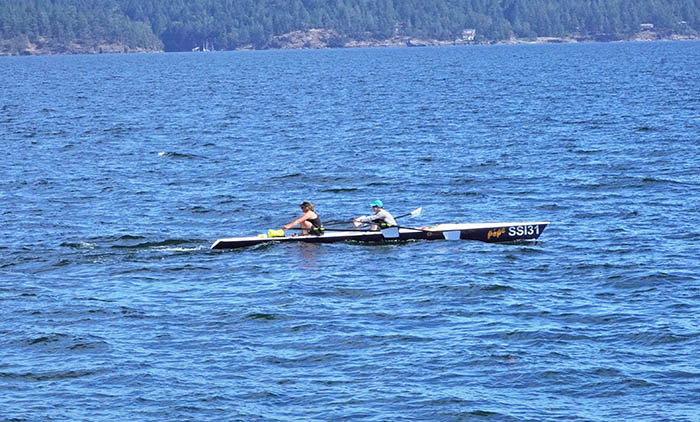
According to organizing committee chair Zoë Clarke, the regatta saw 61 participants from eight rowing clubs row all the way around Salt Spring Island — a total of 88 kilometres — on Aug. 25, with both quads and doubles hitting the water. Rowers began at Drummond Park in Fulford Harbour, travelling up the west side of the island and back to Fulford Harbour.

Rowing club registrants came from more than 10 countries, said Clarke, but rowed for the U.S., False Creek, Gorge Narrows, Edmonton, Open Aviron Coastal Rowing Association (Victoria) and Salt Spring Island clubs.

Clarke said two quads featured LGBTQIA+ athletes, one was an all-female quad and the remaining boats were of mixed genders. Rowers’ age range was from 15 to 78 years old. 

Seven rowers from the False Creek club won the race in a time of 7 hours, 55 minutes and 9.56 seconds.

A pre-race dinner serving 150 people was also held the night before, with safety boat drivers, umpires, volunteers, athletes, family/friends and honoured guests attending.

Clarke said the club collected more than 15 sponsors and six event partners, and even made a small profit for the first time in the event’s history.

“This was a massive success for our club and our island, and cultivated momentum for not only coastal rowing on Salt Spring but also as a sport,” said Clarke.

World-class flamenco performance at ArtSpring

SUBMITTED BY CARAVAN WORLD RHYTHMS

On Sunday, Sept. 15 at ArtSpring’s theatre, Caravan World Rhythms presents an intimate evening of fiery and refined flamenco music and dance, deeply infused with Indian flavours, featuring award-winning international artists.

Those include flautist and bansuri player Lara Wong and flamenco guitarist Melón Jiménez, joined by acclaimed dancer from Bordeaux, France — Deborah “La Caramelita” Dawson — and Italian percussionist Davide Sampaolo.

According to CBC Radio, “The result is stunning; it is fluid, it is sensual and fully embodies the spirit of flamenco: virtuosity and passion.”

Wong and Jiménez redefine flamenco by blending the fiery art form with jazz, Indian music and contemporary global folk. In their new show, called Confluencias, they team up with percussionist Sampaolo and La Caramelita to present dazzling flamenco guitar riffs, mystical bansuri melodies, percussive footwork and entrancing global rhythms in a truly singular musical voyage.

Melón and Wong first met on stage in 2018 in the flamenco jazz capital of Madrid. They have since performed together across Europe, Asia and North America at a variety of venues and prestigious festivals.

Originally from Vancouver but based in Spain for nearly a decade, Wong is a distinctive and now well-recognized musical voice who studied flamenco in Andalusia after completing her degree in classical and jazz performance at McGill University. She is best known for playing flamenco music on the Indian bansuri flute. In 2021, she won a “Filon” award for best flamenco instrumentalist of the Festival Cante de las Minas, making her the first foreigner to win in any category of the festival’s 60-year history.

Jiménez first extensively explored the intersections of flamenco and classical Indian music as a member of Anoushka Shankar’s Traveller Band in 2013. Born into a musically and culturally diverse family, he was encouraged to learn the music of his Andalusian gitano (Spanish Roma) roots and to use the flamenco guitar as a doorway to innovation.

La Caramelita has enchanted international audiences for over 15 years with her unique dance style, with moves inspired by the passion, power and sensuality of flamenco and her Indian heritage. The versatility of this young dancer has led her to collaborate with renowned artists in many events around the world. She began her flamenco journey in Vancouver, but her passion led her to Andalusia, Spain, where she studied with some of the top flamenco dance teachers, such as Juana Amaya and Manuel Liñán.

The Sept. 15 show begins at 7:30 p.m., with tickets available through ArtSpring.

Deborah “La Caramelita” Dawson, a flamenco dancer based in Bordeaux, France who will be part of the Confluencias show at ArtSpring on Sept. 15.

Adam Olsen tribute planned

0

A Salt Spring Island gathering to honour the career and accomplishments of outgoing Saanich North and the Islands MLA Adam Olsen is planned for Friday, Sept. 13. 

Known for his approachability and coalition-building — and for many passionate speeches delivered in the legislature — the two-term BC Green Party MLA took office after an election win in 2017, followed by another in 2020; he announced in June he would not seek re-election, calling the decision an “existential re-evaluation” of what was important to him and citing the best interests of his family. 

The event is set for 1 to 3 p.m. at Lions Hall. Organizers said there will be light finger food and refreshments, a cake and a musical farewell tribute by Bill Henderson.

Saanich-Gulf Islands MP and Green Party of Canada leader Elizabeth May is expected to be in attendance. She will also meet with constituents at Gulf Islands Secondary School that evening from 7 to 8:30 p.m., where she will provide a report on her activities and federal political happenings, and answer attendees’ questions.