
Home Blog Page 115

In Response: Rhetorical sleight of hand

0

By ROBERT WALKER

An Aug. 21 opinion column by Anthony Issa, a Montreal-based writer of Canadians for Justice & Peace in the Middle East (CJPME), is an historically ignorant screed that takes a hacksaw to any semblance of factual accuracy.

Issa’s column entitled: “History and beliefs distorted,” is a response to a previous commentary in the newspaper, and his column attempts to convince readers that the history of the Palestinians stretches back not decades, but millennia. How he seeks to do this is with little more than by rhetorical sleight of hand.

Issa states that the earliest recorded use of the term “Peleset” was from 3,000 years ago, and found in Egyptian hieroglyphics, but this is a complete red herring. The term ‘Palestine’ referred to a general geographic area, where the inhabitants were not Muslims, nor Arabic speaking, and had zero connection to the group self-identifying today as Palestinians. 

In sharp contrast, the modern state of Israel is the land where for 3,000 years of uninterrupted history, the Jewish people have lived in their ancestral and historic homeland, and where archaeology is regularly adding to incredible richness showing 3,000 years of Jewish habitation in the land of Israel.

But for Issa, irrelevant etymology is more important than actual history, writing off the Jews’ three millennia of ongoing presence in their land as a “colonial” enterprise and “biblical stories.”

With these words, Issa is demonstrating either a profound ignorance or deception, given that in no way, shape or form is Israel colonial, but in fact, the epitome of anti-colonial: an indigenous people achieving self-determination in their own land, and one need not believe a single word of the Bible to recognize the veritable mountain of literary, archaeological and other evidence to recognize the indisputable reality of the Jewish presence in their homeland.

That is not to say that there is no colonialism in the Middle East; far from it. The spread of Islam and Arabic throughout the region did not simply take place organically; it is the result of military conquest and expansion, and cultural imperialism spread primarily through the sword.

Not all of Issa’s disinformation is an attempt to rewrite ancient history; he also shows a profound hostility to contemporary reality, writing that “The UN Partition Plan of 1947, although never fully realized, recognized the Palestinian people’s right to statehood, a right that continues to be obstructed primarily by the ongoing occupation of Israel and international reluctance on the issue.”

This is a blatant falsehood. The UN Partition Plan of 1947 was outright rejected by Arab parties, and accepted by Israel. Furthermore, once Israel declared its independence the following year, it was invaded by its Arab neighbours in an attempt to annihilate the newly reborn country. And Israel still offered to give up parts of its own land for the creation of another Arab state in both 2000 and 2008, both times for it to be rejected.

Three times in his column, Issa accuses those who dare to question pro-Palestinian orthodoxies as peddling racism against “a marginalized community.” It is no surprise that Issa opts to follow this tactic, given that seeking to erase three thousand years of Jewish history is a fool’s errand that has been attempted by empires stretching back to the Romans, Greeks and others, all of whom have failed.

Anthony Issa’s column is not only a slap in the face to historical accuracy, it is an insult to the intelligence of readers.

The writer is assistant director for HonestReporting Canada, a non-profit organization dedicated to ensuring fairness and accuracy in Canadian media reporting on Israel.

NSSWD votes to slowly ease hook-up moratorium

0

Editor’s note: This story elaborates on an original breaking news post from Aug. 29.

Ten years after bringing new connections to a halt, Salt Spring Island’s largest water district is gently lifting its foot off the brakes. 

The North Salt Spring Waterworks District (NSSWD) board of trustees voted Thursday, Aug. 29 to propose adding the water-draw equivalent of as many as 300 multi-family dwelling connections — although on only the south side of the district, at least for now. 

NSSWD’s infrastructure comprises two separate water systems, which get supply from two lakes — Maxwell and St. Mary — serving what the district said is currently 1,856 water connections and approximately 5,500 users. After an extensive new supply reliability assessment, consultants and district staff found the latest advanced climate models supported adding more connections on the Maxwell Lake side. 

Noting the numerous reliability reports that had been done in the past decade, NSSWD board chair Brian Pyper emphasized how the latest distinguished itself — comprehensive, he said, district-wide, and heavy on the science. 

“We’re talking about [analysis] across numerous global circulation models, as opposed to the simplistic approaches that were previously used,” said Pyper. “The future water supply in our current study was assessed using monthly temperature and precipitation projections all the way up to the year 2100, across an ensemble of six global circulation models. This is getting us really close to the best available science, and recognized approaches to tackling this kind of issue.” 

Despite the upcoming weir-raising on St. Mary Lake at Duck Creek — a $10-million project funded by the province — those models also indicated that the northern section of NSSWD’s system will be hard-pressed to support its existing connection commitments with high reliability every year — at least, on its own. 

So trustees Thursday also conditionally approved a plan to connect the north to the south, through an upgrade on the Crofton Pump Station across from Country Grocer. That would join them into one large water system, with a target completion of the end of 2026, and would require completing the planned dissolved air flotation (DAF) plant for the Maxwell Lake system and aligning the two lakes’ water treatment.  

Island Health has mandated that plant be built as part of an effort to remove more of Maxwell Lake’s organic matter, which reacts with chlorine treatment to create trihalomethanes (THMs) such as chloroform and bromodichloromethane. St. Mary Lake already has a DAF plant. The cost for that new Maxwell Lake system — and interest on any required borrowing to complete it — is significant and would be borne by ratepayers, although it could be partially offset by money collected on new connection fees.  

Once linked, according to NSSWD CAO Mark Boysen, the combined system would be more resilient and adaptable to shifting climate patterns, population growth and use changes the island could see in the coming decades.  

That two-lake team-up is part of a suite of proposed system improvements, which include some that could boost water supply across the district: exploring an increase in diversion flows from Rippon Creek into Maxwell Lake, and — after significant study and senior government approval — reducing the environmental flow requirements for fish-spawning purposes at Duck Creek. 

The broader implications of new water connections on Salt Spring Island were not lost upon NSSWD’s board and staff, who noted the new projections of supply availability in the Maxwell Lake system could help ameliorate the housing crisis, particularly in Ganges. A 2022 Capital Regional District (CRD) study indicated an immediate need at that time of roughly 300 housing units, notably the same number of new connections proposed. 

Water availability has been a stumbling block for affordable housing projects within the NSSWD in the last 10 years, as they need to prove secure water availability in order to proceed. The Islands Trust Policy Statement also explicitly requires Local Trust Committees curtail new density in areas where freshwater supply is “likely to be inadequate or unsustainable.”  

New connection requests will still have to meet all Islands Trust zoning and CRD building permit requirements, according to staff. 

NSSWD trustees and staff also plan to roll out a new quarterly public reporting process, where any new connections and system capacity would be carefully monitored over the coming months, as well as an updated series of studies in 2027 to confirm the effects of both new connections and system upgrades. 

In the meantime, the moratorium on new connections for the St. Mary Lake side will remain in place, and the district will launch a public engagement process this fall for feedback from ratepayers and residents, as well as a legal review of the proposed policy change in November.  

“We’ll also be communicating with our partners,” said Boysen, “because this is a significant change to the island. So we’ll be working with the province, the Islands Trust and the CRD to make sure that they are informed about the ramifications of this potential change — and get feedback from them as a part of the process.” 

A final revision to the moratorium policy could be presented to the board as soon as December. For more information visit northsaltspringwaterworks.ca/moratorium-review

Campfire prohibition lifted; other fires remain banned

0

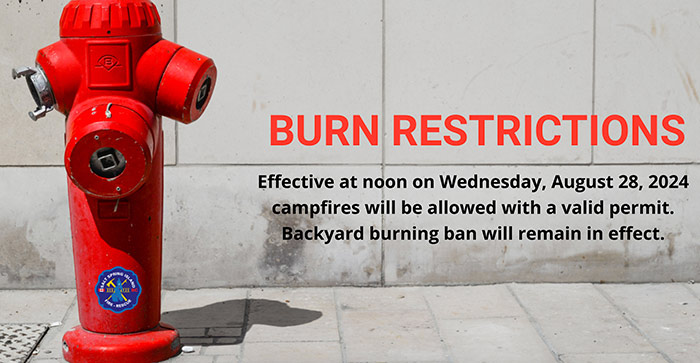
After a nearly summer-long ban, the prohibition on campfires was lifted at noon on Wednesday, Aug. 28 — although fire officials still urge extreme caution. 

Campfires have been prohibited throughout the Gulf Islands and within the entire Coastal Fire Centre region since July 12; Category 2 and Category 3 open fires remain banned, including the use of fireworks, sky lanterns, binary exploding targets, burn barrels, burn cages and air curtain burners, officials said. Those restrictions are expected to remain in place until Oct. 31, unless conditions warrant rescinding the ban sooner. 

Although the fire danger has declined in the Coastal Fire Centre due to recent rainfall and cooler, more seasonal temperatures, the public is strongly encouraged to continue exercising extreme caution with any campfire, according to the BC Wildfire Service; before lighting any fire, they added, check with local government authorities to see if any local burning restrictions are in place. 

Campfires in B.C. are generally defined as smaller than a half-metre high and wide. Anyone who lights, fuels or uses an open fire when a fire prohibition is in place or fails to comply with an open fire prohibition may be issued a ticket for $1,150 or, if convicted in court, be fined up to $100,000 and/or sentenced to one year in jail. If the contravention causes or contributes to a wildfire, the person responsible may be subject to a penalty of up to $100,000 and ordered to pay all firefighting and associated costs, according to the Coastal Fire Centre.    

For the latest information on current wildfire activity, burning restrictions, road closures and air quality advisories, visit bcwildfire.ca. The saltspringfire.com website has more local information, including a “cheat sheet” describing restrictions related to high-risk activities such as chainsawing and mechanical land clearing. 

Truck hits Windsor Plywood fence

0

While it was easy for people to make jokes about “door crasher sales” and the like on social media when a truck crashed into Windsor Plywood’s fence in the early hours of Sunday morning, the effects were serious.

According to Salt Spring RCMP Corp. Steven Davidson, RCMP were called to a report of a collision at 166 Rainbow Road at approximately 3:05 a.m. on Sunday, Aug. 25.

“On attendance it was discovered that the collision occurred when a pickup truck collided with a parked vehicle and then into the fence at Windsor Plywood. Subsequent to the collision, the driver was investigated for impaired driving and was processed under the Provincial Immediate Roadside Prohibition program. There were no injuries to the driver or the passenger.”

A power pole was also damaged, affecting Windsor’s electrical service.

“Monday we didn’t have enough power to have the store open to public,” said store co-owner and assistant manager Jess Harkema. “We had two terminals running and dim light inside, so staff were picking orders for customers. On Monday afternoon, George Horel’s bobcat service put in our new power pole and on Monday evening in the terrible rain Motherwell Accents Electrical was here reconnecting our power.”

Store operations were back to normal on Tuesday.

“Hats off to the fire department for doing a great job securing our fence and property, along with our staff and customers, who keep supporting us no matter what happens,” said Harkema.

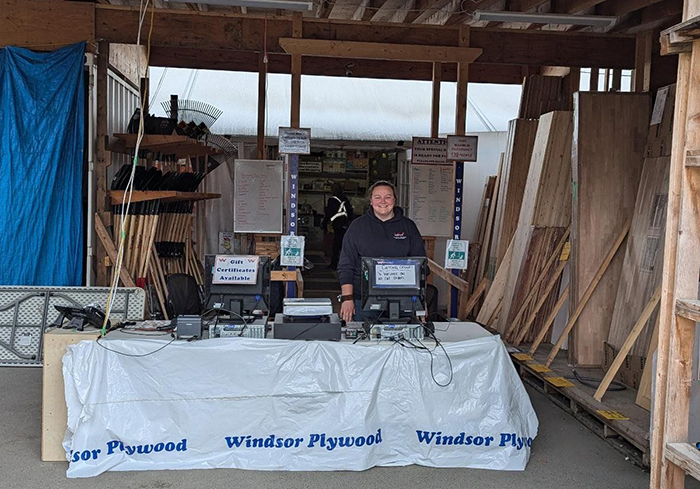
Windsor Plywood Salt Spring co-owner/assistant manager Jess Harkema at a table set up to handle transactions on Monday when the store’s electrical service was impaired due to power pole damage suffered in an overnight Saturday-Sunday vehicle crash. Services were back to normal on Tuesday. (Photo courtesy Windsor Plywood)

Birney and Grittani play at All Saints

SUBMITTED BY MUSIC MAKERS

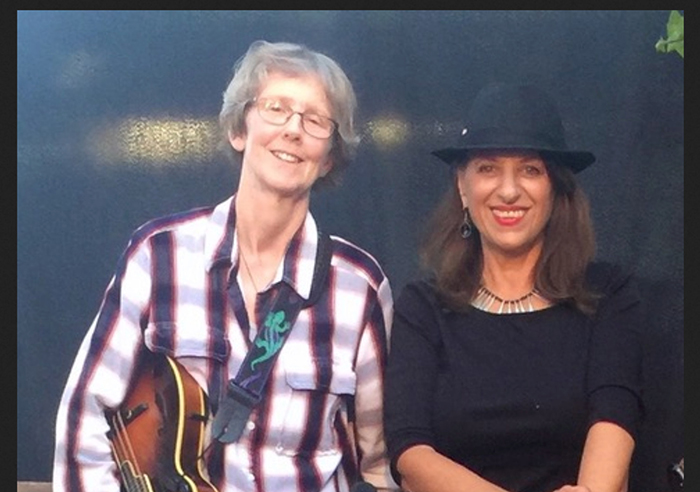
The Music Makers group welcomes long-time Salt Spring residents Marianne Grittani and Rose Birney back to the Tea à Tempo stage for an afternoon of music on Wednesday, Sept. 4 at All Saints by-the-Sea.

Grittani, a singer-songwriter and West Coast Music Award nominee, has been making music for more than 50 years, 20 of those here on Salt Spring Island. When she was here originally in the ‘70s, Valdy recognized her as a fellow folk artist and encouraged her to perform her own songs. They toured the Gulf Islands and Vancouver Island together for many years, along with Kathy Stack and other Island musicians. She returned to Salt Spring in 2013, after 35 years based in Vancouver, and picked up right where she left off, but with that many more years of experience developing her songwriting and performance skills.

Grittani is known now for her warm, engaging stage presence and thoughtful, compelling songs. She was influenced early in her teenage life by artists like Joni Mitchell, Gordon Lightfoot, Tom Rush, Carole King, John Prine and so many more. She is now a seasoned songwriter in her own right, whose musical personality is deep and wide, ranging from swing-era toe-tapping tunes to intimate personal journeys. Grittani knows how to take her audience deep into her storylines with her soulful vocals. Her well-crafted songs explore common themes like love, loss, home, the road, hopes for humanity and more — all in a way uniquely her own. To see her live is to become a fan. 

Birney is a two-time songwriting delegate to the B.C. Festival of the Arts and winner of the North Island Talent Search in the acoustic group category. Birney has played most of the festivals on Vancouver Island, as well as the CBC’s Madly Off In All Directions show, with her many groups from Victoria. Birney brings a lot to the table with her versatility on harmonica, mandolin and harmony — not to mention her humour!

The two musicians met on the dance floor at Moby’s Pub in November 2016. They were introduced by a mutual friend, who said, “You two should know each other.” They got together the following Thursday to play and they’ve been making beautiful music together ever since. 

The Sept. 4 concert begins at 2:10 p.m.

Haysom presses Green nomination case

0

Amy Haysom isn’t ready to give up on becoming the local BC Green Party candidate in this fall’s provincial election.

The Salt Spring Islander who felt confident about her chances of being chosen by Saanich North and the Islands Green party members was left confused and frustrated after her name was removed from the ballot just hours before online voting commenced on Aug. 2.

As reported in last week’s Driftwood, after being unsatisfied with the explanation given for her removal, and noting irregularities with the process of her disqualification, Haysom launched a petition to press for another vote and has continued to publicize her experience, which she says points to irregularities in the party’s stated process. A number of signatories describe themselves as Green party members or supporters.

“I would say you’ve got a lot of livid people,” Haysom said on Monday. “I think this points to a bigger concern around internal party politics. So if we really are a democratic system, and particularly in a nomination contest, where a vetting process has already been completed . . . I mean, they won’t even highlight who made the decision, what the reason was, and it’s very non-transparent. In terms of a party that highlights participatory democracy as one of their core principles, that did not happen here.”

Haysom said she was contacted by BC Green Party returning officer Rylee Maclean on Aug. 2, the date of the vote, which had already been delayed by one day “due to technical difficulties,” and asked to withdraw from the race.

Maclean and Alex Brunke, party provincial field manager, indicated in a Zoom call that evening that the problem arose from an undisclosed person having a work-related “grudge” against her. Despite having successfully passed a thorough vetting process, where she disclosed a contract issue from when she taught some classes at Salt Spring Centre School, the returning officer said “new information” had been received about that situation.

No further details were shared, with confidentiality rules cited as the reason.

Green party officials said in an Aug. 12 statement that the actual complaint about Haysom was not investigated.

“The party is not an arbiter of whether background issues or concerns are objectively true or not . . . it is a confidential decision by the party as to who it wishes to move forward with in the upcoming election.”

But Haysom points out that BC Green Party bylaws state that “any complaint about a nomination contestant needs to be filed by a Green party member in good standing or another contestant, that it needs to be filed in written form, and that it needs to be investigated by the returning officer.”

She requested an investigation, but that did not occur. She also requested use of a 48-hour appeals process provision, but the vote proceeded less than an hour after she was disqualified, so no chance for an appeal was offered.

“I want to say it again: we were vetted. It was a very complete process. I mean, they were asking details about work history, about sexting, all kinds of things. So you have a very open vetting process that went on for about a week, and then they put three of us forward. And so it just seems so suspect that after two weeks of campaigning, nothing came forward until the last day.”

“The whole thing is very stinky,” she added.

Haysom said she has filed a complaint with Elections BC, highlighting the procedural breaches, and will proceed with an injunction next week if the party does not respond.

Salt Spring resident Dennis Lucarelli is one petition signatory who supported Haysom’s candidacy.

He said, “The mystery around the BC Green Party’s disqualifying Amy Haysom from the ballot, in which party members would choose their candidate, reminds me of one of those elite private ‘country clubs’ that don’t explain to applicants why they are being rejected. So I am no longer comfortable to vote for any BC Green candidate.”

When the Driftwood contacted BC Green Caucus press secretary JoJo Beattie to provide a response or update on this issue, she referred the query to John Kidder of the Green Party of Canada’s Federal Council. Kidder is also Saanich-Gulf Islands Green MP Elizabeth May’s husband. Neither Kidder nor May were able to respond to the Driftwood before Monday’s press deadline. May’s name had also appeared on the petition, but despite expressing support for Haysom’s situation, Haysom was assured by May that she did not add her name herself.

Haysom said she has received expressions of support from Green party members across Canada, including Quebec Green party leader Alex Tyrrell.

“He said, ‘You know, Amy, there’s a silver lining.’ He said, ‘None of us knew who Amy Haysom was a couple of weeks ago, but now we all do.’”

Robert Botterell was chosen as the riding’s candidate for this fall’s provincial election in the vote that occurred without Haysom on Aug. 2, with the result announced on Aug. 6.

When the courts turn their backs on farmers

0

By ELSIE BORN

In a decision that has left many of us in the farming community stunned and disheartened, we recently lost a court case that will have far-reaching implications for anyone trying to make an honest living off the land.

This ruling is more than just a legal defeat; it’s a message to every farmer that our struggles and sacrifices mean little in the eyes of those who hold the power.

For years, we’ve heard rhetoric about the importance of local agriculture, of supporting farmers who provide food for our tables and care for the land that sustains us all. But when push came to shove, and our right to farm was challenged by those who find our way of life inconvenient, the court decided that we were the ones who had to change, not the people who lived next door and didn’t like the sounds, smells and realities of rural life.

This case was more than just a dispute over a few noisy animals or the occasional odour that drifts on the breeze. It was a test of whether farming could survive in a world increasingly hostile to the very things that make it possible. And let’s be clear — this was a benchmark case. The precedent set here is one that every farmer in this region, and beyond, should be worried about.

If you’re trying to farm, and your neighbours don’t like it, prepare yourself to make sacrifices — big ones. Because, as this ruling shows, there’s little to no support for you or your farm. Your livelihood, your way of life, and the food you produce are all secondary to the comfort of those who don’t understand, or don’t care, about what it takes to keep a farm running.

We didn’t just lose a court case; we lost a piece of our identity. Farming is not just a job; it’s a calling, a commitment to the land and future generations. But what happens when that calling is drowned out by the complaints of those who see farmland as nothing more than an extension of their own backyards?

This isn’t just about us. It’s about every farmer who wakes up before dawn, who works through long days and uncertain seasons. A farmer who fights to keep their farm afloat in the face of rising costs, changing regulations, and now, unsympathetic courts. We’ve been told to adapt, to modernize, to be more efficient. But now we’re being told to do the impossible — to farm without the very things that make farming possible.

The court may have spoken, but we can’t afford to remain silent. This ruling has put every farm at risk, and it’s time to ask ourselves what kind of community we want to be. Are we going to stand by and watch as farmers are pushed off their land, or are we going to fight for the right to farm, to live, and to work in a way that sustains us all?

The loss is bitter, and the future feels uncertain. But one thing is clear: if we don’t stand up now, there won’t be much left to fight for later.

If you want to be part of the dialogue or lend your support, consider attending the open house that the Salt Spring Local Community Commission is planning for September (date yet to be confirmed). For those passionate about bolstering our local food systems, writing to the Islands Trust and CRD can make a difference. And if you’re in a position to help, please think about donating to Alia and CJ. This has been an immensely costly and challenging experience for them and their family. Sentencing is slated for Friday, Aug. 30, with the CRD seeking an additional $7,000 in fines. You can contribute at gofund.me/e1d74fdc. Every bit of support counts.

This message is endorsed by the agriculture committee of the Salt Spring Island Farmers’ Institute.

The writer is president of the Salt Spring Island Poultry Club.

Judge rules against rooster noise

4

A provincial court judge has found a Salt Spring Island rooster owner guilty on five counts of violating a Capital Regional District (CRD) bylaw related to livestock and noise. 

Clinton McNichol had been charged with keeping livestock — one to three roosters — on his 0.92-acre Woodland Drive property, contrary to a CRD bylaw requiring animals be kept in a manner that does not disturb the  “quiet, peace, rest, enjoyment, comfort or convenience of other property owners in the vicinity.” Seven CRD bylaw infraction tickets were written in November and December of 2022, with two later withdrawn.

While Judge Christine Lowe’s reasons for judgement have not yet been published, both McNichol and next-door neighbour Isy Cohen, who was a witness in the case, shared the Aug. 22 outcome with the Driftwood. If McNichol’s property had been determined to be a farm, or in one of Salt Spring’s Islands Trust agricultural zones, the outcome would likely have been different. But the property is in a “rural” zone of similar-sized lots, and a B.C. Farm Industry Review Board ruling had determined the property was not a farm due to its income level and not subject to the province’s Right to Farm Act.

“Non-intensive agriculture” is a permitted use in the rural zone, however.

McNichol and his spouse Alia Elaraj, who breeds heritage chickens to sell, will be prohibited from having roosters on their land, which they moved to in the fall of 2020, for a period of one year. The judge will dispense fines and any other sentence conditions on Aug. 30.

Both McNichol and Cohen said that despite numerous recordings of the noise presented to the judge by the CRD, the decibel level was deemed not relevant.

“In our case, the judge threw out objectivity, and said while she appreciated the CRD took noise readings, they aren’t applicable. If two complainants say they are aggrieved, that is ‘believable and reasonable,’” McNichol said, quoting the judge. 

Cohen has lived on the neighbouring property — which is about 0.8 of an acre in size — since 2006 and worked as a nurse at Lady Minto Hospital and in community health care since that time.

“Initially, the whole issue was about noise — the bylaw being contravened between 11 o’clock at night and seven in the morning — where the rooster was crowing from two in the morning and onwards, and I wouldn’t be able to sleep.”

Cohen said he would have to cancel shifts at work because he didn’t feel he could safely care for people without adequate sleep. Daytime crowing was also a problem when he worked night shifts at the hospital and then wouldn’t be able to sleep during the day.

He and the neighbour on the other side of the property tried to discuss the issue with McNichol, with various mitigation suggestions made by all parties. While the main coop was eventually moved from being only five feet away from the property line, Cohen said, it had little impact on mitigating the noise for him and made things worse for the other neighbour, who also provided their experience for the CRD case.

Cohen said he first contacted the CRD in June of 2021 just to find out what his rights were, but a CRD bylaw officer ended up visiting the McNichol property and issued an infraction ticket for an unlicensed dog rather than discussing the noise from the rooster. Due to staffing changes at the CRD, a number of different officers were ultimately involved.

McNichol said, “We have been dragged through a process that we do not recommend as healthy on many levels . . . Voluntary compliance is [the CRD’s] stated goal, and legal prosecution is the penalty. That hurts farmers, taxpayers and the community. It is not an effective use of resources. Many people, like ourselves, cannot afford lawyers. We gambled on a lawyer, logic and reason, and are faced with a sizeable debt owing.”

He said fines added to the cost of the legal defence will exceed $40,000. A GoFundMe campaign was initiated by the Salt Spring Island Poultry Club (SSIPC) to help offset those costs.

McNichol said the farming community on Salt Spring and in other parts of B.C. were following the case, concerned about the precedent and implications for backyard and small-hold farmers. SSIPC president Elsie Born articulates those concerns in an opinion piece, which was endorsed by the agriculture committee of the Salt Spring Island Farmers’ Institute.

Elaraj stressed that roosters are necessary for her breeding business, as she is not just producing eggs to sell for consumption.

“It may be considered a small farm operation, but it has contributed significantly to the island,” she said. “One hundred hens from my hatching eggs or chicks will produce 25,000 eggs a year. This number now needs to be replaced by off-island breeders or commercial hatcheries.”

She said only one or two roosters are usually on the property, although they had three for a short time.

“They serve the very important roles of security for the flock and keeping the peace within the group,” added McNichol. “Their presence actually encourages more egg laying.” 

While Cohen believes “the CRD won their case to some extent,” he is concerned that noise could be an ongoing issue.

“Hopefully there’s some resolution. But I’ll just keep on fighting as much as I can, because I believe in having a peaceful environment and enjoying my home.”

Editorial: Give candidate another chance

0

With a provincial election still almost two months away, Salt Spring’s Amy Haysom is turning out to be a fearsome political opponent.

Unfortunately for the Green Party of BC, who she wanted to represent in Saanich North and the Islands (SNI), Haysom has so far used her prowess against and not for them due to their handling of the riding’s nomination process. Haysom was disqualified as a candidate within hours of an online vote by SNI Green party members in early August. Many of them expected to see her name on the ballot after being impressed by her performance in an online debate or otherwise meeting or talking with her during a two-week campaign period before the vote.

With all due respect to nominated candidate Robert Botterell, the BC Green Party needs to revisit the candidacy process that occurred. Haysom’s disqualification did not meet any standards of professionalism or fairness, nor conform to the party’s own bylaws and stated guidelines.

The party may well have valid reasons for removing Haysom from the ballot, and they are not obliged to share those with the public, but at the very least they should allow the party’s appeal process to unfold. Haysom launched an appeal as soon as she received an email confirming the disqualification, but the candidate vote proceeded regardless.

Perhaps most troubling is that party bylaws outline how nomination contestant complaints should be handled. They need to be filed by a member in good standing or another contestant, done in writing and investigated by a party returning officer. An anonymous complaint apparently related to a long past workplace “grudge” does not qualify in any way.

Haysom’s response to her treatment — to create a petition demanding a new candidate nomination contest and to threaten legal action if the party does not comply — may not be helping her win favour from the Green party, but in light of how her disqualification was handled, it’s easy to understand why she has chosen that course.

Sept. 21 is the final date for candidate names to be filed with Elections BC. There is plenty of time to turn the clock back on the SNI nomination and see what transpires. The outcome may well be the same, but at least the Green party will be able to cast off the crippling cloak of a clearly flawed process.

Slasher winners announced

(Video clip from Salt Spring Slasher race on Saturday, Aug. 24 by Bryn Finer)

Some 35 downhill longboard racers — including some of Canada’s best — tackled the Juniper Place hill in the Salt Spring Slasher 13 on the Aug. 24-25 weekend.

Early morning showers on the Saturday gave way to perfect weather conditions for the rest of the weekend. A number of spectators climbed to the designated spot and BBQ site at the course’s final curve.

Organizer Maxwell Kaye reported that Alex Hannigan finished in first place, followed by Ajay Andrew Daniels, Cam Brick and Katerina Hill. Both Hill and Hannigan will represent Canada at the World Skate Games in Italy in September, as will Kaye in the street luge event.

Top four competitors at Salt Spring Slasher 13 were, from left, Katerina Hill in fourth place (she was the first female to make the finals at Slasher), Ajay Andrew Daniels in second place, winner Alex Hannigan and third-place finisher Cam Brick. Some 35 riders participated in the downhill longboard race and free ride on Juniper Place on Saturday-Sunday, Aug. 24-25. Hill and Hannigan are representing Canada in Italy for the World Skate Games in September. Joining them for the street luge event is Salt Spring’s Maxwell Kaye, who also organizes the annual Slasher weekend. (Photo courtesy SS Slasher/Facebook)
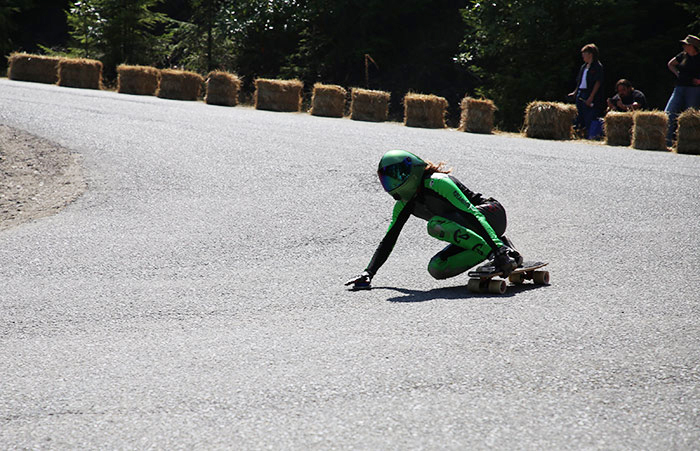
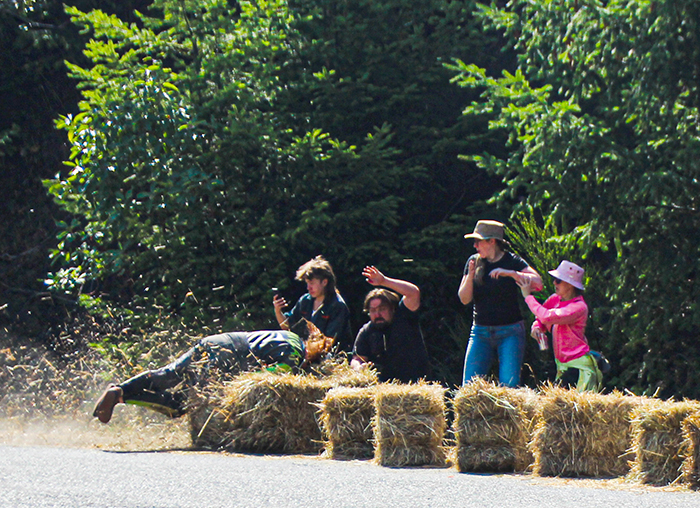
Spectators brace for an impact as a longboarder crashes into the hay bale barrier during the Salt Spring Slasher event on Aug. 24. (Donald Smith Photography photo)
Benjamin Robinson, last year’s second-place Slasher finisher, on the course.