Home Blog Page 120

McDonald and Firestone exhibit photos

CONTRIBUTED ARTICLE

An eclectic photography show by Gwen McDonald and Curt Firestone — called the Her and Him Photography Show — opened last Thursday in the Salt Spring Public Library’s community program room.

McDonald and Firestone are a Salt Spring Island couple who have been actively engaged in photography from young adulthood, photographing for personal enjoyment, to capture their fascination with the world around them, and to document their many worldwide travels, both singly and together.

McDonald and Firestone began their dive into photography while living in the San Francisco Bay area. Their inventory of images grew exponentially. Self-taught photographers, they photographed and printed what they liked, filled their home with photographic art, but until moving to Salt Spring Island in 2007 had never shown their work publicly.

Shortly after their move, and embracing their new island home, they decided to enter a few images in the Salt Spring Fall Fair photography competition. To their surprise and delight, each won awards for their entries. This sudden boost in confidence led to their joining the newly forming Salt Spring Photography Club, an effort spearheaded by several outstanding photographers. This new group provided a supportive, collegial community of photographers, ranging from rank beginners with basic equipment and very few computer editing skills to highly successful seasoned professionals.

The photographs in the library show include favourite images from the past two decades, in both colour and black and white formats. Over the course of these years, they have shown and sold their images on Salt Spring Island, in Victoria and in Mexico. McDonald’s focus tends to be on travel, people, landscapes, architecture and nature, looking for natural beauty, for patterns of light and shadow, and for images that tell a story. Firestone is especially good at street photography and in the post production editing of his images, where he is constantly trying out new techniques.

The Her and Him Photography Show runs through Aug. 30 and is open to the public during normal library hours (10 a.m. to 5 p.m. Mondays through Fridays, and 10 a.m. to 3 p.m. on Saturdays). They will be present to discuss their work from noon to 3 p.m. on Saturdays, Aug. 17 and 24.

Island athlete a magnet for gold

Baseball player Sean Anderson turns just 15 this month, but he is already very familiar with the feeling of medals being placed around his neck.

He has been part of five gold-medal winning teams in B.C., beginning in 2018 as a member of Salt Spring’s U11 AA team, which won provincial championships in a Comox tournament.

“That was pretty exciting and kind of the taste of it all for us,” recalled his mom Jenn Anderson last week.

Most recently, his Victoria Eagles Bantam Premier team, which competes in the B.C. Premier Baseball League (BCPBL), won gold at the BCPBL Bantam Provincial Championships in Victoria, which wrapped up on July 28.

A BCPBL website summary described the Eagles’ gold-medal run this way: “How do you sum up the Victoria BTM Eagles run to the 2024 BCPBL Bantam Provincial Championship? One word. . . Wow! The Eagles, with their backs up against the wall, needed to win a playoff game versus the Whalley Chiefs to get themselves into the semifinals versus perennial powerhouse and defending national champion, the Delta Blue Jays.  Not only did they take their first game of the day against the Chiefs by a score of 10-3, they then faced the Blue Jays and came out on top 5-1. Wow. They were not done. In their third game of the day — yes, their third game of the day — the Eagles faced a tough UBC Thunder squad and got the 3-0 win. Twenty-one innings later, the Eagles were named 2024 BCPBL Bantam Provincial Champions.”

A week earlier, Sean was one of 16 members of the Vancouver Island-Central Coast (VICC) 15U team that won gold at the BC Summer Games in Maple Ridge. He had enjoyed the same result in 2023 on the 14U VICC squad when they earned a BC Summer Games gold medal in Richmond.

Also in 2023, his AAA Bantam Cowichan Valley Mustangs team came from being seventh in their league to winning provincial championships in Kamloops.

Jenn said the last couple of years have been “a whirlwind” of games, travelling, excitement and making great connections.

“We have met so many amazing kids and so many amazing parents,” she said. “We’ve seen so much of our province that we otherwise never would have seen, and we’ve built quite the community. It’s like your second family.”

Sean’s parents were in a slo-pitch league on Salt Spring when he began playing ball at the age of three. Once in the coach-pitch division, Sean was recognized as being a strong athlete with the ability to play with older boys. He was still nine when his U11 Salt Spring A’s team won their provincial title.

Like everyone, he had a hiatus from team sports through the Covid pandemic, but by 2021 was looking for a more competitive experience and found it with the AAA Peewee team in the Cowichan Valley. That began the routine of regularly commuting off-island for both practices and games, which continues today. Sean’s dad Dennis Anderson also works off-island, so Anderson family members are always on the move.

Last year he made the switch to the Victoria Eagles, when there were not enough players to form a AAA Bantam team in the Cowichan Valley. He now plays second base, shortstop and pitches. Jenn said her son hopes to play with that team again next year, with tryouts slated for later this month.

Jenn said that despite all the travelling, time, cost and commitment involved, “We’re just trying to support Sean the best we can.”

“It’s a small window in our lives. It’s memories that we will have for the rest of our lives. So we’ve accepted it, and we’re okay putting everything else on hold. We’re here for our kids. So that’s what we focus on.”

Sean also plays basketball at Gulf Islands Secondary School, and has been asked to join the volleyball team as well.

“And he loves golf,” added Jenn.

Maia Cassie earns U of T National Scholarship

0

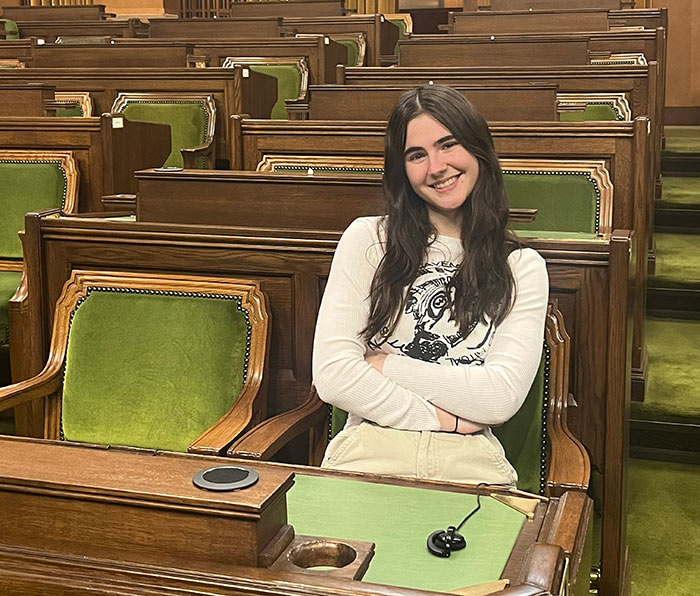
Salt Spring’s Maia Cassie knew she wanted to attend the University of Toronto when she started looking seriously at post-secondary options.

But scholarships were going to be “a big factor” in her ultimate choice of school, Cassie said last week in describing how she earned the U of T’s top entrance award: the National Scholarship. It will cover all tuition and incidental fees and residence costs for her four-year undergraduate degree, and includes mentorship by a faculty member. Approximately 10 National Scholarships are awarded each year, valued at more than $100,000. U of T material states, “These are students who demonstrate superior academic performance, original and creative thought, and exceptional achievement in a broad context. They excel in academic pursuits, demonstrate enthusiasm for intellectual exploration and have a strong involvement in the lives of their schools and communities.”

The scholarship path was both rigorous and interesting for Cassie.

After receiving the required nomination from her high school — Queen Margaret’s School (QMS) in Duncan — she completed the application form. While it included all the standard kinds of questions one would expect, applicants also provided an open-ended writing piece based around a few random words.

“So that was really unique and I really liked that,” she said. “From there they contacted me letting me know that they liked my application and I was going to have an interview. Before those interviews came, we had a lot of cool webinars and got to meet all the other finalists and hear more about U of T.”

Then came a series of interviews with a few staff members, professors and a past National Scholar.

Cassie also submitted one of the video essays from her YouTube channel that looks at film, TV and social media through a sociological lens.

“I got to talk to a professor at U of T about that video and go into it more in depth and hear his thoughts, so that was a very exciting little taste of getting to talk one-on-one with a professor. And I’m very excited to do that more.”

Cassie will be part of the faculty of social sciences, which she said “lined up perfectly with all of my interests.”

“I think a lot of the stuff that I do currently — extracurriculars and such — is about examining the way that people interact with the world, and why and how social change happens, and understanding politics, and those sorts of things.”

She has been a Model United Nations participant, and worked and volunteered with organizations such as Volunteer Cowichan, Literacy Now Cowichan and at the Salt Spring Public Library, often in social media roles. She was one of two winners of the inaugural Judy Nurse Bursary for young library volunteers pursuing post-secondary education in 2024.

She won first place in the English-speaking category of the national Poetry in Voice recitation competition in 2023 and third place in the bilingual category this year.

Cassie moved to Salt Spring with her family from Port Moody, B.C. when she was two years old. She attended Salt Spring Centre School through Grade 5, spent Grade 6 at the middle school and then completed her education at QMS in Duncan. While there she was involved with musical theatre, the competitive theatre team and filmmaking club, and was editor of The Quill literary magazine, captain of the Ethics Bowl team, student council president and head prefect on the prefect council. She was also on a QMS team awarded the international Westmont Prize for their video on creating a sustainable fashion app.

She expressed gratitude to her parents, Aidan and Mike Cassie, for their role in her receiving the National Scholarship.

“I can attribute a good amount to support from my parents who have always been just super helpful and there for me in all these many application things, and in all the extracurriculars that led up to it. They definitely had to read a lot of drafts of my written application. They’ve been pretty instrumental, I think.”

Cassie said she has never been to Toronto, but is excited to discover the city.

“It’s definitely a very different style of living than growing up on Salt Spring.”

The University of Toronto is Canada’s largest university, with almost 100,000 students in 80 departments, according to the online Canadian Encyclopedia.

Saturday Market sign censoring policy in limbo

4

A market vendor’s sign expressing opposition to Israel’s war on Gaza has prompted a firestorm of community controversy.

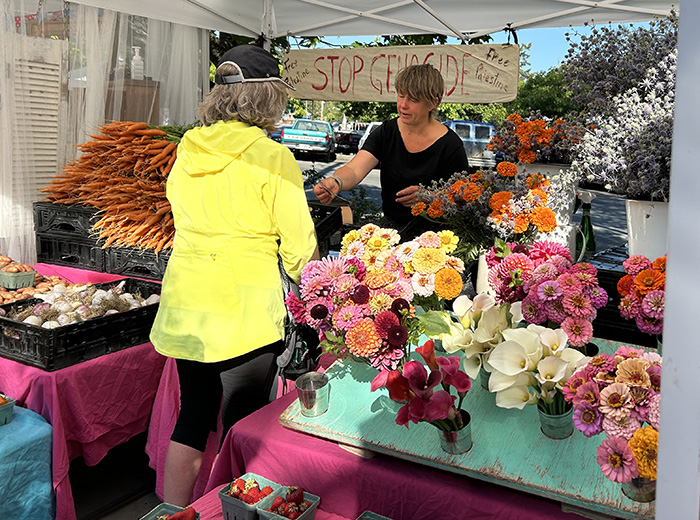
Sofya Raginsky of Heyday Farm first hung a simple hand-written “Stop Genocide, Free Palestine” sign at the back of her Saturday Market and Tuesday Farmers Market stalls last October, and did so again for the 2024 market seasons. On July 10 she received an email from a member of the Salt Spring Island Saturday Market Society (SSISMS) board — which does not run the Tuesday market — asking if she was willing to “tone down the signage in some way. If we don’t have to create a policy to make sure you do, the option remains to express oneself in some less overt way.”

At the next market day on July 13, SSISMS president Alvaro Sanchez came to Raginsky’s booth and politely asked her if she would remove the sign for the sake of preserving neutrality. She refused to do so at such short notice and, as Raginsky said in a letter to the SSISMS board, “I wasn’t interested in expressing myself in a less overt way.”

Then all Saturday Market vendors received an email from the SSISMS advising that a new guideline for vendors was being added regarding signage and displays. It read: “All vendor signage and literature on display and available for public consumption within the market may promote only the vendor’s business name and products for sale. No other signage, literature or other material is permitted.”

The board said its rationale for the change was to maintain a “safe space where all our vendors can share their passion for the items they make, bake or grow. We know that there are very concerning things happening all over the world. We believe during the market hours this should be a time to unplug from those things and celebrate the good that we are creating as individuals living on Salt Spring Island.”

The email also stated: “We know this [guideline change] may be a challenge for some, but we feel this is the best approach to maintain a safe, neutral atmosphere for all to enjoy the products created by our vendors. This decision has been made through a consensus process by the board after much input from many places. It does not indicate the political opinions of the board or any of its members on any issue that is happening locally or globally.”

In her written response to the SSISMS board, Raginsky said, “I do not think it’s a market board’s place to dictate how and when individuals engage with the world,” referring to the suggestion that market hours “should be a time to unplug” from negative things taking place elsewhere.

“I also believe that business and politics are inextricably linked. No business is neutral, ever,” she said.

Vociferous support for Raginsky’s position and opposition to the policy change was expressed directly to the SSISMS board and through social media channels.

Adina Guest was one of many addressing the SSISMS board in writing: “We should all be standing against these horrors, and I am grateful for people like Sofya who are doing so bravely in a general atmosphere of complicit silence . . . let us not silence the one among us who is brave enough to do so. We do not want our island to be known as one who oppresses and silences voices of dissent.”

According to a July 25 Reuters news service, “Palestinian health authorities say Israel’s ground and air campaign in Gaza has killed more than 39,000 people, mostly civilians, and driven most of the enclave’s 2.3 million people from their homes.

“The war began on Oct. 7 when Hamas militants stormed across the border into Israeli communities. Israel says the militants killed more than 1,200 people, mostly civilians, and took 253 into captivity in Gaza.”

Raginsky observed that opposition to protests or signs in Centennial Park has never been an issue in the past.

“It was really that Palestine issue that — I don’t know — there’s just such a forceful opposition to it, and I guess the Saturday Market board was just trying to appease those complaints.”

Sanchez told the Driftwood on Friday, Aug. 2 that the board received a lot of feedback about the proposed signage ban — much of it vehement but not all of it against — and confirmed that the guideline change has been suspended as the board gathers more information, including further legal advice.

Sanchez said some of the comments made to himself and other board members about their proposal have been hurtful.

“I am trying to not take it personally and to just do what’s best for the market.”

Raginsky said the situation has also been extremely uncomfortable and stressful for her, and she hopes a censoring policy will not be adopted.

She is not sure what her response will be if that did occur, but said, “I would think very seriously about not going to the Saturday Market anymore if they did pass that rule.”

No guideline change has been raised as a possibility for Tuesday Farmers Market vendors.

Centennial Park falls under Capital Regional District (CRD) jurisdiction through the Salt Spring Island Local Community Commission (LCC). However, as of this year, the Saturday Market is no longer under direct CRD control as it was in the past through its parks and recreation department.

“We are now at arm’s length from day-to-day management decisions affecting market operations,” said LCC chair Earl Rook. “That is not to say that the subject won’t come up with the LCC, but any discussions or actions would have to respect the terms of the existing management contract.”

Music and fun the focus of youth band camp

By KIM THOMPSON

FOR BANDEMONIUM MUSIC SOCIETY

There’s a new summer camp option for young musicians eager to brush off their instruments and get back into practice before school starts.

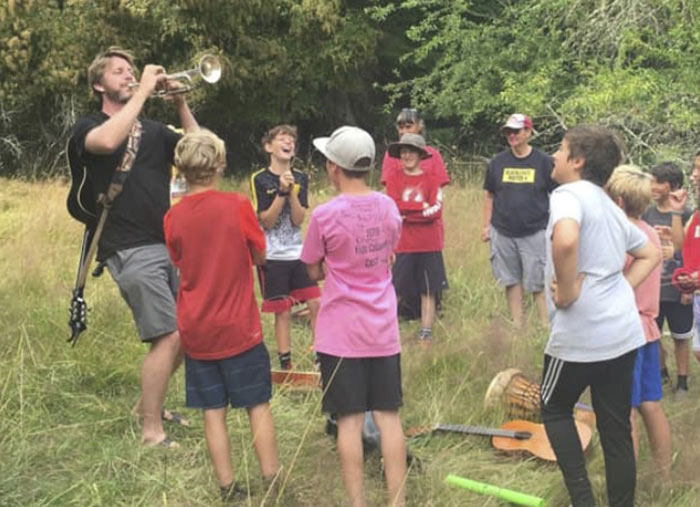
Ben McConchie, music educator, jazz trumpeter and veteran Pender music camp instructor, teams up this summer with the Bandemonium Music Society to present a new Summer Band Camp for students aged 12 and up.

“It’s not easy to start a brand new camp from scratch, but a generous grant from the Salt Spring Island Foundation has made this possible,” said Bandemonium president John Moore. “We are very grateful for the strong community support for music on Salt Spring. And we’ve definitely found the perfect instructor in Ben!”

McConchie is well known in the Gulf Islands for establishing music programs on Galiano, Mayne, Saturna and Pender islands, where he has worked as a school music teacher for over five years. For the past two years he has also conducted the Bandemonium Concert Band, Salt Spring’s community band for adults and youth.

According to McConchie, Salt Spring Summer Band Camp is for “students who are looking to have fun and make music with friends, while also gaining important musical skills like reading music, understanding rhythms, improving their playing and ear training. Through music games, small ensembles and group rehearsals, camp-goers will be exposed to a variety of music experiences in a relaxed, fun and inclusive learning environment.”

The five-day camp will be held Aug. 26 to 30 in the music room at SIMS. Students can sign up for Concert Band (mornings, 10 a.m. to 12:30 p.m.) or Jazz Band (afternoons, 1:30 p.m. to 4 p.m.), or they can choose the full-day option and take part in both bands. Concert Band will focus on music notation reading skills and developing better technique on their chosen instrument. Jazz Band will provide an introduction to jazz music and improvisation. McConchie emphasizes that students do not need any previous experience with jazz to participate in the Jazz Camp.

“I am into teaching anyone who is keen and interested,” he said.

Salt Spring Summer Band Camp is designed to complement the school band program, and as it occurs at the end of August, students will emerge energized and ready for the school band start-up in September.

For more information and to register, contact Kim at kim.saltspring@gmail.com.

Emergency food sovereignty effort launched

0

A project launched this summer on Salt Spring hopes to build resilience to emergencies through one of the island’s greatest strengths: local food production. 

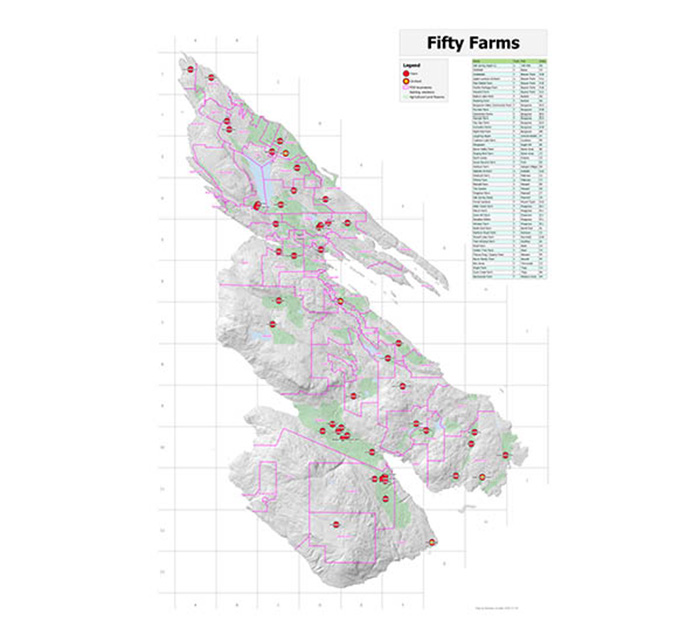
Salt Spring’s rich and diverse food production capability is the foundation upon which the broader emergency food sovereignty goals driving the new Neighbours Feeding Neighbours (NFN) initiative are built, according to co-coordinators Grace Wampold and Heather Picotte. The effort, partly funded by a grant from B.C.’s Investment Agriculture Foundation held by the Salt Spring Island Farmland Trust, means to flesh out an understanding of how Salt Spring’s food resources could be leveraged in an emergency, geographically organized — at least for now — through the extant Salt Spring Island Emergency Program neighbourhood pod system that covers the entire island. 

“The idea is that we connect people with the farms and other food producers in their neighbourhoods, help build relationships between them,” said Picotte. “Then when we have an emergency, those relationships will be in place.” 

The notion was built out from discussions during last November’s Food Summit; in addition to developing a broad inventory of what food Salt Spring’s growers grow, NFN is keen on looking at infrastructure. That includes storage — water and food storage, keeping things cold — and alternative ways of making things work if the power goes out. 

The effort is structured so far around farms that already lie in individual neighbourhood pods. Picotte said the first iteration would focus on identifying 10 pods where food was produced, and organize gatherings so people could get to know their food producers. It’s a “living list,” said Wampold, for sharing with neighbours –– think potlucks and other face-to-face gatherings, building community and imagining ways they can work collectively in a crisis to increase capacity. 

“Not all farms have the same resources,” said Picotte. “They can’t all be expected to go from a CSA box program with 50 boxes to like 100 instantaneously when there’s an emergency, it’s impossible. So we need to meet people where they are and see what they have to offer.” 

Salt Spring is a broadly agricultural island, observed Wampold. In addition to the relatively large number of crop farms, there are homesteads and people who simply grow food in their backyards; there are hunters and those who understand the resources of the island’s food forests. There are also many who keep livestock –– an asset that needs to be protected in any emergency. 

“A lot of homeowners who live on a rural property might have a few goats, a few sheep, cows, ducks,” said Wampold. “Maybe they keep bees. Part of this is connecting with those people so that they have a plan for evacuation.” 

Farms, said Wampold, have traditionally served multiple purposes in communities, being not just food producers but gathering spaces. 

“That makes them great muster points in an emergency,” said Wampold. “And they often have resources like water that are less common for people who are just kind of doing it on their own, living more remote.” 

Picotte said the duo had toured six farms already to talk about planning, and one question kept cropping up. 

“They would ask, well, what kind of emergency are you planning for?” said Picotte. “I mean, that’s it; it could be anything.” 

Top-of-mind threats always include fire, she said, and basic supply chain disruptions — imagine a flood that might cut off a highway, or longer storms that disrupt ferry service. Picotte said NFN had consulted with emergency services manager John Wakefield, who laid out the idea behind the “unforeseen emergency of two weeks’ duration” as a starting point.  

For those who might not get around that well in an emergency — whether anticipating a physical challenge like day-to-day difficulties with walking, or a geographical one like living at the end of a remote road that could be blocked by trees — there’s an added urgency to planning ahead. 

“Most people have two or three days’ worth of food in their house already,” said Wampold. “Once it creeps into two weeks, that’s when you are starting to finish everything in your freezer and probably knocking on your neighbours’ doors.” 

And apart from those sudden upheavals that disrupt our lives in an instant, emergency preparation can also build capacity to adapt to the more gradual changes or chronic stresses we experience. 

“These sort of slow-moving emergencies that we’re seeing,” said Picotte, “certainly climate change, but also in terms of food and fuel costs rising, or land and housing becoming more expensive.” 

Food sovereignty is a naturally attractive concept for many independently minded islanders, Wampold said; but emergency food sovereignty, like most emergency planning, is most effective when approached as a group exercise. It’s a bit of a contradiction, she admitted, but for a community already well-steeped in food exchange and bartering, where relationships — particularly since emerging from the acute stage of the pandemic — are so valued, Neighbours Feeding Neighbours is confident the whole can be greater than the sum of its parts. 

“We have a lot of sovereign individuals,” said Wampold. “Our hope is that communities can help each other be sovereign.” 

Residents are encouraged to take NFN’s emergency food questionnaire online at nfnsaltspring.org — with answers held in strict confidence, and data aggregated anonymously — as well as reach out to join or help plan pod events like farm tours and potlucks. 

Q&A with RCMP Sgt. Clive Seabrook 

0

First off: we hear you’re sticking around? 

I requested an extension back in April, and that was granted! So now my tenure here goes until the end of October 2025. It’s a limited duration post, as we all know, and there are policies surrounding that. So in my four-year post, I can say for sure now I have a fifth year. And that’s a good thing, I think. I’ve heard time and again the community wants some stability; if the community doesn’t feel it’s getting from me what it needs, that might be time for a fresh outlook and a new commander. But I think as long as we’re continuing to be productive, where I’m contributing, I feel like it’s worth staying. My family’s well established in the community, my wife volunteers for different things, we have really good friends we’ve made here. Headquarters knows all that; no one wants to change something if it’s working. 

What’s working particularly well? 

The number one thing? The community engagement. There’s such a thirst for us to engage with the community, and we’re trying to participate in as many different things as we can. I’d heard in previous years, the community felt like they didn’t see enough of us –– certainly if they needed us, they could call and we’d come, but proactively being involved in things, intersecting with things at a lower level before they become bigger issues, I’d heard we could do better in that regard.  

Have you struggled with staff this year? 

I’m really appreciative of our staffing office, they’ve done a good job of working with me to keep the office more or less fully staffed. Of course we have had gaps, but in previous years those gaps were for months, or even a year or more in some cases. Now we find our gaps are more manageable, say being down one member for a few weeks before a replacement gets here. In fact one of the officers that transferred out this year, his replacement was here before that officer even left! So we were actually at surplus for a few weeks. That sort of stability for the detachment definitely helps me do my job, and it’s good for my members’ wellness too.  

Are you seeing any trends? 

Well, you have to be careful with statistics. But five years ago our calls for service were in the 3,400 range per year, and last year they were just over 2,700. So being able to take several hundred calls out of a calendar year is definitely a decrease. People are calling us less, which is nice. In Ganges specifically, the kinds of calls I was seeing back then –– smearing of feces on walls, that sort of thing –– I mean, I don’t want to paint a picture that it’s all roses now. But you don’t see those types of examples anymore. We still have challenges for sure, but those assaults, vandalism, breaking and entering, property crime –– we rarely get those types of calls now.  

Does that include Centennial Park? 

The number of calls we get to Centennial Park for general vagrancy, that hasn’t really dropped, but it’s about the severity. The reality is, Salt Springers are still calling the police for the things they’re seeing in the park; but now sometimes we’ll get calls someone is drinking alcohol, and we’ll get down there and it’s coffee. Not always, but more often. It’s clear that the community’s view of that area is in a lot of ways unchanged, so for the rest of the summer especially we will have an increased enforcement presence down there, to ensure that people don’t take our leniency for granted –– and understand there are lines in the sand where everybody is expected to be able to enjoy the park equally.  

How much does how you do that enforcement help? 

I find with social issues, I haven’t really seen a lot of success with the public solely relying on the police to “arrest the problem away.” As long as public safety isn’t thrown out the window, I think we should be willing to support attempts to avoid that. That’s why to me things like the Ambassador Program that we started is so important –– to have people in the community doing that outreach, just day-in-the-life stuff like filling out forms to rent a place or access health care, or just listening to someone’s problems. From a police point of view, those volunteers will be there year after year to provide some continuity; then as our members come and go, we have this group working with the community to help make introductions. I think it’s a win-win.  

How are the island drivers this year? 

Salt Spring Island still has an impaired driving problem. Unfortunately, it still seems to be relatively easy to find an impaired driver. Right now I don’t think we go a week between stopping them. We stepped up our enforcement on impaired driving last year, and easily doubled the number of impaired drivers we took off the road. I’m sad to say –– and I’m proud of the officer –– but at the same time sad to say there’s one who’s getting the Team Alexa Award for personally having more than 50. Just the one officer.  

How do you tackle that problem? 

This year we’re continuing that enforcement, but also spending more time trying to stop it from happening in the first place. That will be visible as more bar walks, for example, and we have educational materials we’re handing out. Even if patrons don’t take them, they’ll still see it up on the wall and hopefully that can jog their memory a bit about their plans to get home safely. We’re working with ICBC and Island Health this fall, and hope to implement a program at the high school again where we speak with students about the dangers and consequences. I’d rather people not become aware about the consequences because they’ve been caught by police, or worse because someone has been hurt or killed. The best thing for everyone to do is, of course, to avoid drinking and driving in the first place.  

How about mental health resources? 

There’s still more work to do there, but I think we have a good grasp of the situation now. There were a couple of examples earlier this year where people were in and out of psychiatric help for a period of time, and that shone a light on how Salt Spring maybe needed a little more support. And to the credit of the people at Island Health, and Lady Minto staff especially, there were more conversations around what else we could do, what does the Mental Health Act provide, what are our strengths and limitations? We’re seeing more examples where a more meaningful long-term support that doesn’t necessarily involve the police is provided to a person, which is ultimately what they need.  

So it’s less often a police matter? 

We’re still generally involved –– in a lot of these circumstances, people are apprehended under the Mental Health Act, we’re still coming to the hospital –– but wherever we have the luxury of time to have a conversation, then we can build a solution together, get them connected with family or remind them who their doctor is, or that we do have a mental health team here where if it’s a client we can contact them. Police, ambulance, fire, the search and rescue team, all the first responders, all these well-established agencies –– it’s such a wide gamut — between a bunch of us if someone needs help we can get to the right person. Someone has the right phone number, someone knows just the right person. It’s that web of professionals and volunteers that really makes Salt Spring work. We all have official policies and ways to do things, but it’s those relationships with each other that solve the most problems.  

Editorial: Let political sign stay

2

Centennial Park has long been Salt Spring’s go-to spot for protests and displays of opinions about any number of local, national or international concerns.

Strongly worded signs are a natural part of such gatherings. In fact, singing and sign-carrying Raging Grannies used to be a common sight in the Saturday Market space itself. Canadians’ right to express themselves in such ways in a public venue is guaranteed by the Canadian Charter of Rights and Freedoms.

It shouldn’t matter if the people expressing their opinions about important matters through words on a sign are also selling fruit, vegetables and flowers at the same time.

After the non-profit society board now running the market received some complaints about Sofya Raginsky’s “Stop Genocide – Free Palestine” sign in her Heyday Farm booth, it decided to limit vendor market signage and literature to product promotion alone. The understandable backlash has caused them to put a pause on the change, for now, and to obtain further legal advice.

It is not only hard to see how the censorship move could be considered legal, it is also not called for.

It’s okay or even good to feel uncomfortable sometimes. Maybe we don’t want to be reminded of atrocities in the world, or political viewpoints we vehemently disagree with while out shopping, but that should never outstrip anyone’s right to free expression that is not a call to arms, hate speech or a directive to harm others. Raginsky’s sign is a simple, quiet but strong expression of disapproval of the large-scale killing of civilians being undertaken by the Israeli government.

Raginsky is willing to accept the consequences of expressing her opinion in a public space. People don’t have to buy her produce and flowers, or look at the sign if they are offended by it.

In a letter to the Saturday Market board, she said one argument for censorship made to her was that without a policy, then “holocaust denying and [Make America Great Again] signs might also appear.” Her response was spot on. “Most likely they won’t. And if they do? If a vendor decides to display their MAGA sign, let them, and see what happens to their sales. And hate speech is a whole other ball game. There are laws about hate speech. And there are laws about free speech too.”

The Sonic Cocktail takes ’60s trip

SUBMITTED BY MUSIC MAKERS OF THE ANGLICAN PARISH

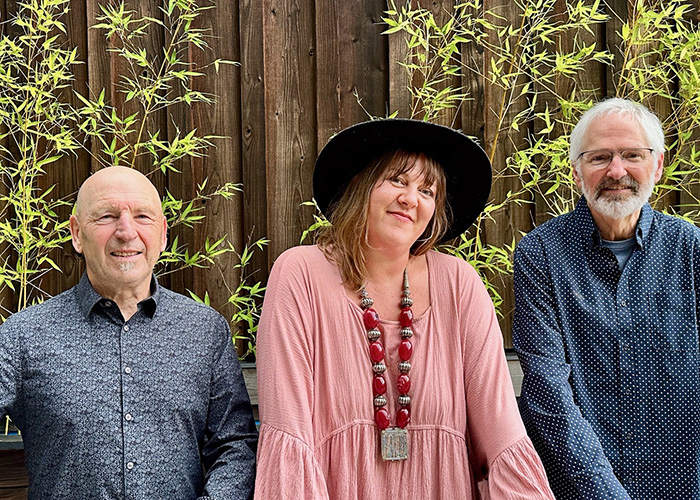
On Wednesday, Aug. 14, the popular Tea à Tempo weekly summer concert series features the welcome return of musicians Suzanne Gay, Jim Shultz and Bruce Grey – this time as The Sonic Cocktail – offering a “locally shaken and stirred musical concoction” for your enjoyment.

They will be featuring some of their favourite tunes from the revolutionary and prolific musical decade of the 1960s. You’ll hear their take on artists such as Crosby, Stills, Nash and Young, Nina Simone, Janis Joplin and The Beatles.

Gay is a Salt Spring-born vibrant pianist and singer known for her versatility of musical styles and sultry voice, creating an ambience of emotionally charged beauty and soul. She is a graduate of VIU’s jazz program and currently teaches piano and voice on the island. 

Shultz has made Salt Spring his home for the last 12 years and has played with a variety of local groups and vocalists over that time. He currently plays guitar with the Afternoon Shift jazz combo, the Swing Shift Big Band and The Sonic Cocktail. He has also been part of more than two dozen musicals over the last 20 years, playing a variety of stringed instruments. 

Grey has been involved in music in a variety of line-ups for many years on Salt Spring Island. Whether it’s lead vocals, harmonizing as an accompanying vocalist, playing electric bass, or on the percussion kit to add colour to a composition, serving the song and enjoying the process with the band members are the key elements to his musical journey.

Music by donation begins in All Saints by-the-Sea at 2:10 p.m., followed by tea and treats at a cost of $5.

Donations provide the honoraria awarded the musicians and contribute to the running of the series.

DAVIDSON, Susan Janet

1

It is with great sadness that we share the news of the sudden passing of Susan Janet Davidson on July 19, 2024. This bright light left us quickly and painlessly, with her children at her side.

Mom was born on October 20,1942 in Vancouver, BC, to Winnifred Winona Wheat (Wink) and Robert Watson.

She grew up in North Vancouver, was a Delbrook High graduate, and attained a Degree in Education from UBC.

In 1966, Susan married Alex Biddlecombe, whom she met at Delbrook Highschool, and had three children, Michael, Robbie and Erin.

Susan travelled the world: Australia, New Zealand, England, Greece, Scotland, Malaysia, and Japan, but eventually found her home on Salt Spring Island.

Once on Salt Spring, Mom worked at West of the Moon, and found her calling teaching at Tree Frog Daycare.

Many connections were formed, and Mom had the good fortune of getting to know several generations of Salt Springers.

Predeceased by her beloved Jerry (Gerald-Me-Darling), her passing marks the end of an amazing journey filled with laughter and love. Susan was mother to Erin, Robbie and Michael, grandmother to Alex and Damien, and grateful other-mother to Kelly(1) and Richard, Kelly(2) and Scott, Mia and Carolyn. She is survived by her brother Bob and his wife Dale, and her cousin Artie. She is also survived by her dear friend and father of her children, Alex and his wife Diane. Susan is also predeceased by her second husband, David Brynn-Jones.

Susan will be dearly missed by her precious Ferry Queens: Mary, Judith, Norma, and Lois and also all the delightful Salt Spring daughters and son: Andrea and Tara, Meghan, Gail, Shellaine and Martin, whom she collected and cherished along the way. She will also be missed by the many friends too numerous to mention here.

Her family and friends filled her life with joy and happiness, courage and support, right to the very end.

Our family would like to express a heartfelt thank you to Sandi and the folks at Heritage Place as well as all the staff at Lady Minto that took such great care of her.

Arrangements for a gathering to exchange memories, stories, and her favourite one-liners is to be held on her birthday, at 1pm on October 20th, at Bullock Lake Farm.

Please join us to celebrate this joyful, effervescent, exuberant, and absolutely unconditionally loving individual.