Home Blog Page 121

WATT, James

Boat builder, cabinetmaker, cartoonist, sculptor. James brought an artist’s eye to all that he undertook. Remembered by friends and family as generous and kind. He lived on Salt Spring Island, Crofton, and Duncan over the last 30 years of his life.

A Celebration of Life for James will take place on Saturday, August 17, 2024, from 2-4 PM at 8-133 Corbett Road on Salt Spring Island.

Viewpoint: Eby’s complaints ring hollow

BY RILEY DONOVAN

At a recent press conference, Premier David Eby declared that British Columbia’s “unprecedented population inflows” are “completely overwhelming.” Visibly frustrated, he described how the province is buckling under the weight of growth: “Our schools are full. We are unable to keep up with housing starts.”

According to Premier Eby, B.C. is adding a jaw-dropping 10,000 new residents every month. B.C.’s growth is not fuelled by interprovincial migration. In the first quarter of 2024, 14,113 people moved here from other provinces, while 16,679 people left for greener pastures elsewhere in Canada. Neither is it driven by births; in 2021, B.C.’s mortality rate exceeded its fertility rate for the first time.

Our province’s population growth is driven entirely by international migration. The federal government’s immigration policy saw Canada grow by nearly 1.3 million in 2023, accounting for 97.6 per cent of national growth.

According to documents obtained by the Canadian Press, the Trudeau government disregarded a memo written by civil servants warning that its pedal-to-the-metal immigration strategy would strain housing and health care. B.C. is now paying the price for Ottawa’s incompetence.

Almost a million British Columbians have no family doctor. A poll from the Angus Reid Institute found that one in three B.C. residents are considering leaving the province because of the cost of housing. Schools are facing skyrocketing enrolment.

Premier Eby’s diagnosis is correct. Now, what’s his treatment plan?

The only solution he has floated is for premiers to work with Ottawa to align immigration targets with provincial capacity. What steps will be taken to move this vague desire into reality?

One option would be to play hardball like Québec, which is threatening to hold a referendum on giving itself full control over immigration.

Premier Eby recently complained about a $750-million federal grant to Québec to help accommodate an influx of asylum seekers, arguing that B.C. also deserves a grant to deal with our own influx of foreign workers and students.

This fundamentally misses the point. Québec receives concessions because it exerts constant pressure on Ottawa. They aren’t ashamed to look out for number one. Rather than being outraged about Québec’s favourable treatment, B.C. should emulate their pressure tactics.

Another way to moderate population growth would be to bypass the feds entirely, and cut the number of nominees accepted under the Provincial Nominee Program, an economic immigration program which allows provinces to select permanent residents.

Prince Edward Island recently took this route, reducing immigration nominations by 25 per cent and refocusing the remaining nominations away from fast food and retail, instead favouring newcomers with skills in health care, trades and childcare. P.E.I. made this decision to slow growth on their increasingly overcrowded island. B.C. could do the same.

Complaining about runaway population growth isn’t working. It’s time for Premier Eby’s government to take concrete action to reduce growth and give our housing, health care and infrastructure some breathing room.

The writer is a local journalist and editor of Dominion Review.

Firefighters contain blaze at hay field

0

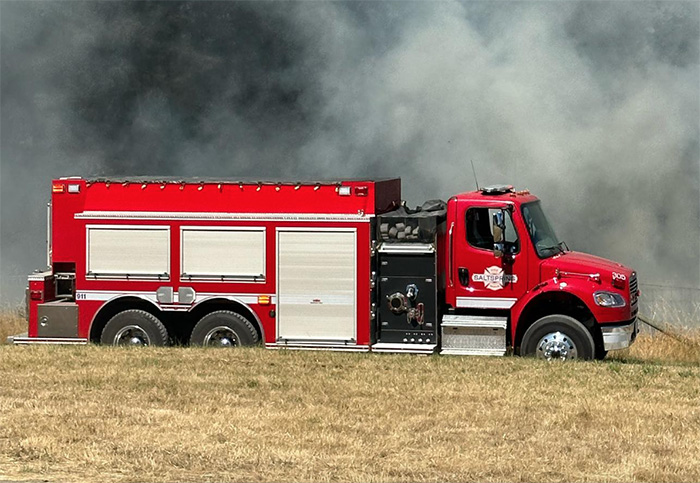
Fire crews from two Salt Spring stations fought a hay field blaze for three hours Saturday, Aug. 3, highlighting what island officials called “matchstick” dry conditions that persist despite last week’s brief rainfall. 

White smoke could be seen from much of the island as a section of field burned at Church Hill Farm on North End Road, according to Salt Spring Island Fire Rescue (SSIFR) Capt. Cody Hunsberger, who said on-duty firefighters arriving there from Hall 1 in Ganges were immediately backed up by trucks from Central’s Hall 3. 

“We were able to split and take on the two heads of the fire,” said Hunsberger. “The duty crew took one and the paid-on-call took the other.” 

The fire had already spread across two acres by the time firefighters arrived, according to Hunsberger, with one end of it headed towards a barn structure and the other toward Suffolk Road to the north. 

“It could have been quite a challenging fire had it gotten away from us,” said Hunsberger. “Suffolk is kind of a natural fire break, but if it had jumped the road, then you’ve got trees, neighbours, all that stuff. A quick response — with a full complement — definitely contributed to us having a quick knockdown.” 

In total, 18 firefighters and seven apparatus used some 10,000 gallons of water to extinguish the fire, Hunsberger said; after the fire was under control, SSIFR’s new brush truck allowed crews to drive into the burnt field to make sure it was fully extinguished. 

“The brush truck has a pump and hose reel on board,” said Hunsberger. “So we could drive the whole perimeter, stopping to soak down hot spots — something we’re really not capable of doing in any other truck.” 

All of the Coastal Fire Centre is currently under a burn ban, according to officials, and Salt Spring Island is at “high” fire danger conditions with a two-hour fire watch — meaning after any currently-allowed high-risk activities, such as operating machinery that might create sparks, someone needs to be watching for fires for two hours after finishing work. 

Conditions across the province will continue to be hot and dry, according to an update from the B.C. Wildfire Service Tuesday, Aug. 6, with weather expected to continue to dry out forest fuels, making them highly susceptible to ignition. 

The cause of Saturday’s fire is still technically under investigation, Hunsberger said, but with conditions this dry he urged islanders to exercise even more caution than usual. 

“The hay is like a matchstick,” said Hunsberger. “If you’re allowed to use machinery, make sure you have some water on site.” 

For daily updates on fire risk conditions, visit saltspringfire.com

Affordable housing site work underway

0

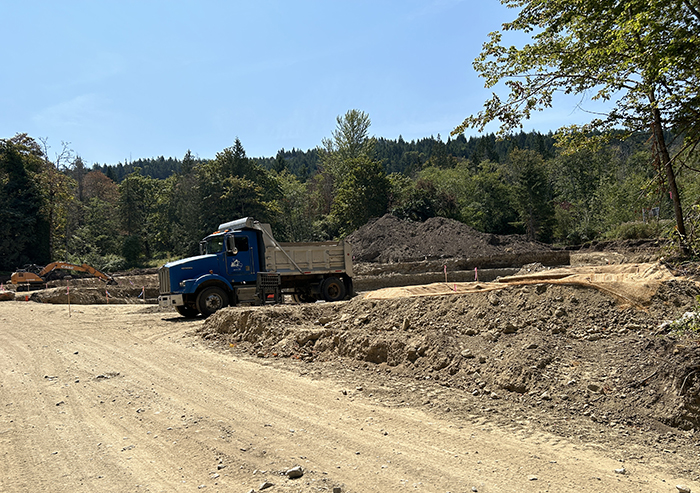
Work is underway at Drake Road, where contractors are preparing the site to receive a special delivery in early 2025: three dozen new housing units for Salt Spring Island, according to provincial officials.  

Permanent purpose-built supportive housing is being constructed at a factory off-site using modular construction methods, BC Housing said, so islanders won’t be able to watch the build over time. But the provincial housing agency said it expects the structures to be transported to 161 Drake Rd. and craned into place in the new year, with occupancy slated for mid to late 2025. 

The effort will bring 32 studios for supportive housing, as well as four additional affordable rental units to be made available for people with low to moderate incomes, according to BC Housing. The supportive and affordable housing will be accessible through separate entrances, the agency added.  

Supportive housing is meant to provide homes for people experiencing or at risk of homelessness. BC Housing had originally announced it would build 28 units of supportive housing at the 5.5-acre parcel back in January of 2022, as the agency — and then-Attorney General and Minister Responsible for Housing David Eby — touted the fast-tracking of the project on land leased from the Capital Regional District. 

When the new units are ready, BC Housing said, they will be offered through its Coordinated Access and Assessment process, “to ensure an appropriate mix of residents with the right supports live in the housing.”  

Eligible people living at Kings Lane will be considered first, the agency added, referring to those currently supported at temporary modular units BC Housing erected on land leased from the Gulf Islands Seniors Residence Association (GISRA), initially to house people displaced by the Lady Minto Hospital Foundation’s purchase of the Seabreeze Inne.

No pricing for rents for the four affordable units has been announced. 

A non-profit operator will be selected to operate the site through a request for proposals (RFP) process, according to a BC Housing spokesperson, who told the Driftwood they expected the RFP to be posted before the end of this year.

Harrington launches voices for the islands

0

A former Salt Spring resident is returning next week to celebrate the launch of a book with stories related to this island and 16 others.

Voices for the Islands: Thirty Years of Nature Conservation on the Salish Sea is about the creation of local nature conservancies — beginning in the 1990s — and the people behind them. Many of the names and stories will be familiar, but Harrington’s book provides an intimate look at local protests, the history and the evolution of conservancies. She also includes her experience of a three-year sailing journey through the islands while interviewing more than 50 veteran conservationists. The foreword was written by Briony Penn.

Harrington currently lives off-grid on Lasqueti Island.

On Thursday, Aug. 8 at 7 p.m., she will read from and talk about her book at the Salt Spring Public Library’s program room.

“Voices for the Islands will inspire readers to turn apathy into action and support the cause of conservation and reconciliation in an era of species extinction and climate change,” states promotional material from Heritage House Publishing. “Full of colour photos, maps and fascinating first-hand stories by unsung heroes of conservation — many of whom are now elders — this book reveals how local people and grassroots movements have the power to transform the future of our precious planet.”

Harrington was the founding executive director of the Land Trust Alliance of B.C. (from 1997 to 2011) and a director of the Lasqueti Island Conservancy for more than 12 years. She co-edited with Judi Stevenson the bestselling and award-winning Islands in the Salish Sea: A Community Atlas book.

“As a sailor, I have had the privilege of visiting every one of the islands in this book and hiked many trails in the parks and protected areas,” writes Bob McDonald, author, journalist and host of CBC radio’s Quirks & Quarks show, about Voices for the Islands. “Each Gulf Island holds a distinct beauty . . . It is a delight to follow in the wake of fellow sailor Sheila Harrington as she meets the people and organizations that have fought tirelessly to preserve these unique ecosystems for future generations to enjoy.”

Viewpoint: March for the Children on Aug. 5

By PHIL VERNON

I was speaking last week with James Charlie, chair of the Penelakut Sulxwe’en (Elders Group). James and his siblings were forced as children to attend the residential school on Kuper Island, just north of Salt Spring, now known by its original name Spune’luxutth or Penelakut Island.

James has given testimony numerous times of his experiences at the school, including at the Truth and Reconciliation Commission, and his brother Raymond (Tony) Charlie has spoken at the Salt Spring library to launch his book, In the Shadow of the Red Brick Building. Today, they continue to advocate for survivors and for increased awareness among the non-Indigenous public about the horrors experienced by children at the Kuper Island Industrial School and at other residential schools across Canada. They also feature in the recent CBC podcast called Kuper Island and in the 1997 film documentary Kuper Island: Return to the Healing Circle.

In 2020, following the revelation by the Tk’emlúps te Secwepemc of 215 suspected unmarked graves at the Kamloops Indian Residential School, the Penelakut Sulxwe’en announced their own work on the issue, where they had already identified over 160 suspected burials near the site used by the since-demolished school in their community.

The Sulxwe’en envisioned a memorial walk through the town of Chemainus to begin the process of healing and reconciliation — for survivors and tribal members as well as for friends and supporters. That first year over 1,500 people poured up the streets of Chemainus, gathering at Waterwheel Park to hear songs, prayers and testimonials from survivors of the school.

In subsequent years the Penelakut Tribe’s search for more graves has continued, resulting in more burials identified at a new site near the grounds of the Kuper Island School, James told me. Evidence found by technicians using ground-penetrating radar and drones indicate an additional 36 “small body” burials, expected to be the babies birthed by girls attending the school who were raped, according to survivor accounts, by the residential school brothers or priests with the collusion of the nuns.

James said that technicians working with the tribe are preparing to use a new type of sonar to scan the sea bed off the shore in an effort to corroborate other survivor testimonies. Tormented by their memories, some who were among the older boys at the school say they were directed by authorities to throw gunny sacks into the ocean from the wharf. Many times they were forced to do this and each sack, they say, contained a baby.

According to the technicians, traces of these remains may still be identifiable using their advanced technologies, despite the passage of time and tide.

This year, the Penelakut Tribe has invited us back for the Fourth Annual March for the Children, to take place Monday, Aug. 5 in Chemainus — once known as Sunuwnets, the largest Penelakut village before colonial authorities burned the longhouses and drove the families away. Supporters are asked to gather at 8:30 a.m. at the Salish Sea Market next to the ferry terminal, then the procession will wind up the hill to Waterwheel Park.

The Penelakut feel so supported by Salt Spring, and islanders are encouraged to attend. If you need a ride, or have room in your car for another, please email pcvernon@gmail.com  or chrismarshall2406@gmail.com with “car pool” in the subject line.

Transition Salt Spring kicks off Lighter Living campaign

By TRANSITION SALT SPRING

Many islanders would agree that summer on Salt Spring is tough to beat. Lakes for swimming, forest trails for hiking and bike rides, ocean beaches for lounging and picnicing, farmstands with fresh local offerings around every corner, and plenty of beautiful places to be social or to take time to rejuvenate. We all agree we live in a very special place and if we would like to ensure that the natural resources we enjoy will be around for our children and grandchildren to enjoy, it’s time to take action. Better yet, get your friends and neighbours involved as well.

What difference can a few of us here on a little island in the Salish Sea make, you ask? It’s just too hard, and depressing. The current narrative is all about personal sacrifice: eat less meat, drive less, fly less, shop less, less, less. We retreat. We disengage. If the future of our planet depends on a few selfless individuals we are doomed! We know that to make significant systems change we need governments and big business to step up without a doubt, but it’s time for everyone to get involved.

Climate change is not just an environmental issue; it also affects our economy, society, and our physical and mental health. Our young islanders are among the most profoundly affected. Transition Salt Spring (TSS) and the GISS Earth Club hosted a Clothing Swap and Textile Repair Cafe in the spring, drawing over 300 students. We conducted a survey and asked students one question; “How worried are you about the effects of climate change on a scale of 1 to 10, with 1 being ‘I don’t worry at all’ and 10 being ‘I can’t sleep at night because I am so anxious about it.’” The average response was 8.5! While planning our Earth Day talk for the student body, one of the members of the Earth Club said in all seriousness, “Just tell all of us the five most important things we can do to save the planet and we will do it!”

Our children feel a deep sense of urgency and anxiety about climate change. They are looking for solutions and inspiration, whether through activism, innovation or community efforts. Highlighting positive stories, encouraging sustainable practices and advocating for systemic change can help foster hope and motivate action. Individual actions do matter; they embody our values and impact those we come in contact with. They can lead to collective action, send market signals to business and trigger larger system change. We need both! We owe it to ourselves and our kids to do more.

Between 2019 and 2021, TSS developed a Climate Action Plan for Salt Spring. Then in 2023, a report card was completed with a full update on progress. Overall, Salt Spring is not on track to meet the emissions reduction and climate change adaptation goals set out in 2021.

What if we told you that there are plenty of actions we can take as individuals and neighbourhoods that do make a difference and do not focus on self-sacrifice?

TSS is launching “Lighter Living,” a new initiative designed to promote more sustainable and balanced lifestyles. Lighter Living emphasizes living within our ecological means, balancing our consumption with the Earth’s ability to regenerate its resources. There is plenty of science connecting behaviour change, happiness, climate change and carbon counting, which has resulted in evidence-based, low-effort individual actions that make real impacts!

Lighter Living aims to provide resources and information to help islanders and their neighbours collaborate in creating a more resilient, thriving and sustainable community. We have consulted loads of experts who have derived low-effort actions that relate to our everyday choices and habits regarding what we eat, how we move and what we do with our stuff. Resources will be shared over the coming months and we are consulting with plenty of locals to find out what changes they are making at home, work and play in order to live a little lighter on this island we are fortunate to call home.

It’s not too late to ensure a bright future for our children, but we need everyone to come along. We are well past the talking stage, it’s time to take action! Transition Salt Spring invites you to sign up for free access to Lighter Living content at signup-can.keela.co/lighter-living-series-subscription. Learn how to take low-effort actions that make you feel good, are good for our community and good the planet.

Editor’s note: The Driftwood will be running Lighter Living features in coming months.

Schinners presents A Place Called Home

By SALT SPRING ARTS

Artcraft’s summer Showcase exhibition series continues on the Mahon Hall stage with a solo show by Rosie Schinners opening this Friday, Aug. 2.

Working with techniques such as mono-printing and collage, Schinners explores the potential of paper as a versatile medium of expression in both two- and three-dimensional approaches while asking the question, “What goes into making a ‘home’?”

Two streams of work are in conversation with one another in A Place Called Home. One is a series of treehouses, symbolizing places Schinners once called home, that exist in a space between reality, memory and dreamscape. The complement is a collection of bird nests that come from the same surreal place.

“For humans, we gather and carry materials through time to surround ourselves with distinctive character, identity and what eventually become memories of places we once existed in. Birds also spend time gathering a unique combination of materials to create an ideal nest to call their home,” Schinners observed. “Whether crafted by human hands or shaped by animal instinct and necessity, our dwellings speak to a shared desire for sanctuary amidst the chaos of the world.”

Schinners is a multidisciplinary artist who resides on Salt Spring. Working primarily with vintage print imagery, she combines hand-cut collage with vibrant splashes of colour to bring new life to old images. She looks to explore and express fleeting moments of magic, memory and nostalgia.

Originally from Barrie, Ont., Schinners holds a Bachelor of Art from the University of Guelph as well as a Bachelor of Fine Art from NSCAD University in Halifax. Although focused on oil painting during her formal art education, collage and paper-based art was always in the background. It became a primary medium after a meaningful workshop with long-time favourite artist and author Nick Bantock in 2014. In 2019, she was selected and collaborated with Kolaj Magazine as the World Collage Day Featured Artist and has since led collage-based residencies and workshops in Canada and the United States.

She has been inspired to create her current work in part by her rural landscape and the variety of birds, both large and small, that she can see from the window of her current home. Her colourful artworks reference nests and treehouses, and make use of upcycled and foraged materials that some might consider scrap, “as if birds themselves were exploring my art studio to create new homes,” Schinners notes.

“The fragmented nature of collage and the inherent glitches and imperfections of the mono-printing process speak to the characteristics of memory itself,” she explains in her artist statement. “Repetitive layering of printing acts in much the same manner as how our thoughts revisit the same recollections frequently — sometimes welcomed, sometimes not. My use of vibrant colour is an invitation into an aspirational space, where joy, magic and playfulness are celebrated.”

An opening reception for the Showcase takes place from 6 to 8 p.m. on Aug. 2, and an artist talk is set for Sunday, Aug. 4 at 2 p.m.

Showcase exhibitions run during Artcraft hours at Mahon Hall, 10 a.m. to 5 p.m. daily.

Editorial: Road wranglers

0

In the pantheon of long-running news stories, it’s hard to top “Ganges Hill repaving plans.”

Indeed, the Beddis-to-Seaview stretch of Fulford-Ganges Road has been specifically on Salt Spring’s radar since well before 2013, when consultants for the Capital Regional District (CRD) concluded one could flank the roadway with a pair of bike lanes  –– and lay a sidewalk on one side –– for $2.3 million on the low side, not including any property purchases that might be needed. 

More than a decade later, with many local advocacy efforts recounted in dozens of Driftwood stories –– and with the movement of a decimal point one tick to the right on the price tag –– a section of Salt Spring’s busiest road may soon no longer require cyclists and pedestrians to take their lives in their own hands when choosing to use it.  

There will be no sidewalk, and both of the new shoulders are not technically wide enough to be called bike lanes; but with more room to share the road, significant and much-needed sub-surface strengthening, and an underground storm-sewer drainage system that should resist even the roughest climate-change-addled storm, we feel Salt Springers who have advocated for safety here deserve recognition. 

Perhaps most visibly our Local Community Commission, and before them the now-defunct Salt Spring Island Transportation Commission (SSITC) and Salt Spring’s CRD director Gary Holman, worked to keep the issue in front of regional and provincial decision-makers. But the local stakeholders –– as well-organized as Island Pathways or as improvisational as our ardent pedestrians –– also helped literally pave the way through their dedication, and their voices.  

At the risk of taking a victory lap before the first backhoe arrives, we see the challenge now –– apart from deciding how to handle the inevitable rush of cars parking up the hill on summer Saturdays –– lies in deciding what’s next. As former SSITC commissioner Gary Lehman said about this project, we don’t want the best we can get, we want what’s best for Salt Spring. 

Hopefully we won’t have to wait another 10 years to find out which of those two options we got.

Junior sailors earn BC Summer Games silver

Submitted by Salt Spring Junior Sailing Team

Two junior sailing teams had a successful competition at the 2024 BC Summer Games from July 18 to 21, with each team garnering a silver medal in their events.

Izzi Pugh Aucoin and Reuben Sol captured silver in the C420 Open category (mixed and male teams) while Malikaa Clement and Maeve FitzZaland won silver in the C420 Female category.

Pugh Aucoin and Sol said conditions of very light winds and hot weather during the first day of games competition led to an early end to competition that day. The sailing teams were only able to complete two heats of the course, set in the harbour of Port Moody, before the winds became too light and unpredictable and the remaining heats for the day were called off.

Competition resumed the following day with the course set further out in Burrard Inlet. The sailors had increased wind and stronger currents to contend with, as well as temperatures around 30 Celsius, and they raced five heats in rapid succession. The Salt Spring sailors said that because they practise in a relatively sheltered area near Ganges, they have less experience in the stronger winds than teams that practise in areas of higher winds.

In spite of the change in conditions, the Salt Spring sailors had very consistent finishes, with both teams in the top four for each of their races. Clement and FitzZaland were particularly pleased with their results, given that this was only their second regatta as a pair.

Because the Games were primarily located in Maple Ridge, sailing teams had long commutes from Port Moody back to the high school where they were staying, and found themselves eating cold dinners outside their classroom dormitories at 10 o’clock at night.

“The food at the Games was not great, and we didn’t have time to eat much in between races,” said Clement and Pugh Aucoin. Nonetheless, they were enthusiastic about their medals, and about the experience of the Games.

Sol, Pugh Aucoin, Clement and FitzZaland all expressed appreciation for their local coach, John Hillier, as well as the support of the Saltspring Island Sailing Club and local donors who have made their successes possible.

The Salt Spring Island junior team will finish off its season with the Fall Dinghies Regatta in Victoria on Sept. 28-29. The C420 racers will be joined by younger Opti sailors, some of whom will be attending their first regatta at that time.

Any donations to the junior team are welcome and can be made via the dinghy fleet captain, Douglas Woolcock: ssidinghy@gmail.com.