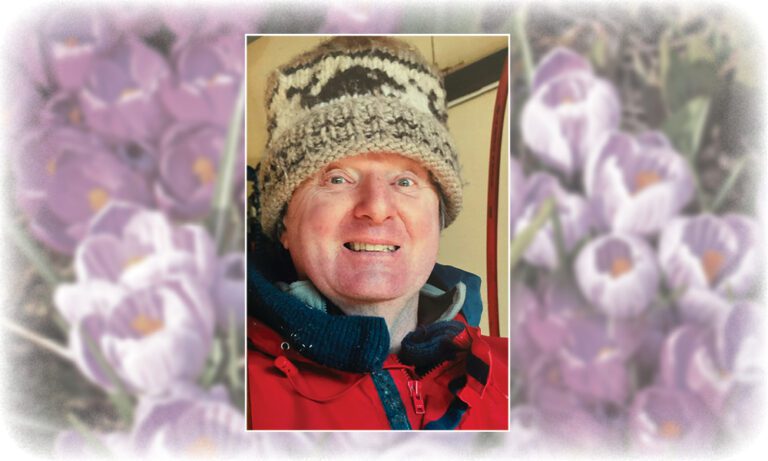
Born in Ottawa on March 8, 1942, only child of Alice and Jack Wilson, beloved husband of Shelley. A kind and gentle man, Keith would say “it’s a wonderful life”.
Retiring to the island in 1995 Keith made things with wood, renovated homes, planted trees and garlic and goodness.
Keith was so thankful for the kind compassionate care and understanding he was shown by home support professionals, nurses, BC Ambulance EMTs and Dr. Peter Verheul. Each of you made his end of life journey…better.
A celebration of his life will be held August 24th at All Saints by the Sea in the Upper Hall At 2:30 pm. Everyone welcome. Donations in remembrance to Lady Minto Hospital.
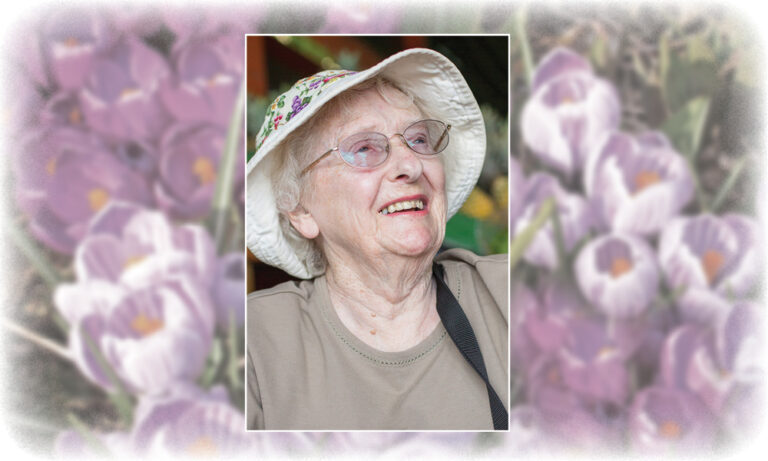
Grace attended the University of Alberta,where she received a BSc with Honoursin Physics, a rare achievement for awoman at that time. After graduation, Graceworked on a project researching the “V” particlewith the US Atomic Energy Commission.
In 1951, Grace married Pat Byrne, with whomshe enjoyed 58.5 happy years. They had threechildren: Jimmy (deceased at 2.5), Sheila(deceased at 53), and Michael. In 1957, Grace andher family moved to Tulsa, Oklahoma, for sevenyears before returning to Calgary, Canada.Upon their return to Calgary, Grace enrolledin the computer science program at theUniversity of Alberta, becoming a pioneer inthe world of computer programming. Sheworked as a system analyst for a Calgary-basedengineering firm.
In 1971, Grace and Pat moved to Canmore, AB,where they bought and ran a motel for fiveyears. Wherever Grace lived, she was alwaysvery involved in the community. While inCanmore, Grace was a school trustee for eightyears and worked as a writer and editor for thelocal newspaper, *The Canmore Miner*.
Grace and Pat moved to Salt Spring Island in1983. Grace was elected to the School Boardand continued as a member from 1985 to1993. She also served one term on the IslandsTrust from 1993 to 1996. Grace’s communityexperience enabled her to serve on the SaltSpring Library Board, eventually becomingHead Librarian. She took that expertise withher when she moved to the MeadowbrookSeniors Residence and updated and organizedthe library there as well.
One of the joys of Grace’s life was taking holidaysto many parts of the world, especially islandnations in the Caribbean and South Pacific.
A memorial service will be held at All Saintsby the Sea, in Ganges, Salt Spring Island, onFriday, July 26, 2024, at 12:00 pm. The servicewill be followed by a light lunch and intermentat Purdy Cunningham Memorial Cemetery. Inlieu of flowers, please consider a donation inGrace’s name to the Salt Spring Foundation(https://ssifoundation.ca/).
Grace is lovingly remembered by her brotherRobert Young, son Michael Byrne, fourgrandchildren (Alicia, Ryan, Scott, and Heather),and seven nieces and nephews.
An elder taught me that slowing down by just five per cent makes all the difference. Learning how to slow down enough to listen, whatever our age, is an eldering skill.
I remember attending a community event 20 years ago when we were asked to divide into two circles. Everyone under 40 was in the inner circle. I had just turned 40. I wept as I was welcomed by the grey hairs with shining, knowing eyes. They took my hand as if to say, “welcome to the losses and joys of aging.” The younger queer people felt equally cared for, knowing those who had travelled a little further down the road had their backs.
As LGBTQIA+ elders, it’s been a wild ride over these last several decades. On top of life’s expected joys and sorrows, we’ve had the added blessings and burdens of expanding cultural awareness, not only for ourselves, but also within families, communities and institutions. We have the scars and laugh lines to prove it.
Alongside other great workshops at this year’s Pride Fest ‘24, including chanting, drumming, sacred intimacy, dance, writing and artmaking, we’re inviting all LGBTQIA+ elders, and elders-to-be, to join the circle. Please, bring a chair along with your stories, questions and concerns.
On Friday and Sunday mornings at 10 a.m. on the festival grounds, Caffyn Jesse, Susan Higginbotham and I will be hostessing 90-minute Elders Circles. We will begin as a larger group to establish some helpful parameters such as accessibility needs and confidentiality before joining smaller gender-focused affinity groups. We will briefly return to the larger circle to share what we’ve learned, likely to nod and laugh.
One coffin size has never fit all. As we all approach the inevitable, many LGBTQIA+ elders have begun to address issues of aging with a renewed sense of purpose and belonging. We’re curious how we queer our death and dying. From authoring “living well to dying well” books to a new queer-inclusive initiative sponsored by Vancouver Island Persons with AIDS called Walking Each Other Home, we’re inviting people to first come into community circles to discuss what matters to us during these strange days of getting older, and hopefully wiser. We’re intending that these gently facilitated circles launch a new chapter for LGBTQIA+ folx here and on Vancouver Island. Together, we can continue to co-create what we need and desire — for our mutual aid, and for the wellbeing of society.
We know Pride takes a village. To Sharyn, Natu, Moss, the Pride committees and DAISSI board, bouquets of roses for making us all shine brighter! To all our dear allies and friends on this big-hearted island, we cherish you. Country Grocer, you continue to model true generosity. We love your amazing staff and community-minded vision. To all our sponsors, volunteers and supporters: thank you for getting it and stepping up. It’s a true honour and privilege to be getting older with you all.
Let’s keep celebrating together, Salt Spring. Happy Pride, everyone!
Regional district directors have asked for options to develop a service that might address the proliferation of private mooring buoys within Capital Regional District (CRD) waters, responding to alarms sounded during an April workshop and linking those buoys to a growing number of derelict vessels in harbours from Sooke to Ganges.
That growth, according to CRD staff, is the direct result of a regulatory change by the Government of Canada, which in 2009 eliminated authorization requirements for so-called “minor works” such as buoys, so long as they did not impede navigation. Those buoys, according to a CRD presentation, directly resulted in an increase in abandoned, wrecked and derelict boats, which, even apart from environmental or safety concerns, have had a financial toll on the regional district, as more government staff are needed to address varying community impacts.
In Ganges Harbour, according to a CRD staff review of historical aerial photographs, what in 1996 was 45 boats and 60 buoys became 138 boats and 144 buoys as of last year. Nearly 500 mooring buoys were counted within the Gulf Islands in 2023; across the CRD, staff tallied 1,185 buoys holding 862 boats, docks and other structures throughout 21 bays and harbours.
At the CRD board’s direction, staff hosted a regional workshop on April 30 –– titled “Collaborative Action to Resolve Boat-Related Issues in the Capital Region” –– that saw nearly 60 elected officials, staff and representatives from First Nations, regional government and municipalities. Senior environmental protection manager Glenn Harris told the CRD Environmental Services Committee Wednesday, July 17 that the gathering also included some provincial government staff, including assistant deputy minister James Mack; and while lack of provincial regulation around buoy placement –– and B.C.’s deference to federal authority on the matter –– had been problematic for coastal communities, Mack gave a brief presentation on the BC Coastal Marine Strategy, meant to directly address the issue of derelict vessels through its focus on marine pollution.
More than 1,400 abandoned or derelict vessels await cleanup in the coastal marine waters of B.C., according to the BC Coastal Marine Strategy’s 2024 summary document.
The Canadian Coast Guard was invited to the April meeting, according to CRD staff, but ultimately there were no federal officials or staff in attendance. That absence was keenly felt by Salt Spring CRD director Gary Holman, who repeated his call for both federal and provincial levels of government to increase their involvement –– while supporting an investigation into establishing a regional service, albeit chiefly as a way to hold the issue in the public eye.
“If the CRD doesn’t continue keeping the discussion going at some level, the senior governments who basically have abandoned the field for sure will do nothing,” said Holman, adding that without the province at least being more “forthcoming” in their support, he was reluctant to establish a regional service.
Harris reported that the workshop participants seemed to agree that without a coordinated regional approach, locally driven changes in one area simply shift issues elsewhere.
“We’re seeing that not only within the region, but between regions,” said Harris, noting that when False Creek moorages saw some restrictions, the number of boats there did decrease. “[But] those boats moved over to the Gulf Islands.”
Harris said the task at this point would be for staff to return with options for the CRD board, and officials could decide then what level of engagement they wanted to pursue –– from a coordination or facilitation role helping local authorities at one end, to establishing regional licences of occupation at the other. CAO Ted Robbins said staff would also look at whether expanding or amending the existing Saanich Peninsula Harbour Service to take on a more regional role might be appropriate.
“That would be our first look,” said Robbins. “Moving forward, we’ll also think of the governance structure around this service. I would expect given that we’re considering this report here today with Environmental Services, ultimately –– either through a service amendment or the establishment of a new service –– this service would report up to the Environmental Services Committee.”
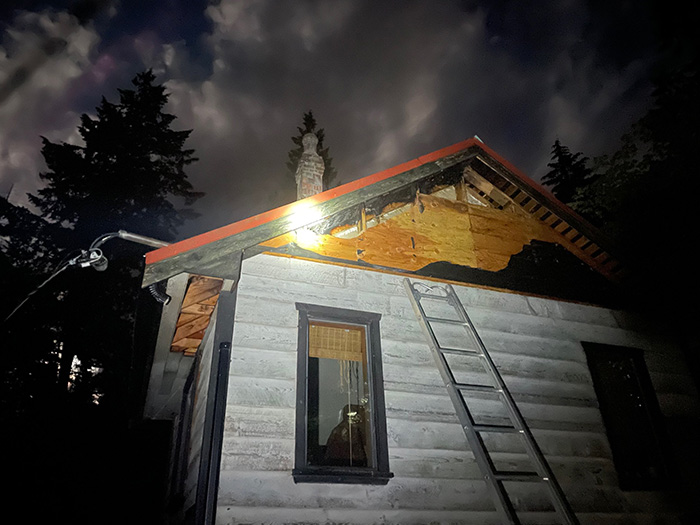
Salt Spring Fire Rescue (SSFR) personnel prevented a home at 185 Arnell Way from being destroyed by fire on Monday, July 22, after responding to a report of hydro lines down at the property at 11:20 p.m.
According to a report from acting SSFR Capt. Patrick Byrne, “Upon arrival, crews were directed by the homeowner to a large maple tree that taken out the residential service drop and had caused damage to the mast. Crews investigated further and found evidence of a fire in the eaves. The fire had spread along the rafters and was hidden from view except for a small glow around the service mast and light wispy smoke coming from the eaves.”
Byrne said firefighters laddered the building, removed the soffits and opened the gable end to expose and extinguish the fire.
Eighteen firefighters responded to the call, with eight firefighters and three apparatus on the fire scene, and 250 gallons of water used to extinguish the fire.
“Damage was minimized as much as possible through salvage efforts,” said Byrne.
No injuries were reported.
“We are thankful that we were able to prevent a fully involved, destructive structure fire. Thank you to our fire crews and BC Hydro for their hard work and their efforts in keeping everyone safe.”
The fire is being investigated at this time and no cause has been confirmed yet.
The Salt Spring Island Painters’ Guild’s 52nd annual Summer Show and Sale opens at ArtSpring at 10 a.m. on Thursday, July 25 with a reception on Friday, July 26 from 1 to 4 p.m.
During the reception, a certificate of recognition will be presented to this year’s Gulf Islands Secondary School (GISS) scholarship winner, Aio Panwar, whose excellent work is on exhibit as part of the show. Each year the guild awards a $1,000 scholarship to a graduating GISS student to assist their further art education.
The guild takes great joy in sharing the astonishing variety of works from our talented members. Our mandate is to encourage fellowship and growth among artists through a variety of both regular and special activities, from weekly workshops to life drawing and ad hoc summer plein air painting sessions.
The show at ArtSpring runs daily from 10 a.m. to 4 p.m. through Aug. 6.
BY DIVERSE AND INCLUSIVE SALT SPRING ISLAND BOARD MEMBERS
Nobody’s free until everybody’s free.
~ Fannie Lou Hamer
Pride is a longstanding and beloved event in our community.
Our local Pride Festival celebrates our local 2SLGBTQIA+ community and draws in visitors from afar, offering a safer space for folks to be their full and authentic selves. At the Pride Festival, we share artistic offerings and, most importantly, we build a collective culture of belonging, support and celebration.
Queer joy is an act of resistance. With mounting violence against trans* and non-binary people, women and the queer community, we need to stand together, now more than ever, in solidarity for the rights of 2SLGBTQIA+ people.
Over the past year, we’ve witnessed an erosion of laws and freedoms for 2SLGBTQIA+ people here in this country and south of the border. Locally, we’ve seen attempts at censoring trans* books in the school system, and anti-trans* sentiments published in a small local publication.
Here on Salt Spring Island, Pride is more important than ever.
The Diverse and Inclusive Salt Spring Island (DAISSI) board and organizers would like to express our deep gratitude for hosting our second annual Pride Festival on the unceded traditional territories of the Hul’qumi’num and SENĆOŦEN speaking peoples. We acknowledge that colonial systems of genocide and oppression are still alive today, not only on Turtle Island, but around the globe.
Across Turtle Island, we have witnessed the weaving of related humanitarian causes into Pride celebrations, as demonstrations denouncing pinkwashing and corporate sponsorships have emerged. In light of these actions, we call upon the colonial government of Canada to decisively intervene and take tangible measures to ensure the safety and well-being of Palestinians. It is not just a moral imperative, but an urgent humanitarian and legal necessity. The situation demands all of our participation to help alleviate the ongoing humanitarian catastrophe.
We support the growing call within our 2SLGBTQIA+ communities to divest from corporations who are supporting the genocide, and we stand with Palestine, Sudan, Uganda, the Congo and many other places around the world where colonial violence is unfolding before our eyes.
We still have so far to go to ensure safety and freedom for all 2SLGBTQIA+ people, right here in our community, and around the world. As queer community, we know that to stay alive, we must find joy amidst the pain. Coming together in grief and celebration has always been our way. The essence of the first Pride parades were expressions of outrage and joy. We are proud to carry this tradition forward with all of our hearts.
Bring your open hearts and minds, and join us from Thursday, July 25 to Sunday, July 28 at the Farmers’ Institute to celebrate Pride!
Some festival highlights you won’t want to miss:
All weekend long:
Camping at the festival grounds, with 2SLGBTQIA+ festival market, beverage patio open daily and hosted by Upper Ganges Liquor Store. Local musicians, DJs and performers will be on stage every evening. Join us for pop-up open mics, workshops and art installations offered by community for community, along with DAISSI-led activities, community discussions, and opening and closing ceremonies.
Thursday, July 25:
Opening ceremony, live music, open mic.
Friday, July 26:
Workshops, open mic, live music and performances, burlesque, karaoke and dancing at the festival grounds, starting at 6 p.m.
Saturday, July 27:
2024 Annual Salt Spring Pride Parade at 11:30 a.m.
Where: Starts at the library (McPhillips Avenue) with speakers and entertainment. The parade weaves through Shiya’hwt/SYOWT/Ganges village.
Join us at the Pride Festival grounds after the parade with the Ruwadzano Marimba Band, followed by a variety show, open mic, local DJs, headliner act Queer As Funk and karaoke. Wander the 2SLGBTQIA+ market and enjoy the beverage patio hosted by Upper Ganges Liquor Store. Entertainment all afternoon.
Sunday, July 28:
Morning Wellness Workshops: yoga, qigong, meditation, closing heart circle and community potluck.
Find out more:
Find tickets (weekend passes, Friday and Saturday night entertainment), view the weekend schedule and find out how to get involved: saltspringpridefestival.ca.
This celebration is proudly sponsored by our presenting partners: Raffi Foundation for Child Honouring, Country Grocer, Country Grocer Pharmacy, Upper Ganges Liquor store, and Harvest Moon.
The fire danger picture on Salt Spring can be complicated, according to officials, but as the boundary of an “extreme” alert crept south to cover the island before the weekend, residents and visitors were warned fires can start and spread quickly now –– and may be difficult to contain.
More than 250 wildfires were burning across the province going into the weekend, according to the B.C. Wildfire Service (BCWS), and with no rain in sight for the Gulf Islands, firefighters are expecting the likelihood of new fires starting will only rise.
The “extreme” fire danger rating, which officially includes all of Salt Spring and the Southern Gulf Islands as of 2 p.m. Friday, July 19, means the risk of fire is serious; new fires will “start easily, spread rapidly, and challenge fire suppression efforts,” according to the BCWS, which enacted a province-wide ban July 12 on all outdoor burning, including campfires.
Last week islanders experienced widespread smoke from a now-contained bark mulch hog fuel fire at Harmac Pacific’s pulp mill in Nanaimo, according to Salt Spring Island Fire Rescue (SSIFR) officials, who told the fire district board they fielded multiple phone calls of concern.
Residents are encouraged to report smoke regardless, according to deputy fire chief Dale Lundy, even if they think it could be from somewhere else.
“It could be from the Harmac fire, or it could be the shed in your backyard,” said Lundy. “Any calls that we get, we look into.”
Weather can have a significant impact on wildfires –– in how they start, how aggressively they spread, and how long they burn, according to BCWS, which operates about 260 automatic weather stations that update hourly and send temperature, relative humidity, precipitation, wind speed and wind direction data to support fire weather forecasting and the computer-based Canadian Forest Fire Danger Rating System (CFFDRS).
Salt Spring Island has its own station sending weather stats from SSIFR’s Fulford Fire Hall property; data to build forecasts for the island are also drawn from a station near Duncan and another north of Ladysmith. That can lead to multiple danger ratings on different parts of the island, particularly as conditions ramp up or down; as recently as last week, the “extreme” fire danger zone only covered part of the north end of the island, ending on Thursday just south of St. Mary Lake.
The CFFDRS is the primary fire management decision aid in Canada. With it, fire managers can assess the potential for ignition, spread and burning intensity. This information is used for making fire prevention, preparedness and suppression decisions and other general fire management decisions.
A housing project for health care workers on Salt Spring is moving forward, and organizers hope to harmonize part of their work with expected summertime construction planned for the island’s busiest road.
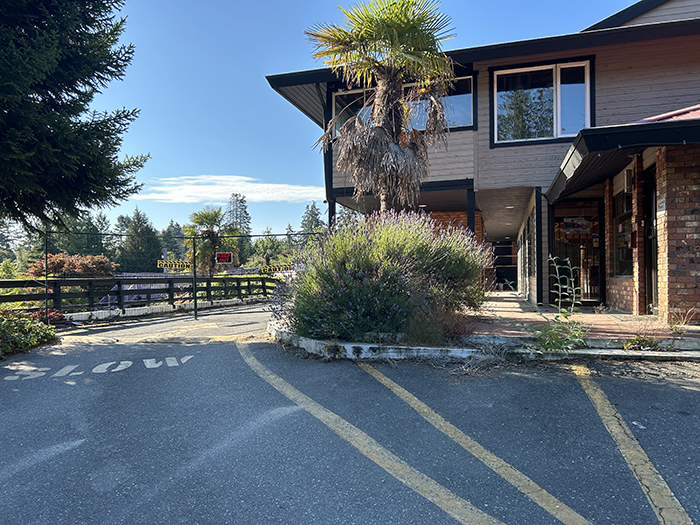
The Capital Regional District (CRD) board approved a bylaw to expand the Ganges Sewer District to include the parcel at 101 Bittancourt Rd., the former Seabreeze Inne property fronting Fulford-Ganges Road, purchased by the Lady Minto Hospital Foundation (LMHF) and slated for conversion into 17 units to house hospital staff.
LMHF board vice-chair Julian Clark told the Ganges Sewer Commission back in June that the facility would also welcome “health care workers generally on the island,” and that the sewer connection was a critical step toward providing adequate septage not only for those planned units but also for any future development that might be contemplated on the two-acre lot.
But timing becomes more complicated after the CRD’s approval Wednesday, July 10, as the clock begins ticking on a hopeful coordination with the multi-million-dollar Fulford-Ganges Road improvement work planned by the Ministry of Transportation and Infrastructure (MoTI), much of which will occur directly in front of the Bittancourt property.
That roadwork envisions resurfacing and widening of 1.6 kilometres of the two-lane rural road, highlighted by drainage improvements and the construction of paved shoulders for pedestrians and cyclists — a 1.2-metre-wide shoulder heading north (or downhill into Ganges) and 1.8 metres in the southbound direction, according to MoTI tender documents.
With the potential of snarling Salt Spring traffic not once but twice for major road works on the island’s highest-traffic thoroughfare, organizers approached MoTI with the idea of an elegant partnership: an effort that could coordinate laying some 300 metres of new sewer line at the same time MoTI’s contractors were moving past the Bittancourt property, Clark said, “so that the road is only ripped up once.”
Clark told the commission the ministry had been “very accommodating” and suggested that once a successful bidder had been selected, the foundation’s planning team would be introduced to the contractors. The potential savings for the foundation, according to Clark, would be about $250,000.
Public records at press time indicate there have been three bids for the Fulford-Ganges construction, ranging in costs from $17.2 million to $19.5 million; while the ministry has previously indicated they were hopeful work would begin before the end of July, a spokesperson for MoTI confirmed to the Driftwood this week only that the province is currently verifying tender bids, and “expects to provide an update in the coming weeks.”
On Thursday, July 11, CRD director Gary Holman reported at Salt Spring’s Local Trust Committee meeting his understanding was that a planned coordination between the foundation, ministry and eventual contractor would likely represent a delay in starting construction – although not long, he said, adding that he felt the Bittancourt project had sufficient support in the community to offset any inconvenience that delay might represent.
“If we have to delay the repaving for a couple of months in order to coordinate those projects, I think that’s a wait that would be acceptable to most,” said Holman.
He also said there would likely be Community Works Fund monies that could be used to cover some costs that come with expanding the sewer system, although according to the CRD board resolution, the LMHF have agreed to pay all costs associated with adding the property to the service area, including multiple capacity and permit fees alongside construction costs.
CRD staff have said the sewer system at Ganges has more than enough capacity to accept potential outflows from the Bittancourt property, as well as from any future connections along the line between it and the existing system boundaries.
The fire was fictional, but its lessons were real.
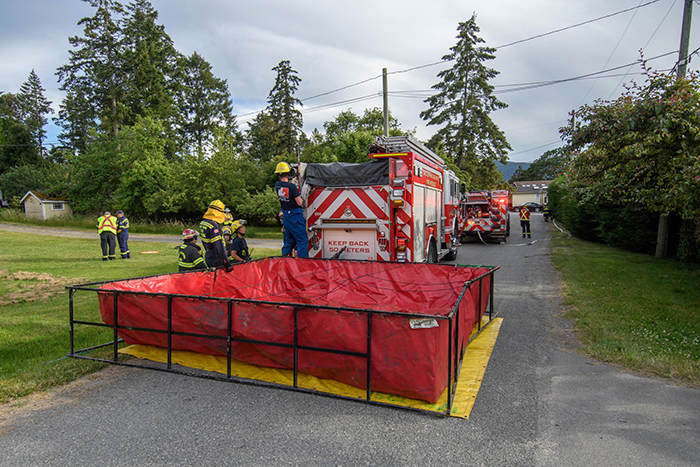
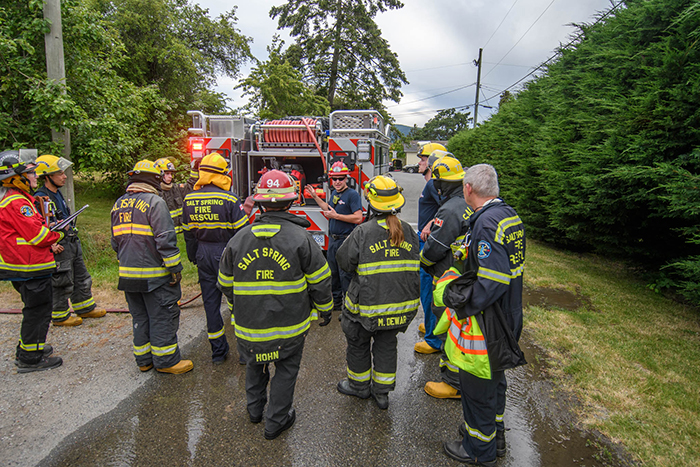
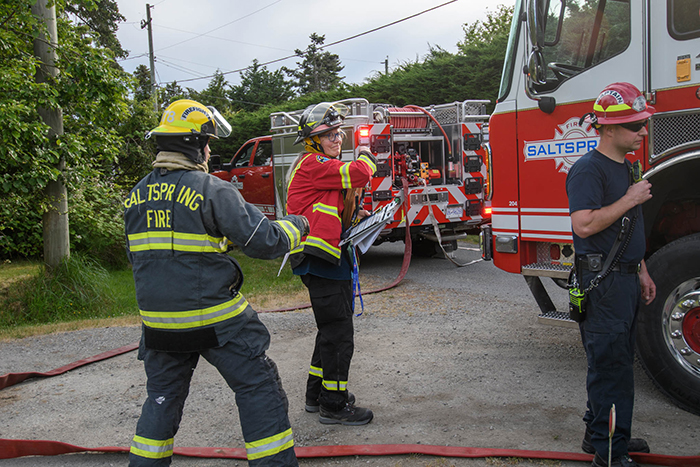
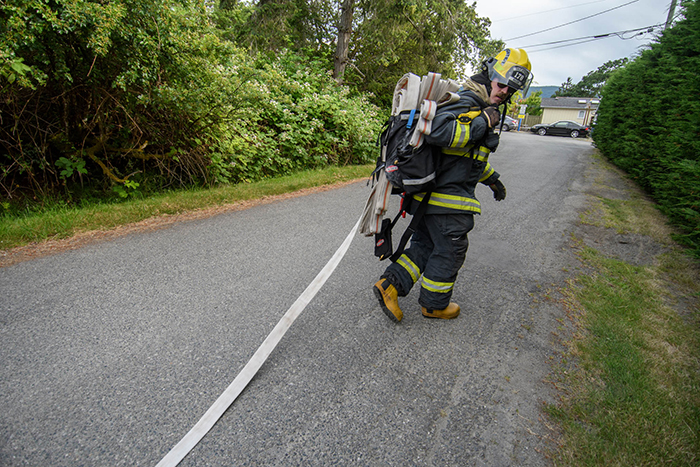
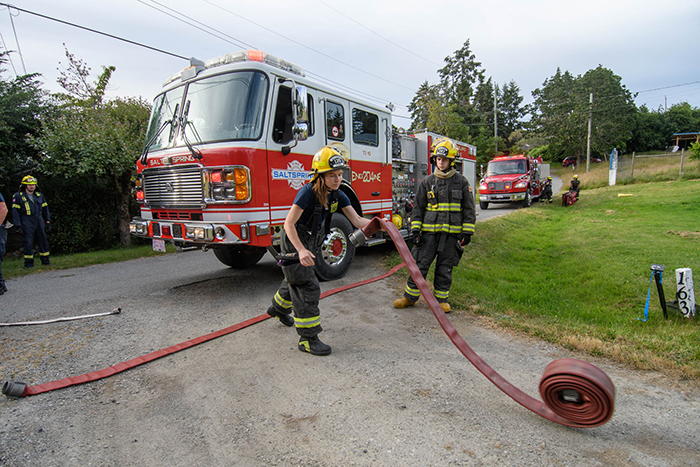
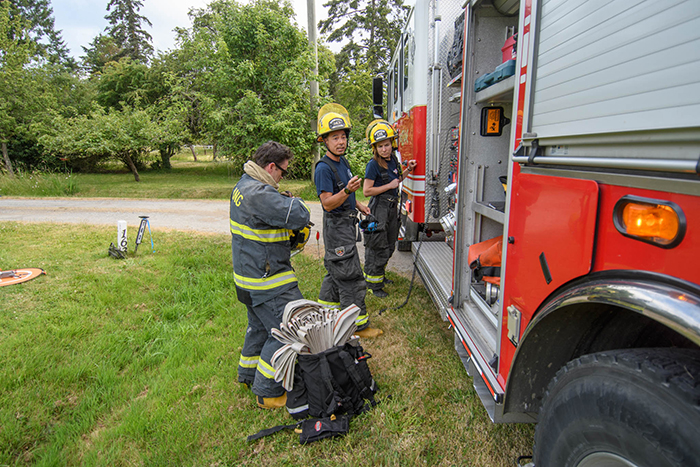
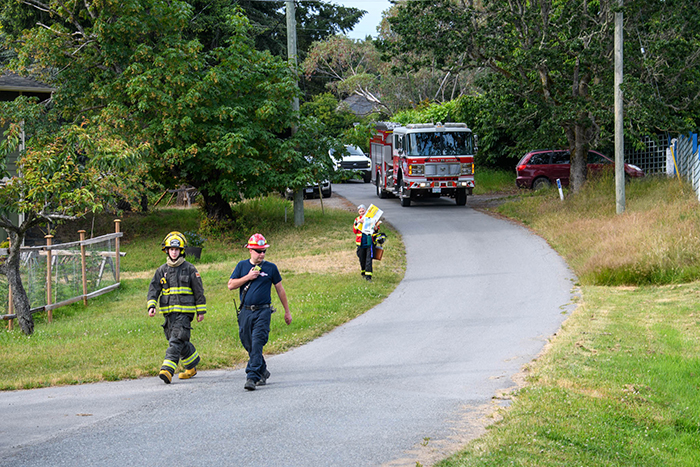
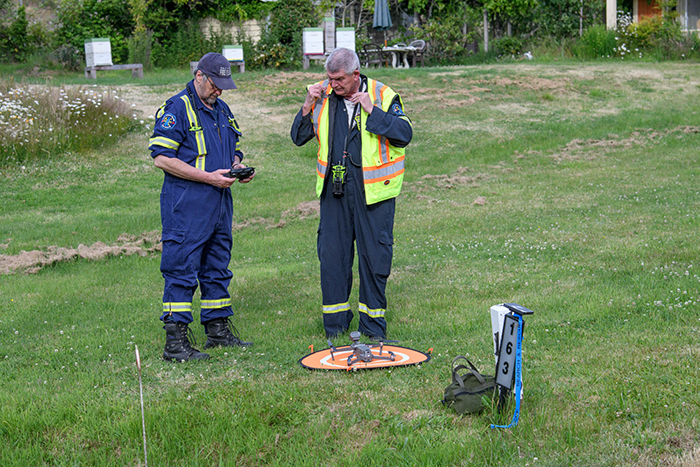
When first responders descended on Vesuvius in a surge of fire trucks, flashing red lights and rescue gear the evening of June 25, they were part of an Emergency Program exercise aimed at preparing Salt Springers – civilians and emergency workers alike – for a disaster that could happen any day.
The goal was to discover what could be learned from a dramatic – if imaginary – fire in a residential waterfront neighbourhood like Vesuvius. How would agencies work together? How would residents be warned and, if necessary, evacuated? How would missing people be searched for? What services, and where, would be offered to victims?
“We know preparation is key,” said Emergency Management lead John Wakefield, whose organization coordinates about four simulated disasters — such as windstorms, wildfires and tsunamis — every year. “When residents know how to take care of themselves and first responder agencies know how to work together, we’ll have far better outcomes when disasters happen.”
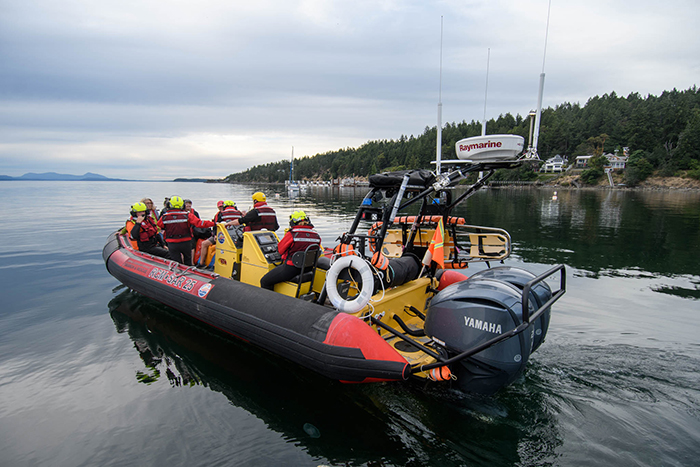
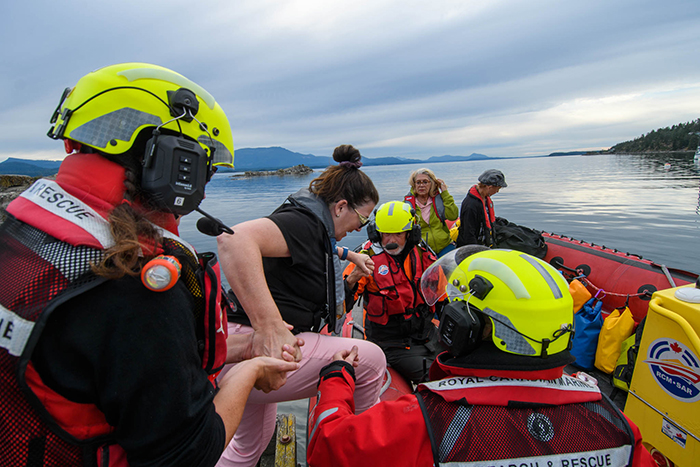
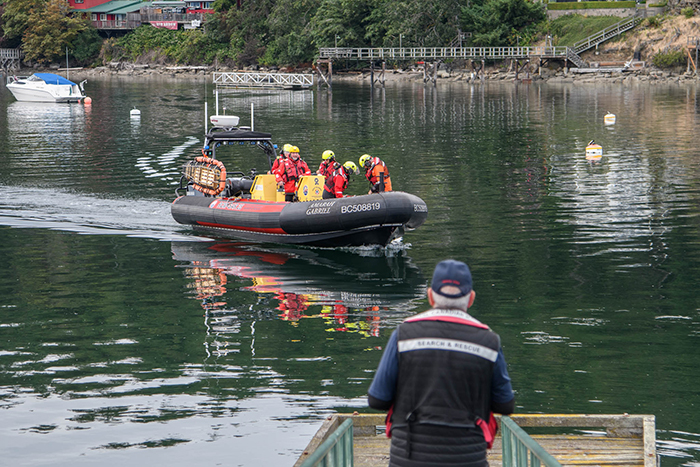
Because it’s wildfire season, the scenario for the latest exercise was a vehicle fire at Tantramar and Bayview that spread through the treetops to cover six hectares. Ground Search and Rescue crews had the job of knocking on doors to warn residents and ensuring they knew where to go. Marine Search and Rescue crews plucked four pre-selected “evacuees” off a private dock and took them across the bay to a wharf at the ferry terminal, then searched along the coastline for others reported missing. A BC Transit bus took the evacuees to a reception centre at the Community Gospel Chapel, where Emergency Support Services (ESS) helped them register for assistance.
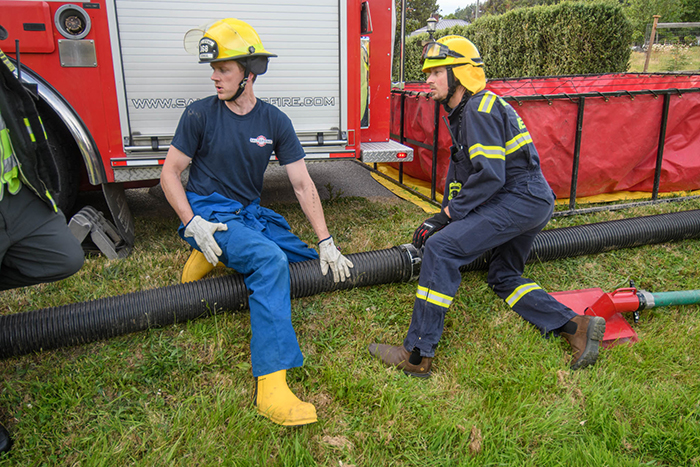
Many aspects of the scenario went smoothly, but there were the inevitable challenges. The first happened shortly after fire crews parked their trucks on Bayview, which was supposedly closed at the intersection with Goodrich. An SUV bearing residents who had just arrived from off-island needed to get past, and had to be carefully guided alongside Salt Spring Fire Rescue crews busy with gauges, hoses and a giant water storage tank set up on the road.
Speaking a few days after the event, Wakefield said a full debriefing will explore what lessons can be learned. But his initial impression was that while the marine and bus transfer parts of the operation went smoothly, there appeared to be issues around the evacuation process, as well as with communications and technology. “The incident command structure – who is controlling what and how people are working together — are the critical pieces when you have a number of agencies working together.”
Wakefield acknowledged that it’s difficult to make an imaginary disaster realistic, especially for those who know from experience how differently things unfold in real life.
“We can’t make it entirely realistic; in real life, people would react differently if there was a real fire,” said Wakefield. “But we did this on a shoestring budget with four months planning. Some agencies will spend years and lots of money to get to another level of realism, with real actors and so on. But the basic sequence of events were realistic in terms of how things could play out.”
In the end, he said, “much of the value of the exercise is the process, not the result.”
Along with providing lessons for first responder agencies, Wakefield emphasized the importance of the exercise in raising awareness among residents. Aware and prepared residents have an easier time in a disaster, and reduce the stress on the agencies tasked with helping them, he said.
Key to this on Salt Spring are the neighbourhood pods, and the Vesuvius pod is particularly enthusiastic about emergency preparedness, he said. In fact, this was one of reasons Vesuvius was chosen for the exercise even though it is not considered particularly high risk.
“The exercise was mainly geared for the response agencies, but the real thing is to involve the pods,” he said. “These exercises help the pods to get to know each other and work together, and they really do.”
Wakefield said disaster planning is often viewed in a top-down fashion, with emergency agencies at the top, but he recently heard a pod webinar presenter Corey Anderson, manager of CRD Emergency Programs, describe it as an upside-down pyramid, with the neighbourhood (pods) at the top. This makes sense to him. “To have people on the ground connecting to neighbours makes for the best responses,” he said.
Suzanne Ambers, one of the leaders of the Vesuvius pod, said Wakefield brought that attitude to the meetings with the first responder agencies on the exercise. “He never made us feel we were less responsible and less involved. He made us feel like a major player.”
As a pod leader, Ambers spent many hours helping prepare the community for the event, as all Vesuvius households had to be told about it and asked if they wished to participate. The small minority that opted out or were away had blue ribbons attached to their gateposts or driveways that day to warn off emergency crews.
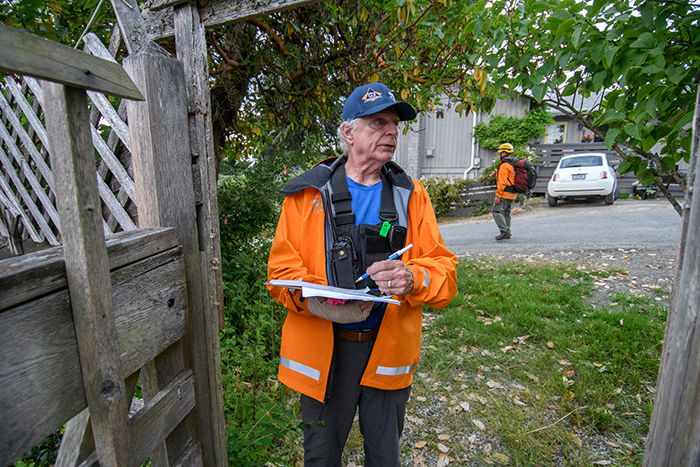
For most people in the approximately 36 participating residences, the exercise amounted to simply answering a knock on the door. There, an orange-jacketed Ground Search and Rescue volunteer asked a few simple questions: How many people living in the household? Would you need help in an emergency? Do you know where to go? Do you have pets?
Ambers said she was pleased by the Vesuvius community’s positive response to the exercise, and by the generosity of those who offered the use of their homes or docks. Most importantly, though, it raised awareness about disasters and interest in how to cope with them.
“I’m impressed with the enthusiasm of the pod for learning about fire prevention and safety in emergencies,” she said. “A lot more people are asking questions and want more information about safety. It brought home to a lot of people that this is going to happen here.”
Ambers agreed with Wakefield that the exercise brought the pod closer together. She said it also sparked interest from other pods who wanted to learn from the Vesuvius event and even participate in it.
The evacuee end of the exercise gave Emergency Support Services a chance to practice its role in a disaster. ESS lead Elizabeth Zook said its first job is to get people away from the disaster zone to safety – in this case by busing the evacuees from the ferry terminal to the reception centre at the Community Gospel Chapel.
The next step is connecting them with the basic services they need – food, shelter and clothing – immediately after evacuation. In this case, ESS workers took advantage of the opportunity to introduce the evacuees to a new process that will mean smoother, faster help for people who have had to leave their homes.
It involves registering your BC Services Card online, then going to the ESS site and creating a profile with the Evacuee Registration and Assistance (ERA) tool.
Zook said the province is encouraging everyone – even those facing no immediate disasters — to do this in advance so they can quickly access emergency support if they ever need it. The pluses are that assistance can come through almost immediately, and by etransfer, allowing evacuees to choose their own suppliers. It also means faster processing in a large evacuation and reduces pressure on emergency responders.
The exercise also allowed the ESS to practice some of its other duties, such as rapid registration – basically a quick “snapshot” of those on the bus – to provide an early heads-up on their needs and numbers in case more support is needed. The ESS also serves as a contact with the Emergency Operations Centre, so it can relay information about what’s happening at the disaster scene to the evacuees.
Zook, who has 30 years of experience in emergency management, said exercises like this can’t portray the reality of what a disaster is like, but “it was a good little practice. We got to practice some good new stuff and break in some volunteers.”
Along with its other lessons, Vesuvius’ imaginary fire shone a light on another important aspect of disaster preparedness – the vital role of volunteers. Whether first responders or community members, they were the backbone of the exercise. Of the 52 people from the first responder agencies who took part in the exercise, for example, the majority were there on their own time.
The need for more volunteers was a constant theme of those interviewed about the exercise.
Ambers said that as helpful as Vesuvius residents were for this event, pods always need more people to get actively involved. “We’re hoping this exercise will prompt more people to be willing to volunteer for pod work.”
Zook said the ESS is building a team and training new people, but it always needs more volunteers. “We’re trying to get people together to help other people.”
Writer Carol Volkart and photographer John Denniston are retired Vancouver journalists who have had a home in Vesuvius since 1999.