
Home Blog Page 127

Salt Spring Island physician recruitment and retention

BY CONNIE GIBBS

Special to the Driftwood

In May of this year, the CBC radio program White Coat, Black Art, hosted by Dr. Brian Goldman, reported that “Fewer physicians are choosing family medicine as a specialty.” Along with the entire country, Salt Spring is in a fierce competition for family doctors.

Maybe you don’t have a family doctor, or you do, but he/she is edging closer to retirement. Happily, there is some good news for Salt Spring Islanders worried about their access to a family doctor. There is a Recruitment and Retention Working Group on Salt Spring whose focus is to bring doctors to our community and keep them here. The group is pleased that Salt Spring is now a member of the South Island Division of Family Practice.

I’d never heard of this membership community of family doctors in southern Vancouver Island and Salt Spring Island. Joining this group means Salt Spring Island now has a family doctor recruiter, Niki Bouchard. She is one busy woman, recruiting to fill locums as well as permanent family doctors for communities on south Vancouver Island and Salt Spring. Locums are short-term backfills for doctors on leave, usually for vacation purposes.

Bouchard explains, “Locums can be an important way to recruit a new doctor. If it’s a good experience, the doctor might commit to setting up a practice and putting down roots. Family doctors are community people.”

Bouchard travels to “meet- and-greet” conferences across the country trying to woo newly minted family doctors to our neck of the woods. At a Toronto conference recently she talked up B.C.’s improved compensation plan for family doctors. Many graduates are struggling with burdensome levels of education debt, not to mention the costs of starting a practice, which comes with overhead, staff and a load of bureaucratic paperwork.

Many family doctors are choosing the new B.C. payment model, called longitudinal family practice, preferring this new plan to the old “fee for service one,” which is still available as a payment option, although less popular. Besides recruiting homegrown Canadian doctors, Bouchard works with international doctors, many of whom are looking to live in their faith communities where they can practise their religion. Salt Spring can’t offer what large urban centres can.

Other barriers are the familiar ones of lack of rental housing, as well as access to childcare, employment opportunities for spouses. Bouchard works holistically with prospective doctors to try and address their needs.

On the plus side, Salt Spring offers a wealth of recreation and natural beauty, opportunities to vary workload with shifts in Emergency and Acute Care, and midwives to handle maternity cases. One of the best draws is that Salt Spring is surprisingly well known across Canada. At a recent meet and greet in Ontario, Bouchard was swamped with questions from new graduates about working in B.C. One had heard of Salt Spring and asked if it was near “Victoria Island.”

Recruiting family doctors is a long process. It can take 18 to 24 months to recruit one. It’s a painstaking journey requiring patience on both sides and a willingness to navigate multiple barriers. Bouchard reassures me that “recruitment is happening” and points to 15 to 20 new doctors recently added to the region.

She stresses the importance of a collaborative community approach to help break down barriers such as housing and to help doctors get to know their new communities. Exciting examples of community support for medical staff are beginning to emerge. Relying on a lone recruiter to do it all is not realistic. It takes a community to throw in their support as the following link outlines: bc.ctvnews.ca/vancouver-island-group-release-playbook-of-proposed-solutions-to-health-carecrisis-1.6922901.

As the White Coat, Black Art program referenced above stated, “Having new doctors and their families feel welcomed and supported in the community helps keep them long term.” Bouchard says simply, “You need to take care of the healthcare people who are taking care of you.”
MLA Olsen will not seek third term

0

Saanich North and the Islands MLA Adam Olsen will not be on the ballot for the fall provincial election.

The two-term BC Green Party MLA made the surprise announcement at a press conference held in Victoria last Tuesday.

Olsen, 48, who is married and with two teenaged children, said he had been greatly impacted by the tragic deaths in the past calendar year of three men, younger than himself, who all had children that would not know their fathers.

“There are three deaths in the last calendar year that each, in their own way, have put me into an existential re-evaluation of what is truly important to me, who I’m prioritizing and where I serve,” he said. “It has put me in an ethical dilemma because frankly, I’m stubbornly reluctant to change how I serve the people of Saanich North and the Islands.

“I began asking myself, ‘How much do my children actually know me?’ Really, for the first time, I allowed myself to consider how much elected public life dictated the mood, the availability and the actions of our family. I became much more thoughtful about the impact that it was having on my partner Emily, our relationship and how that had changed. All but two of our married years have been in elected public life.”

“There’s only one story about this decision,” he stressed. “And that’s the story of what’s in the best interests of our family.”

Olsen expressed gratitude to the BC Green Party staff and volunteers, and to leader Sonia Furstenau.

“The BC Green Party has provided a political space and a rigid political system for me to be creative and expressive. The organization has encouraged me to be me, and supported me. It’s an important instrument of legislative accountability, even when there’s only been two of us in parliament. I raise my hands in thankfulness and gratitude for the opportunity to act as the conscience of the legislature for this time.”

Of Furstenau, he said, “We’ve worked together for the past seven years as close as two people can be in a political landscape that is focused just solely on removing obstacles. We have been those obstacles. And the love and the trust that Sonia has shown in me should be a model for all our political leaders.”

He also gave thanks to Green Party of Canada leader and Saanich-Gulf Islands MP Elizabeth May.

“I’m forever grateful to Elizabeth for the investment she made in me and my development as a community leader. I’ll never forget her generosity with me, and I will pay it forward wherever and whenever I can.”

A provincial election is set for Oct. 19. When asked at the press conference if he was worried that his withdrawal was leaving his party and the next candidate in a difficult position, Olsen pointed out that no other parties had declared nominees in the riding at this point.

He will also be the BC Green Party’s campaign chair for the election.

“We are delighted to have Adam in the role of campaign chair,” said Furstenau. “He brings extraordinary campaigning experience and capacity, and I know that he will help us move forward with the momentum, and with the recognition that we are a voice of integrity.”

Political cohorts offered appreciation for Olsen’s service.

“As candidates competing in provincial elections, and now as elected officials, I’ve always seen Adam as a colleague,” said Salt Spring CRD director Gary Holman. “It’s been an honour to work with him, and I’m grateful for his support on so many local issues. It seemed to me that as a First Nations leader, Adam has a special role to play in British Columbia’s path to reconciliation. He is still a relatively young man, and I hope he can find a way to continue serving our communities while supporting his family.”

His federal counterpart May said, “I am so indebted to Adam Olsen for being such an outstanding MLA. And prior to that I owe him a great deal for, as Central Saanich council member, being the only elected person to endorse me to be the area’s Member of Parliament in 2011. He is like a brother to me and I will miss him as my MLA. That said, I am confident the next BC Green candidate for Saanich North and the Islands will be elected and continue to work for the community following Adam’s excellent example.”

Olsen has been a regular guest at ASK Salt Spring sessions coordinated by Gayle Baker, who is also a Local Community Commission member, where he has reported to the community and taken questions on any topic from attending members of the public.

“While I am pleased that Adam is making life decisions that ‘excite and delight’ him, what a loss for Salt Spring!” she said. “I join so many others in appreciation of his hard work, enthusiasm, responsiveness to our concerns, willingness to address complex issues and his consistent optimism, even during those hard times.”

Baker invites people to wish Olsen farewell at the ASK Salt Spring session this Friday, July 5, from 11 a.m. to 1 p.m. at the Salt Spring Island Multi Space.

Olsen noted in his press conference that there are “many seats at many tables” and he would find alternate ways to serve his communities at those tables.

“I’m certain that after a time to reset and recharge, I’ll begin a new phase of my career,” he said.

Olsen was first elected in 2017, beating incumbent NDP MLA Gary Holman with 41.95 per cent of the popular vote to Holman’s 30.56 per cent, and 26.46 per cent received by Liberal candidate Stephen P. Roberts. He then increased his popular vote in the 2020 election to almost 52 per cent.

The Tsartlip Nation member began his political career as a Central Saanich municipal councillor in 2008.

Raagaverse and Treasure Fair team up

BY KIRSTEN BOLTON

FOR ARTSPRING

With ArtSpring’s annual fundraising auction Treasure Fair set to put over 600 items up for bid between Wednesday, July 10 to Saturday, July 13, the popular summer event has also become known for staging a festive Friday night concert.

Those who love or are curious about jazz will not want to miss Raagaverse, a creative Indo-jazz quartet whose members fuse two deeply historical and culturally significant genres with unexpected and explosive cohesion: ancient Hindustani melodies and jazz.

Quickly rising Indian vocal talent Shruti Ramani and Juno-nominated bassist Jodi Proznick, who both appeared at ArtSpring as part of the all-female jazz Ostara Project in March, are joined by pianist Noah Franche-Nolan and drummer Nicholas Bracewell for the July 12 event. All noted musicians in their own rights, they came together for this jazz experiment in Vancouver in 2022.

Since then, Raagaverse has received attention and appreciation from Canada’s music scene, including performances at the Vancouver International Jazz Festival, Jazz YYC Canadian Festival and Jazz at the Bolt.

In May 2024, they released their debut album Jaya, which includes tracks ranging from a groovy Bollywood bossa nova to arrangements of the “raga,” the colourful, emotional, melodic framework of Indian classical music. Lyrics in Raagaverse’s music tell stories of love, grief, longing and a sense of being at home, underscored by dynamic jazz harmonies.

“Having concerts like this during Treasure Fair has been a wonderful way to create a festival atmosphere for our fundraiser,” said Catherine Griffiths, chair of Treasure Fair’s organizing committee. “Ticket buyers can tour the gallery display of auction items prior to the show or visit during intermission, have a glass of wine and really make an event of it.”

Tickets to the concert can be purchased at the box office or at tickets.artspring.ca.

With just over 600 items up for bid this year, including travel and holidays, seasons’ tickets to arts and culture venues, vintage furniture, collectables, art and jewelry, food and wine baskets, BBQ and pizza ovens, life and learning experiences, and more, islanders will find something for every interest and budget.

Some of the spotlight items include a legendary Fender Jazzmaster electric guitar, a hand-crafted $10,000 wooden kayak and the Porsche 356 Speedster custom-built replica valuated at over $80,000.

In honour of ArtSpring’s 25th anniversary this year, Treasure Fair has also launched a platform to contribute either $25 or $250 to the cause. The proceeds will go towards the replacement of the threadbare and stained carpets in the building. After 25 years of wonderful community traffic to countless concerts, performances, films, school shows and exhibitions, the carpeting is getting a much-needed overhaul. The first phase will happen this August.

Registration at treasurefair.artspring.ca is required to bid and to review the catalogue. Donors and registrants are invited to the Preview Gala Wednesday, July 10 from 4 to 6 p.m., prior to bidding going live online.

Treasure Fair is ArtSpring’s most important annual fundraiser with a goal of raising $55,000. Last year was ArtSpring’s most successful drive, and the hope is in its 25th Anniversary Season, the event will reach a new level of support.

United Church music director retires

BY HELEN HINCHLIFF

DRIFTWOOD CONTRIBUTOR

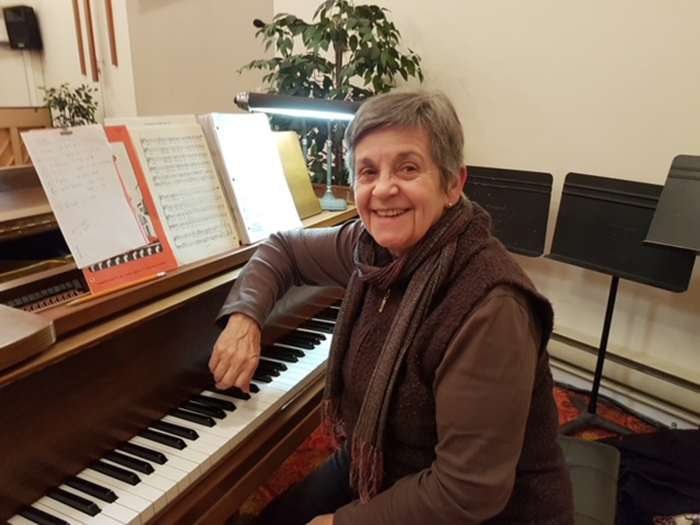
One summer day in July 1994, Shirley Bunyan walked into Salt Spring’s United Church. Lorne Bunyan, her RCMP officer husband, had recently been transferred from Vernon, and as they and their young family got settled here, Shirley, a lifelong church musician, went church shopping.

The local RCMP detachment knew of the Bunyans’ imminent arrival, and Const. Dave Simmons, himself a United Church member, mentioned the fact to Frances Eide. As fate would have it, Marilynne Cunningham, currently the longest-serving member of the congregation and of the choir, happened to be a greeter the day Shirley Bunyan arrived. As Cunningham reached out to shake Bunyan’s hand, she noticed a coil-bound United Church hymn book under her other arm, a clear signal that at minimum the newcomer could play a piano or organ. As Cunningham continued to welcome people, Bunyan found herself sitting in a pew next to Arlene Dashwood, who also noticed Bunyan’s hymn book. The following Sunday, Bunyan found herself on the organ bench, where she has been ever since. And to her great delight, Cunningham, Eide and Dashwood still sing in the choir.

Bunyan has been a church organist, pianist and choir director for over 50 years, serving in many churches and denominations in three provinces. But her longest stint by far has been here on Salt Spring Island at the United Church. Over the past 30 years, she estimates that some 60 singers have participated in our choir. One year we had 29 singers; currently, the choir averages around 15 members, who sing every Sunday from September through June or July, the only consistently serving church choir remaining on Salt Spring.

According to Bunyan, we are also the island’s hardest-working choir.

“We sing about 40 weeks per year, at least two pieces every Sunday service, averaging 80 pieces a year, with some repeats, of course,” she said. “But that means we’ve probably sung around 2,000 different songs in those 30 years.” It also means Bunyan has learned to play them and has taught us how to sing them. But we accept the challenge and, as Bunyan has been frequently heard to say, ‘Who has more fun than us?!’”

When asked for highlights of her United Church musical career, Bunyan mentions participating every year in Schmeckfest, when Salt Spring’s many choirs gather together to perform for each other, as well as for several events sponsored by ArtSpring featuring many of the same choirs. In 2004, Bunyan was deeply honoured when the late Hetty Clews, a University of Victoria professor of English and Salt Spring United Church choir member, penned “Music Makers,” (Clews’ son-in-law Sheldon Corbett composed the music) and dedicated it to Bunyan on her 10th anniversary at Salt Spring United.

Bunyan remembers 2006 as an extra-special year. Not only did we host the Christ the King Church Choir from Kampala, Uganda on July 12 that year, but we also sang the world choral premiere of This Could be the Day, along with its composer, Salt Spring’s own Alan Moberg.

“Alan allowed us to buy the music even before he and Larry Nickel published the choral version that Nickel arranged,” Bunyan remembered.

Speaking of world premieres, last year we sang Holy Ground, an anthem penned by our own Clark Saunders to music composed by Craig Cassils.

Over the years, Bunyan has been exceptionally generous with her musical time and talent, having taken on The Lost Chords seniors choir not long after she got herself settled at the United Church. She has accompanied or sung with or conducted every major Salt Spring choir, played weddings and funerals at every church, accompanied school choirs for the whole 30 years and played for many community events. She also served on the B.C. Choral Federation board for 10 years and is the proud holder of the Joyce O. McGuire provincial award for excellence in choral accompaniment.

Bunyan’s strong connections throughout Salt Spring’s music community give her the opportunity to call on musicians to accompany the choir when our anthems call for special instrumentation. We are grateful to all of them, including, for example, oboist Sheila Spence, trumpeter Michelle Footz, saxophonist John Moore, Celtic harpist Oona McOuat, cellist Paula Kiffner, dulcimer player Christy Cook, and the trumpet/trombone/horn trio of brothers Brad, Geoff and Rob Cronin.

Our exceptionally talented and beloved music director Shirley Bunyan retires on Sunday, July 7 and is looking forward to the next chapter of life that hopefully will provide time to see a little more of the world, hug grandchildren, finish a few quilts and grow a few flowers. But it will also leave her a little time to continue gently with a few musical endeavours; we hope to see her as a member of the United Church choir in the not too distant future.

The writer has been a United Church choir member for 23 years.

Editorial: Gratitude to Adam

0

Saanich North and the Islands Green party MLA Adam Olsen shocked community members last week by announcing he will not seek a third term this fall.

Anyone who has observed Olsen at work in our riding for the past seven years would have seen a person who seemed indefatigable as he thrived in the job. He has been an exceptional MLA and a strong advocate for Salt Spring and Gulf Islands concerns. He reports to constituents with a monthly column, community meetings and frequent social media posts, and has been a regular guest at ASK Salt Spring sessions since its inception. He seems to be everywhere and anywhere, as requested.

Olsen’s reason for not seeking election for a third term is entirely justifiable. Due to his political commitments, beginning in 2008 when he became a Central Saanich municipal councillor, his two children have grown up with a largely absent father. Olsen isn’t willing to let that continue for another four years. Admirably, he can’t see doing the job any other way than in full-on mode. But the loss of Olsen at the provincial political level highlights how without some form of support or structural change — MLA job sharing; more funds for staff support? — we run the risk of being overrepresented by older individuals without family considerations.

Politicians face extraordinarily high expectations. It’s as if they begin their careers with a full glass of grace points, and each real or perceived error takes a sip out of that glass. The political career is over when the glass is empty. (Imagine if the same process applied to corporations that fail to serve us flawlessly. We would have new banks, telecommunications companies and airlines replacing the old ones on a regular basis.)

These days, politicians and their families are also subject to unimaginable mindless abuse via online platforms, as well as in person in some cases. A diversity of voices in the political realm is reduced when elected officials must endure constant threats to safety, yet more diversity is needed if democracy is to function properly with broad representation.

We know Olsen will continue to serve the public in other capacities. He is a natural born leader and facilitator. But we need to find a way to make it easier for truly good people of all ages and circumstances to be the political leaders we so desperately need.

GISPA celebrates 20 years

BY MARCIA JANSEN

DRIFTWOOD CONTRIBUTOR

The Gulf Islands School of Performance Arts, better known as GISPA, celebrated its 20th anniversary at the end of the school year. Teachers and students at the program’s Gulf Islands Secondary School (GISS) home base talked with me about the program that stands out in many ways.

On the last day of school, GISPA teachers Sonia Langer (dance), Michelle Footz (music) and Jason Donaldson (theatre) and their students gathered for a small birthday and end-of-the-year celebration, complete with a cake and a happy birthday song. 

GISPA originated 20 years ago from a discussion between Langer, then music teacher Bruce Smith, Donaldson’s theatre predecessor Christina Pittman and fellow teacher Bo Curtis, who was the producer of two GISS musicals at that time.

“Those musicals, Grease and Little Shop of Horrors, were blockbusters,” Donaldson said. “It was really cool to see that the whole school was flying in the same direction. The science teacher was the stage manager and the sets were built in the wood shop. The musicals played for multiple weekends at ArtSpring and we got a lot of momentum around it.”

At about the same time, the school district was facing declining enrollment and the start of the four-day school week. GISS principal Nancy Macdonald and the school board gave the green light for GISPA, an in- and after-school credit program offering advanced education, as a way to facilitate and attract serious students of dance, theatre and music.

“With the help of coordinator Mitch Howard, who passed away in 2017, we put together this new program,” Donaldson continued. “Providing innovative arts education, integrating music, dance and theatre in ways that are exciting and inspiring; building on a philosophy of student ownership in composition, choreography and design. There is nothing like this program anywhere.”

Steph Cowan, who graduated this year and hopes to go to music school after a gap year, agrees with him.

“GISPA is different from any other class, theatre, dance or music experience in any other school. These inter-connective dynamics you can’t find anywhere.”

“Every year is different, because of the people in the program,” fellow GISPA student Tayler DeBruin added. “Different people and different personalities. We pick our shows based on the people and the talents they have, and we focus on connecting with each person, establishing a collective mind. It creates amazing strong bonds. That’s what makes this program special to me.”

Music teacher Footz joined the program six years ago.

“Our productions are like making a quilt, working with different patches and motives,” she says. “We don’t work in order or in a linear fashion, as we jump around from theme to theme and character to character. It can be a challenging process, especially for new students. I know it will all come together and when they start to see that as well, it is really special.”

Being in GISPA asks for a big commitment from students and teachers alike.

“You get opportunities that you won’t get elsewhere,” said musician Artemis Rome, who has been in GISPA for two years now. “It is not just for a semester, but every single day for a full year. During school, but also several hours outside school.”

Program participants decide on, create, manage and perform in their own productions. Their most recent show was The Curious Incident of the Dog in the Nighttime, adapted from the Simon Stephens play based on Mark Haddon’s novel, and with music composed and performed by GISPA students. Playing gigs in the community and attending shows and workshops in Vancouver and Victoria are additional GISPA experiences.

“We have a strong connection with the Vancouver and Victoria art scene,” Langer said. “Crystal Pite came to Salt Spring and was here for two full days and now she is the biggest name in contemporary dance in the world. She was in our classroom and worked with our students. That was my personal highlight in the past years.”

CRD Kanaka Road site plans shared

0

Salt Spring officials approved first steps toward growing and electrifying the island’s transit fleet, narrowly voting to advance plans for a bus depot — alongside an integrated facility for parks maintenance staff — on Kanaka Road. 

In a 3-2 vote, the island’s Local Community Commission (LCC) directed staff to submit a request to the Islands Trust for a relevant bylaw amendment for the land at 210 and 220 Kanaka Road, which abuts the western edge of the Gulf Islands Secondary School property.  

LCC member Brian Webster, who along with Gayle Baker voted against the proposal, had wanted to retain the larger 0.76-acre 210 Kanaka property for a housing project and put off bus depot plans, utilizing the smaller 0.46-acre parcel for the new parks staff facility. Those staff currently work out of an unventilated modular building on the property, with limited storage and no running water. 

But with no proponents having advanced feasible designs for housing at the site — and with other housing projects on the island that already have land allocated stalling — Capital Regional District (CRD) director and LCC member Gary Holman suggested it was economics, rather than available land, that needed to be overcome. 

“There are nine or 10 lots on Salt Spring already designated or zoned for housing,” said Holman during the LCC’s meeting Thursday, June 27. “The availability of land for housing is not the deal breaker; the deal breaker is funding.” 

Holman said BC Housing, the province’s principal funding source for non-market housing, had been contacted about the Kanaka parcels, and they had “no interest whatsoever.” That, he said, would likely mean any new residential property built on the site would have to pay for itself through market-rate sales or rentals.  

“Our objective should be to create a stock of housing that’s disconnected from the marketplace,” said Holman. “In order to do that you need funding, and Kanaka would have to get in line behind the other lots which already have proponents attached who are in active talks with funders.” 

While electrification of Salt Spring’s bus fleet may be a future aspiration, the need for a bus facility is likely to manifest sooner. Earlier in the same meeting, the LCC directed staff to reach out to BC Transit for revised costing for an expansion of bus service irrespective of fuel sources — prioritizing implementing 1,000 additional service hours on Route 2 (Fulford-Ganges) without adding year-round service to Beaver Point and Ruckle Park in January 2026, and an expansion on Route 7 (Cusheon Lake) to extend to Beddis Beach in January 2027.  

Both service expansions would require Salt Spring’s bus fleet to grow, likely to as many as 10 vehicles, according to Holman.  

Both Kanaka properties planned for the depot and maintenance facility are located in the Agricultural Land Reserve, although according to staff the CRD received confirmation from the Agricultural Land Commission that typical restrictions on use would not apply, as both parcels are less than two acres in size.  

The request to the Islands Trust will be a zone-specific variation based on an already completed conceptual site plan that CRD staff said had been made in collaboration with BC Transit staff. The land use authority would add the planned uses to the statutory definition of “Public Service” as a bylaw amendment — which currently includes facilities for road maintenance vehicles but does not note buses specifically.

Trust Council advances code of conduct

0

Concerns among elected trustees in the Islands Trust area have led to plans for updating that body’s official code of conduct, as members look for a balance that might ensure trustees feel free to voice opinions without feeling threatened. 

The Islands Trust Governance Committee voted during a special electronic meeting Monday, June 24 to advance draft language and recommend a select committee of the Islands Trust Council (ITC) develop the document. And even as committee members expressed philosophical objections to any structural limitations on speech, the sense in the room seemed to be that many were finding the tenor of debate increasingly uncomfortable.  

“This is trying to acknowledge that [discomfort], without trying to curtail free speech and constructive criticism,” said Gambier Island trustee Kate-Louise Stamford. “I think that’s a fine line to tread. But don’t underestimate how low the discourse can get.” 

Updates for the code of conduct were built from extensive examination of other governments and municipalities, and include draft language to make clear that neither staff nor the Islands Trust Council chair would be adjudicating any disputes — and that complaints that might initiate any processes can only stem from staff, trustees or Islands Trust Conservancy board appointees, not the public.  

The document lays out conduct expectations regarding personal interests, conduct in meetings, collection and handling of information, interactions with staff — and advisory bodies — as well as the use of social media and interactions with the public and traditional media. 

Staff also recommended such proceedings should be in a setting mostly open to the public. 

“The meeting should be closed as applicable, for receiving legal advice, for example,” said director of legislative services David Mar lor. “But everything else would then be done in open meetings. It’s politicians, our trustees, policing themselves; so that probably should be public.” 

Citing the wide spectrum of opinion inherent in such a body, ITC chair Peter Luckham said that there had “certainly” been numerous complaints over his time on the council, with mixed results. 

“Often the action that the complainant is anticipating is significantly less than what is prescribed,” said Luckham. “This is a valuable conversation, to figure out how we can land on a place that supports a respectful workplace and respectful dialogue.” 

Lasqueti Island trustee Tim Peterson, who also chairs Salt Spring Island’s Local Trust Committee, said while it was reasonable, for example, to have criticism about the contents of a report, it’s not reasonable to “start saying you’ve done a crappy job.” 

“I have witnessed some Trust Council behaviour,” said Peterson. “I can think of one really bad meeting last term where a trustee was named, and their approach to the particular problem at hand was called names as well. It was really dispiriting.”  

Peterson added that he felt many people struggle to keep themselves at the level of speaking to issues and ideas, rather than to personalities.  

“A lot of folks don’t have practice at that,” he said.  

Gambier Island trustee Joe Bernardo said he preferred to keep the focus on outright bullying, abuse or intimidation, saying he was uneasy with the approach of “attempting to manage the speech of trustees through prohibitions.” 

“Discomfort is part of the game,” said Bernardo. “People aren’t here to agree, they’re here to work out things and then reach agreement. Robust debate isn’t comfortable.” 

And Salt Spring trustee Jamie Harris, as he wondered why ITC needed to “line up” with other municipalities on matters like this “but not on housing,” asked for examples of specific instances of trustees feeling they couldn’t speak their minds without fear of being disparaged. 

“When it comes to the ‘unsafe’ and ‘uncomfortable’ idea, how do we describe that specifically?” asked Harris. “I’ve had another trustee this term tell me that trustees and staff feel unsafe just being in my presence. What are we talking about? It’s not my fault I am the way I am. I’m not threatening anybody, but when I hear this talk it’s very concerning to me.” 

“I’m not saying any one person, I’m just saying that it does come up quite frequently,” said Stamford. “I think this [code of conduct] is a way of framing our conversations in a more political realm, rather than focusing on aggressively winning a discussion and a decision.” 

If the Executive Committee and ITC agree, the next step for the code of conduct will be the latter electing members to a select committee to develop the document, which would then return to ITC for approval.  

In Response: Housing details are important

By GARY HOLMAN

SALT SPRING CRD DIRECTOR

Jason Mogus complains about a backgrounder drafted by CRD staff and I for the May 22 CRD Local Community Commission (LCC) housing workshop (“Housing project update – the real story”) in the June 26 Driftwood.

He says the 10 properties listed in the backgrounder with development potential of over 300 housing units was too rosy. But the backgrounder clearly states that “most properties, already designated or zoned for affordable housing,” still “require development funding, and additional water and wastewater services and approvals.”

Actually, some of these properties listed are being developed, namely the BC Housing 36-unit (originally 28-unit) Drake Road supported and worker housing project, and Seabreeze Inne renovations creating 17 health worker units. I share concerns about project delays, but they weren’t caused by local government, and when completed, these projects will hugely benefit our community.

With those two projects, plus Salt Spring Commons and Croftonbrook, a total of 131 units of affordable, worker and supported housing will have been built within five years. The majority of these new units also free up existing rental accommodation. And during this time, we finally secured year-round funding for our 30-unit homeless shelter. Developing affordable housing is challenging. More has to be done. But decision-makers and our community also need to understand when and how we succeed.

The Brackett Springs and Brinkworthy Road properties Mogus complains about were again simply identified in the backgrounder as being available for housing development. Does he know that Brinkworthy is in the provincially mandated ALR? Regardless, any future housing development there will benefit from the CRD requirement to extend the new fire hall sewer line to the Brinkworthy boundary. Mogus also seems unaware of Brackett Springs’ history: rezoned by the Trust over a decade ago, and awarded grant funding from CRD, BC Housing and CMHC. Most funding was later retracted because the project was floundering. It’s good the lender has finally listed this property for sale.

I share the disappointment about the Dragonfly project. As I wrote in the Driftwood recently, the proponents chose the more difficult strata ownership path, rather than affordable rental. Provincial regulations effectively required the creation of a water utility (to which the CRD agreed) and also precluded Dragonfly from government grants. Contrast this with the Croftonbrook affordable rental project: no utility required and receiving over $6 million in funding from CRD and BC Housing. Thankfully, Dragonfly’s owners state they’ll sell the property at cost to facilitate future housing development. Hopefully, new proponents will see the advantages of an affordable rental approach.

It’s true that an NGO has decided not to pursue the Norton Road property, already rezoned for 26 affordable units. Details are confidential, but essentially it was decided to pursue a BC Housing project grant separately from a more ambitious project on Norton. Hopefully, more news to come on the NGO project.

The LCC housing backgrounder also summarized a number of other housing initiatives, some of which didn’t exist until recently, including: the Housing Now landlord-tenant matching project; CRD Rural Housing Program (both with funding from Southern Gulf Islands Tourism Partnership); a renewed, $85-million CRD housing fund; and other provincial and federal funding and legislative measures. The backgrounder also noted that Islands Trust rezoned most of the properties on the backgrounder list, and legalized suites or cottages on hundreds of properties.

Deciding next steps to facilitate affordable housing on Salt Spring requires an understanding of existing development potential, and a rapidly evolving funding and legislative framework. Apparently, providing evidence of some progress on housing as part of that understanding is offensive to some.

NORFOLK, Terrence (Terry) Edward

 We are saddened to announce Terry’s passing at the age of 92. Terry was born and raised in Leicester, England. In his words: “I had a bloody great childhood because no one was watching.” He served with the British Army in post-WWII Germany and, after returning to England, met and married Barbara Spawton. They moved to Canada in 1956, settling in Ontario where Susan and Peter were born. Terry was very successful in the art supply industry, first as a salesman and then as a manager, which resulted in cross-country transfers between Vancouver and Toronto. After separating from Barbara in 1967, he married Lorraine Wiens in 1972, and together they raised Randy and Leslie. Shortly after Terry’s retirement in 1995, Terry and Lorraine moved from Victoria to Salt Spring Island to be closer to Leslie and her family, where he joined the Salt Spring Golf Club. They had been married for 43 years when Lorraine passed away in January 2015. Terry was predeceased by his sister Doreen, his sons Peter and Randy, and his wife Lorraine. He will be greatly missed by his daughter Susan (Bruce); grandchildren Adam (Janet), Laura (Chris), and Kirk; his daughter Leslie (Chris); grandchildren Allie (Morgan), Liam, Jaci, Zoe, and their father Paul (Diane); as well as seven great-grandchildren. Also important on this list are his treasured friends, especially the amazing Meadowbrook community where he will always be affectionately known as the coffee guy. The family would like to thank Christie and Hannah at Haywards, the staff at Lady Minto, the incredibly supportive Meadowbrook staff and residents, and family and friends near and far. A celebration of Terry’s life will be held at a later date.