Home Blog Page 128

DE LA FRANIER, Marion Agnes  (nee Schikowsky)

 It is with great sadness that we announce the passing of Marion Agnes De La Franier. Marion passed away peacefully, surrounded by loved ones, after a lengthy and very courageous battle with cancer.

Marion was born on March 9, 1940, in Humboldt, Saskatchewan.

Predeceased by her husband, Jack De La Franier, in 1995,Marion is survived byher children, Denise (Shawn) Coward and John (Yolanda) De La Franier; and her grandchildren, Benjamin, Sophia,and Colin.

Marion will be dearly missed by her family and everyone who knew and loved her.

Rest in Peace.

There will be a graveside gathering and interment for family at a future date.

Letter: BC Ferries spends responsibly to build new vessels

This letter is in response to the June 19 “Build ferries closer to home” Viewpoint by Phil Venoit.

As we embark on a significant expansion of our capacity by building new major vessels to replace aging ships, it is critical that our decision-making process for selecting shipyards prioritizes technical excellence and competitive pricing.

Our customers have been very clear: affordability is their top priority, and we cannot justify passing on the cost of a contract that is not the most competitive, simply because the shipyard is local. In fact, building locally could cost hundreds of millions — or even billions — more.

We do recognize the importance of local investment for economic support and service reliability, but it must be balanced with affordability for our customers. BC Ferries invests $15 million annually in local shipyards like Seaspan and allocates $60 million for maintenance, totalling approximately $900 million over the next 12 years. These investments are key for fleet reliability and go a long way to be a good economic partner in this province.

As we look ahead to seeking bids to build these new major vessels later this summer, we encourage all eligible shipyards to submit competitive proposals that consider the financial pressures faced by British Columbians and that deliver the vessel reliability our customers expect.

Mr. Venoit is right on one point: as an essential public service, BC Ferries is committed to delivering reliable, affordable and integrated ferry services in British Columbia. The best way we can do that is by not asking our customers to pay higher fares as we build high-quality, safe ferries and deliver them on time.

JEFF GROOT,

Executive Director, Communications

BC Ferries

Ganges beach water improves

0

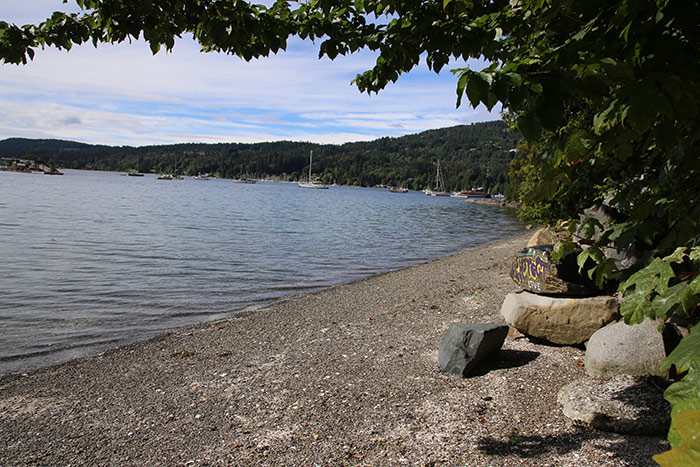
Follow-up testing at two of Salt Spring’s ocean beaches suggests island swimmers can rest easier about entering the water, according to results released by Island Health. 

Testing of saltwater samples taken on June 12 and again on June 18 showed “LT5” or less than five enterococci bacteria per 100 mL of water at Churchill Beach, down from what now appears to have been a temporary spike of 85 on June 4. 

At the Centennial Park bulkhead, where readings of 70 and 55 bacteria per 100 mL were tallied May 22 and June 4 respectively, a sample tested from water collected on June 18 showed just 9. 

Enterococci are indicator bacteria Island Health uses to identify the presence of fecal contamination and determine potential risk associated with swimming. On June 11, Island Health and the Capital Regional District issued a water quality notice advising visitors avoid swimming at Churchill Beach and to keep animals on a leash to prevent them from ingesting or swimming in the water until the advisory had been lifted. Churchill Beach is not a well-used swimming spot.

None of Salt Spring’s popular freshwater swimming lakes have shown high levels of indicator bacteria so far this year. 

Saltwater beaches are generally deemed “acceptable” when single sample enterococci results are less than or equal to 70 per 100 mL, where there is considered a “significant risk of illness” from entering the water, according to Island Health, or if the average of the most recent five finds fewer than 35 of the bacteria per 100 mL sample.  

Last summer, just three samples were taken at each Salt Spring Island ocean beach; this year Churchill Beach has already been tested four times since water quality monitoring restarted May 22. 

LCC considers bus service expansion

0

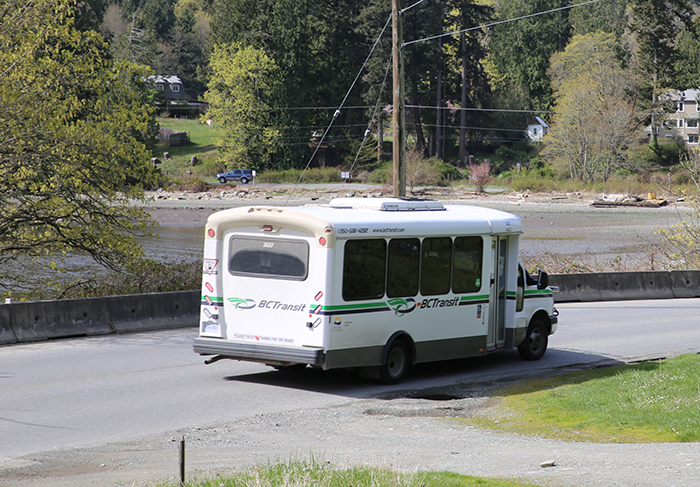
Despite an unclear timeline, the future of bus service on Salt Spring is both to grow and to “go electric,” according to BC Transit officials — but how soon those things happen lies in establishing funding schemes and infrastructure. 

That message came in broad comments delivered by senior government relations manager Seth Wright Thursday, June 20, as Salt Spring’s Local Community Commission (LCC) received a presentation on the past, present and future for the provincial transit authority’s presence here, on a modest system Wright described as performing “exceptionally” above its peers. 

“This is something that, historically, Salt Spring has always been able to take some pride in,” said Wright. “And that continues to be the case.” 

Salt Spring’s bus system still punches above its weight for a “small community transit system,” he said, in part because of rider habits but also due to historically low operating costs. Wright presented several recommendations for transit expansion in coming years, notably including a plan for additional service on Route 2 — the Fulford-to-Ganges service that represents roughly half of all rider numbers on Salt Spring. 

Any potential expansion comes at a cost into six figures, according to presentation documents. Capital Regional District (CRD) director and LCC member Gary Holman joined other commissioners in expressing concerns over the price tag, even as all agreed the system was oversubscribed by an amount that may be greater than calculated — from potential riders who don’t even consider riding the bus due to that under-servicing. 

Back in March, Wright had brought the LCC startling data surrounding increasing numbers of “pass-ups” on Route 2, as drivers tallied a rise in the number of people who were waiting along the road hoping to catch the bus but were thwarted by it being fully occupied. 

And even as Wright on Thursday reported the happy news that Salt Spring ridership has returned to 100 per cent of its pre-pandemic numbers, Holman warned of what he saw as the “other shoe” dropping on the island come 2025: a likely need for increasing the tax requisition. 

“We haven’t had, really, a sustainable requisition,” Holman said. “We basically exhausted our operating reserve, in part because of Covid and all of that ridership going down.” 

“So we’ll be facing a cost increase from BC Transit — to be confirmed,” he continued, noting plans had not been finalized. “And we already need an increase just to get our current requisition sustainable. And then added on to that would be the cost of improved service.” 

Any decision to expand service — on the Fulford route, or on any others under consideration by the LCC, such as the Beddis Road or Ruckle Park routes — would need to be received by Sept. 20, Wright said, in order to be included in BC Transit’s proposals to the province. 

“Salt Spring has been one of the most affordable transit systems, when you look at operating dollars for service,” said Wright. “But as we face the affordability crisis, our operating company on Salt Spring has identified there are some significant ‘pinch points’ and they need to allocate more resources — for supporting the administration of the transit system, supervision of the service and being able to respond to emerging issues.” 

Such costs have been on the increase across B.C. and indeed North America, Wright said, within the transportation industry. But, he said, increasing funding would also ensure future reliability and being able to pay drivers a living wage. And all that, he suggested, should start on the Fulford-Ganges route, where scheduling is currently driven by the BC Ferries schedule. 

“There is a bus for every ferry,” said Wright. “This additional service would add extra trips that would not be aligned to the ferries — and that would guarantee greater access to service for local residents.” 

That bus fills up at peak in both directions, according to ridership data — “And no one wants to plan to get on a crowded bus,” said Wright. 

And while his analysis suggested those ferry-aligned trips would continue to represent the highest ridership numbers, over time people who used the system regularly would adjust. 

“If you know there’s a bus after the ferry bus, you’re going to plan to take that one,” said Wright. “Behaviour changes, and after some time it balances out a little bit. I think it will benefit the community.” 

Ultimately, according to Wright, the better solution would be bigger buses serving the route — but without suitable space for them to turn around in Fulford, BC Transit can’t make plans in that direction. 

“BC Ferries does have a capital vision and a detailed plan to move that forward, but there’s a number of steps,” said Wright. “Their capital budget is combined with their operating budget; that means that they don’t have any certainty until they have extra operating money they can use on capital projects.” 

Wright also said when BC Ferries moves to additional ferries not only on the Vesuvius Bay route but also at Fulford, that will help with bus scheduling. 

“Right now we have to build our schedule very tightly around the ferry,” said Wright. “But if eventually they run often enough that we can just put a bus down there every hour and make it so people never have to wait more than half an hour for that connection, that will enable us to build more flexible schedules.” 

Asked about a timeline for the local fleet’s electrification — particularly relevant as commissioners consider significant plans for a new bus depot and maintenance yard at CRD-owned land on Kanaka Road — Wright was vague, if optimistic.  

“I have passionately and vigorously waved my arms every time there are conversations about this,” chuckled Wright, “and said that Salt Spring is very interested in the introduction of battery-electric buses and would be keen to do that.” 

But the current bus storage area on the island — an unfenced gravel yard behind the Community Gospel Chapel on Vesuvius Bay Road — is “very suboptimal.” 

“We’d like a proper paved and fenced facility for safety, security and maintenance reasons,” said Wright. “But also that [level of infrastructure] enables battery-electric buses, and the sequence is based on the ability to install infrastructure. So proceeding with that capital project on your end will enable you to move forward with that.”  

Discussion of Kanaka Road plans — currently in the conceptual stage, envisioning a combined facility for bus depot and park maintenance uses — was planned for June 20 but postponed as an in-camera discussion on potential legal issues took much of the afternoon’s allotted time.  

While funding for a bus service expansion would likely come from a combination of user fees and local taxes, a staff report prepared for the meeting noted the Kanaka Road project would likely be completed through a combination of grants, capital reserves and Community Works funding — what used to be called “gas tax” monies, as that fund was originally built from federal gasoline excise taxes, allocated to local governments based on a jurisdiction’s population.  

Viewpoint: Good start for Salt Spring LCC

By EARL ROOK

Salt Spring Local Community Commission chair

In the 2022 general election, Salt Spring approved a new government entity, the Local Community Commission (LCC). Just over a year ago, four new local commissioners were sworn in, joining the local Capital Regional District (CRD) director on the first Salt Spring LCC.

Our first year was spent setting up and making the new LCC operational, diving deeply into the details of the CRD services delegated to the LCC, and confronting the most significant issues facing our community. One’s view on the success of our first year may depend upon your perspective, but from my perspective as chair, a good start has been made. Some highlights include:

The LCC instituted a regular, predictable, public meeting schedule for the second and third Thursdays of each month, the former at 5 p.m. to make it easier for working residents to attend. Holding regular evening business meetings was a priority for the LCC from the beginning. Making it happen took several months of negotiations and planning, an object lesson in the challenges of making even seemingly simple changes.

One of the first major tasks for the new LCC was the review and approval of the 2024 budget for LCC delegated services. The initial budget came in at over 200 pages with a year over year increase of 20.5 per cent. After delving into the details over many meetings, we approved a final budget in February that maintained current service levels with an increase limited to 10.5 per cent. A crash course in the arcane world of CRD budgeting, the process called for difficult choices, while exposing long-term fiscal concerns (maintaining adequate reserves, funding capital projects) that will need ongoing attention. The LCC is already at work on the 2025 budget.

At one of its first meetings, the LCC declared that housing for working people and their families is Salt Spring Island’s most pressing economic sustainability issue. We moved that the CRD Board endorse adding Salt Spring to the provincial Speculation and Vacancy Tax program, and formally requested revision of the economic sustainability bylaw to maximize our allowable scope of activity. We held a housing summit with stakeholders to clarify the role of the LCC in housing and are working the housing crisis on multiple fronts.

As the new player in our fragmented local government, the LCC has made a priority of collaboration with other government bodies and non-profits. In addition to the housing summit, we have begun regular joint meetings with the Salt Spring Island Local Trust Committee, to coordinate work on issues of common interest, including revision of the official community plan, housing, water, Ganges revitalization and harbour management.

Our strategic plan for the remainder of the term will be published soon. Among top priorities are housing (particularly for workers and the unhoused), liquid waste and Ganges village revitalization, including the long delayed harbour walk project. We also plan a review of local bylaws and operating procedures, development of a more sustainable and transparent budgeting process, and expansion of the initial LCC mandate to more island CRD services. Stay tuned — we’re just getting started.

COOMBES, Alan Sydney

 Alan Sydney Coombes, a beloved husband, father, grandfather, and friend, passed away on June 14, 2024, after a short illness. A celebration of his life will be held on July 13th, 2024 from 2 to 4 pm at 210 Bridgeman Road, Saltspring Island, BC. In lieu of flowers, the family requests donations be made to SPCA or Pacific Opera Victoria in Alan’s honor. Condolences may be offered to the family atwww.mccallgardens.com

ADALIAN, Yvonne

 Born in Sussex, England, Yvonne emigrated to Vancouver in 1959 with her first husband. She loved the wildness of BC, and although she lived and worked across Canada, she always returned to it. She enjoyed her acting career in radio, stage, TV, and film, and on Salt Spring Island, she also enjoyed directing and producing with her own theatre company.

She loved animals, wild or tame. Her travels included a trip to Kenya, where she could experience the raw wild of that continent in person. As an activist and always the optimist, she expected the people of this planet to grow up very soon, pull themselves together, and honour the sacredness of every living thing.

She is survived by her son Eric; predeceased by her brother Barry, father John, mother Flora, and grandson Kai.

SHAAK, Robert “Bob”

 Bob departed on his final adventure sooner than expected and, like many of us, I guess, leaving behind unfinished plans and projects. Although he was not ready, complications from a heart valve implant dictated otherwise. 

Bob had a great sense of adventure and zest for life. He was passionate and committed to most everything he did, from building our home to baking buns! Whether it was flying, sailing, motorcycling, scuba diving, skiing, welding, working on his many vehicles, or reading a book, he enjoyed it all. He especially loved his tractor and could hardly wait for snow so he could help plow out the neighbourhood. 

Other interests included music, singing (Salt Spring Singers), attempting to learn to play the five-string banjo, and practicing the trumpet. He enjoyed poetry and charmed us with his recitations. The intricacies of the sewing machine fascinated him; from hemming his own pants to sewing sail covers. 

One friend described him as a “true prairie renaissance man. There seemed to be nothing that he couldn’t do or learn how to do.” He would have loved to have been a farmer. As a young man, while attending college in the States, he followed the harvest, custom combining from Texas to North Dakota. After graduating, he spent two and a half years in northern Thailand volunteering as a mechanic on a Presbyterian mission farm. 

After meeting and marrying Dawn in Regina, we both completed Master’s Degrees in Social Work from the University of Toronto. Most of our working years were spent in Saskatoon, where Bob enjoyed working with delinquent kids. Following our move to Salt Spring 30+ years ago, some will remember him as a school bus driver. 

His older sister, Lorraine Bell, and nephew, Ken, will grieve his loss. 

I will miss most his wonderful smile, sense of humour, keen wit, and enduring love over these past 60 years. He was a kind and generous man, loyal to his many friends. I will miss our Happy Times as well as our “Happy Hours,” where we discussed the day and plans for the morrow. We, as a couple, were good together. My best friend, my partner, my soulmate. 

Thank you to the many of you who have reached out to me with your support and comfort. 

There will be no service or celebration of life. 

Cherish your families, your friends, and your neighbours!  

Dawn

Trust Council commits to public mandate discussion

0

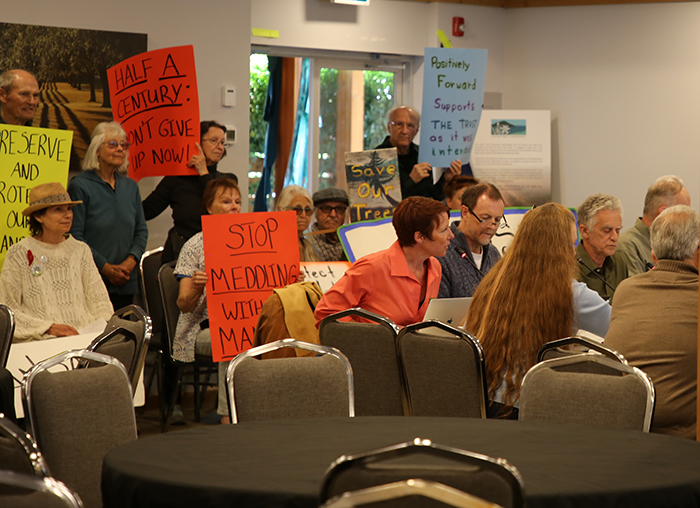
As protesters gathered outside a meeting held on the most populous island within their jurisdiction, elected officials serving on Islands Trust Council (ITC) struggled with what one trustee called its status as a “structurally unsound organization.”  

And for a topic not technically on the agenda, Section 3 of the Islands Trust Act — commonly called the “preserve and protect” mandate in the Trust’s foundational authority — used up an outsized amount of the parliamentary oxygen in the room during ITC’s June 18-20 meeting on Salt Spring Island.  

From opening “roundtable” trustee remarks to delegations, public comments and written correspondence, it was clear islanders’ concerns over that mandate — and uncertainty about how trustee consensus on its interpretation may have been reached during a closed session in September 2023 — have survived both Executive and Governance Committee efforts to class the matter as settled.  

That closed session, from which trustees emerged to eventually release multiple versions of a “consensus statement” on interpreting the mandate, has rankled open government advocates ever since — and “blowback” from islanders has led to public disagreements among trustees, disputing not only the substance of that interpretation but even whether it qualified as an interpretation at all. 

“This is a hurdle we have to get over,” said ITC chair Peter Luckham. “We can’t ignore it. We need to get over it so that the public can have their answers and we can move on with the important work that we need to do — particularly around the Policy Statement.” 

In October the Islands Trust released a draft “consensus statement” disclosing trustees had — reportedly through an examination of specific legal opinions — reached consensus on interpreting Section 3, notably in that the definition of “unique amenities” targeted for preservation and protection may include “housing, livelihoods, infrastructure and tourism.” 

That seeming shift away from what some considered a foundational focus on protecting the natural environment and limiting growth sparked lively public comment, which in turn prompted the Trust to release a second statement in January on the “scope and meaning” of the mandate clause, “to make public the results of our discussions and share with our constituents how the current Trust Council intends to interpret our mandate, which in turn will help inform our strategic planning.”   

And at trustees’ first Committee of the Whole meeting at the beginning of June, disagreements arose about whether the in-camera session produced a consensus at all — and whether there was any new direction as a result of those discussions. 

Luckham told trustees last week he believed the best way forward was to have another, similar meeting — this time fully in public session. 

“The only way we’re going to be able to provide this answer is to re-do that conversation,” said Luckham. “Maybe we’ll come up with a different conclusion, because we’ve certainly heard a lot of concerns from around the Trust Area.” 

Bowen Island trustee Judith Gedye, who chairs the Trust’s Governance Committee, said the “blowback” from those public releases had often become personal — and she worried a broad repeat of the discussion among the entire Trust Council might not yield better results without some guidance. 

“We haven’t had a chance [in the Governance Committee] to talk about where the mistakes were, and how we would improve,” said Gedye. “How do we analyze it? How do we make sure that we don’t do the same thing again?” 

Gambier Island Local Trust Area trustee Joe Bernardo characterized the in-camera discussion not as a change in direction for the Trust, but rather a clarification of its current direction. 

“The purpose of that whole thing was to reach an accurate understanding of what Section 3 has always meant,” said Bernardo, adding that trustees have always had “tremendous” discretion in how they interpret it. 

“With respect to the general discussion about the Section 3 issue that’s come up, the communication over this — let’s face it, we’ve got to be honest with ourselves — we failed,” said Bernardo. “There’s quite a bit of suspicion that we’re up to something; I don’t think we can do much about a conspiratorial mindset, but we can be more transparent.” 

To that end, Bernardo suggested any future public discussion should centre not on revisiting that interpretation, but rather whether and how trustees might simply release the legal opinions that guided trustees into that interpretation — a move which, he added, would likely require additional legal counsel on the merits and risks involved. 

“The public may not agree with our conclusion,” he said, “but at least it will address the question in good faith.” 

Saturna Island trustee Mairead Boland pointed to the mandate interpretation kerfuffle as emblematic of a governance structure that may have outlived its purpose. 

“In 2024, [the Islands Trust] is a structurally unsound organization that cannot find its way,” said Boland. “How many local governments repeatedly seek legal opinions on the meaning of the mandate they have been given?” 

Boland said it could be argued the work of the Islands Trust Act was complete by the 1990s, by which time each island had an Official Community Plan which could be used to manage growth — instead of the Trust itself having grown to where “a budget of $10 million, 65 staff and 26 trustees are required to do what is described at its core as ‘land use management’ — for a population of 30,000.” 

She and other trustees echoed the sentiment of previous councils’ appeals to the Minister of Municipal Affairs for a provincial review of the structure and governance of the Islands Trust. 

“We are too wounded to heal ourselves,” said Boland. “We are propping up, repairing and limping on with a governance structure whose time has passed.” 

Trustees ultimately voted to add a discussion on the Section 3 mandate to September’s ITC meeting, set for Sept. 24-26 in Nanaimo.  

Shiny geranium spread prompts alarm

0

While Salt Spring residents may be fully educated about the need to eradicate Scotch broom and gorse, a new destructive species has bloomed its way into the invasive species spotlight.

Shiny geranium (Geranium lucidum) has suddenly taken hold in a number of areas of Salt Spring — including on one part of my own property on Cranberry Road — prompting Transition Salt Spring Native Plant Stewardship Group (NPSG) and members to spend many hours of volunteer time pulling it from the ground and finding the best way to deal with it to prevent the seeds from travelling and sprouting elsewhere.

Jemma Green is the Islands Trust Conservancy (ITC) rep in the CRD-led Capital Region Invasive Species Partnership (CRISP) program. As an ITC protected areas manager, she works with private landowners to manage their conservation covenant lands. Green said she hadn’t seen shiny geranium on Salt Spring Island until last May.

“While doing a routine annual survey of one of our conservation covenants in the Reginald Hill area, I noticed an infestation of shiny geranium. It was growing on an unstable, rocky, southwest-facing slope, in both sun and shade, with very shallow soil. This plant seems able to grow in most conditions.”

Green said she and the landowners felt it could be an isolated incident that needed to be contained to protect the rest of the island, and spent several days last fall and this spring hand-weeding as many plants as possible, before they could go to seed.

Then just a few weeks ago she was contacted by islander Trish Cannon and others inquiring what to do about shiny geranium, “because it was all over their neighbourhoods and other neighbourhoods on the island.”

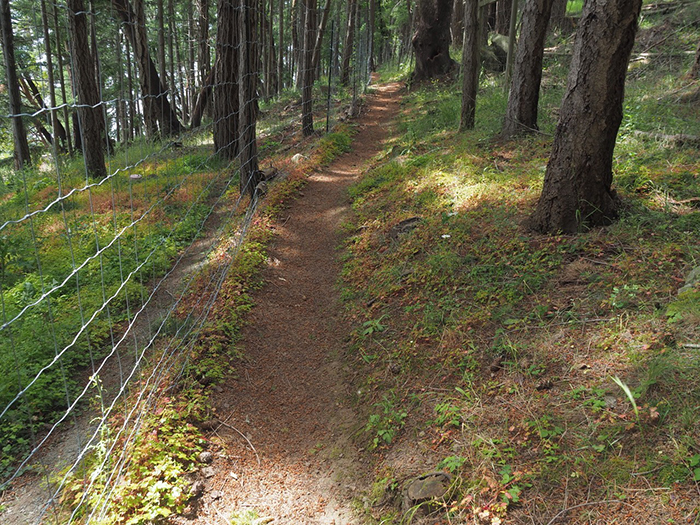
Cannon and longtime NPSG volunteer Cathy Young said there are extensive areas of the plant — which outcompetes native vegetation — in the Capital Regional District’s Quarry Drive park trail and on the trail between the former Vesuvius Inn and Margaret Drive. Trail edges have been cleared there for quite a distance. Other places it has been found besides the Reginald Hill area located by Green are North Beach Road, Arbutus Road, Morningside Drive, Cusheon Lake Road, in a Channel Ridge, on King Road south of Beaver Point Road, and along the trail in the north end of Ruckle Park.

“We’ve barely got a dent in it,” Cannon said about volunteer efforts to remove it from Ruckle Park.

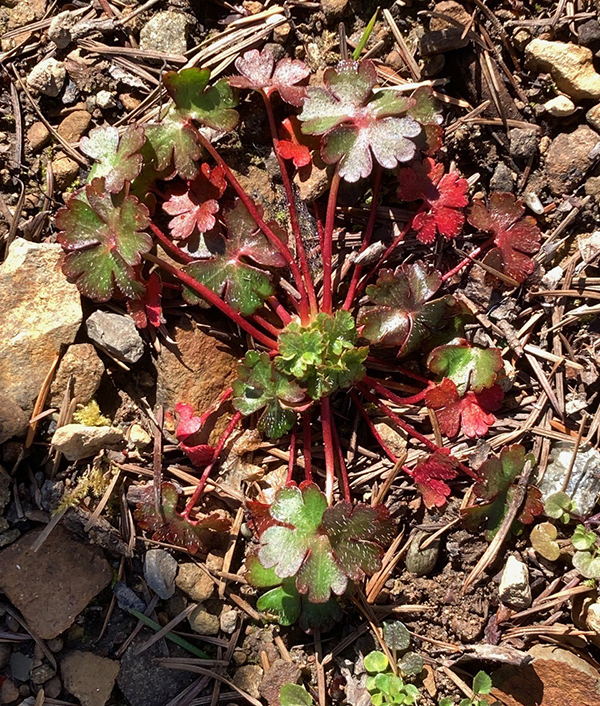
Shiny geranium growing in dry, gravelly terrain, with leaves turning red and bright red stems highly visible. (Cathy Young photo)
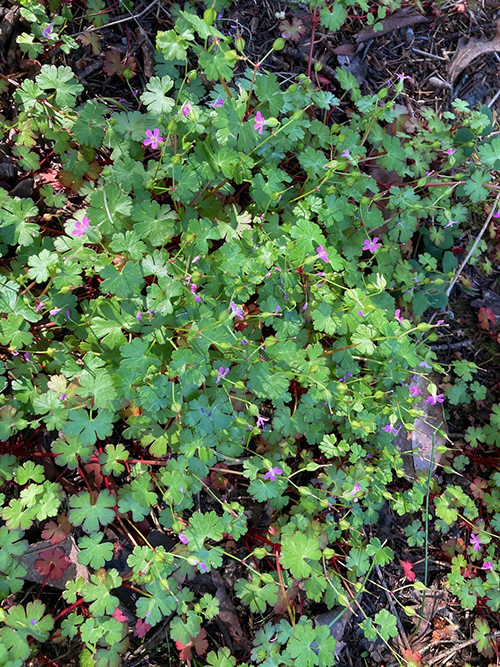
Shiny geranium in wetter terrain and when blooming in spring. At this point it can be mistaken for dove’s foot geranium, although its leaves are shinier and dove’s foot geranium does not have red stems.

The plant’s potential impact on rare Garry oak habitat is of particular concern.

I knew nothing about shiny geranium until Salt Spring Island Conservancy (SSIC) biologist Susan Hannon was visiting my property for a conservation site visit in late May. She spied it instantly in a small cleared area just off my driveway. I have since been alarmed to see how far it has spread from there and have spent a fair bit of time on removal attempts, but have much more work to do!

Fortunately, the plants have a shallow root system and are easy to pull out of the ground, and because they are annuals, it doesn’t matter if the entire root is removed. It’s the prolific seeds that must be kept from germinating.

Young adds that the plants are not hard to find. Their stems are bright red, and even the leaves turn red when the weather warms up or the soil is dry. Otherwise, the small five-petaled pink flowers look similar to those of other geranium species such as dove’s foot and herb Robert, and a couple of others. I could describe what the plant looks like with words, but the photos on this page tell the story better.

“It is quite happy to grow in almost all conditions of sun or soil and water, though it needs a minimum,” said Young. “Unusually, seedlings germinate after the first substantial fall rains, and persist over winter, to flower in April and May, when it may have three generations before the heat of summer turns leaves red, and almost disappear. Seeds are forcibly ejected up to six metres (20 feet), and are small but thankfully not tiny: at two millimetres, they are about the size of a sesame or tomato seed. Seeds can survive in the soil for two years, and spread on hikers’ boots, dogs, etc.”

Young is hoping that applying concentrated vinegar when the plants are small — in the fall or early spring — could kill them. A CRD Invasive Species Alert Sheet suggests mulching an infested area as another option for smothering young plants and suppressing the seed bank.

Young said the NPSG hopes to have an eradication workshop for the public sometime this fall.

She said disposal of the pulled plants is “problematic because it can’t be composted — the seeds continue to develop — but I’ve been ‘solarizing’ them: sealing them in a clear garbage bag and leaving it in the sun. Inside the bag it heats up tremendously, quickly turning them into dead brown plant matter, hot enough to kill the seeds.” Alternatively, they can be taken to the Blackburn Transfer Station and included in regular garbage, or to Hartland Road Landfill in bags labelled “Invasives.”

Cannon said the biggest challenge at the moment is the lack of hands available to do the hand-picking required. She hopes a grant may be acquired to hire people next year.

Islanders can also help prevent the spread of shiny geranium by checking their own property or public lands and following the advice for eradication.

“I want to make Salt Spring ‘shiny free,’” said Cannon. “If it gets out of control, we are never going to get on top of it.”