Home Blog Page 129

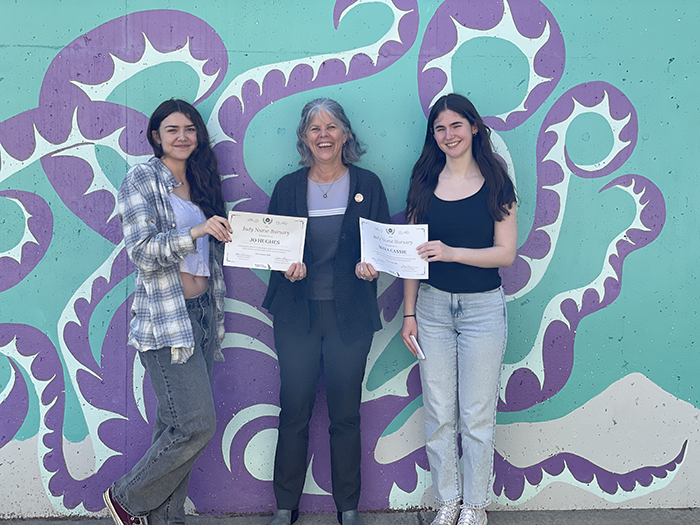
Judy Nurse bursaries awarded

SUBMITTED BY SALT SPRING ISLAND PUBLIC LIBRARY

Judy Nurse was a dedicated Salt Spring library volunteer for over a decade, serving on the board of directors for six years, from 2017 to 2023. 

As library board chair for her last two and a half years of library service, she gave countless hours of her time, skill, intelligence, insight and goodwill.  As the chair of the library’s long-term planning committee in 2021, Nurse was a champion of the library’s current strategic plan. Her vision and leadership led to broad community engagement, and new library priorities on diversity, equity and inclusion, reconciliation and climate change. Working together we moved quickly forward on new initiatives including the FabLab and Indigenous Learning Area. Above all, Nurse valued the library as a place for everyone, and it was her idea to put the new library guiding principle “You Belong Here” above the library’s front entrance.

Now the next generation of library volunteer and working students can benefit from Nurse’s love of our library. Her husband, Murray Nurse, and three children — Laura Morris, Michael Nurse and Heather Connolly — are sponsoring the new Judy Nurse Bursary in her memory.

This year’s recipients, Maia Cassie and Jo Hughes, have been wonderful volunteers and working students with the library for many years. They both worked in different positions, from summer camp leader to social media expert. Cassie and Hughes are not only highly valued library team members but also exceptional high school students.

Hughes graduates from Gulf Islands Secondary School and will follow her passion for archaeology, having been accepted into the archaeology program at Simon Fraser University.

Cassie graduates from Queen Margaret’s School in Duncan. Her next step will be to study social sciences at the University of Toronto.

The library congratulates them and wishes them the best of luck in their future endeavours.

Housing project update – the real story

By JASON MOGUS

Many people were confused by the positive message on housing projects put out by the Capital Regional District (CRD) at their recent housing forum, and even more so with the notes from a recent CRD/Local Community Commission meeting shared as news to a popular local website.

The CRD said “up to 335 units could be developed on 10 properties already designated or zoned for affordable or market housing,” and went on to list nine projects.   

A casual reader would have been impressed by the CRD’s list. These are the types of non-profit-led and government-funded projects that even the most ardent opponents of housing action here say they support. 

Unfortunately, the list is quite misleading. Very few of the projects on it either still exist, or have much hope of moving forward. Here is a more realistic update.

Two of the best projects on the CRD’s list have been outright cancelled in 2024. The most heartbreaking housing story of the year was when Dragonfly Commons pulled its project, moved to dissolve its non-profit society and sell the property. This was a beautiful project, brought forward by a mission-driven, experienced team who invested years of their lives. The developers shared a surprisingly honest letter as to why it collapsed in this newspaper. It wasn’t possible for them to continue jumping through the endless hoops — permits, water, roads, funding or appropriate support from the CRD, Islands Trust and Province. Who is going to take another run at this when such an experienced, committed, and well-resourced team couldn’t make it happen after nearly a decade of effort?  

The second phantom project on the list is Norton Road, where the non-profit developer also walked away, saying they lack the staff capacity to go through the extensive rezoning marathon that is Salt Spring. Both these projects were withdrawn before the CRD’s list was published online.  

The proposed Brinkworthy project, a neat farm, food and non-market housing mix planned for under the power lines next to the new fire hall is also receiving bad news. Far from rolling up their sleeves and asking how they can help, rigid and non-collaborative local agencies instead present barrier after barrier to Island Community Services. This project might now also be at risk.  

What about Brackett Springs, the abandoned homes on Rainbow Road that have been rotting for the past decade? Multiple banks, non-profits and private investors explored reviving it, but they all walked away because the cost of rescuing it was too high for the possible rent return on 11 affordable units which is what is allowed under the zoning. And even if a mission-driven developer showed up to run a multi-year re-zoning process to increase the density, where would the water for the additional units come from? Remove one barrier and another is revealed. This is the story of non-market housing projects on Salt Spring.

The CRD’s own Drake Road project, promised as an emergency modular supportive housing to be built rapidly during the pandemic two years ago, is still an empty field, although excavator work has begun there, and the Seabreeze Inne also appears to remain abandoned, though in fairness for different reasons.

The sad truth is, many of the projects the CRD director regularly touts as “housing wins” for our hurting community are either not happening or not likely to happen any time soon. Each one will take years and years of effort by as-yet-unidentified non-profits or good-willed individuals. Even then, they are just as likely to fail given our community’s lack of leadership and poor inter-agency collaboration between the Trust, CRD and North Salt Spring Waterworks District.

Most of us working on affordable housing are disillusioned and tired from working so hard to make progress in a system that seems only designed to slow things down, with no inter-agency plan for solving housing, and a passionate local conservation movement organizing in opposition to most solutions proposed by local governments, the most impacted people and housing experts. 

I’d like to hear what housing opponents have to say about so many of these projects failing to advance, after working so hard to kill the Salt Spring Local Trust Committee’s accessory dwelling unit bylaw. I would also like the CRD director to be more frank with the community about the real state of affairs. It does us no good to be fed false hope, or information that veers on misinformation. 

Lynn Kodeih begins residency

ARTICLE CONTRIBUTED BY SSNAP

The Salt Spring National Art Prize (SSNAP) community is excited to welcome Lynn Kodeih to Salt Spring Island this week as she begins her residency.

Kodeih was a finalist in the SSNAP 2023/24 competition with her piece titled Impossible Garden and chosen by jurors from those who applied for the residency opportunity.

In her recent project — Récits de plantes #2 (2021-2024) — the immigrant artist creates a way to transport house plants from her home country. Over the course of her first year in Canada, she collects species of house plants she owned in her country of origin, makes cuttings for propagation, covers them with liquid clay and fires them. In an attempt to circumvent the regulations of the Canada Border Services Agency, the artist transforms living matter into objects and relocates it. Only imprints remain, crumbling to the point of disappearance. Questioning notions of states and borders, the work investigates her immigrant position in a country haunted by its colonial history.

Kodeih is an artist/researcher born in Beirut and based in Montréal (Tiohtià:ke/Mooniyang). Focusing on the interweaving of art and politics, her practice is at the intersection of textuality and auto-theory, video and installation. She is interested in the notions of territory and borders from a decolonial perspective.

Her practice has been supported by several scholarships and grants, including from the Canada Council for the Arts. Kodeih is the recipient of the 2024 Bronfman Fellowship in Contemporary Art. Her work has been shown in numerous group exhibitions in Canada and abroad, including La Galerie de l’UQAM (Montreal), SAW gallery (Ottawa), Kunstbanken Performance Festival (Norway), Rotterdam Film Festival (Netherlands), Transart Triennale (Berlin), Home Works – Ashkal Alwan, Beirut Art Center and Beirut Art Fair (Lebanon).

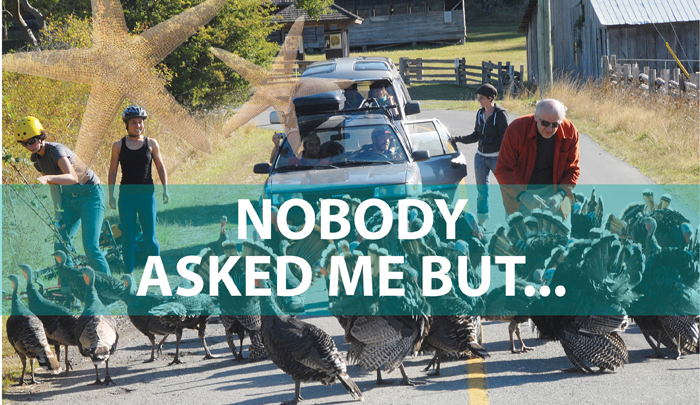
Nobody Asked Me But: Who’s the real invasive species?

0

Lock your doors! Shutter the windows! They are on their way and they’re coming to get us.

No, this is not the imminent zombie apocalypse that the social networks have been warning us about for ages. Neither is it an alien invasion from outer space that will steal our planet and replace us with mindless pods.

We are not dealing with science fiction here. The danger, it seems, stems from invasive species which have escaped into our forests, wetlands, rivers, oceans and even the skies above our heads. Whether they have been imported accidentally or intentionally, they pose a threat to the biodiversity of our country, province and even this island we call home.

These alien invasive species may come in the form of plants, mammals, reptiles, amphibians, birds, invertebrates, and even micro-organisms. Instead of bearing ominous monikers like Vlad the Undead or Gork from Klingon, they may carry innocuous names such as Lilly of the Valley, zebra mussel or house finch. Make no mistake, though; once they get a foot, root or fin in the door, they are almost impossible to control.

According to the Salt Spring Island Conservancy, approximately 175 different exotic plants have infiltrated our woods and forests. They may look pretty and may even have some beneficial effects, but they are bullishly aggressive and it’s almost a guarantee that they will not play “nice” when push comes to shove. If left to their own devices, they are sure to choke out the native plant species that have spent eons adapting to our climate and geography. The conservancy advises that these intruders should be removed whenever and wherever they are encountered.

You can draw a comparison between these noxious weeds and your obnoxious, good-for-nothing, freeloading brother-in-law who lands on your doorstep with yet another sad-sack story about how his landlord has evicted him for absolutely no reason and he just needs a place to crash for a few days, max, and you know that months later he will still be couch-surfing in your basement while eating you out of house and home.

Okay, maybe I’m exaggerating. Your invasive plants are much worse than that. Once you let even one in, it will spread like a cancerous growth, sucking up all the nourishment and moisture from the soil while at the same time blocking any light from reaching those native organisms that depend on the sun’s energy to survive. Come to think of it, I have a cousin who is just like that.

Never mind that, though. Let’s take a look instead at how the introduction of an invasive animal can spell disaster for an ecosystem. In the mid-19th century, Hawaii was a major global producer of sugar cane. Unfortunately, rats, themselves invasive aliens who had come ashore from the holds and bilges of sailing vessels over the previous centuries, had multiplied to the point where they were destroying entire cane crops on the plantations. As a result, somebody came up with the brilliant idea to import the mongoose, a small furry mammal native to Africa, Asia and parts of Europe. The plan was for the mongoose to eradicate the rat population and thereby save the sugar cane economy. The Hawaiian brain trust brought in 72 mongooses, bred and raised them, and eventually let them loose to feed on the island rats.

There was one problem, though. Rats are nocturnal creatures who sleep during the day. Mongooses, on the other hand, are active only during the day. Consequently, the two never had the pleasure of making each other’s acquaintance. Instead, the mongoose practically demolished much of the local native species of fauna, including seabirds and nests of turtle eggs. You might say Hawaii was mon-“goosed” by an invasive species.

You may ask why we revere our native species so much while we discriminate against the invasive outsiders. Shouldn’t it be equal opportunity for all and let the best organism win? Why not let Darwinian natural selection decide who sits at the top of the food chain for species?

To answer this conundrum, let’s take a closer look at an insect that has had great difficulty gaining entry to our Canadian land of plenty. This insect, the Asian red-necked longhorn beetle, is a wood-borer that breeds in flowering hardwoods, particularly Asian orchard crops such as plum, peach and apricot trees, themselves non-natives but not on the no-go list. Seeking refuge from the uncertain political turmoil in their home countries, these beetles have been stymied in their attempts to gain entry to our otherwise welcoming land. This unsuccessful beetle invasion has been turned back by border officials declaring that we don’t need foreign tree-killing insect pests when we have more than enough of our own. Plus, we really enjoy our stone fruits! So we pick and choose our enemies. Is it any wonder that, due to our border discriminatory policies, these beetles have developed red necks?

Nobody asked me, but there exists one invasive species that makes all the rest of the unwelcome others come across as specially invited guests of honour who are being hosted at the environmentally friendly VIP lounge wet bar. Can you guess the name of this species? Of course, we refer here to the human being. We are the ones who can take a sublimely unique and fragile ecosystem and transform it, willy-nilly, into a sterile wasteland, just because we can. We have the knowledge and power to drain precious wetlands and flood ecologically diverse grasslands. We pollute the oceans with micro-plastics at the same time as we foul our rivers and freshwater catchment basins with excrement and industrial wastes. In short, we are our own brothers-in-law. We are the ones just looking for a place to crash until our situation takes a turn for the better.

So, if you’re making a list of all the invasive species we should be vigilant and suspicious of, here are a few you should consider:

Marsh plum thistle, knotweed, purple loosestrife, Atlantic salmon, bullfrog and European starling. And at the top of the list: Homo sapiens.

DE BOER VISSER, Nicola

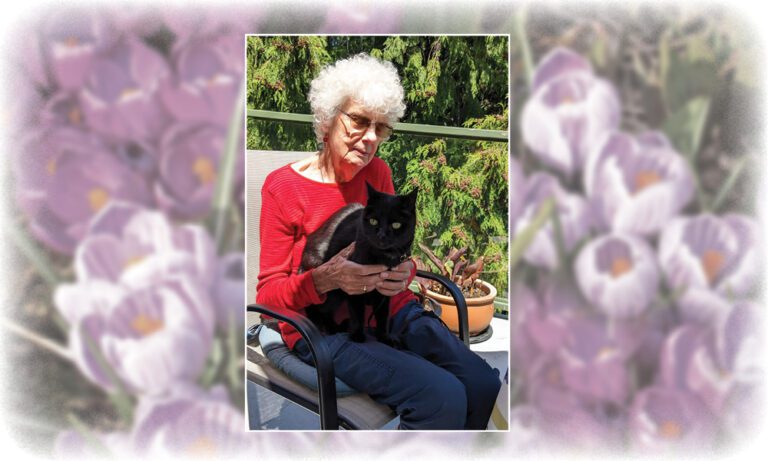
 It is with sadness that we have to announce the passing of Nieke de Boer Visser, on her own terms. She was born in Amsterdam, the Netherlands, on March 2, 1946, to Nicolaas de Boer and Johanna Piels. She had a much older brother, Ger, who predeceased her in 2012.

After her schooling at a Gymnasium (which in the Netherlands is the highest preparatory school for university admission), she went to the University of Amsterdam to do her medical degrees, which she finalized in 1973. At the Gymnasium in Amsterdam, she met her future husband, Kees. They married on October 10, 1969.

After their doctoral degrees (Kees in geology), they left for Zambia in 1974, where she worked as a medical professional for the Health and Pollution Control Department of the Zambian mining industry.

In 1982, they left Zambia for Calgary in Canada, where Kees was employed by Petro-Canada. Nieke discovered that Canada did not recognize her medical degree, which embittered her until her death.

She found employment with the AIDS Clinic, as an assistant, in Calgary until a car accident in 1992 stopped this career. In 1994, she followed Kees to Algeria, Tunisia, and France, where Kees was Exploration Manager for North Africa and the Middle East.

In 2003, Kees retired, and they moved to Salt Spring Island. Nieke volunteered energetically with the Salt Spring Trail and Nature Club, where she joined the Board in various capacities and was President from 2014 to 2016. With her energy, she organized a number of camps and one of the most successful BC Nature AGMs in 2015.

She loved animals and had dogs and cats; she was also active in birding. She leaves behind her devastated husband of 54 years, Kees, and two children, Marjolein and Frank; also two grandchildren, Calum and Sebastian.

We thank Dr. Slakov and Dr. Kalf for their help with this difficult journey in the last few years. At Nieke’s request, please no flowers, but a donation to the SPCA or Dying with Dignity.

Indigenous People Weekend meaning shared

By MARCIA JANSEN

DRIFTWOOD CONTRIBUTOR 

Salt Spring Island is celebrating Indigenous Peoples Day with a three-day weekend of events and activities that celebrate Indigenous arts and culture, creating opportunities for discussion of reconciliation. We asked islanders, Indigenous people and settlers, what this weekend means to them.    

Gizem Sozen

A conversation between islanders Jon Cooksey, Pam Tarr, Gizem Sozen and Adina Guest was foundational to the idea of the weekend.   

“For me, the Indigenous Peoples Weekend is a chance to show support and solidarity to the Indigenous Peoples whose traditional lands we are living on,” said Gizem Sozen, who moved to Salt Spring Island in September 2023. “As an immigrant settler new to Salt Spring Island who runs a small pop-up bookstore focusing on social justice, I feel that it is my political responsibility to participate however I can in the efforts of Indigenous Peoples and their allies towards decolonization. So when Jon and Pam broached the idea about the Indigenous Peoples Weekend, which I think at that time was still germinating, Adina and I, enthusiastically told them that we would support the project and like to participate.” 

Caroline Dick 

Caroline  Dick (Tahltan/Irish) is the Indigenous coordinator at the Salt Spring Island Public Library and helped form the idea of the Indigenous Peoples Weekend. She’s organizing the Indigenous Art Market — on Friday, June 21 from 10 a.m. to 3 p.m. (note the date has changed from the original schedule) — and will be giving mini-tours of the Indigenous Learning Area in the library on Friday from 10 a.m. to 4 p.m. Tours start in the lobby every half hour. 

“With Reconciliation work, there is a focus on trauma; that tends to be what a lot of people focus on. There is so much joy and beauty in Indigenous cultures and this weekend is an opportunity to celebrate and share our cultures.”

At the Indigenous Art  Market visitors can brow and purchase artwork, jewellery, paintings, knitting, cedar weaving and northern-style bannock. Vendors include Indigenous folks who are residents of Salt Spring Island, as well as from various First Nations on Turtle Island. 

Sherry Leigh Williams

On Friday, June 21, from 10 a.m. to 2 p.m., Métis artist Sherry Leigh Williams is hosting a “Meet the Artist” drop-in event in the ArtSpring lobby gallery space, with Sheena Gering, to conduct walk-and-talks about their work and Métis culture. The ArtSpring lobby exhibition is also open on Saturday, June 22 from 10 a.m. to 2 p.m. for the festival, and continues until June 28 during ArtSpring opening hours.

“For me, this weekend is about acknowledging the struggles that every Indigenous person has endured since contact,” said Williams. “Despite losing our way of life, our homes, our land and even our children, we have not only survived but we continue to thrive. I feel it is important to develop relationships with both settler and Indigenous People, to have an understanding and appreciation for our cultural differences as well as the things we share, so that true reconciliation can occur.”  

Joe Akerman and Chris Marshall

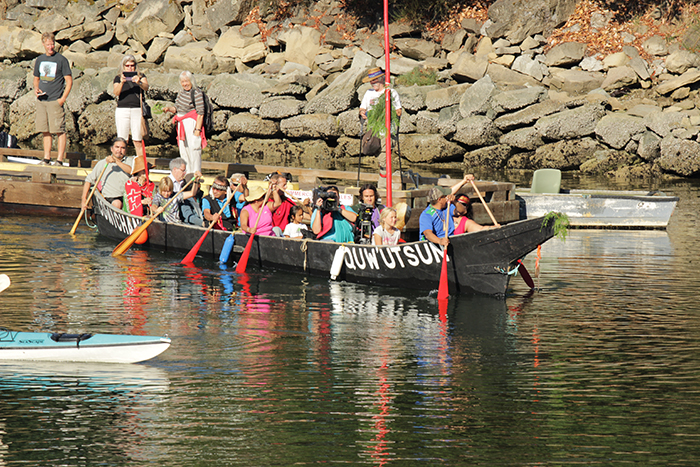
Joe Akerman, who is of mixed Quw’utsun and European heritage, and Chris Marshall are involved with the Grace Islet 10-year Anniversary Event at Centennial Park on Sunday, June 23 from 10 a.m to 2 p.m.

Akerman: “It has been 10 years since local nations and Salt Spring residents came together to protect the burial ground of our ancestors on Grace Islet. This gathering is an opportunity to talk about what happened then and since, to discuss the present and future and to pay respect to local elders, as well as a way for us as a community to support them.”  

Chris Marshall adds: “I think this weekend is a chance for us newcomers — that’s what I’d like to call the settlers — to educate ourselves about what happened in the past and what we can do today. Do your research, there is so much material available out there, and of course, come to the anniversary event to learn about the people who lived here before us.”

Volunteers are still needed for the Anniversary Event at Centennial Park. Contact Chris Marshall if you can help out: chrismarshall2406@gmail.com.

Events list updated

Indigenous Peoples Weekend events kicked off on Tuesday with a webinar presented by Transition Salt Spring featuring Quw’utsun speakers Deb George (Sulsameethl) and Maiya Modeste (Sulatiye’) and called Climate, Culture, Land: Cultivating Community Resilience Through Indigenous Approaches.

 Go to gulfislandevents.com/indigenous-peoples-weekend/ for details about everything that will take place. Several more events have been added since last week’s article about the festival was published.  

Ganges Hill improvement plans detailed

2

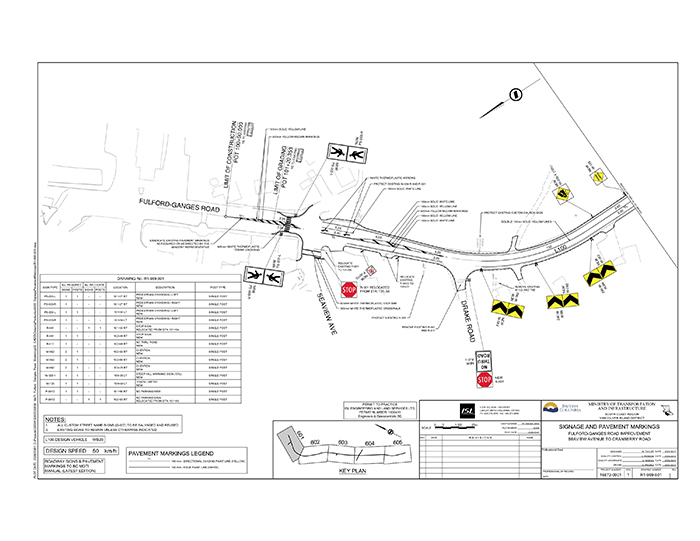
Plans for road construction this summer on Salt Spring Island are becoming clearer, and a submission for tenders expiring Friday, June 21 reveals some detail surrounding likely improvements to “Ganges Hill” — Fulford-Ganges Road between Seaview Avenue and Cranberry Road. 

Island residents have been repeatedly warned to prepare for traffic disruptions this summer, as significant surface improvements will be accompanied by the installation of a closed storm-sewer drainage system and new culverts.  

The project envisions resurfacing and widening of 1.6 kilometres of the two-lane rural road, highlighted by the construction of paved shoulders for pedestrians and cyclists — a 1.2-metre-wide shoulder heading north (or downhill into Ganges) and 1.8 metres in the southbound direction, according to Ministry of Transportation and Infrastructure (MoTI) tender documents. 

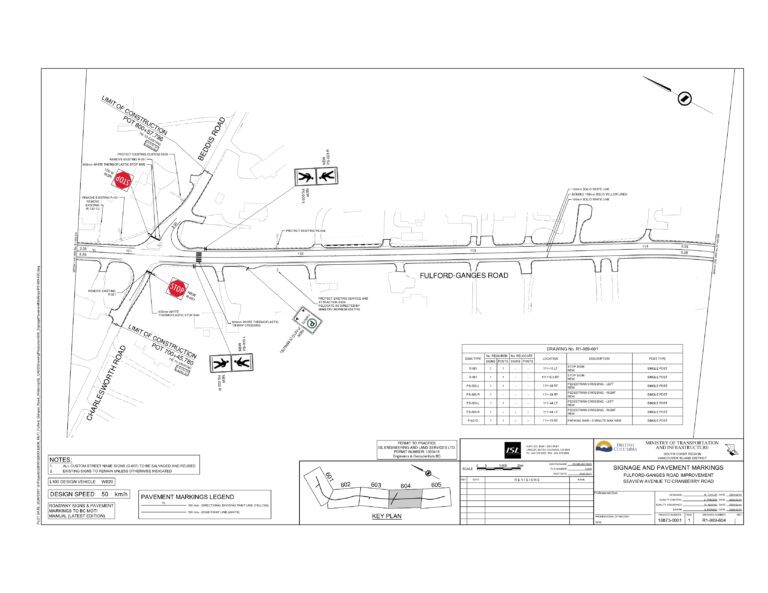
Undated technical drawings included in MoTI tender packages also specify a pedestrian crossing marked below a paint-delineated “narrowing” of Fulford-Ganges Road below Seaview, with a thermoplastic zebra crossing flanked by new median markings. Another crossing, but without accompanying traffic calming, will be marked just uphill (south) of the Fulford-Ganges intersection with Beddis and Charlesworth roads. 

A notable change also envisioned at the Beddis/Charlesworth intersection calls for relocating a notorious utility pole there, and removing the island that sits in the middle of the first few metres of Beddis Road. Fresh white lines to indicate to cross traffic where to stop, combined with a narrowing of Beddis Road at the turn, should clear up long-time disagreements about whether southbound traffic turning left onto Beddis should turn before or after drivers turning right off Beddis onto Fulford-Ganges — with “after” prevailing, as the former path will no longer be present. 

A significant geotechnical investigation and environmental assessment took place, and reports on both were completed late last year, according to the ministry. Assuming a successful bidding process, MoTI has said construction is expected to begin this summer.

MoTI drawings show plans for Ganges Hill repaving and marking in the Seaview Avenue and Drake Road areas.

Editorial: Livestreaming improves democracy

0

The Gulf Islands Board of Education will join the 21st century this fall when school trustees’ business meetings will be livestreamed for viewing online.

School District 64 is late to the party when it comes to making its discussions and decisions easily accessible for those who don’t have the time or ability to attend a meeting in person. School board meetings have traditionally taken place at least once per year on the four “outer islands,” as they are still referred to by the district, and the rest of the time on Salt Spring. Starting in September, all regular business meetings will take place in the school board office on Salt Spring where internet transmission can be reliably done. Trustees and administrators will still visit Saturna, Mayne, Pender and Galiano, but for committee meeting and information-sharing purposes only.

The change of process is a positive one and we applaud SD64 for taking the steps required to make it happen.

Watching public officials and staff from any form of government crawl through a lengthy agenda (and when the audio quality is sometimes sub-par) may not be many people’s idea of a worthwhile way to spend their time. But outside of attending such meetings live in the flesh — which a few Salt Spring residents do quite religiously — it’s the only way to get a sense of what the people we elect are really doing and saying as they fulfill their duties to their constituents. It’s easy to look at the posted agendas online and see if anything of interest is listed and check in to watch those items alone.

This week Salt Spring Islanders have the opportunity to see Islands Trust Council in person, when 26 trustees from 13 islands in the federation plus senior Trust staff meet at the Harbour House until early Thursday afternoon. With the sheer number of voices needing to be heard, council proceedings may be unwieldy at times, but also offer a fascinating look at how elected officials communicate and make decisions.

Democracy may not offer rivetting entertainment most days, but the more people paying attention at any level the better the system works. We encourage fellow islanders to tune in either online or, when possible, with their bum in an actual meeting-room seat.

School board opts for livestreaming

0

A draft meeting schedule for the coming year has been laid out for Gulf Islands School District (SD64) Board of Education members — and starting in September, for the first time, the regular meetings will be streamed live online to members of the public. 

Board meetings have always been open for the public to attend in-person, and trustees and school officials have — from time to time — “zoomed in” for meetings when they could not be there. But while technology costs and privacy considerations had made board members reluctant to provide live video in the past, the news will be welcome for many Gulf Islanders — particularly since the current draft schedule puts all meetings for the coming academic year at the district’s board room facility on Salt Spring Island. 

“It’s all here at the school board office,” said SD64 board president Tisha Boulter at the June 12 board meeting. “Our connections to the outer islands will be during our committee meetings.” 

Those committee meetings will continue to be held on other islands — including Saturna, Galiano, Pender and Mayne islands — as well as online. The regular board meetings will be held the second Wednesday of each month September through June, excluding October, December and March. 

While the public may not spontaneously participate in trustees’ regular meetings — they are “open to the public for observation” while board members conduct business — they will include a question period at the end of the meeting. Boulter said that during live streams, the current plan was not to record “the back of the room, and all the guests,” focusing on just keeping the stream aimed at board members “for privacy reasons.” 

“We don’t want to implicate a person who [simply] comes to a board meeting being seen live streamed,” said Boulter. 

The first meeting after the summer break will be Wednesday, Sept. 11.

 Strategic plan input

Also at the meeting, trustees and staff noted that Sunday, June 23 is the final day for people to provide input on the district’s strategic plan.

Four plan focus areas are proposed: Truths, Reparation and Restoration; Integrity and Responsibility; Relationships and Belonging; An Ethic of Learning.

The feedback form can be found on the district’s sd64.bc.ca website.

Viewpoint: Build ferries closer to home

By PHIL VENOIT

BC Ferries’ engagement report called Charting the Course affirmed the public’s top three priorities are reliability (33 per cent), affordability (30 per cent), and better integration with transit and active transportation (17 per cent).

These are improvements to the service, and we can usually count on needing more funds to implement improvements. So, if keeping shipbuilding local can address all these priorities and bring in money, then why has there been such a pushback?

The main argument (or myth) against building the new ferries here in B.C. is that it will cost millions of dollars more than building them in Romania or Poland due to skilled trades workers’ higher wages. However, this argument is too simplistic and untrue as it lacks consideration of many other elements. When we send manufacturing overseas, we leave our supply chain vulnerable to international and external factors, one of them being quality control. It’s old news that BC Ferries constantly cancels sailings due to mechanical issues, which then results in vessels being out of service for days, or even weeks. British Columbians told us your time is valuable, and that cancelled sailings also means lost revenue for BC Ferries. By keeping shipbuilding in B.C., we will have control over quality, knowledge and expertise; meaning, skilled Canadians will perform the work properly, and materials and equipment can be sourced in Canada. This will streamline repairs, shielding shipbuilding from global shocks, and will put the ferry back in the water faster. That is how you build reliability.

When we fixate on fair ferry construction wages as being the reason why fares go up, we ignore the real contributors, which are fuel and shipping and other corporate overhead costs. The fluctuation in oil and diesel prices are major contributors to fare increases, and then there are all the expenses associated with international building, such as carrier rates, transportation of parts, packing costs, warehousing/storage, and customs/duties/tariffs. Moreover, there’s the opportunity cost, which is the amount of potential benefits we give up by outsourcing: potentially $2.5 billion in municipal and provincial government taxes, $4.3 billion in contributions to B.C.’s GDP, and $3.1 billion in labour income over the years. The higher cost of building at home doesn’t factor shipyard workers’ income taxes, corporate taxes the government would receive back, or the spin-off jobs created by sourcing the materials and equipment here at home. If BC Ferries used the current procurement model brought in by David Hahn in the early 2000s, we could actually be opting for the more expensive version of the same vessel. These are taxes that would historically be used to keep ferry fares affordable.

And thirdly, priority number three – better integration. Revitalizing and strengthening shipbuilding in B.C. would bring more density to coastal communities and this would spur innovation, green technology, investments in real estate and spin-off benefits to education, retail and beyond. It would result in more apprenticeship opportunities for our youth, and good mortgage-paying, family-raising jobs in B.C. communities.

When BC Ferries fixates on the price tag of a new ferry, they ignore the true costs, and benefits to all British Columbians.

The writer is the business manager and financial secretary of the International Brotherhood of Electrical Workers Local 230, Vancouver Island.