Home Blog Page 131

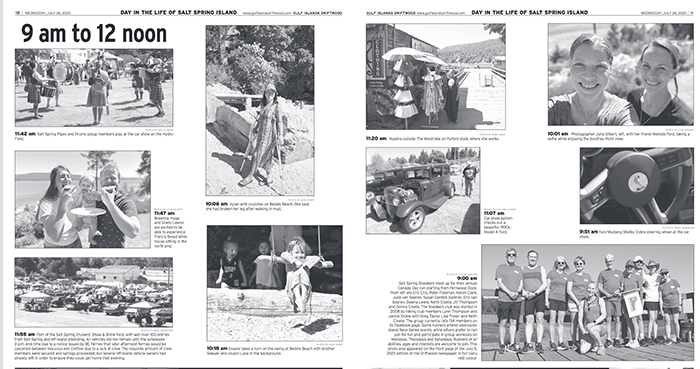
Day in the Life shoot day on June 22

It’s time for the Driftwood’s annual Day in the Life of Salt Spring Island photo shoot, and everyone is invited to contribute.

This year marks the 21st consecutive event that sees photographs taken over a 24-hour period and published in a special pull-out section later in July. The 2024 date and time is Saturday, June 22 at 6 a.m. to Sunday, June 23 at 6 a.m., which falls on the island’s first Indigenous Peoples Weekend.

People are welcome to submit one, two or up to 20 photos of friends, family, pets, coworkers or things and people seen out and about on the island during that time period. Photos should be at least one megabyte in size and include caption information plus the time of day the photo was taken.

Submissions deadline is Wednesday, July 10. Photos can be emailed to news@gulfislandsdriftwood.com, sent by other transfer services, or brought into the Driftwood office on a thumb drive.

While registration is not required, having an idea of how many people plan to participate is appreciated. Driftwood editor Gail Sjuberg is the contact person at news@gulfislandsdriftwood.com or 250-537-9933 and can answer any questions people may have.

Last year’s Day in the Life of Salt Spring Island edition can be viewed here.

Indigenous Peoples Weekend activities announced

0

Indigenous peoples and settlers of the Gulf Islands region are invited to come together next week to enjoy food, music and other arts and cultural activities for the first Indigenous Peoples Weekend.

The concept sprung from a conversation at the Salt Spring Coffee Cafe between islanders Jon Cooksey, Pam Tarr, Adina Guest and Gizem Sozen Cu Unjieng about celebrating both National Indigenous Peoples Day on June 21 and National Indigenous History Month in June. Since then, enthusiasm, support and participation have flowed from individuals, organizations and businesses.

Events actually begin Tuesday, June 18 at 7 p.m. with a webinar featuring Quw’utsun speakers Deb George (Sulsameethl) and Maiya Modeste (Sulatiye’). Presented by Transition Salt Spring, it’s called Climate, Culture, Land: Cultivating Community Resilience Through Indigenous Solutions and is a fundraiser for Stqeeye’ Learning Society. The sign-up link is on the transitionsaltspring.com website.

On Thursday, June 20, a Clam Garden Tour and Community Training session takes place at W̱ENÁ¸NEĆ (Fulford Bay) at a time to be determined.

Most of the weekend’s events are free. The following is a list of what had been confirmed as of June 10. Visit the gulfislandevents.com/indigenous-peoples-weekend/ site for more details and updates.

FRIDAY, JUNE 21

• 10 a.m. to 4 p.m. – Salt Spring Public Library Indigenous coordinator Caroline Dick (Tahltan/Irish) will give mini-tours of ITOTELNEW̱ HÁUTW̱ / Tatul’ utew’t-hw, which is the Indigenous learning area at the library.

• All day – Clam garden monitoring with SD64 and Parks Canada at W̱ENÁ¸NEĆ (Fulford Bay).

• 11 a.m. – Indigenous Story Time at the library.

• 1 p.m. – Carver Howard Lafortune (Tsawout) artist demo at Mahon Hall, hosted by Salt Spring Arts.

SATURDAY, JUNE 22

• All day – This is the Driftwood’s annual Day in the Life of Salt Spring Island photo shoot day! Weekend participants are encouraged to take photos and submit them for the Day in the Life print and digital publication.

• 10 a.m. to 3 p.m. – Indigenous Art Market in the library’s community program room. The market will feature artwork, jewellery and Wanda’s famous northern-style bannock. Vendors include Indigenous folks who are residents of Salt Spring Island, as well as from various First Nations on Turtle Island.

• 1 p.m. – Beader Katie Phillips (Quw’utsun) artist demo at Mahon Hall, put on by Salt Spring Arts.

• 3 to 7 p.m. – Community-wide Potluck Feast to celebrate the success of the Stqeeye’ Learning Society land acquisition project; hosted by Stqeeye’ with the Salt Spring Island Farmland Trust in Xwaaqw’um along Burgoyne Bay Road. Transit from Farmers’ Institute parking lot starts at 2:30 p.m. Supported by a grant-in-aid from the CRD.

• 5 to 9 p.m. – Our Ancestors’ Prayers: a Cacao and Breathwork Journey, co-facilitated by Ariana Fortinakis (Aamjiwnaang First Nation) and Lena Del Mar (Colombian/Indigenous) at Peace Farm near Ganges. Registration and payment done through the festival website.

SUNDAY, JUNE 23

• 10 a.m. – Christine Hunt, Kwakiutl noblewoman and member of the Raven Clan, will be the Indigenous speaker at the Salt Spring Island United Church morning service.

• 1 p.m. – Drum Painting demo with Virgil Sampson (Tsartlip/Nez Perce) at Mahon Hall, put on by Salt Spring Arts.

• 3 to 5 p.m. – Discussion: From Turtle Island to Palestine: Settler Colonialism and Decolonization, put on by Stinging Nettle Books and Love’s Galettes at Bullock Lake Farm. This event will include readings from the works of the late Sto:lo writer and academic Lee Maracle, two brief presentations, followed by an open group discussion.

• 10 a.m. to 2 p.m. – Event honouring the ancestors at Grace Islet and Lunch Feast for all tribes/nations in Centennial Park.

• 5 to 9 p.m. – Evening livestream music event benefitting Stqeeye’ Learning Society at Mateada Yerba Lounge, featuring performances by Indigenous musical artists and allies, including Logan Staats, Tia Wood, Saltwater Hank and Salt Spring’s own Daryl Chonka. Doors open at 5 p.m., event starts at 6 p.m. MC will be Cree teacher Rosanna Jackson and the DJ for the Decolonial Dance Party will be Djama.

As well, the ArtSpring lobby areas feature work by three Indigenous artists this month: Sherry Leigh Williams and Patricia Rose Williams (Métis) and Quentin Harris (Secwepemc).

The interactive First Nations Placenames site was also launched earlier this month through the saltspringarchives.com website, as detailed in a June 5 Driftwood story.

Organizers are extremely grateful to the numerous individuals, businesses and organizations that have stepped up to support the weekend in countless ways.

Donations to supplement grants received from the Salt Spring Island Foundation and the CRD for honoraria and travel will be gratefully accepted. Charitable tax receipts can be provided by the Salt Spring Island Farmland Trust for this purpose.

For more information beyond what is available on the website, email info@ipw24.ca.

Salt Spring hosts Trust Council meeting

0

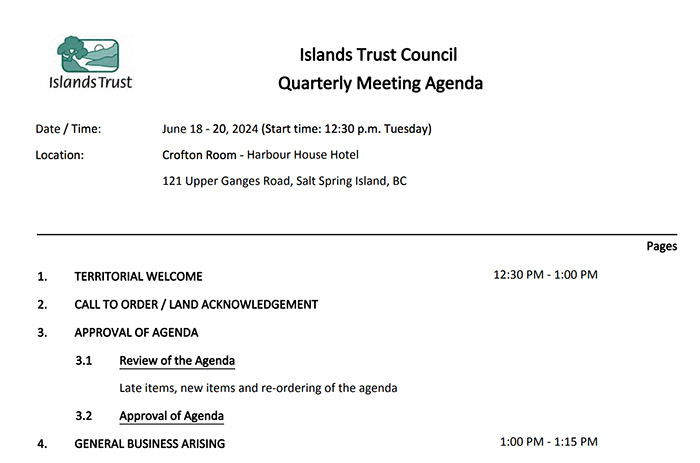
The Islands Trust marked 50 years since the proclamation of the Islands Trust Act on June 5 and will celebrate in person when trustees and staff meet on Salt Spring Island for their quarterly business meeting.

Proceedings will take place at the Harbour House Hotel from Tuesday, June 18 to Thursday, June 20, with most sessions open to the public.

The agenda gets underway at 12:30 p.m. on Tuesday, with highlights including a trustee roundtable with reports from all islands in the federation, and the delegations and public comment session from 2 to 3 p.m.

Registered delegations are Ted Olynyk with a BC Hydro operations update; Peter Pare from The Gulf Islands Sue Big Oil Group; Glenn Stevens of the Clean and Safe Harbours Initiative; Ronald Wright of Keep Salt Spring Sustainable; and Jennifer Margison of Friends of the Gulf Islands.

Saanich North and the Islands MLA Adam Olsen will give a presentation on Inclusive Governance at 5:45 p.m., with the meeting adjourning at approximately 6:30 p.m.

Wednesday, June 19 is devoted primarily to strategic planning, from 9 a.m. to 3:30 p.m., followed by business from the administrative and planning services arms of the Trust until about 5:30 p.m.

Trustees will begin Thursday morning in a closed session, and are expected to convene publicly for new business items such as trustee-initiated requests for decisions at 10 a.m.

At 12:15 p.m., the meeting will hear a presentation and a question-and-answer session from Ryan Greville, manager of the Navigable Waters Protection department of Transport Canada on actions to address wrecked, abandoned or hazardous vessels on the coast, including use of the Wrecked, Abandoned or Hazardous Vessels Act.

According to a news release issued by the Trust last week and marking the 50th anniversary, “the Province of British Columbia created Islands Trust in 1974 in response to rates of development in the Gulf Islands and the need to protect the unique amenities and environment of the region. Today, Islands Trust preserves and protects the islands in the context of many complex challenges, including climate change, lack of affordable housing, freshwater limitations, hundreds of species of risk, and development and tourism pressures.

“Over the past five decades, Islands Trust has evolved to meet new challenges and opportunities. The organization is deeply committed to reconciliation with Indigenous Peoples. It is also working to address housing equity and climate change-related challenges.”

“For 50 years, Islands Trust has been working to preserve and protect the unique amenities and environment of these islands. Our commitment to protecting these islands for future generations remains as strong as ever. We are proud of our history and excited about our future as we continue to adapt and innovate in response to a changing world,” said Islands Trust chair Peter Luckham.

Minister of Municipal Affairs Anne Kang commented: “For half a century, the residents of the Gulf Islands have come together to preserve and protect the special context of their community. That’s why today we are not only celebrating this anniversary by looking back at its legacy but also by looking forward to future challenges that will be taken up by those dedicated to serving their communities, working toward further reconciliation with local First Nations and tackling contemporary challenges head on.”

Evolve Dance Collective hits ArtSpring stage

Creative dance activity is taking place for all ages on Salt Spring Island, as witnessed by the Community Dance Performance hosted by Gulf Islands Secondary School Dance program members at ArtSpring on Friday, May 31.

Another group of dancers will share the fruits of their love, labour and community in upcoming shows at ArtSpring when Evolve Dance Collective presents Creation — An Odyssey of Womanhood on Monday and Tuesday, June 17-18 at 7 p.m.

Lara Von Maydell started Evolve three years ago with Veronika McKee. Von Maydell had grown up in the dance world in Nelson, B.C., but as she reached semi-professional status she found the environment had become “toxic” and experienced some related health issues. But the desire to dance at a high level while having fun never faded, and Evolve on Salt Spring Island grew from that root.

“I really feel like there’s a lack of dance spaces where it is structured and people learn really intentional techniques, and yet it’s fun and supportive and empowering for women, specifically,” she said.

After McKee left Salt Spring, collective member Jasmin Skye stepped up to take her teaching place.

Skye started dancing at age three and continued through her teenage years. “It was my everything: my lifeline, my joy, my place to just be myself.”

But the effects of dance competitions and the constant striving for technical perfection eroded the natural joy and, like Von Maydell, prevented her from pursuing a professional career.

Skye continued moving her body through ecstatic and free-flow dance forms.

“It was really fun and I loved it, but I was craving choreography again, and a structure where other people understood the magic of choreographed dance. And I also craved it to be storytelling, I craved it to be deeper — and then I found Evolve on Instagram.”

Synchronistically, she ended up moving from Victoria to Salt Spring, and it became apparent that Evolve was everything she was looking for in a dance community and practice.

The collective’s 12 women who meet at the Salt Spring Island Multi Space have diverse backgrounds. A few have intense dance training histories, like Von Maydell and Skye, while others bring gifts and experiences from the island’s ecstatic and/or contact dance groups, or other movement arts.

Skye said, “It’s really refreshing to see all the different walks of life come into one group and be like, ‘Wow, this person moves in this way or learns in this way or expresses in this way,’ and how do we choreograph to highlight people’s gifts, and how do we involve these different aspects of each person into the story of what we’re trying to tell as well?”

They observe that it’s been interesting to see members develop storytelling with choreographed dance, which is a language they speak so fluently, while others may not have that experience.

“To me, dance is like telling a story,” said Von Maydell. “And every sequence is a sentence. But then within that sentence, each move is a word.”

She said the most potent part of Evolve is having people who joined in the first year now choreographing their own pieces with mentorship and guidance.

“Actually, most of our main pieces in the show are not by Jasmin and me this year, which is exciting.”

The June 17-18 Creation show focuses on the female hormonal cycle and women’s relationships to their bodies throughout the month, as seen through a lens of the four seasons.

“The dances explore themes that come up for women,” explained Von Maydell, “like pre-menstrual syndrome, what it is to bleed in our culture, how we were raised to talk about our periods and taboo subjects that are still kind of taboo — though maybe not so much on Salt Spring — but in the rest of the world, they kind of still are.”

“I think we use art as a way to bring these topics to life in a different way that’s not just using words,” added Skye. “There are words and poetry in the show, but there is something special about being able to dance this topic, which we feel really passionate and strongly about, because in some places in the world there are women who are still hiding their period and don’t even get to talk about it or have to stay home. So we’ve just been really lucky and blessed to be able to feel safe enough to go on stage and do this.”

One extra-special aspect of the show is that a birth piece was planned and then one of the dancers became pregnant and is now the “star” of that dance.

Among positive feedback collective members received about their initial public show called Belonging last year was that it sparked a huge range of emotions.

“That’s what we’re hoping for,” said Skye, “is that each piece can evoke an emotion in someone, and everything is going to hit differently for each person, because that’s how art works.”

“Our raw storytelling is what people are affected by, and that each dance has a very specific message,” continued Von Maydell, “and it really hits that emotional tone for the audience . . . so people often feel quite included when they come to our shows, and moved on a personal level.”

That’s in contrast to dance performances where the emphasis is on dancers’ technical abilities, they note.

All ages are welcome to the Evolve Dance Collective’s Creation show, but it does come with a parental advisory for some of the mature themes.

Tickets are on sale through the ArtSpring website and box office.

People can learn more about the group at evolvedancecollective.com or through their @evolvedance_collective Instagram account.

Opinion: Salt Spring governance confounds

BY PAUL MCELROY

With no disrespect to the fine reporting by Robb Magley of the recent Islands Trust’s Committee of the Whole meeting — (COW. Really?) — and despite reading it through twice, I put the paper down with the disturbing sense that I’d just fallen into a black hole. A Committee of the Black Whole.

What in the name of God were they talking about? For hour after hour, round and round in circles, looking for a policy to define a policy to define a policy. Or rather, to “discuss the process by which it will be considered.” After all these years, the Islands Trust is still trying to work out what the hell it’s for, what its “object” is. To quote Deb Morrison, one of the Trust’s worthy from North Pender Island: “We don’t need to get into the weeds about having a consensus vision of the object because the Trust Policy Statement is our consensus vision of the object.” Well said. Now, what on earth does this piece of Orwellian gibberish mean?

The rest of the meeting could have been in Klingon for all the sense it made. Bowen Island trustee Judith Gedye put her finger on it. “I think the Section 3 mandate discussion that we have to have is important … but I don’t want to hold up this process.” Er, what process is that? Processing a process? Processing the process to process a process?

In any ordinary small jurisdiction, local councilors meet to discuss dogs fouling the play areas, whether to appoint a school crossing attendant or to buy a new computer for the library. Not so the Islands Trust. It never seems to decide anything because it’s far too busy trying to figure out why it exists in the first place.

I cut my journalistic teeth on council meetings, admittedly in the U.K., but in rural Buckinghamshire — Long Crendon, Princes Risborough, Little Missenden, Quainton, Aston Clinton, Tring — long, dull evenings in villages where the only exotic thing about them were their names, but where local councillors dealt with local issues. Planning permissions, tree preservation orders and parties on the village green. They argued, of course, but in the end they got things done. What they didn’t do was spend hours trying to establish what their mandate was.

Meanwhile, just across the page from the COW nonsense, the cockerels were having their day in front of another entirely pointless branch of Salt Spring governance, the Local Trust Committee. A bunch of chicken fanciers were up in arms about the persecution of a noisy rooster and its owners and wanted the LTC to do something. Fat chance.

Never mind that the rooster owner was claiming that his little plot was agricultural and that he was so far facing seven counts of bylaw infractions, the chicken people wanted a resolution: “That livestock noise wasn’t something you could complain about . . . .”

Needless to say — and whatever you think of this absurd and entirely undemocratic resolution — it went nowhere because the LTC doesn’t have the authority to do anything. Still, all was not lost, the LTC plans to take it up with the Capital Regional District, which should ensure it goes nowhere even faster.

And then there’s the new fire hall, or to be more accurate, the large hole in the ground where the new fire hall might eventually get built once the proper permits come through. Building For Tomorrow, it says on the site notice board. Building For Today is presumably just wishful thinking since the fire trustees can’t seem to even be on the same page about how big it’s going to be.

As ever, local governance on Salt Spring is a hopeless case. It doesn’t work for the many of us who despair at the clumsy anarchy that passes for management. If we ever get the chance again, a properly constituted municipality is the only obvious solution. An elected mayor and elected district councillors, with defined wards . . . and defined jurisdictions.

Editorial: Celebrating and building relationships

0

Relationships between Canada’s First Nations and settlers have been hugely impacted by the work of Canada’s Truth and Reconciliation Commission.

But relationship-building with the First Nations of the Gulf Islands had begun even earlier, developing slowly as essential trust was established. We recall the powerful connections created between the Penelakut people and some Salt Spring settlers more than 20 years ago when the disposal field for a sablefish hatchery was proposed for a known Penelakut gravesite. Similarly, the Penelakut and others worked hard to stop a house from being built on Grace Islet gravesites in Ganges Harbour in 2012 after the project was already underway. Collaboration in that case resulted in the province stepping in to buy the islet.

Since those earlier days the number and strength of connections have continued to surge. Among several examples is an Indigenous Interpretive Panels project completed last year through First Nations and settler collaboration that has seen beautiful signs installed at Fernwood dock and at Ganges Alley. School District 64 has engaged in cultural and relationship-building activities. The Salt Spring library now has an Indigenous coordinator and an art- and book-filled Indigenous learning area (ITOTELNEW̱ HÁUTW̱ / Tatul’ utew’t-hw) was opened this year. For these and other efforts the library was honoured with a British Columbia Library Association award for its truth and reconciliation work. The Stqeeye’ Learning Society and its Xwaaqw’um land purchase have also had a major impact.

The historical society and archives group also launched its amazing First Nations website and interactive Indigenous Placenames maps in time for National Indigenous Peoples History Month, inspiring everyone to learn the Hul’q’umi’num’ or SENĆOŦEN names for many spots on Salt Spring Island and their significance to those peoples.

Next weekend — Friday, June 21 to Sunday, June 23 — the fruit of the relationship-building and cultural resurgence will be fully ripe with the first Indigenous Peoples Weekend festival running on Salt Spring. Tours of special sites, artist demos and an Indigenous arts market, plus music, feasts, fundraisers and all kinds of community-building activities are taking place.

Continued work on and celebration of reconciliation and moving forward together is at the heart of the festival. Everyone is invited and encouraged to participate.

Viewpoint: Trustee criticism not deserved

By MAIRI WELMAN

I gave up trying to engage in reasonable fact-based dialogue on the editorial pages of the Driftwood some time ago and have since focused my energy on moving forward with work to solve our island’s challenges, particularly the housing crisis.

But the more I watch the drama unfold, in the pages of the Driftwood, on social media channels, and in person at meetings, the more I remember a lesson I learned a decade ago when I worked for Dr. Penny Ballem. Always ask yourself, who benefits from the conflict that is being created?

Frants Attorp and the “Positively Forward” group take almost weekly aim in these pages at trustee Laura Patrick’s performance as an elected official, promulgating misinformation and, at times, outright lies about her motivations and actions. The nefarious schemes they accuse her of would be almost laughable if it weren’t so calculated on their part.

On the other extreme of the ideology scale we have Eric Booth and trustee Jamie Harris. Eric’s missives against Laura on social media are toxicly mean-spirited and frankly surprising, if only for the fact that, as a former trustee, he knows all too well just how dysfunctional our governance system is and would therefore, one would think, have some empathy for the woman who is trying to find a third way.

Jamie Harris seems to have decided that near constant belligerent opposition is his singular contribution to local governance. As a first-term elected representative, he is still learning that governing well is about being able to sit across the table from someone you fundamentally disagree with and have a respectful, open-minded conversation to find the nugget, no matter how small, of shared value from which to take a step forward together.

I have witnessed that Laura Patrick is the only local government official on Salt Spring Island who is actually doing the hard grind work of reading all the material, going to ancillary meetings, talking at length respectfully with staff, deeply understanding policy implications, and trying to find a middle way that will satisfy some needs for all sides.

It is no small wonder that so few women are interested in public office, and I’m amazed at Laura’s willingness to tough it out. The two sides currently firing into the middle directly at the one person they have a chance of working with had better hope she doesn’t decide “life is too short for this crap,” and step out. They would then have to face each other and reckon with their complicity and lack of substance.

“Democracy is a long, slow, hard business. It requires sacrifice and virtue. It requires listening to the views of others and it demands an acceptance of the necessity of difficult choices. It requires, above all, commitment to forging a common good out of the disparate and varied material of our social and economic lives, a good that recognizes the worth of everyone whatever their differences. If we don’t do this, we don’t do democracy.” Marc Stears

Poultry group appeals to LTC

0

Salt Spring land use officials had words of encouragement but few answers for small-scale poultry advocates, who seized a moment during a regular meeting with agricultural leaders to press trustees for help protecting their flocks. 

The meeting held Thursday, May 30 was a regular session for the Salt Spring Island Local Trust Committee (LTC) to have a discussion with members of the Salt Spring Island Agricultural Advisory Planning Commission (AAPC) and representatives of the Salt Spring Island Agricultural Alliance (SSIAA) on agriculture-related issues.  

For Salt Spring Island Poultry Club executive member Elsie Born and supportive club members, it seemed a ripe opportunity to urge trustees toward advocacy — for islanders who raise poultry generally, and for Salt Spring resident Clint McNichol specifically. According to court documents, McNichol is facing seven counts of Capital Regional District (CRD) bylaw infractions at his 0.92-acre Woodland Drive property related to noise from a rooster kept there. 

“People have bought property where they’ve been told they’re allowed to farm, and now are being either ticketed or taken to court,” said Born. “It’s very frustrating for small-scale farmers to start up on Salt Spring — and I think it shouldn’t be. Those are the people we want here.” 

Court documents show McNichol’s first appearance in Victoria Law Courts was in May of last year, two weeks after he shared redacted images of what appeared to be an official summons for the seven counts on social media; that undated document indicated McNichol had been charged with keeping livestock — specifically a rooster — on his property, contrary to a CRD bylaw requiring animals be kept in a manner that does not disturb the  “quiet, peace, rest, enjoyment, comfort or convenience of other property owners in the vicinity.” 

The CRD bylaw in question does have an exception: “except in an Agricultural Zone.” The Islands Trust has two agricultural zone designations on Salt Spring Island, Agriculture 1 (“A1”) and Agriculture 2 (“A2”). The property where violations are alleged to have occurred is zoned Rural (“R”), which — as far as the Islands Trust is concerned — indeed allows livestock.  

But similar to how provincial building codes prescribe how zone-permitted buildings are constructed, the manner in which livestock is kept is not within the purview of the Islands Trust. Planner Chris Hutton explained during Thursday’s meeting that while the land use powers the Trust exercises are significant, they are not the only authority on Salt Spring.  

“We don’t really have a direct authority over what regulations the [Capital] Regional District puts in place,” said Hutton. “However, they do not have [our] ability to create land use regulations. We’re essentially parallel entities; we regulate in the same space, but in different ways.” 

Trustees were asked whether they could add stipulations or amendments in their bylaws — “so livestock noise is not something you can complain about,” suggested small-flock poultry grower Donna Saffel. LTC members seemed to agree that would be outside their authority. But with full-throated support for agriculture on Salt Spring broadly, trustee Laura Patrick said the LTC was planning a joint meeting with CRD officials in the near future — and suggested that the issue should be part of that meeting’s agenda. 

“We want to make sure that agriculture is maintained, grows [and] thrives,” said Patrick. “We want to enshrine that use, because to me this is Salt Spring — this is what it is, and what’s so important to me is the agricultural base of our island.” 

Trustee Jamie Harris returned to his well of criticism for the Islands Trust, suggesting the issue was yet another that might be solved by the island becoming a municipality, and worried trustees stepping in might turn into more restrictions, not fewer.  

“We clearly don’t want to have more regulation and say OK, you can’t do that,” said Harris. “Maybe it’s up to people that are farming to sort of use their better judgment as far as getting along with your neighbours goes.” 

The latest court appearance for McNichol on the bylaw infractions was set for Monday, June 3; CRD officials have indicated they would not be commenting on the issues surrounding the case until court proceedings concluded. 

Viewpoint: Route 6 and 4 changes will be significant

By Harold Swierenga

The Salt Spring Island Ferry Advisory Committee (SSIFAC) would like to provide some clarifications and updates regarding the plans for the Vesuvius Bay ferry terminal and Route 6.

When it was confirmed last year that the replacement of the 64-vehicle Quinsam with twin 47-vehicle Island Class ferries and reconstruction of the Vesuvius and Crofton terminals were scheduled for 2027, it was obvious a new experience was coming to ferry travel on Route 6. There had been many discussions, meetings, proposals and plans over the years between BC Ferries, the SSI FAC and the public, and now the plans were firming up.

However, as with any capital projects, funding is a constant underlying factor and we are not surprised that completion of the work will be staged to some extent as funding becomes available. A major role of the SSIFAC is to focus on ensuring that all aspects of the project are completed regardless of the timeframe and staging involved.

The two critically essential and costly elements of the project are the Island Class ferries themselves and the rebuilding/life extensions of the trestles and berths to accommodate them in both Vesuvius and Crofton. The two elements are interdependent and scheduled to be in place and functioning in early 2027. A major additional feature of the new berth in Vesuvius is the provision for lineup parking on the trestle, thus reducing the lineup pressure on the land-side holding lot and the street. This additional planned capacity will be significant, but the other huge factor, of course, in resolving the lineups on the streets in both Vesuvius and Crofton will be the increased combined capacity and much more frequent sailings of the twin Island Class ships. Vehicles will be underway to the other side of the channel rather than taking up parking space on shore to the extent they do now.

Other planned features of the Vesuvius berth will be the elimination of the 90-degree turn in the trestle, replaced by a sweeping curve, and a pedestrian shelter at the berth itself. A dedicated lane for pedestrians and cyclists from the land-side to the berth will be provided. A full waiting room and washrooms are planned for construction on the edge of the land-side parking area and will be among the SSIFAC’s highest priorities of the next phase of improvements. The SSIFAC will also be paying particular attention to the overall needs of cyclists and pedestrians, such as SSI Transit access, pedestrian drop-off and pick-up and bicycle parking etc.

When the Island Class ferries go into service on Route 6, the Quinsam now on that route will become available to provide additional “peak” period service on Route 4 (Fulford-Swartz Bay). The definition of “peak” period will need to be adjusted as traffic builds over time and the Quinsam would be needed on the route for longer periods each year over the years. Until 2027, the 10 round trips per day peak service will continue, but the SSIFAC is advocating for that service to start in early rather than late June.

The SSIFAC is extremely disappointed that financial constraints will require the Vesuvius terminal reconstruction work to be staged rather than entirely completed by early 2027, but we are confident that the Route 6 experience will be markedly enhanced. As planning continues and when construction proceeds there will be further opportunities for community input. As well, the actual berth construction will involve some temporary modifications of service, but we are confident that the end result will be well worth waiting for.

The writer is SSIFAC chair.

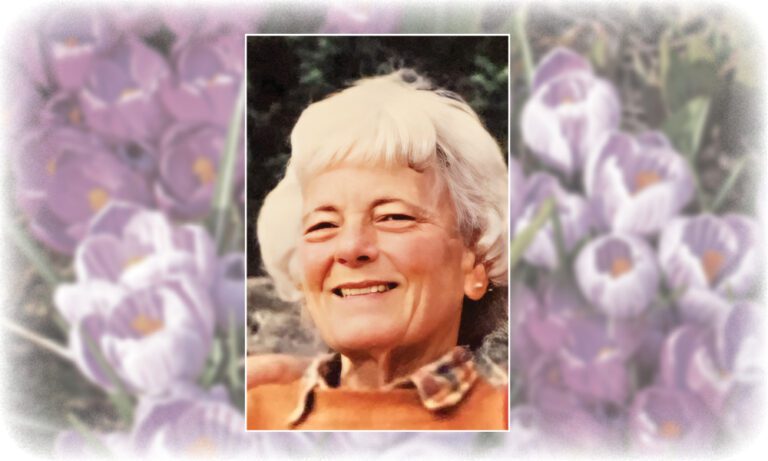
WARD, Norah “Denise” (nee Fader)

 Denise passed away in Victoria, BC, on April 5, 2024. Born in Vancouver, she was a proud graduate of Prince of Wales, class of 1955. She went on to St. Paul’s Nursing, graduating in 1959, where she dedicated her work to maternity and obstetrics.

She was predeceased by her beloved husband, Phil Ward (1926–2019), whom she met while traveling in Europe in the early 1960s. After living in London, they settled in Victoria and then Ottawa, raising their family before eventually retiring back to BC.

Denise is survived by her daughters, Carol and Nancy; five wonderful grandchildren; and one adorable great-grandchild.

A long-time resident of Salt Spring Island, Denise, or Denny to her friends, loved the outdoors, her beloved pets (Simba), walking, gardening, creative projects, and most of all, having a good laugh over a glass of wine. She will be missed.

Special thanks to the staff at Douglas Care in Victoria and Lady Minto on Salt Spring Island.

A private interment of ashes will be held later. Memorial donations may be made to the BC SPCA.