Home Blog Page 132

RAGINSKY, Nina O.C. RCA

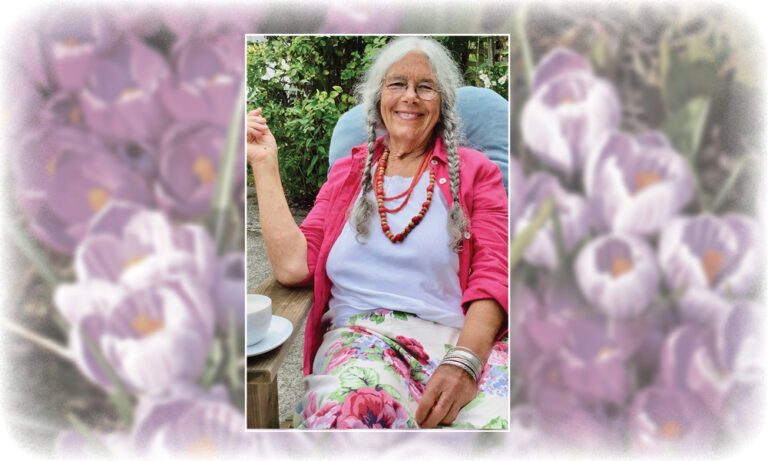
 With much love and sadness, we share the news that our beloved Nina suffered a massive stroke on Mother’s Day in her garden on Walter Bay on Salt Spring Island and died early May 17 with her daughter Sofya at her side. As she noted in her day planner, May 17 is Eric Satie’s birthday. Nina would have been pleased with this date.

Widely acknowledged and honored in her lifetime, first as a photographer and artist and later as an environmental activist, she cared deeply about the earth and loved to walk her talk.

Nina was born on April 14, 1941, in Montreal, the only child of Helen and Ben Raginsky of Russian and German Jewish heritage.

In 1962, she graduated from Rutgers University in NJ, where she was forever influenced by her studies with the artists Roy Lichtenstein, George Segal, and Allan Kaprow.

She was fundamentally creative and worked making jewelry, ceramics, and sculpture, but by 1964 the camera became her primary tool of expression. Nina worked as a freelance photographer in Mexico, London, Old Crow Yukon, and later in Vancouver and Victoria. She had a great eye and was exhibited many times; her photographs are in books, international collections, museums, and galleries. She was made an Officer of the Order of Canada in 1984 and was a member of the Royal Canadian Academy of Arts. Her photography was recognized in 2015 with a Canada Post stamp of one of her full-figure portraits in her distinctive sepia-toned and hand-colored style. In 2022, she was delighted to be included in the anthology ‘A World History of Women Photographers.’

Throughout her career, Nina used only one camera and only one lens, a Nikon 50mm. In 2020, she got her very first flip phone. Another era of photography began as she enjoyed using its rudimentary digital camera to document and share her quiet and solitary daily life.

Nina traveled widely and finally settled in Victoria in the late 1970s where she raised Sofya and taught photography and, as she liked to say, metaphysics, at Emily Carr University of Art and Design in Vancouver.

In 1988, Nina and Sofya moved to Salt Spring Island where Nina turned her keen eye and attention to the natural world. Phenology delighted her endlessly. She worked hard to protect Xwaaqw’um from logging as well as eelgrass, heron, and oyster catcher habitat. She was especially proud of her work to protect the sensitive ecosystem of her beloved Walter Bay.

In addition to her many accomplishments, Nina was generous, warm, and witty. She spoke forthrightly and had intense compassion for all living creatures. She loved conversation, and invitations to tea were cherished times. She had a prodigious memory and could recite passages from whatever book she happened to be studying. She remembered important dates in friends’ lives and could connect with people of all backgrounds. She touched many lives, had a strong presence, and was a force for good.

Working and being in her beautiful garden was one of Nina’s greatest joys. Many people still fondly remember her geraniums and colorful gardens in James Bay. Thankfully, she was able to garden right up to the end of her life.

She also loved food and was a fantastic cook and bread baker. She was committed to promoting and eating local food, and one of her last projects was to produce a cookbook highlighting Salt Spring farmers and their recipes.

Always prolific, she created and shared countless recipes and guides to living simply and with respect for Gaia. She spent a month every year on her Winter Solstice cards and correspondence, handwriting in her distinctive printing style, sharing photographs, recipes, stories, treasures from her garden, and her latest find from the thrift store. Even her envelopes, like everything she did, were works of art.

Besides Sofya, who was instrumental in helping her live well and up to her standards in her later years, Nina leaves cousins and many friends. She will be missed.

Myna Lee Johnstone described Nina beautifully with this spoken word poem at her small funeral on May 23rd:

We all saw Nina

Nina Raginsky

Out in the market

Landmark on Salt Spring

Grace Beauty Strength

braided salt and pepper hair

red shawl long skirt

wicker basket with bread

NO yeast!

water and salt

Blue Herons

Water Watch

Blue Slow Salt Spring Signs

We loved you Nina

Thank You

In lieu of flowers, please remember Nina by observing the natural world, buying less, and buying used. A remembrance will be held at a later date.
Policy Statement meeting diverted by ‘object’ consensus disagreements 

0

A first pass at considering amendments to a cornerstone Islands Trust document got off to a rocky start last week.

Islands Trust Council chair Peter Luckham kicked off the first-ever Committee of the Whole (COW) meeting for that body, and a nearly complete roster of trustees spent three hours on the Policy Statement amendment project — a meeting on fundamental values that was punctuated by fundamental disagreements.  

The online gathering Thursday, May 30 marked the start of the first significant revisiting of the Policy Statement in decades, in a structure — the COW — designed to be more informal. Technically, the plan was for the COW to receive a draft version of the amended document and “discuss the process by which it will be considered,” launching what Trust Area Services director Clare Frater that morning called “the beginning of a multi-year journey” to revise the Policy Statement and address emergent issues.

Those issues include the climate crisis, growing housing needs and the Trust’s commitment to reconciliation with local First Nations, she said. 

But after introductions and the matter of who would chair the meeting were sorted out, and after Frater briefed trustees on the background and outline for advancing the project — the meeting shifted. Disagreements arose, not surrounding the Policy Statement revisions themselves, but regarding the Islands Trust’s “object” — the Trust Act’s so-called “preserve and protect” Section 3 mandate — and whether trustees had truly come to consensus last year on how to interpret it, or whether that agreement was limited to some manner of legal interpretation.  

Section 3 states, “The object of the trust is to preserve and protect the trust area and its unique amenities and environment for the benefit of the residents of the trust area and of British Columbia generally, in cooperation with municipalities, regional districts, improvement districts, First Nations, other persons and organizations and the government of British Columbia.” 

Consensus on that section’s interpretation had reportedly been reached last year; in September 2023, trustees emerged from a closed-to-the-public session of Trust Council to report the group had “just had a lengthy discussion about the interpretation of Section 3 of the Islands Trust Act,” according to Luckham at the time, “and have come to a conclusion of how we wish to interpret that.”  

Luckham did not elaborate then on the discussion, but in October the Islands Trust released a draft “consensus statement” disclosing trustees had — reportedly through an examination of specific legal opinions — reached consensus on interpreting the object, notably in that the definition of “unique amenities” in that section may include “housing, livelihoods, infrastructure and tourism.” 

That consensus statement can be viewed at https://islandstrust.bc.ca/document/trust-council-statement-section-3-of-islands-trust-act/

Following lively public comment in response, the Islands Trust released another statement in January on the “scope and meaning” of the object clause, “to make public the results of our discussions and share with our constituents how the current Trust Council intends to interpret our mandate, which in turn will help inform our strategic planning.”  

That second statement can be viewed at https://islandstrust.bc.ca/islands-trust-council-statement-on-the-scope-and-meaning-of-section-3-of-the-islands-trust-act-object-clause/

But on Thursday, some trustees at the COW meeting disagreed with how that consensus was reflected in staff reports supporting the Policy Statement revision project — seemingly at odds with both the released statements and other trustees’ public comments.  

“The Trust Council did not come to consensus on the interpretation of the object,” said North Pender Island trustee Deb Morrison. “We came to consensus on the interpretation of the legal interpretation of the object. And that is a different thing.” 

Gabriola Island trustee Susan Yates echoed the sentiment, and trustees expressed a range of opinions throughout the meeting — some stating they believed consensus was not reached, some stating it was, and some opining it might not even matter.  

“My understanding was that in that [September 2023] meeting, we had reached a consensus as to what this Trust Council’s interpretation of that mandate was,” said South Pender Island trustee Kristina Evans. “If that’s not the case, we have to absolutely go back and get that done up front, because that is an integral basis for this work that we’re undertaking with the Policy Statement.” 

Morrison said her understanding was that the September 2023 in-camera discussion was for “examining legal decisions,” and that it would be the Policy Statement that would do the “unpacking” of the object. 

“We don’t need to get into the weeds about having a consensus vision of the object,” said Morrison, “because the Trust Policy Statement is our consensus vision of the object.” 

Bowen Island trustee Judith Gedye agreed, suggesting a fuller understanding of the object/mandate could be developed “in parallel” with the Policy Statement project. 

“I think the Section 3 mandate discussion that we have to have is important,” said Gedye, “but I think it’s not necessarily before we have any of this. I don’t want that to hold up this process.” 

Trustees have previously stressed that consensus among them on the Trust’s mandate was critical; in April 2023, as the Governance Committee put gaining that consensus at the top of its priorities, Gedye warned fellow committee members that if they didn’t have “some sort of discussion about Section 3, that’s going to hamper us in terms of getting into whenever we do all of the background and the details of the Policy Statement.” 

At the same meeting, Salt Spring trustee Laura Patrick said that “if there is any doubt” among trustees on Section 3, then it would be “undermining automatically what we’re trying to do to go forward.”  

“So there is a benefit,” said Patrick last year. “I think you have to make a decision, make it clear and move forward. Say ‘this is our interpretation’ as we’re moving forward on the conversation.” 

Indeed, last year Gambier Local Trust Area trustee Joe Bernardo called developing a “working definition of the Trust mandate that we can all get behind, that can be supported by everybody” an eventual “centrepiece” of the corporate planning process, and was among trustees advocating later that the consensus document be placed prominently on the Islands Trust’s website. 

At the COW meeting Thursday, Evans reiterated that beginning the process to amend the Policy Statement without consensus on the mandate was “not going to help us out here.” 

“Without that, we don’t have a position to start from, because we’re all coming from different positions,” said Evans, turning to staff. “Was that [document] a consensus by the trustees on the interpretation of the mandate, or was that just consensus by the trustees on the legal interpretation of the mandate?” 

“That was a decision of the council,” replied legislative services director David Marlor. “It may not be ‘consensus,’ but it is council’s decision. I’m not sure I understand the differentiation, so maybe that’s something we can discuss offline or with the Executive [Committee] outside this meeting?” 

Saturna Island trustee Mairead Boland called the return to the mandate discussion “destructive and erosive of our capabilities and resources.” 

“It’s quite depressing,” said Boland. “Every term there will be this debate, because the act is ambiguous, and it’s left to us to redefine over and over and over.” 

With the fundamentals unaddressed, Boland said, she worried it would be difficult to get through details. 

“I personally believe that if there was more evidence needed — which I think there isn’t — this is evidence that we need an intervention from the province.” 

A motion to schedule time to further consider the Policy Statement during the next Trust Council meeting — set for June 18-20 at the Harbour House Hotel on Salt Spring Island — failed; Luckham suggested the Executive Committee will be advancing recommendations for a schedule of future meetings. 

The currently proposed draft changes can be viewed online at https://islandstrust.bc.ca/document/trust-council-committee-of-the-whole-special-meeting-agenda/

New fire hall project updated

0

Action at the site of Salt Spring’s future fire hall has been taking place under the surface, fire district trustees heard last week — and as much might be said for the board itself. 

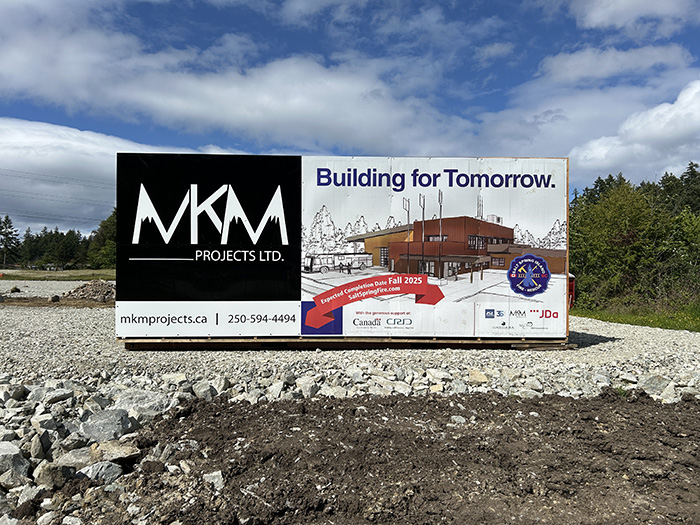
Salt Spring Island Fire Protection District CAO Rodney Dieleman gave a few updates at the board’s meeting Monday, May 27, including on the current state of construction for the new hall on Lower Ganges Road where excavation began in earnest last month. 

“Right now, we’re in a bit of a waiting game,” said Dieleman, noting that in addition to a pause in hope of receiving an additional bid for a mechanical contract, the district was still waiting for its building permits to be issued.  

“They told us six to eight weeks,” said Dieleman. “I think we’re getting pretty close to that. I think things move as they move on this island, and our plans don’t necessarily mean a lot when we’re not in control.” 

Trustees noted some concerns expressed on social media regarding delays, as well as what seemed to be digging of trenches just to seemingly fill them in again; Dieleman agreed it might be difficult to visualize the work progressing, particularly given how much would be going on underground.  

“There’s a lot of drainage to be constructed there, including reservoirs and swales; it’s an understandable question,” said Dieleman. “It’s difficult for anyone who’s not familiar with what we’re doing to look at that site and imagine the final product just yet.” 

Fire Chief Jamie Holmes noted how fortunate it had been to get the initial ditch at the property undertaken in December. 

“That was right before we got that atmospheric river that came in,” said Holmes. “It kept all that water to the outside of the site, versus going in. As people saw, the soil coming out of there was very black, rich, loamy soil that would’ve held all that water — and the equipment would’ve been working in soup.” 

More than 372 truckloads of that rich topsoil has been relocated from the fire hall construction site to Agricultural Land Reserve properties elsewhere on Salt Spring Island, according to a staff report on the fire hall project’s status. 

Dieleman also addressed a pending request through B.C.’s Freedom of Information and Protection of Privacy Act (FOIPPA) for the release of “architectural drawings of the new fire hall, prior to and during the tendering process.” A response is being prepared, he said, although the request raised “significant” concerns surrounding intellectual property rights and not giving bidders any competitive advantages. 

“We don’t own [the drawings],” Dieleman told trustees. “They’re the intellectual property of the architect. We get to own the building, but we have no rights to distribute, sell or reproduce those drawings without the architect’s permission.” 

The architect — and the construction manager for the project — could and do distribute them, he added, but did so on what Dieleman called a “need-to-know” basis. 

“The reason is, there’s a competitive process going on,” said Dieleman. “They’re really confidential and being evaluated in confidence. Architectural drawings are integral to the tendering process; when we tender, we go to different vendors to receive competitive bids. Right now, people are competing dollar for dollar on those drawings.” 

Dieleman suggested that after the tendering process concluded, they could likely engage the architects to permit a partial release, but that would be similar to what was currently available on the district’s public website — necessarily vague, and unlikely to satisfy the requester. 

That person was not named in Dieleman’s report — “No matter who would have made this request, my response would have been the same,” he said — but trustees seemed unwilling to leave things there. 

“I’m going to be a little but more forthright,” said board chair Rollie Cook. “This request came from a trustee; this is not an information request from a member of the public, but from a trustee who is fishing.” 

“It’s not only a trustee who’s looking,” said trustee David Courtney, seemingly revealing himself as the requesting party. “It’s other people in the community. They want to know the size of the building; we have three numbers — 11,500 [square feet], 16,500, and 15,500.” 

“I think the size is advertised on the BC Bid [website],” said Dieleman. “We’ve advertised 15,500 as the size of the building drawn, 16,500 is in the Community Charter — really just the box we’re supposed to build within — and 11,500 was a number pre-design. So you’re right, [but] the building number is advertised as 15,525. Whether you have drawings or not, that number doesn’t change.” 

Trustee Robin Williams told fellow board members he took exception to Courtney’s conduct, saying he felt it was rising to the level of employee harassment. 

“Because what he’s been doing is going behind the board’s back,” said Williams, “badgering and threatening the CAO with [legal] action.” 

Courtney directly addressed Dieleman. 

“CAO Dieleman, have I harassed you?” asked Courtney. 

“I would say that if I felt you were harassing me, I’d probably say something directly to you first,” said Dieleman after a brief pause. “I welcome some questions, and it’s within your rights. It’s just a little frustrating; I communicate my position, then you go through the official act, and threaten to go to another governing body like the Ombudsperson if I don’t comply with that act, which I fully intend to. So, it’s not harassment, but it’s frustrating.” 

“A point of clarification,” said Cook. “The square footage [of the fire hall] has not changed in 15 months. The square footage is [in the drawings] on the wall, right behind Mr. Courtney. The number of bays has been the same, the square footage has been the same. Mr. Courtney has chosen not to avail himself of information that’s already been public.” 

Dieleman said his concerns on intellectual property and competitive advantage would form the basis of his official response to the request, in a written form where “anybody who wanted to challenge it” would be able to see his thinking on refusal.  

Young sailors tackle tricky conditions

BY IZZI PUGH AUCOIN, RUEBEN SOL and ANNA PUGH

Six junior sailors from the Salt Spring Island Sailing Club (SSISC) attended the Royal Victoria Spring Dinghies Regatta, which took place on May 4-5 in the waters of Cadboro and Oak bays.

Aoi Otsu and Luci Pugh Aucoin, both age 12, participated in the Opti Red fleet, while Malikaa Clement, 14, Maeve FitzZaland, 13, Reuben Sol, 15, and Izzi Pugh Aucoin, 14, all participated in the C420, double-handed dinghies division.

The racing format for junior sailing involves multiple races over a set course throughout each day of racing, with points awarded in order of placement: the goal being a low overall score. 

Shifty winds and choppy waters made for tricky conditions, but the Salt Spring sailors held their own. After a disqualifying false start on the first heat of the day, all the SSISC 420 sailors recovered well, with Izzi Pugh Aucoin and Sol earning first over the course of the day, and FitzZaland and Clement earning fifth. This was Clement and FitzZaland’s first regatta as partners and their confidence and teamwork was impressive.

The second day brought more challenges, with heavy winds, strong currents and cold temperatures on the water. Izzi Pugh Aucoin and Sol had an eventful capsize, resulting in a DNF on the second heat of the day.  Once they righted their boat, they were able to continue racing in the next heat, and came back with strong results and a first place finish overall. FitzZaland and Clement gave a consistent performance, only dropping one place from the previous day.  

The rough conditions caused the remaining Opti to retire early from the racing. Many capsized boats were witnessed throughout the fleet by spectators on shore, and several racers from other teams had to be towed in from the races before the day was over.

Despite being unable to finish their races, Opti sailors Luci Pugh Aucoin and Otsu finished 35th and 36th respectively, in a large pool of sailors at their first competitive event. 

The junior sailing team greatly appreciates the support of the SSISC in their training and racing, as well as coaches John and Finley, who spent the weekend out on the water with the team.

Mayne clay team first in Showcase season

By ELIZABETH NOLAN

For Salt Spring Arts

The creative force behind Mayne Island Clay Works makes an exciting launch on Salt Spring this month when ceramic artists Kim Korol and Kristine Webber open Phenomenologies, the first event in Artcraft’s 2024 Showcase season.

Opening along with Artcraft at Mahon Hall on Friday, June 14, the exhibit features select pieces of ceramic works generated over a six-month period using iterative cycles of making, mutual critique and personal reflection. Taking their cue from a term used in social sciences, Phenomenologies explores the ways in which two artists may influence each other’s work both intentionally and unconsciously when working in the same space — how they respond to each other’s work, opinions and ideas.

“Phenomenology is all based on experience and the influence of those experiences on what you do next, your attitudes and your expression of those experiences. So it felt like a really good word: How our experiences with our making and with each other then influences the next making — and how that then influences the next making,” Webber explained.

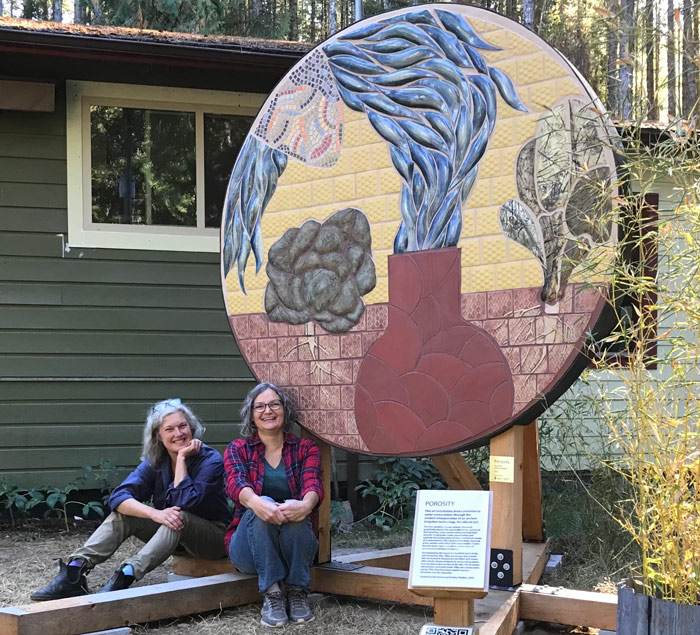
The two women first met after Korol moved to Mayne around five and half years ago, and an immediate connection was forged. They decided to create a joint business and shared studio outside their homes in 2021, and together received a Canada Council for the Arts grant that same year to complete a six-foot diameter tile mural titled Porosity, which was exhibited in the Mayne Island Japanese Memorial Gardens. But it was their pattern of working alongside each other as independent artists on seemingly separate journeys that invited the philosophical theme behind the show.

Kim Korol and Kristine Webber with their Porosity installation at Dinner Bay Park on Mayne Island.

Known for delicate, small vessels, Webber’s new work pushes the boundaries of what clay can do and what it can represent, such as a series of technically challenging knot sculptures.

“I think working with Kim has given me permission to explore different ways of working with clay. I don’t feel limited to making functional work. So it’s just like this brain explosion of potential and permission to explore different things,” Webber said.

As for Korol, she said, “I like making very large vessels and big things and Kristine really makes me pay attention to the form and colour and why I would use certain colours. I think she makes me pay more attention to it, which has been really good.”

Asked whether clay turned out to be a good material for expressing their philosophical theme concept, Korol confirmed it is.

“Clay is an excellent medium for this process because you can make clay into anything. There are an unlimited number of ways to use clay, from how you decorate clay to what you make with it. We could make big things and small things and functional things and torn up things and broken things … so it really pushed us with our creativity.”

The exhibit is therefore a window into the specific creative process of two ceramic artists, but as they explain, it also “invites the viewer to consider the important role of supportive connections and safe spaces in enabling us to flourish as artists and humans.”

“I think for me personally the work that I have made for the show is about finding my voice. And it’s about the internal struggles, as to what humans go through,” Korol said. “It’s been an interesting personal journey for me this winter and I think that really is reflected in the work I made. And so it’s like expressing the inner workings of human beings; the way our minds work and don’t work and the stresses and anxiety.”

“You’ll see a lot of very vulnerable work,” Webber added. “And similarly, I think an underlying theme in all of the things that I have been working on is connectivity in relationships.”

A joint opening reception for Phenomenologies and Artcraft 2024 is set for 6 to 8 p.m. on June 14. An artists’ talk will take place at the hall on Sunday, June 16 starting at 2 p.m. The show will continue daily during Artcraft hours through July 8.

‘Quiet’ Trust conservancy has major impact

By CHARLES KAHN

Fifty years of quiet accomplishment! In this era of climate change, when all levels of government are trying to protect forests and wetlands, the Islands Trust Conservancy (ITC) has greatly contributed to these goals.

What is the ITC? You mean you’ve never heard of it? That’s not surprising, as it enjoys working quietly in the background to accomplish its goals of protecting as much of our fragile forests and wetlands as possible. To make its identity more confusing, the ITC started as the Trust Fund Board in 1990. The name was changed in 2018. And of course there are several conservancies around here, so you’re bound to be confused.

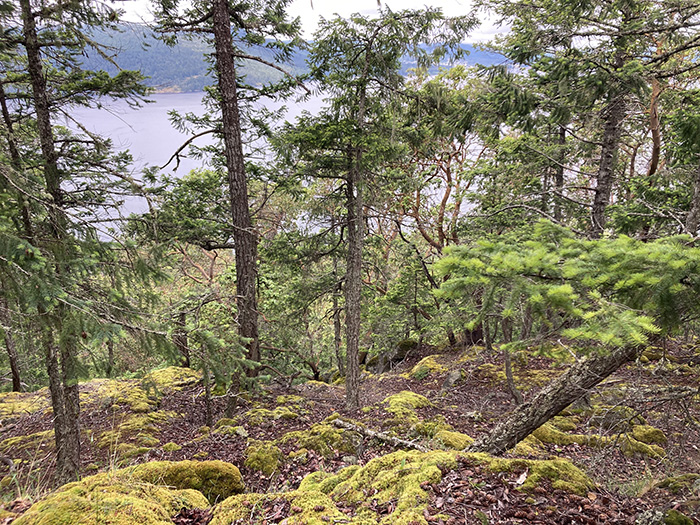
While the Islands Trust was established in 1974 to protect the beautiful environment of the Gulf Islands, the ITC was not created until 1990. Its first covenant was on Salt Spring Island and its first nature reserves were on Denman and Salt Spring. Today, the ITC owns 34 nature reserves and holds 79 covenants, protecting around 1,400 hectares (over 3,400 acres) of land on over 20 different islands. To put that in perspective, 1,400 hectares is about two-thirds the size of Mayne Island.

The ITC is working with the many First Nations in the Trust Area to develop a plan that includes their interests and knowledge in the future of conservation. It also partners with other similar organizations like the Salt Spring Island Conservancy and The Land Conservancy of BC, so that most covenants are held jointly by two conservancies.

The ITC’s Opportunity Fund provides seed money to other organizations to help them purchase land for nature reserves or conservation covenants. It has provided assistance to other organizations to protect over 50 pieces of land.

What does all this mean to us? Well, one of the ITC’s earliest acquisitions on Salt Spring was the Lower Mount Erskine Nature Reserve, which contains a trail leading to Mount Erskine Provincial Park, often referred to as Salt Spring’s Grouse Grind. For many years this trail has been one of the most used on the island.

Gabriola’s Elder Cedar (S’ulhween X’pey) Nature Reserve is the most popular walking trail on that island. Denman Island has three lovely nature reserves with trails open to the public. The ITC’s largest nature reserve is Gambier’s Mount Artaban Nature Reserve with 107 hectares. It includes many hiking trails and a great view from the summit of Mount Artiban. Lasqueti’s Mount Trematon has similarly great trails and lovely views.

Now when you think of the Islands Trust, think of its conservancy and all its wonderful achievements. With a sterling staff of about eight, it collects research and other data, which it shares with others, as well as protecting individual properties for the next generations. If you can’t participate in a public celebration, raise a glass or have a piece of birthday cake on your own to celebrate an institution that has been working to keep the Gulf Islands as beautiful as ever for five decades.

The writer is an Islands Trust Conservancy board member, active in the Salt Spring Island Trail and Nature Club and in conservation efforts, and author of Hiking the Gulf Islands, an Outdoor Guide to BC’s Enchanted Isles.

Indigenous placenames given voice in map

SUBMITTED BY SALT SPRING ISLAND HISTORICAL SOCIETY AND ARCHIVES

National Indigenous Peoples Day is June 21. As newcomers living on these unceded First Nation territories, we can educate ourselves every day about the land and people whose territories we occupy. 

Consider making June a jumping-in point to begin or to further your knowledge of local First Nation history, challenges, continuing strong presence and resurgence. 

If you live on the north end of the island, you can say that you live near P’q’unup. If you are travelling south to “Ruckle” you are going toward ȾESNOEN or (S)ts’usna’um’. 

And now, you can learn to pronounce these ancient names. 

The Salt Spring Historical Society and Archives is pleased to announce an interactive First Nations Placenames Map of the island to help you do just that. The map page is a rich resource, offering names and recorded pronunciations of significant First Nation places in both the SENĆOŦEN and Hul’q’umi’num’ languages. We are grateful to ȻOSINIYE (Lindy Elliott) and Luschiim (Arvid Charlie) for lending their voices to the initiative. 

This “reconcili-action” project is a direct tie-in to the Indigenous Interpretive Panels at Ganges Harbour and Fernwood Dock. The panels are beautiful and carry significant information, but only touch the surface of the layers of learning to be done/undone. 

“People talk about truth and reconciliation a lot these days. Let’s talk about the truth first. Acknowledge what was actually done to our homeland and territories, and then look at reconciliation,” said J’SINTEN (John Elliott). 

A team of volunteers, including Phil Vernon, Maggie Ziegler, Christina Marshall and Ceridwen Ross Collins, have been working for over five years with Elders from Tsartlip, Tsawout, Quw’utsun, Halalt and Penelakut to learn what mattered most to include on these panels. Funding for traditional artwork, interview time with Elders and the materials required for the creation of the panels was provided primarily by the Salt Spring Island Foundation and the Donna Martin Legacy Fund. 

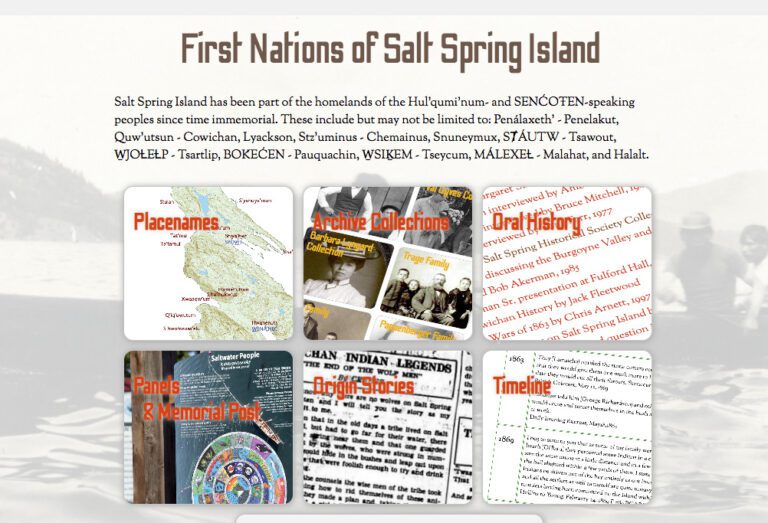
Adding QR codes allowed for the archives team, led by our formidable webmaster Brian Smallshaw, to greatly expand on content by linking the panels to the new First Nations page on our website. The landing page provides options to search collections, oral history, information about the panels, origin stories, a timeline by Chris Arnett, further links, and the Placenames Map of Salt Spring Island with clickable pronunciations by local Elders. This menu will continue to be expanded as more work is completed. Clicking on the “More” button on the map will give the viewer a comprehensive overview of the First Nation background for each labelled site, compiled by Chris Arnett. 

The interactive Placenames Map project is the culmination of two decades of effort. In 2004 the late Frank Neumann of the Salt Spring Island Historical Society and Chris Arnett, anthropologist and author of books such as Terror on the Coast, began working with First Nations Elders to record placenames and any other information they were willing to share in connection to Salt Spring Island. 

“It really is a privilege to be able to work on this type of project with knowledgeable Indigenous Elders to give Indigenous voice to the land,” said Arnett.

The archives team is grateful for the generous donation of Arnett’s time and for his extensive contributions to local knowledge through this project. 

To view this work, a First Nations link can be found on the “Collections” page at saltspringarchives.com.

We respectfully acknowledge the following Elders for their generosity in sharing their knowledge of “Salt Spring” place names with us over the years: Earl Claxton Sr., Ray Sam, Henry Edwards, Ernie Rice, Louis Pelkey, Christopher Paul, Richard Harry, Ernie Olsen, Bob Akerman, Luschiim (Arvid Charlie), August Sylvester, Dave Elliott, J’SINTEN (John Elliott), ȻOSINIYE (Lindy Elliott) and SELILIYE (Belinda Claxton).

The above is the first of weekly articles leading up to Indigenous Peoples Weekend on Salt Spring from June 21-23. 

Editorial: Trust work not a solo act

0

We regularly refer to the Islands Trust as the area’s “land use authority,” which — while correct — fails to convey something important: that authority is built upon a foundational reliance on other agencies to complete its work. 

The Islands Trust Act mandates the Trust “preserve and protect . . . in cooperation with municipalities, regional districts, improvement districts, First Nations, other persons and organizations and the government of British Columbia.”  That “cooperation” means they will help the Trust achieve its purpose and the Trust will help implement their policies.

When the Islands Trust’s object/mandate was deliberately re-examined in 1985, the process was launched over an explicit concern: the “divergence of perceptions” among trustees and the public on how to interpret it was so debilitating to the Trust’s operation that the body was not effectively holding up its end of the bargain. Without an agreement on what the object meant, for example, the Trust was not able to achieve the provincial policy of “sound management of the islands.” So in that spirit, the 1985 review and re-interpretation of the mandate was exhaustive, and included not just trustees and Islands Trust staff, but elected provincial and regional officials (and their staff) with responsibilities within the Trust Area.   

And had the current Trust Council chosen to merely discuss the Trust’s object out of the public eye at a September 2023 meeting, and without such external agencies represented, it would have been perhaps just an unfortunate footnote. But instead, trustees announced a conclusion. Indeed, consideration of how to interpret the Trust’s mandate was explicitly called “completed” and multiple versions of that interpretation were guardedly alluded to in meetings, teased on social media, and — finally — published officially. That occurred, we now hear, without the agreement of everyone in the room.  

Even the staunchest originalist should concede that interpretations of foundational documents might shift over several decades. But despite whatever reasonable justifications there may have been to hold that September 2023 mandate meeting without the public present, doing so has caused a predictable quagmire — one we would hope the leadership of a 50-year-old organization might’ve seen coming. Instead, that quagmire just keeps expanding as the current regime wades into it deeper.

Salt Spring OCP/LUB work kicks off

0

If a recent ASK Salt Spring discussion is any indication, Salt Spring’s upcoming targeted official community plan (OCP) and land use bylaw (LUB) review could be pretty interesting.

Salt Spring trustee Laura Patrick and planner Jason Youmans were ASK Salt Spring guests on May 24, providing information about how community consultation for the review will shake out and answering people’s questions about the process that will focus on diversifying housing options.

Patrick said the problem to be addressed through the upcoming process is why the OCP’s current stated goal of creating a diverse community with diverse housing options is not being met.

“Why are we only getting more and more single family homes that the real community can’t afford to live in? How do we fix that? Those are the questions I’m going to be looking for as we go into this conversation with the community. How do we make sure that we have the housing we need for a healthy community?”

The topic and a staff report is also on the agenda for the Salt Spring Local Trust Committee (LTC) business meeting on Thursday, June 6, accessible now through the islandstrust.bc.ca website.

Those attending the May 24 session at the Salt Spring Island Multi Space heard how the review process will be supported by a provincial $150,000 Complete Communities program grant, which Patrick said will provide all kinds of maps and data to aid the OCP/LUB updating process.

“So that we’re not walking into a room just having theoretical conversations, we’ve got information at our hands,” she said.

Frants Attorp, a frequent commenter on Islands Trust matters, was critical of the focus on housing and pressed for a full OCP review.

“You’ve already defined the goal. It starts with a goal that you’ve decided on, not one that the community has decided on. It’s predetermined, and it’s going to be housing. And that’s not the focus of the Islands Trust. The Islands Trust has a different mandate.”

Youmans defended the decision to not do a wholesale OCP review, observing that the existing document adopted in 2008 is “pretty good and most of it should probably be maintained in a form that looks pretty close to the way it looks today.” The point of this land-use planning update, he said, is to determine “how do we begin to get out the housing options and the housing equity that the trustees and many members of the community have identified as being shortcomings from which our community is suffering? The OCP doesn’t need a big overhaul. Housing has been identified as the area lacking.”

He noted that both trustee Patrick and Jamie Harris were elected in October of 2022 on platforms that promised ways to increase the island’s housing stock.

Attorp and Maxine Leichter also pressed Youmans and Patrick to explain how growth beyond the existing 17,000 population cap in the current OCP would be held in check. Leichter said she and some others felt the underlying purpose behind the OCP/LUB targeted update is to get rid of Section B.2.1.2.1 of the existing OCP, which states: “Zoning changes should be avoided if they would likely result in a larger island population than is expected under the development potential zoned in 2008. Exceptions to this policy are to be few and minor and only to achieve affordable housing and other objectives of this Plan.” The population number cited in the current OCP is 17,000. Salt Spring’s population in the 2021 census was 11,600.

Youmans admitted that policy was not “sancrosanct — it is a policy that was included in the OCP by the local trustees who adopted the OCP at that given time, and that can be revisited.” But he also pointed out that the LTC is constrained from eliminating development caps by a number of legislative factors such as the Trust Policy Statement.

“The latitude to depart grossly from the Policy Statement, or even the existing OCP as it reflects the Policy Statement . . . is very limited, right? Like this is not a place where you can wipe the slate clean and start fresh.”

New Maxwell park: The good, the bad and the ugly

By PATRICIA DONNELLY AND ABRAHAM RUBEN

We are lucky enough to have a local government that thinks the acquisition of a new park is a priority.

With the assistance of generous landowners and concerned citizens they have recently acquired the new Mount Maxwell Community Park. It’s called a community park for two reasons. First, we already have an incredibly beautiful park called Mount Maxwell Provincial Park right next door. The second reason is because the word “community” gives the illusion of inclusiveness.

Unfortunately, this luck is tempered with cost. New parks mean more administrative, insurance and maintenance costs at a time when property taxes and rents are sky high. Many islanders must choose to live off-island because of housing costs.

The environmental cost of this venture must also be noted. PARC claims that it will be saving this wilderness by preventing development and by planting trees. Anyone who has walked through Mouat Park or hiked Mount Erskine will know that no amount of trees or trails will prevent humans from degrading land. Both areas are worn out by people and need renewal because of people. Every trail on the island is a dog walk and few things are more destructive than unleashed dogs in the woods. Every trail on the island has off-leash dogs no matter what signs are posted. Mountain bikes are also destructive. Those who ride off-trail leave tracks through the soft soil that cause erosion in the winter rains.

But the really ugly part of this beautiful park idea is the notion to put a trail head at the end of Wright Road. PARC wants to park horse trailers at the cul-de-sac. They want to make access to the new park easier through an existing right of way. There are some serious problems with this notion. Access to the cul-de-sac may be level (excluding the 20-foot drop to the start of the trail) but Wright Road is an over-used, under-serviced dirt road. The Cranberry Road that leads to it hasn’t been maintained properly for years. It’s a winding mountain road with many blind corners and too much traffic. The idea to send people up these roads for easier access is a mistake. Direct access to the park with a provided parking lot would be more sensible. If PARC wants people to park at parks, they should provide a parking lot. The cul-de-sac is a requirement for fire safety. The size of the turnaround is directly linked to the length of the dead-end road. While parking is permitted, it must remain clear for emergency vehicles. Taking away the cul-de-sac from emergency services would create a direct threat to our neighbourhood’s safety.

And that brings the story to the fire hazard created by people in the woods where there is no emergency access. Forest fires are a very real possibility. The rest of the province is looking for ways to mitigate forest fires while PARC is helping to create a new threat.

The Cranberry Valley has been a farming community for almost as long as there has been farming on Salt Spring. The proposition of increased traffic, fire hazard and dogs that are a threat to livestock are causing fear and anxiety in that community. We have a lifestyle that is not compatible with urban outdoor recreation. If PARC decides that it’s in our best interest to allow a trail head at the end of Wright Road, then I suggest that we bring our geese down to Centennial Park to pasture in the afternoons to demonstrate that incompatibility.

There doesn’t have to be an ugly part to this story. The park is a reality and will happen. But the trail head and trail from Wright Road can be prevented. The community up here will not benefit from it and will be put in danger from it.

Why not make lemonade and promote the use of the unmaintained Mount Maxwell park road as a hiking, trail running, mountain biking and horse riding trail. We could then skip the danger and expense of a Wright Road trail head and trail while offering an alternate access point to the community park through Mount Maxwell Provincial Park. PARC could save a bundle, not worry about fire insurance for the Wright Road trail and we could make use of the existing infrastructure.

The writers own Elderberry Farm on Wright Road.