Home Blog Page 134

LCC disburses grants-in-aid

0

Salt Spring officials anguished over community funding last week, as requests exceeded the available budget — and tough decisions were hammered out. 

The island’s Local Community Commission (LCC) finalized plans for distributions through its grants-in-aid funding Thursday, May 16, answering requests from more than a dozen Salt Spring organizations for one-time support dollars. And despite a modest carryover surplus in the fund, the answer for some “spring intake” applicants would be “no.”  

Indeed, even for those who will receive funding, most will not be getting as much as hoped — in an effort, commissioners said, to have something left for another round of applications in six months. 

“I am struck,” said commissioner Brian Webster, “by how much really valuable work is happening in so many different areas in our community. It’s quite stunning. But my overall feeling is we’re going to have to give a little bit of disappointment to almost everybody.” 

Including the carry-over, the LCC’s budget for all 2024 grants sat at nearly $54,000; had they fully funded every spring intake request made by the April 30 deadline, they would’ve run out of cash — and been more than $9,000 short.  

The process was clearly painful for commission members. 

“Every one of us knows every one of these applicants,” said commissioner Gayle Baker. “We care so deeply about our friends and our neighbours, and we’re looking at picky things. It’s not personal.” 

Recipients of funding will include — in no particular order — Salt Spring Literacy ($997.54), Bandemonium Music Society ($2,150), The Circle Salt Spring Education Society ($2,000), the Wagon Wheel Housing Society ($2,500), Copper Kettle Community Partnership ($5,000), Gulf Islands Community Radio Society ($2,770), Transition Salt Spring Society ($5,000), the Salt Spring Island Farmland Trust Society ($4,000), the Salish Sea Inter-Island Transportation Society ($4,000) and the Salt Spring Community Health Society ($5,000). 

Approved for funding — but waiting briefly, in case the project can be funded by Community Works dollars instead — was the Salt Spring Abattoir ($5,000). A request for $3,150 from Capital Bike was deferred for additional information, and requests from the Lady Minto Hospital Auxiliary Society (for $5,000), the Salt Spring Island Chamber of Commerce (for $5,000) and the Salt Spring and Southern Gulf Islands Community Services Society (for $12,000) were not approved. 

Library’s Truth & Reconciliation efforts earn award

Salt Spring Island Public Library has been recognized for its Truth and Reconciliation work through a British Columbia Library Association (BCLA) award.

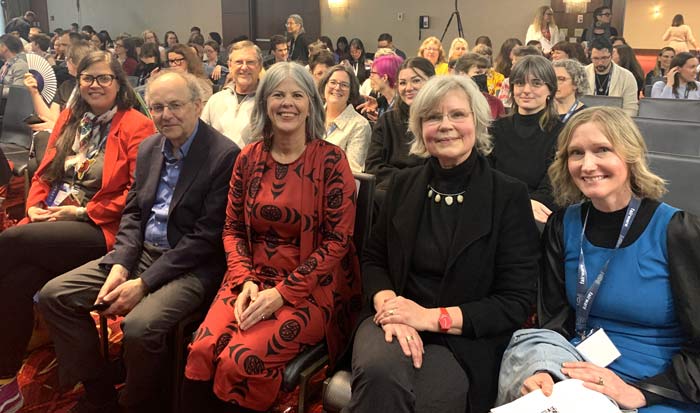
Library director Karen Hudson, library board chair Adrian Wright and Indigenous coordinator Caroline Dick accepted the Building Better Communities Award during the annual BCLA conference held last month in Vancouver.

This award goes to an organization responsible for increasing the relevancy and impact of library services through partnership, collaboration and building trust where little had previously existed.

“Salt Spring Island Public Library formally began doing Truth and Reconciliation work in 2018, with an UNDRIP series, Indigenous author readings and Indigenous displays, and expanded in 2019 with the formation of their Reconciliation Reading Circle, which continues to this day,” states information about the award. “Most recently, in January, they opened ITOTELNEW̱ HÁUTW̱ Tatul’ utew’t-hw, their new Indigenous Learning Area. The awards committee was impressed by the ongoing commitment and leadership Salt Spring Island Public Library has demonstrated to Truth and Reconciliation, and what they have been able to achieve as a relatively small library.”

Pender Island Public Library nominated their Salt Spring counterpart for the award.

In her acceptance speech, Hudson encouraged other libraries to take steps in reconciliation.

“This year’s conference theme is Commitment – Courage – Community, and it takes courage to stand up for what is right, take risks and pursue innovation,” said Hudson. She added they learned that building relationships with Indigenous Peoples is ongoing, takes its own time and the way of working is based on trust and patience. To be successful, you need to be flexible and respectful.

Hudson also mentioned the library’s “ReconciliActions,” including completing the Indigenous mural with Quw’utsun artist Charlene Johnny in 2021, to raise awareness of local Indigenous communities and to be a symbol of the library’s commitment to Truth and Reconciliation; making the library’s commitment to Truth and Reconciliation a strategic priority, with a focus on policies, operations and programming that support the Calls to Action of Canada’s Truth and Reconciliation Commission Report in 2022; and hiring Indigenous staffperson Caroline Dick in 2023.

After thanking the long list of supporters and Indigenous partners, Hudson encouraged everyone to attend the conference session the next day with herself, Caroline Dick, and Amelia Boissoneau from Surrey Libraries, titled Committing to Community Reconciliation at a Public Library, which was attended by more than 100 people.

Viewpoint: Fulford water expansion plan flawed

By IAN PEACE

With about one week of advance notice, the Capital Regional District (CRD) has tasked Fulford Water Service commissioners with a 426-page agenda of documents for a special meeting to “consider including the proposed Ocean Estuary (Vortex) development in the Fulford Water Local Service Area and to make a recommendation in that regard.” One week to prepare for a meeting that draws on some 400 pages of reports effectively bars Fulford Water Service ratepayers from meaningful participation in the CRD decision.

CRD urgency for local approval of their preferred outcome is one of several sources of a reasonable apprehension of bias in favour of the developer. For examples, CRD hired GW Solutions to study the issue of water availability for Vortex. In 2022, GW Solutions published “Weston Lake Water Availability and Climate Change Assessment.” In it, GW Solutions estimates climate change will reduce the volume of water available to the Fulford system by up to 30 per cent. Tellingly, in their three-page summary of the issue, CRD does not mention the effect of climate change.

Furthermore, GW Solutions recommended that CRD “Improve the relationship between land development and groundwater usage and place a high importance on land development and land management decisions that do not jeopardize water resources.” This recommendation suggests an imbalance between approval of high water use developments like tourist resorts and scarce water resources.

Various reports and the CRD claim “Increased and improved water conservation will ameliorate the situation.” Individual water meters for Fulford ratepayers are at or near the top of the list for conservation measures. However, these reports do not include costs such as the cost of installing the meters. Conservation also includes restricting water from agricultural uses. Since the dry season coincides with high tourist season, CRD recommends growers of food give up their water to the Vortex. Virtually all the costs of additional conservation fall to the ratepayers.

In addition, CRD refers to annual water requirements. This includes the Vortex application’s annual requirement. Focusing on annual demand misleads the public away from seasonal drought concerns. Likely, some large fraction of Vortex water demand will occur in the dry season. Supposing some 80 per cent of demand occurs in the summer season changes the water demand picture to the degree the developer’s estimates may not be reliable. Is it reasonable to predict some 60 resort guests, retail operations and a restaurant will get by on about 40 cubic metres of water per day?

In general, CRD speaks more to the capacity of their water distribution system and less to the availability of raw water for treatment. This approach results in a reasonable apprehension of bias toward the developer.

In light of the above and other reasons, the Fulford Water Service Commission could vote for Alternative 3 “Refer the report back to staff for additional information.” That could include answering questions like “what are the costs of conservation” and “what impact will climate change deliver to fresh water availability?”

Editorial: Missing terminal upgrade piece

0

If good things come to those who wait, we were hopeful that whatever was coming to the neighbourhood around the Vesuvius Bay ferry terminal would be very, very good. 

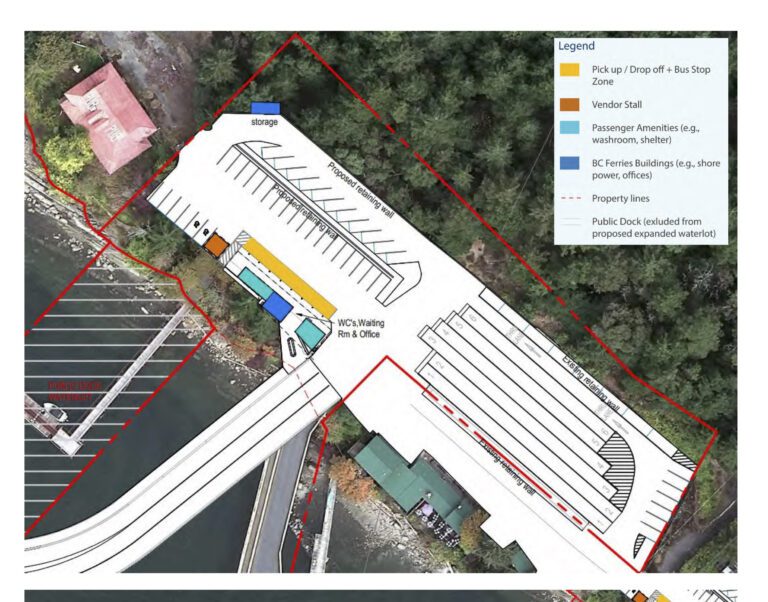
BC Ferries has lifted the lid on some planned changes to infrastructure and layout at Salt Spring’s westernmost access point, with improvements for drivers that might help the neighbours a little, too. Additional holding lanes could get a few more cars off the village’s main thoroughfare, and a few more parking spaces in the lot might unclog some side streets. Sorting out a drop-off and pick-up zone might organize the congestion chaos that begins every spring and persists later and later each fall. 

And we know Vesuvius needs improvement — because the problem is hardly new. Like the shortage of affordable housing, islanders identified the growing traffic issues in and around Vesuvius years ago. But unfortunately, and again perhaps like affordable housing, the steps being taken today would have been a great idea a decade ago — and we’re still missing a big part of the puzzle. 

The re-tooling at the terminal stems from a 2017 traffic safety review that identified four “key issues” — consultant-speak for “problems” — happening there. The plans for construction starting nearly a decade later address just three — namely those surrounding vehicles navigating an increasingly crowded landscape. The fourth and thus-far unaddressed “key issue” was the lack of pedestrian and cyclist accommodation. 

“It is expected that as traffic volumes increase,” read that safety review, “the level of exposure for vulnerable road users (e.g. pedestrians and cyclists) will increase.” 

Setting aside the profound safety issue, it feels like BC Ferries is addressing traffic congestion with perhaps the only management technique that we know doesn’t work, at least in the long run: building more lanes. 

Like planting a tree, the best time to have improved non-vehicle infrastructure for visitors and commuters was 20 years ago, and the second-best time is today. With BC Ferries’ priorities seemingly still laser-focused on cars, it looks like we’re not planting any time soon. 

Opinion: Fulford water report raises serious concerns

By JOHN MILLSON and JEAN WILKINSON

For SSI Water Preservation Society board

The Salt Spring Island Water Preservation society is a charitable organization that has been working since 1982 to protect drinking water resources on the island.

We are writing today regarding the recent public announcement of an upcoming (Friday, May 24) Special Meeting of the Fulford Water Service Commission (FWSC) and the Capital Regional District (CRD). We have serious concerns about the special meeting agenda recommendation from CRD staff that “The Fulford Water Service Commission recommends that the Ocean Estuary Development (aka “The Vortex”) be granted permission to proceed with an application to be included in the Fulford Water Local Service Area.”

From a brief review of the 426-page special meeting agenda document that has (at very short notice) been shared by the CRD with the FWSC community representatives, the SSI Water Preservation Society has some significant areas of concern relating to the planned Fulford Water Service meeting CRD recommendation:

1) Given the short notice on the timing of the meeting (and the 426-page report’s contents) there appears to be an absence of any in-depth consultation with the FWSC (and thereby the local Fulford community…), negating the ability for the commissioners to provide an informed view on the above CRD May 24 meeting recommendation.

2) Previous, informal water district communications (with CRD included) under an informal SSIWPA umbrella have suggested that the CRD would not allow the respective opinions of the FWSC commissioners to be overruled. It is hoped that the CRD will provide a suitable opportunity for the district’s commissioners to have their say in the final decision-making, and that the community views will be appropriately considered in any decision(s).

3) The CRD staff recommendation in the May 24 Special Meeting agenda that “The Fulford Water Service Commission recommends that the Ocean Estuary Development be granted permission to proceed with an application to be included in the Fulford Water Local Service Area” seems to be counter to the above community input/considerations.

4) The CRD special meeting agenda/report does not appear to adequately address or consider the concerns expressed in the 2023 science-based study of Lake Weston Water Availability and Climate Change Assessment water budget. This study, sponsored by the CRD with support from Islands Trust and WPS Freshwater Catalogue data, flagged concerns around existing summer-time over-exploitation of the community’s water source, and the need to better understand (and maintain) in-creek summer environmental flow needs. This is especially important given that climate change is bringing longer periods of drought in the summers, stressing natural systems.

5) The CRD May 24 Special Meeting document comments that the “addition of the (Ocean Estuary) project will not make things better.” Indeed it will ensure that the current freshwater sustainability situation in this watershed deteriorates further, even if “the increase in use associated with Ocean Estuary is expected to have less than a 5% influence on current flows.”

Due to these issues, the SSI Water Preservation Society suggests strongly that careful attention be paid to the scientific analysis of the 2023 study of “Weston Lake Water Availability and Climate Change Assessment” and a more integrated freshwater sustainability plan for the Weston Creek Watershed area be developed. This “holistic” view of a sustainable freshwater future should be in place before any commitments to additional freshwater extractions are considered.

A carefully thought-out sustainable model, developed by the community and water district commissioners, might include options for reducing in-creek and lake freshwater use, especially during the summer. Some possibilities are: rainwater catchment incentives; increased tariffs for higher volume users; seasonal, in-situ surface storage; a lake weir; etc. A sustainable freshwater plan with defined execution and funding options should be in place before any additional connections are to be considered.

Furthermore, it is worth noting that any alternative “well and water treatment system drawing from a different aquifer” proposal(s) (page 5 of the CRD staff report) should also be underpinned by a similar watershed sustainability review and appropriate freshwater shortfall management measures.

We respectfully suggest that the appropriate response to the CRD Special Meeting of the Fulford Water Commission is “Alternative 3: this report be referred back to staff for additional information.”

John Millson is Freshwater Catalogue lead and Jean Wilkinson is president of the Salt Spring Island Water Preservation Society.

ENGLISH, Sandra

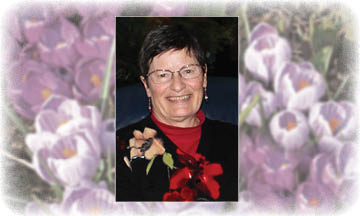
 ENGLISH, SANDRA (nee SKINNER) March 20, 1944 – April 27, 2024. Passed away peacefully at the Good Samaritan Delta View Care Home at age 80. 

Sandra was born to Wallace and Olive (nee Bain) Skinner in Sydney, Nova Scotia, and was close to her maternal grandmother “Ma Bain.” Sandy was predeceased by her infant brother, Robert, and recently lost her eldest brother, Wally. She is survived by her twin brother, Carl (BC), and siblings Donald and Debbie (NS), and Jane (NB), their spouses, and nieces and nephews. 

As a young woman, she made the bold move to the west coast to continue her career. In 1973, she married Gordon English, and the two were very happily married until Gordon’s passing in 2016. They visited family in the Maritimes through the years, keeping the west/ east connection alive. Sandy became part of the extended English family, and will be missed by her stepchildren Elizabeth, Susan, Geoffrey, Janet, and Diane, their spouses, children, and grandchildren. Many thanks to Janet and her husband Bruce for their attention to her care and the wonderful gift of music, and thanks to the dedicated staff of Delta View. 

Sandy and Gordon made Salt Spring Island their retirement home in the 1980s. They enjoyed boating, golfing, and playing tennis with their many friends. Sandra discovered a passion for stitching and was renowned for her award-winning hooked rugs. She also enjoyed working at the Waterfront Gallery and helping Gordon with his fundraising efforts for the hospital and Meadowbrook Seniors Residence. Her effervescent personality, boundless energy, and positive approach to life made being with her a true joy for everyone. The family will be holding a private memorial service at a later date.

World travellers present at book launch

By MARGRIET RUURS

for SS Trail and Nature Club

The Salt Spring Trail and Nature Club will host a free presentation by Maria Coffey and Dag Goering on Saturday, May 25 at 2 p.m. at the Salt Spring Public Library program room, celebrating adventures in nature as well as the launch of a new book.

Many people around the Salish Sea know the writer/photographer couple.

“Salt Spring has a special place in our hearts,” Coffey admitted, and the couple keeps their boat here.

Many years ago, the couple chose travelling over starting a family, a decision that has led to a lifetime of adventures. They have cycled across Vietnam, kayaked Lake Malawi in Africa and explored many unusual places around the world.

When asked which of their adventures was their favourite, Coffey smiled. “It’s hard to say, because all the experiences were so different. But the one that stands out is our six-week kayak trip on India’s River Ganges in 1992. That trip was life-changing. It turned us inside out, it challenged us on every level, and it became, quite unexpectedly, and especially for me, a spiritual odyssey.” She wrote several popular books about each of these trips.

Even though many of her books focus on travel adventures, Coffey said, “All my books have also been very personal stories. My first book, Fragile Edge, was a memoir about my relationship with a high-altitude n who died on Everest. I went on to write a succession of travel narratives about my adventures with Dag, and then turned back to the subject of extreme risk in Where the Mountain Casts its Shadow and Explorers of the Infinite. These were both more journalistic in style, but with my own story wound through them. Finally, many years after Fragile Edge was first published, I returned to memoir with my newest book Instead. The original theme was aging, something I’d been in denial about, but, at 66, suddenly could no longer ignore. I wanted to look at challenges I’d faced in my past, to see if the lessons I’d learned then could help me navigate this new and rather frightening terrain ahead. But as I started writing about these challenges, the decision to be child-free kept cropping up. A few chapters in, I realized that this was the big story I needed to examine — with aging just one part of that.”

And, as if their world travels, writing and photography aren’t enough, the couple runs Hidden Places, a small travel company offering small group trips to places they love and know well. The trips can range from kayaking on the Turkish coast and living aboard a gulet, to walking across the high savannah of Kenya supported by Samburu tribesmen and their camels.

But her newest book, Instead: Navigating the Adventures of a Childfree Life – A Memoir, is more than a personal account of a life full of adventure without children or grandchildren. It is also a look at growing older and adapting, learning to go with the flow of life.

“How would our lives have been different,” Coffey muses throughout the final chapters, “if we had opted for children?” And when her husband has a major accident, and no children are able to support them, the couple realizes that friends and family are already the support network needed.

Salt Spring Books will offer books for sale at the library event.

Vesuvius terminal changes clear LTC hurdle

0

BC Ferries is proposing big changes at the Vesuvius Bay terminal — and will need the ongoing approval of Salt Spring’s Local Trust Committee (LTC) to advance much of it. 

To kick off the multi-year process, Evan Peterson from BC Ferries’ contractor Barefoot Design came before the LTC Thursday, May 16, bringing a rezoning application that would enable redevelopment of the three parcels that comprise the terminal’s infrastructure.  

Those include the vehicle holding area, which BC Ferries leases from the B.C. Transportation Financing Authority; the parking lot, leased from the Ministry of Water, Land and Resource Stewardship; and the marine area, which BC Ferries controls through a licence of occupation from the province. 

On land, BC Ferries plans to increase the number of public parking stalls — from 21 to 25 — and retain 16 additional spots for staff. A “thru-lane” is planned for where Lane 7 currently sits, to improve traffic circulation. A designated pick-up and drop-off zone would be built in the existing parking lot near the government wharf, and improved passenger amenities — washrooms, a waiting room and a vendor stall — would be placed alongside the BC Ferries office. Additional holding lanes would increase capacity during busy times, potentially reducing vehicle line-ups onto Vesuvius Bay Road. 

For the marine area, BC Ferries will be applying to provincial regulators for a water lot expansion to replace the existing trestle with one that would be long and shallow-sloped enough to allow for vehicle holding — all of which will accommodate the plan for an eventual two-vessel service between Vesuvius and Crofton.  

BC Ferries has proposed a phased approach to the project, which means the marine terminal development will start first, with the upland portion once the company allocates the budget for it. Throughout, according to Peterson, islanders can expect ongoing “engagement and communications” about what’s happening and any interruptions or changes to service as a result of the work. 

“And then the marine improvements are slated to begin in 2026,” said Peterson. “We’re hoping to have the Island Class ferries for 2027.” 

The water lot expansion application is contingent on the LTC approving the rezoning and appurtenant official community plan (OCP) amendment, according to staff. And as it lies within development permit areas, both demolition of the existing trestle and construction of the new one — as well as the parking area upgrades — will require a development permit from the Islands Trust before construction can begin.  

Trustees agreed the opportunity to improve both accessibility and traffic at the terminal was worth pursuing. As well, it would bring the existing land use into compliance: despite decades of use for ferry service, the upland terminal and parking area are currently zoned “residential” in the land use bylaw with a “residential neighbourhoods” OCP designation. The LTC directed staff to “notify and seek input” from local First Nations and relevant agencies, and proceed with drafting an amendment bylaw to bring forward at a future meeting. 

“This is preliminary; we’re just kicking the process off here,” said Salt Spring trustee Laura Patrick. “I’m glad to see it. I know the terminal is in dire need of some updating.” 

The Gulf Island Ferry Company provided ferry service between Vesuvius Bay and Crofton from 1955 until 1961, when BC Ferries started doing so.

Former trustees press Islands Trust over ‘unique amenities’ decision

The following letter, signed by 34 former islands trustees as noted at the end, was sent to the Islands Trust Executive Committee and filed with the Driftwood for publication.

As former Islands Trust trustees from various islands in the Trust Area, we are writing to inform you of our concerns regarding Trust Council’s intention to broaden the meaning of the words ‘unique amenities’ in Section 3 of the Islands Trust Act (the Object). The spirit and intent of those words seem unmistakable in light of the 1986 Ministry of Municipal Affairs/Islands Trust “Position Paper; The Object of the Islands Trust: Renewing the Consensus,” that specified a combination of many natural factors.

Following an in-camera meeting on September 26, 2023, it was reported that Trust Council had come to a “consensus” on how Section 3 of the act that created the Islands Trust would (not “should”) be interpreted. What those conclusions were and how they had been agreed upon was not revealed. A silence, lasting almost four months, followed before the “Islands Trust Council Highlights” with a link to “Trust Council’s consensus statement” was officially released on Jan. 18, 2024.

It was then that the details of Trust Council’s conclusion were revealed to the general public. “Unique amenities” were to include, “but not be limited to, housing, infrastructure, livelihoods, and tourism.” How and by whom these four categories were identified and selected for inclusion is not mentioned.

Apart from consideration of legal opinions, we question the propriety of holding this discussion during an in-camera meeting. We have heard different explanations of how council’s decision was arrived at: from staff, the Executive Committee and from trustees. These contradictory responses are problematic and confusing. There is no evidence of a motion being passed by council which would provide a record of Trust Council’s approval for the addition of these items under the umbrella of “unique amenities,” or how individual trustees voted. It would have been helpful knowing whether this “consensus” was reached by referring to the 1986 Ministry of Municipal Affairs/Islands Trust “Position Paper; The Object of the Islands Trust: Renewing the Consensus” and the 2021 “Discussion Paper: The Islands Trust Object: Past, Present and Future.”

These additional categories, now identified as “unique amenities,” are not unique to the Trust Area. Further, housing, infrastructure, livelihoods and tourism are services provided by regional districts and government agencies. More alarming, this expansion and interpretation of “unique amenities” has the potential of influencing or compromising environmental policies. The Trust is limited to regulating land use in order to preserve and protect the natural environment and rural character of the Trust Area for all residents of B.C., a duty specific to its intended purpose and function as a “trust.”

How will this new interpretation of “unique amenities” influence Trust Council as it embarks upon a review of the Trust Policy Statement? Will this decision result in environmental policies being compromised or excluded to facilitate development?

Pertinent and fundamental questions have been raised by numerous individuals and groups regarding both the process and the conclusions of that process over the course of the past six months and, as of this date, none have been addressed by the chair of the Islands Trust Council.

We believe the credibility of the Islands Trust’s promise of a transparent and open public process has been hurt by the manner in which this decision was reached, the lack of a rationale for this decision, and the lack of information provided.

We ask, therefore, that the chair make a public statement with full disclosure of why the interpretation was not made in an open meeting, how a “consensus,” unanimous or not, was arrived at, the reasoning used to arrive at this interpretation of the words “unique amenities” and how this interpretation will influence the Trust Policy Statement review.

Sincerely,

Nerys Poole, 2008-2011 (Bowen Island); John Rich, 1976-1984 (Bowen); Kim Benson, 1993-2008 (Gambier); Harlene Holm, 1978-1984 (Denman); Roxanna Mandryk, 1992-1996 (Denman); David Critchley, 2014-2022 (Denman); Deb Ferens, 2011-2014 (Gabriola); Gisele Rudischer, 1996 to 2008, 2011-2014 (Gabriola); Kees Langereis, 2018-2022 (Gabriola); Debbie Holmes, 1996-99, 1999-2002 (Galiano); Tahirah Rockafella, 2018-2022 (Galiano); Sheila Anderson, 2002-2005 (Galiano); Sandy Pottle, 2008-2018 (Galiano); Tony Law, 1996-2005, 2007-2018 (Hornby); Barry Kurland, 1986-1992 (Lasqueti); Peter Johnston, 2011-2015, 2018-2022 (Lasqueti); Tom Weinerth, 1999-2002 (Lasqueti); Jen Gobby, 2008-2011 (Lasqueti); John Barre, 1982-1986 (Lasqueti); George Ravenscroft, 1996-1999 (North Pender); Ben McConchie, 2018-2022 (North Pender); Christine Torgrimson, 2008-2011 (Salt Spring); Peter Lamb, 2005-2008 (Salt Spring); David Borrowman, 1996-2002 (Salt Spring); Elaine Jacobsen, 1986-1996 (South Pender); David Greer, 2008-2011 (South Pender); Wendy Scholefield, 2014-2018 (South Pender); Wendy Munroe, 1984-1988 (South Pender); John Rumble, 1996-2000 (South Pender); Cameron Thorn, 2018-2022 (South Pender); Bruce McConchie, 2014-2018 (South Pender); Liz Montague, 2011-2014 (South Pender); Steve Wright, 1982-1990, 1996-2000, 2018-2022 (South Pender); and Doug Fenton, 2018-2022 (Thetis).


Singers soar in Across the Universe

As a community choir that passed its 50-year milestone last year, Salt Spring Singers members have explored countless themes in their biannual concerts.

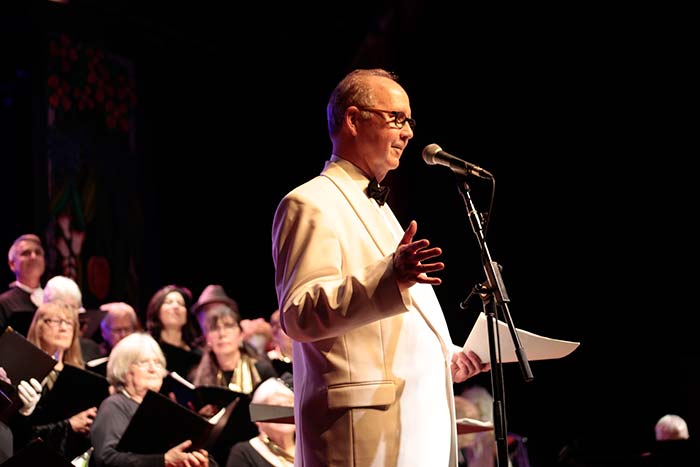
A choir’s artistic director is generally responsible for coming up with concert program concepts, but this time Don Conley asked his members what themes they would like to consider. That’s when someone suggested “outer space or the universe,” he said, and people “started shouting out songs they knew of with space in the theme.”

It ended up providing a rich galaxy of musical choices, which audiences will hear at this weekend’s two concerts called Across the Universe at All Saints by-the-Sea church. The first is on Saturday, May 25 at 7:30 p.m., with a Sunday afternoon show beginning at 2:30 p.m.

James Yi is the choir’s accompanist.

Conley said the first part of the concert features classical works, such as Creation’s Hymn by Beethoven and Haydn’s The Heavens are Telling from The Creation oratorio.

“Both of them are big numbers. You get that full, powerful choral sound,” he said.

Music by renowned contemporary composers includes A Flight Song by Kim André Arnesen, which is based on a beautiful poem about coming of age and going out into the world and “flying.” The metaphor is applicable to just about anything, said Conley.

Across the Vast, Eternal Sky, about the phoenix rising myth, comes from choral-world superstar composer Ola Gjeilo, and Walking in the Air is a magical piece from an animated British film called The Snowman.

The Robert Frost poem Choose Something Like a Star set to music by Randall Thompson is another beautiful and cinematic song on the program.

The concert’s second half enters a contemporary orbit with Elton John’s Rocket Man, Across the Universe by the Beatles, Fly Me to the Moon — the jazz standard made famous by Frank Sinatra and Count Basie — and From a Distance, which was a Bette Midler hit in 1990. Six of the choir’s singers will perform the poignant Underneath the Stars by Kate Rusby, which was hugely popular for Grammy-nominated British ensemble VOCES8.

Because humour is pretty much a constant in Salt Spring Singers concerts (and rehearsals), choir member Jean Brouard will sing The Galaxy Song from Monty Python.

The concert’s closing number is an absolutely on-theme classic — take a guess at what it will be and you might be right!

Conley said his choir is growing in numbers again after the reducing impacts of the Covid pandemic, and the 40-plus group has embraced the Across the Universe repertoire.

“They really like the program so they are singing it enthusiastically.”

Tickets for the show are available through the ArtSpring box office, or at the All Saints door, if still available.

While the choir’s membership has grown in the past year, Conley would like to see even more islanders enjoy the benefits of group singing, so a free workshop encouraging people to try it out, which will also be valuable to experienced singers, is being offered next month.

Eva Bostrand, a well-known vocalist, teacher and choral director from Edmonton, will lead the June 21-23 event at All Saints. More details will be available soon.

Conley said hosting educational and outreach events like the Bostrand workshop are one of the Singers’ purposes.

“Part of our mandate is to reach out to the community and provide education about choral singing and the benefits of it,” he said.