
Home Blog Page 135

Policy Statement draft trims mandate interpretations

0

The islands’ land use authority has given notice and offered a first look at possible changes to its core guidance document, 30 years after the last time the Islands Trust’s Policy Statement was meaningfully revised. 

The Trust’s Executive Committee last month directed staff to arrange the first-ever Islands Trust Council “Committee of the Whole” (COW) meeting, where they plan to receive the new draft of the Policy Statement and “discuss the process by which it will be considered,” according to a resolution, after which the EC will hold a special meeting “for consideration of next steps.” 

A special electronic meeting of Trust Council’s COW is set for Thursday, May 30, from 9:30 a.m. to 12:30 p.m. The posting of that meeting’s agenda on May 7 marked the first time trustees have seen the proposed changes to the Policy Statement, right alongside members of the public.  

It’s a novel bit of public policy tradecraft hoped to help avoid re-igniting public rancor; in 2021, Trust Council hit pause on the revision process after a posted agenda included a proposed draft amendment bylaw — and that prompted backlash and a petition over worries trustees were moving forward without sufficient public input.

Trust Council reacted then by sending staff back to the drawing board, to incorporate what became a significant amount of feedback — hammered out into 32 resolutions — into a new document. That work has been done and a document was produced, which before May 7 had been shared only with nine First Nations representatives and staff at the Agricultural Land Commission, the Ministry of Agriculture and Food, Bowen Island Municipality and the Island Trust Conservancy for their feedback. 

The proposed changes are unsurprisingly plentiful and would have mixed consequences.  

The structure and readability of the Policy Statement is improved, staff believe, and they noted several significant changes from the 2021 draft, including the deletion of “preamble language” about interpretations of the Trust’s Object — also called the “preserve and protect” mandate — and the removal of advocacy policies, including one about desalination plants and another about the Trust seeking tree-cutting authority for local trust committees.  

That last reflects a Trust Council motion from March 2023, when a majority of trustees voted to “promptly inform the province that it no longer wishes to proceed” with efforts that sought provincial authority to let individual islands enact tree-cutting bylaws. 

And on the object/mandate, staff suggested it simply doesn’t belong there. 

“There is no requirement to include a specific breakdown of the Object, [nor] to include a definition of unique amenities” in the Policy Statement, according to an accompanying staff report. “Indeed, the document has never had these definitions, but rather goals/objectives and policies.” 

Instead, according to staff, the Policy Statement read “as a whole” will offer Trust Council’s vision for the “future of the Trust Area, its understanding of the unique amenities it wishes preserved and protected, [and an] expression of how it wishes to balance the elements (unique amenities and environment)” included in the mandate. 

“For this reason, staff reflected on the challenges that the Islands Trust Object interpretation section presented in relation to the value offered, and comments received from First Nations,” read the report, “[and] are recommending this section not be included.” 

This would not, staff noted, preclude any LTCs from opening their own official community plans with a “context statement” on interpreting the mandate. 

Among the 34 Trust Council resolutions that guided these draft revisions, Resolution 4 — which instructed staff remove “commitments of Trust Council” from each subsection and replace them with more general guiding principles — is cited most often as the rationale for specific changes.  

And while those are essentially simple rewordings, the result may seem jarring. For example, a sentence that previously read “. . . the rate and scale of growth and development in the Trust Area must be carefully managed and requires limitation” now begins in the assertive: “Limit the Rate and Scale of Development: to define and maintain appropriate limits for the rate and scale of development in order to preserve and protect the unique amenities and environment.” 

The COW will include all trustees and was designed to allow a less formal structure for discussing complex issues — such as budgets, policy development or advocacy — without being constrained by rigid meeting procedures.   

And decision-making is off the table at COW meetings, according to staff and trustees, who believe rolling out the first discussions of the Policy Statement in such a meeting will help alleviate any concerns the proposed changes might be approved without public feedback.   

An update to the Policy Statement — to revise the guiding document to address issues such as the climate crisis, growing housing needs and the Trust’s commitment to reconciliation with local First Nations — has been in planning since at least 2019. 

The proposed changes to the Policy Statement can be found within the agenda for the COW meeting at islandstrust.bc.ca/event/trust-council-committee-of-the-whole/. Those interested can also join the May 30 meeting electronically at the same URL.  
Community, LCC weigh in on moth spray issues

0

By ROBB MAGLEY & GAIL SJUBERG

Driftwood Staff

Salt Spring officials are fielding community concerns about recent aerial spraying for the invasive spongy moth — worries fueled, they said, by misinformation online. 

Messages spread via the internet include allegations the spraying violated conditions of the permit issued by the Ministry of Environment for application of the bacteria-based insecticide Foray 48B, which took place May 6 over a 48-hectare area centred on Elizabeth Drive. 

While islanders seem to agree a spongy moth infestation would endanger local trees, at the last meeting of Salt Spring’s Local Community Commission (LCC) Thursday, May 9, commissioners lamented that because of the online discourse, much of what they had heard directly from their constituents seemed misinformed. 

“My concern about it is that there’s a lot of inaccurate information that’s spreading in the community,” said commission member Brian Webster, characterizing what he’d seen online as “about three parts inaccurate information to one part accurate.” 

In online posts, some islanders alleged the product causes a wide range of health effects — and that the BC Ministry of Forests-contracted aircraft sprayed during a period of excessive wind, endangering Salt Spring waterways. In a communique sent to the Driftwood and multiple government offices via email, Salt Spring resident Oona McOuat said she witnessed high winds from her vantage point on the north end of Mary Lake — an assertion she supported with weather data from a privately owned monitoring station seven kilometres away from the spray area — and that the plane “sprayed directly over Duck Creek” downstream of St. Mary Lake, and the spray drifted back over the lake itself.

McOuat provided, and posted online, photos of the aircraft and a video showing swaying branches and waves on the lake, which she said proved May 6 was not a safe day to spray due to wind levels. 

Driftwood coverage — from beside an open field inside the target zone — reported practically windless conditions throughout the May 6 early-morning spraying, including about a half-hour before the aircraft arrived and just after it left the area. 

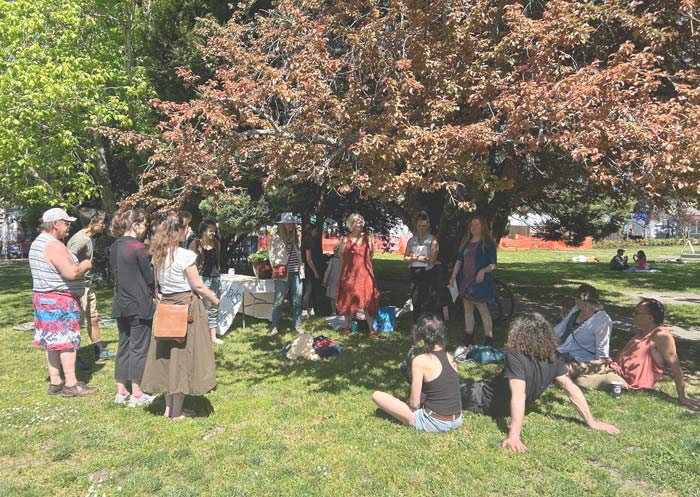
A group of about 15 islanders gathered in Centennial Park on Saturday to share information and encourage a demand for government to halt the next planned spray session — tentatively set for the early hours of Thursday, May 16, weather permitting — and to consider alternate spongy moth eradication methods instead. They expressed concerns about the potential impacts of Foray 48B on human, animal and lepidoptera health, and said they felt the notice given to residents was inadequate. A number of attendees living in the affected area said they did not receive advisory postcards sent in the mail, see pesticide use permit ads or stories in the Driftwood and on its website, or signs erected on roadsides. Some people were caught off-guard out walking their dogs as the spray event occurred, they said, and other vulnerable people were likely affected.

Foray 48B — like related products 48F and 76B — is a water-based suspension of the Bacillus thuringiensis variety “kurstaki” (Btk) bacteria, designed specifically for forestry applications, according to manufacturer Valent Bioscience. Available products that contain Btk are certified for use on produce labelled “organic” by the Organic Materials Review Institute; the bacteria itself is often found in soil, according to B.C. government officials. 

During a specific period in a moth’s life cycle, the insect will die if caterpillars ingest live Btk bacteria; once the product is sprayed, according to provincial officials, those bacteria only survive for about a week, making the use of Btk attractive for targeted spraying without endangering other insects that develop at other times of year or under different conditions. 

A list of Foray 48B’s non-bacterial inert ingredients have been made available to multiple governments, including Canada’s; after analyzing them for health considerations, each agreed to keep the specific formulation in confidence to protect those “trade secrets” from competitors. 

When asked if the North Salt Spring Waterworks District was concerned about the spraying’s impact on water supply, NSSWD CAO Mark Boysen said, “Our primary concern was that the NSSWD was not engaged or formally notified before the spraying. We reached out to the Province prior to the spraying to confirm if the St. Mary Lake community water supply was considered in their planning. The ministry shared that it was considered and addressed through the buffer zone.” 

Capital Regional District director Gary Holman told fellow LCC members he spoke with Dr. Murray Fyfe, Island Health’s medical health officer for the region, who told him while he did advise people as a precautionary measure to stay indoors during spraying, that was “about it.” 

“He assured me that there’s a long history of using Btk,” said Holman, “and that there have been no documented health effects.”   

While Btk products have been used for decades, there have been reports of health effects. A 2003 article published in the New Zealand Medical Journal studied hundreds of residents in one neighbourhood — through symptom checklists and questionnaires measuring health perceptions — before and after an aerial spraying there of Foray 48B. That study found the spraying to be associated with increased reporting of upper airway, gastrointestinal and neuropsychiatric symptoms, as well as “a reduction in overall perception of health in the exposed population.” 

In a 2005 article published in the peer-reviewed journal Psychosomatic Medicine, researchers studied the same questionnaires and discovered that residents’ worries about “the effects of modern life on health” strongly influenced the attribution of symptoms and beliefs about health effects from the spray.  That study concluded the number of symptoms reported after the spray “was most closely related to the number of symptoms reported at baseline.” 

“I’m relatively familiar with what’s being sprayed,” said Webster, an apple orchardist, “and I’m confident Health Canada and the provincial Ministry of Health know what they’re talking about when they say what’s being sprayed is not a health risk to anyone — or any mammal, or any bird, or any fish, or any flying insect.” 

B.C.’s Environmental Appeal Board recently dismissed an attempt to halt spraying in B.C. brought by Communities United for Clean Air, a committee of Freedom Rising-affiliated political activism group BC Rising. In a decision released May 3, the board found, in part, that the appellant’s “evidence [did] not support a conclusion that any of the human health effects they describe are likely to occur.”

Rain or high winds could postpone any treatments until the following suitable morning. For up-to-date information visit gov.bc.ca/spongymoth-news

Island artist creates cancel stamp image

0

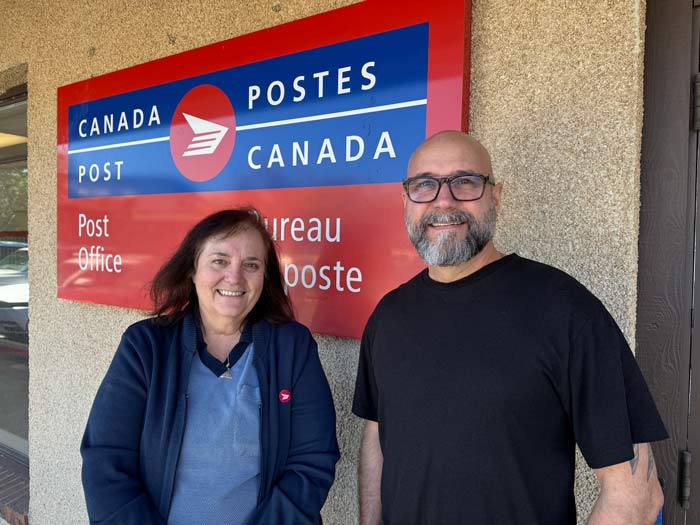
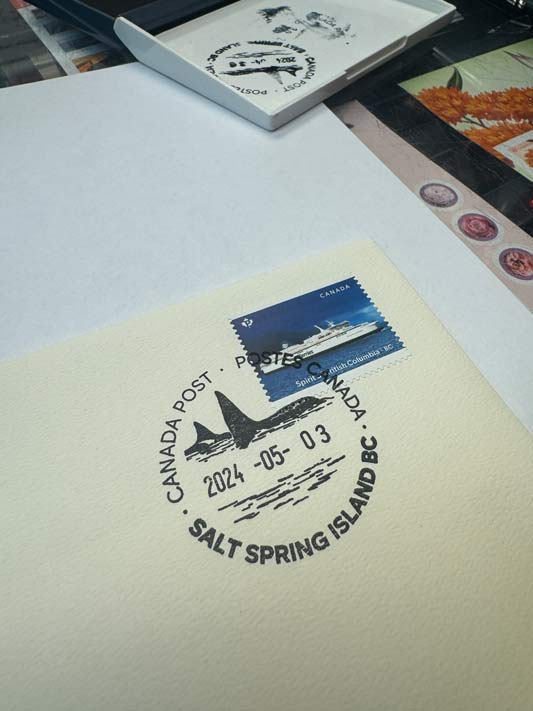
A new cancel stamp is in use at the Ganges Post Office, attracting interest from philatelists across the globe — and designed by a local wildlife artist often known for his work being featured on gold and silver coins from the Royal Canadian Mint. 

Allan Hancock said his love for nature and the outdoors was launched when he was quite young, thanks to his grandfather William — Hancock works professionally as W. Allan Hancock. 

“He was a big outdoorsman,” said Hancock. “When I was a kid, he’d take me out into the bush all the time. That’s a big part of my love for the outdoors.” 

Hancock’s artwork has appeared at Canada House Gallery in Banff and White Rock Gallery, as well as on Salt Spring Island at Gallery 8. It first appeared on coins thanks to an unexpected phone call from a project manager at the mint who had seen his work.

“Honestly, at first I thought it was just a joke,” he said. “I didn’t think that it was a serious phone call.” 

But after having returned to provide imagery for more than a dozen coins, typically selected from among artists Canada-wide who submit designs — and most recently a pure gold bullion piece featuring a pair of polar bears — Hancock said he was grateful to have been so fortunate. He and his family moved from the Comox Valley to Salt Spring nearly 13 years ago, after coming to the island for a book launch at ArtSpring, and it was another phone call, this time from Ganges postmaster Heather Adshead, that brought him in for the cancel stamp.  

Salt Spring Island cancel stamp with orca image created by artist Allan Hancock.

“It’s been a fun project,” said Hancock. “And it’s something a little bit different.” 

A “cancel” is an inked stamp, imprinted over postage to indicate the value has been used to mail something — showing the date a letter or parcel was mailed and the post office where it was processed. Hancock said Adshead had warned him that some previous stamps in her experience would clog with ink, particularly around fine details. 

“I always had to clean the old one, if you wanted to get all the ocean on it,” said Adshead. “You’d have to clean out the letters. We’d have to wash it. 

“I tried to keep that in mind,” said Hancock, and he designed the new stamp from a photo he had taken from his kayak, featuring the killer whales lucky islanders see from Salt Spring’s shoreline.  

“Orcas are wonderful, and it’s always exciting to see them, even from the ferry.” 

Adshead, who noted she had requested the whales, said customers have enjoyed the new cancel. Collectors have been sending return envelopes with a request for the new stamp to be carefully pressed on them to mail back — just cancelling the stamp, but not covering the picture. 

“When you’re doing one for collectors, you have to press very evenly and make sure all the edges go down without smearing or smudging,” said Adshead. “You have to only hit the corner of the stamp.” 

And they’re going all over the world. 

“Everybody loves it so far,” said Adshead. “Everybody wants one. I think there’s 12 years on each stamp, so there’s plenty of time.”

Viewpoint: Protect island’s farming heritage

By DONNA SAFFEL

I am writing to express my deep concern over the recent actions taken by the Capital Regional District (CRD) regarding agricultural activity on rurally zoned properties on Salt Spring Island.

As a resident who cherishes the unique character and heritage of our island, I believe it is essential to uphold the rights of property owners and respect the historical agricultural culture that has defined Salt Spring for generations.

Salt Spring Island has a rich tradition of agriculture, with small-scale farming playing a pivotal role in shaping our community’s identity. From lush vineyards to organic produce farms, our island’s agricultural landscape is not only a source of sustenance but also a reflection of our values and way of life. However, recent crackdowns by the CRD threaten to undermine this heritage and disrupt the livelihoods of property owners who depend on agricultural activities for their income.

One particularly contentious issue is the regulation of chickens on rural properties. For many residents, keeping chickens and roosters is not only a practical means of producing fresh eggs but also a cherished aspect of rural living. These small-scale flocks not only provide valuable nutrition but also foster a deeper connection to the land and a sense of self-sufficiency. However, the CRD’s crackdown on agricultural activities is threatening to curtail the rights of property owners to keep chickens, further eroding the traditional practices that have long defined life on Salt Spring Island.

By imposing stringent regulations and restrictions on agricultural practices in rural zones, the CRD is not only limiting the rights of property owners but also stifling the vitality of our agricultural sector. Small-scale farmers and landowners should have the autonomy to cultivate their land in a manner that aligns with the island’s agricultural traditions and their own livelihood needs. Instead of heavy-handed enforcement, we need policies that support and encourage sustainable farming practices while preserving the rural character of Salt Spring Island.

Furthermore, it is crucial to recognize that agriculture is not just an economic activity but an integral part of our cultural heritage. For centuries, farming has been woven into the fabric of our island’s identity, shaping our traditions, festivals, markets and sense of community. By neglecting the historical significance of agriculture on Salt Spring, the CRD risks eroding the very essence of what makes our island special.

As stewards of this land, it is our responsibility to protect and nurture Salt Spring Island’s agricultural legacy for future generations. I urge the CRD to reconsider its approach and work collaboratively with property owners and stakeholders to develop policies that uphold the rights of landowners while safeguarding our island’s rich agricultural heritage, including the freedom to keep chickens on rural properties.

Porsche anchors Treasure Fair item list

BY KIRSTEN BOLTON

FOR ARTSPRING

ArtSpring’s best known fundraiser Treasure Fair is announcing its spotlight item, which organizers hope will entice local and off-island bidders to make this popular three-day event in July its most successful effort yet: a Porsche.

Long-time Treasure Fair community chair Catherine Griffiths was so excited by the donation she delayed her retirement from the position, after overseeing 2023’s most successful Treasure Fair drive in ArtSpring’s history by only $850.

“There is something magical about this opportunity that aligns with ArtSpring’s 25th Anniversary Celebration,” says Griffiths. “An anonymous donor reached out after reading an article in the Driftwood about last year’s Treasure Fair, and wanting to support the arts on Salt Spring, he felt compelled to put up this very generous opportunity.”

A collector’s item, the vehicle is a Porsche 356 Speedster replica built from the ground up based on the 1956 iconic model with a main frame chassis from a 1968 Volkswagen Beetle custom restored by sought-after Vintage Motors in California. The rest of the components are brand new. The car has only 670 kilometres on the engine.

More details are expected to be released, including information for curious bidders seeking to see the car in person, which is planned to be hosted on-site at ArtSpring as of July 2 during opening hours.

While this may be a five-figure highlight item, donations are rushing in that will give bidders plenty to consider at all price points and interests. Already, bucket list vacations to the Yukon, vintage furniture, artworks, lifestyle experiences, art and concert experiences, sporting and gardening equipment, jewellery, sailing trips and more have been added to the auction database.

Last day for donations is June 19 and information is available about tax receipts from the Treasure Fair team. Some limited storage is available. Interested donors and online bidders are required to register at Treasure Fair’s auction site, which can be found at treasurefair.artspring.ca

Donors and registrants are invited to the Preview Gala on Wednesday, July 10 from 4 to 6 p.m. to see an advance presentation of items in person. Bidding opens online at 6 p.m. and closes Saturday at 6 p.m.

The 2024 Treasure Fair fundraising goal is $55,000.

This week’s letters to the editor

Support local food production

Home vegetable gardens and backyard chicken-keeping are essential to food resilience and health here on Salt Spring, in addition to small-scale farming. Our small flock of a dozen hens produce ample eggs for the family, and more to share in the high season. 

Because I believe that home egg production, where feasible, is key to sustainable food security on Salt Spring Island, I volunteer at the schools to help classes hatch poultry in incubators. They learn about embryology and how to raise poultry in a caring manner, and perhaps most importantly, where their food comes from. 

After tending the newborn chicks for a few weeks in class, parents may sign-up to take chicks home. (Some call me “the poultry pusher.”) Through this program, the Salt Spring Island Poultry Club has supported many families in setting up small egg-production coops. 

We hatch heritage breeds at the schools so that the students who take birds home can enter them in the fall fair competitions to continue with their agricultural learning. These opportunities wouldn’t be possible without the small-scale heritage breeders here who donate fertile eggs and keep many rare breeds alive. The family under fire from the CRD bylaw enforcement department has been contributing to these school programs for years. Some school families have also been forced by the complaint-driven CRD noise bylaw to give up their birds, which can be hard on a child.  

As we navigate the challenges of the 21st century, it is essential to recognize the importance of supporting and expanding local food production. By supporting small-scale farming and accepting the sound of a well-kept rooster in our neighbourhoods, we can reduce our reliance on imported goods and strengthen our local economy. Villages around the world wake to rooster calls each morning, let’s not remain silent on Salt Spring.

ROBIN JENKINSON,

Salt Spring

Aerial spraying a nightmare

I am writing in response to the front page “Spray Day” image and caption featured in last week’s Driftwood.

While it may have been “calm” where reporter Robb Magley was on the morning of May 6 when the first “dose” of Foray 48B was sprayed over my neighbourhood, wind was estimated by an observer to be 19 to 28 km/hr across St. Mary Lake, with spray seen blowing back over the lake, which provides drinking water to 1,400 households.

Spraying in winds over eight km/hr is a clear violation of the province’s Integrated Pest Management Act, the federal Pest Control Products Act, and the conditions of the Pesticide Use Permit held by the Ministry of Forests.

The safety data sheet for Foray 48B warns it must not be released in waterways. Duck Creek — home to cutthroat trout and coho salmon — is directly in the spray zone.

I am the owner of Duck Creek Farm. While Btk, the active ingredient in Foray 48B, may be used by some organic farms in limited and targeted ways, I choose not to use chemical sprays, ever. Repeated doses of this pesticide, with 87 per cent undisclosed ingredients, can kill all caterpillars, moths and butterflies for two to three years.

This aerial spraying has been nightmarish for me and many of my neighbours — scrambling to protect crops, pets, elders and children. Many islanders are willing and eager to help with mass trapping and other non-invasive spongy moth control methods, as was done on Salt Spring Island in 2006. Instead, we are being forced to douse our homes and the land we love with an unknown cocktail of chemicals.

I personally do not think “Spray Day” is something to celebrate.

Sue Earle,

Duck Creek Farm

Safer cycling possible

The cycling season is upon us (it never ends for many island cyclists).

Our society’s transition to safer cycling is a challenging one. For example, wider road shoulders for cyclists on the 19 km Fulford-Ganges-Vesuvius link of the regional Salish Sea Trail Network are needed. They’ve been talked about for decades and nothing gets done. Last June, we were promised imminent improvements to 1.3 km of the Ganges Hill, yet nothing has changed one year later. Hopefully we’ll see action this year.

Emcon, the road maintenance contractor, has a role to play in safer cycling. Sweeping away dirt from the too-narrow paved road shoulders is a start (and much more needs to be done). Recent plowing back of the grass on the dirt shoulder along Lees Hill by Emcon is helpful.

The new 30 km/hr posted speed limit in Ganges is helpful too. Maybe the next step is to reduce the 80km/hr posted speed limits on the Island to 60 so vehicles pass cyclists at a slower and safer speed.

The next provincial initiative to protect vulnerable road users, like cyclists and pedestrians, is coming June 3. That’s the date when safe passing distance regulations come into effect (one metre on roads with 50 km/hr or less posted speeds and 1.5 metres for higher speed roads). Failing to maintain prescribed minimum passing distances could net drivers a ticket with a $368 fine and three driver penalty points. Let’s make it safer and avoid the penalties. Get the word out to all drivers to follow the new law.

Steve New,

Whims Road

Stand with rooster owners

As someone who was born and raised on this rural island, I am troubled by the recent attacks on rooster noise, particularly when it disproportionately affects those who rely on farming for their livelihoods. It is disheartening to hear that despite extensive mitigation efforts and cooperation with the Capital Regional District (CRD), one of the property owners is still facing legal action for alleged nuisance noise.

What is particularly troubling is that these property owners are operating on rurally zoned land, where agricultural use is not only permitted but encouraged. It is evident that there is a lack of consideration for the longstanding cultural significance of farming in the CRD’s enforcement actions. Instead of fostering collaboration and understanding, the CRD’s approach only serves to undermine the rights of these farmers.

We must stand in solidarity with those who are being unfairly targeted and advocate for fair treatment and respect for our fundamental right to grow food. We cannot allow bureaucratic overreach to threaten the livelihoods of our neighbours and the sustainability of our rural way of life. The upcoming trial date for this local family is this Friday, May 17, at 9:30 a.m. at the Victoria provincial court house. 

Farming is a way of life on Salt Spring; that contributes to the vibrant culture of our community. Let us not forget the importance of preserving our island’s farming roots and ensuring that we can continue to thrive in harmony with the land.

BROOKE SHERGOLD,

Salt Spring

Rescue appreciated

Jill Oakes (skipper) and I (crew) would like to send a big bunch of roses to the kind couple in the lovely new powerboat who rescued us from Ganges Harbour on Sunday, May 5 as we were trying to get control of Jill’s sturdy F15, Robyn Hood, for the annual sail past parade at the Salt Spring Sailing Club.

Yes, the winds were indeed blustery, and we were indeed perhaps foolish to be out there given our relative inexperience. But we learned a lot, including later how to tack in precisely such winds, and that using the mast is actually perfect for towing.

We thought you’d be pleased to know that we built on that experience to sail in the club race that afternoon from which we emerged in second place (granted, those were club handicap results, but still, we were pretty chuffed).

Thanks again for your kindness, sorry for your trouble! 

Kristi Norget,

Salt Spring

Eclectic Visions photo show opens May 17

The Salt Spring Photography Club (SSPC) will kick off its 15th annual Eclectic Visions exhibition this Friday, May 17, with a reception and performance at Gallery 8 by island musician Wilf Davies.

The club’s exhibition runs from the opening reception at 5 p.m. Friday through Thursday, May 30 at Razali May’s Grace Point Square space — and Davies said he was looking forward to his performance. 

“I’m delighted to play for this reception in Gallery 8,” said Davies. “It’s a great venue, and the instrument is a nice one.” 

Many images at this year’s show are digitally enhanced, merged, scaled or coloured, according to SSPC president Judy McPhee; some are printed on metal, art papers or canvas, she said, and technology is evident in the evolution of visions.  

But the purist can also find camera direct photos that are beautiful, stirring, and artistically desirable.  

“Every year we share our finest efforts with the audience at Gallery 8,” said McPhee. “Every member of our club sees a unique vision and this exhibit gives each one the chance to share that vision with the community.” 

Eclectic Visions will showcase the variety and diversity of SSPC members’ creative photographic talent, according to May — a perfect reflection of their arrayed membership, from seasoned professional photographers to new and relatively inexperienced beginners. 

“This year’s exhibit is fresh and interesting,” said May. “’Eclectic Visions’ is exactly what this exhibit presents — a wide-ranging collection of photographic subjects that often have little in common, other than being great photographs in themselves. It’s a chance for our community to enjoy fine photography from local artists.” 

Gulf Islands Secondary School Grade 10 photographer Galveston Gill has been invited to show some of his photography with SSPC members at Gallery 8 this year. Gill has been photographing since age seven, when he began borrowing his grandmother’s Canon EOS camera. He entered his photos in the fall fair for the first time in 2015 and since then has won five different trophies in this venue — and the Salt Spring Photo High Aggregate Perpetual trophy many times, due to several “Best in Show” photo wins over the years.  

Gill was also chosen student photographer for the Photosynthesis Show in 2023.  

“I would like to take photos professionally,” said Gill. “I like to photograph nature, animals and action.” 

Gallery 8 hours are 10 a.m. to 5 p.m. Monday through Saturday and 11 a.m. to  4 p.m. Sunday.

SSPC meets the second Wednesday of each month. For more information, visit ssphotog.ca

Editorial: Adverse effects

0

Since a Ministry of Forests-contracted airplane sprayed Foray 48B on a small part of Salt Spring May 6, fear and anger has been a measurable byproduct.

Some people concerned about the aerial spraying of the long-used pesticide to help eradicate a small spongy moth infestation centred on the Elizabeth Drive area feel residents were not given adequate notice about the plan.

While some may have been aware that spraying was in the works at some point, many did not know that May 6 had been chosen as the first date. Postcards may have been mailed advising generally of the intention to spray, but the specific date and time was available on short notice via a few roadside signs and the spongy moth website. Even Driftwood readers only heard of a likely “late April/early May” timeframe in a March 27 story. So it is understandable how many people were not aware of the May 6 event. Last-minute weather plans notwithstanding, the Ministry of Forests needs to look at its methods of giving notice and do better to ensure affected residents are informed when a day is picked. The ministry’s advice is for those concerned to stay indoors while spraying occurs and for up to an hour afterwards; in the May 6 case the spraying was from just after dawn until about 6:15 a.m.

It’s easy to create fear with words like “pesticides” and “spraying.” No one wants to or should be sprayed with a pesticide. But while this stuff might be icky, cause irritation and discomfort to some people, it is not poisonous and meets credible standards of safety when used properly. And just because the manufacturer advises it should not be spilled into waterways, that does not mean any water it comes in contact with — in any amount — is then contaminated.

With respect to those advocating for an alternate way to stop the establishment of spongy moth populations — and certainly people’s concerns should be heard by relevant authorities — this is a case where heeding the advice and long experience of those in the field is warranted.

A May 3 B.C. Environmental Appeal Board decision to dismiss an application for halting of spraying thoughtfully analyzes arguments for and against use of aerial spraying of Foray 48B. It can be found on the Canlii.org site by searching Communities United for Clean Air. It’s a welcome antidote to fear-based emotional responses that are so easy to find and spread online these days.

OVERHOLT, Michael

 It is with great sadness that the family of Michael Overholt announces his sudden passing on March 27, 2024, in Vancouver, B.C.

Michael John Overholt was born in Vancouver, BC, on February 19, 1940, to John (Jack) and Jean Overholt. Mike earned a degree in Commerce from the University of British Columbia and went on to become the successful business owner of Murphy’s Stationery, a company founded by his maternal grandfather. He was proud to carry on his grandfather’s legacy and continued to grow and modernize the business throughout his career.

Mike enjoyed teaching courses at Simon Fraser University and later sharing knowledge through mentoring. He was a generous supporter of local artists and worthy causes, one of his favourites being the Lady Minto Foundation.

An avid golfer and member of Salt Spring Island and Shaughnessy Golf & Country Clubs, Mike served as Shaughnessy’s Men’s Golf Captain in 1998 and Club President in 2002. He was also an enthusiastic member of the Salt Spring Eggheads.

During his time at UBC, Mike met his beloved wife and best friend, Linda. They shared 57 wonderful years of marriage together and had two sons, Christopher and Steven.

Mike and Linda divided their time between Vancouver and Salt Spring Island. The two of them had many adventures together and enjoyed travelling, skiing, playing tennis, golfing, boating in Desolation Sound, wintering in Palm Desert, and spending time with friends and family—especially their grandkids.

Mike is survived by his sons Christopher (Yvette) and Steven (Amanda), grandchildren Jacob, Olivia, Woodrow (Rachel), great-granddaughters Sophia and Claire, his sister Lynne (Ken), nephews, great-nieces and nephews, and his adoring Irish Terrier companion Madi.

He is preceded in death by his parents and his wife, Linda.

The family will be holding a private ceremony but invite you to join them afterwards, in a gathering of remembrance, at the Salt Spring Golf Course on June 8, 2024, from 1 pm to 3 pm.

Rest in peace, Mike. Your legacy of hard work, love for family and zest for life will always be cherished.

Blossom Picnic celebrates Japanese culture

The Japanese Garden Society and Salt Spring Japanese community are ready to welcome everyone to the 13th Annual Blossom Picnic at Heiwa Garden in the Peace Park on Sunday, May 19.

The free event runs from 11 a.m. to 2:30 p.m., weather permitting, with plans for martial arts demonstrations, live classical and popular Japanese music, a Tate samurai sword performance and a Bon Odori dance.

Kid-friendly activities include a paper airplane making and flying contest; making origami ninja stars and target shooting; go fish yo-yo water balloons; and “pick an Omikuji slip and read your fortune” activity.

People of all ages are also encouraged to dress up in a Japan-themed costume or as an anime character for a chance to win a prize.

As always, delicious food, including homestyle Inari sushi and an Oboro sushi bento lunch, is available for purchase. To pre-order the Inari sushi, people should email heiwagardensaltspring@gmail.com or call 250-653-0099 by May 18 at 3 p.m.

For more information, people can email info@saltspringjapanesegarden.com.