Home Blog Page 144

Paving complete, Centennial to shine for market’s opening day

0

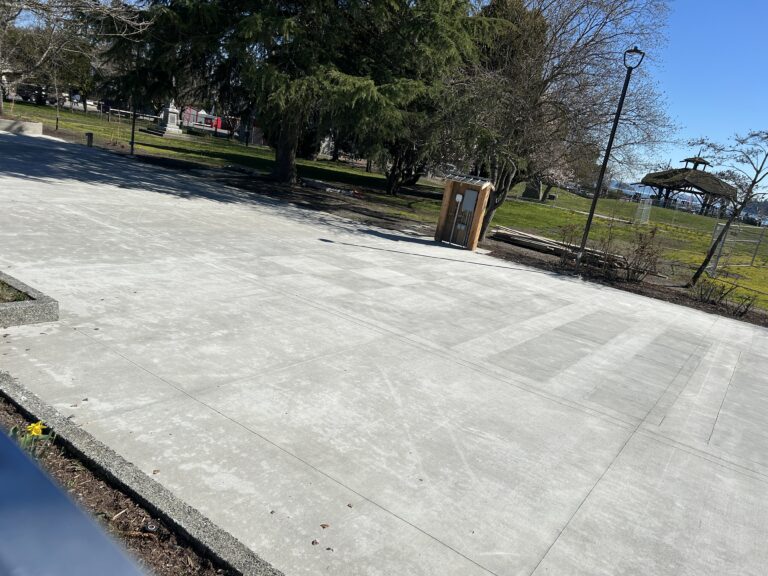
Revitalization work on Salt Spring’s busiest park is “pretty much done,” according to Capital Regional District staff, who said fences that have surrounded the project all winter would be down in time for the unofficial start of the tourist season: the first Saturday Market. 

“I’m doing a walk-through next week,” said Salt Spring electoral area manager Dan Ovington, briefing the island’s Local Community Commission Thursday, March 14 on progress of the Centennial Park renovation.

Ovington said park staff were leaving the fencing in place until right before the Saturday Market opening day, mostly to protect newly planted grass from “all of our friendly dogs that aren’t supposed to be in there.” 

Representatives of the new Salt Spring Island Saturday Market Society, now in charge of operations for what might be the island’s largest visitor attraction, came down to do measurements earlier and again last weekend, Ovington said, to sort out placement of vendor stands and tents for the upcoming season.  

Centennial Park would be reopening without new benches and bike racks in place, Ovington said, at least at first.  

“Rather than having the contractor do that, there was quite a bit of cost savings for us to order and install those ourselves,” said Ovington. “That created a bit of a delay, and what we also want to see is how the market is actually set up.” 

Both park staff and vendors noted that there were no benches on the plaza to begin with, Ovington added, so at the last walk-through everyone agreed to see how it shook out on the first weekend before final placement is determined.

The Centennial Park upgrade has been underway since the beginning of November 2023 — right after the Saturday Market officially ended its season Oct. 28 — with crews removing the concrete and brick pavers, improving drainage, landscaping and adding lighting. The rush to beat inclement weather displaced many hoping to use the park during the winter; Salt Spring’s Remembrance Day ceremony plans were largely shifted to Fulford-Ganges Road in front of the park, although park crews were able to move fencing to ensure access to the cenotaph, as well as the sidewalk, washroom and playground, for the event.  

The project launched thanks to a $561,748 grant from Pacific Economic Development Canada, $298,000 of Community Works funding and $100,000 from the Salt Spring Island Parks and Recreation capital reserve fund — and is technically ahead of schedule, having been initially planned for completion by March 31. 

The Saturday Market opens for the 2024 season on Saturday, March 30. 

Trustees give approval to enforcement review

0

“Administratively fair, reasonable and transparent with the aim of restoring public confidence.” 

That’s the target for the Islands Trust’s bylaw enforcement policies and procedures review, which was officially kicked off Thursday, March 14 as Trust Council voted unanimously to approve the project’s charter.  

A straight line can be drawn between those goals — and any future revisions to bylaw compliance and enforcement policies — and a list of recommendations from the provincial Office of the Ombudsperson received back in September, sought by Trust Council as a result of public complaints heard at previous council meetings. 

Trust Council had directed staff develop a workflow plan and project charter to implement those recommendations — and that, as planning services director Stefan Cermak explained, is what happened. 

“The scope of the work is to review, assess and implement the recommendations of the Ombudsperson’s report,” said Cermak, “through changes to Trust Council policies, bylaw enforcement practices and procedures, and [to] implement changes through staff training and regular communications.” 

The Ombudsperson’s report included several “best practice” recommendations, such as distinguishing between policies and practices, and suggested a clearer publicly available policy to assist staff in exercising discretion. It also recommended various updates to definitions and guiding principles, as well as clearer procedures for handling complaints — updating communications materials to follow “principles of administrative fairness, and to ensure that the reader is in mind.” 

Cermak said the Trust’s Regional Planning Committee did make several amendments to the original proposal; Salt Spring Island trustee Laura Patrick said the biggest change out of that committee was simply to clarify purpose. 

“We wanted to be clear on why we were doing the work,” said Patrick. “The purpose statement was quite clear; we’re doing it to resolve bylaw enforcement matters efficiently and with minimal conflict, by reviewing and amending the Islands Trust bylaw enforcement policies and procedures to be administratively fair, reasonable and transparent. And with the aim of restoring public confidence.” 

Cermak added that the Ombudsperson’s office is willing to continue to offer advice and review changes as they become finalized. While the review does not contemplate amending bylaws themselves, the work plan indicates new enforcement policy and practice revisions could be referred back to Trust Council for adoption by the end of the year, with implementation beginning as soon as spring 2025. 

Trust plans special meeting on Policy Statement

0

Within the next few weeks, both Islands Trust trustees and the broader public will be getting a first look at a draft of planned amendments to the Trust’s official Policy Statement — and as staff repeatedly emphasized the word “draft,” Trust Council voted to take their first look as a group next month, before it wound up on any subcommittee’s agenda. 

The latest version of the project’s charter was presented to Council by Trust Area services director Clare Frater at that body’s meeting Thursday, March 14, updated to include funding for a virtual “open house” discussion session about the policy statement, as well as a “professionally designed and administered” survey.  

“Our anticipated timeframe now is to bring the document out in mid April,” said Frater. “I think the watch word is going to be ‘flexibility’; as we move this forward, we’re going to move at a pace that all of you are comfortable with.” 

That is expected to be unhurried; the Islands Trust turns 50 this year, with the Policy Statement marking 30 years since its last meaningful update in 1994 — coming up short, according to officials, in adequately addressing issues of reconciliation, climate change and housing.  

Efforts to begin an update process began in 2019, but were delayed in 2021 when residents crowded public meetings — and filled newspaper opinion pages — with negative reaction to both wording and process during a first reading of the proposed changes. 

Trustees reacted then by sending staff back to the drawing board, to incorporate what had become a significant amount of feedback — hammered out into 32 resolutions — into a new document. That work has been done and a document has been produced, and has been shared with nine First Nations representatives for their “feedback and reflections,” Frater said, noting the next step would be presenting all of that to trustees for their consideration, alongside the draft itself. 

Trustees serving on the Trust Programs and Executive Committees had anticipated an “early 2024” first look, at which point the broader public would also see the draft, since it would be posted in public agendas as the long work to refine the document began. 

But at the March 14 meeting, Trust Council voted to amend the project charter just a bit more — to have the draft be provided to the full Trust Council instead, at a special meeting almost certain to be held electronically.  

“We’re intending to bring a whole suite of information associated with that draft,” said Frater, “which will include a summary of how we’ve dealt with each of the 32 resolutions that directed the changes, a 45-page concordance table tracking every change from Draft 1 to Draft 2, and comments from First Nations; we’ll be providing you with a ‘track changes’ version of how the draft might get amended, based on the feedback that we’ve heard, along with a summary of other issues for Trust Council to contemplate.” 

After that, trustees can choose how to go forward with public engagement — a process unlikely to wrap up before current timeline estimates that put Local Trust Committee referrals and the professional survey on the calendar for April 2025. 

“I’d just like to add, council staff are very excited to bring you this draft,” said Frater. “It is a draft. And we expect you to take the time that you need to make it yours, to have it represent the vision of Council and set the future of the Islands Trust.” 

The April date for that special Trust Council meeting will be posted, when scheduled, at islandstrust.bc.ca

Editorial: Best policy

0

At just three words, the shortest sentence in the Islands Trust’s 33-page-long Policy Statement reads: “Changes will occur.”

It’s a 30-year-old warning that the Trust, in its mandate to “preserve and protect” the area’s environment and unique character, will have to make course corrections over time to accomplish its mission.  

But moving that rudder has been a painful experience. The first effort since 1994 was met in 2021 after an early draft document was met with crowded public meetings, angry letters to the editor and online vitriol, and a general sense of a loss of public faith — in the direction being chosen, perhaps, but also in how decisions were made to choose it. 

Trustees sent staff back to the drawing table with a daunting workload: take 32 individual resolutions, each recommending changes for the new Policy Statement, and weave them into the Trust’s guiding document — and, simultaneously, gather “feedback and reflections” from almost a dozen First Nations and incorporate that, too. 

Little wonder it’s been a bit of a wait. 

And, given the history, even smaller wonder that the Trust Council wants to start trustees and the community at the same point, planning to take a first look at the new draft all together. 

The Policy Statement sits, in the hierarchy of Islands Trust’s planning, at the top — above each local official community plan and every land use bylaw. In the Islands Trust, community plans and bylaws must be consistent with the Policy Statement — and it’s that document regional and provincial agencies consult to determine whether their plans and policies are compatible with our islands. 

With that significance, it’s heartening to see a careful, thoughtful process being laid before us. We may not all be wonks excited to sift through a 45-page concordance table, but hopefully many will take time to join the public engagement in the coming two years — reading the draft, participating in the survey, attending discussion sessions and visiting with our local trustees. 

Opinion: Fire hall charger a great result

By JIM STANDEN 

The Salt Spring Island Electric Vehicle (EV) Group congratulates the Salt Spring Island Fire Protection District for the successful negotiation with BC Hydro for the installation of the electric vehicle DCFC charging system (“Fire district agrees to new EV charging station,” March 6 Driftwood).

Pay-for-use DCFC charging on our island has been the top priority of the EV group for the last two years and we are pleased that our reaching out and lobbying with BC Hydro helped pave the road.

Our initial meetings with BC Hydro revealed that DCFC installations along numbered highways were their number-one priority, which makes sense. By providing some additional information, we were able to steer them to the needs of smaller communities and the possibility of a test-dip to one that has a lot of EVs (estimated 450 owners, based on the most recent ICBC stats) and is located near Vancouver and Victoria. Salt Spring then moved from “not on the five-year installation list” to a higher priority, which led us teaming up to investigate possible locations and approaching local business partners.

The new DCFC stations fill an important gap. Even though our community is blessed with 18 currently free public chargers and, according to the CRD, 10 additional chargers are planned for the Ganges area, DCFC provides an additional unique service: very fast charging. This is required for the busiest of our high-demand vehicles that may need a quick boost during the day.

That could include taxi and delivery vehicles, but in the near future, other uses, which could include hospital, public transportation, RCMP and emergency vehicles that are now coming to the market in EV format. The vehicles have a much lower cost of operation, which draws the attention of government and agency bean counters.

There is also another need, and that is tourism. I have personally received messages from day-trippers coming to Salt Spring who did not bring their EV to the island as they were concerned about getting in “tourist time” and then taking a few minutes to obtain a fast charge to get back home.

Other uses are an alternate way to charge your vehicles if your Level 2 port is damaged, or for homes where Level 2 charging is difficult or impossible to install. For those uses, think of DCFC charging as the gas station model (pay and fill).

The centrally located DCFC chargers will be a welcome solution to the above challenges, and probably some additional ones that will reveal themselves.

Thank you, Fire Chief Jamie Holmes, the fire hall board and the negotiation crew for a great result.

The writer is the team lead for the Salt Spring Island Electric Vehicle Group.

Road to arts centre opening recalled by panel

0

A gathering held in ArtSpring’s gallery on Saturday afternoon may not have been an “official part” of the arts centre’s 25th anniversary celebrations set for April 17-21, but it was a perfect kick-off to get the ball rolling. 

The Pre-history of ArtSpring panel event saw the gallery packed with people who had both lived through all or part of the arguably challenging 10-year process to fund and build ArtSpring, and those who have come to use and appreciate the facility in the past 25 years.  

And judging by the warm applause and laughter— sometimes occurring spontaneously in response to a specific anecdote or phrase — and comments made in the Q&A portion of the event, all the blood, sweat and tears required to create ArtSpring were worth it. 

The panel discussion was the first in a series of events being organized by the Community Roundtable Committee, which formed as a result of a “listening session” with members of the public hosted in May of 2023 by ArtSpring’s executive and artistic director Howard Jang, who took on the post in January of 2022.

“As we all know, this is a community that is not short on ideas,” said Jang in describing the beginning of planning for how to celebrate the centre’s 25th anniversary. “I mean that in the nicest way possible.” 

After Jang’s introduction, four people involved with different aspects of advocating for the arts centre from its birth to opening shared some of the history, which was followed by a social break and then questions posed or memories shared by attendees. 

April Curtis, who was the artistic director of Off Centre Stage in the latter 1980s, was in the original organizing group and on the first Island Arts Centre Society (IACS) board, which was formed in 1989. She recounted how various art groups were discussing the need for a large, centralized space for their activities “when a miracle happened.” Two large government grant possibilities — a $200,000 “Windfall” grant from the Capital Regional District and a $434,000 Go BC (provincial) program grant — came available and were acquired by 1990, after support for the project was proven with a well-supported petition. At that time the centre was estimated to cost $1.3 million, so local fundraising activities — often with fun themes, as audience member Debbie Magnusson noted — took place. The initial volunteer committee, formed in November of 1989, consisted of Curtis, Bill Cowan, Arvid Chalmers, Bob Hassell (the building’s architect), Trish Nobile, Simon Rook, Mary Koroscil, Lawrie Neish, Stan Lam and Geoff Swift. 

Curtis described how the ArtSpring name was chosen. 

“We were actually building over deep springs that fed Ganges Creek, and we also hoped to build a space where the community could come to be absorbed and refreshed by the essences of art, music and creativity. So I suggested it be named ArtSpring, and the majority agreed and it was passed.” 

Sue Newman, a dance teacher, choreographer and head of Newman Family Productions, gave people a sense of the high level of local performing arts activity that existed in the 1980s, which was the major reason for the push to create a centre to be shared by many groups. After detailing a fulsome list of dance, theatre and music initiatives and events, Newman asked, rhetorically, “So was there a need for a dedicated place? I don’t know!” 

That one of the pre-ArtSpring fundraisers was a Salt Spring Academy Awards (and Chair-ity Night) — with tiny golden gumboots handed out to winners — was an indication of how much was going on in the various community halls and churches, at Off Centre Stage (where the Lady Minto Hospital Auxiliary Thrift Shop is now located) and the Salt Spring Elementary School gymnasium, AKA the Activity Centre. 

Newman also reminded everyone that while the official opening of ArtSpring took place on April 16, 1999 with a ribbon-cutting by Birgit and Robert Bateman, who were major supporters of the project, a soft opening event was held on the weekend of Dec. 5-6, 1998, with non-stop local entertainment. 

Victoria Olchowecki, who joined the Salt Spring Weavers and Spinners Guild when she moved to the island in 1993, recounted the various guilds’ financial contributions to the centre. Some guilds were raising funds right off the bat, with Salt Spring Weavers and Spinners Guild meeting minutes from 1991 noting that $75 was being budgeted for the ArtSpring project that year. In 1999, guild president Ida-Marie Threadkell presented a cheque for $6,000.  

“So when these weavers put aside $75, and then $500, and $250, we’re talking about a meeting, we’re talking about a raffle, we’re talking about deciding how much money goes where and how you pay your bills. So that sense of ownership of ArtSpring is very, very strong,” said Olchowecki. 

The Salt Spring Island Painters Guild paid for the gallery lights — both initially and for an upgrade — and the Salt Spring Potters Guild bought a special trap for the sink and provided the plinths. 

For Saturday’s event, the gallery walls were hung with work by weavers/spinners and painters guild members. 

Tom Toynbee was general manager of Mouat’s Trading Co. in 1998 when fundraising to complete the building had stalled. 

“I began to hear comments in the community like, ‘Oh, it’s like another [Ganges] boardwalk and we’ll never get it finished. I thought this was really dangerous and was concerned about it,” he said.

Toynbee said he was then approached by Bob Weeden, IACS president at the time, for Mouat’s to not only provide a financial donation but for Toynbee to chair a “Funding to the Finish” committee with a goal of raising the final amounts needed within a one month period. 

“In addition to his many talents in academia, Bob proved to be a very good salesman, because he said the things that I was really wanting to hear,” said Toynbee.

With a realistic but conservative number of dollars — $375,000 — set as a fundraising target, Toynbee agreed to be the committee chair, and especially because his wife Yvonne had a career in theatre as a vocalist and they were big supporters of the arts. 

Mouat’s Trading made a contribution, he said, and then he asked a part-time island resident of means named Robb Peters if he and his wife Ruth would consider donating to the cause. Peters offered a donation of up to $50,000, conditional upon matching funds coming from other contributors. That was a quickly successful effort, and Toynbee was then contacted by Susan Bloom, who said she wanted to do the same.

A further $195,000 in federal-provincial infrastructure funds were promised during the campaign, which sent the fundraising total over the top. 

“It is certainly something that we’ve been so pleased to be associated with and continue to be pleased to be associated with,” said Toynbee. “I was just looking around today at the building and its condition, 25 years later, and it’s top notch. Look at all the performances that have gone on here, and all the exhibitions, in the last 25 years. It’s a wonderful achievement and I’m so happy to be celebrating the 25th anniversary.” 

ArtSpring supporter and past board member Joan Farlinger recounted how in the early days of ArtSpring a committee did the programming and looked after the visiting artists. One occasion saw a classical ballet company willing to perform, but only if a hot meal could be provided to all the dancers before the show. 

“Now today we just would have gotten take-out, but there was no take-out in those days, and even then we couldn’t have afforded it.”

Farlinger said the volunteers ended making a spaghetti dinner in ArtSpring’s tiny kitchen and serving it to the troupe in the gallery.  

“The audience loved their performance and wanted them to come back, and we received thank-you notes and Christmas cards from that company for years to come,” she said. “So, one of the things that an organization such as ours must have — and I think we have shown — is imagination. And with imagination, you can achieve almost anything. It was a very happy occasion.”

Grade 12 volleyball players compete at high level

BY MARCIA JANSEN 

DRIFTWOOD contributor

Seven Salt Spring high school students travel off island a few times a week for club volleyball in Nanaimo and Victoria. 

Finn Hughes will be playing Nationals in April with his Victoria Volleyball Association (VVA) U-18 team and earned himself a four-year scholarship to play on the University of Guelph volleyball team next year. Izzy Nowell, who also graduates from the Gulf Islands Secondary School (GISS) this year, is part of the Mariners U18 team and hopes to play varsity volleyball at UBC Okanagan.  

Hughes and Nowell started playing volleyball at Salt Spring Island Middle School in Grade 8 and decided to level up in Grade 11. Hughes’ volleyball coach at GISS, Kellie Suzanne, suggested he should try out for a club team and Nowell gave the try-outs a go after she participated in volleyball camps over the summer in 2022. 

Both of them made the cut. Hughes was selected out of 300 players his age and Nowell out of 150. 

“I was surprised that I made the team,” Nowell said. “I hadn’t learned much about the specific skills because we don’t have a club team here on Salt Spring.” 

Hughes said, “We only play for a few weeks during the school season, while club volleyball runs from January until May. We are less experienced, so I didn’t expect to make the A team.”

After a successful first season, in which Hughes played one year up in the national championships, he made the team again in 2024.

“When I started last year, I didn’t know anyone. I was that one weird Salt Spring kid on the team,” he said with a smile. “This year we have the same group of guys,  some of whom are now my best friends. We are second in B.C. at the moment and we are playing nationals again in April.” 

Nowell and her team will be heading to provincials next month. 

“We have a great season so far,” she said. “Our coach is amazing, I’ve learned to put myself out there on the court and I’ve built stronger connections with my teammates. I like how we collaborate as a team and the fact that I have been able to make new friends through volleyball.” 

As Hughes and Nowell will graduate from GISS this year, this is their last year in the club league. Hughes received a four-year scholarship to play for the Guelph University volleyball team. He is enrolled in the arts program and his goal is to play volleyball as much as possible. 

“First years obviously don’t get a lot of playing time, but I want to develop myself and do as well as I can; shooting for as much rookie stuff I can do.” 

Nowell was recently accepted into the sciences program at UBC Okanagan. 

“I am in contact with the coach and I hope I can play varsity volleyball there. I just love volleyball and my goal is to keep playing. If I don’t make the team, I will sign up for an intramural league.” 

BRITT, Constance “Connie”

 Connie Britt passed away on March 6, 2024, at age 99. She was born into the Crandall family in Kalamazoo, Michigan, joining older sister Genevieve in what would be a close sibling friendship lasting a lifetime.

Growing up for Connie was a happy time. Her family weathered the Depression as did all Americans but still managed to vacation at the lake. Connie was a good student, intelligent and vivacious. She graduated with a degree in Economics from Kalamazoo College. Sadly, her father passed away during her final year.

Connie met her future husband, Max Holt Britt, while working a summer job at a lakeside resort. The couple waited to become engaged until after Max had safely returned from WWII. Meanwhile Connie went to work for United Airlines.

Connie and Max married in 1946. Max hailed from the Britt family, well known in ranching and horse racing circles in New Mexico and Texas. They moved to Pasamonte, the family ranch in Union County, New Mexico, working in tandem to create the ranch infrastructure and start their family. Their first child was son Michael, followed by daughter Kimberly.

By this time Max had suffered a heart attack and the young family decided to move from the family ranch to Los Angeles, where Max became a sought-after horse trainer, racing primarily at Santa Anita and Del Mar racetracks. By all accounts the couple had a good life during this time, making frequent trips to Las Vegas, entertaining friends and clients at their home in Arcadia, and spending much of each summer in La Jolla.

In 1966, Max succumbed to another heart attack. Widowed at the age of 40 with two young children, Connie made the decision to move the family from Los Angeles to Lubbock, Texas, where her sister Genevieve lived with her husband.

In Lubbock, Connie became involved with confirmation dog shows. Before the family left Los Angeles, she had gotten a Norwegian Elkhound. This dog turned out to be quite a specimen, and Connie was approached about breeding and showing the dog. This turned into a hobby for the next two decades, first with Norwegian Elkhounds followed by Finnish Spitz, before finally adopting her first and only rescue dog Roomie.

During the height of the dog shows, Connie moved to Denver, then in the mid-1980s she moved to Austin, where she lived for the remainder of her life. Connie was also involved with the League of Women Voters and began to sharpen her bridge-playing skills, which only improved as she aged. Connie enjoyed music all her life (cutting her own demo recording as a teenager), especially big band music; once she moved to Austin, she quickly found kindred spirits in support of the Austin Symphony.

In the early ‘80s she took a trip with her daughter to Europe – 13 countries in 27 days! That trip sparked an insatiable travel appetite for the next 40 years. Connie visited all seven continents, several more than once, including five trips to her favorite destination – Africa.

In 2008 she discovered the island of Salt Spring in British Columbia and promptly set up a summer residence schedule. She made fast friends with her love of bridge, fishing, and nature. Nothing was more fun to Connie than taking the ferry over to Duncan and then driving herself to Nanaimo for a day of shopping. In her 100th year she was able to spend 10 weeks in her Canadian home, bird watching and reading a novel a day. 

Constance was a mother, a sister, a wife, an adventurer, and an avid bridge player – a life well lived for over 99 years. She is survived by her daughter Kim, her son Mike (Anne), her granddaughter Winter and her great-grandson Robert (son of Melanie and Brandon; granddaughter Melanie predeceased her).

In lieu of flowers, the family suggests a donation to Central Texas Food Bank or your favorite charity. A private celebration of life will be held at a later date.

PEAT, David Wood

 David Peat, aged 98, passed away peacefully on Thursday, March 7th at Heritage Place on Salt Spring Island with family present.

Born in 1925 in Portland Maine, he was the eldest child of David M. Peat and Elizabeth D. (Lochhead) Peat. After serving in the U.S. Navy in World War II he returned to McGill University in Montreal graduating in 1950 and worked in the pulp and paper industry in the New England states and across Canada before retiring to Salt Spring Island in 1989.

He was predeceased by his wife of forty-eight years Helen K. Peat. He leaves behind his sisters Janet, Margaret and Mary, sons Andrew and George (Liana), daughters Janet (Marcel) and Elizabeth, seven grandchildren and six great-grandchildren. A private service will be held at a later date with interment at St. Mary’s Anglican Church (Fulford).

Thanks to the staff at Lady Minto Hospital and Dr. Magda Leon for the care given our father and a special thanks to Ms. Sandi Muller and staff at Heritage Place – dad’s second home for the past four-and-a- half years.

If wished, contributions in David’s memory can be made to the Lady Minto Hospital Foundation (www.ladymintofoundation.com/donate/) or the Barbara E. Peat Memorial Fund at the University of British Columbia(https://give.ubc.ca/barbara-peat-memorial).

Island’s main road gets flood prevention work

0

Construction is set to begin this summer addressing the “undersized and fatigued” culverts that allow Cusheon Creek to flow beneath Fulford-Ganges Road at the so-called Blackburn bridge — increasing climate resiliency at a spot where water topped the roadway during the November 2021 atmospheric river event. 

Salt Spring’s Local Trust Committee (LTC) discharged parts of a conservation covenant and right-of-way agreement Thursday, March 7, clearing the way for the Ministry of Transportation and Infrastructure (MoTI) to proceed with road improvements that would have encroached upon a 10-metre setback from the natural boundary of Cusheon Creek. 

Cusheon Creek is protected in part because it supports a population of coho salmon and sea-run cutthroat trout, according to the 2006 conservation agreement, and is the third largest fish-bearing stream in the Southern Gulf Islands. 

But with approval to proceed from Fisheries and Oceans Canada — thanks in part to a design that provides improved fish passage and “restores a more natural stream environment,” according to planning documents — trustees agreed with staff recommendations and supported the planned work, which includes roadway and shoulder improvements at 1001 Fulford-Ganges Rd. 

“They will be following stringent requirements for works in and about a stream,” said planner Charly Caproff. “And this is a net benefit for the community; we don’t want to see washout of Fulford-Ganges Road, and we want to be prepared for future atmospheric rivers.” 

Indeed, according to the project manager referenced in Caproff’s report, the next “significant weather event” could result in a complete failure of the road, which had been fully closed for several days in 2021 as the road shoulder was washed out. 

“They’re actually building a bridge, not just a culvert,” said trustee Laura Patrick, as the LTC passed a resolution approving the discharge and requesting MoTI provide finals plans when available. “So it’s pretty cool.” 

The restrictive covenant and statutory right-of-way agreement was registered on the title for the residential lot at the time of its original subdivision, to protect the riparian area and hydrology of Cusheon Creek and Cusheon Lake; the rest of that property is still subject to those conditions, staff noted. 

MoTI is planning for construction to continue into the fall, according to Caproff. Islanders will soon be able to follow progress for this and other planned Salt Spring Island road projects — including a potential summer start to Ganges Hill work between Seaview Avenue and Cranberry Road — by visiting MoTI’s Transportation and infrastructure projects website at www2.gov.bc.ca/gov/content/transportation-projects.