Home Blog Page 146

NSSWD and fire board candidates step up

0

Governance for Salt Spring’s two largest improvement districts will see changes this spring, as candidates have been nominated and an election set for trustee positions with both the Salt Spring Island Fire Protection District (SSIFPD) and the North Salt Spring Waterworks District (NSSWD). 

Three nominations for two trustee positions on the fire district’s board triggered election plans there, according to SSIFPD staff. Rob Oliver (incumbent), Dennis Lucarelli and Jenny McClean were successfully nominated to be candidates. That election will be held April 27, with trustees beginning a three-year term. 

At NSSWD, three nominees will also vie for two seats on the water district’s board at an election set for May 2; both positions there are also for three-year terms, according to that district’s staff, who announced incumbent Brian Pyper, with Bryce Chapman and David Courtney, are all seeking office. 

SSIFPD trustee Wynona Cook and NSSWD trustee Chris Dixon will not be seeking further terms. 

For the fire district, voting will take place by both mail-in ballot and in person; mail-in ballots will be sent out March 26 and must be received at the fire hall in Ganges — 105 Lower Ganges Rd. — by 4 p.m., Thursday, April 25. Advance in-person voting will be held 9 a.m. to 5 p.m. Wednesday, April 24 at the fire hall, with regular voting at the same time and place Saturday, April 27. 

Similarly, in the NSSWD election, voters can participate in an advance mail-in ballot process or an in-person voting process; voting packages and instructions will be mailed to all eligible voters on March 22, and ballots must be received at the district office — 761 Upper Ganges Rd. — by 4:30 p.m. April 30. In person voting on May 2 will begin at the Community Gospel Chapel at 2 p.m. and end at 6 p.m.  

NSSWD’s AGM will begin as soon as voting closes. The fire district’s AGM will be held at the fire hall 6:30 p.m. Monday, April 29. A link to those meetings, for those interested in attending online, will be available closer to the dates at northsaltspringwaterworks.ca and saltspringfire.com. 

Trustees halt ADU bylaw plans due to Tsawout Nation concerns

0

Land use officials have shelved their latest proposal for permitting accessory dwelling units (ADUs) on Salt Spring Island, putting that housing initiative on the back burner and focusing first on improving their relationship with First Nations leadership. 

The deferral of proposed Bylaw 537 came Thursday, March 7, as the initiative was returned to the Salt Spring Local Trust Committee (LTC) for adoption, after a Feb. 28 approval by the Islands Trust Executive Committee (EC). 

The measure had been read three times in a single LTC meeting in late January and seemed poised to be adopted swiftly; trustees instead have pumped the brakes, citing a Feb. 2 letter to the EC from Tsawout First Nation Chief Abraham Pelkey expressing Tsawout’s “deep concern and continuing opposition” to the bylaw, as well as frustration with the process — saying they were not consulted or even informed that the January meeting was taking place, nor given time to express opposition before it happened. 

“The Salt Spring LTC lobbied us through much of last summer and fall, months after presenting a version of Bylaw 530 that was almost the same as Bylaw 537, and which we could not support,” wrote Pelkey. “They then told us they would sponsor a potlatch to build a relationship for reconciliation, but never did so.” 

At the LTC meeting March 7, trustees worried a miscommunication during what they understood to be an informal, broad-ranging meeting with Tsawout representatives had led to a sense that a promise had been broken. Salt Spring trustee Laura Patrick said the meeting where the idea of a potlatch came up was itself borne out of discussions the Trust Council had in June, when the Ministry of Municipal Affairs spoke about the importance of crafting relationships with First Nations leadership. 

In that spirit, and as an “individual trustee,” Patrick said, she had sent a letter to Pelkey to congratulate him on his election, introducing herself, and requesting a general meeting to discuss working together in the future. 

The resulting gathering was not specifically about the ADU bylaw or any other policy, Patrick said; further, her recollection was that while everyone present supported a suggestion made “to host a feast with all 13 First Nations,” at the time it was left for future planning. 

Regional planning manager Chris Hutton said Islands Trust staff did continue the conversation around what that feast would look like, and were working to get “some sort of buy-in from Tsawout staff that there was a desire to proceed.” 

“Had that been an avenue [everyone] wanted to pursue, that would have come back to the LTC,” said Hutton. “The understanding on the part of the Islands Trust was that this feast was not surrounding Bylaw 530, it was around our overall engagement and relationship-building.” 

Hutton pointed out the Islands Trust recently received a $150,000 grant for First Nations relationship efforts — some of which could likely be allocated for a potlatch. 

“Often, we are misunderstood,” said Thetis Island trustee Peter Luckham, who was acting as LTC chair March 7. “There is a misunderstanding here, and we need to resolve that misunderstanding.” 

Luckham expressed further concern that the letter suggested Pelkey’s interpretation was that the EC, which he chairs, “approved” the bylaw — a characterization he worried would cause “further offence,” as EC was in receipt of Pelkey’s letter when they acted. 

“We don’t ‘approve’ it,” said Luckham. “It’s just another check mark on that journey. It comes back [to LTC] and ultimately, we can decide today to proceed no further.” 

That distinction is subtle; the motion, made on Feb. 28 by Lasqueti Island trustee Tim Peterson and carried unanimously by the EC, was indeed that the committee “approve Salt Spring Island Local Trust Committee Bylaw No. 537.” EC approval does not put a bylaw into force, but it is the final procedural hurdle before an LTC may adopt it.

“And I think [the potlatch plan] probably was a kernel, a seed of an idea more than it was a formalized proposition,” said Luckham. “I don’t think we got to a place where there was a decision being made, or necessarily even an invitation.” 

Luckham, who was not at the Tsawout meeting in question, said he had heard about the potlatch proposal — and remembered thinking it was a great idea, but that it was not developed any further. 

“Clearly there was hurt here, for want of a better term,” he continued. “There was something of an idea that was put forward and we haven’t followed through with that, and we can take responsibility, I think. So let’s fix it.” 

Patrick agreed, despite saying she was “inclined” to adopt Bylaw 537, as the 369 properties it would affect already have permission for a secondary suite. 

“This is not an increase in density,” said Patrick, addressing what had been a concern expressed by Tsawout representatives in the past, as they have the only reserve on Salt Spring Island at Fulford. “I was in favour of moving quickly with this version of the bylaw, because I believe the community was tired of hearing us talk about accessory dwelling units, and we had more important work to get to.” 

But, she said, trustees should have done a better job. 

“We should have sat down, government to government, with First Nations,” said Patrick. “We are on a journey of learning and relationship-building, and it is a journey that’s fraught with bumps and potholes. But we should’ve.” 

Trustee Jamie Harris repeatedly emphasized that he was not himself part of any meeting or promise to hold a potlatch. 

“That letter is of great concern. Chief Pelkey is concerned,” said Harris. “Until the record is set straight, I am not in any way, shape or form able to support adoption of the bylaw at this time.” 

Trustees agreed to hold off on adoption of Bylaw 537, and by resolution directed staff to schedule a meeting between the LTC and Tsawout First Nation leadership.

Bylaw 537 would add a new map to Salt Spring Island’s planning documents, indicating where ADUs would be allowed — essentially everywhere secondary suites are already permitted, except for lands subject to excessive saltwater intrusion and those subject to the existing moratorium on new connections within the North Salt Spring Waterworks District’s service area. Salt Spring’s LTC has asked staff to develop a streamlined spot-zoning “pilot project” to allow residents request their properties be added to the map.


RCMP asks for help with wanted person 

0

Police on Salt Spring Island are seeking help from the public in locating a person wanted for several alleged offences. 

Salt Spring RCMP said Tyler Jordan Pascal, 27, is being sought on an arrest warrant for multiple charges, including impaired driving causing bodily harm, dangerous driving causing bodily harm, resisting arrest, mischief under $5,000 and two counts of assaulting police officers. 

Information on Pascal was released Tuesday, March 6; anyone with information on Pascal’s whereabouts is asked to call the Salt Spring detachment at 250-537-5555 or provide information anonymously through Crime Stoppers at 1-800-222-TIPS (8477). 

Maxwell plant referendum likely in October

0

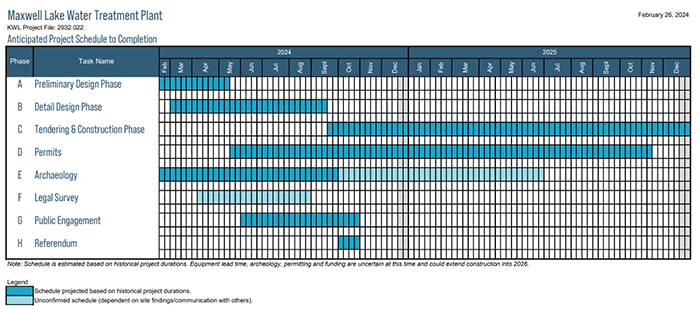
Salt Spring’s largest water provider has a preliminary timeline for a new water treatment plant, according to officials, who have set a goal for completing the project at Maxwell Lake by the end of 2025. 

“It’s an optimistic timeline,” said North Salt Spring Waterworks District (NSSWD) operations manager Ryan Moray. “But it does outline essentially basic timelines, which could be influenced by a few contributing factors — such as the water master plan, or the comprehensive supply study.” 

Island Health has required completion of the new Maxwell Lake Dissolved Air Flotation (DAF) Treatment Plant by the end of next year, part of an effort to remove more of the organic matter that reacts with chlorine treatment to create trihalomethanes (THMs), such as chloroform and bromodichloromethane. While Health Canada has noted the health risks of THMs are far less than those from consuming water that has not been disinfected, they direct utilities — including NSSWD — to make every effort to keep THMs at the lowest levels possible, so long as they do so without compromising the effectiveness of disinfection. 

The Maxwell Lake DAF plant is expected to do just that, although the process toward completion is a long one. One of the larger considerations at the site thus far has been archaeology, according to Moray, who noted as a defined archeological area there was a permitting process required to make any changes. That application was submitted in November, he said, and the province has indicated a processing timeline of about six months. 

“So for the preliminary design phase, our timeline is [finishing that] about mid-May,” said Moray, “with the detailed design phase kind of going on right now in concert with the preliminary design.” 

Moray said there had been some planning made around potential “unknowns” such as unanticipated results of soil testing, or any archaeological discoveries that might necessarily bring delays — and while the consultant they were working with didn’t expect either, due diligence was part of the process.  

“And of course we’ve got our public engagement, and a referendum,” said Moray. “Nothing is going to be moving forward, in terms of construction phases, without having that referendum.” 

The timeline as it currently stands calls for public engagement beginning in June, running concurrent with detailed designs, legal surveys, archaeology and permitting, carrying through to a referendum in October. CAO Mark Boysen pointed out the referendum was a loan authorization process, and while the ratepayers would ultimately be responsible for paying it back, those dollars might not entirely come into district coffers via higher bills to water users. 

“The referendum is an authorization for us, from our ratepayers, to take out a loan,” said Boysen. “There’s other ways of paying off that loan; there’s reserve funds, it could be other one-time funding sources or possibly a continual [payoff] through our surpluses.” 

“The worst-case scenario, we’d have to pull the entire loan out, and the ratepayers would have to pay that over 25 years,” said financial officer Tammy Lannan. “But our hope is that we can pay for it with other funds.” 

Moray agreed, saying while ratepayers are a “big portion of that story” right now, staff would be looking at opportunities to keep direct costs to water users at a minimum. Trustees said they looked forward to hearing regular updates. 

“It will be a bit of a moving target,” said Moray. 

Burlesque passion shared at upcoming show

0

When Tala Small Wolf was a student at Gulf Islands Secondary School (GISS), one place she would not be found was in the dance studio.

“I was an apprentice cook, like nowhere near dance, because as a plus-sized human, dance wasn’t really open to people who weren’t straight sizes at that time,” she said.

But Small Wolf is now the owner, producer and creative director of SINnergy Productions, a Victoria-based burlesque dance company she founded in the summer of 2022, and is bringing her group’s Caravan of Desire show to ArtSpring on Saturday, March 16, beginning at 7:30 p.m.

Dancing in the show will be Small Wolf, whose stage name is Chai Tease, as well as Jacqueline Daniels, Tommy Tricker and Ginger Vicious, and drag performer Oliver Clozoff.

How did Small Wolf end up dancing professionally after graduating from GISS outside of the performing arts stream in 2013?

Small Wolf moved to Victoria two years later and started taking general dance classes at the Passion and Performance dance studio.

“I really started to learn about dancing sexy, and just how fun dancing is, and it kind of reevaluated my entire relationship that I had with my body,” she said.

When the studio added a burlesque program to their offerings, Small Wolf immediately signed up, having loved the 2010 movie Burlesque, which starred Cher and Christina Aguilera.

She said she was surprised when the instructor turned out to be “a plus-sized human. I was not expecting that. I kept taking the classes, and being like, ‘Oh my god, there is space for us. There is a lot of space for us.”

Small Wolf is now the burlesque class instructor at the studio and loves to share her passion for the genre.

“Burlesque is incredibly transformative for how people feel about the skin they are in,” she said, “because I can say, personally I’ve been 140 pounds — and 240 pounds — on stage and the cheers never change.”

Even if Small Wolf wasn’t part of the GISS dance program, she always enjoyed the shows, supporting friends on stage and being amazed by the choreography.

“Whenever I listened to music, I would create routines in my head — the creativity has always been there — but there was just that blockage of ‘Oh, but that’s not for me.’” Now, she says, “Choreographing routines for groups is my favourite thing to do and I cannot imagine my life without that.”

Small Wolf was encouraged to create Caravan of Desire, where the dancers play travelling showgirls, and bring it to Salt Spring after getting enthusiastic feedback from a burlesque show she participated in at Mateada in Ganges last year.

For the March 16 performance at ArtSpring, the audience will get a taste of the huge range of burlesque forms that exist.

“We’re going to be going through styles like bump and grind, drag-lesque, nerd-lesque, burlesque that tells a story . . . There’s just so many micro categories of burlesque that I’m really excited to show everyone who comes to the show.”

Varied music is used for the routines, from an Elvis piece to smooth jazz to metal. A BC Ferries joke routine that uses sounds from the ferries is also on tap.

Due to nudity, the show is for people aged 18 and older, with two pieces of ID required at the door.

Small Wolf explained that the word burlesque has 18th-century Italian roots in “burlesco” and “burla,” which means to joke or to make a mockery of.

“So original burlesque was making fun of the higher-ups. It would be common for them to take highfalutin Shakespearean plays that normal people couldn’t get their hands on and make some jokes out of them and make it a parody.”

Small Wolf said while some people might initially think it’s “a little weird” to watch people dance naked, “Every single person I’ve talked to afterward who’s gone to a burlesque show is so enthralled in the art form itself. It’s just such a beautiful way for people to express themselves and show how happy they are with their body . . . and it’s just such a creative world; it’s just another type of dance.”

Tickets for the March 16 show are available through ArtSpring.

NSSWD fact-finding survey finds little trust in CRD

0

A new survey suggests there’s no great confidence among current and former Salt Spring Island water officials with the regional district’s handling of formerly independent water authorities. 

The North Salt Spring Waterworks District (NSSWD) board had commissioned on-island pollsters Return on Insight (ROI) back in October to explore “attitudes” toward the process of converting independent water authorities to a service owned and operated by the Capital Regional District (CRD). ROI was tasked to reach out to current and former water and wastewater commissioners for their thoughts.  

“That was a part of the strategic work that the board wanted to move forward,” said NSSWD CAO Mark Boysen, who shared results at the board’s regular meeting Thursday, Feb. 29, “starting back when we finished that work in the summer.”  

Board chair Brian Pyper added the report was sought as a means of “accurately and objectively” measuring their experiences, for the information of both the board and ratepayers. 

Among the 27 completed surveys received, the majority — 63 per cent — characterized the experience of being a commissioner as negative, according to the report, mainly due to “frustration at not feeling listened to, respected [by], or spoken with by CRD management.” 

Indeed, specifically asked how NSSWD should approach any potential conversion, eight per cent said to begin “ASAP,” 27 per cent said to proceed with caution, 23 per cent said not to proceed until more information was available and 42 per cent responded, “Do not proceed under any circumstances.” 

“Attitudes toward conversion are predominantly negative,” according to the report, “with half thinking conversion was not beneficial or necessary, and two thirds lamenting not being informed. Two in three commissioners do not think the CRD has the best interests of ratepayers in mind, and a similar proportion disagree that the process was or is smooth and easy.” 

Four out of five, per the report, “do not trust CRD promises” with less than one in 20 trusting the CRD. Although close to half believed conversion did or would provide better access to financing for infrastructure investment, 44 per cent disagreed that an expected impact of conversion would include providing potable water at competitive rates. Nearly all commissioners agreed that local influence over project design, execution and budget decreased once conversion to a CRD service proceeded. 

“The net impact of conversion is perceived negatively,” according to the report, “particularly for communications, affordability, debt levels and competitive rates. The only three aspects that commissioners believe may be positively impacted are water quality, service reliability and financing.” 

Ratepayers will be able to view the survey in its entirety — including anonymized comments from respondents — in the coming days at the district’s northsaltspringwaterworks.ca website.

Viewpoint: It’s a noise issue, not a rooster issue

By MIKE STACEY

When I was a kid we lived on a farm out in the Fraser Valley. None of the farms had cute names, farmers did not walk around in spotless bib overalls and straw hats, and it sure as hell wasn’t Little House on the Prairie.

The farmers were all thin, wiry and dressed in clothing that had been caught up in machinery, torn, sewed back together and washed a million times. Their hands had the look of a baseball glove. The same applied to their wives. No driveways had shiny new cars, but once in a long while a shiny new piece of farm machinery would appear somewhere out of necessity.

Dad said more than once that he could never be a good farmer because he did not grow up on a farm. In my mind this would also apply to farm vets. The Bond family is living proof of this. Some things cannot be taught in school.

When we made the move to Salt Spring I could spot the farmers right away. In those days farming was “Do well or die.” I remember one oldtimer telling me, “The beef got sold, we ate mutton.” The difference here was that there was not a great deal of dirt, so it was that much tougher to stay ahead of the game.

Almost 60 years later we have small farms and gardens producing food for local consumption. This is not a life-or-death situation anymore, but is great news for those of us who like to know where the veggies came from and how many chemicals were NOT sprayed on them. There are a whole lot more people here now, and some of them are jammed up tight against one another on small properties.

Enter the rooster. There is no “rooster issue.” There is a noise complaint. It matters not what produced the noise. The Capital Regional District (CRD) did not crash this party, they were invited. I have known plenty of bylaw enforcement officers and none of them enjoy this kind of thing. They prefer a quick settlement so that everyone goes home happy.

In the current battle between neighbours, the voice of doom is telling us that the CRD is going to do away with all the roosters and wipe out small farming on the island. That is a load of swill. The CRD wants out of this situation, and sure as hell doesn’t want to make it worse. But a story like that, with somebody being persecuted by the government, will get lots of attention.

What we have is two neighbours, both with heels dug in so deep that they are unable to settle the issue themselves, so everyone else is being dragged into it.

The actual rooster is oblivious to all this. All he wants is to get into the henhouse, put on a little Barry White music and get it on.  

The writer is a Salt Spring resident.

Axis Theatre and Verdi on tap

BY KIRSTEN BOLTON

For ArtSpring

Vancouver-based Axis Theatre and its imaginative productions for children have become an island favourite with many appearances in ArtSpring’s programs over the years. On March 13, it returns with the curiously titled Frog Belly Rat Bone, a performance especially for pre-school through elementary-school-aged students.

Incorporating beautifully handcrafted puppets and an original pop-rock musical score, the setting of Cementland comes to life as two enigmatic garbage collectors tell the story of a very special boy whose singular wish is to find a treasure.

As the plot unfolds, the boy discovers a rusty tin box packed with colourful envelopes and an old wrinkled note: “put my wondrous riches into the earth and enjoy.”

The boy opens the envelope and tosses the contents — hundreds of tiny grey specks. As night approaches, the specks must be protected from junkyard thieves so the boy invents a guard by gathering wet smelly socks, moldy old pillow stuffing and scraggly wire to bring his creation Frog Belly Rat Bone to life.

With an energetic running time of 40 minutes and a post-show talkback with the performers, the production is designed to keep young minds and attention spans engaged.

“With this kind of programming, ArtSpring seeks to be a place and a resource that promotes the arts within the curriculum, provides opportunities for teachers and parents to introduce students to ideas, and gives children the chance to experience a performance in a theatre setting — sometimes for the first time,” explains Howard Jang, ArtSpring’s executive and artistic director. “It’s quite wonderful to have a theatre full of young children cheering or participating back and forth with the actors as they get drawn into the story.”

On March 9, the Saturday a few days prior, ArtSpring’s second last Met Opera Live in HD broadcast pushes the artistic pendulum out the other way with Verdi’s La Forza del Destino, starting an hour earlier than usual due to its epic scale and two intermissions.

Yannick Nézet-Séguin conducts Verdi’s grand tale of ill-fated love, deadly vendetta and family strife, with soprano Lise Davidsen in her role debut as the noble Leonora, one of the repertory’s most tormented and thrilling heroines. Director Mariusz Trelinski delivers the company’s first new Forza in nearly 30 years, re-setting the scene in a contemporary world and making extensive use of the Met’s turntable to represent the unstoppable advance of destiny that drives the opera’s chain of calamitous events.

Scrabble, silent auction events raise funds

SUBMITTED BY SSG2G

Salt Spring Grand(m)others to Grandmothers are presenting their 16th annual Scrabble Fundraiser for the Stephen Lewis Foundation’s Grandmothers Campaign.

HIV/AIDS continues to devastate communities in Africa as grandmothers struggle to raise millions of orphaned children. The Salt Spring Grand(m)others to Grandmothers fundraising efforts support over 300 community-led organizations turning the tide of HIV/AIDS in the 15 African countries hardest hit by the pandemic. An integrated and holistic approach focuses on projects in healthcare, income generation, food security, education, protection from violence, counselling and community mobilization. Communities are recovering, but much more needs to be done.

The Scrabble Fundraiser is the Grand(m)others’ foremost effort, and between it and other initiatives has donated over $250,000 to the campaign since 2007. Games are played by donation at events at the Salt Spring Inn (2 to 4 p.m. on Thursday, March 7) and the Harbour House from 6 to 9 p.m. on Saturday, March 9 with a silent auction. You can bring a friend or come on your own and be partnered with new friends. You might even win a prize.

Online donations are also welcomed.

Editorial: Water commissioner survey shows lack of trust in CRD

0

It’s a question asked from time to time by newcomers and long-time islanders alike: why doesn’t the North Salt Spring Waterworks District (NSSWD) get folded into a Capital Regional District (CRD) service? 

It seems we might have at least a partial answer now. According to results of a survey, current and former commissioners say they don’t think it’d work out. 

NSSWD commissioned a survey late last fall, reaching out to more than 50 people who have served, or serve today, as a CRD water commissioner on Salt Spring Island. The objective was to “explore” how they felt about the process of conversion from an independent water authority to a CRD one — something that has happened on Salt Spring, but never on the scale a switch would represent for NSSWD. 

A total of 27 responded and took the survey; among them, half were current commissioners and half former.  

At first blush, the results might raise more than a few eyebrows. 

Half of the respondents thought conversion wasn’t beneficial, two-thirds said they didn’t think the CRD had the best interests of ratepayers in mind, four in five “do not trust CRD promises” and fewer than one in 20 “trust the CRD.” 

One might be tempted to dismiss the survey findings by questioning how those opinions broke down between current and former commission members — were the negative attitudes mostly among those currently serving, or mostly those with memories of days done by? — but that information could at best round the sharp corners of the prickliest responses. And it would risk missing the point. 

While even the most casual student of Salt Spring Island history could excuse a certain amount of skepticism for decision-making from the other side of the water, there’s a gap in confidence here that needs addressing — and an opportunity for the CRD.  

The regional district should take the negative feedback seriously, take a hard look at the conversion process, and start mending a few fences. It’s in all our best interests to ensure responsible — and responsive — management of the island’s most precious resource.