
Home Blog Page 152

LCC reduces bylaw enforcement budget

0

As alternative programs grow, Salt Spring’s Local Community Commission (LCC) is taking what it calls a small first step in shifting how bylaw contraventions within its purview are resolved. 

During a special meeting focused on the 2024 budget, LCC members voted to approve reducing their requisition for bylaw enforcement labour next year by $10,000 — an ongoing reduction, according to resolution, not a one-time spending change, justified by the seeming success of both RCMP community engagement efforts in Ganges and similar programs run at a community level. 

“I think the best information we have from the RCMP is that specifically at Centennial Park, the number of incidents has dropped dramatically over a period of time,” said LCC member Brian Webster at the meeting Thursday, Feb. 1. “I’m hoping to be able to shift gradually away from an enforcement approach and toward fostering positive activity in that park.” 

Webster said he envisioned a time where local expenditures on bylaw enforcement could be reduced by as much as half — “like it used to be,” he said — but that even a modest reduction now could be seen as a helpful first step in a cultural shift. 

“And if the incidents are down dramatically, according to the police, then we shouldn’t have to spend more than we did before,” added Webster. 

Salt Spring Electoral Area manager Dan Ovington cautioned of a potential risk of deficit spending if more enforcement is needed despite budgetary plans, noting staff are legislatively compelled to respond to complaints and enforce bylaws regardless.  

But LCC members were buoyed by the increasingly positive news coming from RCMP, as well as  from Salt Spring’s volunteer Ambassador Program, the green-vested community members that have been visible and approachable in Ganges since last summer, working to help solve small problems before they escalate. 

“I’ve been careful about not doing the ‘Susie Sunshine’ act here,” said commissioner Gayle Baker. “But I’m going to tell you that there are other alternatives, using our resources in a way to stop the issues and problems [beforehand] rather than having to address them with enforcement.” 

Baker said a large number of new volunteers were being trained to join the Ambassador Program in the coming weeks. And Ovington said the Salt Spring Island Saturday Market Society would be stepping up its education efforts regarding dogs not being allowed in the park, which can lead to conflict — particularly during the busy summer season. 

“And bylaw [officers] are typically doing walkthroughs, checking to make sure they’re supported in those efforts,” Ovington said. “Then they’re going to those alternative areas where people have been displaced to.” 

Commissioner and CRD director Gary Holman said he remained optimistic; while a current bylaw enforcement officer has been on medical leave “for some time,” he said, necessitating bringing staff from off-island to fill gaps, he agreed the RCMP’s reports of significantly fewer problems was a good sign — as was an expected completion of a long-languishing supportive housing project on Drake Road by the end of next year. 

“And that’s not just the housing, it’s with the ongoing supports,” said Holman, noting that with the recent influx of charitable societies on Salt Spring bringing experience working with marginal populations, mental health and addiction issues, there could be multiple organizations vying for management of that facility. 

“Now we’ve got Lookout [Society] on the island, we’ve got the Umbrella Society,” said Holman. “That supportive housing facility will provide another avenue for people to go, to get not just their housing but their broader needs met.” 

Opinion: Doggone manners

2

By ROBERT STURREY

A couple of weeks ago I was hiking in Burgoyne Bay Provincial Park when I was attacked from behind by an off-leash dog.

The dog bit me in the calf and ran back to its dog walker. The wound wasn’t serious, and after giving the dog walker a suitable lecture I carried on with my hike.

But I began to feel uneasy. What if my wound had been serious? What if this unleashed dog attacked someone else? What if the victim was a child who was seriously injured and traumatized for life?

I knew I had to speak up, so I placed a warning on the Salt Spring Exchange with details of the attack. I received emails of support but also tales of dog attacks on Salt Spring, one requiring hospitalization, stitches and rabies injections.

I have been hiking Salt Spring’s beautiful trails for years and I have encountered many hikers and their dogs. Most dogs are friendly and well behaved but not all. I have been barked at, growled at, jumped on by overly friendly dogs while the owners shout at me, “Don’t worry, my dog is friendly and won’t hurt you.”

I am dog friendly and not afraid of dogs, but some people are. A poorly trained dog that rushes towards another hiker can be a frightening experience for those people who are afraid.

You who are dog owners know your dog. Do they walk alongside you unleashed, or do they rush down the trail ahead of you looking for an exciting encounter? Perhaps a deer to chase or a hiker to bark at.

The rules in a provincial park are clear. All dogs must be leashed. Personally, if a dog is well trained and stays with its owner I don’t think it needs to be leashed. But the rules are there to protect the public so everyone can feel safe. Unfortunately, we do not have strict CRD enforcement, and no one here seems to be enforcing the rules. My question to the CRD is this: Where are you?

If walkers and hikers could be brave enough and suggest to dog owners that their poorly behaved dog needs to be on a leash, we would all benefit. Most of us don’t like to be told we are breaking the rules, and some owners may react defensively. I don’t see any alternative.

Don’t we all deserve to enjoy ourselves in this beautiful nature without fear and harassment? If all of us, dog owners and non-dog owners alike, could take responsibility to ensure our environment is safe and friendly, then perhaps we can avoid dog aggression that leads to serious consequences.

If not, then incidents like this will happen again — sooner or later.

From bop to beauty, Buddy Holly and Baroque make an eclectic weekend

By KIRSTEN BOLTON

FOR ARTSPRING

Get ready to jump to your feet and sing along next weekend as The Buddy Holly Concert takes over ArtSpring with high spirits on the evenings of Feb. 16 and 17.

This joyous concert is a dynamic two-act show featuring Zachary Stevenson in a dead-ringer performance of the famed rock-and-roller, bringing such hits to life as That’ll Be the Day, Peggy Sue and True Love Ways. Stevenson presents Buddy Holly so perfectly we seem to be watching a genuine replica of the nerdy, hip young Texan, right down to the guitar licks, trademark hiccup and energetic dance moves.

Above and beyond the ballads and rock-a-billy songs, Stevenson weaves in engaging stories about Buddy and pays tribute to Buddy’s friends — The Big Bopper, Ritchie Valens, Dion and Eddie Cochrane — to recreate this nostalgic era and connect it to today, proving the music lives on.

Raised on Vancouver Island, Stevenson is an internationally recognized award-winning actor, musician and writer, a true showman with well over a thousand performances under his belt. Vancouver Presents calls him “the epitome of effortless cool with a gorgeous voice and a star-quality stage presence,” while The Chicago Sun Tribute simply says, “If you don’t like him, you don’t like much of anybody!”

From toe-tapping bop to the beauty of baroque, Sunday, Feb. 18 changes gears with an intimate Sunday matinee to present Ensemble Mirabilia, featuring rising Canadian soprano Myriam Leblanc, winner of, among other titles, the Audience Choice Award at the Canadian Opera Company Centre Stage Competition.

Ensemble Mirabilia members, from left, are Malette-Chénier — baroque harp; Myriam Leblanc — soprano; Grégoire Jeay – flute; Antoine Mélisande Corriveau — baroque cello. (Photo by Mandie Guerard)

From her acclaimed debut album, Luce e Ombra (“Light and Shadow”) Leblanc assembles a collection of her favourite works by Venetian composer Antonio Vivaldi: opera excerpts, a chamber cantata, along with instrumental pieces transcribed or adapted for Ensemble Mirabilia’s inspired accompaniment consisting of Antoine Malette-Chénier on the baroque triple harp, Marie-Michel Beauparlant on cello and artistic director Grégoire Jeay on baroque flute.

Audiences can expect a warmth and pure scale in Leblanc’s voice that conjures up a cozy room with a few close friends rather than an opulent chamber soiree. As The Montrealer reviewed, “It’s like a brandy distillate, absolutely transparent . . . one of the most beautiful voices, perhaps the most beautiful, to come out of the Québec breeding ground in the past 10 years.”

Founded by Leblanc and Jeay, Ensemble Mirabilia seeks to promote mainly baroque music played on period instruments, but also explores earlier and more contemporary genres to create a wide repertoire reaching audiences of all backgrounds, while remaining in the great sphere of the classic.

Viewpoint: Care for cyclists will pay off

0

By SIMON ROMPRE

I was very happy to read in last week’s Driftwood that BC Ferries is looking into making the ferry terminal safer for cyclists and I think that painting lines at the terminal to prevent accidents is a good move (“BC Ferries targets biker safety at terminal”). Nevertheless, I think that considering moving all cyclists to the back of the ferry so drivers don’t have to deal with people on bicycles while zipping off the ferry is a backward move that sends a message that visitors on bikes are not welcome here. 

It is pretty obvious to anyone who has spent any time on Salt Spring that our island is not currently a cycling destination; many of our main roads are narrow and windy with no shoulders and in need of repair. Most local cyclists wanting to remain unharmed are well aware that staying out of drivers’ way when unloading off the boat makes sense, but sending everyone on bikes to the back of the ferry to breathe car exhaust while unloading will not improve Salt Spring’s popularity in the cycling population.

While many people that like to get from A to B as quickly as possible may like the idea of getting cyclists out of their way, I don’t think there is a single Salt Springer that likes long ferry waits due to car overloads. No matter how annoying having to slow down to go around a cyclist may be, it is still preferable to have fewer ferry waits, more parking space in town on busy days and quieter roads. These are some of the advantages that come from having people on bikes and e-bikes rather than in cars; it actually is good for everyone, especially drivers and their passengers, something worth remembering next time we have to slow down for cyclists.

Another factor to keep in mind is that many riders are also drivers and leave their cars at the ferry terminals; they are not going to be in the way of hard-pressed-for-time drivers once off the ferry. As a matter of fact, by riding their bikes onto the ferry they create more space for other cars and should be encouraged rather than being sent to the back of the boat.

Salt Spring is located within a short distance of many big urban areas and our local economy could benefit tremendously from being more bike friendly. Many visitors don’t come here because spending the better part of the day in a ferry line-up is understandably not their idea of a good time.

I encourage BC Ferries and the Ministry of Transportation and Infrastructure to make the needed changes, either by installing bike racks on the boats or creating safer shoulder lanes along the busiest parts of our main roads and ferry loading areas. 

As someone once reminded me, you don’t build bridges by counting how many people swim across the water, you build them because it is the best way to cross the river. 

Once the infrastructure is in place, it will get used, and Salt Spring, because of its location, has great potential to be one of the best cycling destinations on the coast.

The writer is a member of Island Pathways and Cycling Salt Spring. 

Islanders’ generosity expands trail network

By MARGRIET RUURS

For the SS Trail & Nature Club

In England it is quite common to hike a trail that is on private land. In North America, most publicly accessible trails are on public lands such as parks or nature reserves.

The Salt Spring Trail and Nature Club (SSTNC) recently recognized landowners who have generously allowed walking trails to be developed on their private property.

Claire and Will Cupples are long-time Salt Spring residents living at the north end of the island. They offered the club the opportunity to establish a two-kilometre, round-trip trail on their property. Through the Gulf Islands Trails Society, the Trail and Nature Club is able to provide liability insurance for such a trail on private property. The Cupples’ initiative is a commendable act of community mindedness that benefits hikers. The property borders North View Nature Reserve. It is hoped that others will consider a similar act by allowing more trails on private property.

The SSTNC also presented a Trail Blazer Award to Nicholas Courtier for his valuable contribution to trails on the island. He has created and designed maps for all Salt Spring’s provincial parks, as well as the new “you-are-here” maps in Channel Ridge.

“Nicholas has indexed all the new trails that we’ve developed with the club over the last 10 to 15 years on GPS,” said the SSTNC’s Charles Kahn. “His digitized map collection has proved a terrific resource for us, as well as for emergency services, the Salt Spring Search and Rescue Society and the Salt Spring Island Conservancy.”

The SSTNC helps develop and maintain most of the trails on the island. The club has signed agreements with BC Parks to work on trails in the provincial parks. It also has an agreement with the Islands Trust Conservancy to maintain the trail in the Lower Mount Erskine Nature Reserve. 

The generosity of both the Cupples and Courtier benefits all islanders who enjoy using the hiking trails.

For more information on joining the club or information on making land available for trails, send an email message to info@sstnc.ca.

Editorial: Supporting cyclists means infrastructure improvement

2

It seems in our nature to look for increasingly simple solutions as the problems we face become increasingly complex. 

Cycling on Salt Spring is already an adventure, with our narrow roads, scant shoulders, few dedicated bike lanes and ever-increasing vehicle traffic. What’s more, the reality of arriving on an island by boat is that it’s all uphill from the start — and nowhere is that in sharper focus than at ferry terminals, where vehicle traffic can back up behind the slower bikes on steep slopes. 

Our own Ferry Advisory Committee — and no doubt many a delayed motorist — has imagined it might be simple enough to hold the bicycles back and let the vehicles through first. Operationally, according to ferry crews, it would be a nightmare to implement. 

Setting aside compliance — who would want to be last? — we agree. The mental picture of people trying to walk their bikes between vehicles from the front to the back of a full car deck isn’t pretty. And as one astute letter-writer has pointed out, many bicyclists disembarking aren’t going any farther than the parking lot. Nothing would be gained, traffic-wise, from keeping them aboard longer — and discouraging those types of commuters from bringing their bikes would only add to the number of cars on the sailing. 

A complex problem indeed.  

There seems to be a broad agreement among officials that more cyclists and pedestrians should be encouraged, from both a ferry capacity standpoint and an environmental one. It’s a straightforward and popular position to take, but without prioritizing adequate infrastructure for both, it rings hollow.  

BC Ferries can only do so much aboard their vessels; we’re encouraged by their efforts to improve the “bike experience” on ferries. But if we truly want more cycling — and walking — on our ferry-served islands, we probably should solve the complex infrastructure puzzle first.  

We can all be a little more patient with one another as we travel our island roads. But some impatience with our transportation ministry — now that we’ve completed our Active Transportation Plan and quantified gaps in our network — is perhaps warranted.  

In improving how we move around, we look forward to signs of movement. 

Centennial Park revitalization work resumes

0

A renovation project at the home of Salt Spring’s Saturday Market was set to resume this week, according to officials, and is still on schedule for completion before vendors’ “opening day” this spring.  

Delays for the Centennial Park revitalization were weather related, according to Salt Spring Electoral Area manager Dan Ovington, who said while crews can work in most conditions, the extreme cold was beyond the tolerances of the materials themselves. 

“We can’t pour [concrete] in those temperatures,” said Ovington, answering a question from Local Community Commission (LCC) member Ben Corno at that body’s Feb. 1 meeting. Ovington added that concrete pouring was scheduled for the coming week, and the effects of predicted rain could be mitigated by tarps. 

“We’re still on schedule to be done March 15,” said Ovington, which is two weeks before the Salt Spring Saturday Market Society’s planned first market on March 30. 

The Centennial Park upgrade has been underway since the beginning of November 2023 — right after the Saturday Market officially ended its season Oct. 28 — with crews removing and replacing the concrete and brick pavers, improving drainage and landscaping and adding lighting. The rush to beat inclement weather displaced many hoping to use the park during the winter; Salt Spring’s Remembrance Day ceremony plans were largely shifted to Fulford-Ganges Road in front of the park, although park crews were able to move fencing to ensure access to the cenotaph, as well as the sidewalk, washroom and playground, for the event. 

The project launched thanks to a $561,748 grant from Pacific Economic Development Canada, $298,000 of Community Works funding and $100,000 from the Salt Spring Island Parks and Recreation capital reserve fund — and is technically ahead of schedule, having been initially planned for completion by March 31. 

Next Salt Spring Trust office location remains uncertain

1

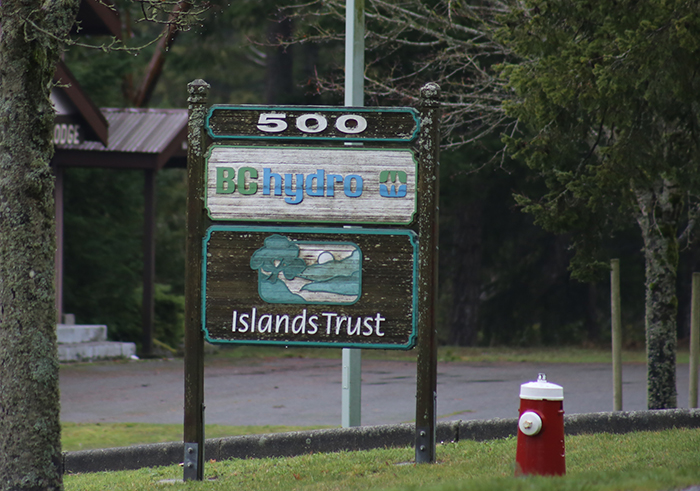
As the end of their lease draws nearer, Islands Trust staff are still searching for a new home for the busy Salt Spring Island office. 

But given few choices within the island’s limited commercial space market, and facing high costs for upgrading what there is to fit their needs, some trustees are asking whether it’s time for the land use authority to purchase, rather than rent — or perhaps, one trustee suggested, even leave Salt Spring altogether.  

This past summer, BC Hydro — which owns the building currently being used by Trust staff on Lower Ganges Road — gave notice it would not renew the lease, planning to end its agreement with the Islands Trust on July 24.

Since then, staff have considered various options to meet its needs for space to collaborate, store documents, operate servers and greet the public as members of the community navigate the often-complex processes that surround the Islands Trust’s mission. 

But pickings are slim, and the clock is ticking. 

“On July 1, we need to be somewhere,” said CAO Russ Hotsenpiller, who told the trust’s Financial Planning Committee (FPC) that despite staff efforts and engaging the services of a realtor, finding a medium-sized office space that ticked all their boxes had been challenging.  

In fact, as of the committee’s meeting Wednesday, Jan. 24, staff had identified just three potential sites — none of which were actually office spaces, and all required renovations. 

Those renovations are estimated to cost more than $250,000, according to Hotsenpiller, depending on the site. One lacks sufficient ventilation and a connected HVAC system, for example, and another currently has no plumbing whatsoever. That dollar figure had several trustees wondering whether the Trust should invest in its own property, rather than spending money improving someone else’s. 

“So we’ve been at this local government thing on Salt Spring for 50 years,” said Denman Island trustee David Graham, “and I presume we’re going to be there for another 50. Why wouldn’t we consider the political advantage of having a purpose-built local government building that offers the services that the Salt Spring Island has been offering the community — a place to gather, where trustees can meet with constituents, et cetera?” 

Noting what he called a large contingent of residents who feel the Trust itself may not be the “right government” for Salt Spring, Graham said he also felt moving as often as they seemed to might not send the right message.  

“It does not look like we’re a serious local government, to be quite honest,” said Graham, “when we keep moving every time the owner says ‘no, this isn’t working for me.’” 

Hotsenpiller pointed out that while there are very few places available to lease, there are even fewer commercial properties offered for purchase — and none, according to their research, with structures that would meet their office needs. 

“So if there was a purchasing regime in place, it would be a bare land construction kind of scenario,” said Hotsenpiller. “And we have had discussion with both the CRD and the North Salt Spring Waterworks District about future collaborations, both of which were positive. But neither is imminent.” 

Hotsenpiller said that pursuing that sort of partnership — a notion of all local governments under one roof often mused upon by Salt Spring CRD director Gary Holman — would be a protracted, strategic direction for the Trust, with a two- to five-year timeframe. 

With a deadline approaching — and a shared understanding that there was no possibility of completing a new build before July — several trustees wondered whether a temporary move off the island to Sidney would make sense.

Mayne Island trustee David Maude pointed out the same questions were being asked with consideration to moving the Gabriola office across to Nanaimo.

And Salt Spring trustee Jamie Harris said he thought perhaps a move to Oak Bay could be permanent. 

“It seems at first glance that it would be more than workable for all the Southern Gulf Islands to move there, including Salt Spring,” said Harris, noting the ability for planning, clerical work and even meetings to be done electronically.  

Hotsenpiller said in terms of foot traffic, it was the busiest office for the Islands Trust. And Lasqueti Island trustee Tim Peterson, who chairs Salt Spring’s Local Trust Committee, said he hears frustration from islanders whenever that office isn’t open. 

“There is definitely a strong contingent on Salt Spring that wants an office there,” said Peterson. “And I really do like the idea that instead of shelling out big money for leases that we consider purchasing. However, time is of the essence here.” 

Committee members seemed to agree, choosing to recommend leaving funding in place for improving a leased space — for the moment — and making it clear they were holding out hope another alternative would present itself. 

“I’m up for crossing my fingers,” quipped Hotsenpiller.  

BC Ferries targets cyclist safety at terminals

0

New “wayfinding signage” for cyclists should be in place around ferry terminals on Salt Spring Island before this summer, although there is some skepticism that a change in behaviour will necessarily result. 

In response to community concerns, BC Ferries’ CEO Nicholas Jimenez had announced the company would be installing new signs to help passengers on bicycles navigate through terminals. BC Ferries’ marketing and customer experience manager Rebecca Jamieson said while she and her colleagues had been out to the terminals to review options, they agreed there wasn’t enough set up for cycling there — and that things needed to change. 

“We made a number of recommendations for signage,” said Jamieson, who gave an update at Salt Spring’s Ferry Advisory Committee (FAC) meeting Wednesday, Jan. 24. “So that as you’re approaching the terminal, you know whether to go to a ticket booth, or what lane you should go down.” 

Those signs are being developed, according to Jamieson, with installation expected in late February or early March. Additional recommendations surrounding line painting specifically at Fulford were likely to happen this spring as well, according to regional manager for terminal operations Camrin Hillis, who said extending and better defining the fog lines might be the best they could do, at least with the road as it currently stands. 

“Not necessarily a designated cycling route,” said Hillis, “but [at least] providing some area for cyclists to exit the terminal safely.” 

Salt Spring’s Capital Regional District director Gary Holman, who sits on the FAC, asked whether BC Ferries had made any decision on an earlier committee recommendation to hold cyclists back on arriving ferries at Vesuvius and Fulford, disembarking them after vehicle traffic.  

The proposal was brought to captains and crews, according to Capt. James Bradley, marine superintendent for BC Ferries’ south region, but despite agreeing there would be increased safety — particularly given the lack of a good place for vehicle traffic to pass cyclists near those terminals — they predicted problems with implementing it. 

“Theoretically on paper, I agree with you, it makes sense,” said Bradley, “so that the traffic doesn’t have to overtake the bikes. I wish it was as simple as that.” 

Bradley described the problem being the eagerness of foot passengers in general, who tend to crowd front decks as soon as vessels approach the dock; ferries lack enough staff to pick out each cyclist and explain a change in process and move people and bikes to the back of the ferry while underway — much less police bicyclists who simply don’t want to wait. 

“Once the ship is fully loaded, from basically one end to another, we’re looking at potential damage to other vehicles, and bikes,” said Bradley. “When it was proposed to the teams, they just said it was at the moment unrealistic that we’d be able to achieve that completely from the shipboard side.” 

Bradley did say that as a matter of procedure, captains and crews do their best to inform cyclists about the dangers of heading out ahead of vehicle traffic, noting many of them are local bikers themselves. FAC chair Harold Swierenga mused that perhaps the issue was cultural as much as operational. 

“I’ve noticed at Fulford, the bikers that come — especially if it’s a major group — they’re the first on, and then the first off,” said Swierenga. “It’s a difficult one to police. There’s a big sign right where the bus passengers board that has been there for years and been ignored for years.” 

Jamieson said BC Ferries was currently working on a “bike experience” project. Although focused on major terminals, it will eventually phase into looking at things like racks on vessels, working with B.C. cycling associations to find better solutions overall.  

“We should be encouraging cyclists — and pedestrians,” said Holman. “It’s about moving people. MoTI definitely needs to be part of the conversation. We still want to organize an interagency meeting to talk about Fulford Hill and things we can do to improve pedestrian and cycling safety.” 

Little Rainbows kids ready to learn and play

0

“We are open!”  

Those three words from Little Rainbows Early Learning Centre manager Janice Shields seem at once like a relief to say, the culmination of lifetimes of work — but also the beginning of a still-lengthy journey, as a long-overlooked education sector works to keep up with demand.  

The 1,500-square-foot infant and toddler-care facility in the new addition at the Rainbow Recreation Centre, just across the lobby from the pool entrance, has been more or less physically complete since early 2022 — a Capital Regional District (CRD) grant-funded project years in the making, itself born from a steady four decades of work by the Gulf Islands Early Learning Society (GIELS) to provide child care for working families. 

Shields has been part of those relentless efforts since coming to Salt Spring Island in 1994, specifically to work for the long-running Tree Frog Daycare — Salt Spring’s only space for infant and toddler care when it closed in 2021, another victim of the combined staffing and affordable housing shortages. When the last contractors at Rainbow Road packed up, organizers for Little Rainbows felt those same pressures, according to Shields; despite having a new facility, they were without instructors to operate it. 

“For a while we were calling them ‘unicorns,’ you know?” said Shields, recounting the struggle to find early childhood educators (ECEs) to work at Little Rainbows. “A rare breed. But that’s the whole issue with the sector.” 

Shields said while funding for ECEs has increased — a provincial average wage of perhaps $23 per hour, she estimated, now bolstered with an addition from government sources of another $6 when working for a nonprofit — it still lags, particularly considering the levels of education and work tempo the positions demand.  

And while it feels like the sector has never been so supported, Shields said, people can still make more money doing other things — and without having to go to college. 

“I mean we’ve never had a federal and provincial commitment like this to a national system before,” said Shields. “So that is exciting. But we’re not there yet.” 

With improved compensation and a concerted hiring campaign, Little Rainbows ultimately brought infants and toddlers into care this year, as those “unicorns” slowly appeared — a sort of “build it and they will come” philosophy, Shields said, with incremental growth. At full enrolment, the capacity will be 12 children; right now, they serve eight. 

“We’re two-thirds of our way,” said Shields, adding that with ECEs and ECE assistants currently coming onboard they believe they can serve the full dozen by March. “But we still have 25 families waiting to get in — and we capped the waitlist in the summer, so there’s probably really 50.” 

It’s a demand not likely to shrink; on average, Shields said, about 70 to 75 children are born on Salt Spring Island each year. Not all will need care outside the home, she said, but the demand is growing — likely parallel to growth in the island’s cost of living, as the number of families who can financially manage a stay-at-home-parent dwindles.  

Of course, children in the infant and toddler program will come and go as family situations change — and the children grow up. Shields said the vision has always been that the Little Rainbows would feed into GIELS programs for older kids as they aged out. 

In the meantime, Shields said, the Rainbow Road location has been as good as anyone could have hoped — central for families to drop off and pick up as they go to and from work, and close to Mouat Park and the Farmers’ Institute for quick outings. And despite everyone having to learn on the fly, building a program in many ways from the ground-up, the space has been nearly perfect.  

“Just little ‘growing pains’-type things,” chuckled Shields. “Like, you turn the lights off and put the kids to sleep for a nap, but if someone moves, the lights come back on because they were on a sensor!” 

The CRD grant provided for the building and essential furniture; other donations, including recent funding from the local 100 Men Who Care group, helped in the final push to get the doors open. Ongoing needs will include early learning resources — developmentally appropriate toys and games to fill the new shelves, said Shields, and a playground sized for Little Rainbows. 

“I’m excited we’re seeing these young, enthusiastic educators here,” said Shields. And, she added, government and private donations have also brought the community a wonderful space and the right equipment.  

“Shelves, cribs and carpets,” said Shields, smiling broadly as she looked across the room. “Now we need things to put on those shelves, and to play with on those carpets.” 

Anyone interested in making financial donations to support Little Rainbows should reach out to Shields at littlerainbows@giels.org, or they can donate directly through GIELS’ website: saltspringearlylearning.ca/donate/p/little-rainbows-donation