Home Blog Page 154

Salt Spring LTC gives three readings to Bylaw 537

0

A bylaw meant to create a path for some Salt Spring properties to be allowed “legal” accessory dwelling units (ADUs) was read three times at one meeting this week, and is now on its way to the Islands Trust’s Executive Committee for approval. 

Salt Spring’s Local Trust Committee (LTC) held a special electronic meeting Monday, Jan. 22, advancing Bylaw 537 — a downsized spiritual successor to trustees’ last effort on ADUs, Bylaw 530 — without a public hearing. The plan establishes a map of island parcels where ADUs, such as secondary suites or cottage/garden suites, would be permitted. It is much like the most recent version of Bylaw 530, except that it was introduced — and notice given to the public — such that a first, second and third reading could all occur in one meeting. 

The Local Government Act allows for trustees to skip holding a public hearing on proposed bylaws if they choose, so long as the proposals are consistent with an existing official community plan (OCP), which trustees — at least, most of them — and staff agree Bylaw 537 is. The Jan. 22 agenda did not include a live “town hall” public comment period, although trustee Laura Patrick said she felt much had been heard, particularly regarding Tsawout First Nation concerns on the original plan’s scale possibly exceeding the island’s “living capacity.” 

“I feel comfortable that we have more than addressed concerns that were raised,” said Patrick. “This being a substantially scaled-back version, I think we’ve shown that we’ve taken it into account. So I am more than satisfied to move forward today with this bylaw, and I’m hopeful we will have a spot zoning process created in the future.” 

Trustees have asked staff to create a streamlined “spot zoning” process that would allow property owners outside the map boundaries to ask to be included, conceivably growing the scope incrementally. But trustee Jamie Harris remained unconvinced. 

“This bylaw, as it is now, will not do anything to help us out with the housing crisis,” said Harris, who suggested they proceed no further with the bylaw, opting instead to amend the OCP to fit the “original intent” of the old Bylaw 530, as it would have involved far more parcels from the outset.  

“I won’t be debating anything else,” said Harris. “I’ll just be voting against everything [today].” 

At all three readings — and at motions to indicate the LTC’s belief that the bylaw is not contrary to the Trust’s Policy Statement and to advance it the Executive Committee — Harris was the sole vote against. 

Trustees had previously sought to have Salt Spring, as a Local Trust Area (LTA), included under recent provincial legislation Bill 44, which could have outright prohibited a public hearing on housing matters such as ADUs. But officials at B.C.’s housing ministry declined a November LTC request to put the Salt Spring LTA under the same regulations as municipalities, with Minister of Housing Ravi Kahlon citing Salt Spring’s “existing infrastructure capacity issues” surrounding drinking water and waste disposal — as well as interests of local First Nations and the Trust’s “preserve and protect” mandate. 

“I think all of us recognize this is not the ultimate fix or solution for Salt Spring,” said LTC chair Tim Peterson. “This is just one small step towards where things need to go.” 

The Islands Trust Executive Committee next meets Wednesday, Jan. 31.

‘Forgotten’ horses find refuge on Salt Spring

0

In the summer of 2022, Salt Spring Islander Natascha Wille found herself at the computer, as many of us might, mouse-clicking her way down a rabbit hole of online posts, each tugging a little more insistently at her heartstrings.  

But what began as merely an education — learning how “surplus” horses are dealt with in North America — developed into a passion, and then into direct action.  

Reached as the run of her photo exhibition Faces of Forgotten Horses entered its second week at the Salt Spring Coffee cafe in Ganges, Wille said this was not the first time she had been moved by the plight of companion animals destined for human consumption — she once rescued a pair of cats from the Indonesian meat trade.

And, she pointed out, she herself breeds lamb — harbouring no illusions surrounding the realities of meat production. But discovering how some horses are treated at the end of their “useful” lives — whether injured or old, too wild or simply unwanted — she turned her attention to what she and others call the “forgotten” horses. 

“You Google pictures, you click on the picture, that picture leads you to a Facebook page,” said Wille. “And you suddenly hit the reality of this animal being in a kill pen. And you go, ‘What the hell is a kill pen?’” 

The “last stop” for many horses on their way to slaughter is at various kill pen facilities in the U.S. — mostly in Texas, but also in states like Oklahoma and New Mexico. They have evolved alongside a sort of diversion stream in recent years, as a mix of good-heartedness and cold financial calculation, spawning a horse “adoption” industry that runs parallel to one for horse meat.  

While arguably an industry in decline, the American Journal of Veterinary Research estimates some 20,000 horses are still slaughtered in Mexico and Canada each year — nearly all of them brought from the U.S., where a patchwork of local laws — and a 2007 de-funding of federal inspectors — has largely shut down American horse slaughterhouses. 

In Mexico, where the majority are brought, pet food is the final product; in Canada, it’s a source for human consumption. But it was the journey from auction houses — in states like Iowa, Montana, Pennsylvania and Tennessee — more than their destination that moved Wille to intervene in her very personal, meaningful way. 

“It is extremely sobering,” said Wille. “Speaking as somebody who has a farm and raises animals for meat, the horse slaughter industry is a cruel, ugly thing. These horses are bred as companion and performance horses — and once they’re no longer used, they’re discarded.” 

Conditions in the kill pens are regulated by the U.S. Department of Agriculture, but the frequency of enforcement varies between states; an animal representing as little as $100 in revenue becomes, as a problem of scale, supported at the strict minimum required. In response, a handful of “rescue” organizations — driven either by compassion or profit, or often some combination — have sprung up online, posting photos and videos of available horses in varying states of health. They can be “bailed out” of the kill pen, and a second industry — transporting and “papering” the animals for adoption — fills in the gap from there. 

“The Facebook pages are sometimes set up by meat traders, who pick the horses up at auctions,” said Wille. “If they can sell them on a Facebook page, they would rather do that than pack them into a trailer and do the trip to Canada or Mexico, because there’s just a little bit more profit in it for them.” 

The animals themselves are former work horses — largely from Amish communities, Wille said — or were bred for the quarter horse, bucking or racing industries. Auction houses obtain them for as little as $50. Also in the mix are wild horses collected under a U.S. Bureau of Land Management arrangement, where shrewd entrepreneurs receive payment from the government to pasture them, after which they can be sold in as little as one year.  

“At my age, you know, you feel when there’s a space to be had, you want to give it to someone that really needs it,” said Wille. “I was turning 50; it’s sort of the half-century mark, where you feel okay, if there’s things you still want to do, you better do them now.” 

The decision to adopt one horse, bringing a single animal from a kill pen in Texas to Salt Spring Island, to live out their last days in the peace of Wille’s Three Gables Farm, was simple enough, she said. But after making the commitment, there were fraught moments; at every stage, from the initial “bail” payment to sending money to people she’d likely never meet for transport and documentation, there was always the possibility for fraud.  

“You’re sending these funds by PayPal to this person, and you think ‘I’m gonna get scammed, this is a scam,’” said Wille. “But the sums that you’re sending — a few hundred dollars — are within a sort of a limit, where you think if I’m losing this, well, I tried, you know? I put a good foot forward here to make a difference.” 

But at each step, she said, her faith prevailed; people did what they promised. The horse Wille “bailed out” was indeed removed from the pen; a second, and ultimately a third were as well — brought through additional donations, as Wille reached the end of her own budget before the end of available space at her Salt Spring farm. All were picked up by the transport company; the quarantine facility came through, and the GST was paid as they crossed the border into Canada. All in, she said, she sent about $20,000. 

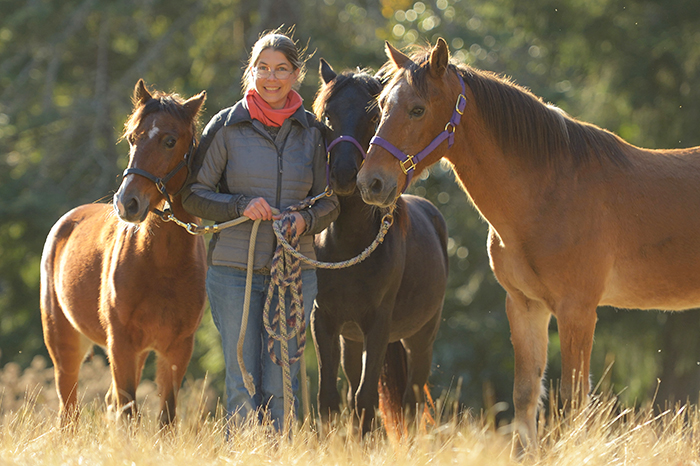
And finally, the three horses she first saw on a stranger’s Facebook page were standing in her pasture. 

“When these horses came, they were skin and bones,” said Wille, “because of their experience and all the stress.” 

The youngest horse began to thrive almost immediately, becoming “plump, shiny and playful,” Wille said, seemingly protected from lasting effects of the ordeal by his youth and vigour. The other two are even now still “waking up,” she added, and have continued to be more mistrusting of people. 

“They were work horses, we believe from the Amish,” said Wille, “who do use their horses very, very hard.” 

Wille compared it to a person’s recovery from trauma, where the attention of people wanting to help is more than the traumatized can handle. The horses were genuinely frightened, she said, by her attempts to be kind to them. 

“They have trouble coping with my expectation of wanting to be nice to them, because they’re just not ready to receive help,” she said. “They feel like they would have to show their appreciation for that help, somehow, to avoid punishment. This is how traumatized they are, that they aren’t able to fully enjoy what they now have, that safety, because they’re so suspicious that it’s all going to change again.” 

It was unexpected and upsetting, Wille said, and disappointing, particularly at first. As a photographer, she was saddened to discover that just pointing a camera at the horses would frighten them.  

“Seeing a beautiful horse like that, and you can see the scars of hard work all over,” said Wille, her voice breaking slightly. “And they’re shrinking away, just from you wanting to look at them. They’re not trusting your intention.” 

Wille describes the horses reacting to seeing a piece of harness with terror — turning their stomachs, making them physically ill. There was for her a grieving process as she adapted to life with these animals. Part of her, she said, had imagined adopting a “horse with experience,” one that could practically show her how to drive a buggy. 

But instead, she said, they wound up teaching her what charity really meant — how the act could flourish without expectations of appreciation. It was a learning curve, she said, one she wouldn’t trade for anything. 

“Horses are great teachers,” she said. “Oh man, does it ever sound corny. But it’s true, the lessons are coming in very unexpected ways.” 

Would she do it again? In a heartbeat, she said.  

“It’s fulfilled me,” said Wille. “It’s not the way I thought it would turn out, but it’s better. You might have an expectation that your kindness will be received with gratitude, but I’ve learned I need to completely leave it up to them— when they’re ready, they’ll receive that kindness.” 

Wille said she’d also gained a profound, practical understanding of the power each person holds to change a life — and if she had room today, she would add more horses. She always has her eye on those websites, she said, and always has another animal picked out. 

“They can show you where you’re still lacking,” she said. “If you can take that, and make something good from it, then the lesson was fruitful. 

“And I’m hopeful,” she added. “One of these days, the horses will smile into my camera.” 

Wille’s exhibition Faces of Forgotten Horses will be on display at the Salt Spring Coffee’s Ganges Cafe and Kitchen through Feb. 12. 

Academic expert illuminates Canadian housing crisis

0

One of Canada’s leading academics on housing, homelessness, inequality and social protection gave a capacity crowd at Mahon Hall a truck full of building materials for understanding our country’s housing crisis at a Salt Spring Forum event on Jan. 14.

Alison Smith, an associate professor in the faculty of political science at the University of Toronto, said her interest in the issue of homelessness was sparked by a field trip to Vancouver’s Downtown Eastside while she was a masters student under Michael Byers, Salt Spring Forum co-founder and UBC political science professor. Byers also moderated the event.

Smith detailed how the loss of federal government funding for housing in the 1990s and lack of leadership at the provincial government level across Canada was largely responsible for the state we see today.

“This is what happens when you try to create the conditions for the market to develop an inclusive, equitable, fair housing market. It doesn’t happen without senior government investment, with all of their resources, and we haven’t had that for a long time,” she said.

Smith contrasted that with Finland’s situation, which has longstanding experience with ensuring all of its citizens are housed.

“It’s always held up as a country that has ended homelessness; the only country that has a really long-term sustainable response to all different forms of homelessness,” she said, explaining that “about 20 years ago they responded really quickly when they saw increasing housing insecurity, not just in the big city of Helsinki but elsewhere.”

Smith said Finland has advantages in tackling the problem by having a smaller population, a unitary governance structure without provincial governments — which makes policy implementation easier — and a more generous welfare state. Finland has much more social housing, prioritizes early intervention and has solid information about what kind of housing is needed.

She said someone coming to Canada from Finland would tell us, “It doesn’t have to be like this. We’ve got some roadmaps for what can be done differently.”

The federal Liberal government’s National Housing Strategy, pledging more than $82 billion in funding over a 10-year period from 2018 to 2028, is laudable, she said, but there are concerns about if and how the money will be spent.

“It needs to be going to the communities and to the Indigenous-led organizations and municipalities and the housing providers that have the expertise and know what needs to be done and how to do it.”

Smith said the current B.C. NDP government is “the clear innovator, the clear leader” in Canada in trying to tackle the lack of housing, with other provincial governments watching how it plays out.

“This provincial government is doing more certainly today, and historically, than any province has done in terms of trying to intervene in the housing market,” she said.

When asked by audience members what people could do at the local level, Smith stressed the importance of advocating to all levels of government to take measures needed and to ensure that announced funding translates into housing units where and for whom they are needed.

“There are a lot of complexities, but at the end of the day, it’s actually frustratingly simple what it is that needs to be done . . . ultimately, it’s a tremendously reasonable thing to ask for everyone to have access to the type of home that they would like to live in, to have some type of choice in terms of where they’re living and to make sure that that’s safe. That’s not asking too much.”

Forum event tickets sold out several days in advance, attesting to local interest in the subject. People who have been advocating for local housing solutions and people living outdoors were among those in the crowd. They also set up a warming space outside the hall.

Smith is the author of Multiple Barriers: The Multilevel Governance of Homelessness in Canada.

For more reading on the issue, Smith recommended Gregory Suttor’s book called Still Renovating: A History of Canadian Social Housing Policy. She also pointed to David Wachsmuth, Canada Research Chair in Urban Governance at McGill University, as the expert on the impacts of short-term rental platforms such as Airbnb.

Post-disaster standard met in fire hall design

0

A lifetime inside the darkest-red area of every seismic hazard map might have left many of us a little nonchalant about living under earthquake threats. 

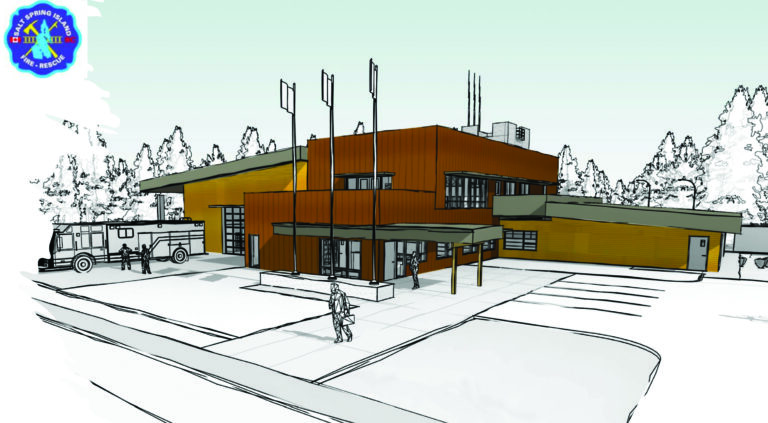
Not so for emergency responders, thankfully; and after coring and sounding more than 100 feet into the soft — and often moist — dirt beneath the site of Salt Spring Island’s future fire hall, staff and trustees decided a little delay in final design work now could make a big difference down the line.  

Now, as of the district’s meeting Monday, Jan. 15, that final work is complete — and the new fire hall on Lower Ganges Road next to Brinkworthy will still be fully “post-disaster” compliant, according to CAO Rodney Dieleman, who delivered an updated status report on the delayed start of the project.  

“Normal” buildings in seismic hazard zones are designed to remain standing after an earthquake; so-called “post-disaster buildings” are meant to also remain operational. The difference reflects the importance of those buildings’ functions during a catastrophic event, and how they are used during a crisis to deliver essential services. 

With a little more structural steel, fewer wood beams, slightly smaller windows and a solid foundation underpinning, the fire hall when completed will be more resilient — and the 90 days taken to review site conditions and redesign to ensure compliance with the “post-disaster” standard won’t affect the construction schedule, according to Dieleman. 

“The design is complete,” said Dieleman. “On Wednesday the consultants will be stamping off their designs, and we’ll be submitting our building plans for permitting. The construction manager has been pricing out his plans since last week, and will be tendering those plans probably before the first week of February.” 

The standard time those tasks should take, according to Dieleman, is two to three weeks — meaning construction could begin as early as mid-March. 

“We are now at a point where the bus has left the station,” said board chair Rollie Cook, noting there had also been indications of some better pricing for building materials — and downward-creeping interest rates, possibly reducing the costs of borrowing. “With a bit of luck, we will actually come in below our projected budget.” 

Dieleman noted there had been no changes to the $13.7-million project budget, construction schedule timeline, or the approved borrowing amount of $9.7 million authorized by referendum. The project’s current financial estimate is $12.3 million — fully financed, he added, with no increases to taxes or the Salt Spring Island Fire Rescue Service budget for the new fire hall construction and financing.  

As of the new year, expenditures totalling $477,000 have been allocated to building design, civil design, site survey, geotechnical investigations, and associated electrical, structural and mechanical designs, according to Dieleman’s report.

For more information as the project continues, visit saltspringfire.com/new-firehall

Plan to fund housing with tourism dollars paused

0

An agreement to put tourism tax dollars toward housing is on hold for the moment, as Salt Spring’s Local Community Commission (LCC) and the Southern Gulf Islands Tourism Partnership (SGITP) try to come to an agreement on how the money should be spent. 

LCC commissioner and Capital Regional District (CRD) director for Salt Spring Island Gary Holman had made a notice of motion, and that body had planned to vote Thursday, Jan. 18 to recommend conditional support for a five-year renewal of the two per cent municipal regional district tax to be allocated to the SGITP. Those conditions included allocating the online portion of the tax for affordable housing, with employee housing being “top priority”; allocating $100,000 per year to the CRD for the rural housing coordinator position; allocating $50,000 per year for a housing voucher program; and that the remainder be placed into an affordable housing reserve — added to the $200,000 that the SGITP already has allocated. 

The understanding had also been that the allocation of these resources across Salt Spring and the other Southern Gulf Islands would be “equitable” and reflect the proportion of revenue from the two electoral areas. But Salt Spring commissioners deferred the motion until their Feb. 1 meeting, tasking Holman and fellow commissioner Brian Webster to meet again with SGITP to hammer out particulars. 

“There have been discussions leading up to this,” said Holman, noting that the intended motion had represented his understanding of what SGITP was proposing. But, Holman said, while SGITP executive director Randy Cunningham indicated his discussions with accommodation providers showed support for the rural housing coordinator position, the housing voucher program and the additional allocation to the housing reserve, there was now some reluctance to fully commit the online portion of the tax — roughly half of what was close to $700,000 in 2023 — to the reserve. 

“They’re not willing to commit to the same degree to all of the online funding going to housing there,” said Holman. “They’re wanting to control the funds, so aside from the contribution to the CRD’s Rural Housing Program, all the other funds would be controlled by them — leaving open the possibility that some of the online revenue could be used for marketing.” 

That left the agreement at a “fairly significant difference of opinion” at the moment, Holman said, noting that both local government and accommodation providers have to vote to renew the five-year plan. 

“So if there’s the prospect of either local government and/or the accommodation providers saying no, we’re at a bit of an impasse right now,” said Holman.  

Southern Gulf Islands Electoral Area director Paul Brent, who attended the LCC meeting remotely, spoke in support of the SGITP generally, and said his area’s community economic sustainability committee had been “very, very pleased” with the work the group did, particularly in its efforts to shift visitor demand away from the summertime and into shoulder and winter seasons. 

“I have faith in the Tourism Partnership,” said Brent. “I worry that we could put a stick in the spokes by asking them to do more than they’re willing to do for starters, and doing that out of the gate before there’s an appropriate negotiation.” 

Brent said he had questions about the revenue proportionality between Salt Spring and the other islands, citing a lack of data to support what those numbers should be. But Webster characterized the disagreement as less of an “impasse” and more of the way such back-and-forth is meant to play out. 

“That’s part of a negotiation, and I don’t think they should be panicking, although time is going to get tight on us,” said Webster. “But we’ve been trying to have this discussion for quite a few months, so if time gets tight, that’s certainly not because the Local Community Commission didn’t get around to dealing with it.” 

Webster noted that there are some jurisdictions — including some northern Gulf Islands — where 100 per cent of the tax goes toward housing. 

“I think we need to stand up for our community, and make sure that with a renewal of the agreement that it’s down in writing that the Tourism Partnership will continue to do what they’ve been doing of late,” said Webster, “which is listening, cooperating, being flexible and thoughtful when dealing with the whole thing. That’s awesome, let’s put it down in writing to make sure it continues for five years.” 

Commissioner Gayle Baker noted the enthusiasm about the partnership she’d heard from members of the Salt Spring Island Chamber of Commerce, and agreed that holding off approving the five-year plan until the details were ironed out shouldn’t be construed as negative. 

“There’s definitely a sea change going on, in terms of how the Chamber is approaching this,” said Baker. “Each one of them has said that they’re really excited about the Tourism Partnership.” 

First local Repair Café set for Feb. 3

Wondering what to do with a malfunctioning toaster, a non-functional stereo, or a moth-hole-ridden sweater? Don’t throw them away just yet! Transition Salt Spring is thrilled to announce the launch of Salt Spring’s very first Repair Café, to be held at the Salt Spring Library Community Room on Saturday, Feb. 3 from 10:30 a.m. to 1:30 p.m.

A team of dedicated volunteer repair experts will be on-site, offering their skills to facilitate free-of-charge repairs (though donations are greatly appreciated). Tools and materials will also be provided, making it a convenient one-stop solution for those looking to revive their broken items. Attendees are encouraged to bring in anything from toasters, lamps and hair dryers to clothes, toys and crockery — virtually anything that needs fixing.

The Repair Café operates on a first-come, first-served basis, with a one-broken-item limit per person. If time allows, additional items may be addressed after everyone has had their initial item fixed. Join us for a day of skill-sharing with community fixers and learn from experienced experts.

Transition Salt Spring aims to contribute to the reduction of waste in our local community through this initiative. According to Morgan Fraser, Transition Salt Spring’s climate action coach, we discard so many things we own that have a broken part. “Some of those could easily be used again with a simple repair. Repair Café seeks to change this mindset,” she said.

Additionally, Repair Café aims to foster new connections between neighbours and showcase the wealth of knowledge and practical skills within the community. Often there are intergenerational links and knowledge sharing between the fixing volunteers and people who visit the repair cafe.

“Repairing things together benefits our community — strengthening our neighbourhood connections and island resiliency,” said Fraser. 

Fraser added that beyond the environmental benefits, repairs can save money and resources, ultimately helping minimize CO2 emissions and material waste.

Originating in Amsterdam in 2009, the Repair Café concept was developed by Martine Postma, a journalist/publicist. In 2010, she founded the Repair Café International Foundation, providing support to local groups worldwide wishing to initiate their own Repair Café, now including Salt Spring Island. The CRD Waste Reduction Grant has helped Transition Salt Spring’s ability to make this first Repair Café happen on Salt Spring Island.

Transition Salt Spring intends to organize regular Repair Cafés on the island starting with the Feb. 3 event.

Viewpoint: We all need each other

2

By JASON MOGUS

We all live together on this very small island, and as things get increasingly hairy out there in the world, it would be good if we could find better ways of working across our relatively small differences. In science fiction stories it’s known not to shoot your laser inside a small spaceship, lest everyone suffer the consequences of a hole in the hull. 

Case in point: recent (and fairly constant) articles submitted by organizers trying to sink the accessory dwellings unit (ADU) affordable housing bylaw continue to use extreme language to make the idea and those supporting it look far bolder and more sinister than they really are. While I respect the intellect, rhetorical powers and good intentions of these passionate fellow activists, these claims create a lot of alarm and confusion as to what’s really going on. I’m not sure they would survive a peer review process either. 

Nowhere that ADUs have been allowed has seen over a 10 per cent uptake across the housing stock. No developers are lobbying to build small cottages and suites. All water and other restrictions, as well as continued incredibly high building costs, will greatly limit the number of ADUs that might actually get built on Salt Spring. 

To say with such certainty that ADU’s will “double the population” and “unleash mass private development” when there is no credible evidence supporting either statement doesn’t contribute to our community’s understanding of complex policy issues. This black and white thinking harms community cohesion, and I’m not sure it helps us become more sustainable. 

The use of extreme language also maligns the reputations of the many people who are — like nearly every elected leader in Canada right now — working to address the incredibly unfair and painful housing reality thousands of our fellow community members struggle with, through no fault of their own other than being part of less lucky demographics.

Some may note I’m hardly one to preach on the topic of restraint. I’ve made some missteps myself on this topic in the past, by using words too harshly, creating unnecessary distance between those of us who would otherwise share most of our values if we were to go on a hike together in our beloved coastal rainforest. 

Thanks to the wise counsel of some friends, I’m trying to learn one does effect social change differently in a small community. Perhaps the kinds of campaign tactics that work when fighting greedy corporations aren’t appropriate when arguing nuance with your neighbour who was just over for tea last month, or who might be called on to help fix your frozen pipes tomorrow. 

Those laser holes in the hull can suck out everyone’s life support system. 

Salt Spring has long been renowned for its smart and compassionate population. I would love to see a bit more restraint in our use of words and a bit more faith being placed in our fellow community members who dare to lead on complex issues, and not always assume subterfuge, worst case scenarios, and malintent. Can we disagree without taking it to such extremes? 

The world is an increasingly scary place, and we really do all need each other on this tiny ship. 

The writer is a Salt Spring Island resident.

Opinion: The Green Machine

1

By JOE STACEY

Shilo Zylbergold’s column in the Dec. 27 issue about the holiday season and regifting got me to thinking (and chuckling of course) about how much of our society is driven on useless consumerism.

Ask yourself this: “Do I really need a new phone or electric car, whenever a new model comes out?” Or how about “Has the human species learned nothing about the effects of exploitation from history?” In what is now Canada, it started with the furry beaver trade, then cod, whale oil, coal, timber, herring, salmon, crude oil, and the list goes on. What’s next? I know, it’s lithium! All this to feed the green machine. It did build our nation, but it hasn’t been without its consequences, many of which we are still paying for today. Some call it progress, but what are we progressing towards?

Whatever happened to respecting the land (and oceans) that feed you? I remember when I was in school, we had “REDUCE, RE-USE, RECYCLE” drilled into our heads. Notice how recycle is the last option? It seems the modus operandi has always actually been “PRODUCE, ABUSE, NEW CYCLE.”

I wish people would step back and realize the potential environmental damage that will be caused by building more lithium mines, power plants, extra gas, or wells of oil, that would be needed to accomplish this shift to more electric energy. We need to remember that electricity doesn’t just magically appear from a hole in the wall, and that some natural resources are a finite thing.

According to the leading electric car maker, we will need to triple our electricity output in order to achieve an “all-electric” society. It will never be truly all electric, as there will still be some oil and gas, unless we as a society are prepared to give up a lot of things, including jobs. I feel we will need to more than triple the output because by the time that happens, we will all be glued to our electricity-gobbling phones/computers, and will need AI bots to do all the skilled jobs that the younger generations didn’t learn because it was easier to make money selling pictures of their feet online.

Now while it is true that electric cars are quite clean in the local environment in which they operate, as a whole, they are damaging to the planet. This is very easy to overlook when the damage isn’t in your backyard. Kind of like gas and oil. I say “the” planet, because it’s not ours. We as humans are not the only species here, but I think that is often forgotten, in the name of capital gains.

If you’re going to buy a new electric car with honest, hard-earned, unborrowed money because you need it, and like the tech, that’s your choice, and you have that freedom. But if you don’t need one, and you are buying it with borrowed money, on the pretense of it being better for the planet, I believe you are being misled by certain groups pushing a new agenda/resource.

It seems most things built today have a planned obsolescence. It’s kind of like Grandma’s blender from 1945, that could still blend up the neighbourhood Tomcat that has been spraying on your shoes, but most blenders built last year couldn’t shave the hair of said pussy. Maybe our society should be focusing on building/buying quality, long-lasting, repairable products. The higher incomes would use the new, and the lower incomes would use the old, just like it is today, and has always been.

When you see my gas-sipping, 34-year-old truck driving by, just know that it will still be operational long after your electric car battery has failed, deeming it uneconomical to repair, but that’s OK, you can just recycle it and buy a new one, and claim you are doing your part for the environment.

Before you label me “far right,” “anti-electric,” “pro oil” or any other polarizing name, just know that I am none of these, as labels create division, which leads to wars. Maybe we should all be “bi-polar.” Wait a minute, that’s not a very nice label. We are all just “human” and that’s a label I think we can all agree on. I definitely support clean air, clean water, healthy soil and critical thinking. Sometimes it feels like there are far too many sheep on the animal farm, or, well, maybe you’ll figure it out sooner rather than later.

It seems to always boil down to power, profit and the need to keep up with the Joneses. This at the cost of what we actually need to survive. Life isn’t meant to be all peaches and cream.

I will thank my local community and my parents for teaching me the values behind, and joy created in, repurposing or rebuilding what others consider to be trash. I used to be ashamed, like I was a lesser being, until I realized it’s those who abuse and take their mother for granted that should be ashamed.

So do your mother a favour: support local businesses, repair or repurpose what has already been built, grow or buy food that is grown/hunted ethically, and don’t worry so much about socio-economic status. I have been learning this since 1984.

Now don’t just take my word on any of this. I encourage you to get out there and do some thorough, open-minded research, and THEN tell me I am wrong. Remember, we are all in the same boat together, and in the end, does it really matter what powers it? It does if once way out at sea, we are all led to one side.

The writer is a long-time islander.

Editorial: Advocating for housing

1

When it comes to seeing publicly subsidized housing built in our community, or any other, advocacy is key.

That was one takeaway from a recent visit by University of Toronto associate professor Alison Smith, an authority on issues of housing and homelessness, who spoke to a Jan. 14 Salt Spring Forum crowd.

Smith praised the federal government’s National Housing Strategy, initiated in 2018, and the more recently announced Urban, Rural and Northern Indigenous Housing Strategy. After decades of inaction on the housing front, those steps acknowledge the critical role that senior governments play in ensuring its citizens are adequately housed. But Smith cautioned that it’s one thing to make funding announcements and another for those funds to be translated into completed, habitable shelter.

While the amount committed to the strategy initiated in 2018 keeps climbing, and the government has a “progress report” on its NHS website, exactly how many units have been completed is not easy to gauge. As of the end of September 2023, the site states $38.89 billion in “funding commitments” have been made and 151,803 housing units created or funds committed to their creation. There is a critical difference between a funding commitment and units being created. For true accountability, the “created units” and “funding commitments” for them should be separated in their reporting.

Smith stressed in her presentation to islanders how it’s “really easy” to make a funding announcement about supporting housing, and not difficult to get it into a budget, but not necessarily easy to get it out of the feds’ bank account “and into the hands of the people who need it.”

That’s where focused advocacy comes into the picture. If public funds have been promised for a particular project, the funding agencies must be pressed to spend the money — responsibly, of course.

The Capital Regional District has been taking a leadership role in creating public housing, with its recently announced plan to seek ratepayers authority to borrow $85 million to build housing in the region the latest evidence of that. But provincial and federal dollars are also needed to complete the vision, along with advocacy from citizens to ensure those funds end up unlocking new housing doors.

MITCHELL, Douglas Herbert

2

Douglas Mitchell Herbert

July 14th, 1942 – December 21st, 2023

Doug passed away on December 21st, 2023, after a lengthy illness. He had a full life, accomplishing many goals along the way, and he influenced the lives of his students and players while teaching and coaching.

One of his life goals was to play football in the CFL, the same as his older brother. He started his seven-year football career in 1968 and retired in 1974 having played on two winning Grey Cup teams (one with Hamilton and one with Montreal), and as a rookie was on the sidelines with Hamilton for another.

While playing football he taught high school and then, after leaving football, began a career coaching at the university level, first at Mount Allison University and then at the University of Toronto, before returning to his roots and a successful high school coaching career. Eventually retiring, he and his wife moved to Salt Spring Island and opened a clothing store, Ganges Garment Company, closing it after 14 1⁄2 years. He enjoyed meeting people and this was a perfect setting for him. As life slowed for him he still persevered on the golf course and his family appreciated the care shown him by his fellow golfers.

Doug emigrated from England when he was four years old and grew up in Windsor, Ontario where he and his wife met when they were both in high school. They were married for 57 years.

He is survived by his wife Diana, three children, Christina (Matt), Stacy (Michael) and Todd (Racheal), two grandchildren, Michelle and Mackenzie, brother Bill and several nieces and nephews. He was predeceased by his parents Nelly and Fred, and by his brother Michael.

Doug’s outgoing personality created strong bonds in all facets of his life He had connections across the country, whether an athlete, a coach or a fellow golfer, but the centre of his life was his family. He celebrated their successes and encouraged them when things weren’t going too smoothly. He was passionate about his life and always gave a hundred percent to whatever he did. His passing leaves a big hole in their lives.

Thank you to the home care workers for their care while he was still at home, and to Dr. Kalf, the staff of Lady Minto Hospital and the Extended Care Unit for the care he was given over the last months, and to Dr. Crichton, family doctor for several years.

A celebration of his life will be planned for a later date.