Home Blog Page 158

Residential values fall in Gulf Islands

0

Gulf Islands property owners started the new year with new assessed property values — and they’re lower, at least for most residential parcels.  

But sussing out the trend from 2022 to 2023 will be more difficult for islanders this year, due to changes in the BC Assessment Authority’s reporting. Those changes include electing to group together Salt Spring Island with what used to be considered a distinct outer island “neighbourhood” — a designation in last year’s report that included Pender, Saturna, Mayne and Galiano islands. 

While not broken down by neighbourhood, the “typical” residential property in the broader Gulf Islands was assessed at $850,000 for this year, according to a fact sheet, down roughly three per cent from last year’s $874,000.  

So-called single family residential properties were assessed at 3.4 per cent less, as measured from July 1 of each year, according to officials; strata property similarly lost 3.2 per cent in assessed value.  

In contrast, commercial parcels saw valuation gains — averaging four per cent locally, according to BC Assessment’s neighbourhood data, with “light industry” in the Gulf Islands rising 0.7 per cent in assessed value. The trend is similar in nearby areas; North Saanich saw more modest losses in value across residential properties — less than 1 per cent — but commercial and light industry parcels gained 5.1 and 11 per cent respectively. District of North Cowichan residential values fell 3 per cent for both single family and strata residential properties, while business and light industry values jumped 2.8 and 9.1 per cent. 

The total value of all real estate on B.C.’s 2024 Assessment Roll is $2.79 trillion, an increase of just 3 per cent from 2023. 

The province has said a change in assessment value does not necessarily mean property taxes will go up or down by a corresponding amount; taxes are most affected if a specific property rises above (or falls below) the average value change in its geographical area. If tax rates rise enough, however, even a property with falling value could face a higher bill.   

To see the assessed value of a property, visit the website bcassessment.ca and enter the address or parcel number. Property owners concerned about their assessments can find contact information there as well, if they feel their valuation or other information is incorrect.  

“Those who feel that their property assessment does not reflect market value as of July 1, 2023, or see incorrect information on their notice, should contact BC Assessment as indicated on their notice as soon as possible in January,” said deputy assessor Matthew Butterfield.  

“If a property owner is still concerned about their assessment after speaking to one of our appraisers, they may submit a Notice of Complaint (Appeal) by January 31st, for an independent review by a Property Assessment Review Panel.” 

The Property Assessment Review Panels operate independent of BC Assessment, are appointed annually by the provincial government, and typically meet between Feb. 1 and March 15 to hear formal complaints. 

SIDEBAR 

The higher-value parcels, at least in the Gulf Islands, were not immune from drops in assessed value. 

A property encompassing a home and land on the entirety of Samuel Island — between Mayne and Saturna Islands — was valued at over $19.4 million, down from $20.7 million last year. To the south, Forrest Island was assessed at $14.6 million, down from $15.2 million. Domville Island dropped to $16.1 million from $17.1 million; and James Island — the top-valued residential property in the Vancouver Island region — is valued at $57.9 million, down from $61.2 million.  

James Island’s value placed it third among all residential properties in B.C., behind two single family homes in Vancouver’s Kitsilano and Point Grey neighbourhoods. 

A home and acreage at the tip of Scott Point on Salt Spring Island, which last year had been valued at just under $13.2 million — $2.3 million more than the previous year’s assessed value, or about a 20.7 per cent increase — fell off the province’s top 500 valued residential properties list this year, coming in at $11.7 million. Outside of the privately-held islands, that property is still the highest-valued home in the Gulf Islands, resting at not quite $1 million higher than its assessment two years ago. 

Polar Bear Swim photos

0

New Year’s Day Polar Bear Swims took place at Vesuvius Beach and Fulford Harbour on Salt Spring Island this year, with other people doing personal dips at other beaches.

Dave French and John Denniston sent in the photos in the attached gallery from the Vesuvius Beach event. See also this week’s Driftwood newspaper for photos by Erin Magley.

Epic Verdi opera at ArtSpring

By KIRSTEN BOLTON

FOR ARTSPRING

During this holiday season, ancient Babylon comes to life with the classic Met Opera revival staging of biblical proportions — Verdi’s Nabucco — broadcast live in HD at ArtSpring on Saturday, Jan. 6. 

The opera debuted in 1842 and was Giuseppe Verdi’s third of 26 operas. It presented a stirring drama about the fall of ancient Jerusalem at the hands of Nebuchadnezzar (Nabucco) and catapulted the 28-year-old composer to international fame. 

The music and Verdi himself were subsumed into a surge of patriotic fervor, culminating in the foundation of the modern nation of Italy. Specifically, the Chorus of the Hebrew Slaves (“Va, pensiero”), in which the Israelites express their longing for their homeland, came to stand for the country’s aspirations for unity and that exciting era in Italian history, the Risorgimento, or “Resurgence.”

In this epic revival, baritone George Gagnidze makes his Met role debut as the imperious king Nabucco, alongside Ukrainian soprano Liudmyla Monastyrska reprising her thrilling turn as his vengeful daughter Abigaille. Daniele Callegari conducts Verdi’s early masterpiece, which features the ultimate showcase for the great Met Chorus, in the moving “Va, pensiero.”

Epic sets, costumes, music and voices make for a dazzling experience. As local insiders have discovered, however, the benefits of sitting down in real time with New York Met audiences, getting subtitles, close-ups and behind-the-scenes interviews, and being part of the famous “intermission quiche break,” it truly makes the Saturday morning Met experience a calendar must. 

Tickets are on sale at tickets.artspring.ca or at the door on Jan. 6.

Trustees ditch Zoom for 2024 council meets

1

As many local and regional governments anticipate tax rate increases in the double digits for 2024, the Islands Trust says it will certainly look for savings — but not in the costs of holding meetings. 

The Islands Trust Council (ITC) has made plans to meet 100 per cent in-person in the coming year, choosing locations in Nanaimo and Victoria, as well as on Salt Spring Island and at one yet-to-be-determined island venue. ITC has met quarterly for decades — and agreed in 2024 to continue with tradition, meeting in March, June, September and December for three days each time.  

The decision to skip virtual meetings was not unanimous, and the split vote reflected some differences in opinion over the intrinsic value of meeting face-to-face — as costs for travel, accommodation and food have risen. Earlier this year, the Trust’s Financial Planning Committee (FPC) asked staff to brief them on the “true costs” difference between holding ITC meetings online via Zoom versus in-person, and administrative services director Clare Frater delivered, presenting a review of the last eight meetings — five in-person, and three via Zoom — from as far back as the ITC’s Nanaimo meeting in March of 2022. 

One unsurprising finding was that in-person meetings are generally more expensive; but the difference — and, some trustees argued, the potential for budget savings — was eye-opening. With accommodation, catering, meals and travel expenses, bringing the council together for an in-person meeting cost an average of $31,300 for each event— or more than $10,000 per day for a typical three-day gathering. 

The average Zoom meeting cost just $900.  

“I would suggest we have all Zoom meetings,” said Saturna trustee Mairead Boland at ITC’s December meeting. “I suspect most people won’t support that. But we need to challenge those costs.” 

The FPC had already defeated a motion brought by Denman Island trustee David Graham in October to recommend ITC hold all meetings in the next fiscal cycle remotely, and another asking staff to bring ITC a consideration of options to reduce in-person meeting costs. Instead, through a motion by Tobi Elliott, the committee requested the briefing be attached to the ITC’s December agenda packet “to support discussion.” Elliott reminded colleagues they had “lost staff because [they] had such a stressful Pender Island meeting.” 

Some trustees bristled at the idea the costs were excessive. At the ITC meeting, Gambier Local Trust Area trustee Joe Bernardo, who lives on Keats Island, pointed out the $31,300 number sits against a backdrop of a nearly $10 million budget. 

“It costs money to have legislators come together to meet and discuss,” said Bernardo. “It’s just a cost of doing business, and we don’t need to apologize for it.” 

And at the October FPC meeting, council chair and Thetis Island trustee Peter Luckham had defended the meetings’ overhead. 

“We’re not frivolous,” said Luckham at that meeting. “We’re not drinking champagne and eating caviar. In fact, quite often we do eat sandwiches. Outside of us all bringing our own lunches, I’m not sure where you can save money, because it just simply costs money to cater.” 

There was some discussion about whether Local Trust Committee (LTC) chairs and others who need to travel to those meetings might be able to attend remotely — for cost savings, but also for the sake of trustees’ travel time. Trustee Tim Peterson, who takes multiple ferries between his home on Lasqueti Island and his work chairing Hornby, Galiano and Salt Spring Island LTC meetings, said that while having the option to attend remotely can be helpful, it needs to be left to individual trustees’ discretion when to choose to be in-person. 

“I wouldn’t be comfortable, for example, not being in-person at the Salt Spring LTC special meetings,” Peterson told colleagues, as managing often lively town hall meetings is challenging enough in-person. “I think there’s cases where not being there in-person might be fine, but I wouldn’t have been comfortable trying to chair those [town hall meetings] not being in the room.” 

The ITC schedule shows 2024 meetings will be held March 12-13 in Nanaimo, June 18-20 on Salt Spring Island, Sept. 24-26 on a yet-to-be-determined island, and Dec. 3-5 in Victoria. The Islands Trust budget will be finalized in March. 

Speed boards, more EV chargers planned

0

While Salt Spring’s new fire hall is hoped to be home to the island’s first-and-only Level-3 fast electric vehicle (EV) chargers when completed, regional work is expected to start next year on an expanded Level-2 charging network throughout the Capital Regional District (CRD). 

A request for proposals went out Thursday, Dec. 21, for a contractor to bring online approximately 149 Level-2 charging stations across 66 different sites in the region over the next three years, 14 of which would be on the Southern Gulf Islands.

On Salt Spring, the plan includes four new EV charging connectors at the ArtSpring parking lot, two at Mouat Park, two more at the Rainbow Recreation Centre and two at Centennial Park. The plan also envisions two new connectors on Galiano Island at the town centre, two on Mayne at the Mayne Island Community Library, and two on Pender Island at the Community Hall.

The Level-3 charger proposed on Salt Spring would be adjacent to the future fire hall, with equipment to charge four EVs simultaneously.

Radar speed signs planned for three sites

One effort to slow speeding drivers on Salt Spring inched closer to completion, with three solar-powered “speed reader” boards planned for the island, according to project tender documents from the CRD. 

The electronic signs, which measure the speed of approaching vehicles with radar and display the results, have an estimated project cost of $50,000, according to the CRD, and are planned for three locations.

The first, on Cusheon Lake Road opposite the swimming area, will be within the “playground zone” lower-speed area already marked there. That stretch of road is often busy with pedestrian traffic, especially during summer months as swimmers flock to the lake. 

Additional speed reader boards will be placed on the south side of Lower Ganges Road — between Village Terrace and Kingfisher Cove, by the mailboxes — and on the east side of North End Road, just north of the intersection with Fairway Drive. 

Just over $19,000 in grant funding has so far been awarded through ICBC’s Road Improvement Program, according to the CRD. Site preparation and installation of the signs is expected to take place early this year. 

CRD greenlights transportation service study

0

There may be a regional transportation service, and later perhaps even a regional transportation authority — but first, according to Capital Regional District (CRD) officials, there shall be a regional transportation study. 

And despite Salt Spring’s Local Community Commission (LCC) sending along an arguably tepid response to the notion over the summer, electoral area director Gary Holman joined the rest of the CRD board this month in a unanimous vote before the winter break, directing their staff to complete that study even while island representatives seemed more than a little hesitant.  

Back in August, as the LCC considered responses to the CRD’s local government engagement survey on a regional transportation service, nearly every question about whether a service should be administered at a regional or local level was answered in the latter — and commissioners punctuated their response with a unanimous resolution of their own, requesting Salt Spring be excluded from any such regional service — “based on [our] current understanding,” they politely added. 

Indeed, as the “What We Heard” report on the CRD’s summer engagement with the 13 municipalities and three electoral areas in the region showed a trend of agreement among municipalities in the value of regional transportation governance, there was clearly less support within the electoral areas. On “connectivity,” for example, local officials were asked to consider whether “a focus on their residents’ ability to travel intra-municipally (within their municipality) or intra-regionally (between municipalities) would have the greatest impact on improving mobility.” CRD staff reported that while responses “leaned” regional overall, there was “not a strong level of agreement between local governments and electoral areas in the region.” 

Put more bluntly, Salt Spring representatives — and, to a lesser extent, those representing the Juan de Fuca Electoral Area — generally believe a local focus, not a regional one, would have the greatest impact on improving residents’ mobility. That opinion held on matters ranging from active transportation to new mobility services, from transit to traffic flow — “local” was the response.  

But the broad agreement among the municipalities will likely be enough to advance the proposal, according to that report — at least for now. While the threshold of “agreement” has been set at two-thirds, or at least 11 local governments and electoral areas, a service establishment will require unanimous support, again according to the report — so the two-thirds threshold is really meant to justify further investigations for the potential for changing transportation governance.  

Those investigations will proceed; in addition to the study, the CRD board tasked staff with developing an engagement plan, and scheduling a workshop for local governments, electoral areas, partner agencies and interested First Nations this spring, as well as to start planning the next stage for the concept — connectivity, grants, traffic flow and congestion analysis. If an agreement is reached among CRD board members, the regional transportation service could be in place by the end of 2024. 

George Sipos featured guest at Poetry Open Mic

The first Poetry Open Mic evening of 2024 at the Salt Spring Public Library on Thursday, Jan. 4 features the island’s own George Sipos. 

Locals may know Sipos from the days when he was executive director of ArtSpring prior to his retirement nine years ago. 

Before moving to Salt Spring he had owned a bookstore in Prince George for some 17 years, through which he brought many Canadian poets to read, and hosted other literary activities such as short residencies.

During those years he became a poet himself, owing to the encouragement and friendship of such poets as Don McKay, Jan Zwicky, Patrick Friesen, Roo Borson and Sue Sinclair.

After a residence at the Banff Writing Studio in 2001, Sipos published two collections of poems with Goose Lane Editions, and a bit later a non-fiction work with Gaspereau Press. The first poetry collection, Anything But the Moon, was shortlisted for the Dorothy Livesay Prize at the BC Book Awards. The non-fiction title, The Geography of Arrival, was a finalist in 2011 for the Charles Taylor Prize. Sipos said a third poetry collection, with the working title Rehearsals of Rescue, is currently “marinating.”

At Thursday’s event at the library, Sipos will read one poem from his first book, about the Perseid meteor shower, written about 20 years ago, and then a more recent poem about the same meteor shower written not that long ago. 

“They should make a nice contrast between images of living in the North and a different world view that’s recognizably Salt Spring,” he said. 

Poems from the new manuscript will fill out his time at the mic.

Open Poetry Mic evenings begin in the library’s Community Program Room at 7 p.m. with poems read by anyone who signs up beforehand, beginning at 6:45 p.m. (Only one poem per reader is allowed.) The featured poet follows at about 7:30 p.m.

Editorial: Borrowing Change

2

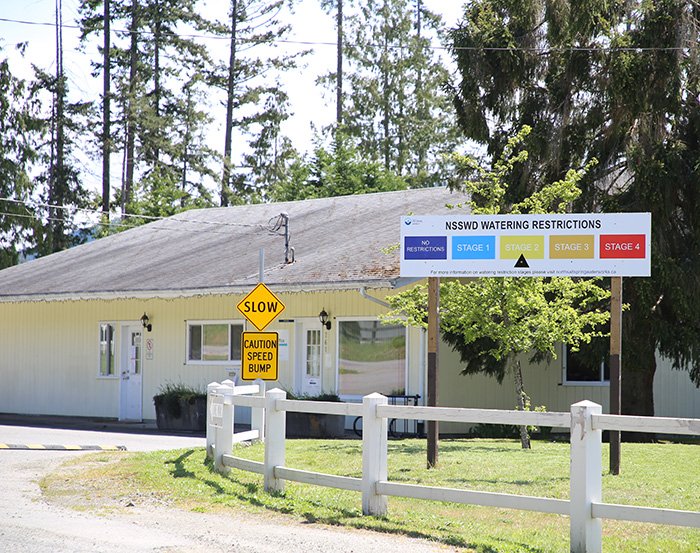
Costs for infrastructure and service from Salt Spring’s largest water utility have steadily climbed in recent years.

But the North Salt Spring Waterworks District (NSSWD) board and staff have at the same time sought ways to stem the rising-cost flow. 

Without access to federal-provincial infrastructure grants, owners of the NSSWD’s 2,100-plus properties have had to foot the entire $8.4-million bill for constructing a water treatment plant for St. Mary Lake, which was completed in 2018. They will do the same for a Maxwell Lake plant most recently estimated at more than $10 million that the province says must be built by the end of next year. 

The NSSWD has for years pressed the provincial government to change its policy of not providing infrastructure funding to “improvement districts” like the NSSWD and Salt Spring’s fire protection district. The government has so far not agreed to do so. The NSSWD also explored becoming an entity under the Capital Regional District, which would have qualified them for infrastructure grants, but could not come to an agreement about the details. 

The latest attempt to help ease the pain for ratepayers is by requesting a change to the Local Government Act that would give the NSSWD access to lower-interest provincial lending rates on the millions of dollars it must borrow for the Maxwell plant and the remainder owing on the St. Mary plant. They estimate the change would save NSSWD taxpayers some $4.5 million in interest payments. 

At present, provincial financing is available to improvement districts providing “fire protection or street lighting.” The NSSWD proposal is to add districts that provide “essential domestic and emergency water supply” to that list. Surely water supplies are as critical as fire protection or street lighting services and should be valued in the same way when it comes to reducing the cost to citizens to provide them.

Not making an exception to infrastructure funding rules for large, financially solid improvement districts feels unnecessarily punitive; forcing them to use the private market for borrowing funds to build essential infrastructure the government itself demands be built is downright cruel. 

We urge the Ministry of Municipal Affairs to give serious consideration to the NSSWD request and encourage ratepayers to provide support for change as needed.

NSSWD seeks rate-saving path

0

The North Salt Spring Waterworks District (NSSWD) is requesting a change to B.C.’s Local Government Act (LGA) that would reduce the cost of borrowing for its water treatment plants. 

NSSWD chief administrative officer Mark Boysen sent a letter to the Ministry of Municipal Affairs (MMA) on Dec. 22 asking for an amendment to Section 711 of the LGA that would allow the NSSWD to access provincial lending rates, rather than relying on private bank financing, for a potential savings of $4.5 million. 

“With access to provincial lending rates, NSSWD ratepayers would realize savings of nearly $2.5 million in loan interest charges for the Maxwell [water treatment plant],” Boysen states in the letter to Tanja Faganello, assistant deputy minister of the MMA Local Government Division. “If these preferred rates were also applied to our existing financing for the St. Mary Lake plant, there is a potential ratepayer savings of $2 million in additional loan interest charges, resulting in a $4.5 million total savings to our residents.”

At present, only improvement districts that provide fire protection or street lighting are eligible for the preferential interest rates. The NSSWD is requesting that criteria be changed to include “improvement districts that provide essential domestic and emergency water supply to communities.”

Costs for the new Maxwell Lake treatment plant, which the province has mandated NSSWD to build by the end of 2025 due to health issues arising from the current treatment method, have come in at more than $10 million, said Boysen. NSSWD ratepayers have already seen significant tax increases to pay for the St. Mary Lake treatment plant that was completed in 2018. 

Trustees considered requesting the LGA change at their Dec. 14 meeting, following a staff report. NSSWD financial officer Tammy Lannan noted the change would shift tax-collection responsibilities from the district to the province, with the implications not yet clear. Despite some unanswered questions, trustees agreed the letter should be sent to Faganello, and especially since they said local MLA Adam Olsen has indicated support for the move. 

“I don’t think this is an unreasonable request for the district, and it’s a question of fairness to our ratepayers as well,” said Boysen. “I think we have a really strong point here to make to the province and a benefit for our ratepayers.”

The NSSWD has tried on more than one occasion without success to be granted an exemption from provincial government rules that bar improvement districts of any size from applying for federal-provincial government infrastructure grants. 

Also at the Dec. 14 meeting, trustees agreed to provide a commercial water connection for domestic purposes only, that does not exceed one-inch internal diameter, for the new fire hall at 455 Lower Ganges Rd., which makes it an exception to the current water hook-up moratorium. As explained in a letter to the NSSWD from fire district CAO Rodney Dieleman, a domestic well and rainwater capture system will provide supplementary water supply to the facility. 

Trustee elections for 2024 were also discussed. NSSWD will again use a combination of mail-in ballots and in-person voting. May 2 is the date set for voting and the annual general meeting.  

Also included in the process this year will be an online information session for people interested in trustee positions scheduled for Wednesday, Jan. 24 at 7 p.m. Trustees and staff agreed that if that opportunity does not arouse much interest then another session could be set up. The additional outreach followed a discussion at a previous meeting where some trustees felt it important for potential candidates to have as much information as possible about the position before declaring their candidacy.  

Pender connector road set for repair

0

A damaged section of roadway on South Pender Island that has languished since the heavy rain and flooding in November of 2021 is finally set to be fixed after the new year, according to the Ministry of Transportation and Infrastructure (MoTI). 

In fact, according to MoTI officials, the repair work on Canal Road — including clearing, rock blasting and offloading the existing slide and roadway, realigning the road onto solid bedrock and placing a new larger culvert and reinforced retaining wall — is expected to improve the critical connection road’s resilience in “future extreme rain events.” 

Crews are expected to begin in February 2024, according to MoTI, and a tender for the repair project has been posted. A temporary barge landing facility will be constructed at Boundary Passage Drive to transport equipment and materials. 

After the 2021 floods, MoTI said it installed a number of safety measures in and around the roadway, including slope deformation monitors that track earth movement and load restrictions. The single-lane-alternating traffic, with timed signals at each end of the site, will remain in effect during the project — and could disrupt drivers further, according to officials, as there may be a need to close the road “intermittently” for as much as four hours at a time. 

“All efforts will be made to minimize traffic disruptions during peak travel times,” according to a ministry press release. “Advance notice of traffic disruptions will be provided via DriveBC.” 

Crews will continue to monitor deformations and perform any necessary maintenance while the repairs are ongoing, according to MoTI. 

The damaged section of road is roughly 2.5 kilometres east of Pender Canal Bridge, the link between North Pender Island and South Pender Island. MoTI officials said additional federal environmental permitting was secured due to the project’s proximity to the Gulf Islands National Park Reserve, and that revegetation and mitigation measures will be in place following construction.