
Home Blog Page 162

Summit sets the table for food security action

2

About 80 people feasted on a homegrown initiative at the Salt Spring Island Food Summit held Nov. 26 at Meaden Hall, hoping to spark revolutionary change when it comes to the amount of local food available to islanders.

The brainchild of writer and film/TV producer Jon Cooksey, who with his partner Pam Tarr has immersed himself in the food-growing potential of a Salt Spring property they bought a few years ago, the summit’s aim was to find ways to increase local food production from the current four to six per cent level and make the island more resilient in the face of climate change.

Many summit attendees were those with their hands in the soil or connected to food-producing endeavours, but the roster also included local government representatives and people involved with impactful businesses or non-profits. Everyone contributed to the discussion about possibilities and priorities.

First Nations summit participants provided a longer-view perspective, illustrating that our region’s lands and oceans had in the past provided an abundance of food and important trading commodities.

Maiya Modeste, the Garry oak ecosystems restoration coordinator for the Stqeeye’ Learning Society and keynote speaker, spoke of how the camas bulb, a staple food for her Quw’utsun ancestors, was traded up and down the coast and inland.

“It’s a way that we’ve connected with each other for thousands and thousands of years, and my goal, my dream in this life, is to be able to start those connections again, to go up and down, north and south, and share this story, and to revitalize this food system for our youth.”

Tsawout First Nation elders and knowledge keepers on a Projects for Action Panel also touched on reinvigorating traditional food sources. Earl Claxton, Jr. spoke of salmon once being part of his people’s daily diet, and his current activities of growing berry plants and transplanting them at Todd Inlet. Lorne Underwood shared the importance and challenges of projects such as clam garden restoration.

Anne Macey, of the Salt Spring Agricultural Alliance and other key groups, and John Pattinson of Bright Farm introduced the “50 Farms” concept that would see development of farms across the island, using the Capital Regional District Emergency Program’s neighbourhood pod grid as a guide.

“Leveraging from that pod system helps us have an organizational structure,” said Pattinson, “and so in the case of an emergency or food insecurity events, you’d have a way to access or know where your closest farm is.”

Nick Adamson-Jones, who with Polly Orr has coordinated a Grow Local project for the past two years, described recent activities related to gleaning — the harvesting of fruit trees or wild foods that are not otherwise tended — and to neighbourhood food production through community gardens.

“There are some beautiful models and inspiring projects that are already happening in that realm,” he said.

Joanna Ashworth, director of Professionals Programs and Partnerships in the Faculty of Environment at Simon Fraser University, provided facilitation for the day; and summit committee member Tarah Stafford prepared a delicious buffet lunch (made with approximately four per cent local foods).

Fuelled by lunch and the words of the morning’s presenters, event participants brainstormed ideas that ultimately led to nine project areas inviting development and commitment to work on them as soon as possible. (See sidebar, below.)

Summit sponsors and donors included the Salt Spring Island Foundation, the Institute for Sustainability, Education and Action, the Simon Fraser University Initiative Funds (through the Grow Local program), Salt Spring Coffee, Hen & Hound, Country Grocer, Heyday Farm (sponsored by Island Natural Growers), Jane Squier at The Garden, numerous home bakers, the Agricultural Alliance, Salt Spring Island Farmland Trust and Transition Salt Spring.

Cooksey described the summit as “just the beginning of a revolutionary change in how we work together on Salt Spring,” noting how the connections made that day were key to the actions that would be undertaken as a result.

A shared intention and believing that things can change are also crucial, he said in his closing remarks, which concluded with a lighthearted note.

“We have to each decide if we want to be part of a different future than the one that’s heading our way. So I think that takes sharing one intention, which is to feed the people of this place with food from this place, because this place and our friendships are what connect us. So we look forward to collaborating with you and becoming one big systemic family and, if I may say so, I believe in you, and I believe in dinner.”

Some of the Nov. 26 summit participants hard at work at Meaden Hall talking about practical ways to boost Salt Spring food security. The group came up with nine areas of focus to help achieve summit goals.

Nine Projects Selected 

From small-group discussions at the Nov. 26 Salt Spring Island Food Summit came nine areas of focus, with participants signing up to spend time on one or more of them in the near future. 

• 50 Farms – an initiative to make local farming more cooperative and financially stable, increase community connections to farmers, mentor and support new farmers, and integrate food security with emergency preparedness.

• Grow Local – supporting bottom-up food growing and gathering initiatives at the neighbourhood and island-wide level.

• Indigenous Collaboration & Marine Foods – bringing together all who are connected to this land and these waters, indigenous and settler, to solve the obstacles to boosting food abundance, resilience and sovereignty for all, with a particular focus on marine foods.

• Forest Food & Native Plants – support for the restoration work being done in Xwaaqw’um (Burgoyne Bay) by the Stqeeye’ Learning Society, with a focus on bringing camas and other native plants back into our regional food supply.

• Youth-focused Programs – including education, support, resources and work experience for youth relating to food production.

• Shared Resources – creating a system of sharing food-related resources from information to mentoring to tools and equipment.

• Public Engagement – bringing everyone on Salt Spring together over the joy of food and its benefits for our health, our resilience and our community bonds.

• The Business of Food – improving the economics of our food system, ensuring supply chain stability and providing capital for boosting food production, processing and distribution.

• Food Security Coordinating Committee – providing systemic coordination and planning between the other projects, possibly in liaison with a paid food security coordinator for the island.

Pathway bench roster keeps growing

By JEAN GERLWICKS

FOR ISLAND PATHWAYS

The Partners Creating Pathways (PCP) committee of Island Pathways’ (IP) volunteers has been busy again. This month they have installed two benches.

The bench that has lived for many years under some cherry trees, along Lower Ganges Road, the very first pathway IP constructed, needed relocating.  It was in the way of the ground preparation for the long-awaited new fire hall that will be going in at this spot. PCP committee members moved it further down the pathway, to a lovely spot on RCMP property, with that agency’s permission.     

They also installed a bench, in honour of Dorothy Cutting, for ArtSpring on their property.

These benches have been built by long-time PCP member/volunteer Donald McLennan. The ArtSpring bench is the 49th bench he has built since moving to Salt Spring and that he, most often with PCP help, has installed along community pathways and numerous other spots around our beautiful island. There will be a special celebration thanking McLennan when his 50th bench gets installed next year. 

Island Pathways wants to say a big thank you to McLennan and the entire PCP Committee for their well over 10 years of service to our island for the Ganges Village Pathway Network, numerous map kiosks, informative interpretive panels, installation of bike racks, fencing and even a bridge.

Kennel owner seeks second chance at approval

1

Supporters hoping to reverse a November decision barring a Salt Spring Island dog rescue and boarding organization from operating at its new location face an uphill battle, as local officials’ options appear limited by the island’s official community plan (OCP).  

The biggest hurdle is seemingly the proposed kennel property’s land use designation under that OCP, and that it is — mostly — mapped as “Watershed and Islet Residential,” severely limiting what can be built there. 

“The nature of this zoning is very restrictive to any development further than a dwelling unit and agriculture,” said planner Chris Buchan at the Nov. 16 Salt Spring Local Trust Committee (LTC) meeting.

Buchan added that the restriction is reflective of the OCP’s policy to limit land uses in ways that protect watershed health.

Indeed, under Bylaw 434 — the 2008 establishment bylaw for the island’s OCP — the property’s designation does not allow for exceptions under the Islands Trust’s temporary use permit (TUP) process, which was how Salty Dog Retreat’s Jaime Halan-Harris approached the LTC. 

Since 2018, Salty Dog has taken in lost animals and provided rescue and pet shelter services to islanders at its own expense. Last winter, according to Halan-Harris, personal circumstances prompted the business to relocate from its site on Rainbow Road to a 10-acre parcel she purchased on Blackburn Road in March.  

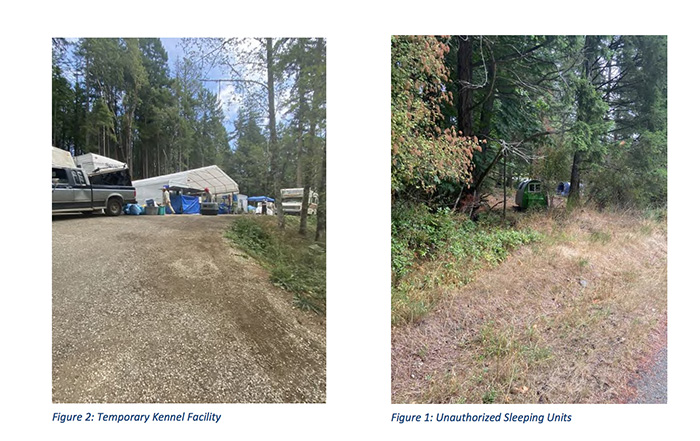
In April, Halan-Harris applied for permission — through a TUP application — to operate in that new location. That application was modified after its initial submission, according to a staff report, ultimately including plans to expand by the fall to offer worker accommodations using three recreational vehicle pads and a campground. 

“The kennel is not just a kennel,” Halan-Harris said. “The kennel is also a vocational rehab program and therapy for youth who were homeless … They do 15 hours of cleaning (sometimes only five hours) and they get support from me as well as each other and a sense of community.” 

Halan-Harris seemingly believed she could apply for a TUP for these uses under Bylaw 355 — Salt Spring’s land use bylaw (LUB). While most of her new property lies in that bylaw’s restrictive Rural Watershed zone, a small portion is in the Rural zone — where businesses such as a dog kennel and even campground could generally be approved, if an LTC chose to do so. 

Placement of kennel operations — to say nothing of campground facilities — in the slim 30-metre-wide northern Rural-zoned section of the property would, at a minimum, likely run afoul of setback and septic requirements, according to staff — and trustees at the November meeting expressed concerns about suitable road access. 

But even if the LTC intended to grant variances on such matters later, the OCP limits where they might contemplate even starting the process. 

The relationship between the OCP map and the zoning map is largely congruous, but is also such that while the latter lays out specific regulations — showing what can and cannot be built on a particular property — the former governs where an LTC is permitted to make rezoning decisions. If the LTC chooses to issue any TUP within the OCP’s watershed zoning, according to staff, it would be in contravention of its own OCP — and would invite a legal challenge, particularly given the importance of the aquifer to residents in the Cusheon Lake area. 

While staff told trustees they communicated the “policy restrictions and outcomes of recommended denial” to Halan-Harris “throughout the process,” there was apparently no consideration of simply not accepting the application form (and application fee) for the TUP in the first place. Such an action by staff could have been arguably overstepping, as they hold no authority for land use decisions; that power lies exclusively with the LTC. And, in an explanation of process on the first page of the TUP application, applicants are advised to review both the OCP and LUB before applying. 

Meanwhile, bylaw enforcement entered the picture early on, according to the staff report, as the business began “land alteration” and kennel operations in advance of any decision on the permit. With the appearance of a “dog kennel structure, multiple RVs, small tent/non-permanent cabin units, and onsite servicing (i.e. a well and holding tank),” Trust staff stated, complaints were received — over noise and concerns about environmental impacts — and officers responded, issuing infraction notices.  

Halan-Harris has encouraged supporters to write letters to the LTC and to attend the next LTC meeting on Thursday, Dec. 14.

Editorial: Buy and donate locally

0

Without a doubt, holiday season festivities are back to full strength, as craft fairs and all kinds of entertainment activities take place on Salt Spring this month.

Islanders’ talents and creativity are highlighted in both the things they make and the things they do, ensuring no shortage of unique gifts and shared cultural experiences for those able to partake. Islanders are encouraged to spend money on gifts locally, to provide both direct support to our artisans and retailers and to help keep the funds flowing on the island as the dollars continue to (hopefully) be spent here. The Love Local Winter Wander late-night event, which runs this Friday, is a fun way to shop locally.

Numerous local non-profit organizations also send out appeals for donations at this time of year. Registered charities can provide tax receipts for donations received before the end of 2023, reducing the amount of income tax payable, which in effect subsidizes the donation cost. A successful appeal campaign can make a huge difference to what our much-valued non-profits and foundations are able to do in any given year, and donation amounts of any size add up to have big impact. The Circle Education Salt Spring Society, Salt Spring Island Foundation, Island Arts Centre Society, Salt Spring Island Conservancy, Salt Spring Arts and Salt Spring Public Library Association are some of the larger organizations issuing appeals right now.

Then there are the more grassroots efforts focused on helping to alleviate the stresses of poverty on our island at this time of year. Inflation, high housing costs, housing insecurity and lack of stable income are affecting so many families and individuals. The Stocking Stuffers for Seniors initiative is taking place again, as is a Holiday Hampers program described in our letters section this week.

Santa’s Workshop is also accepting donations of new or lightly used toys, books, art supplies, sports equipment or Christmas decorations in its boxes at West of the Moon, Mouat’s Home Hardware or Country Grocer until Dec. 10.

Numerous other groups are working behind the scenes to bolster those who need it most this year. If you have the means to help out, please do so and help make our community stronger through compassion and sharing.

TOWNE VAILLANCOURT, Kathleen “Amina” Faith

4

Passed peacefully surrounded by song, family and friends. 

Kathleen will be remembered for her generous heart, and her beautiful spirit. She was a dedicated social work instructor, counsellor, and advocate for social justice. She was a supportive ally for family, students, and friends alike. She touched many lives and will be remembered lovingly. She is survived by her loving husband Don, her two daughters Maia and Serena, her grand children Kyrus, Madrid, Rowan, and Cooper, her siblings Anna and David Vamvakius. 

Kathleen has been laid to rest among the trees in the Burgoyne Valley Natural Cemetery.

Viewpoint: Retreat and rescue provides vital service

1

The following was sent to Premier David Eby, Minister of Housing Ravi Kahlon and media outlets, including the Driftwood.

By OLGA MCGILL  

We need urgent help. 

I am writing in support of Jaime Halan-Harris, the owner of the Salty Dog Retreat and rescue service. 

The Salt Spring Island Local Trust Committee held a temporary use permit (TUP) hearing on Nov. 16, without Jaime or her supporters present, and denied her TUP. It means to close the kennel business and send single moms with young children and youth who were homeless before onto the street — right before Christmas. 

Jaime is allowed to bring a delegation and speak at the next meeting, as well as hand in support letters and have supporters speak at the meeting.  

The kennel is not just a kennel. Jaime has taken lost dogs and rescues into her care for almost six years now, at no cost to the community and with no funding. It is all out of pocket. She cares for dogs brought to her by the RCMP, Capital Regional District, Islanders Working Against Violence, the vets, ambulance and hospital personnel, and many COVID pups (all about two or two and a half years old) have been surrendered.

The kennel is also a vocational rehab program and provides therapy for youth who were homeless, many of whom are on the spectrum and/or have mental health diagnoses. She specializes in helping those with autism and trauma/mental health diagnoses, and previously ran a successful vocational rehab program through Community Services, as well as the Yellow Sub mental health program. Jaime’s existing program offers them food, housing and support. There are three single parents (one on the spectrum), with a total of five children aged nine months to eight years. One was evicted from her housing due to her son (who is on the spectrum) having meltdowns. So, no support for her, and she will be sent out in the cold with a baby, a four-year-old and her autistic eight-year-old. Can we help these vulnerable people stay in an RV on the property? 

The kennel is a vital community service that has been offered free for years, and the housing and vocational rehab are vital to the youth and families who are homeless. Jaime is in the process of registering as a charity so she can get funding support, all for the goal of reducing homelessness and providing support to those in need.  

Please be present at the meeting with the Salt Spring Island Local Trust Committee on Thursday, Dec. 14 at 9:30 a.m. at SD64 Learning Hub at 122 Rainbow Rd. We need your help and support. 

The writer uses the dog-boarding services of Salty Dog Retreat.

Salt Spring water: a developing storyline

0

By John Millson, Anne Parkinson, Samantha Scott and Peter S. Ross

Freshwater is vital to life on Salt Spring Island, and to a healthy marine realm surrounding our beautiful home. Efforts to understand, monitor and protect our island’s watersheds are increasingly needed to support our island communities’ freshwater sustainability. Healthy freshwater and marine ecosystems underpin our island’s community and its natural systems sustainability.

During 2022-2023, the Salt Spring Island Water Preservation Society (SSIWPS), Marine Stewardship Group of Transition Salt Spring and Raincoast Conservation Foundation undertook a pilot study to examine water quality in seven creeks entering Fulford Harbour and possible effects on the adjacent marine ecosystems. The study goals included supporting the planned restoration of the sea gardens in W̱E¸NÁ¸NEĆ/Hwune’nuts (Fulford Harbour) by the W̱SÁNEĆ nations and Hul’q’umi’num-speaking nations. The participation of members from the W̱SÁNEĆ nations and Hul’q’umi’num-speaking nations delivered a strong sense of purpose, with Parks Canada contributing funding to the analyses. 

The pilot undertook summer, fall and spring water sampling, and measured flow, temperature, water velocity, conductivity, pH, dissolved oxygen, metal concentrations and fecal coliform.  The SSIWPS FreshWater Catalogue (FWC) provided a five-year baseline dataset which underpinned the pilot study field locations and informed an understanding of natural and seasonal change, key information for developing an appropriate pilot freshwater quality sampling program.

Our study measurement results largely fell within measured FWC ranges, from Fulford Harbour streams and other freshwater sampling sites across Salt Spring Island. There were no exceedances of B.C. environmental quality guidelines for the protection of aquatic life for any of the water properties or metals. However, fecal coliforms were detected in the majority of water samples, indicating land-based contamination of creeks from wildlife, livestock, pets and/or humans. Fecal coliform counts were highest in summer and their detection raises questions about coliform sources (humans through failing septic tanks and/or faulty wastewater connections). 

The results of our collaborative stewardship island watersheds pilot study were published recently in a pilot water quality report for streams discharging into W̱E¸NÁ¸NEĆ/Hwune’nuts (Fulford Harbour), Salt Spring Island, British Columbia report. The pilot study did not include pesticides, hydrocarbons, pharmaceuticals, roadway contaminants or other contaminants of concern, “invisibles” that may originate from homes, businesses and roadways in the watersheds draining into Fulford Harbour.  However, more than five years of SSIWPS-led freshwater cataloguing and watershed reconnaissance work (some 8,000+ recorded FWC field sites across the island’s watersheds) highlight several potential sources of invisibles that impact our island watersheds and creek-systems. Tagged “refuse” (tires, sofas, cars, “historic” household waste, etc.) occurs in multiple in-stream or near-stream settings within the Fulford Creek watershed and elsewhere.   

The findings from the pilot study speak to the value of collaborative stewardship and of the need for sampling for a wider suite of contaminants. The pilot study report recommendations include:

• Regular monitoring of the seven streams for coliform levels to establish temporal and seasonal trends,

• Bacterial source tracking to identify the host species for coliform contamination in these streams,

• A more in-depth study of Fulford Creek to assess the extent to which this principal freshwater stream in Fulford Harbour releases other contaminants of concern (“invisibles”), and

• A regular forum that brings First Nations, government agencies and stewardship organizations together in support of transparency, sharing, monitoring for threats and solution opportunities for our precious fresh and marine water systems.

Future re-opening of shellfish harvesting in the sea gardens will benefit from comprehensive data that identifies threats to the freshwater that discharges into Fulford Harbour. A first glimpse into water quality in Fulford streams provides some reason for optimism, but suggests that we may wish to dig a little deeper into contaminants that were not part of this study. In-depth knowledge will provide meaningful guidance for best practices in Fulford-area watersheds. 

To see the full report, visit: raincoast.org/reports/saltspring-pilot/.

Want to get involved? Contact info@ssiwaterpreservationsociety.ca or marinestewardshipssi@gmail.com.

John Millson is a SSIWPS board director at large and the FWC project lead. Anne Parkinson is the chair of the Transition Salt Spring Marine Stewardship Group. Samantha Scott is the water quality coordinator at Raincoast Conservation Foundation. Peter S. Ross is senior scientist and director of the Healthy Waters Program at Raincoast Conservation Foundation.

Gothic Voices present medieval choral experience

In what BBC Music Magazine chose as its number one “unmissable Christmas event,” Nowell Synge We Bothe Al and Som is a reimagined carol evening from U.K.-based Gothic Voices.

For more than 40 years, the ensemble has been renowned for the excellence, refinement and spirituality of its performances of medieval music. The group is recognized as an absolute leader in the field, having toured extensively throughout Europe and the Americas.

Friday, Dec. 15 marks the first appearance at ArtSpring for tenor Julian Podger, mezzo-soprano Catherine King, tenor Steven Harrold and baritone Simon Whiteley,, whose other-worldly repertoire includes late medieval English carols, chants, mono- and polyphonic songs for the Advent and Christmas season, focusing on Mary, her Annunciation and the birth of Jesus.

Larger-scale motets and the festive mass movements of early English “medieval celebrities” John Dunstable and Leonel Power also feature.

Just as music lovers gather today during the Christmas season for a hearty carol-singing evening focusing on traditional melodies of the past, Gothic Voices invites audiences to imagine such an event from 600 years ago where singing traditional music from the past meant reaching back a further 300 years.

The result is a haunting and powerfully unique choral performance that transports audiences back to the time, tone and spirit of the Middle Ages.

Originally founded in 1980 by the scholar and musician Christopher Page, Gothic Voices has gone on to record 25 CDs with a mission to bring medieval music into the mainstream. Its first recording, A Feather on the Breath of God – Sequences and Hymns by Abbess Hildegard of Bingen, still remains one of the best-selling recordings of pre-classical music ever made.

Tickets are on sale for $35, with the Angel Ticket program opening up seats for only $15 a week before the performance, available in person or by phone.

Cat rescue society donations matched

By JENNIFER MCMILLAN

Founder, Cats of Salt Spring Rescue Society

Please help us continue our work with the community cat population here on Salt Spring Island by supporting our third annual year-end matching fundraising campaign.

We are thrilled to report that, once again, a generous individual here on Salt Spring Island has offered to match donations received as part of our year-end fundraising campaign. He has increased his maximum contribution to $3,000, which means that with your help, we can raise $6,000.

Trap neuter return (TNR) and community cat care activities are essential for managing the community/feral cat population here on our island. TNR is a cost-effective and humane way of stabilizing community cat populations and, in fact, reducing them over time, as the spayed or neutered cats are no longer reproducing. In addition, unwanted behaviours such as fighting and spraying are significantly reduced when all cats in a colony are spayed or neutered. We ensure that all cats released back into the community are not only spayed or neutered but are also vaccinated and treated for fleas / parasites. All cats are released to a responsible caretaker, who feeds and monitors the cats’ wellbeing, contacting us if any health issues arise.

We need your support! Cats of Salt Spring Rescue Society does not receive funding from any organization or government. We rely solely on donations and monies that we fundraise (e.g., through our bottle drives, burger events, Country Grocer Save-a-Tape box) to support our community TNR program. We charge adoption fees for our kitten and social adult cat adoptions. However, these adoption fees do not begin to cover even our veterinary and food costs.

We are a completely volunteer-run, foster-based organization, relying solely on donations from the public and fundraising events to sustain our programs and operations. We do not have any overhead or staffing costs, meaning that all funds received go directly toward assisting cats in our community.

In addition, we were recently notified by Revenue Canada that Cats of Salt Spring Rescue Society is now a registered Canadian charity. As such, we are now able to issue tax receipts to our donors.

We are very proud to highlight some of our accomplishments for the first 11 months of 2023:

• Total number of cats and kittens assisted by our rescue: 145 (a 27 per cent increase over 2022!)

• Cats surrendered by owners to our rescue: 31

• Stray cats / trapped cats or kittens born in care: 70

• Number of cats and kittens adopted to date in 2023: 91

• Cats/kittens provided with medical care (spay/neuter, vaccinations or other medical services) as part of our TNR/community care program: 51

• Cats currently in care as part of our Lifetime Foster Program: 4

Donations to Cats of Salt Spring Rescue Society can be made in several ways:

1. Cheques can be mailed to us at the following address:

Cats of Salt Spring Rescue Society

PO Box 837 Ganges

Salt Spring Island, BC

V8K 2W3

2. Donations can be made through e-transfer to our email address – info@catsofsaltspring.com or using our phone number: 236-508-2287.

3. Donations can be made through Canadahelps.org. Although they take an administrative fee, tax receipts are provided directly to donors from Canada Helps.

4. Contributions can be made through PayPal. Please note that PayPal does take an administrative fee on all contributions made. For our link to PayPal, please visit our DONATE page (and click on the DONATE NOW button): catsofsaltspring.com/support-our-work

Tax receipts will be issued for all donations made of $20 or greater.

We are so thankful to our community for their continued support. Working together, we are making such a difference in the lives of so many cats and kittens here on Salt Spring Island.

World-class musicians perform for Ukraine benefit

A celebration of heritage and homeland, the song, dance and music of Ukraine will be performed by eminent nationally and internationally recognized artists at ArtSpring on Sunday, Dec. 3 beginning at 2:30 p.m.

Bandurist Georgiy Matviyiv has performed in over 500 concerts and authored more than 60 works for the traditional instrument of Ukraine. His combination of bandura and jazz is unique in the world of bandura music.

Soprano Nataliia Temnyk holds a Ph.D. from the National Academy of Music in Odesa. She has won awards in London, Romania and Belarus and was a member of Opera Viva in England for four years before coming to Canada. She arrived in Canada a month ago and will be teaching at the Victoria Conservatory of Music. 

Violinist Tatiana Kostour is a graduate of the Kiev Conservatory of Music. She teaches violin and has performed with numerous orchestras and chamber music ensembles. Pianist Irina Graifer was born in Ukraine and has worked with opera singers and instrumentalists, as well as having spent a decade as an accompanist with the Royal Winnipeg Ballet School.

Victoria’s Kalyna Ukrainian choir is proud to share their beautiful cultural traditions with the community and the world. The Veselka Ukrainian Dancers, founded in 1971, are appreciated nationally for maintaining the culture as well as promoting collaboration among the arts.

The Tribute to Ukraine concert is a benefit to raise medical equipment and medicines for the armed forces of Ukraine.