
Home Blog Page 165

Delayed Drake Road project draws MLA’s ire 

4

As a supportive housing project on Salt Spring Island remains stalled, the provincial agency in charge has increasingly come under fire from local officials — and recently faced public rebuke from a Member of the British Columbia Legislative Assembly.  

BC Housing first announced it would be building 28 units of supportive housing at 161 Drake Rd. back in January of 2022, as the agency — and then-Attorney General and Minister Responsible for Housing David Eby — touted the fast tracking of the project, to support and house people experiencing or at risk of homelessness on Salt Spring Island.  

The province used its authority under the Interpretation Act — commonly known as “statutory immunity” — to bypass the local zoning process, predicted an opening date for the facility in late summer, and announced construction would begin “within weeks.” 

Now, more than 90 weeks later — and in the wake of the removal of a group of housing-insecure campers from the parcel — construction has yet to begin. Saanich North and the Islands MLA Adam Olsen lamented the state of affairs last week, telling the Legislative Assembly that delivery of the island’s most pressing needs have apparently stumped B.C.’s government. 

“As the Premier, Housing Minister, Transportation Minister, Health Minister, Mental Health and Addictions Minister, Education Minister, Public Safety Minister and Finance Minister have all made very clear to us, there’s not an infinite supply of cash for Salt Spring,” said Olsen Tuesday, Nov. 7. “There’s not even a modest amount of money, or even a desire to create land use and community planning that could facilitate it.” 

Instead, continued Olsen, the province sent BC Housing — “fluttering around the island, claiming that they are going to purpose-deliver 24 or so modular units of supported housing, and somehow that will create housing stability for the thousands of people who are currently housing insecure.” 

Olsen told colleagues that BC Housing’s Drake Road project had “ground to a halt,” a characterization difficult to dispute. A draft design and site plan for the project was shared in December of last year, showing two storeys of studio units set at an angle off the road — following the slope of the land, according to planners — along with an outdoor amenity space and a modest amount of landscaping. 

And while BC Housing representatives at that time suggested the plan to use modular construction would speed completion, Olsen told colleagues his understanding was that the agency had purchased units that were “not suitable” and that needed renovation. Responding to a Driftwood request for details, a written statement from BC Housing reaffirmed its commitment to completing the project, once again laying blame for construction delays upon both “environmental complexities” at the site and unspecified challenges with the former contractor. 

“To ensure that the project moves ahead despite the challenges with the previous contractor, BC Housing is now exploring having new modular units fabricated for the project,” read the statement. “BC Housing is in the process of identifying a new contractor so we can move forward with construction as quickly as possible.” 

BC Housing added a note of appreciation “for the community’s patience.”  

Capital Regional District (CRD) general manager of Planning and Protective Services Kevin Lorette told the CRD’s Electoral Areas Committee Wednesday, Nov. 8 that he understood BC Housing was starting site preparation, although the timeline for the moment continued to be unclear. 

“There is some active construction work that they’re planning,” said Lorette. “And [work that] CRD staff is planning to do with well drilling on that site, that would be coming up shortly.” 

Over the past several months, CRD staff and a consulting hydrogeologist have been separately prepping for a groundwater exploration meant to inform the CRD board for future development opportunities on the site — constructing a temporary drilling pad and access trail to the property. And while public details regarding how BC Housing will ultimately provide as many as 28 units of permanent supportive housing there have been few and far between, CRD officials have said that agency has committed to quarterly progress updates as the CRD investigates whether to launch its own housing project on another part of the 5.5-acre parcel. 

“We’ve had active discussions [with BC Housing] on how the renovations of the modular units are going,” said Lorette. “They’ve hit some roadblocks in that, and they’re looking to find an alternate company that can come in and provide better service, in terms of renovating those. In terms of any timelines of when they’ll be mobilizing, we don’t have that specific detail.” 

Lorette said he hoped more information would come from a scheduled conference call with BC Housing set for Nov. 20. 

Beta-tester shares self-driving car experience

0

By JIM STANDEN

EV-OLUTION COLUMNIST

I really enjoyed Shilo Zylbergold’s humorous take on self-driving cars in his Nobody Asked Me But column in the Sept. 27 Driftwood.

Most readers may not be aware of the fact that self-driving cars have been operating on the streets of Salt Spring Island for more than two years. Tesla has been on the forefront of this technology. The current software is a beta version, which is not ready for prime time, just for select cool beta-testers.

When you purchase a Tesla, the self-driving software is an optional add-on.  However, to be able to use it, you have to apply and commit to some safe driving rules. The first is that you must have your hands on the steering wheel at all times in case something goes awry. You also have to agree to some legalese.

You have to manually turn on the full self driving (FSD) software and optionally enter a destination. At all times when the FSD software is active, your driving habits are monitored. If you don’t have your hands on the wheel, are not paying attention or are distracted, the car will flash a warning and give penalty points. After five points, you are bumped out of the program.

Does the self-driving car have advantages? I believe so. I only have eyes in the front of my face.  The car has way more electronic eyes and they are located at the front of the car, on the left and right, allowing the vehicle to see around corners, and in the rear and also inside the car.  It can process images and avoid objects, like deer, faster than I can.  It has the experience of millions of miles of self-driving video footage, which is uploaded to Tesla, analyzed in a massive computer, optimized and downloaded to your car as free updates. It is always 100 per cent aware and can take action to avoid an accident or shift your direction slightly to reduce the odds of personal injury. Tesla is very serious about driving and occupant safety, making the brand among the safest cars you can buy. 

My understanding is that impaired driving is not just driving over the blood alcohol limit, but any impairment to safe driving. Unclean windows come to mind. However, if you are legally within the .05 blood alcohol limit and driving, you may still actually be less than 100 per cent of your peak performance.  With FSD turned off the car is fully alert and will warn you about lane-drifting, getting too close to road side lines, speeding, etc. Or if FSD is turned on, it will safely drive you back to your home. 

Another example? I was recently apple picking and was asked to pick those at the top of the trees. After a few hours of looking up, my neck froze in pain. Driving home, shoulder checking at intersections was a real pain. I was an impaired driver.  The solution? FSD came to the rescue and drove me home (but I still shoulder checked to the best of my limited abilities). 

Note: under no circumstance can the use of FSD keep you from a potential impaired driving charge if you are over the legal limit or intoxicated. You are still the operator and if caught you will get your day in court.    

What does the average drive look like? As I drive to town from Vesuvius, the software recognizes speed limit signs and follows them. Especially important are playground zones.  It sees stop signs and stops (something humans rarely do), signals turns approaching intersections, and after ensuring it is safe to do so, completes the turn and accelerates at a reasonable pace. It follows cars in traffic at an appropriate distance (one of the many attributes that are adjustable to your personal preference).  It especially recognized the wonderful new 30 km/h zone signs in Ganges. It even does reasonably well on our narrow unlined roads and seems to love driving in darkness. When I discuss the state of the software with the other Salt Spring Island beta testers, we agree that the current version is impressive, but FSD is a very tough problem and much more refinement is required.  

This, to me, is the most interesting use of Artificial Intelligence I have encountered.  It is actually very cool (and a bit creepy) to feel the car do its decision making while I hold the steering wheel.  It takes a bit of getting used to. 

If you want to see a shocking video of a Tesla in FSD mode saving the lives of the occupants of a car by preventing it from entering an intersection when an unseen car is running a red light, google “Tesla Intersection saved lives.”  

I have yet to be pulled over by our local friendly RCMP while FSD is engaged but I am ready to say I was not driving. I wonder how that will go?

Hydrophone added to whale monitoring efforts

0

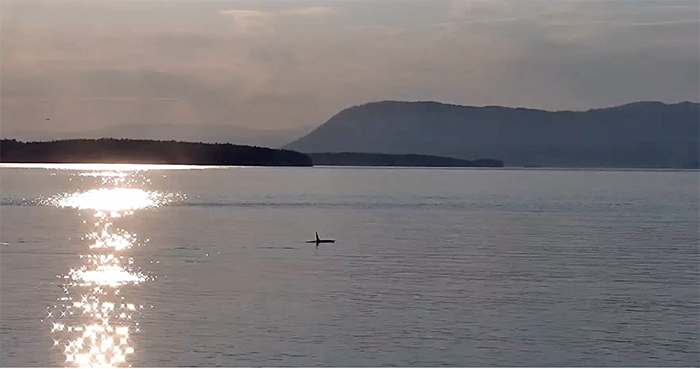
Spotting one of our southern resident killer whales is always a thrill — and now, thanks to one conservation organization’s efforts, you might also be lucky enough to hear one. 

Raincoast Conservation Foundation’s whale sanctuary livestream, which broadcasts live video over the internet from a camera on North Pender Island, is now wired for sound — through a hydrophone, an underwater microphone situated in hopes of picking up whale vocalization from the interim sanctuary zone there.  

And apart from marine life, it should be fairly quiet when the whales are expected, according to Valeria Vergara, senior scientist and cetacean conservation research program director, since vessel traffic is prohibited for part of the year to reduce both physical and acoustic disturbance. 

“It’s essentially a no-go zone during the summer months, at the time when southern resident killer whales use this area for foraging,” said Vergara. “But there’s also a lot of other marine mammals; humpback whales use this area, and of course they [also] vocalize.” 

Seeing — and hearing — the whales will certainly be entertaining, but the foundation also hopes data acquired from the monitoring station will help inform development and implementation of new or strengthened regulation and enforcement efforts there, to support recovery of the whale population.   

The location of the station will also allow conservationists to document the use of the area by other marine mammal species; according to the foundation, in addition to humpbacks the camera and hydrophone could capture imagery and sound of Bigg’s killer whales, porpoises and sea lions. The hydrophone will also continuously measure underwater noise levels, sharing that data with the multi-location NoiseTracker project to get a better understanding of ocean noise across B.C. 

To view and listen in, visit Raincoast Conservation Foundation’s YouTube channel, youtube.com/@RaincoastConservation. 

‘Slow down’ events merge community and action

0

If the first Slow Down Salt Spring event is any indication, there’s a real appetite on the island for the sort of traditional get-togethers organizers hope can become first steps toward climate action. 

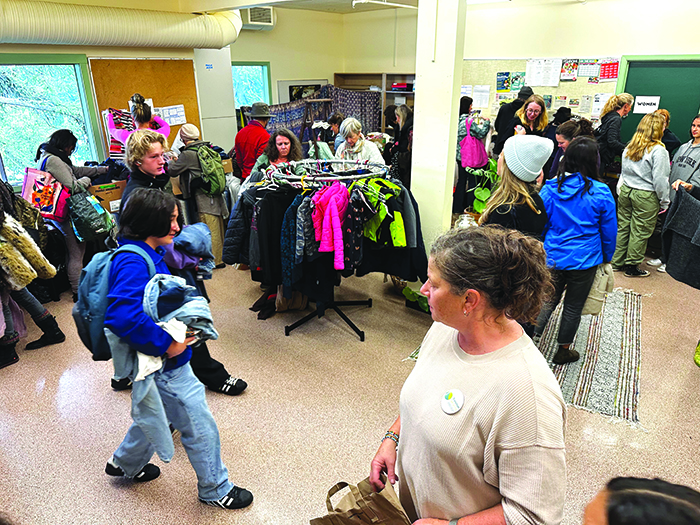
Transition Salt Spring (TSS) held a clothing swap at its SIMS office space on Saturday, Oct. 14, and it was a resounding success, according to TSS climate action coach Morgan Fraser, who said word-of-mouth led to a bigger turnout than they had expected. 

“It was quite the thing,” said Fraser. “I was imagining maybe 50 people would show up, we’d have a sweet little event with some tea and cookies.” 

She laughed. “There were over 500 people in this room. It was spilling out into the hall!” 

Fraser said the event took in more than 900 kilograms of clothing, and in a single afternoon participants took home over 800 kilograms — all of it free, and all done without a single drop of fuel or a scrap of packaging. It’s a culture change, she said, for people who normally might’ve bought something new to do something different — a wonderful first step in realizing climate action efforts aren’t all doom-and-gloom. 

“There is something so empowering about it,” said Fraser. “There’s the community connection — there was clearly a huge need, and it was great seeing everyone taking the opportunity to say ‘hi’ to each other — but it’s also exciting to have something empowering, because the climate crisis can feel overwhelming.” 

Taking part in these kinds of events answers a common question, said Fraser, of how we as individuals have an effect — and helps encourage people to do more. 

“Now that you’ve had this first experience with ‘climate action,’ you can start to reconsider other things you do,” said Fraser. “Maybe you look at things you can do in your own home, or your investments and where you bank, or how you spend — maybe it can inspire you to advocate, and vote in a way that will help with the adaptation and mitigation of the climate crisis.” 

Fraser said the clothing swap was likely destined to be an annual — if not biannual — community event; it also is the launching point for additional efforts under the “Lighter Living” initiative, including the upcoming second Slow Down Salt Spring event: a toy swap next month, right in time for the holidays. 

“We’re planning Dec. 1 for intake, and Dec. 2 for the big free shopping day,” said Fraser, adding that the toy swap would again be at SIMS.  

Toys, she said, often are made of materials that are difficult to recycle — particularly on Salt Spring — and represent a huge amout of packaging and shipping fuel around the gift-giving season. And a community exchange is a great way to reach people who might never have considered buying something second-hand. 

“When we’re looking at how much new stuff gets made and sold every year, and ends up in the landfill, I think it’ll be a big contribution to the community,” said Fraser. “We can say yes, this is great for your wallet, but this is also what waste reduction looks like in your life. Maybe you’ll think about doing a little clothing swap with friends now, instead of going to the mall off-island, or buying something online.” 

The shift in thinking will hopefully inform the climate coaching program’s next Lighter Living initiative: a Repair Café, according to Fraser, that’s in early planning stages. They’re reaching out to Salt Spring’s fixers and tinkerers, the menders and sewing pros — anyone who can support the idea of repairing things that might otherwise be discarded. 

“So much of this could end up in a landfill,” said Fraser. “But the Repair Café will be set up so if you bring in your broken lamp or toaster, you’ll be able to sit beside someone and start learning as well — again, empowering people to be able to make better choices in their lives.” 

For information about volunteering for the upcoming toy swap, or to help with the Repair Café, email Fraser at climatecoach@transitionsaltspring.com. TSS has more information about their climate coaching program — including a list of rebates available to islanders, for everything from water storage tanks to heating systems — at transitionsaltspring.com/climate-action-coach-program

Toy Swap details

 Organizers are seeking no-longer-needed toys for tots, kids, tweens and teens for the Slow Down Salt Spring Toy Swap — and shoppers are encouraged to return for the latest event, regardless of whether they were able to donate. 

Items in giftable, used condition will be accepted for drop-off Friday, Dec. 1 from 2 to 4:30 p.m. at the Transition Salt Spring room at SIMS, top of the hill at 124 Rainbow Rd. Organizers and volunteers will then sort and curate, welcoming everyone on Salt Spring to come shop for free on Saturday, Dec. 2, from noon to 3 p.m. 

Shoppers are encouraged to bring their own bags, and cash donations will be accepted. The event is made possible by the TSS Climate Action Coach Program and the CRD Rethink Waste Grant; to pre-register (recommended), visit tinyurl.com/toy-swap.  

Housing task force members urge citizens to press Trust for change

0

BY HOUSING ACTION PROGRAM TASK FORCE MEMBERS

In April 2021, the Islands Trust appointed community members — including business owners, farmers, frontline workers, academics, tiny home and sustainable building experts — to an advisory task force to help address the housing crisis. During the first year of the Housing Action Program, the Trust conducted a housing survey among Salt Spring residents. This is what we heard:

• 83 per cent agreed secondary suites and accessory dwelling units (ADUs) should be permitted in garages and other accessory buildings

• 80 per cent agreed more small residential lots should be created, for example for tiny home villages

• 95 per cent are concerned about housing needs on the island

• 94 per cent agreed Salt Spring needs more affordable housing

(See islandstrust.bc.ca/document/salt-spring-housing-needs-survey-results-2022/ for the survey report.)

Starting with the first finding, we recommended increasing rental housing options through Bylaw 530 to allow accessory dwelling units in basements, garages and other places where housing already exists. This is one of the simplest zoning policies in the world to help create new housing and build inclusive communities where diverse people can live, work, raise a family, and age in place.

For two and a half years, the task force met twice monthly, volunteering our varying expertise, time, labour and resources to help enact policy changes that would allow for more suites and ADUs to be used for long-term housing. The task force included a diverse range of ages and voices. Some of us are homeowners, some are renters, and some have lived experience of homelessness. We are different in many ways. However, we agree on the need to improve the supply of long-term rental housing by allowing ADUs.

In 2023, the B.C. government introduced new legislation that legalizes small-scale accessory dwelling units in municipalities province-wide. The province is offering homeowners a forgivable loan of up to $40,000 to create an accessory dwelling unit. While similar communities across the province have proven that this results in a modest uptake of 10 per cent of additional housing, our local government has not moved forward on implementing policy changes that would allow for ADUs. In the meantime, we have heard from workers in schools, businesses, Lady Minto Hospital and BC Ferries about how they struggle to provide essential services for our community due to our housing crisis.

Salt Spring Island is becoming a gated community that only provides housing for those who want and can afford to purchase a detached $1-million-plus home.

We encourage you to attend Islands Trust meetings and to reach out to our local elected Trust members to remind them of the promises they made to our community when they were elected one year ago. Trustees Jamie Harris and Laura Patrick were elected to do something about housing and they were united in their support of Bylaw 530.

We are shocked and disheartened by the lack of trust, collaboration and goodwill between our trustees, the Islands Trust staff and different agencies across the island.

We call on everyone to stand up together and say enough is enough. We need to act now to improve housing options for our renters and our community. Breaking the gridlock will only come when regular people from the community demand it.

We have been fighting to make sure that housing is not just a privilege but a right for every single person who lives here.

The next Islands Trust meeting is on Thursday, Nov. 16, from 9:30 a.m. to 4 p.m. at 122 Rainbow Rd. You can watch any part but the open floor to speak is only from 9:30 to 9:50 a.m. A town hall meeting also takes place on Nov. 15 at the Salt Spring Golf Club from 5 to 7 p.m. The elected trustees are Jamie Harris, jharris@islandstrust.bc.ca, and Laura Patrick, lpatrick@islandstrust.bc.ca.

Housing Action Program Task Force members signing this piece are Stanley Shapiro, Kerrie Proulx, Daniel Wood, Nejmah Guermoudi, Bryce Chapman, Yvonne Saunders, Jessica Terezakis and Rhonan Heitzmann.

Restorative Justice Week activities coming up

0

Restorative Justice (RJ) Week runs Nov. 19 to 25 nationwide, and Salt Spring’s RJ group has organized two special public awareness events during that period.

The first is an information sharing gathering on Tuesday, Nov. 21 that will include storytelling about the transformative power of peace-making circles and casework, and volunteering opportunities with RJ Salt Spring Island. It takes place in the library program room from 6:30 to 8 p.m. Registration to info@rjssi.org is requested.

RJ Salt Spring Island coordinator Jessica Terezakis, and long-time organization volunteers and current board members Roberta Temmel and Laura Dafoe, will be at that session.

Temmel said it is exciting to have Terezakis, who has recently completed Simon Fraser University’s restorative justice program, as the group’s new leader. But Terezakis points to the relationships built by Temmel, Dafoe and others as being critical to the success of RJ on Salt Spring.

“I think the largest and most important part of restorative justice is the relationship building,” said Terezakis, “and when you’ve been in this community doing that kind of work for that long, relationships are at its centre.”

RJ is usually thought of in the context of the criminal justice system, as an alternative to traditional court appearances and judgements in cases where harm has been done. It involves bringing the responsible party together with the affected party in a circle facilitated by individuals trained in RJ. The responsible party hears about the impact of their actions directly from the affected party, and the affected party hears what may have led to those actions.

“For me, the biggest part of restorative justice is that connection with people,” said Temmel, “and giving that time for somebody to feel that they’re heard and that you meet them where they’re at, and to give them the opportunity to share what was happening with them. I always think nobody is the worst thing they’ve ever done, this isn’t who we are, this is just a part of our path.”

People who make poor choices have often lacked support in the past, she adds, and RJ volunteers can help provide that support.

Dafoe observed that RJ “holds complexity . . . it’s not guilty/not guilty, or good/bad. It’s a structure and the processes are able to hold complexity — and every single thing that happens is complex.”

She also said RJ is not just for the criminal justice system, but people and groups can request their services to help resolve any kind of personal or organizational conflict.

RJ has its roots in Indigenous cultures, which makes a second Restorative Justice Week event that much more meaningful.

A Land Acknowledgement Circle led by the library’s Indigenous coordinator Caroline Dick will be an opportunity for settlers to learn more about how to meaningfully incorporate land acknowledgements into their lives as an important part of Truth and Reconciliation.

It will run on Saturday, Nov. 25 from 10 a.m. to 1 p.m., also in the library’s program room.

Dafoe said Dick will talk about what the land means, and participants will learn proper pronunciations and how to create their own acknowledgments.

“When we go to another meeting we’ll be ready to be the one to stand up and say, ‘Hey, I’d like to do this,” said Temmel.

To register for the Nov. 25 session, email info@saltspringlibrary.com.

For more information about Restorative Justice Salt Spring Island, visit rjssi.org, email info@rjssi.org, check out RJ books at the Salt Spring library or explore YouTube videos about restorative justice.

EXPERIENCE SHARED BY RESTORATIVE JUSTICE SSI PROGRAM PARTICIPANT:

“My experience with the Restorative Justice Program (RJP) surprised me. I had a mentor assigned to me and they were so kind and empathetic. I felt safe with them. They said to me, ‘If you don’t keep in contact with me, this won’t work’ and I took that to heart because I didn’t want to be charged again by the police. It’s just what I needed at the time — guidance, support and acknowledgement. Someone who genuinely cared for my well-being. I was starving of eldership in my life and this opportunity with the RJP nourished that aspect. With the commitment for weekly communication, consistency, I felt less alone. My mentor made me feel anchored during a pivotal time in my life and I can’t express fully how much that has helped me heal from what led me to Salt Spring Island.

“Through my journey with the program, I built connections with the community which was all I desired from the beginning. A sense of belonging and purpose. I learned that there are more people out there than we realize that truly care for all. That there is always a solution. It’s allowing the time and creation of space to do it.

“I have so much gratitude for the people who worked with me and listened to my story. I hope we can continue to collaborate with community and rise together, instead of repeated behaviour of immediately casting out individuals who don’t fit the status quo. Thank you for your extending your hand to me.”

Editorial: Still waiting

1

Avoiding the word “still” in headlines is a time-honoured goal among newspaper folk. It’s not easy, particularly when the déjà vu lately is so strong it could lift the Parliament buildings. 

Consider the story we have at Drake Road: there’s a proposed housing project that’s stalled, campers moved onto the five-acre parcel there in the interim, they were made to leave, and the project still continues to languish. If the story from recent weeks sounds familiar, it’s because we told it (and many of you read it) in 2016. And we’re still unable to write a conclusion. 

Seven years ago, it was a proposed 80-unit Capital Regional District (CRD) project that stalled at Drake Road, not a 28-unit BC Housing one. The campers then were twice the number, and were asked to leave during a particularly dry October after (but not, according to staff, because of) a stump fire brought firefighters and apparatus to extinguish a blaze at the property.  

The languishing project of the day was for affordable, rather than supportive, housing; and it began falling apart in early planning stages largely because of drinking water availability issues, rather than the surface-water-rich riparian environment complexities that seems to have vexed BC Housing’s first round of contractors.  

But still.  

Salt Spring’s Point in Time homeless count this summer came in with a 15 per cent increase over the previous year, a number that is stubbornly rising as islanders continue to face a housing affordability crisis that has been advancing inexorably for decades and turned up to “high” since the pandemic. 

Back in 2022, the enthusiasm of provincial housing ministry officials seemed boundless; it still seems the same way today. We’ve opined in this space about the disconnect between the provincial government’s messaging and reality before, and as BC Housing thanks the community for their patience during the latest “unexpected” delay, we can only ask whether there are any Salt Spring Islanders left with patience remaining, or any who were actually surprised. 

FUOCO, Theresa (Terry)

1

July 29, 1948-October 23, 2023

It is with profound sadness that we announce the passing of Theresa (Terry) Fuoco, beloved sister, auntie and friend after a brief, but bravely fought, battle with cancer.

Predeceased by her parents Santy (2005) and Louise (2018), she is survived by her brothers Russ (Star) and Michael (Karen) Fuoco, nieces Holly, Kristi, Leila and Nicole and their children.

Terry spent her youth in Grand Prairie, Victoria, Nanaimo, Winnipeg and Vancouver. In Winnipeg her lifelong passion for music and attending rock concerts began. In 1964, at the age of 16, she travelled by train from Winnipeg to Vancouver to see The Beatles. Terry also interviewed an emerging band from Winnipeg, for her high school newspaper: The Guess Who! 

Over the following 43 years, Terry attended over 50 U2 shows around the globe in places like Toronto, California, Hawaii and even Ireland. 

Terry was a vibrant woman. People naturally gravitated to her friendly and fun personality. She never had a dull day after taking early retirement from Telus in 1999. She began her retirement by enrolling in a Vet technician course, a lifetime dream. Another dream was to move to Salt Spring Island where in 2006, she purchased a lovely home above St. Mary Lake.

She made many new friends on the Island, volunteered at the SPCA and worked as a Vet Clinic technician. She had an abiding love for all animals and took meticulous care of those in her charge.

 Terry had a way with cats and was called the “cat whisperer” by friends. After 16 happy years living on Salt Spring, Terry decided it was time for a change. She bought a lovely apartment in Downtown Sidney in 2022 and immediately made many new friends.

Special thanks to all her wonderful friends during this difficult time and to the Care team at Royal Jubilee Hospital.

In lieu of flowers donations to the Angel Fund at Gulf Island Veterinary Clinic or the Victoria Humane Society would be appreciated.

A celebration of life will be held on Friday, November 24, from 11 AM to 1 PM at the Mary Winspear Centre, 2243 Beacon Avenue, Sidney BC.

“I know that this is 

not goodbye.”

ELLIOTT, Verna Helen 

0

September 1950 — November 2, 2023 

VERNA HELEN ELLIOTT 

September 1950 — November 2, 2023 

Verna passed away in palliative care at the Saanich Peninsula Hospital with family by her side after a short illness. 

Born in Grande Prairie, Alberta to Peter and Annie Toews, both of whom were born in Russia, Verna was the youngest of six and is survived by four brothers, Donald, John, Henry and Lawrence, and one sister, Melita. The family farmed grain and in the early years a few mixed livestock. There were so many wonderful memories she had of the adventures with her siblings, like using an old tractor to tow each other around on an ice-covered pond when their parents were away, having it break through the ice and then borrowing all the chains in the neighbourhood to get it out and back into the barn before their parents’ return. She remembered winter chores before school, like chopping a hole in the ice on the dugout for the cows to drink in 40-below weather. Verna credits being the youngest and smallest as giving her strength and tenacity to keep up and play with the big boys without complaint. 

She attended secretary college, much to her father’s disdain as he wanted her to be a teacher. He reluctantly went to her graduation ceremony and was so proud of all the awards and accolades she received. After graduation she moved to Calgary with very little capital, found work and struggled the first few months. After paying her rent, money for food was minimal and liver was a high-protein, low-cost staple. She endured and it wasn’t long before wages and living costs found a balance. 

She continued her education in career development, social philosophy and fundamentals of petroleum technology and went on to become a valued team member of Marathon Petroleum.

The mountains being so close beckoned to her. Weekends in the mountains spent hiking or cross-country skiing with her brother Lawrence and friends gave her so much enjoyment. This slowly led to mountain climbing and with her brother or a past boyfriend she had been to the top of every major mountain from California to Alaska. This was by no means a small feat. 

The next chapter of her life started when while visiting friends who had moved to Salt Spring she was introduced to John, a commercial fisherman. After a few visits back and forth and many letters, they married in 1990. She also accepted into her life two step-children, Adrian and Nigel. She wore fishing well, an ever-changing adventure, with fresh air, hard work and always an uncomplaining attitude for any obstacles the day put in front of her. 

Verna and John retired in 2005, but kept their boat and made many beachcombing and sports fishing trips around Vancouver Island. Locally, prawns and crab were always near at hand. They enjoyed camper trips to Arizona and to the Olympic Peninsula where they had an oceanfront lot. Ocean waves and miles of beach always left her rejuvenated. 

Verna’s happy place these past few years was her yard. It’s a little wild in places. Rhododendrons, flower beds, lawn and always a few tomatoes. She thoroughly enjoyed looking after it all. 

Verna volunteered at the Lady Minto Thrift Shop for the past 15 years and treasured the friendship of so many of her workmates and the comments of appreciation from so many happy customers. 

Verna was a remarkable woman. Her soft-spoken, kind and gentle nature, paired with her strengths and a smile that took so little to earn, endeared her to all who came to know her. She left with a large circle of friends.  

Her passing leaves a large hole in many hearts that can’t be filled. We can only try to borrow some of her strength and learn to live with the loss. 

There was no service by her choice, but hopefully a celebration of life will be held in the spring when her yard comes into bloom. 

Thank you to all the medical staff and doctors at various locations that took part in helping her the best they could over these past few months.  

Bouge de là for the young and young at heart

BY KIRSTEN BOLTON

FOR ARTSPRING

A curious mystery about exploring the very nature of creativity is afoot at ArtSpring for the young and young at heart thanks to Québec-based dance company Bouge de là in their Nov. 21 award-winning performance of Through My Eyes.

A dancer enters the stage and discovers a larger-than-life ball. Intrigued, she moves towards it, carefully. As soon as she touches it, the magic of the stage is unleashed. The lights go up, the decor appears all around her, shadows play their tricks and transform one dancer into many. Now there are four of her to play together and discover a constantly changing environment — a graphical world made up of forms, colours, textures, sounds and illusions.

A topsy-turvy playground where dance continually shifts with the context, this performance promises to be full of surprises and invites audiences to see the world afresh through the curious eyes of a child.

The work is conceived, directed and choreographed by Bouge de là’s artistic director Hélène Langevin, who has been creating children’s dance shows for nearly three decades. It won the Prix du CALQ for best choreographic work of the 2018-19 artistic season from Prix de la danse de Montréal, the first piece for youth to win the title, and has since been toured across Canada.

While specifically designed for youth, Through My Eyes is sure to delight parents, grandparents, teachers and dance enthusiasts of all ages. The show begins at 7:30 p.m.