
Home Blog Page 174

Envisioning a universe where self-driving cars rule island roads

4

Probably three decades or more ago, I stood on the shoulder of the road near Beaver Point Hall while trying to thumb a ride into Ganges. 

A newish-looking vehicle pulled over and I clambered into the passenger seat. Just as I was swinging the door shut, a rather mechanical sounding voice asked me to please fasten my seat belt. I looked quizzically over at the driver and he explained to me that the voice was not his but a talking safety feature of the vehicle. Instead of using warning lights and buzzers, this car actually communicated with speech.

I remember thinking to myself at the time that the introduction of this new technology is tantamount to prying open Pandora’s box in order to check out what kind of goodies lie inside. Owning a car that talks to you is certain to introduce a variety of interesting experiences. At the top of the list is the programmed “back-seat driver” voice that criticizes your driving skills. Having your vehicle tell you to slow down, shoulder check, and keep your hands at 10 o’clock and two o’clock will eventually lead you to the brink of insanity. 

Being nagged by your car with questions such as “When was the last time you checked my oil?” or “Are you too cheap to pump a little premium into my tank, for a change?” is guaranteed to put you over the edge. And of course, nowadays the final straw would be when your car threatens you with something like “Put that cell phone down or I’m calling 911!”

Talking car technology did not come all at once. One of the earliest methods by which vehicles were programmed to communicate with humankind was the car alarm. That worked out well, didn’t it? Especially on the ferry! Whenever an alarm goes off, you can bet that everyone within earshot is silently cursing the car’s owner. A thief could smash the window, hotwire the ignition and drive away to the applause of all the bystanders who are just relieved that the piercing noise is finally eliminated. These car alarms have the same ultra-annoying effect on us as undersocialized two year olds in shopping carts at the local supermarket wailing away at the top of their lungs because their accompanying parent won’t let them sample the Pop-Tarts the parent has no intention of buying. Although most of us turn a silent ear to the child’s screams, we realize that if we were to act on our impulses, we would undoubtedly have to face consequences involving serious fines and possible prison time.

Fast forward to the future, which is actually the present, and we find ourselves at the precipice of the age of the self-driving car. Auto manufacturers are easing us into this new technology gently. There are already vehicles on the market able to park themselves without human intervention. The self-parking app allows you to take your hands off the steering wheel and let your “ride” do the maneuvering for you. You can opt for one of three options: parallel, angle, or the Alberta Tourist parking function. The last option will leave you three feet from the curb while taking up two parking spots.

It’s inevitable that these self-driving cars will begin to take on some of the characteristics of the drivers they have pushed to the curb. Here on Salt Spring, can you imagine two of these self-drivers stopped in the middle of the road, obliviously blocking traffic both ways, while communicating to each other about how their days have gone since being let out of the driveway.

Similarly, these driverless automobiles will waste huge amounts of time circling around island parking lots in search of that lone unoccupied stall and then each one will get locked in a horn-blaring standoff with another self-driver convinced that it saw the open spot first. They will flash their brights, send out vulgar threats through their turn signals and generally try to intimidate each other in a serious game of self-driving chicken.

It would be a mistake to assume that driverless cars would necessarily be competitive with and hostile towards each other. There’s no reason why a Honda Accord could not establish a meaningful relationship with a Kia Sorento Hybrid. If their profiles are compatible and sparks fly, they might just be able to date in an empty after-hours romantic lot on the island, or at least find a good spot to double park. 

Driverless cars can also offer us a few perks. We could send them out to do a few chores for us. Why not get your Toyota to drive over to the local liquor store to pick up a case of Kokanee lager for you? Mind you, it might have to provide proper age I.D. and convince the clerk that car years are like dog years and get multiplied by seven. On the other hand, you have to be careful that your car doesn’t get sucked into an impulse buy of an unplanned litre of oil at the drive-through checkout lane.

You also have to consider how these vehicles will fare when it comes to ferry travel. How these self-driving cars are supposed to load themselves onto the ferries is anybody’s guess. Will they all want to be sent down the centre lanes and stubbornly refuse to be directed to the outside lanes? Mind you, with ferry staff shortages being what they are, it’s only a matter of time before we will be dealing with self-propelled ferries. Just imagine — there will be humanless sailings with no drivers, no crews and no captain. 

And, as a side-note, with RVs getting bigger and bigger with push-out compartments and bump-outs increasing their sizes to the point where they become 10,000-square-foot mansions on wheels, it can’t be long before the ferries themselves start sporting push-out decks and bump-out lounges to accommodate the super-inflated loads. When expanded to its maximum capacity, the modest-sized Skeena Queen will more likely resemble a Liberian registered freighter.

Nobody asked me, but at the rate that technology is advancing, none of the scenarios described in this column are that far a reach. Like it or not, the self-driving vehicle is just around the bend and accelerating towards us. Keep your fingers wrapped around your steering wheel and hold on tight. Oh, one more thing: where exactly are 10 o’clock and two o’clock on a digital clock?

D’ATTILIO, Djuna

0

JULY 4, 1952 – MAY 31, 2023

There’s a rich moment of possibility and promise in the last breath of darkness before dawn, an offering to release yourself from the toils that weigh you down and to step, renewed, into the coming day.

It was at that specific time, when Djuna D’Attilio, our precious, remarkable Mom, Grandma, Sister, Auntie, answered the twilight call of the Pacific Ocean that had always enchanted her soul and was ushered onward to the next realm.
“Let this be your year of no regrets.” In her final days, these words were her wish, not just for the loved ones who surrounded her, but for us all.


On May 31st, 2023, after a years-long battle with COPD and Emphysema through a worldwide pandemic including many hospitalizations and countless complications, Djuna passed away near Cobble Hill, B.C. She was 70 years old. Djuna fought her illness with her characteristic fortitude, stoicism, and dignity, and, as always, her resilience and love of life and family were front and center.
Forever cherished and remembered by her children, Tangerine (Guy), Gina-Lily (Steven), Gemma-Rose (William), and Paolo; grandchildren, Emma, Alessia, Tennyson, Avalon, Corben, Benjamin, and Theodore; nephews and niece, Jarvis, Carlow, and Esmée; also her brother, Brian, and sister, Lisa.
She was pre-deceased by husband, Joe, parents Lois and Robert, and brother, Blaine.


Djuna was a wildly creative woman who loved nature and the ocean. She got down on her hands and knees to point out sea anemones and limpets at the beach. She admired the intricacies of spider webs, and praised the majesty of water. She was fiercely committed to nurturing the individuality of every child she met.

Despite a life fraught with more trauma than should have been her due, Djuna accomplished incredible things. When her husband died suddenly at the age of 43, leaving her with 3 young children and a 3500 sq ft mountainside home with no flooring, walls, indoor plumbing or electricity, she learned the building code, wielded power tools, framed walls, and built a staircase. All the while, Djuna folded origami whooping cranes to capture and release her grief, until more than 1,000 cascaded from an arbutus branch suspended from the ceiling.
She turned her ‘Mosquito Coast’ into her children’s ‘Secret Garden’. Her passion for plants and flowers, West Coast ocean and rainforest, language and literature, and radical compassion lives on in her children and grandchildren.
We are proud of and grateful for this legacy.


A gathering in Djuna’s memory will be held on Vancouver Island; please contact the family or email address below for details.
In lieu of flowers, please consider a donation to an environmental or humanitarian cause in Djuna’s honour.
Condolences may be sent to RememberingDjuna@gmail.com

HOGG, William John

0

February 18, 1924 – September 18, 2023

Bill was born in Toronto and was an only child. His mother died when he was 9 and, due to circumstances during the depression years, at 11 was sent across the country by train to live with his aunt and uncle in West Vancouver, where he spent the rest of his childhood.


As a teen Bill worked on Union Steamship Company ships serving BC’s coastal communities and had many fond memories of those times. In 1942 he joined the Royal Canadian Navy and served at sea as a telegraph operator. On his return at the end of the war he went to UBC and earned his degree in Chemical Engineering.


Bill met his wife Mary in 1948 while hiking up Hollyburn Mountain to ski. They married in Toronto in 1950 and lived in Montreal, Vancouver, Toronto and Ottawa, raising two children along the way.


He was a wonderful husband and a supportive and caring father.

Bill’s interests included camping, fishing, skiing, golf and boating. He enjoyed his workshop and built and refinished a lot of furniture over the years. He also built two Sabot sailing dinghies that he and Mary raced at the Kitsilano Yacht Club. Later they had cruising boats and explored the BC coast and Ontario’s Rideau Canal System. He and Mary enjoyed travelling and were able to visit a few places Bill saw during the war such as Bermuda, Malta and Singapore.


In 1987 they retired to Salt Spring Island, where Mary had been born. They took pleasure in their garden and continued boating and travelling. Bill also took up woodcarving, was an active member of the Power Squadron, was a Salt Spring Seniors’ driver and a proud member of the golf club’s Fickle Fingers. Mary passed in 2012.


Bill died peacefully at Greenwoods Eldercare on Salt Spring with family around him. He is survived by his son Brian, daughter Brenda, grandchildren Rebecca, Ciara, and Kevin (Amanda), and great grandchildren Macsen, Heidi and Millie.


We very much want to thank the staff at Greenwoods; Bill felt well looked after by everyone there. Donations to Greenwoods Eldercare would be appreciated.

Films Create Awareness: “Still Working 9 to 5”

0

SUBMITTED by SALT SPRING COMMUNITY RESPONSE NETWORK

The Salt Spring Community Response Network, in partnership with the Salt Spring Film Festival Society, is offering a free film screening and presentation at ArtSpring theatre on Monday, Oct. 2 at 6:30 p.m.

The film, Still Working 9 to 5, features the iconic Dolly Parton, Jane Fonda and Lily Tomlin. With humour, it explores the lasting impact of the original 1980 film, addressing issues of gender discrimination still relevant today. Their success demonstrates that these three remarkable actors and activists continue to defy ageism and champion equity.

Following the screening, we will delve into the significance of intergenerational relationships in empowering older adults to combat ageism and abuse.

This event is one of eight taking place from Sept. 29 to Oct. 5 across southern Vancouver Island. It’s an opportunity to honour and celebrate the seniors and elders in our communities and recognize the importance of both Truth and Reconciliation Day on Sept. 30 and the United Nations International Day of Older Persons on Oct. 1.

The United Nations’ theme for Oct. 1 is Fulfilling the Promises of the Universal Declaration of Human Rights for Older Persons: Across Generations. Intergenerational solidarity has the potential to drive political will toward fulfilling these promises.

On Salt Spring Island, the Still Working 9 to 5 film screening will emphasize workplace equity and celebrate the enduring commitment of the three lead actresses, despite their advanced age. The film will be introduced with a slide show, followed by a presentation on the value of intergenerational relationships in reducing vulnerability to abuse and changing ageist attitudes that empower and value both the young and the old.

Seniors/elders and young individuals attending together will receive a special gift at the door, symbolizing the United Nations’ “across generations” theme. People are encouraged to wear orange shirts as a reflection on the truths necessary for reconciliation to take place.

Truth and Reconciliation Day, also known as Orange Shirt Day, is a day to acknowledge the legacy of the Canadian Indian residential school system and take a stand against racism.

The International Day of Older Persons highlights the value older adults bring to society and raises awareness of human rights abuses against them.

The International Federation of Ageing recently addressed the United Nations Human Rights Council, underscoring the prevalence of elder abuse rooted in ageism and exacerbated by discrimination such as sexism, racism, homophobia, transphobia and ableism.

GIFTS marks 25 years of inclusion

0

SUBMITTED BY GIFTS

The Gulf Islands Families Together Society (GIFTS) is celebrating 25 years of community inclusion and everyone is invited to the birthday festivities.

On Tuesday, Sept. 26 at 6:30 p.m., we will be hosting an open house, enjoying cake and previewing our silent auction event called Art 2 Art.  

Our birthday was the year 1998, when families and advocates of children with diverse abilities came together to look to the future of their teenage loved ones. Opportunities for social integration, employment and recreation were limited at the time. The group embarked upon a journey focused on providing personalized circles of support and founded GIFTS. A generous community member purchased and renovated the building at 152 McPhillips Ave. where the youth could meet, work, learn and play. An innovative partnership with School District 64 began in the year 2000. The first of its kind and a model for other school districts across North America, the Transition Program supported graduating students in accessing appropriate community-based job placements, volunteer positions and socio-recreational activities.

Over the last quarter century, GIFTS has witnessed both the generosity and the willingness of our island community to welcome people of all abilities into its fold. Our participants are working, volunteering and recreating. More recently, donations from the Elliott family, an anonymous donor and the Aqueduct Foundation allowed GIFTS to purchase and renovate the property, which was integral to our growth.   

As GIFTS plans for the next quarter century, we are once again looking to the future and to the community. We envision an engaged and active non-profit model where people with diverse abilities can imagine and create their individual life plan while being fully supported in achieving their goals, where supports align with changing needs and flexibility is foundational and where participants can grow an ever-increasing circle of support. 

This is why we are inviting the community to be an integral part of this exciting planning and outreach process by attending the open house on Sept. 26 at 6:30 p.m., which will be followed by the society’s annual general meeting at 7:15 p.m.

2023 Greenwoods raffle winner is sitting pretty

0

SUBMITTED BY GREENWOODS ELDERCARE

Bonnie MacPhail of Brinkworthy Place on Salt Spring is this year’s winner of the Greenwoods garden bench raffle.

On Sept. 11, Greenwoods resident Bill Hogg drew the name from the tickets sold this year. Bill will celeebrate his 100th birthday later this year.

The annual fundraising raffle of a beautiful, hand-crafted garden bench to benefit Greenwoods Eldercare has become a celebrated tradition on Salt Spring, now in its 25th year. The 2023 garden bench was once again created by island artisan Luke Hart-Weller of Copperwood Gallery at the south end of Salt Spring, and is hand-crafted from salvaged Salt Spring cedar, embellished with copper leaves.

But the real winners of the raffle were the people who call Greenwoods and Braehaven home.

Greenwoods Eldercare is a not-for-profit, community-based organization that owns and operates Greenwoods long-term care and Braehaven assisted living residences. In addition, it offers community programs like Meals on Wheels and an Adult Day Program. Every dollar raised in the annual garden bench raffle goes directly to supporting the needs of the residents and clients that Greenwoods serves. This year the popular fundraiser brought in over $8,000 in ticket sales.

Under the local management of a volunteer board of directors, Greenwoods’ operations are carried out by a highly trained staff of professionals in elder care. The organization receives operational grants for Greenwoods from Island Health under an affiliate agreement, as well as funding from BC Housing to help support Braehaven. However, direct fundraising in the community is vitally important to provide the high-quality living space, infrastructure and equipment that make Greenwoods and Braehaven the comfortable, welcoming homes residents deserve.

“We’re so grateful to the community for their support,” said Greenwoods Eldercare board member Wayne Glover, who organized this year’s event. “From Luke Hart-Weller for his beautiful craftsmanship, to Country Grocer and Island Savings for their support of ticket sales, our fundraising volunteers for their time, and of course all those who bought raffle tickets for their generosity. We thank you Salt Spring.”

Climate Report Card 2023: Can we handle the impending challenges?

1

By TRANSITION SALT SPRING

Amid a wild year with extreme droughts and massive wildfires, B.C. has faced some unusual and disturbing climate situations.

Even though Salt Spring Island finally got a break from all that smoky air that took over in August, things aren’t exactly normal. North Salt Spring Waterworks District is still at Stage 3 restrictions, and the Salt Spring Island Fire Rescue department says our Fire Hazard Rating is back at an Extreme level (as of Sept. 18). July 2023 went down in history as one of the driest months ever on Salt Spring, showing us just how severe this climate crisis is.

Now, the big question on our minds is: Are we on Salt Spring Island ready to handle the climate challenges coming our way?

Transition Salt Spring has just wrapped up the Climate Report Card 2023, an update on how we’re doing with the Salt Spring Island Climate Action Plan 2.0 that came out in 2021. The plan’s goal is to cut greenhouse gas emissions by half by 2030 in line with Canada’s commitments at the United Nations and also to get our island and all its humans and non-humans ready for the climate changes heading our way.

Since the plan came out, we’ve been making progress in many areas. Electric transportation has increased, taking care of our forests, improving food security and making our buildings resilient against severe weather impacts. All of this shows we’re committed to keeping our community safe.

Some great work worth noting so far:

• The community bought several important land parcels, helping us protect our forests and trap carbon. 

• There’s now a Salt Spring Island Watershed Protection Plan. 

• The Salt Spring Island Farmland Trust launched The Root Food Hub.

• The Capital Regional District (CRD), the Farmland Trust, Salt Spring Island Abattoir, and Island Community Services announced a new composting facility.

• Electric vehicles (EVs) are catching on, with a 40 per cent increase from 2020 to 2021. Also, the CRD has supported more EV charging spots, and we have our first two electric school buses. 

• Island Pathways received federal dollars to push the Salish Sea Trail Network forward.

• Transition Salt Spring’s Climate Adaptation Research Lab (CARL) is working on projects that make our wetlands healthier and cut forest fire risk on Mount Maxwell.

But here’s the hard part: even with all these wins, the Climate Report Card tells us we are far from hitting the mark to meet the goals of the Climate Action Plan. We must recognize that we’re not ready for the unusual weather here now and the more extreme weather that’s coming. To tackle these issues, we’ve got to change how we build things, plan our community and take care of our natural areas to cut the risk of things like fires, droughts and storms. It’s not just about cutting emissions; it’s about getting tougher in the face of wild weather.

As we gear up for more weather extremes, we must remember that we also need affordable places for folks to live and smart solutions for managing water to enable more housing on the island. The report card reminds us about a crucial issue: climate change hits people differently based on where they live, how much money they have, their gender and their ethnicity. Our actions should ensure everyone on Salt Spring, human and not, becomes more resilient as climate problems worsen.

Transition Salt Spring has begun the process of engaging with our local elected officials with an invitation to determine which priorities get integrated into their planning, supported by discussions with island organizations and the community.  

Keep an eye on the Driftwood; Transition Salt Spring will soon roll out the main ideas from the Climate Report Card. If you’d like to learn more about the report, please join us for the next ASK Salt Spring event on Friday, Sept. 29 at 11 a.m. at the Salt Spring Island Multi Space. We look forward to seeing you there!

Funding from the Salt Spring Island Foundation and the Capital Regional District made the Climate Report Card possible. We thank our dedicated board and staff, particularly climate researcher Kacia Tolsma, for bringing this report together.

Archipelago artworks head south 

By SALT SPRING ARTS

Salt Spring Arts is taking the final installment of Archipelago — Contemporary Art of the Salish Sea across the border into the United States this fall.  

Six Southern Gulf Islands artists will exhibit at the San Juan Islands Museum of Art (SJIMA) starting Sept. 22. The exhibition will be on display through Dec. 4 across all three galleries at the museum located in Friday Harbor, featuring eclectic works by Temoseng Chazz Elliott, Anna Gustafson, Jane Kidd, John Macdonald, Sam Montalbetti and Joanna Rogers.  

In April 2023, Salt Spring Arts’ annual Spring Art Show was part of the cross-border collaboration that included ArtSpring and the SJIMA in Friday Harbor. ArtSpring Gallery presented the works of six San Juan Islands artists, while Mahon Hall featured the works of six Southern Gulf Islands artists. A highlight of the spring exhibitions included attendance by artists from both sides of the border, a rich dialogue about their artworks and how they are impacted by life in the Salish Sea.  

For this final phase of the Archipelago collaboration, six Southern Gulf Islands artists will now journey down to San Juan Island where their art will be featured in the final exhibition.  

“I am very happy to be a part of this important cultural exchange,” said Pender Island textile artist Joanna Rogers. “I love the idea of art collapsing boundaries and forging connections, be they cultural, geographical, emotional or intellectual.”  

Initially, this event was set to feature only Southern Gulf Islands artists, but after travelling to Salt Spring and bearing witness to the two parallel exhibitions in conversation with one another, the San Juan Islands artists have decided to present a pop-up exhibition to coincide with the museum’s Southern Gulf Islands artists’ presentation.  

Exploring pieces created by artists who hail from different countries, yet within part of the same archipelago, is a special part of the experience. Inspired by how the coastal environment shapes artistic process, lifestyle, aesthetic and creative themes, the exhibitions showcase a wide range of responses to the Salish Sea.  

Yael Wand, Salt Spring Arts’ executive director, noted, “Usually, our work at Salt Spring Arts is very much focused on our local community. In this case, this exchange with our American neighbours in the Salish Sea is an incredible opportunity to highlight the rich culture of visual arts in the Gulf Islands.”  

The pieces featured in the SJIMA exhibition range from traditional Coast Salish artwork to bold landscapes, with disciplines including photography, woodworking, fibre arts, painting and installation, all drawing inspiration from the same concept.  

The voice of Indigenous artist Temoseng Chazz Elliott will be present through his skilled carvings and sculptures. His works highlight Coast Salish design, handed down to Temoseng by his father and ancestors.  

“[This exhibition] means I’ll be going back to an ancestral home that’s important for me and my family, connecting to a place where my ancestors have lived and visited for thousands of years,” Temoseng said. 

Temoseng’s art features imagery that represents his W̱SÁNEĆ culture, history, legends and teachings, intrinsically rooted in the lands and waters of the Salish Sea.  

Local art professionals Richard Steel and Patrick McCallum curated the Southern Gulf Islands portion of Archipelago — Contemporary Art of the Salish Sea, selecting the diverse artists that represent the Canadian portion of the collaboration. Peter Lane, director of operations at SJIMA, determined the San Juan Islands-based artists. In total, the show amounted to 12 artists, six mediums, three exhibitions, two countries and one sea.  

Artist talks for Archipelago — Contemporary Art of the Salish Sea will take place at the SJIMA on Saturday, Sept. 23 at 10 a.m. San Juan Islands artists will also be featured in a pop-up exhibition at the San Juan County Fairgrounds from Sept. 22 to 25. 

For more information, visit sjima.org

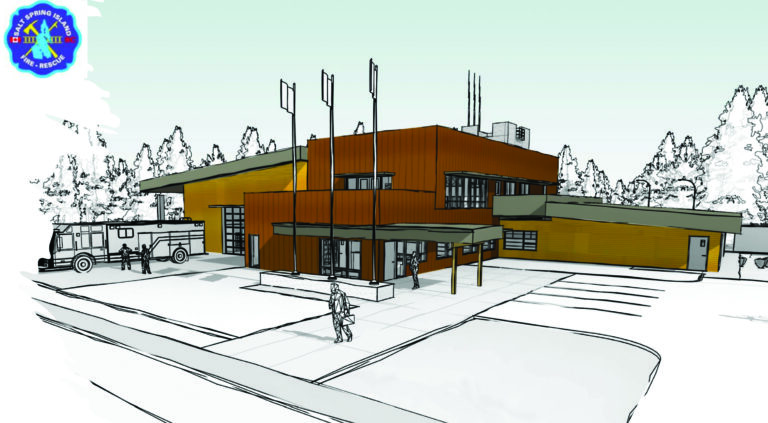
Fire hall project updated 

0

People attending the Salt Spring Island Fire Protection District (SSIFPD) town hall meeting last Thursday came away with a fulsome three-course meal of information. 

The fire department’s five-year strategic plan, budget projections for next year and beyond, and the new fire hall project were all detailed at Community Gospel Chapel with about 40 people in attendance and a number of questions and comments aired.  

Chief Jamie Holmes gave a detailed update on the fire hall’s progress, describing the process used to determine the architectural firm — Johnston Davidson Architecture, which has designed more than 60 fire halls — and the construction management company — MKM Projects Ltd. from Qualicum Beach. Both companies came out on top in the criteria matrix and also provided the lowest bids received from 11 architectural firms and four in the construction management field.  

SSIFPD has also hired well-regarded retired contractor Hans Hazenboom to be “the owner’s representative,” someone who can look after the district’s and ratepayers’ interests.  

“Any decisions that are put towards us on a technical matter that we’re not comfortable with, Hans is our expert in the room to help us with that,” said Holmes, “and he just bills out at an hourly rate for us rather than a contract rate.”  

Holmes described several features of the 11,500-square-foot building with a double-length two-bay garage for four apparatuses. Some of those, in addition to staff offices, are classroom and training areas, a gear room, hose tower and workshop area for maintaining the fleet and equipment.  

“A fire hall should support operations,” he said, “and that’s what we tried to design. Currently our building hampers operations versus supporting operations. This building is going to support operations, making it easier for our firefighters, both career and paid-on-call, to be able to do their jobs and to do their training, and to do it safely.”  

Some eco-friendly items included that were based on public input are a rainwater catchment system to store 40,000 gallons of water, climate control considered in the design and electric vehicle charging capacity.   

The Salt Spring Emergency Program will lease space from SSIFPD, and community rental of meeting and classroom space will also be possible. 

Fire trustee David Courtney again raised his idea that a less expensive but larger hall could be designed and built, as had been done in the village of Cumberland by MKM Projects. But Holmes, Hazenboom and board chair Rollie Cook were emphatic that the course taken following the 2022 referendum approving borrowing of $9.7 million for a $13.7-million hall would not be changed now.  

Cook said the board had reconfirmed its process at its Aug. 21 board meeting and was now focused on delivering the project.  

“The time for that discussion is over,” he said.  

Holmes reiterated that every department and community has different needs and that the Salt Spring facility is not out of scale.  

“There’s no bells and whistles. There’s no looking for the stars and the moon and asking for the world. What we’re designing is a functional fire hall to meet our needs.” 

Meeting attendees heard some design changes may occur when MKM Projects gets down to detailed costing, a process that is now underway. Removal of soil and groundwork preparation is hoped to take place later this fall.   

Chief administrative officer Rodney Dieleman gave a presentation on the draft 2024 budget, detailing the reason for a 9.47 per cent increase, as reported in an Aug. 30 Driftwood story.  

“The biggest issues are contracted wage increases,” he told Thursday’s meeting. “We’ve done a minimal increase to administration. And we’ve done a minimal increase to operations, based on the staff.” 

One person’s question about what the department is doing to improve its access to water supplies for fighting fires, and particularly in the Ganges area, prompted a lively discussion.  

Dieleman said the department is working with the North Salt Spring Waterworks District to improve flow to hydrants. Holmes reported that the Fire Underwriters Service had certified the Ganges boat launch as a dry hydrant area, so that a second in-town water supply is now available.  

Dieleman asked meeting attendees if they wanted him to put another $100,000 into this year’s budget for improving the water supply, but people didn’t leap at the opportunity.  

He summarized the feedback as being “This is a good idea, you support it, ‘but go get me some more information before you start taxing me for it.’” 

Fire board trustees were scheduled to consider giving first reading to the 2024 budget bylaw at their Sept. 18 meeting, which occurred after the Driftwood went to press. 

Trustee John Wakefield, who chairs the Strategic Planning and Policy Committee, gave a presentation on the draft 5-Year Strategic Plan.   

Information about the strategic plan, budgets and fire hall are all available on the fire district’s website. People are welcome to provide comments on all three topics through the website. 

Viewpoint: Lack of response disturbing

0

By JENNIFER LANNAN EMEKOBA

In the Aug. 30 Driftwood, there was an article regarding the cancellation of the SD64 Anti-Racism Advocacy Working Group (ARAWG). I’ve been monitoring the responses to this article virtually and in public and was disturbed to learn (at the point of writing this) of only one online group post and one letter to the editor in the following week’s edition of the paper.

Inaction is a problem. A problem for you, yours and mine; for the children I birthed and the love of my life; for the people in your neighbourhood and your extended family; for the students raised in the school district, the educators within it, and for all the hearts and souls wanting to do more and better. Where are all the supposed allies that supported Black Lives Matter rallies and anti-racism groups, and the beautifully crafted responses to important discussions for the public to see? Are you there now?

The cancellation of the ARAWG isn’t insignificant. The Black, Indigenous and People of Colour (BIPOC) members of Salt Spring Island are in fact growing in number and more should be expected from organizations, employers and the members of our community. Our governance systems and school district are behind the times in anti-racism and BIPOC representation. Look around — who do you see? What do see? Is a banner on the SD64 website actually accepted as sufficient? 

I don’t come to the table as a BIPOC person, but I do stand as a white person with a Black family and the lack of respect from SD64 that I feel for my family and people in the BIPOC community means that I won’t be silent.

I started this school year with a lump in my throat and an ache in my heart as I wonder how committed SD64 is to creating a healthy environment for black and brown bodies in this very white place. There have been countless incidents of harm towards all individuals and families of colour in and out of school in this community. Anyone learning this should be uncomfortable, sit in that discomfort and think about making a step in a new direction.

I did not witness as much as others, but the ARAWG was a space for having important discussions about incidents that happened near and far. It was an example of what should be happening in our communities, workplaces and governance systems. Cancelling the group without deliberation and no plans for next steps is like slamming the brakes as you’re about to crash your car into a tree, then deciding to turn off the air bags just to see what happens. 

I have to ask community members to look deep within themselves regarding SD64’s choices. Efforts to advance student and SD64 community development in areas such as information technology, physical education and arts would never be taken away, so why the complacency with cancelling anti-racism work? I doubt the district would cancel committees and working groups for the 2SLGBTQIA+ population and supporters without notice, so why should dismissal of issues for the BIPOC community be tolerated?

Our society is only as strong as the people most disinvested. Look at the state of our community and that can be seen in so many directions and rings true here.