Home Blog Page 176

Paper Covers Rock returns for fourth year

The annual Paper Covers Rock Festival is back, bringing together writers, readers, artists, creators and storytelling enthusiasts from all walks of life from Sept. 22 to 24.

Now in its fourth year, Paper Covers Rock has become an anticipated event on Salt Spring, attracting visitors and locals alike who are passionate about literature, storytelling and the arts. With an exciting lineup of engaging workshops, thought-provoking discussions and inspiring performances, the festival aims to ignite imaginations and foster a community of literary enthusiasts.

One of the festival’s highlights will be the Storytellers’ Dinner, taking place on Friday, Sept. 22 at The Jam Factory. Chefs Haidee Hart and Deb Peña will curate a delightful multi-course meal, carefully crafted to prompt storytelling around food. Attendees will have the opportunity to indulge in this unique sensory experience, accompanied by wine pairings and a musical performance by author and festival speaker Darrel McLeod.

Throughout the weekend, attendees can engage in a diverse range of workshops led by esteemed industry professionals. Poet Jen Currin will explore The Music of Poetry, using words and sounds to unlock the power of poetic expression. Award-winning food photographer and cookbook author DL Acken will share insights on crafting a compelling book proposal in the Book Proposal Playbook workshop. Additionally, McLeod will delve into the realm of memoir and fiction, offering participants a chance to enhance their narrative prowess in both genres. Salt Spring Books will host a free author reading and book signing with McLeod on Sept. 22 at 3 p.m. to celebrate the launch of his new novel, A Season in Chezgh’un.

The festival also offers opportunities for aspiring authors to receive personalized feedback through Blue Pencil Sessions. Participants can book limited 30-minute manuscript reviews with Anna O’Keeffe, head publisher at Douglas & McIntyre, gaining valuable insights and guidance on their writing projects.

“We are thrilled to present the 2023 edition of the Paper Covers Rock Festival,” said Terri Potratz, festival founder and director. “This year’s lineup features an incredible array of talented speakers and workshops that will inspire and empower individuals to explore the art of storytelling. We invite everyone, from seasoned writers to curious readers, to join us on Salt Spring Island for this extraordinary celebration of creativity.”

Tickets for the Paper Covers Rock Festival 2023 can be purchased on the festival’s website. Early ticket purchase is encouraged, as workshop capacity is limited.

For more information and to acquire tickets, visit papercoversrock.ca.

Viewpoint: Polluters should pay costs

0

BY RYDER BERGERUD

Exxon knew. It was a headline in the New York Times, on the BBC and the CBC, and almost every major news outlet at the beginning of this year.

In the late 1970s, Exxon built its own research group, hiring leading scientists of the day to get a sense of how big the climate problem might be. At that time, Exxon’s own research did more than confirm burning fossil fuels was covering our planet in a blanket of pollution that would overheat the planet. They also were able to predict with accuracy rivalling today’s climate models the temperature rise we’ve experienced over the past 40 years.

So what did Exxon do once they had made their findings by the 1980s? With a coalition of other oil, gas and coal companies, they spent the intervening years deceiving the public, denying the science and now delaying action.

How do we know this? Over the past decade lawsuits against these companies have forced oil companies to hand over internal documents, everything from research reports to private messages.

Big oil’s sophisticated sabotage of our collective ability to respond to this crisis is why, over the past five years, the global number of climate litigation cases has almost tripled, now well into the thousands. 

And now right here on Salt Spring, we are bearing the costs. Some of these costs we bear alone or as families — not being able to access insurance due to increased fire risk, having our driveways washed out in floods and having wells running dry at the end of summer.

Many of these costs will be shouldered by our local government. Here on Salt Spring, we will need to do more work each passing year to keep our community safe from catastrophic fire. The potability of water in Maxwell Lake is particularly at risk from fire and erosion with extreme weather. This is a lake that provides thousands of islanders with drinking water.

Elsewhere in British Columbia, our provincial government estimates that the Lower Mainland will have to spend $9.5 billion to protect that area from sea level rise. This is just one example of the overwhelming cost that profiting polluters need to pay, not us.

Sue Big Oil is a class-action lawsuit of local governments in B.C. joining together to stick it to these fossil fuel companies and make them pay for these costs. You can sign the declaration of support at suebigoil.ca, and write to our local Islands Trust trustees and/or our Capital Regional District electoral area director to encourage them to join.

Ebike rider airlifted after Cusheon collision

2

A collision between an electric bicycle and a pick-up truck with a camper brought a medical helicopter to a Salt Spring Island farm on Saturday, as emergency officials warned travellers to exercise caution on island roads. 

According to Salt Spring Island Fire Rescue Assistant Chief Mitchell Sherrin, the crash closed Cusheon Lake Road for at least an hour as fire, police and local ground ambulance crews responded near the intersection with Lord Mike’s Road at approximately 3:15 p.m. on Sept. 9.

Sherrin said the air ambulance landed at Cusheon Lake Farm to transport the patient, who was not wearing a helmet and suffered a “significant” head injury, warranting a higher level of care right away. 

“We wanted to get definitive medical treatment for the patient as soon as possible,” said Sherrin. “The air ambulance carries critical care paramedics, who have the highest level of training and were able to [further] treat and transport the patient immediately.” 

Sherrin said emergency responders were grateful to passersby for rendering assistance, and expressed concern and empathy for those who might have found the crash distressing. 

“It’s upsetting when someone is badly hurt,” said Sherrin. “There were a lot of bystanders, and they were very helpful.” 

Salt Spring RCMP Sgt. Clive Seabrook said the cyclist’s injuries were “serious but not life threatening.”

It was not clear whether speed was a factor in the crash, but Sherrin said it was regardless a “good reminder” to always wear a helmet — and that when riders and drivers encounter one another, both should be aware that electric-assist bicycles are often moving faster than expected. 

“We’ve seen a fair number of electric bicycle crashes, and some of them involved significant injuries,” said Sherrin. “As a driver it can sometimes be surprising how quickly one is moving, since electric bicycles move so much faster than standard bikes. Please, take that extra moment to look and make an adjustment.” 

Saturday use of ArtSpring parking lot appreciated

0

Some island visitors braving the busy summertime Salt Spring Saturday Market crowds recently have found a small miracle: a great place to park. 

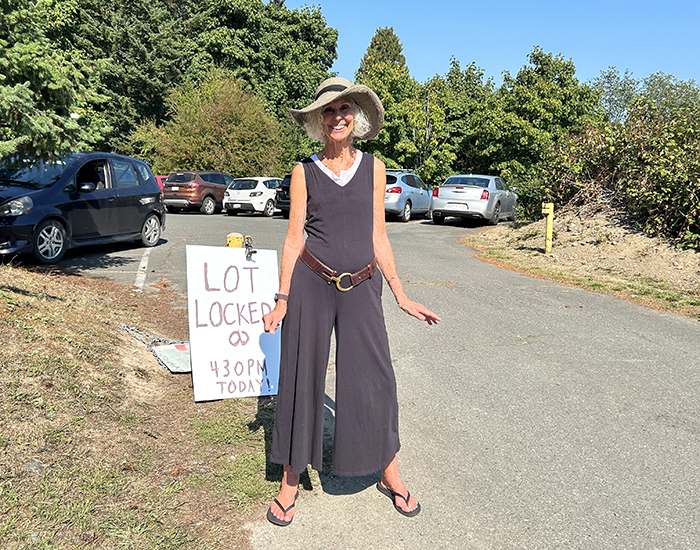
“Five Saturdays now,” laughed Local Community Commission (LCC) member Gayle Baker, who has been “staffing” the locked chain at the usually closed parking lot above the ArtSpring theatre building on Seaview. “It’s full by 10:30 a.m., and then they leave, and even more come.” 

Baker was handed the keys through a trial arrangement with ArtSpring, with a promise to personally attend to people parking there — and to take responsibility for clearing them out if they don’t leave at the end of the day, including agreeing to pay for a tow truck if it became necessary. ArtSpring — as the Island Arts Centre Society — leases the entire property, including the second uphill lot, from the Capital Regional District (CRD); that arrangement was first laid out in the 1990s when the society transferred ownership of its land holdings there to the district.

Baker said people have been so grateful to find a spot, they quickly agree to her pleadings to ensure they leave in time — and they’ve all followed through, allowing her to lock up an empty lot each evening. 

“I figure it’s 140 to 150 people, mostly tourists,” said Baker, who spoke at length about her weekend adventures during the recent LCC town hall meeting. “They are so excited that they found a place to park, and I tell them they have to be gone by 4:30 or I’m in big trouble!” 

The lot is used for overflow parking on busy performance nights at ArtSpring, but otherwise sits empty and chained-off — and not unintentionally, according to CRD Director Gary Holman. 

“The reason it was originally closed off is that it had become something of a parking lot for RVs,” said Holman, many of which had left trash behind. “The key is to manage it; ArtSpring doesn’t have the staff to take that on, so Gayle has pointed the way.” 

Baker said she’d been the “Saturday attendant” without compensation, but apparently some visitors looking to park thought otherwise. 

“It’s been the funniest thing,” laughed Baker. “One person absolutely insisted on giving me $20. So when I give back the keys next week, I’m going to give ArtSpring that $20.” 

The future of the lot is uncertain, although LCC members have said securing off-street parking around Ganges will need to happen before any further improvements are made to streets there — particularly those that might reduce the number of curbside spaces. Commissioners are hopeful that Seaview lot will be part of the solution. 

“Gayle’s demonstrated that if you manage it properly, it will be fully utilized,” said Holman. “Particularly Saturdays.” 

Coroner’s memoir presented at library

0

Retired community coroner Dr. Robert (Bob) Crossland will be at the library Tuesday, Sept. 12 from 7 to 9 p.m. with a presentation accompanying the launch of his new book, Death Calls: A Coroner’s Memoir.  

With more than 20 years’ experience in the position, Crossland attended 600-plus unexpected deaths — from natural causes to accidents to criminal investigations — and his job took him to every corner of his Salt Spring Island home and beyond, all in service of an attempt to sort out the “who, when, where, how and why” of unexpected deaths. 

“I’ve dealt with scuba diving, airplane crashes, boats, people falling in the harbour, house fires,” said Crossland. “Quite a few circumstances.” 

Balancing running a medical practice with coroner duties wasn’t always easy, he said, nor was attending to deaths in a small community — a personal connection to the deceased was practically inevitable — and Crossland said he’d mostly put the experiences away in his mind after retiring.  

“My way of dealing with it at the time was to talk to my wife, to diffuse things,” said Crossland. “She was very patient.” 

But shortly before passing away two years ago, she had suggested he write his memoirs, Crossland said — initially for his grandchildren, to know more about the work he’d dedicated so much of his life to. And as the writing progressed, it started to become apparent there might be a wider audience. 

“Friends said, ‘well, can we see it?’” chuckled Crossland. “People are interested in death; they’re curious about the how and why, and how do we determine that.” 

Most coroners in B.C. — particularly, he said, when Crossland was on the job — aren’t usually doctors. They came from a variety of backgrounds, from various public and private service jobs to law enforcement.  

“And police look at things differently than doctors,” said Crossland. “We both maybe divide the world in two, but police are looking for good guys and bad guys; doctors are looking for the sick or the healthy.” 

Crossland’s path to becoming a coroner seems circuitous, he admitted, but it ultimately helped make him better at the work. Starting as an army officer, he went to Royal Military College, then UBC as a chemical engineer — going to work on nuclear reactors at the Chalk River laboratories in Ontario. 

“I was a reactor operations engineer; our job was to keep the reactors running,” said Crossland. “Then I went into medicine, did psychiatry for a couple of years, then internal medicine and became a consultant in internal medicine.” 

“That is not a common path,” he said. “But it also gave me an ability to think like an engineer — how do things work? And why?” 

That inquisitiveness — and a bit of happenstance — led to Crossland answering the call for a community coroner in 1981 in Powell River. The man he was replacing, he said, was a jeweller by trade. 

“And his grandson eventually married my daughter,” he laughed. “That’s what happens in a small community.” 

The second part of his career as a coroner began in the Gulf Islands in the 1990s — where he responded by car and boat to hundreds of scenes of loss, tragedy and sometimes mystery. 

“There were some true surprises,” said Crossland. “Something right out of left field that you’d never expect. Some real mysteries. But our job was to determine the facts.” 

Crossland’s book launch presentation will go over just a few of the more notable cases, he said, including a plane crash, an unfortunate logging incident, and others; he said there will naturally be scenes of — and discussion about — death, but framed to inform rather than to shock. 

“I’m going to show slides about the circumstances,” he said, “mostly to give people an understanding of how unusual they can be.” 

There will also be exhibits of typical coroner’s reports, as well as those from formal inquests and specialist investigators. For more information about the book, visit the deathcalls.ca website.

First LCC town hall proves lively

1

Salt Spring Islanders filled all the seats put out Thursday, Aug. 31 for the first evening town hall organized by the Local Community Commission (LCC) — a new evening format for the island’s newest governing body, and one commissioners hope to repeat. 

Some 50 to 60 islanders made their way into the Lions Club Hall up Drake Road, and most brought specific issues to raise with the new five-person governing body. And as commissioners appeared without Capital Regional District (CRD) staff — and without the trappings and protocol of a formal meeting — commission chair Earl Rook emphasized that the plan was to stay on-topic to discuss services the LCC actually provides. 

To that end, there was a handout at the door for anyone unfamiliar. 

“Our enabling legislation has given us certain areas of responsibility,” said Rook. “We’re going to go through and ask for comments specific to those.” 

And, it was pointed out, that same legislation also required they not advance the business of the commission meaningfully without a formal meeting structure in place. 

“We’re not allowed to further any commission decisions in this meeting, because this is a town hall as opposed to a business meeting,” said commissioner Brian Webster. “So we can’t make a deal on anything here and now.” 

Unsurprisingly, those who turned out Thursday night found none of this dissuading, and the LCC heard from a wide range of islanders with concerns on a broad spectrum of island topics. From parks to parking, from liquid waste disposal to economic development, members of the public weighed in and commissioners listened eagerly, and — from time to time — tried to help fill in the histories and status of various projects. 

Much of the discussion centred on Salt Spring’s plans for Portlock Park — a master plan process that, despite being modelled on the seemingly successful Rainbow Road master planning procedures, left many in attendance feeling unsatisfied. While people speaking on behalf of the large baseball-playing population on the island supported a plan that would add a senior ball field to the park, several local runners felt the subsequent loss of the oval track there would be disastrous.  

Pickleball players said they felt they’d “missed out” on giving input on Rainbow Road, and now the Portlock Park engagement process seemed difficult to access online — a sentiment echoed by others who said their experiences had been similarly vexing. For example, they said, if someone didn’t like any of the three park layout options in the web-based survey — or if they liked one but didn’t want to rank the other two — it was unclear whether the form would even allow any further comments to be submitted.  

And as each group sympathized with the next, one participant suggested — to a round of applause — that perhaps “pitting different park users against each other” to compete for space in a utilitarian format might not be the kind of collaborative process Salt Spring could be proud of.  

Regardless, ultimately it will be the elected LCC that makes decisions — either informed by consultations and formal public input or, as commissioner Ben Corno put it, also remembering how they personally felt as people spoke passionately before them on particular issues.   

“I don’t think we’ll be scoring all these things, and saying ‘this checks off that box so that will be the choice,’” said Corno.  

“There’s a process that’s ongoing, thankfully,” said Webster. “You’ll be able to credit, or blame, the five of us.” 

One new way to reach out to LCC members will be through just-announced “office hours” that will begin today (Sept. 6), intended to be held every Wednesday from 8:30 a.m. to 4:30 p.m. at the CRD offices — with Corno, Webster, Gayle Baker and Rook taking shifts to gather input and answer questions in-person. 

“It will be posted [online] and in the Driftwood,” said Baker. “And we’ll be there, we’re going to be available. We want to listen.”  

The LCC’s next regular meeting will be Thursday, Sept. 14 at 9 a.m. in the Salt Spring Island Multi Space boardroom on Rainbow Road. 

Editorial: Nonprofits and BC Housing need to evaluate after Seabreeze situation

3

After months of people asking if the Seabreeze Inne court case had been resolved, the answer was revealed through an Aug. 21 court filing, as detailed in our Driftwood story last week.

We think it’s fair to say that the process leading to this point could not have been much rockier. It’s not that anyone would have expected such a transaction to proceed smoothly, but it certainly could have gone much better than it did.

When the initial notice to vacate was given to people living at the Seabreeze Inne in the fall of 2021, Lady Minto Hospital Foundation (LMHF) kindly extended the deadline, responding to public pressure about throwing people out on the street during the winter. But one incorrect assumption made was that people who have a comfortable-to-them place to live would willingly leave it in order to accommodate a “noble” use for that space — housing for hospital workers — especially a use that did not seem to be immediate. It’s another case of privileged people and institutions not understanding the challenges and reality faced by some disadvantaged individuals.

While apportioning blame publicly serves no purpose at this point, all institutional parties involved need to have a hard look at the decisions they made and actions they took. LMHF, the Provincial Rental Housing Corporation (AKA BC Housing) and Island Community Services all had a role to play in how things transpired.

Use of professional mediation services earlier in the dispute could have yielded the same result at a much earlier time and at a much reduced cost, both financially and in terms of personal stress for all involved.

Annual general meetings are coming up for both the LMHF and ICS. Boards of both bodies should make reporting out and accepting questions on the Seabreeze situation a part of those proceedings.

In the meantime, housing for hospital workers is still desperately needed. Community member Connie Gibbs has detailed the needs and how people can help in a submission this week. Please, if you can provide affordable housing of any duration as she describes, follow the instructions in her article and help make a much-valued contribution to your community.

Rainwater harvest and management course offered

0

Ken Nentwig has worked on the ground in the rainwater harvesting and management industry for years, and is eager to share his knowledge with islanders.

“I’m just back from California, training rainwater practitioners for their ASSE certification exams as designers and installers,” he said last week. “Everywhere you look, water is the topic — either not enough, or suddenly too much of it.”

And while B.C.’s coast obviously receives a lot of rainfall, he said, “gardening is hampered in summer with drought conditions and many areas are seeing aquifer problems due to oversubscription of the available ground water. Rainwater harvesting can be one tool that helps mitigate water shortages being experienced across southwest B.C. and across the globe.”

Beginning Sept. 11, Nentwig is leading a three-month online Rainwater Harvesting and Management course. Offered through Gaia College, it has been in place for several years and offers an overview of water problems, rainwater system design and how-to’s for the homeowner and do-it-yourselfer.

“Understanding nature’s manner of sending and managing water in the environment is key to us being able to work within those parameters for safe, efficient and suitable applications of the abundant winter rainfall we receive on the B.C. West Coast. Builders, developers and approvers all can benefit from the knowledge available through this course.”

Nentwig has worked on numerous projects on the Gulf Islands and Vancouver Island in recent years.

Most are preliminary designs, he said, covering the feasibility and sizing of storage and components for systems. Applications range from irrigation to flushing to full potable usage, and even a few for multiple-family applications. Stormwater management aspects are sometimes a part of the overall concepts, where excess runoff from a roof or the ground surface can be infiltrated into the soil. Installations in these areas have included potable use for a cottage, fire suppression storage, and irrigation storage outdoors or in the crawl space below the residence.

He has also worked with the technical working group of the Salt Spring Island Watershed Protection Alliance.

Nentwig’s background is landscape architecture, and he is certified through American Society of Sanitary Engineering (ASSE) 21000 as a rainwater harvesting practitioner.

“I am also deeply involved in the ASSE and American Rainwater Catchment Systems Association training program evolution, and have developed a Canadian certification program through the Canadian Association of Rainwater Management based on the CSA Rainwater Standard.”

For more information about the Gaia Rainwater Harvesting and Management course, see gaiacollege.ca.

Residents urged to open suites for LM hospital staff

0

By CONNIE GIBBS

As a hospice society volunteer, I visit patients in Lady Minto Hospital (LMH) every week.

Frequently I notice new faces among the staff. These are the temporary staff: nurses and health care assistants who travel from outside the community to support our hospital and local staff. It’s Heather Stone’s job to ensure health care staff are recruited, welcomed, housed and supported so Lady Minto can continue to provide the care people need.

“Affordable accommodation supplied by Salt Spring homeowners is a huge, huge part of welcoming health care workers into the community,” says Heather Stone. “If temporary staff have a good housing experience, they are more likely to return which means our orientation efforts were put to good use.”

Staff travelling from out of community to support LMH include licensed practical nurses, registered nurses and health care assistants.

In order to house temporary staff, Heather Stone must find affordably priced accommodation that can range from two weeks to multiple months depending on the contract length.

The proximity to Lady Minto is important because the majority of temporary staff do not have access to a vehicle while working locally. The bus schedule on our island doesn’t match well with shift schedules at the hospital.

Caren Fennell works in the Acute Care Unit. She has been renting her suite to temporary nurses and health care assistants for over a year.

“It’s been a good experience for us. The six hospital staff who have used our suite at different times have all been respectful and nice. We can keep using the suite for family visitors, and help the hospital too.”

It’s not just temporary staff that need accommodation. The hospital is always looking for affordable long-term housing for permanent health care staff. The Lady Minto Hospital Foundation has set up a housing information portal, a password protected webpage only accessible to current or prospective Island Health staff. Homeowners can submit their listing to the portal and staff would reach out directly about housing. Homeowners can submit their rental listings to: ladymintofoundation.com/projects/hip/portal.

Requirements for short-term housing include:

• Fully furnished;

• within a 10-minute walk or drive to LMH;

• kitchen, bathroom, bedroom, internet and utilities.

Heather reminds me that health care staff include a long list of positions beyond doctors and nurses: lab and medical imaging technicians, lab assistants, administration, physiotherapists, rehab assistants, activity assistants, social workers, health records clerks, admitting clerks, nursing unit clerks, housekeepers, laundry, maintenance and kitchen workers. These positions are “absolutely imperative to the functioning of the hospital,” according to Heather.

It’s stating the obvious to say there is a worldwide health care staffing shortage as well as a housing crisis and there are no quick fixes. Doesn’t it make sense for Salt Spring homeowners to do everything possible to support Lady Minto staff? I don’t have additional housing but I can offer my house (and be remunerated) whenever we take a vacation just in case our empty house might match a temporary housing need at Lady Minto.

It will take a community effort from those who have the resources to help house temporary and permanent health care staff working at Lady Minto Hospital. We can’t simply wait for new construction of workforce rental accommodation. It’s taking far too long.

If you can help with long-term or short-term housing for hospital staff, submit your listing on the LMH Foundation website listed above or contact Heather Stone at Lady Minto Hospital through the Google form at the following short link to see if your suite is a good fit: bit.ly/3KCnRmF.

Crews douse two brush fires at Mouat Park

0

A pair of small brush fires at Salt Spring’s Mouat Park Wednesday, Aug. 30 were likely human-caused, according to officials, who credited quick calls from the public with helping to keep both fires contained. 

Neither fire grew particularly large before being extinguished by responding firefighters, according to Salt Spring Island Fire Rescue (SSIFR) Deputy Chief Dale Lundy, who said some fire crews had been at Portlock Park helping set up for a helicopter transport for a Lady Minto Hospital patient when they were paged out. 

The initial call to respond to a brush fire on McPhillips Avenue was soon followed by reports of a second, also burning at Mouat Park. Sixteen firefighters and three apparatus responded in total, from both the fire hall and the helicopter staging area at Portlock, according to Lundy.  

“As we responded to the second fire, we had reports from eyewitnesses about a person that seemed to be responsible for the fires,” said Lundy.

RCMP Cpl. Steve Davidson confirmed a Salt Spring detachment member had attended upon request from SSIFR, located and identified the person, and issued them a $575 violation ticket under the Wildfire Act for failure to extinguish a burning substance. 

Lundy said after the two fires were thoroughly extinguished, SSIFR crews carefully walked through all the park trails to ensure other fires hadn’t been started. 

“Fortunately it was all contained, and we were able to extinguish both,” said Lundy, who added that while the creek at Mouat Park was still dry, the moisture-rich foliage around the shaded walking trails were not as fire-prone as that on much of the island. 

Despite some recent rain, forest fire danger level has crept back up to “high” on Salt Spring Island — and a burn ban remains in effect, prohibiting all burning, including burn barrels and campfires. Contravention of that ban can lead to a $1,150 fine under the Wildfire Act.  

For more information on current fire conditions, visit saltspringfire.com