Home Blog Page 188

Nobody Asked Me But: Riding the rails on a runaway-train bad day

0

You know this feeling. You’ve just opened a can of home-made mango chutney, helped yourself to a couple of spoonfuls, and are now ready to close up the jar and place it back in your fridge.

The only problem is that, no matter how hard you try, you can’t seem to get the canning jar ring to screw back onto the glass jar. You get it halfway on and then it jams and won’t turn any farther. You can see that the lid has a slight tilt relative to the neck of the jar, so you back it off and try again. This time the lid is leaning the other way. You tell yourself to breathe, just breathe. You make a couple of more attempts, one of which results in you dropping the lid onto the kitchen floor, interior side down, of course. You begin to doubt your sanity at this point, thinking that maybe you should be twisting the lid counter-clockwise instead to get it back on. You tell yourself that it won’t really matter if the lid is securely in place as long as you keep the chutney refrigerated. It is only now that you discover you have cross-threaded the lid and cannot turn it in either direction; it is stuck where it is forever and the only way you will ever taste more of this yummy chutney is if you break the jar open without getting any of the tiny glass shards and splinters caught in the mango preserve. What you are experiencing here is the beginning of a bad day.

Once your bad day begins, there is no way to slow it down or stop it. It’s like you’re riding on a runaway train and heading for the last stop, which is a ghost town called Disaster. All you can do is hold on and pray you will survive all the other spirit-breaking catastrophes about to befall you.

And yes, these demonic twists of fate are sure to pile on you as your day progresses. You should know better and probably ought to jump back into bed with your covers pulled tightly around you, but you delude yourself into thinking that the worst is over and your luck is sure to change.

You are partially right about your luck changing, but unfortunately it takes a turn for the worse. Maybe you realize, a moment too late, that the big bead of toothpaste you squeezed onto your toothbrush is actually antibiotic ointment. Or, perhaps, you open your chest freezer only to discover that all the identifying labels you had meticulously stuck on the various food containers inside have become unglued and are now gathered in a frozen heap at the bottom. How will you know if that Tupperware container is full of curried rice and chicken or pumpkin pie filling?

Poor labelling will also undermine you in the laundry room and pantry. Baking powder or Borax? They look the same. Why not give it the good old sniff test? Oops, right up the schnozz. From now on, anything you eat will smell like freshly swabbed hospital floors.

Just in case your bad day is not moving along fast enough for you, try a little visit to a public washroom. Invariably, all the motion sensors and detectors will have a mind of their own and will try to sabotage any attempt you may have to get in and out quickly. In the case of the old manual taps, you can be sure that the stainless shallow sinks combined with cranky water flow control knobs will leave you with a big water stain right in the area of your body that you would least want to be so obviously soaked. Of course, as usual, you again forget to pull the paper towels from the metal dispensers while your hands are still dry, and so your wet fingers can only tear off tiny pieces of the tightly packed napkins. which will gather on the floor only to stick to the bottoms of your shoes for much of the rest of your miserably bad day.

Undoubtedly, at some point during the day, you will find that one of your gadgets or appliances will stop working. Luckily for you, this has happened before and you know exactly how to fix it. Not so lucky is the fact that the only socket missing from your tool box is the one you need for this repair. Even more distressing is the fact that the vise grips you use to take the place of the missing socket ends up stripping the nut you need to remove, but not before it flies off suddenly and catches you flush on the cheekbone, leaving you with a grossly colourful welt.

When it comes to finding the motherlode, or shall we call it the black hole, of precursors for having a bad day, you need look no further than your computer. Not only will cloud-bound important files disappear into the ether, never more to reappear, but the one time you forget to save or do a backup is the time your computer will decide to turn itself off or simply crash. You will be so harassed by viruses, malware and ransomware, that you will mistakenly in your frustration hit the “send” button instead of the “cancel” for a delicately composed intimate email which will bring about the downfall of a friendship or relationship.

Nobody asked me, but there really is no way to avoid a bad day once you have started off on the wrong foot. You do have some options open to you, though. You can fight, tooth and nail, against every bad break the universe aims at you, but that often makes it seem as if the target on your back is getting bigger and brighter. You can adopt a Zen-like attitude to allow the universe to wash over you just as the tide flows in and out, but the next wave about to hit you may be of tsunami proportions. Or, you can kick back, open a bottle of bubbly, and wait for the clock to strike midnight which will herald the beginning of a new day. The choice is yours.

Meanwhile, why are all these little bits of cork floating in my glass?

Jon Kimura Parker is next Forum guest

SUBMITTED BY SALT SPRING FORUM

Jon Kimura Parker needs little introduction.

His journey from growing up in Vancouver to performing as a classical pianist in the great concert halls of the world is well documented. He is known for his dynamic performances and for his passion and enthusiasm for classical music, taking on roles advising and directing numerous festivals, lecturing at Julliard and Yale, and teaching passionately as professor of piano at the Shepherd School of Music at Rice University. He is also an officer of the Order of Canada.

The Sunday, July 2 Salt Spring Forum discussion that begins at 7:30 p.m. will seek to explore his thoughts on the role of classical music, and of the arts more generally, in the contemporary world. Have the traditions of serious music become peripheral against a background of social turmoil, climate collapse and shifts to electronic realities? What enduring values does live performance have amid the proliferation of virtual experience?

While these are our overall thoughts about ideas we hope the evening will explore, the conversation may, and likely will, range more broadly. Jackie — as he is widely known — brings a breadth of cultural experience and passion that set him in the first rank of major Canadian artists.

And since the Forum event will be at ArtSpring, Parker has offered to include a short performance on ArtSpring’s fine Steinway piano.

Tickets are available through ArtSpring.

Viewpoint: Abattoir society memberships needed

By ABEY SCAGLIONE

Local abattoirs help the environment by providing local food and decreasing our demand on fossil fuels. We cannot meet our climate goals without local food and in order to keep Salt Spring animal agriculture viable we need a local processing facility. 

Local abattoirs save farmers time and money on transportation costs, which very well could be the deciding factor in whether a farm is able to produce food for their community. We need local farmers and specifically those producing meat, one of the most nutrient-dense foods there is and necessary for the long-term health of our population, both for the food itself and because well-managed animals enrich the soil and enhance biodiversity.

The need to support local agriculture is of utmost importance. We may never need a police officer or firefighter in our entire lives but we need a farmer three times a day to provide the meals we eat. We must take steps to support farmers and supporting local abattoirs is a very important step. 

Local abattoirs provide resilience in our food system and are a vital resource that warrants the financial support offered to other community services such as the theatre and pool. While we applaud arts and culture in our community, we cannot survive without food and water.

At this time the Salt Spring Abattoir does not receive tax funding and therefore I am urging the community to support this community-run not-for-profit organization with a $30/year membership e-transferred to ssabattoirpay@gmail.com (please include your full name and email in the comments box). While the abattoir is always looking for volunteers, you are not under any obligation as a member. All that membership requires is your financial support of $30 per year.

The Salt Spring Abattoir faces rising costs that they don’t want to transfer to the already struggling farmers. Staffing continues to also be an issue, not only in finding qualified staff but due to the issue of finding affordable housing on the island. 

While the abattoir society continues to explore long-term funding opportunities through provincial, federal and local government, if just 10 per cent of our community population got a membership, that would mean approximately $33,000 in funding that would allow the abattoir to take full advantage of the valuable infrastructure already in place in order to support local farmers who provide food security for our community.

We must keep animal agriculture viable on Salt Spring Island and in order to do this we must have a local processing facility. 

The writer is part of the family that operates Ruckle Heritage Farm.

Beedie Luminaries scholarship winner off to UVic

0

Pender Island Grade 12 student Matthew Hinton is on his way to the University of Victoria in the fall, with a big boost: a scholarship that will provide up to $44,000 towards tuition and related expenses. 

Established in 2018, the Beedie Luminaries Grade 12 scholarship program is awarded to students who demonstrate strong academic potential and determination but face financial barriers to attending post-secondary; Hinton said such barriers were “not hard to find” on the Gulf Islands and was grateful to have been selected. 

“They want to focus on helping students who can excel in university, in post-secondary studies, but who don’t have the financing for it,” said Hinton. “For me, it’s going to be really helpful, allowing me to explore my interests in music and physics, and really fly in university and not have to worry about working to pay for my schooling.” 

But funding is only part of the award; the scholarship also grants access to mentors, student coaches, paid internships and ongoing support from the Beedie Luminaries community, according to the foundation. Hinton said he is looking forward to exploring the support network, including a community of students — and former students — who have received the scholarship, ready to offer guidance and advice. 

“I’ve just started to see what the scholarship has to offer,” said Hinton. “But it does seem like it really sets students up for success.” 

In total, Beedie Luminaries is awarding $6.9 million in scholarships, delivered as $11,000 per year, to 116 Grade 12 students, 10 refugee and immigrant students and 20 single parents in B.C. Hinton, the only recipient in the Gulf Islands, said while he had often been elsewhere for education — most recently attending Victoria’s Pacific School of Innovation and Inquiry — he was always happy to get back to his island. 

“My family moved to Pender when I was born,” said Hinton, “and my dad built our house here.” 

Hinton said his ties to the community have only strengthened over time, most recently through live music performances — islanders will find him playing at Pender’s Community Hall on several Fridays this summer — and through the island’s sailing club. 

“Right now I’m the only sailing instructor at our club that’s from Pender Island,” laughed Hinton. “Half my waking time this summer is going to be spent teaching sailing students.” 

Hinton’s advice for his younger peers is simple: follow your dreams. 

“I really believe that if you love what you do — for me it was sailing, math and music for about as long as I can remember — you’ll benefit a lot from pursuing it,” said Hinton. “It makes it all worthwhile — the education, the working through everything, to get to the point where you can follow your own interests at university.” 

For more information about the Beedie Luminaries program visit beedieluminaries.ca

Editorial: Liveaboard regulation proposal not realistic

17

It’s hard to argue with the logic of a proposal to regulate liveaboards in the name of creating “clean and safe” harbours on Salt Spring.

Who is in favour of seeing human waste and garbage floating in the water or washing ashore? Who thinks our harbours should be left to fill with decaying or burnt boat hulls until the Dead Boats Disposal Society and federal government can get around to removing them?

Unfortunately, it seems hard to believe that the Clean and Safe Harbours Initiative (CASHI) is primarily concerned with the long-term health of our harbours. Salt Spring’s existing environmental organizations have not flagged this as a critical issue. The impetus seems to be coming from waterfront property owners who are impacted by noise and visual pollution, and others who have somehow conflated social problems in Ganges with unregulated liveaboards.

The CASHI initiative highlights a disconnect with reality on a few different fronts.

Firstly, we have an acute housing crisis. Many people who work on our island have been pushed to live in potentially unsafe housing on the water because it beats living in a vehicle or a tent. Enforcing the current illegality of those dwellings, or imposing regulations that people without means would not be able to meet due to the financial costs involved, would just exacerbate that crisis. This island cannot afford to lose more people of working age. For the CASHI folks to say they don’t want to eliminate liveaboards, just regulate them, is laudible, but not realistic. Many vessels would be eliminated by the proposed CASHI system.

The second place this initiative hits the wrong note is in our democratic process. Normally, candidates stake out their positions during election campaigns. Creating more housing for workers was stressed as a priority by the electorate. “Cleaning up” Ganges Harbour was not. For a behind-the-scenes process to produce a draft bylaw and detailed regulations that trustees have been pressured to consider eight months later is not acceptable. Lobbying government for action is one thing; doing its work is another. Still more unorthodox is a proposal to cover costs by creating a charity for that purpose.

The answer to the very real sewage and garbage issue is to create a workable system of dealing with it. At present the blackwater facility at Centennial Dock is only open in summer months, and it has just been repaired after a period of inoperation. Garbage collection facilities could be improved. Rather than running boat dwellers off the water with unrealistic demands, let’s work with them to minimize the impacts that affect the environment and community.

Salt Spring radon risk determined to be low

1

Roughly one in 25 homes tested on Salt Spring Island show unhealthy levels of radon, according to just released data, but those owners may need to take steps to ensure a healthy living space. 

Take Action on Radon’s Pam Warkentin presented results from recently completed testing Thursday, June 22, at Salt Spring’s Local Trust Committee (LTC) meeting. Radon is a naturally occurring radioactive gas released when uranium breaks down in soils and rocks; free test kits were distributed across the island in November through the 100 Radon Test Kit Challenge program. 

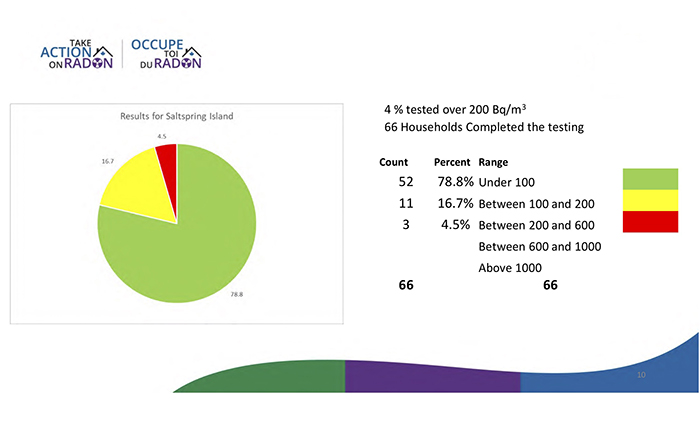
Of 66 test kits successfully deployed, returned and interpreted, three of them tested above Health Canada’s safe guidelines, according to Warkentin, with another 11 showing elevated levels. 

Radon concentrations in air are typically measured in becquerels per cubic meter (Bq/m3) — where a becquerel (Bq) is equal to one radioactive decay per second. When released from the ground into outdoor air, it becomes highly diluted and not harmful — outdoor air typically has a radon concentration of less than 10 Bq/m3 — but radon is a health risk in indoor settings where it can build up. 

“We’re finding that as more buildings are becoming airtight, that soil gas is coming into the building but not escaping,” said Warkentin, “and we’re seeing higher levels across the country in homes affecting people’s health.” 

On Salt Spring, homes testing between 200 and 600 Bq/m3 represent 4.5 per cent of the total; 16.7 per cent showed levels between 100 and 200 Bq/m3. According to the B.C. Centre for Disease Control (BCCDC), long-term exposure to radon — at any level, but especially at high concentrations — can cause lung cancer. 

“Radon is the leading cause of lung cancer in non-smokers,” said Warkentin, “and it greatly increases a smoker’s risk of lung cancer. Health Canada estimates that 3,000 Canadians per year are dying of radon-related lung cancer.” 

BCCDC hosts data from the BC Radon Data Repository, containing anonymized indoor radon observations integrated from multiple datasets. Previous measurements taken in 2021 — 52 homes across the Southern Gulf Islands, in that case — found a median radon concentration of 30 Bq/m3, placing the region’s risk category as “low” — although even then some concentrations were as high as 151 Bq/m3. 

In response to questions, Warkentin said there was no geographic “clustering” among the higher results on Salt Spring, and — at least with the small sample size, about one per cent of residences — no clear trend resulting from the age of homes.  

“From the data we’ve seen across the province, Salt Spring is certainly on the lower prevalence side,” said Warkentin, “and also below the provincial average.” 

Warkentin said there were resources, including grants, available for those who tested at high levels and wanted to hire professionals to mitigate radon in their homes. For information visit lung.ca/lungs-matter-radon-mitigation-support.

MOTI: Beaver Point sinkhole spot safe after repair

0

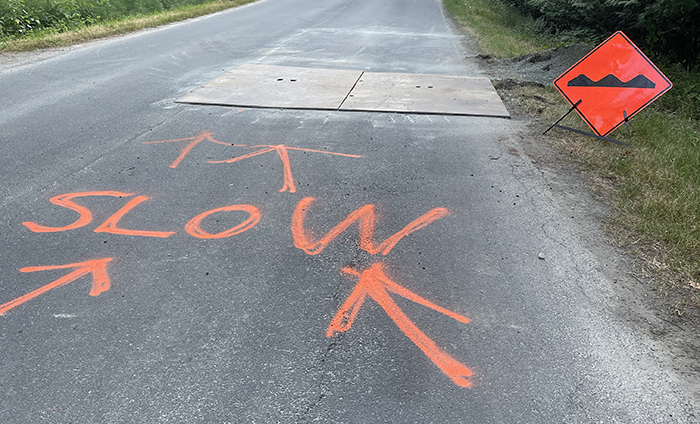
A deep culvert failure beneath Beaver Point Road caused Sunday’s dramatic sinkhole, according to officials, adding that the temporary repair in place is safe for drivers and the road will remain open. 

Ministry of Transportation and Infrastructure (MoTI) public affairs officer Ceara Kavanagh said Tuesday the old concrete culverts were installed in four-foot sections, which occasionally can become disjointed over time; water leaking through the gaps can create a void which — depending upon the properties of the infill and surrounding material — can become large. 

Several firefighters and apparatus responded to reports that a vehicle had crashed into the sinkhole Sunday, June 25. Salt Spring Island Fire Rescue (SSIFR) Assistant Chief Mitchell Sherrin said the vehicle had departed prior to their arrival that afternoon. 

“We were impressed by a quick response from our local Emcon maintenance crew, who attended the scene and made a patch to the road Sunday evening,” said Sherrin. 

Emcon crews filled the void with crushed rock and set steel plating on the surface; Kavanagh said the ministry is currently putting together a replacement plan for the culvert in this location, and will continually monitor the site until the culvert replacement project is underway. 

Beaver Point Road sinkhole spot after being temporarily repaired by Emcon personnel.

First LCC meeting in the books

0

Salt Spring’s new Local Community Commission (LCC) met for the first time, making clear it intended to move quickly and — within the limits of legislative procedure — not bind itself to convention. 

After what seemed a tacit agreement to use first names among the new commissioners, and with a full complement of local and regional Capital Regional District (CRD) staff on hand — including district CAO Ted Robbins and corporate services general manager Kristen Morley — commissioners Gayle Baker, Ben Corno, Earl Rook and Brian Webster were sworn in, with a round of applause from the dozen or so members of the public present.  

Those among them hoping to gauge the tenor of Salt Spring’s newest governing body didn’t have long to wait.  

Rook was swiftly nominated and acclaimed as chair, and CRD director Holman, in his role as fifth commissioner, as vice chair. The LCC decided the two will receive staff briefings and draft agendas together “at least to start with,” said Rook, as new commissioners become accustomed to the job.  

That administrative motion was just one of several resolutions the new commission passed quickly and unanimously Tuesday, June 20, including an expression of gratitude to the community members who worked toward — and voted in favour of — the establishment of the LCC, with nods to past members of the various advisory commissions, senior manager Karla Campbell, Holman (in his role as CRD director), Robbins and Morley.  

Next came a comprehensive statement of commitment to accessibility, transparency and accountability — including a promise to minimize the use of closed meetings and to hold meetings in ways easier for more community members to attend. That would necessarily include exploring options for evening meetings, according to commissioners, and staff were asked for a report on how best to accomplish this. 

“There was nothing I heard more, or more intensely, from the community during the campaign than the importance of having open and accessible meetings,” said Webster. “We need to work through whatever the implications, complications and challenges are to achieve that.” 

In that vein, the new LCC proposed a work-around for a procedure bylaw requiring delegations being allowed to speak only about items already on the published agenda, hatching a plan to have a broadly phrased item called “discussion of community issues and priorities” included at every meeting. 

“I would rather err on the side of a few times saying ‘geez, three more minutes on this?’ rather than closing the door and having the community feel like ‘oh, there isn’t a place for us,’” said Webster. “This is the only body under the CRD where directly elected members do not have other meetings where this kind of input can happen.” 

Morley said while she appreciated the theme of being transparent — and giving the opportunity for a robust exchange of ideas — she worried there might be pitfalls. 

“I think the commission has to be a little bit careful not to stray into just discussing things ad hoc,” said Morley, “because that’s where you get into that issue of not having [enough] notice to the community.” 

“We want to get this commission started on the right footing,” said Robinson, adding that he agreed with the general intent. “[But] I think it would be difficult to be in conflict with the board procedures right out of the gate.” 

Ultimately the LCC asked staff to report back on how to “hold the door open,” as Corno put it, for more public participation during meetings. In the meantime, the LCC will be able to waive some procedure requirements for delegations on a case-by-case basis with unanimous agreement — which seems to be the norm for the new governing body, where every vote has so far been 5-0. 

“You may have noticed a sense like we’re in a big hurry here,” said Webster. “And we do feel that way. But on the other hand we want this to work.” 

Commissioners decided to extend an invitation to past members of the dissolved commissions whose business now comes under the LCC’s purview. The hope, according to commissioners, is not only to set priorities going forward but also to maintain momentum — and avoid the loss of knowledge and “lessons learned,” according to commissioners, who were hoping for both attendance and written correspondence. 

“I’m definitely in support of requesting they forward documentation to us in advance [of the next meeting],” said Corno, adding that he was aware at least one of those former groups was “moments away” from finalizing such a report for the new LCC. 

But while the possibility of several dozen former commission members flooding a regular meeting certainly raised a few eyebrows among staff, a unanimous motion to add a special meeting to the schedule specifically for them — on July 11, one week before the next meeting scheduled for July 18 — seemed of little comfort. 

“It’s a real challenge,” said Campbell. “We have multiple projects we’re managing right now with a limited staff capacity. The challenge that you guys will have in working with us is to not be monopolizing that capacity, because we have a higher level of priority to water and sewer, [things] that affect people’s daily lives. As much as we’d like to serve you, [and] we are here to get your business done, we do have a lot on our plate right now.” 

“The bylaw says clearly that the meeting times and dates are set by the commission,” said Webster. “It’s very difficult for us to have staff essentially saying we can’t make [additional meetings] work.” 

Robbins said the biggest issue would be keeping enough time for staff to be able to report back on things the LCC brings to them. 

“These are more comprehensive reports, typically that rely on not only the on-island team, but potentially advice from folks at corporate services, finance, whatever the case may be,” said Robbins. “We’ve got to manage expectations here. It’s going to be difficult for staff to turn around reports even on a four-week cycle — particularly if there’s [unanticipated] business being generated through a meeting.” 

To help alleviate staff strain, commissioners opted to structure the July 11 meeting strictly for the purpose of feedback — no reports from staff would be needed before the July 18 regular meeting. 

“It’s just focused on the dissolved commissions, bringing them in, getting their feedback,” said Baker. “Not a lot of pre-meeting prep, but having a conversation we really need to have before we make decisions.” 

The LCC also took first steps toward reinitiating the Harbourwalk Steering Committee by appointing Webster to represent the LCC there. They also directed staff to report on budgeting for at least some LCC members to attend the Union of BC Municipalities conference in Vancouver this September. 

Court orders two of six Seabreeze residents to vacate

1

In a court decision unlikely to satisfy any of the parties involved, a B.C. Supreme Court judge has ruled partly in favour of the Lady Minto Hospital Foundation (LMHF), and partly with current occupants of the former motel the foundation now owns. 

The issue before the court was an interlocutory one, brought in advance of the primary court case between LMHF and people remaining in the Seabreeze Inne building on Bittancourt Road. While that case waits for a full hearing, LMHF had sought an injunction that would have resulted in an ejectment and restraining order, giving the foundation “vacant possession” of its building and allowing contractors to begin converting the rooms to hospital staff housing even while the case was being tried.  

Without ruling on the broader merits of the pending litigation, Justice Anthony Saunders dismissed the foundation’s application against four of the hotel’s current occupants, but ordered two of them to vacate the premises by noon Friday, June 30. The lawyer for the four still allowed to stay, according to the judgement written Wednesday, June 21, had alleged facts “more than sufficient to raise triable issues,” and in Saunders’ view their dispute required a complete hearing. 

The two who must leave did not respond to the application, according to Saunders’ written judgement, and since LMHF had established a prima facie case that both only ever occupied their rooms as emergency shelter or transitional housing, “the plaintiff [LHMF} is entitled to the relief it seeks against them.” 

While Saunders awarded “ordinary” costs to the four occupants, he declined to award “special” costs requested by their lawyer, who had alleged LMHF’s litigation was “plainly improper” and “an apparent attempt to bury the Tenants in applications and affidavits.” 

“Notwithstanding the force of this submission [by the occupants’ lawyer], I am not able to find that the plaintiff’s conduct of this litigation has fallen to the level of an abuse of process,” wrote Saunders. “It is indeed unfortunate that the chronic shortage of judges being experienced by this Court, arising out of a lack of sufficient judicial appointments for the Court to be at its full complement, led to the adjournment of the hearings scheduled for March, which could have resolved all matters on their merits.” 

Campfire ban still in place in Gulf Islands

0

Despite a relaxation of some restrictions regionally — and Salt Spring Island’s fire danger rating moving from “extreme” to merely “high” — at least for the moment — officials stress the campfire ban is still in place on all the Gulf Islands, and fire season has really just begun. 

Salt Spring Island Fire Rescue Chief Jamie Holmes said summer forecasts from the provincial forest service were calling for a drier-than-normal June and July. 

“And they said the ‘good news’ is that August is average,” said Holmes, who had recently attended the BC Fire Expo in Penticton, where the forecast was discussed. “And all the departments around there looked at each other and said ‘well, that’s great’ because their August average [rainfall] is zero.” 

Holmes said the prediction system was highly sophisticated, and well-relied upon — but had some simple indicators despite the “complicated science” of the full forecast. 

“They’ve really found over the years that if we have a wet June, we have a quiet forest fire season,” said Holmes, addressing the fire board Monday, June 19. “And if we have a dry June, we have a busy forest fire season. The ‘tale of the tape’ will be at the end of June, but [right now] they are predicting a busy year.” 

The campfire ban, Holmes said, is an attempt to minimize human-caused forest fires so firefighters have enough resources to combat the fires that start naturally during dry conditions. 

“Putting a campfire ban in place early on in the season helps that out,” he said. 

The Coastal Fire Centre is also keeping similar prohibitions in place on Vancouver Island.