The third and final community event in The Suitcase Project exhibition takes place this Friday, June 23 at the Salt Spring Public Library program room.
Doors open at 6 p.m. for exhibition browsing (with refreshments available), followed by guest speaker Kirsten Emiko McAllister, Ph.D., professor in the School of Communication at Simon Fraser University giving a presentation at 7 p.m. Called Japanese Canadian Memory Projects: Rebuilding the Community and Recognizing Our Responsibilities Today, McAllister will discuss the Japanese Canadian internment, dispossession, dispersal and the role of art in rebuilding the Japanese Canadian Community. She will also examine our responsibilities to Indigenous Nations and the other groups currently experiencing hardship, and how the community’s larger pursuit of social justice urges us to look beyond our own experiences of persecution.
The talk will offer an opportunity to acknowledge the painful memories of Japanese Canadians and the contentious history of British Columbia, allowing us to see the landscape in which we live with different eyes.
Together with The Suitcase Project by Kayla Isomur, the local Japanese Canadians’ history in photographs is also on display. The exhibition will be on until July 7 at the library’s program room.
The following piece was written by Gitxsan artist Shar Wilson, AKA Wiihlbuun, whose daughter Jaren was married to Reid Pirie on Galiano Island on June 10.
Indigenous peoples in B.C. have begun their harvest of salmon and other seafoods. July and August are busy months as we prepare to catch, catch, process, preserve and store our harvest for the coming winter months. While this all sounds like a lot of work it is also how we continue to strengthen our culture and share the teachings of our Ancestors with the next generation. Even though this is becoming less and less true, we fight to keep this practice alive.
As we prepare our gear, we share stories of our recent history with our youth. We tell them how we used to help our parents and grandparents. We tell them how hard it was “when we were young” and how much easier and better the gear has gotten over the years. I can only imagine how early the preparation had to start as our Ancestors started to make cedar ropes for the fishing weirs and dip nets. They had to carve their hooks out of bone and wood and hammer the stones for their anchors. Today, the gear preparation is as easy as going to a store. As young people, Bob and I recall helping my grandfather and our fathers by pulling the nets out of storage and remember their stories of when they were young. We are fortunate that we are able to do this with our two youngest grandsons, Lloyd and Linden.
When and where we fish has been taught to us by our Ancestors. We fish in the same areas they did, and they showed us where, when and why we put our gear in certain waters. All Coastal Indigenous people are “salmon people.” We have relied on salmon for thousands of years; we have the same relationship with cedar.
All factors are related to Mother Nature and Grandmother Moon, our Matriarchs. Tide, wind and the timing of the return of the salmon all play a huge part in our harvest time. This knowledge, once inherent for all Indigenous peoples, is now only known by a few in comparison to a short 50 years ago. With the efforts of our society, we have reinforced the transfer of this knowledge to the next generation by informing the Department of Fisheries and Oceans (DFO) of our intention to continue our practice of fishing in our territory. We have agreed to provide our members with a fishing permit issued from our office that is recognized by DFO and this permit allows our members to fish ‘as formerly’ and without hassle from DFO. It is known that Saraughtanaogh was a skilled fisher person and she fished as she was taught – this knowledge was transferred to her children. Today, our members fish in the same areas as their Ancestors. Saraughtanaogh’s descendants are strong, knowledgeable sea masters. Many of our Ancestors were fishermen, pilots and lighthouse keepers. Today, we have many fishermen and one pilot. The lighthouses are automated. We are proud to be harvesting in our territorial waters – we are strengthening our right to claim and revitalizing our culture.
People process their salmon in many ways. This is how we process our salmon. The first way is to smoke our salmon. Many of you have had Larry and Bailey’s smoked salmon and can appreciate this delicacy that we call our food. Smoking salmon is a process that was taught by our grandparents and parents. However, with the attempts to break the link of knowledge (residential schools and 1960s scoop), these lessons were not taught to many of us. Smoked salmon has been in our Indigenous families for thousands of years, so, many of us are teaching ourselves or reaching out to others to teach us how to smoke salmon. In my Gitxsan territory, the smokehouses are abundant. We are fortunate that we have one smokehouse on Galiano and it is our hope that we will have more in the near future. The second way to preserve our harvest is to air dry the thinly cut salmon until it is like a dry jerky. The third way is to soak our salmon in a salty brine. These are the Ancestral ways we preserved our salmon.
More recently (within 100 years), we have taken full advantage of the glass jars, the aluminum cans, the pressure cooker, the vacuum pacs and the freezer. We can now can/bottle and freeze our salmon. The teachings were in the preparation of the salmon, the cutting of the salmon for the various processes, how long to hang the salmon in the smoker and so on. I remember my grandmother running her fingers along the back of the salmon as she cut strips off of the salmon to make fully dried salmon strips that we call “hooxws.”
“This is how my Tsiits showed me,” she’d say. I would help her carry the strips into the smoke house and watch as she skillfully skewered them onto hand-carved skewers. My favourite days were a few days later when we would also play the part of “quality checkers” and taste the freshly smoked hooxws/salmon jerky. Indian Candy is relatively new, I didn’t have Indian Candy until I came to Galiano. I look forward to the time we can build a smokehouse on Galiano that we can use as a community smoke house. We can revitalize the culture and tradition of sharing stories as we process our salmon with the next generation.
While it seems that the storage of the harvest is the final step, it is not. The final step of this cycle is the eating of the salmon in the cold, winter months. It is around the table where more stories are shared with our relations. It is where we give thanks to Creator for the bounty from our Matriarch Mother Earth, for the knowledge of our Ancestors, and for our presence. Summer is a busy time for Indigenous peoples. It is a time for sharing, teaching, laughing and creating relationship within family, land, sea and Universe.
June 10th Wedding of Jaren and Reid Pirie
Jaren and Reid Pirie with a blanket, cedar crowns and cedar rope at their Galiano Island wedding, as described by Jaren’s mother in this piece. (Jessica Kirkwood photo)
I would like to take this opportunity to thank everyone who helped, participated, attended and made space for our daughter Jaren’s wedding. Her ceremony was beautiful and was the first Coast Salish wedding ceremony to be performed on Galiano since the arrival of the settlers.
I want to take this time to also thank my cultural advisor, my daughter-in-law, Cecilia Wilson. She was married in a similar fashion and helped me with the ceremony. I will explain the ceremony to you.
The wedding arbour was built by the bride’s brother, Rob Wilson. It was set up to face the East to represent the new journey of the couple. The sun rises in the East and since time immemorial we have learned that Grandfather Sun will always rise in the east to give us a new day. We do not expect tomorrow but we live for the present day.
The number four is significant to Indigenous peoples. Four represents the four medicines of Cedar, Sage, Tobacco and Sweetgrass. It also represents the four colours of the human race: Red, Black, Yellow and White. Four represents the four directions of East, South, West and North. We also have four cherished main elements of Water, Fire, Air and Earth. Within us, we have four chambers in our hearts, we have four sections in our brains, and we have four parts in our bodies. You will often see four figures in art created by our Ancestors. This is why four is important to us.
Traditionally, the family Elders and Grandparents led the wedding ceremony. As this was the first time the ceremony was being performed, we chose to use family that knew the significance of the parts of the ceremony. While my father was there, he was torn about the ceremony as God was not present. He went to residential school and he was forced to fear God and the bible. However, he agreed to witness the wedding ceremony with his Ancestral blanket on. I thank him for this as his blanket represents his Ancestors.
We began the ceremony by the laying of four Cedar boughs, each had to be laid in a specific way. Cedar has been a part of Indigenous life and culture for time immemorial and we still work with it today. The next thing was the laying of the four blankets that represent our Ancestors and all the four elements mentioned above. We asked the bride’s Aunty Eva Wilson and Uncle Lindsey Wilson to walk the couple onto the blanket from the East. Once they were on the blanket, a Cedar crown was placed on the groom’s head. One would have been placed on the bride’s head but Jaren chose to have her Cedar crown woven in with her hair. The Cedar crowns represented the union of thoughts for the couple. Each have their own minds but as a couple joined in the eyes of our Ancestors, they must now have joined thoughts that will bring them through their life together in a strengthened and unified way.
Secondly, a cedar rope, woven by me, Mother of the Bride, was placed around the couple. The rope signifies the encircling of the couple by tying the Cedar and making them as one. The joining of the rope was very significant to me as I learned a lot by weaving the rope. The rope and Jaren’s Cedar crown was made with Cedar from our Gitxsan territory. As I was weaving the rope that morning, I marvelled at the beauty and strength of the Cedar. I also thought about our Ancestors and how they used Cedar in every aspect of their lives, including clothing, shelter, harvesting and adorning their lives. I was also able to see weak spots coming up so I weaved in extra Cedar for those times.
“Ooh, I see!” I exclaimed as the lessons came to me from Ancestors. I was able to make the rope as long as I wanted as I had prepared enough Cedar to keep going. “Ooh, I see!” At a few points I lost my focus and the rope began to unravel. I had inadvertently changed the direction of my weaving, having one of the two strands going one way while the other maintained the course. I had to go back to the point where everything was right and begin again. “Ooh, I see!” The final weave was the biggest test of the rope and for me. I had to let it go. I had to see if the rope would stay wound up and it did. “Ooh, I see.” So many lessons from weaving this Cedar rope for my daughter’s wedding.
The next thing that happened was a blanket was placed around my daughter, Jaren, and her new husband, Reid. The blanket represents all her Ancestors and all of those present. As they stood on the four Cedar boughs, the four blankets, I asked them to acknowledge the faces of everyone there and know that everyone had made space for them in that moment. Those beautiful humans who were present are represented by the additional Cedar in the rope that was used to strengthen the weak spots. So, while they are two, they are not alone, they are strengthened by all of those present. Finally, Aunty Eva and Uncle Lindsey were once again asked to take the hands of the couple and walk them off of the Cedar boughs and blankets to their future. They begin their journey as one.
The first part of the ceremony was all related and as noted by one of Reid’s family the second part of the ceremony in comparison to the first part seemed detached. To him, the second part was very rigid in the words – “will you,” “do you,” “I now take you,” “now we must sign the paper.” I agreed with him. There will be another Coast Salish wedding ceremony on Galiano, and when that does happen, maybe we will not need the rigidity of the signing of papers and our ceremony will be enough.
My husband Bob and I want to thank you all again. We also want to acknowledge our Ancestors and all the fours in our lives. We are in our busy time now, so stay safe, be present always. As my grandmother taught me, “Walk softly, be aware, be careful, be mindful.” Hamiyaa! **Hands raised.**
As many of you are aware, the local bus fleet is being renewed. What you may not have noticed is that the new buses are equipped with surveillance cameras.
To my knowledge, these cameras were not installed because anyone from Salt Spring asked for them. They are a gift from BC Transit.
In the past, camera surveillance was passive. We have become accustomed to cameras recording our actions in public spaces. Typically, unless something out of the ordinary occurs, no one is actually watching these cameras. Even so, it is important to be aware when you are on camera lest you behave in some manner that could haunt you, were it to blow up 10 years later on social media.
These days, technology exists to actively monitor cameras in real time. Now the camera is not just recording. Someone may very well be watching. Of course the entities that are increasingly spying on us are not human. They can be powered by AI. Consequently, there is no labour cost in mass surveillance and very little to inhibit those who wish to abuse the technology to monitor our every action.
Big Brother is not only watching. Big Brother is capable of knowing your identity the moment you step on the bus and can instantly correlate this to everything else that is known about you: where you live, who your friends are, which causes you support financially and what kinds of websites you frequent. To some this may sound far-fetched, but the technology exists and is very much in use. There are cities where cameras are so ubiquitous that citizens’ whereabouts are known at all times.
I’m not suggesting that BC Transit has nefarious intent. The concept of cameras on buses is nothing new. From a BC Transit perspective, this is purely a safety measure. Some will be able to accept this and possibly even welcome the new cameras. Personally, I reject the notion that surveillance culture makes us safer. I feel decidedly less safe on a bus that is equipped with camera surveillance.
The bus is a public space. If we are going to install cameras in public spaces where previously there were none, then citizens ought to be made aware of the change before it happens. There ought to be public consultation.
Big Brother is no longer science fiction. Everything Orwell wrote about in 1948 has now come to pass. BC Transit is an extension of the B.C. government – a government that has become increasingly totalitarian in its ways. I would argue that given what we know about AI surveillance technology, what it is capable of and how it is already being used elsewhere in the world, we ought to be careful about welcoming more surveillance into our public spaces. I would rather we look towards finding ways of reducing the number of cameras that spy on us all day long, rather than bringing in new cameras in places where they are not needed.
The erosion of freedom is incremental. If we as a community embrace more cameras in public spaces we may not be able to get rid of them, should it become apparent that the technology is oppressive rather than freeing. For those who may see these cameras as a bad idea, the time to be heard is now.
Two Gulf Islands Secondary School (GISS) Grade 12 students were at the Capital Regional District (CRD) boardroom in Victoria last week to receive bursary awards presented by CRD vice-chair and Sooke mayor Maja Tait.
First to be honoured before the CRD board was Maggie Naphtali, chosen by the selection committee from School District 64 to receive the 2023 Nils Jensen Memorial Bursary in the amount of $2,500 per annum. The family of the former CRD board chair established a bursary in his memory in 2022, which is administered by the district and awarded on an annual rotating basis to one of four school districts within CRD boundaries based on a student’s financial need and an interest in environmental protection or water security.
Naphtali, who maintained an academic average of over 95 per cent, was a founding member of the GISS Earth Club and will be attending Dalhousie University where she has been accepted into the environment sustainability and society program, with an intended minor in journalism. She has also been selected to receive a BC Excellence Scholarship, according to Tait.
Next up was Elvin Shoolbraid, who was chosen to receive the 2023 Ed MacGregor Memorial Bursary, also in the amount of $2,500 per annum.
This bursary was created in 2003 in memory of MacGregor, the first mayor of the District of Sooke. The bursary is also awarded annually on a rotating basis based on financial need, with recipients selected through a collaboration of principals at the eligible school. Shoolbraid is this year’s top academic student at GISS, with an average of 97.6 per cent maintained while working part-time through the school year and full-time through the breaks, according to Tait.
Shoolbraid is also class valedictorian and receiving a president’s and a dean’s entrance scholarship to attend the University of Victoria, where he will pursue a degree in mechanical engineering.
Starting next week, BC Ferries hopes more sailings in and out of Fulford Harbour will help alleviate growing system strain, as Salt Spring heads into the “peak” summer season.
The new 10-sailing plan — nine on Sundays — starts Wednesday, June 28, with first sailings most days departing Fulford at 6 a.m. for Swartz Bay, and the last chance for Salt Spring passengers to return home departing Swartz Bay at 10 p.m.
The structure, according to fleet deployment and scheduling manager Steve Anderson, builds five round-trips into each crew shift — up from four, and a “tight fit,” he told Salt Spring’s Ferry Advisory Committee in April, but the best chance at relieving line-up congestion at Fulford.
BC Transit said it would make changes to better align with the ferry schedule, with a bus generally arriving at Fulford a few minutes before sailings; all trip time changes will be reflected in the new Rider’s Guide on the Salt Spring page of BC Transit’s website.
Added sailings from Fulford come on the heels of an announcement of the highest vehicle traffic numbers ever recorded, as BC Ferries released fiscal year-end figures through March 31. System-wide, BC Ferries carried 9.4 million vehicles and 21.6 million passengers last year — a new record for vehicles, and an increase of 11 and 21 per cent respectively, compared to the same period in the prior year. Those vehicles and passengers were carried on 86,835 round trips, an increase of more than 4,000 trips over the prior year.
A Driftwood analysis of fuel consumption found the two added Fulford-Swartz Bay round-trips each day — plus one added on Sundays — will consume nearly 95,000 additional litres across the 126 planned “extra” sailings between June 28 and Sept. 4. That’s enough fuel to drive a typical school bus from Vancouver to Montreal and back — more than 17 times, per Natural Resources Canada data.
On average, according to BC Ferries’ fuel consumption data for 2020 released under a Freedom of Information and Protection of Privacy Act request, the 92-vehicle-capacity Skeena Queen uses roughly 750 litres of fuel per round trip on Route 4 between Fulford Harbour and Swartz Bay.
First in a series of awareness-raising stories from Salt Spring’s Mental Wellness Initiative. This is called William’s Story, written by William MacPherson.
I didn’t know I had a chip on my shoulder when I began my journey with the Mental Wellness Initiative (MWI).
I was doing some volunteering when I found out that the Salt Spring Health Advancement Network (SSHAN) was working on a mental health project. This is where I met David Norget and got involved with the MWI.
For the last 20 years I had been focused on understanding why I was mentally ill, determined to correct the imbalances and become a force for healing in the world.
I imagined I was a good collaborator. I didn’t realize how much I had to learn about working with people. I wanted to talk. Talk for all the times I wasn’t heard. The MWI is where I learned to listen.
This became possible initially because the pace of the group was slower. But I’m a doer, I wanted to proclaim! Little did I know that listening with your whole body is a superpower, and the quality of the attention we pay opens up healing potentials. Learning to really pay attention would open up opportunities for me to work in a new profession.
I didn’t recognize how many coping strategies I employed to compensate for not feeling safe with people. The MWI puts participants’ safety first and it was experiencing this safety, and the relationships that developed, that gave me the confidence to step way outside my comfort zone and accept a position as a harm reduction peer support worker at Salt Spring Community Services.
I didn’t know if I could hold a job. My neurodivergence made me feel like I needed to do things my way. But my new work supported my growing pains just as the MWI supported my spirit. I discovered what a great privilege it is to hold space for people. My job started at 18 hours a week and a year later I was working full time. I found myself collaborating with the RCMP, with the staff of Mental Health and Substance Use, as well as colleagues from a variety of programs at Community Services. So much became possible as I learned how to really listen and be collaborative.
It was the safety and support the MWI provided that allowed me to take a chip off my shoulder. Safety allowed me to humble myself. To stop trying to prove to everyone that I had value. To build a sense of self that replaced the arrogance that I had used to defend against my vulnerability. To become a better version of myself.
The MWI is currently fundraising in the community. We are asking for your help.
These are some ways you can help:
1) You can volunteer.
• Become a goodwill Ambassador (two hours per week paired with another person in the Ambassador Program).
• Consider donating your administrative skills to our Volunteer Counselling Project (one to two hours per week).
• If you are a mental health practitioner (or offer a related wellness service) consider donating 10 hours of your services (per year) to our Volunteer Counselling Project (to be provided to those who can’t otherwise afford these services).
• If you are skilled with writing, help us with writing pieces for the volunteer counselling project website. We have a communication working group to assist you (one to two hours per week).
• Become a recruiter with the Volunteer Counselling Project to recruit practitioners in the community willing to donate 10 sessions per year to those who can’t otherwise afford these services (one to two hours per week).
• Become part of our dynamic Communication Working Group team to support our overall communication efforts to the community.
2) Or you can donate. (A charitable tax receipt can be requested.) We currently have two angel funders each willing to donate up to $5,000 to $10,000 that, if matched by community donations, will equal $20,000 in donated funding!
• Cheque – payable to Salt Spring Community Health Society mailing address: 181 Booth Canal Rd., Salt Spring Island, B.C., V8K 2N2 (Please specify “SSHAN – Mental Wellness Initiative” on your cheque).
• Online – CanadaHelps.org. Search for Salt Spring Community Health Society and please specify “SSHAN – Mental Wellness Initiative” in the note section. During the month of June through CanadaHelps, every $1 donated gives the MWI the chance to win $20,000. The more that’s donated, the greater the chances of our winning (canadahelps.org/en/givingchallenge/).
• For any significant (>$25,000) donation of securities (publicly traded stocks and bonds), there is a possibility of avoiding paying capital gains tax by contributing to a flow-through fund through the Salt Spring Island Foundation (SSIF). Please talk to us to discuss further details. (Great thanks go to the SSIF for this option.)
Our motto is “Co-creating a community of caring and belonging.”
The Mental Wellness Initiative thanks our past and present sponsors — Island Health Community Wellness, SSIF, Capital Regional District Grants-in-aid — as well as the many organizations and community members who have contributed their time to our efforts. We also thank Harlan’s Chocolates and Salt Spring Coffee for contributing chocolate and coffee to support our community appeal!
Salt Spring Island has unfortunately gained notoriety on the environmental front recently, but not for a positive program or achievement.
The Canadian Food Inspection Agency puts out green tent traps containing female spongy moth pheromones annually to detect the presence of the invasive moths, with the males enticed into the traps by the scent. Until last year on Salt Spring the low numbers of trapped moths were not of particular concern. But a jump from three in 2020 to six in 2021 and then 16 in 2022 — combined with a significant rise in numbers in other parts of the province — have prompted the first steps of an eradication plan to be taken.
Members of the provincial Spongy Moth Technical Advisory Committee and staff from member government agencies and the non-profit Invasive Species Council of B.C. held an open house at Fulford Hall on June 7 to bring the community up to speed about the need and plan to address the increasing population. The spongy moth caterpillar’s appetite is huge and they’re not too fussy, with oaks (including Garry oaks), arbutus, alders, apples, pears, roses and willows among the list of favoured trees and shrubs. The species is not yet considered “established” in B.C., as eradication efforts have so far been successful.
But the sense of alarm about the numbers from last year, while measured, was palpable among presenters at the Fulford Hall event. A resident couple who had dealt with an infestation in Ontario added to the discussion, stressing the devastation to trees they witnessed was incredible.
Back in 2006, a large volunteer corps was organized to put out traps and look for egg masses in the Lee Road area of Salt Spring in order to prevent the overhead spraying of the biological insecticide Bacillus thuringiensis kurstaki (Btk). Ground spray was eventually used to control an outbreak as well.
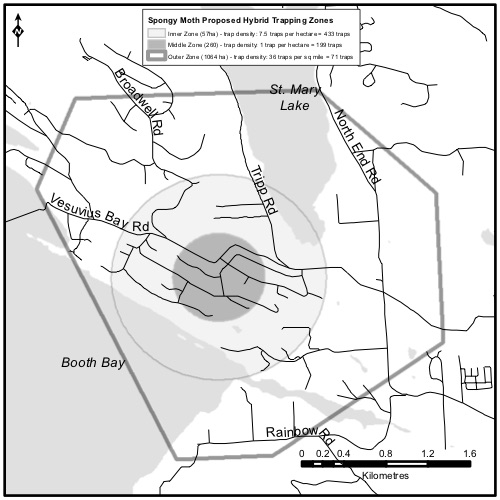
Looking for spongy moth egg masses might not sound like a ton of fun, but hopefully everyone — especially in the Vesuvius-St. Mary Lake area shown in the map accompanying the Driftwood’s June 21 story — will take the time to look for egg masses lodged on or in vehicles, boats, sheds, flower planters or trees. Reports of caterpillar or moth sightings are welcomed as well, but the moths, especially, are not as easy to be seen or identified.
Some Salt Spring Island trees are sporting a new shade of green this summer as a spongy moth trapping program shifts into high gear.
More than 700 bright-green tent-shaped traps have been set out in three different zones around Vesuvius and St. Mary Lake where the moth population grew significantly between 2021 and 2022. Some pheromone-laced traps, which attract the male moths, are always set out by the Canadian Food Inspection Agency (CFIA), but the rise in trapped moth numbers last year prompted a major response for 2023. European spongy moth caterpillars (or Lymantria dispar, formerly known as gypsy moths) are voracious defoliators of numerous tree and shrub species.
Outer, medium and high-density spongy moth trapping zones.
Brian Van Hezewijk, a research scientist with the Canadian Forest Service in Victoria, detailed the Salt Spring-specific increase to about a dozen people attending a recent open house event at Fulford Hall.
“It went from three moths in one trap two years ago to 13 moths in six traps [in the Vesuvius area],” said Van Hezewijk. “That tells us that it’s now well on its way to increasing . . . I wouldn’t be surprised if we saw 100 moths in our traps this year. What we’re hoping is that it’s in a concentrated area — or zero. That would be great, but I’m not betting on it.”
Three male moths were also trapped in other areas closer to Ganges last year, for a total of 16.
“Those numbers might seem low,” said Babita Bains, chair of the province’s Spongy Moth Technical Advisory Committee, “but they are quite significant for a species that we eradicate for.”
Province wide, 356 male spongy moths were trapped in 2022, which Bains said is “huge” compared to the more usual 20 or 50 she has seen in the previous six years in her role.
“I was away for a year and when I came back and saw 356, I almost fainted. I thought that was a typo, but that is correct.”
Intense trapping is a basic part of an eradication strategy, the meeting heard.
“Every male that you take out of the population means that there’s another unmated female out there that’s not going to produce viable eggs,” said Van Hezewijk. “And that means 500 or 1,000 caterpillars that we have fewer of next year.”
But just as important is the information about the moths’ whereabouts that trapping provides, so egg mass searches and perhaps spraying with the biological insecticide Bacillus thuringiensis kurstaki (Btk) can be more focused.
“That’s what we want to know — where those reproducing females are. So the more information we have about egg masses and caterpillars the better,” said Van Hezewijk.
He and others working to keep the moth from establishing itself in B.C. are urging people to be on the lookout for the flat, sponge-like egg masses on their property, or the moths and caterpillars themselves. (Online searches provide images.) Because the male moths have few distinct markings they are not easy to identify. Caterpillars are distinguished by their four sets of two blue dots and six sets of red dots on their body.
Egg masses are usually placed in protected spots. While they may be found in the crook where a branch comes off a tree, the moths actually prefer human-made objects, such as vehicles, boats or garden-related paraphernalia, as host sites.
Nick Wong of the Invasive Species Council of B.C. (ISCBC) said “cars and RVs seem to be the preferred spot,” while also giving the tray of a flower planter as another typical example during his presentation at the June 7 meeting.
Wong said the recent rise in B.C. spongy moth numbers can be attributed to egg masses attached to the undercarriage or wheel wells of vehicles travelling from Ontario, which has experienced a huge infestation in some areas. A couple of former Ontario residents at the meeting attested to the devastation caused by the spongy moth caterpillar and the challenges of trying to control it, which falls to private property owners in that province.
Any sightings of eggs, moths or caterpillars should be reported to the ISCBC at bcinvasives.ca/take-action/report/ or the CFIA at 250-363-3618. Take digital photos, if possible.
“Once they’re here, the females themselves don’t fly,” said Wong, noting that their bodies are too laden with eggs for flight, “but the small larvae can balloon on the winds” and spread for about a kilometre by that method.
Bains addressed the issue of Btk spraying, as she said it would inevitably be used on Salt Spring if the trapped moth numbers do not drop significantly. Btk was applied from the ground on an area near Lee’s Hill back in 2007, along with intense trapping and egg mass searching.
She said that even though people seem to think ground spraying is better, “they actually use a way higher concentration of the product. And they’re way more invasive because you have people in your yard, it stinks. So your exposure to the product is a lot higher than if it’s aerial spraying.”
Some audience members said they were concerned that aerial spraying would kill other moth/caterpillar species, which was acknowledged to be the case.
Van Hesilijk said spray application is now very precise and controlled by a GPS system. However, he added, if the infested area is small enough, ground spray may be a feasible option.
Caroni Young and her Viva Chorale choir are finishing their concert season on an emotional note.
This weekend at ArtSpring the long-running ensemble will present O Love, which the group says “features songs of love and longing that are guaranteed to pull those heart strings.”
As Young explained, “It ranges from some folk songs like the Log Driver’s Waltz, which is more about the funny side of love and looking for that perfect person, and then it goes over to a song by Healey Willan that is based off the Song of Solomon — it’s called Rise Up, My Love, My Fair One — that’s sort of a sacred love, and everything in between.”
The concert’s title song is written by prolific American choral composer Elaine Hagenberg.
“It’s just a beautiful piece that uses piano and cello accompaniment, and provides a moment of rest and tranquillity and a break from the craziness of today’s world. It’s really the anchor point for the whole concert,” said Young.
Newer works by Canadian composers such as Laura Hawley and two pieces commissioned by Viva Chorale by Sarah Quartel and Donna Rhodenizer will also be performed.
“I think it’s going to be a wonderful show, and I really hope we can get the audiences out to see it,” said Young.
The Saturday night concert begins at 7:30 p.m. and Sunday’s is at 2 p.m. Tickets are available through ArtSpring.
The June 24-25 concerts will be Viva Chorale’s last full public shows of their season on Salt Spring, but Meadowbrook and the hospital’s Extended Care Unit will be visited by choir members on Canada Day, and people might catch them outside Country Grocer on July 1 as well.
“I think getting out performing and sharing what we do with people is really important,” said Young, “so we like getting to take music to the folks who can’t get out to see our concerts.”
Young and about 20 Viva Chorale singers are then heading to Scotland on July 5 where they have organized a tour that will see them perform with four different Scottish choirs and by themselves in various places.
Salt Spring Island’s U17 Girls Fastpitch team secured a slot at B.C.’s provincial championships with a three-game district finals performance over the weekend that brought a silver medal back to their island.
Head coach Bruce Dunbar said the girls played what were “the best three games of their season” when it counted most, playing two games Saturday at Lochside Park, first against Beacon Hill — beating them 19-9 — then against Carnarvon, who had dominated previous opponents in their first two games, with those contests ending early through the “mercy” rule. Salt Spring was up to the challenge, according to Dunbar.
“We battled hard, and beat them 5 to 4,” said Dunbar, “placing us in the silver/gold final game on Sunday.”
Once again Salt Spring faced the Carnarvon team, and despite great play the girls had just “a few too many errors,” said Dunbar, allowing Carnarvon the 17-7 win.
“The girls played their best,” he said, “and showed us what it takes to win.”
The team now moves on to Maple Ridge July 7-9 for provincial championship play.