Home Blog Page 19

Litter bucket waits for contributions

0


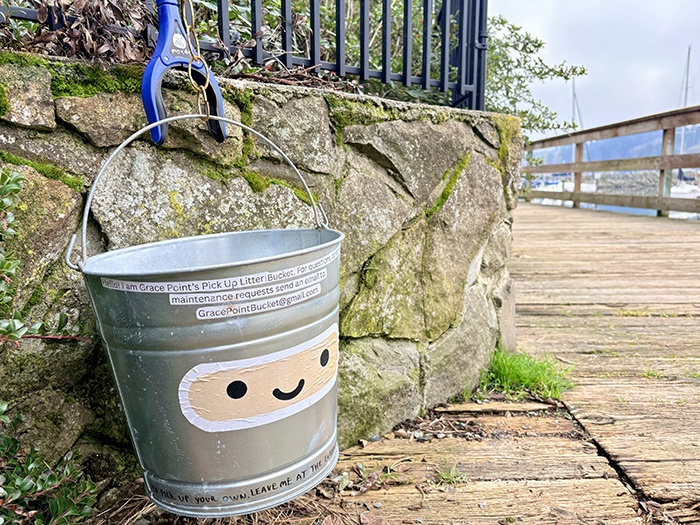
A smiling face greets visitors at one section of Salt Spring Island boardwalk: the Grace Point Pick Up Litter Bucket, one resident’s spontaneous creation that for the last month or so has been helping passers-by pick up garbage at the high-traffic waterfront location.

The bucket’s sponsor, who wishes to remain anonymous, said that after a few early hiccups — someone made off with the bucket’s first “arm,” he said, hopefully to pick up litter elsewhere — the little pail on the rail has been a cheerful friend to locals looking to tidy some trash.

Anyone interested in helping or establishing another bucket elsewhere on the island should reach out to gracepointbucket@gmail.com.

Viewpoint: We are a diverse community

0

By JASON MOGUS

I was disappointed to read our MLA Rob Botterell’s recent public statements opposing the Trust Policy Statement our current council is trying to move forward.

Mr. Botterell should remember he was elected to represent our whole economically and culturally diverse island, not just those in the traditional Green party base who have hardened around housing issues. 

Botterell’s criticisms of the Trust Policy Statement don’t hold water. He argues the current council shouldn’t dare move this process forward until another election, yet we’ve been watching this debate for two terms and almost seven years already. Laura Patrick was elected, twice, on a mandate that included housing and environment. The other Salt Spring trustee received the second most votes on a strong housing mandate, and many of the other 26 trustees across the Islands Trust area were also elected on strong housing mandates. It is not anti-democratic for our elected leaders to act on the orders the community gave them. 

What is more concerning is Botterell’s incendiary suggestion that the real reason an evolution to the Trust’s goals is being discussed is to unleash growth and development. “For those seeking urban amenities and growth, Salt Spring and the other islands in the Trust are the wrong places to live.” This tired argument gains clicks but lacks evidence. It dismisses both the data showing a third of this community is housing insecure, and the stories of countless working class and young people who struggle to stay in our increasingly unaffordable community.  

Botterell’s argument is suspiciously aligned with that of a small but vigorous group who have decided any attempts at dealing with our community’s housing crisis, no matter how incremental or responsible they are, is tantamount to treason of the founding principles of the Trust. 

I’ve been in rooms with dozens of islanders who care about making a difference on this issue that impacts us all. While there are varying degrees of agreement around what we should do, all agree we have to move forward, and that those with different views are acting in good faith.

Our MLA has had a full year on the job now. He should listen to a more diverse group of people before taking extreme positions that further erode trust in our institutions and needlessly divide our community.

The writer is a Salt Spring resident who works on campaigns for climate justice and housing around the world.

Islands Trust tax increase firms up

0

As both federal and provincial agencies continue to announce job cuts and other belt-tightening measures, finance-focused officials at the Islands Trust hope they can assure skeptical islanders — and fellow trustees — an upcoming tax increase here is necessary to keep the status quo. 

The draft budget before the Financial Planning Committee (FPC) as of Wednesday, Jan. 21 had inched back up to $11.94 million; with the year’s property values now set by BC Assessment, staff said the Local Trust Area general tax increase had shifted to 13.9 per cent, with the increase in the Bowen Island general tax levy rising 31.1 per cent.

For an average property, according to financial and employee services director Julia Mobbs, that’s a roughly $55 to $60 increase per household within the Local Trust Areas — and $50 to $55 for Bowen Island taxpayers.

Notably, the bulk of those tax increases is tied to replacing external revenue streams — like lost grants, lost investment income and lost draws from surplus and reserves, according to Mobbs, who said even zero change in spending next year would still require a 7.1 per cent tax increase for Local Trust Areas to make up the difference.

“And 3.7 per cent of the tax increase is due to non-discretionary costs,” she added, “such as elections and changes to base staff wages.”

That left only 3.1 per cent, which she said was due to more discretionary spending and inflationary factors — very little “wiggle room,” as Lasqueti Island trustee Tim Peterson put it.

Trustees asked staff to prepare “speaking notes” summarizing that lack of flexibility, to help them illuminate the budget — not only to other trustees during budget discussions at the upcoming Trust Council Committee of the Whole meeting but also within their own communities. Trustees said they were already fielding questions from islanders about the wisdom of tax hikes in the current fiscal environment — even from taxpayers who said they deeply valued the organization’s mission.

Indeed, the Friends of the Gulf Islands Society’s delegation to the FPC Wednesday supported a letter, not only opposing any new staff positions — within either the Islands Trust or the Islands Trust Conservancy — but also urging budget increases be capped to the rate of inflation.

“This is a plea for fiscal discipline from this committee,” said society member Maxine Leichter. “We feel the Trust cannot just go on adding staff year after year, especially when we see no increase in actual protection of the Trust Area as the [Islands] Trust Act requires.”

Leichter noted the environmentally focused society was saddened by the likely cut of a planned full-time biologist for the Islands Trust — a critical new position, they argued, given the organization’s mandate — and said that loss represented a misalignment of priorities more than simply an outright lack of funds.

“I know it’s hard to abandon [projects] that so much money has gone into,” said Leichter, pointing to the Trust’s now six-figure groundwater sustainability strategy project as an example. “But sometimes it’s better to cut your losses before there are more.”

The Committee of the Whole meeting on the budget is set for 1 p.m. Wednesday, Feb. 18 and can be viewed online through the islandstrust.bc.ca website.

Fire district creates Fulford hall pond

0

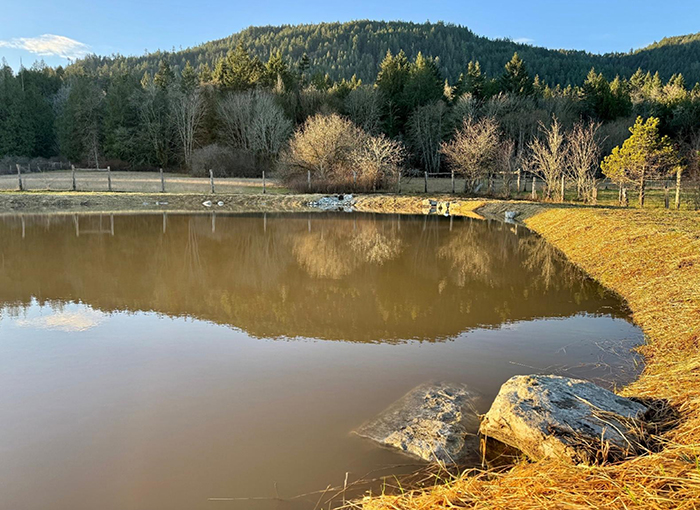
South-end firefighters have a new tool at their disposal: a recently completed 750,000-gallon water supply pond, now in service at the station serving Fulford. 

Salt Spring Island Fire Rescue Chief Jamie Holmes said water from the new pond will be used for training at Fire Hall No. 2, meaning firefighters won’t be pulling from the on-site well or tanks for training nights — and the substantial extra water will likely be a key resource for the district during emergencies. 

“It’s really going to boost our emergency response down toward Fulford,” said Holmes. “We can even take that water and pressurize the two training hydrants that are hooked up there, and put pressurized water out to the front tarmac of the fire hall.”

A six-inch dry hydrant pipe already installed at the site brings water to the corner of the nearby tennis court, Holmes said, where water tender trucks can pull in and out quickly. Holmes said the tailings from digging the pond were all used nearby, levelling out the training grounds and helping with some minor drainage issues around the fire hall — a “win-win,” he said, with most of the water now captured and sloping back into the pond.

The new pond is fully fenced for safety, he added, and a dock will be added in the spring — for drafting drills with the department’s portable water pumps. 

In other news, trustees agreed to support an effort led by regional fire chiefs who are forming a collective to address the role of improvement districts with the Office of the Fire Commissioner — specifically, Holmes explained, the exclusion of improvement districts like Salt Spring’s from fire inspections and investigations under the new Fire Safety Act.

Holmes said he felt joining the coalition was an opportunity to educate provincial regulators, who he had come to believe didn’t fully understand improvement districts — “And I don’t say that lightly,” he said.

“Every level of government I talked to [before the new act] said their rationale was that a regional district was a better representation of the community because they have regular elections,” said Holmes. “So when I explained to them that we also have elections — and hold them more often, so possibly an even truer representation of the public’s wishes — their only reply was, ‘oh.’”

The fire districts — so far including those on Thetis and Quadra islands, as well as Shawnigan Lake, Cowichan Bay and Mill Bay — hope a unified response will ensure any legislative changes don’t leave improvement districts away from the table. For now, according to board chair Rollie Cook, that support will take the form of a letter indicating their endorsement of the group’s work.

Editorial: Good old days are gone

0

At a time in life when personal connections can seem vanishing, it’s all the more tragic our treasured elders are urged to be suspicious of new ones.

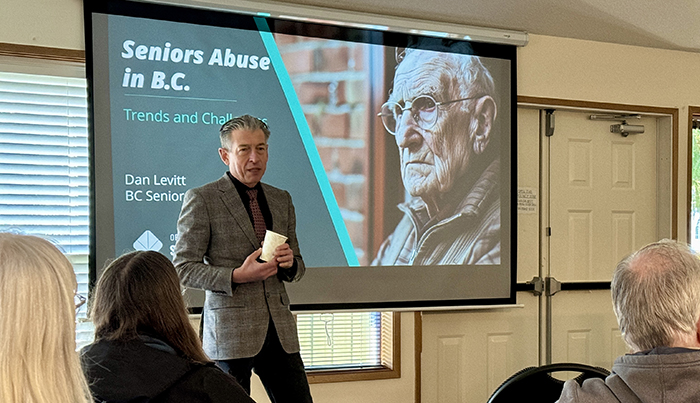
The message delivered from our visiting B.C. Seniors Advocate Dan Levitt may not have meant to be dispiriting, but there was a sad acknowledgement underpinning his excellent advice at the Salt Spring Seniors Centre last week: times have changed, and we need to keep up with them — even on Salt Spring.

The dramatic increase in calls to the province-wide Seniors Abuse and Information Line, or the rise in reported scams targeting senior victims, represent an industrialization of what once might’ve been a boutique area of criminal operation. With so much personal data being shared online, savvy scam artists have upscaled their efforts to direct fraud toward the most vulnerable with unprecedented precision — and with technologies that can now mimic the voices of loved ones, both seniors and those who care for them have to be vigilant.

It’s one thing to agree to take on the hard work of shifting our old habits; it’s quite another to recognize the downstream effects of making those now-necessary changes. Not picking up unknown phone calls, for example, or even being wary if they look familiar — because even an island prefix can be faked, Levitt confirmed — leaves many older residents mourning a lost opportunity for conversations, particularly as it becomes more difficult to get out and about to have them. It’s a complicated truth that a rise in these types of scams makes socially connecting programs offered for seniors — many supported by our own Salt Spring Seniors Services Society — all the more important.

Perhaps our local governments should also take a page from Levitt’s book of recommendations and begin work on a Seniors Plan — acknowledging this growing demographic’s needs before they reach crisis levels, and setting aside resources to meet reality. Because we will all be someone’s elder, sooner or later.

Nobody Asked Me But: The last Mecca of lost steps and unintentional backtracks

0

Let me be brutally honest. I have the worst sense of direction on the planet. Had I been born a few centuries ago and sailed with Columbus, I probably would have fallen off the edge of the earth. Had I been dogsledding with Robert Peary and searching for the North Pole, there’s no doubt in my mind that I would have been stranded together with a flock of penguins on a floating iceberg just off the shores of Antarctica. Had I been leading the Franklin expedition in the quest for a northwest passage that cut across the continent, I would probably have ended up bogged down in an endless lineup at Disneyworld.

It’s sad, I know, but I have a hard time knowing my left from my right, east from west and north from south. If it wasn’t for gravity, I probably wouldn’t be able to distinguish up from down. They say that there is no up and down in space, so maybe the life of an astronaut should have been my career choice. Unfortunately, any vital instruction telling me to turn left at Jupiter would jumble up any possible intergalactic travel plans for me.

Possibly even more challenging than trying to navigate the Northwest Passage are excursions to the local supermarket. Directions as to where I can find a package of Bob’s Red Mill organic ground flax are just as likely to send me and my shopping cart off into deep space as to the proper location in aisle 7B. Precise verbal directions and hand signals from supermarket staff employees may prove helpful to normal shoppers, but knowing the aisle and shelf numbers always seems to plop me directly facing the canned persimmons display rack. Being informed that a certain specialty item can be located two aisles over on the bottom shelf between the lactose free sour cream and the triple cream Greek yogurt may pinpoint the exact location to other shoppers, but is more than likely to deposit me smack-dab in the pet food section right in front of the doggie rawhide chewy bones. Most discouraging is the feeling I get after I have passed the bulk chocolate-covered jujubes five times and made a mental note to myself to finally pick them up on my last sweep through the aisles. Inevitably, I then forget which bin they are in, which results in my having to scan every container in the bulk food row. Almost as frustrating is leaving my buggy in one of the aisles so that I can quickly sprint over to pick up a forgotten grocery item in another location in the store, and then not be able to locate and retrieve the shopping cart no matter how much I search.

I have discovered, however, that all is not hopeless when it comes to having a rotten sense of direction. There are proven tactics and exercises that can increase the chances of not getting lost. The first and most important one is to ask directions. If you are of the male gender, you will never stoop to this strategy, so you might as well move right on to the next most important maneuver: using clues in your surroundings to assist in helping you find your way. You might recall that in the fairy tale Hansel and Gretel, the siblings dropped breadcrumbs as they wandered through the forest so they could later retrace their steps and find their way back home. It’s a pity that the crumbs were devoured by the forest wildlife, which is why the children ended up on the menu at the evil witch’s cake and sugar house. But hey, at least they had a plan. Other techniques for finding the way back home include tying one end of a large ball of yarn to your starting point, unrolling the ball until you reach the destination, and then rolling it back up as you follow the line of yarn back to where you started. This method is guaranteed to work unless any living being or machine happens to cross the line of yarn and accidentally or purposely breaks it.

Perhaps the most annoying challenge to navigating your way between here and there is the roundabout or traffic circle. Once considered an innovative engineering tool for integrating traffic flow, this monstrosity of misunderstanding and misdirection completely confuses both competent drivers and those who have zero sense of direction. As a result, either all traffic stops because nobody knows who actually has the right of way, or all traffic continues to go around in circles because nobody knows when it is their turn to exit the circle. If, by some miracle, you do manage to disengage from this merry-go-round of disoriented vehicles, you can be certain that the exit you took was not the one you wanted.

Speaking of confused directions, Salt Spring Island is possibly the Mecca of lost steps and unintentional backtracks. So many establishments and businesses have changed locations over the years that directions as to how to find these have to describe not only where they are presently, but also where they may once have been located. An example of such a direction could be something like “turn left at where the Video Ranch used to be before they moved into Grace Point and then head up the hill to the old hospital right across from what was once the cop shop.”

If you’ve lived on the island long enough, you may still remember how to find your way to the Vesuvius Inn or the Fulford Inn, although neither of these still exist. Long gone as well is the dark bar at the back of the Harbour House which was affectionately known as the Dungeon (or was it the Pit?). Any list of business past incarnations would have to include the credit union, which bounced around the downtown core so many times that you can still find old deposit slips blowing along the sidewalk and lining the shores of Ganges Creek.

Nobody asked me, but I’ve learned that it’s still possible to find my way around this island even if my sense of direction is beyond atrocious. The GPS app in my dashboard ought to be a great help if only I could locate its location on the instrument panel. Oh well, a little perseverance and a lot of luck wouldn’t hurt, especially since I can’t often track down my vehicle because I can’t find the actual parking lot where I last left it. Worst of all, however, are situations like the time I drove onto the ferry and walked off. Now that’s beyond beyond atrocious. That would have been the perfect time to jump off the edge of the earth.

B.C. Seniors Advocate shares tips to tackle abuse

0

In the face of a marked uptick in incidents of scams and abuse, local seniors and caregivers last week heard they have ways to fight back — and that on Salt Spring, local government should be stepping up as the island’s demographics shift. 

About 30 people attended a discussion led by Dan Levitt at the Salt Spring Seniors Centre Tuesday, Jan. 20. Levitt heads the Office of the Seniors Advocate, an independent agency in the B.C. provincial government, which acts in the interest of seniors and their caregivers.

Levitt’s office monitors and analyzes seniors’ services and makes recommendations to government and service providers to address systemic issues. He gave a preview of an annual report on elder abuse being released later this year, and said given the aging population in B.C. — and indeed on Salt Spring Island — the trends are worrying.

“Over the past five years, we’ve seen 28 per cent more calls to the Senior Abuse Information Line,” said Levitt. “Victims of violent offences reported to the RCMP are up 18 per cent, financial abuse reported to the Vancouver Police Department is up 68 per cent; trends are going in the wrong direction.”

And much senior abuse goes unreported. Levitt said victims often feel ashamed, or worry reporting would make things worse. Friends and family can watch for signs of abuse — different behaviours, he said, like if someone seems more generally anxious or depressed, or physical signs things aren’t going as usual. 

“When I worked in care homes, we were always concerned about bruising — and that’s a tricky one, because many seniors are more likely to bruise because of a blood condition,” said Levitt. “But someone might have poor hygiene, dehydration or poor nutrition; they might be going through their medications faster than usual. Or they might seem more isolated, withdrawing from social situations.”

Levitt said that isolation was a technique perpetrators of financial abuse in particular use — trying to isolate a senior so the grift is less likely to be noticed. Things to watch out for include the appearance of new legal documents, like a will or power of attorney, or changes in banking.

“They could have less money available all of a sudden,” he said, “or suddenly be more reluctant to speak about their financial situation.”

The days of one-off, small-scale scammers seem to be over. At last Tuesday’s event, island social worker Ellie Parks said she and her colleagues see a perhaps surprising number of people on Salt Spring being swindled, with the cons having an increasing level of sophistication — and tempo.

“Now it is organized crime, thousands of people,” said Parks. “This is their job, all day long: to scam people. And it’s very sophisticated.”

Levitt agreed there were good habits to get into, like avoiding unknown phone numbers, or regularly checking banking statements for irregularities. Parks said anyone concerned about themselves or someone else should reach out to Island Health for support, particularly if that kind of “outside expert” advice might be more convincing than hearing it from a family member. 

“And if you meet someone new on social media, be very wary,” said Parks. “Particularly if they want you to go to another platform. Salt Spring is a place where we have a high degree of trust, because we have such a strong community — but you have to be more on your guard now.”

Local government has a role to play, Levitt said. He regularly encourages communities to develop a “seniors plan” — something which would be undertaken by entities like Salt Spring’s Local Community Commission or the broader Islands Trust — to map out future needs as the community’s population ages.

“If you had a seniors plan for Salt Spring, then you might be thinking about things like transportation services for seniors, how many long-term care beds do you need, how many retirement homes — and how do you organize that?” said Levitt. “It’s a bit of a vision, some things will take a long time to get, but it’s worthwhile getting that plan so you know where you are going.”

In addition to Island Health, Levitt said anyone concerned they or someone they know is a victim of abuse could reach out to Seniors First BC’s Seniors Abuse and Information Line (1-866-437-1940), local RCMP (250-537-5555) and the Seniors Advocate Line (1-877-952-3181).

For more information on services from the Seniors Advocate office, visit seniorsadvocatebc.ca.

TreeFrog Daycare needs post-flood support

0

TreeFrog Daycare in Fulford has filled a vital community role for more than three decades, facing its share of “character-building” challenges, including its most recent one last week.

Staff arrived at the centre on South Ridge Drive Tuesday, Jan. 20 to discover a flood caused by a faulty toilet fill valve and water shooting out of a toilet tank.

Danielle Taylor, chair of the Fulford Harbour Childcare Society (FHCS), which runs TreeFrog Daycare, said the plumber’s assessment was that the bizarre scenario couldn’t be duplicated, “even if you tried.”

The result was more than an inch of water on the bathroom floor by Tuesday morning, which leaked underneath the walls and into daycare coordinator Lisa Bleskie’s office.

“Immediate action was taken to get soaking wet carpet removed, dehumidifiers and fans in place, and the plumbing issue repaired, and we were able to contain the situation in a way that allowed us to continue to provide care for the children scheduled,” explains a funding request letter sent to the Salt Spring Lions Club.

Lions Club treasurer Sandy Harkema had seen Taylor’s social media post about TreeFrog’s plight and asked that a letter be delivered in time for the club’s Jan. 23 board meeting. Bleskie and board members were thrilled when Harkema told them the board approved a $7,000 donation for the society.

Between that money and funds donated to a GoFundMe campaign so far, the society can deal with remediation costs either directly or through paying the insurance deductible, said Taylor.

“So the immediate issue of the flood has been dealt with — aside from having to refloor the office and stuff like that — but it basically opened up a Pandora’s box that we didn’t know existed to way bigger issues.”

Those include a need to replace the building’s original poly-b pipes, which the society has been advised will cause problems in the foreseeable future.

The timing of the flood was particularly unfortunate as it was the first day of the daycare’s operation under a new multi-aged program licence that helped address a staffing shortage causing a facility closure in December 2021.

“We had a quite comfortable nest egg when we had to close for six months due to lack of staffing, right after Covid,” said Taylor, “but obviously we had to eat into that, and there wasn’t much left when we reopened our doors. And we’ve just slowly been rebuilding these last two years, and it’s just been really, really hard.”

Other financial challenges included damage from a washing machine malfunction, hot water tank replacement and a period of higher staffing costs before the multi-aged program licence was obtained.

TreeFrog provides daycare for more than 20 island children. Taylor, who was among the facility’s first cohort in 1994/1995 and whose three children have also attended, said the society has a solid business plan and TreeFrog is in no danger of closing, but any and all community support is appreciated to tackle building upgrades in plumbing and other areas.

“If there are any donations of material or time or labour that the public can offer to get us back on our feet, that would be huge,” said Taylor.

People can reach out to the daycare at treefrogdaycare@shaw.ca or 250-653-4998.

Contributions can also be made to the GoFundMe campaign.

Opinion: A Missed Opportunity for Leadership on Shoreline Protection

0

By ETHAN WILDING

In its decision last week, the Supreme Court of British Columbia dismissed a judicial review challenging the Islands Trust’s rejection of the Baker Beach nature-based shoreline protection proposal.

The implication is troubling: that professionally designed, peer-reviewed solutions — supported by both the province and Fisheries and Oceans Canada — are being treated as unacceptable responses to shoreline erosion in the Gulf Islands.  Yet shoreline loss continues, driven by climate change, and the responsibility to adapt accordingly has not disappeared. This leaves homeowners in an untenable position, even as the Islands Trust itself acknowledges that property owners must have access to feasible, science-based means of protecting their homes.

So how did we arrive at this point, where acknowledged needs and approved science lead nowhere? Quite simply, through a breakdown in fair and predictable process. Although the court dismissed our judicial petition, the decision itself is sharply critical of how the Islands Trust handled our application. The judge found the Trust’s process so problematic that he took the extraordinary step of denying them costs. This means the Trust must absorb its own legal expenses as a direct consequence of its mismanagement here.

It did not have to unfold this way. When we entered the Islands Trust development permit application process, we did so deliberately and in good faith. We sought early meetings, followed staff guidance, and invested heavily in professional advice and technical work. We did this not because we expected special treatment, but because we understood the system to be rules-based. The premise was simple: if you understand the bylaws, meet them, and do the work required, the process should be predictable.

That premise failed.

For much of the application period, there was no indication that our proposal was anything other than compliant. We coordinated parallel reviews with federal and provincial agencies, assuming that land-use confirmation by the Trust was a necessary first step and not a discretionary hurdle that could change without warning. At no point were we advised early on that the application was considered defective, or that policies applicable to the nature of the development permit would not be met.

Then, without any clear explanation, the ground moved. Criteria appeared to change. Standards were applied differently than before. Communication slowed, then stopped. We were left trying to understand how a project that aligned with the Trust’s own stated objectives could suddenly be deemed unacceptable, without a clear or consistent rationale.

The court took explicit note of this. Justice Milman found that the Islands Trust should have communicated and raised fundamental concerns at the outset, rather than allowing the process to unfold over many months without clarity. As he wrote:

“The petitioners should have been told early on that the [Islands Trust] considered the applications to be defective . . . After submitting the original application on Dec. 27, 2023, the petitioners had to wait until May 2025, nearly 18 months, for a decision that was forthcoming only after an application was made to this court to compel an answer.”

The concerns did not end there. Justice Milman went on to observe that even when a decision was finally issued, the Trust failed to address key issues directly:

“The record before me indicates that the [Islands Trust] failed at any stage to address important issues squarely, such as the claim for an exemption based on the DFO letter or the question of how the opinion expressed in that letter could be reconciled with the [Trust’s] own conclusions as to the anticipated impact of the project on fish habitat.”

That finding bears emphasis. Throughout the entire process, the Islands Trust never engaged with us to discuss how the proposal might be adapted to address concerns, despite repeated requests for dialogue. At no point were we given the opportunity to modify the project in response to objections or evolving issues expressed by members of the public. Instead, after 18 months, our first and only indication of any deficiencies with our application came in the form of an outright rejection. Core questions were left unresolved, conflicting evidence was not meaningfully reconciled, and we were left without clear explanations for how conclusions were reached. This is not a minor procedural flaw; it strikes at the heart of administrative fairness.

Justice Milman acknowledged the consequences of this failure, noting that “all of this made the process, including the court process, more costly for the petitioners than it should have been.”

But the true cost extends well beyond legal fees. Consider the broader resources consumed: multiple technical and environmental reports, coordination across federal and provincial agencies, staff time across multiple departments, and litigation that could have been avoided entirely with competent administration. All of this for a privately funded project proposing nature-based shoreline protection, aligned with the Islands Trust’s stated goals.

There was another cost as well: opportunity. The fact is that shoreline erosion is an ever-escalating challenge in the Gulf Islands. Our generation, and future generations, will need to contend with this reality. But rather than working with us to develop an appropriate, science-based response, the Islands Trust declined to engage this project outright, missing an opportunity to provide leadership at a moment when clarity is urgently needed. A collaborative process could have helped implement a region-appropriate shoreline protection measure, one that could be evaluated and applied responsibly across our island and beyond. Instead, what could have served as a constructive example of how climate adaptation and clear land-use governance can coexist became a case study in procedural breakdown.

The broader concern here is the risk this case poses for projects going forward. Under British Columbia’s Local Government Act, development permit processes are meant to be predictable when established guidelines are met. If staff positions can be reversed without explanation, if timelines extend well beyond what applicants are told to expect, and if bylaw compliance no longer offers predictability, then the message to the community is clear: proceed at your own risk. That discourages exactly the kind of careful, responsible and environmentally conscious projects that the Islands Trust says it wants to see.

If there is a constructive path forward, it lies in reforming the process itself. The Islands Trust must recommit to a genuinely rules-based system, one where concerns are raised early, standards are applied consistently and applicants can rely on published bylaws rather than shifting interpretations. Clear timelines, transparent reasoning and respect for jurisdictional boundaries are not optional extras; they are the foundation of credible land-use governance. Without those reforms, future applicants will face the same uncertainty and the Trust risks undermining both public confidence and its own policy objectives.

The writer and Salt Spring Island resident is one of three petitioners in a recently dismissed B.C. Supreme Court case against the Salt Spring Island Local Trust Committee.

Baker Beach petition against LTC dismissed

0

Chiding Salt Spring’s Local Trust Committee (LTC) about its process, a B.C. Supreme Court justice nonetheless dismissed a petition for review from three islanders owning waterfront property above Baker Beach, a ruling that shores up trustees’ authority over land use on the island — even if that land is covered by water.

In a decision issued Tuesday, Jan. 20, Justice Warren B. Milman rejected several grounds for review advanced by petitioners Ethan Wilding, David Demner and Heidi Kuhrt concerning the LTC’s decision not to issue a permit for a shoreline stabilization project at their high-bank waterfront homes. 

Among their arguments had been that the LTC overstepped its authority in crafting development permit areas (DPAs) to protect ocean fish habitat in Salt Spring’s official community plan, specifically the DPA-3 “Shoreline” area, which the petitioners said amounted to an improper attempt to regulate fisheries — and that the authority falls under federal rather than provincial jurisdiction.

Justice Milman disagreed, siding with the LTC’s submission that the Islands Trust’s DPAs regulate “land use and protection of the environment,” not fisheries — and that “land” subject to regulation under the Local Government Act “includes land covered by water, including intertidal waters” and “the surface of water.”

Further, Milman wrote that he found no basis to distinguish between the power to regulate the placement of structures on the water and the power to regulate the placement of sediments in the intertidal zone — referencing the proposed “beach nourishment” material central to the property owners’ “green shores” erosion protection plans.

“Both are within the purview of the local government’s authority to regulate land use,” wrote Milman, “including the use of land covered (permanently or intermittently) by the ocean.”

As the successful party, the LTC — and by extension, island taxpayers — would ordinarily be entitled to having the costs of legal proceedings covered by the other party. The judge, however, felt differently, noting several deficiencies and lengthy delays in the process, all of which he laid at the feet of the LTC.

“After submitting the original application on Dec. 27, 2023, the petitioners had to wait until May 2025, nearly 18 months, for a decision that was forthcoming only after an application was made to this court to compel an answer,” wrote Milman. “Even then, the record before me indicates that the [LTC] failed at any stage to address important issues squarely . . . All of this made the process, including the court process, more costly for the petitioners than it should have been.”

Reached for comment after the decision was issued, Wilding said he and his neighbours were considering their options moving forward. Since then Wilding has provided a written response. The Driftwood also reached out to Salt Spring Island LTC chair Tim Peterson, who was unable to comment before press time.