A special multimedia exhibit opens at the Salt Spring Island Public Library program room this week, with the artist also providing a talk on opening night.
The Suitcase Project by Kayla Isomura shares the experience and history of the Japanese Canadian community’s mass uprooting and internment in the 1940s in a personal way that viewers can feel and connect with.
“Through her photography and video of the participants’ packing process, supplemented by local archival photos, we will learn about this dark chapter of Canadian history and connect with how it impacts us today,” explains a press release from the Japanese Garden Society of Salt Spring Island (JGSSSI). “It is also an opportunity to reflect on the uprooting and dispossession of people around the world due to natural disasters, political instability and war.”
Isomura is a Vancouver-based photographer currently exploring intergenerational trauma and racialized identity.
The show opens at 6 p.m. on Friday, June 2, with Isomura giving a talk at 7 p.m.
The Suitcase Project can be viewed Mondays through Saturdays in June when the program room is not otherwise in use.
Two other related events are scheduled for the program room. On Friday, June 16 from 5 to 8 p.m., Susanne Hunter, MD and RCC, will offer a Community Workshop of Intergenerational Memories. Hunter will lead a gently guided exploration of intergenerational and collective trauma and healing through the Japanese Canadian uprooting experience.
“We are all affected by intergenerational and cultural trauma — sometimes from the distant and sometimes from the more recent past,” states press material. “In this workshop we are going to explore the mistreatment of Japanese Canadians on Salt Spring Island and in B.C. before, during and after World War II from the trauma perspective.”
Hunter’s workshop is limited to 15 participants and people should pre-register at heiwagardensaltspring@gmail.com.
Then on Tuesday, June 27 at 7 p.m., SFU communications professor Kirsten Emiko McAllister presents a talk called Japanese Canadian Memory Projects: Rebuilding the Community and Recognizing Our Responsibilities Today.
“McAllister will explore how the community’s wider pursuit of social justice requires us to go beyond our own experiences of persecution and examine our responsibilities to Indigenous nations and our links to other groups facing persecution today,” states the JGSSSI.
The Suitcase Project event on Salt Spring is presented by the JGSSSI, with sponsorship from the Salt Spring Island Public Library.
The exhibition’s community talks and workshop are funded by the Salt Spring Foundation, archival photographs are courtesy of the Salt Spring Island Archives and this mini travelling version of The Suitcase Project is a loan from the Nikkei National Museum.
Salt Spring Island voters have elected Gayle Baker, Ben Corno, Earl Rook and Brian Webster to serve on the island’s first Local Community Commission (LCC).
The four will join Salt Spring’s electoral area director Gary Holman to form the five-person commission under the Capital Regional District (CRD), with its first official meeting taking place Monday, June 19. Holman had championed the LCC concept as voters re-elected him in 2022.
Some 10,000 people were on the CRD’s registered voter list before election day: 9,905 resident property electors and 128 non-resident property electors. The number of eligible voters grew to 10,219 (from 10,033) due to people registering at the advance or May 27 polls, according to CRD chief election officer Kristen Morley, who reported the total number of voters that cast ballots in this election was 3,262.
Salt Spring Island’s voter turnout — reported alongside official results Wednesday, May 31 — stood at 32%.
As part of the official determination of results, the CRD said it confirmed and verified the accuracy of all ballot accounts, confirmed the calculation of vote tallies from the electronic tabulators and ensured the correct consolidation of total results from across all polling locations including mail ballots.
New commissioners expressed their gratitude on Monday. Top vote-getter Baker — with 1,977 votes — said she was particularly thankful to “loved ones, who were there to encourage when it got tough,” and to those who helped with the campaign.
“I am touched by the amazing support from hardworking folks always willing to help,” said Baker. “It takes a village. I have hope that this victory will help pave the way for progress on our most important issues. Working as one, we can get it done.”
Corno, in fourth place with 919 votes, said he was “flattered” to be elected and eager to begin work.
“I’m looking forward to finding my feet with this group,” said Corno. “Maintaining the value of the knowledge-gathering experiences of the past will help us to become both efficient and accurate.”
Ben Corno, one of Salt Spring’s first four Local Community Commission members.
Corno added he wanted the community to reach out to him to share their thoughts and vision for the future of CRD services that the LCC is helping to administer.
Webster, who received 1,974 votes, echoed the sentiment, saying every community member needed to feel welcome and “that their views are valued.”
“We have a great deal of work to do and nothing is more important than making sure the LCC meetings are as open and accessible as possible,” said Webster. “We have a strong team on this first-ever Salt Spring LCC and I know we all are motivated to make our local government effective and good value for tax dollars.”
Webster thanked both Salt Spring’s voters and those islanders who stepped up to run.
“We had a lot of good candidates,” he said, “and I expect many voters thought long and hard about which four would represent our community best.”
Rook (1,538 votes) joined in appreciation for “cordial and respectful” campaigns run by all candidates, as well as the keen interest voters showed during the campaign period, thanking them for their “commitment to democratic self-governance.”
“I spoke with many people over the course of the campaign and was impressed by the depth of their questions and their understanding of the issues,” said Rook. “Continued engagement with Salt Springers will be key to the success of the LCC.”
Rook said he felt the first LCC commissioners needed to set the tone for future commissions: “effective, transparent and responsible.”
“I think the commissioners we elected have the skills and motivation to work together in a constructive way for the benefit of the community,” said Rook, “and I look forward to being a part of that effort.” Salt Spring Island voters approved the change of CRD governance that created the LCC in a referendum held at the same time as local elections in October 2022. The LCC election saw about half the candidates combining forces during their campaigns. Positively Forward, a group that had initiated the process leading to last fall’s referendum, publicly endorsed Baker, Rook and Webster, although those three did not officially run as a “slate” or share a platform. Cudmore, Harris — also a Salt Spring Islands Trust trustee — Kerrigan and Marcotte had declared themselves as a “Core-4” slate. Corno ran independently, as did the balance of candidates. Salt Spring CRD director Gary Holman provided the following comment: “Thanks to all the candidates who put themselves forward in the election, and congratulations to Ben, Earl, Brian and Gayle. I look forward to working with you over the next three and half years.”
Salt Spring Island voters have chosen their first Local Community Commission (LCC) representatives.
Gayle Baker, Brian Webster, Earl Rook and Ben Corno were the top-four vote-getters and will become members of the LCC under the Capital Regional District, joining Salt Spring’s electoral area director Gary Holman, who had championed the LCC concept.
With results still unofficial, the vote tallies were as follows:
Gayle Baker: 1977
Brian Webster: 1974
Earl Rook: 1538
Benjamin Corno: 919
Jennifer Lannan: 863
Jamie Harris: 842
Jennifer Kerrigan: 790
Lloyd Cudmore: 753
Nejmah Guermoudi: 680
Donald Marcotte: 649
Jesse Brown: 381
Jennifer McClean: 296
Kylie Coates: 285
David Courtney: 284
Eric G. March: 146
Some 10,033 people were on the CRD’s registered voter list: 9,905 resident property electors and 128 non-resident property electors. The number of eligible voters would have grown due to people registering at the advance or May 27th polls.
Cudmore, Harris, Kerrigan and Marcotte had run as a “Core-4” slate. Harris is also a Salt Spring Islands Trust trustee, elected last October. Baker had served on the transportation and parks and recreation commissions under the CRD, and Webster had been a parks and recreation commission member.
Salt Spring Island voters approved the change of CRD governance that created the LCC in a referendum held at the same time as local elections in October 2022. Positively Forward, a group that had initiated the process leading to the referendum, publicly endorsed Baker, Rook and Webster.
Check back on this website or see the May 31st Driftwood newspaper for updates to this story.
Andria Scanlan won’t ever forget the howling winds and trees that came crashing down around her house that December afternoon in 2018.
“We have a long distance view from Channel Ridge, and I could see and hear the gusts rolling in and watch the trees bending over almost to the ground before they would split and crash like thunder,” she said. “It was terrifying. Power was out for 11 days, and our carport was destroyed. Thank goodness no one was hurt.”
Many islanders remember that severe windstorm that hit Salt Spring and caused widespread power outages, downed trees and property damage. Also seared into memories is the atmospheric river of 2021 that washed out many roads, and the extreme heat dome in the summer of 2021 that saw many people suffering under sweltering temperatures.
We are getting all too familiar with the effects of wildfire smoke in our skies every summer. Fortunately, we haven’t experienced a catastrophic forest fire on the island yet. Nevertheless, the fire department deals with an average of nine brush fires and eight to 10 structure fires each year, which could potentially ignite a disastrous and widespread wildfire.
Climate change undoubtedly contributes to severe weather conditions, threatening our community and jeopardizing our families and homes. Our forests, however, can play a vital role as buffers and can safeguard us against wildfires, road washouts, flooding, extreme heat, and drought, and, most importantly, preserve the quality of our drinking water.
According to forest ecologist Erik Piikkila, “Healthy forests play a super important role in reducing the impacts of climate change, such as flooding and forest fires. They act as natural defence systems, providing cooling, shading and water retention during periods of intense heat, slowing down and absorbing water and preventing road washouts during heavy rainfall. They even slow down winds during severe storms. Also, healthy forests help store water in the ground, recharging our groundwater supplies, which is critical during our summer droughts.”
Forest ecologist Erik Piikkila.
Piikkila comes from a forestry family from the Comox Valley and has extensive experience in the industry, working for the BC Forest Service as a forest technician for several years, and has been trained in forest ecology by world-renowned forest scientist Jerry Franklin. Piikkila has been a principal consultant with Transition Salt Spring (TSS) and plays a key role in TSS’s Hwmet’utsum/Mt. Maxwell watershed restoration project. This project aims to restore a forested area in the North Salt Spring Waterworks District watershed where historical land use has made the area vulnerable to climate change and forest fires.
“Contrary to being a fire risk, healthy forests can act as natural firebreaks. A diverse, rich understory can act like a sponge, keeping the forest floor damp. This lush vegetation makes it hard for fires to start and spread,” says Ruth Waldick, Ph.D. and lead scientist on the Hwmet’utsum (Mt. Maxwell) project.
Salt Spring’s assistant fire chief Mitchell Sherrin says a diverse forest is fire-resistant.
“The most resilient trees, such as Douglas-fir with their thick bark, and native ground-covers such as salal, have adapted to protect them from fire, while others, such as Garry oaks, have deep root structures helping them to regrow and regenerate after a fire. In contrast, invasive plants such as broom and gorse can power up a wildfire, fuelling the fire due to their naturally flammable oils. There are no real problems with the native species; they are perfectly adapted to fire.”
Although our island is covered by 14,000 hectares of forest, over the last century, the Coastal Douglas-fir zone on Salt Spring Island has undergone changes due to logging, housing, road building and other human activities. Many of these forests have been replanted and consist of second- and third-growth trees of the same age and type, which have grown very close together with very few large old trees. These plantations have altered a naturally fire-resistant and diverse ecosystem to one vulnerable to fire and severe weather. Forest ecologists call these single-species forests “monocultures” or “tree plantations.”
Many of these forests don’t hold water well and lack the native understory that prevents washouts and flooding in extreme rain. Salal, Oregon grape, ocean spray, moss and lichen mats contribute to a healthy understory.
Over 75 per cent of Salt Spring’s forests are owned by private landowners, which gives most of us a unique opportunity to play a big role in ensuring that the forests are kept healthy and resilient to the effects of climate change.
“Individual property owners can play a crucial role in maintaining healthy forests to protect themselves against climate emergencies,” says Piikkila. “We need to manage the forests in a way that restores some of the biodiversity and complexity that made them naturally resistant to fires. Thinning tightly packed trees can create small gaps in the canopy, allowing light to reach the ground, which encourages the growth of saplings and understory vegetation. These gaps also reduce the risk of fire moving across the forest canopy. Removing invasive plants and leaving some dead standing trees and large logs on the ground as moisture sponges are a few actions landowners can take.”
Transition Salt Spring is committed to helping islanders care for their forests through collaborative partnerships and building upon the Maxwell watershed restoration project, which has gathered a community of partners to share expertise and the latest science to apply on the ground. As part of this effort, TSS is rolling out workshops for islanders and practitioners to exchange lessons learned and promote knowledge sharing.
Reflecting on the damage from the windstorm that hit Salt Spring in 2018, Scanlan shares, “If I had known then what I know now about how a healthy forest can stop trees from coming down under high winds, perhaps the damage wouldn’t have been so severe. It’s never too late to learn and take action.”
If you want to learn more about healthy forests and protect your home from climate emergencies, register for Transition Salt Spring’s upcoming webinar on Thursday, June 1 or a field trip walk in Duck Creek on June 4, both with forest ecologist Piikkila.
Last weekend saw the fundraiser exhibition for the Salt Spring National Art Prize (SSNAP) with an exhibition devoted to fine craft artisans, held at historic Mahon Hall. Curated by Anthony Matthews, the show included 36 Southern Gulf Islands makers across diverse media, including clay, textiles, metalwork, glass, basketry, wood, stone and more.
Titled PUSH, the exhibit explored the intersection between fine craft and fine art. The artisans were asked to take their material and process to the very edge and create work that “pushes” their craft solidly toward the realm of art. Visitors to the exhibit saw exquisite and outstanding pieces that transcend their disciplines, inviting visitors to ponder the question “Is it craft or art, or perhaps both?”
The quality of the works was exceptional and is a reflection of the high calibre of artisans working on these islands. Collectors seemed to agree: as of this writing, one third of the works had been sold.
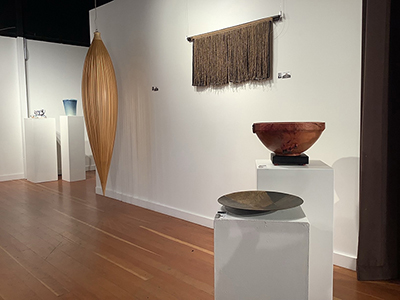
Five of some 40 pieces in the PUSH exhibit are, clockwise from left, Margo Zak’s ceramic vessel, Fine Plumb Light by Peter Pierobon, Hippolyta’s War Belt by Joanna Rogers, arbutus bowl with rock inclusions by Dave and Allison Roberts, metal disk plate by Steve Paterson.
To start off the festivities on Friday was a pair of receptions, one with the artists meeting SSNAP donors and sponsors and following that was an opening for the whole community. Mahon Hall was filled with enthusiastic visitors for the entire day and evening.
On Saturday evening, a panel discussion was held to explore the theme of the exhibit. Three highly respected artisans — studio furniture maker Peter Pierobon, textile artist Jane Kidd and potter Gary Cherneff — joined Steven McNeil, the curator of Canadian Art from the Art Gallery of Greater Victoria, in a panel moderated by exhibit curator Matthews. Attendees enjoyed a lively discussion and were able to dialogue with the panelists directly.
Julie MacKinnon mini ceramic vases, with Jane Kidd textile piece on the wall behind.
Something of a dry run for the SSNAP finalist exhibition, it gave the organizers an opportunity to engage with the community of artists as well as the visitors and residents during a traditionally busy Victoria Day weekend.
We can all look forward to the fifth biannual SSNAP finalist exhibition opening this Sept. 22. People can join the SSNAP social media pages and email list to stay in touch. Artists have until midnight on May 31 to get their submissions in.
On May 17, Penelakut and Salt Spring communities came together to witness the unveiling of new interpretive signage by Fernwood Wharf, and to share a celebratory meal on the lawns of the Fernwood Road Café. The crowd included Penelakut Elders, knowledge keepers and community members, Fernwood School students, and many Salt Spring community members.
Also present were members of the extended Sampson family, descendants of Penelakut Lucy Peatson and Henry Sampson, an early settler at Fernwood.
The two panels, back to back on a cedar frame, explore the historical and current relationship of the Penelakut people to Tl’elhum (Salt Spring Island) and its surrounding waters using art, photographs and testimony. Created under the guidance of the Penelakut Sulxwe’en (Elders group), the panel content is the result of four years of relationship-building between the Penelakut people and the small Salt Spring project team, part of the Salt Spring Island Historical Society and Archives.
On that beautiful day, with a warm sun reflecting on happy faces and a cooling breeze off the water, Augie Sylvester lifted his drum and opened the proceedings with an ancient song. Following a short prayer, the panels were uncovered and James Charlie, chair of the Sulxwe’en, welcomed everyone and spoke from his heart about the importance of the day, the challenges of creating the panels, about truth, and reconciliation.
After the community-created meal, Penelakut Elders shared how much this day meant to them, how they felt welcomed and feasted, and how the panels honoured their story.
The Fernwood panels — born of earlier friendships forged in 2003 when Penelakut and Salt Spring Islanders joined forces to protect an ancient burial site at Walker Hook — also honour the memory of the late Donna Martin. She was instrumental in that earlier (unsuccessful) fight, keeping the Penelakut connections alive through the subsequent protection of Grace Islet. In 2020, when Martin died, her daughter Tara looked for a way to honour her mother, establishing the Donna Martin Legacy Fund to support Indigenous signage at Fernwood and in Ganges.
That fund helped bring this project to completion, as did support from the Salt Spring Island Foundation, Salt Spring Arts Council, Mouat’s Trading and many businesses, organizations and individuals.
The Salt Spring Indigenous Signage Project continues under the auspices of the Salt Spring Island Historical Society and the dedicated creative team. Watch for the coming four panels in Ganges highlighting shared usage of the area and the voices of elders and youth from the SENĆOŦEN and Hul’q’umi’num’-speaking nations. Expect to see them in late summer or early fall.
In our fast-paced, technology-driven world, where stress and anxiety levels are soaring, a unique form of therapy has emerged uniting nature and horses.
Equine Facilitated Learning (EFL), a branch of nature-based education and eco-therapy, has gained recognition as an effective method for improving health and wellness, fostering personal growth, and developing essential leadership skills. This article explores the profound benefits of EFL for individuals of all ages and sheds light on how this transformative approach can positively impact their lives. Prior experience with horses is not a requirement to experience these benefits.
Personal Growth through Horse Wisdom
EFL offers a distinctive approach to personal growth that goes beyond traditional methods by emphasizing learning through direct interaction and experience. Horses offer unbiased feedback, reflecting and mirroring our emotions and energy. This feedback becomes a valuable tool for self-reflection and self-awareness, allowing individuals to gain insights into their communication styles, behavioural patterns and areas for growth. The horse-human bond deepens individuals’ understanding of their own emotional states and helps them develop greater empathy and compassion towards others. By embracing the honest reflections from horses, individuals can develop a stronger sense of self, improved emotional regulation and empowerment to overcome challenges.
Leadership Development: Exploring Herd Dynamics and Interpersonal Connections
Based on years of research into herds and nomadic pastoralists, Linda Kohanov published a groundbreaking approach to socially intelligent leadership incorporating five key roles: the dominant, nurturer/companion, sentinel, leader and predator. By engaging with horses and a specially trained facilitator, humans can learn more about the roles they emphasize and the roles they find challenging. These practical insights help participants balance the five roles to enhance leadership qualities applicable in both personal and professional settings. A balanced leader values the diverse contributions of each team member, fosters open communication, and creates a culture of trust and collaboration. Through their presence, purpose and nurturing approach, these leaders inspire individuals to reach their full potential while guiding the collective towards shared success.
Wellness: Connecting with Nature and Horses as Healing Allies
The hectic nature of our modern lives has made finding relaxation and solace increasingly elusive. EFL recognizes the profound benefits of connecting with nature and horses as a form of healing for the mind and body. Spending time in the presence of horses, engaging in activities such as grooming, equine-guided meditation and mindfulness has a profound calming effect, reducing stress levels and promoting relaxation. A harmonious connection with horses serves as an antidote to the demands of our contemporary lifestyle. Nature and animals become powerful sources of healing, restoring balance and fostering overall well-being.
Building Resilience: Fostering Connection and Coherence
By cultivating coherence — a state of physiological, mental and emotional balance — we can experience a range of significant benefits. Some specialized facilitators combine EFL with the research of the HeartMath Institute, prioritizing the development of resilience through connection-focused experiences and coherence practices. Horses are “super coherent” and can help individuals cultivate their own balance and regulation. These experiences promote resilience, empowering individuals to navigate life’s challenges with greater ease and bounce-back from setbacks. Engaging in coherent breathing techniques, mindfulness exercises and heart-centred practices helps regulate the autonomic nervous system, leading to decreased levels of stress hormones and a greater sense of calm and relaxation.
In conclusion, Equine Facilitated Learning harnesses the healing power of horses to address the challenges of modern life. From personal growth and leadership development to improved health and wellness, EFL offers a transformative approach for individuals and groups. EFL is unmounted and does not require any prior horse experience, a fear of horse can also be accommodated. By immersing oneself in the presence of horses, connecting with nature and embracing the lessons they offer, individuals can embark on a journey of self-discovery, resilience building and personal empowerment.
Juliana Brossolette is triple certified, licensed, registered and insured and has 30 years of horse experience. Juliana apprenticed under industry pioneer and bestselling author, Linda Kohanov, and offers signature services with her herd of three Iberian horses at a private facility on Salt Spring Island. She also offers specialized coherence training as a HeartMath facilitator. To learn more, visit ConsciousEquineConnections.com.
An official-looking document circulating on social media has alarmed Salt Spring’s liveaboard boater community, and officials rushed to put distance between themselves and a citizen-crafted bylaw proposal — itself still in early draft form, according to proponents.
Islander Glenn Stevens said he had drafted the version of the Clean and Safe Harbour Initiative recently posted online, but that it was not a final document — and that it wasn’t an attempt to get rid of everyone living in boats at Ganges.
“That’s not the bylaw that we were going to submit to the Trust in June for their consideration,” said Stevens, who attended an evening town hall meeting held by Salt Spring’s Local Trust Committee (LTC) Wednesday, May 17. “It’s a very early edition. And it does not want to kick out the liveaboards, period. That is not the goal.”
The draft bylaw has not been formally presented to the LTC, but trustees were nonetheless peppered with questions from people who made their homes afloat in Ganges Harbour. Several expressed concerns, not just with the substance of the not-yet-proposed bylaw — which in its current form seeks to establish a fee permit system and strict regulations for boats staying more than 48 hours — but also with the lack of engagement with the liveaboard community.
While trustees acknowledged a familiarity with the proposal — Stevens first broached the subject of such regulations to the LTC in February, during a regular meeting’s public comment period — they maintained that reaching out to people who lived on boats was premature, while echoing the sentiment that no one wanted to remove them from Ganges.
“There is no bylaw before this Trust committee,” said trustee Laura Patrick. “There’s a citizen group that’s working on something, but that’s not legislation. This body has not asked for regulation of the harbour.”
“This isn’t from us,” agreed trustee Jamie Harris, who added that Ganges Harbour might represent “a huge opportunity.”
“I think we need more liveaboards in the harbour,” he said, “and to have it done cleanly and safely. We have a housing problem, and this is a cheaper way for people to be housed — and people might enjoy that lifestyle.”
Patrick also said that recent bylaw officer activity in the harbour was unrelated, and coincidental.
“I know that there was bylaw enforcement on the water, but they were out there because of complaints of commercial use on the water, not the liveaboards,” said Patrick. “They do not enforce the rule that we have that applies to liveaboards.”
That rule technically prohibits people from living on their boats within Ganges Harbour — or, more accurately, does not permit long-term occupancy at any of the water-covered parcels there under the authority of the Islands Trust. There has been little appetite for enforcement of those land use bylaws, partly because of the lack of lower-cost housing elsewhere on Salt Spring Island.
Capital Regional District (CRD) director Gary Holman, who represents the island’s electoral area and was also at the LTC’s town hall, said some form of regulation had the potential to increase housing security — if done respectfully.
“I think it’s worth pursuing the idea of secure tenure for liveaboards in the harbour,” said Holman. “Right now, liveaboards are not allowed, so you have absolutely no security at all. I realize it does raise concerns, so this means [the community] has to stay on top of it, if the Trust committee decides to pursue it.”
Stevens said the citizens’ initiative was born from a sincere concern about both the environmental health of the harbour and the wellbeing of those who live there.
“I think everybody wants a clean and safe harbour,” said Stevens. “We don’t want garbage in the harbour, we don’t want human waste.”
“There’s a whole pile of boats that have just been left, and nobody’s living in them,” said Harris. “And that’s a concern. Some are sinking. There are some docks out there that have industrial things on them that are very compromised, and there are reports of stuff being thrown overboard.”
But, Harris added, the people causing those problems were in the minority — and if legislation eventually appeared, he said he would be an advocate for liveaboards “doing it right,” possibly even expanding resources and services.
“As long as your sewage and garbage aren’t going into the water, then you’re completely going to be legal to live there,” said Harris.
“We want to work as a community to make sure that it’s safe,” said Stevens. “Of course, it’s only going to succeed if we’re all in this together.”
But even with robust engagement of the liveaboard community — something Stevens repeated was critically important to the success of any regulation — trustees admitted there was only so much the LTC could accomplish this term with its limited resources.
“We’ve spent some time trying to assess and prioritize the work we’re wanting to do,” said LTC chair Tim Peterson, speaking directly to the liveaboard residents in the audience. “That proposed bylaw by the citizens did not factor in that. So I hope that gives you some sense of security, that it isn’t high on our list at this point.”
I love living on Salt Spring. I feel very lucky to have spent the last 27 years on this beautiful island, with wonderful people who work together with respect, and humour to build a community that is accepting, engaged, vibrant and resilient.
Like on all islands, our volunteers are amazing. They are the life blood of Salt Spring. We have more volunteer organizations and clubs listed in our phone book than communities twice our size. They hold wildly successful events like our Fall Fair, the Pride Parade (third largest in BC), Ruckle Heritage Farm Day, festivals of ALL kinds — from the film festival to the Blossom Picnic and beyond — theatre productions, and really fine music (to name only a few) and they do these every year.
Volunteers work with others, including governmental entities: run our beautiful library, were responsible for the construction of ArtSpring and help to run it, put solar panels on the roof of the secondary school and with the energy cost savings give out scholarships to students, started our community’s transit system, take care of our community halls, and run all kinds of sports activities for kids. They have constructed kilometres of pedestrian pathways (open to everyone, 24 hours a day), the skateboard park, indoor tennis and squash facilities, our indoor pool and so much more.
These wonderful organizations of volunteers are also responsible for most seniors’ and low-cost housing on the island and they have protected thousands of acres of public green space. Every year we are growing more food, and we have an Area Farm Plan, an Agricultural Alliance and a Farmland Trust all because of volunteers. We have people keeping us safe doing Search and Rescue and firefighting and we have an exceptional neighbourhood emergency response (POD) program.
I am personally thankful for Lady Minto Hospital where the care is exceptional and patients are treated like family. Our thriving arts community helps define us. Our schools are great. We have hiking trails galore and everywhere you look it is just plain gorgeous.
I am not saying we can’t do better . . . but give me a break. Living on Salt Spring Island is pretty good, especially if you compare us with any other place our size. At this time in our history, let us remember, we have done all this under our current model of governance.
In our brilliance and with an attempt to govern ourselves even better, we have voted “yes” to the formation of a Local Community Commission and now we need to elect four very good people to both protect what is working well on our island and make our community even better.
It’s hard to believe that something could overshadow Salt Spring’s first Local Community Commission election, but that is exactly what has happened.
After months of rumours and back-channel buzz, most of Salt Spring Island’s physicians issued a letter to the community on May 19 outlining the dire state of affairs at Lady Minto Hospital when it comes to staffing shortages. The letter was sent from the LMH Medical Staff Association to its main community partners: the Lady Minto Hospital Foundation, the Salt Spring Community Health Society and the Salt Spring Health Advancement Network, as well as Island Health, and was also filed with the Driftwood.
For residents, the most alarming part of the letter is news that for 25 overnight shifts between now and the end of August, the emergency room will have no on-site physician services available. Island Health was quick to formulate a response, pointing out that off-site physicians are consulted remotely to support the emergency department in those cases, and admitted that has already happened four times this spring. Midwifery and psychiatric services are also severely impacted, the medical staff say.
The giant elephant in the room is the brand new, larger emergency room currently growing at the hospital site. Island Health has always promised it would cover the extra costs of staffing that facility, but if they can’t staff the current ER it begs the question how they plan to take care of an expanded one.
The Copper Kettle Community Partnership has already offered to spearhead a broad community effort under a “save our hospital” banner. Partnership members Marsha Goldberg and Cherie Geauvreau and others on their team are calling on all non-profits, businesses, churches, charities, schools and sports organizations to participate, as well as concerned individuals. They say they need places to set out petitions and sign-up sheets for volunteers and suggestions.
We can support those efforts, but they and other community members need to hear exactly what our hospital medical staff feel is needed and how those things might be achieved. We look to the three community partners listed above to liaise with the physicians and Island Health, and to work with groups like Copper Kettle or others to get the most effectiveness out of any grassroots campaign.