Home Blog Page 196

PAGE, Robert

1939~2023

Bob is survived by his wife Gabrielle (Gabe) and three children, Laura Lea (Doug), Blair (Lisa) and Andrea, and five grandchildren. After retiring  early Bob and Gabe moved to Salt Spring Island and have spent 30 happy years here. He worked at several part time jobs over those years and made many friends in the community. 

Our thanks go out to the health care workers who helped Bob stay at home for as long as possible and to Dr. Ron Reznick for all his care.

Collaboration and enthusiasm on display at first LCC forum 

0

Salt Spring voters got their first in-depth look at potential future members of the new Local Community Commission (LCC) this week, as an online forum brought a preview of engaged, earnest candidates in front of the public — and each other. 

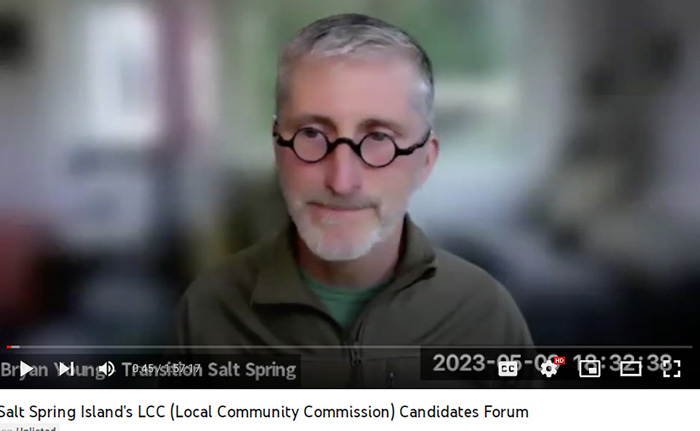
About 170 islanders tuned in to a Zoom discussion moderated by Transition Salt Spring chair Bryan Young and Salt Spring Island Farmland Trust co-chair Sheila Dobie. The two-hour event followed a tight format that included questions the nine candidates present had seen in advance, followed by several they hadn’t — and even an opportunity for candidates to ask questions of one another. 

And if that last was a test of the hopefuls’ capacities for respectful dialogue and collaboration once on the LCC, according to Young, the evening’s winners may indeed have been the voters. 

“I think we were prepared with the hammer to come down on everybody,” said Young, who noted that even in the back-and-forth allowed between candidates, no one spoke over anyone or cut other people off. “I appreciate your grace, and your patience with one another.” 

Public questions — and those from candidates to one another — were directed at individuals, and the most went to former Parks and Recreation (PARC) commissioner Brian Webster. Webster was quizzed on his own policy priorities, and his answers were unapologetically ambitious — outlining a plan to not only deal with Capital Regional District (CRD) services within the LCC’s current mandate, but a hope to expand to other services on Salt Spring. 

“Do you really think we should be talking about this when the LCC is so new?” asked fellow candidate Earl Rook. “The commissioners might need some time to learn the system before we go delving off into new and different things outside the mandate.” 

“There are pressing issues in the community that we need to be dealing with,” said Webster, pointing to challenges surrounding North Salt Spring Waterworks District’s moratorium on new water connections and housing for working people as examples. “We can’t wait around for the first term to pass before talking about [these] issues.” 

Rook himself had a busy night; a question from candidate Jennifer Lannan on specifics from the Community Economic Sustainability Commission’s March report on the island’s economy led to the political newcomer positing how the economic development portion of LCC responsibilities might naturally encompass policies to encourage affordable housing — and even additional commercial or industrial space in Ganges. 

“We need to support a diversified economy,” said Rook. “[Small businesses] struggle just to get a place on the island where they could make a go with their business. Young artists don’t have studio space, and in our farming community the price of land is making it terribly difficult for new people to enter.” 

Candidate Nejmah Guermoudi, who at one point led a lively discussion on a sustainable social and economic development framework known as “doughnut economics,” spoke to ways the LCC could encourage walkability and active transportation on the island as part of environmental responsibility.  

“We need the tourism,” said Guermoudi. “We want these folks to come over. But they’re all driving.” 

Guermoudi and candidate Eric G. March had a congenial back-and-forth — March said he was mostly a pedestrian on the island, cycling occasionally from his home “about 5K out” from Ganges. 

“We really need to find ways to support our workers and our vulnerable community members,” said March. “We need to build bike lanes, pedestrian pathways and better bus service — really get people out of their cars and lower that carbon footprint.” 

Candidate Gayle Baker pointed out it was “easy to say we need bike lanes everywhere,” but that collaboration with entities like the Ministry of Transportation or BC Transit would take effort. 

“As you all know, we don’t own our roads,” said Baker, who was the most recent chair of the Salt Spring Island Transportation Commission. “So unlike PARC, that can make some decisions, we have to partner, and we have to collaborate, and we have to have a good relationship. We’ve done some of that, but boy, we can do so much better.” 

Baker said she would use her collaborative experience to advocate for traffic initiatives, including better road markings, traffic calming and reduced speed limits in Ganges.  

Candidate Jennifer McClean pointed out the lack of public washrooms in Ganges, and brought a host of ideas to improve bus service on Salt Spring — a climate problem, she said, but also a socioeconomic one. 

“I think we have to look at the people who don’t have very much money,” said McClean, who said she thought the cost of transit needed to move toward greater equity. “They’re carrying the lion’s share of the burden to solve climate change.” 

Candidate Ben Corno spoke to a pressing need for reducing fire fuel load inside the parks that surround Salt Spring’s population centres — and how critical it would be in the future for local food growers to be supported by LCC policies as food security became a priority as the climate shifted.  

“When we plan our villages, we need to be considering how our comfortable existence here could go badly, and plan away from those weaknesses,” said Corno. “Empowering our local food system by supporting farmers and vendors of local foods, so that when we need them to step up, we have been supporting them to grow and become capable of making a difference.” 

Jesse Brown pointed to his own history working at the CRD — one of “getting things done” as a staff person working there.

“I want to bring that knowledge specifically around the economic development portfolio that is now under the purview of the LCC,” said Brown. “What I can bring is the knowledge of someone who’s a professional, who’s working, who’s raising children and who also knows Salt Spring.” 

Brown went on to a discussion with Lannan about how the experience of parenting impacts how one looks at community service. Lannan lamented what she had seen as division on Salt Spring, and hoped for ways around it. 

“There’s polarizing ideas, there’s a difference of background or socioeconomic issues,” said Lannan. “We have to look at all of what we go through with grace and humility — and we have to look to creating a safe and inclusive environment to make some changes. I hope we can all do this together.” 

The full debate is online at youtube.com/watch?v=UiDCcPaesCw. All 15 candidates have been invited to a second event, hosted by the Driftwood and the Salt Spring Chamber of Commerce, Tuesday, May 16, from 6:30 to 8:30 p.m. at Fulford Hall. A video recording of that event will also be available afterwards.

Passenger disagreement delays Crofton ferry 

0

An argument at a Salt Spring Island ferry terminal escalated, according to officials — and the crew of MV Quinsam found themselves holding in dock while police sorted it all out. 

RCMP and BC Ferries confirmed that staff at the Vesuvius Bay terminal had called on police to attend a confrontation there between ferry passengers. Salt Spring RCMP Detachment Commander Sgt. Clive Seabrook said officers were called late afternoon Tuesday, May 9, and asked to assist with the driver of a vehicle. 

“There was a dispute between two customers at the Vesuvius terminal,” said BC Ferries public affairs executive director Deborah Marshall. “The Quinsam was delayed 25 minutes while we waited for police to arrive and address the issue between the two parties.” 

The matter was concluded, according to Sgt. Seabrook, shortly after officers arrived. Apart from the delayed departure, there were no additional disruptions to the Vesuvius-Crofton ferry service that day, according to BC Ferries. 

ePlane makes first Ganges visit

0

Science talk, ePlane presence and panel discussion plug into low-carbon issues

Salt Spring got a glimpse of a lower-carbon future on the weekend through a visit by a trailblazing electric seaplane, a panel of people working to electrify transportation and one of Canada’s best-known science journalists.

Bob McDonald of CBC radio’s Quirks and Quarks fame was the keynote speaker for the festival called Electrify Salt Spring! Accelerating Pathways to Carbon Zero, organized by the Salt Spring Community Energy (SSCE) group. His entertaining talk to a capacity ArtSpring crowd on Friday night was called The Future is Now: Solving the Climate Crisis With Today’s Technologies, the same title as his just-released book. 

McDonald explained that he was motivated to research how greenhouse gas emissions could be slashed because he was getting depressed by the lack of action on something that scientists had been predicting since he started reporting on the environment in 1977. 

“It’s been frustrating for me to listen for all these years to the scientists warning us about what was going to happen. But we weren’t doing anything about it,” he told the crowd. 

In wanting to make a difference with a new book, he was determined to look for solutions instead of rehashing the problems.

“And I came to the wonderful realization that all the solutions to go green already exist. We don’t need to invent anything new to go to a low-carbon or zero-carbon economy. Those technologies already exist.” 

With visuals on the screen behind him on the stage, McDonald gave the audience the basics of energy science and the ways we can eliminate the burning of fossil fuels and its impacts. But first he explained how the density of energy provided by oil is so difficult to replace, with one barrel providing 6.3 billion joules of energy. One joule is equivalent to raising one kilo of rice one metre in the air, an action McDonald illustrated for the crowd. 

“So if you do this six billion times,” he said, raising and lowering his arm, “you’ve got the amount of energy in one barrel of oil. That’s a lot. That’s huge. No wonder we like it.” 

But he also pointed out that it’s not efficiently used: for every litre of gasoline put into a vehicle, 80 per cent of it is burned off as heat, he said, so only 20 per cent is used for its intended purpose. 

More energy is actually provided by the sun.

“The amount of solar energy hitting the Earth in one hour is more than all of our civilization uses in one year,” he said, “but it’s spread out. It’s not dense like [oil].”

McDonald described how it would still be possible to use oil but for the production of hydrogen energy, with the carbon remaining in the ground. He also detailed advancements in solar, wind and tidal energy, and the huge potential of electricity created by new kinds of batteries.

“There’s so much happening in batteries . . . Toyota is working on solid-state batteries that are very thin; they don’t have the liquids in them so they won’t catch fire. I’ve heard of sodium batteries, aluminum-air batteries. I even heard of a battery that’s made of iron. All it does is rust and you get electricity. People are looking at all kinds of different materials.”

If McDonald’s presentation was decidedly hopeful, a discussion about the electrification of transportation in B.C. and on Salt Spring cooled the optimism somewhat. Representatives from Harbour Air, BC Ferries and BC Transit formed a panel moderated by SSCE’s Kjell Liem, where the on-the-ground challenges to achieving quick change were made apparent.

But tilting the optimism balance back the other way was the arrival of Harbour Air’s first “ePlane” in Ganges on Thursday, piloted by company founder and CEO Greg McDougall. Excitement from the docks was palpable, with Harbour Air staff, SSCE and other community members watching the retrofitted all-electric lime-green DHC-2 de Havilland Beaver land. It was the star of an open house event on Saturday afternoon, and was charged up before leaving on Sunday morning. 

Harbour Air is the world’s only carbon neutral airline, first announcing its plan to offset 100 per cent of its emissions through “green” practices in 2007.

SSCE also marked its 10th anniversary over the weekend, with its achievements summarized at the McDonald event at ArtSpring and delicious cake shared before the Saturday panel event at GISS.

Park drug ban probed by CRD

0

Officials fear more unattended deaths if use moves away from public eye

As some municipalities in B.C. move to ban drug use in parks and playgrounds, regional officials were told Island Health would not support similar health bylaw changes for Salt Spring Island and the Capital Regional District (CRD). 

The message was delivered as part of a May 3 presentation by Island Health’s chief medical officer Dr. Réka Gustafson to the CRD’s Hospitals and Housing Committee, regarding the province’s decriminalization of people who use drugs, and how that intersects with the CRD’s Clean Air Bylaw. 

For example, that bylaw prohibits cigarette smoking in public parks — including Centennial, Mouat, and Portlock parks on Salt Spring — but excludes controlled substances such certain opioids, cocaine, methamphetamine and MDMA that are at the centre of B.C.’s decriminalization policies.  

Citing the province’s assurance that local governments would continue to have authority to develop appropriate bylaws, a handful of municipalities have taken steps to regulate open use of those substances since those policies took effect. The District of Sicamous was the first to pass a bylaw April 12 banning open drug use in several of its parks. Penticton is considering the same, and Kelowna officials are looking at banning drug use in playgrounds.  

And while CRD directors had expressed interest in regulating drug use on properties they oversee, Planning and Protective Services general manager Kevin Lorette explained any amendment to a public health bylaw — including provisions the CRD currently uses to guide enforcement — requires approval from Island Health. 

“And Island Health has recommended the CRD not make any changes to the Clean Air Bylaw at this time,” said Lorette, adding that Island Health said they needed to see “specific evidence that was going to show the controlled substance they use was going to cause public harm” before they would consider approving changes. 

“That’s kind of hard to believe,” said committee chair Kevin Murdoch, “when it’s the highest cause of death in B.C. at the moment for the younger age groups.” 

Murdoch asked Gustafson what the public health rationale was behind the exclusion of decriminalized substances from the Clean Air Bylaw, given the ban on “absolutely everything” else being burned near air intakes, playgrounds, parks and beaches. Gustafson said Island Health’s position was that there was “no urgency” to amending the existing bylaw — and that any bylaw that drove people using drugs away from public spaces would increase unattended deaths. 

“It may be the only space where somebody else may observe if [people who use drugs] overdose,” said Gustafson. “Four out of five deaths occur indoors, when a person isn’t observed and there’s nobody there to reverse the overdose.” 

“Are we seeing less deaths from this now?” asked Colwood director Doug Kobayashi. “What does the data show?” 

“We aren’t seeing less deaths,” said Gustafson. “The purpose of decriminalization was not to reduce deaths, [but] the purpose of our overall response is to reduce deaths.”  

Salt Spring Island director Gary Holman asked district staff whether general nuisance provisions could guide enforcement apart from public health bylaws. Lorette said he would need to consult legal counsel before responding. 

Holman made a notice of motion requesting Island Health return with a presentation regarding measures to scale up the safe supply of opioids and related toxic drugs, and what role the CRD could play in supporting such measures. 

‘Dead Boat’ hunters gear up for new season

0

Society seeks location information on Salish Sea derelict vessels

A not-for-profit that’s been removing derelict boats from shorelines across British Columbia is once more on the hunt in the Gulf Islands — and is asking for the public’s help. 

This week, as another round of funding from Transport Canada spins up for the federal Oceans Protection Plan’s Abandoned Boat Program, John Roe said he and his Dead Boats Disposal Society (DBDS) will be submitting their application and starting their season removing derelict vessels, docks and other debris. But what they need most right now, he said, is location information.  

“We’re getting better at doing our surveys, and our drone work — we have some volunteers to do that,” said Roe. “But there’s a real lack of data in all these bays and inlets. If we don’t know where they are, we can’t put them on our list to get rid of.” 

Roe and DBDS have removed over 250 vessels and hundreds of tons of debris since forming in 2017; Thetis Island’s Peter Luckham, who chairs the Islands Trust Council, said Roe was an invaluable asset to the islands and urged the community to reach out with information on derelict vessels. 

“Not only has he done all of this advocacy,” said Luckham at a Trust Executive Committee meeting last week, “John also is doing the physical work of being out on the water and pulling these boats up from the bottom.” 

Roe said the boats are abandoned for a variety of reasons — often simple neglect, he said — but sometimes even the best-intentioned owner can’t handle the price tag associated with recovering a boat sunk in a storm. 

“The cost of these disposals has gone up,” said Roe, “so it’s making it even more difficult for a person that wants to be responsible.” 

The key to efficiency this year would be a good inventory, according to Roe. With funding, accurate locations of derelict vessels and favourable weather, his team can move fast — and could easily remove a dozen or more boats a day. But public reporting is key.  

“People that are out there paddling and everything else tell us where they are,” said Roe, adding that he also encourages people to call the Coast Guard and report derelict craft and debris. “Sometimes they just don’t want to deal with the government agencies, so they come to us.” 

To report wrecked, abandoned and hazardous vessels to the Canadian Coast Guard, call 1-800-889-8852; to reach Roe and DBDS visit deadboatsdisposalsociety.ca and fill out the reporting form with as much information as possible, email reportdeadboat@gmail.com or call 250-383-2086.

ISED denies trustees on tower

0

Feds say process on Rogers tower complete despite LTC opposition

The latest effort by the Islands Trust to relocate construction of a Rogers telecommunication tower has been sidelined by federal regulators, who relied upon a strict reading of their own policy and refused to start a dispute resolution process. 

Salt Spring Island’s Local Trust Committee (LTC) had tried to trigger the procedure April 3, passing a resolution outside of their regular meeting schedule and asking staff to request an impasse with the Minister of Innovation, Science and Economic Development Canada (ISED) regarding trustees’ “rescission of concurrence” for a Rogers cell phone tower proposal on Channel Ridge.  

Trust regional planning manager Chris Hutton sent a letter to ISED Coastal Offices STS-Western Region director Ken Pungente the following day, reiterating the LTC’s rationale for having last year rescinded its 2021 statement of concurrence with Rogers’ application — including “multiple, substantive and material” areas where the LTC believes Rogers did not follow its protocol.  

Salt Spring trustees have also said Rogers “falsely asserted they had fulfilled the protocol, provided inaccurate information, and omitted material information in their application, which are valid reasons for rescindment of the concurrence decision.” 

Pungente’s April 27 response did not address these matters. ISED’s position, according to Pungente in his reply, is that Rogers completed the required consultation process for the site because it satisfied ISED’s default public consultation process — and that technically, the dispute resolution process applied strictly to conflicts between tower proponents and land-use authorities during an ongoing public consultation. 

“Since the relevant consultation process was successfully completed in the summer of 2021, ISED will not take steps to commence a Dispute Resolution Process in accordance with your request,” reads a letter from Pungente sent to Islands Trust planners. 

For nearby residents, the response seems suspiciously familiar. In 2022, in what was seen by Channel Ridge advocates as an overreach, Pungente had written the LTC to advise that ISED “did not support” trustees’ decision to rescind concurrence with the application for the same reason — saying it found Rogers had been in compliance with ISED’s default process.  

That felt preemptive, according to resident Julian Clark, and telegraphed an early unwillingness on the part of federal regulators to fully involve the LTC as the local land use authority. 

“There was no basis in the regulations for ISED to involve themselves in the matter [in 2022],” said Clark, “because neither Rogers nor the LTC had invoked the dispute process.” 

LTC chair Tim Peterson agreed the unfolding of events was frustrating, partly because while all parties supported improving service for cellular phone users and the Capital Region Emergency Service Telecommunications Inc. — whose emergency operations would also be augmented by a new tower — and a fulsome public consultation had clearly pointed to the community wanting it located elsewhere, the previous LTC’s concurrence seemed to end the matter for federal regulators. 

“Ultimately, it’s the feds who are in control,” said Peterson, adding that the other local trustees hadn’t yet indicated whether they planned a further LTC response. “It seems that once you’ve made a concurrence, that is pretty much the end of it as far as the regulators are concerned.” 

Grading shifting to ‘proficiency’ reports

0

A provincial shift in assessment reporting will mean most School District 64 (SD64) students next year will no longer see letter grades or percentages on their report cards — and a four-point scale will instead be part of a push to help students build a better relationship with their own learning. 

The shift to the Provincial Proficiency Scale will affect SD64 students up to Grade 9, according to district officials, and is being guided by British Columbia’s Ministry of Education and Child Care to help align assessment with the curriculum changes from the last several years. 

Grades 10-12 will still receive letter grades, at least for now, as the Ministry of Education and Child Care said it will work with post-secondary institutions in the coming years to explore the use of the scale, and to ensure students are able to successfully transition to post-secondary learning.

Gulf Islands Secondary School principal Ryan Massey said that while letter grades are easy enough to understand for parents, the proficiency scale — designating Emerging, Developing, Proficient and Extending levels in each subject area — provides a lot more information for the students about the progress of their own learning. 

During a parent meeting Tuesday, May 2, Massey said he’d been using the language in his classrooms for the last two years, and the feedback is that it urges students to become more engaged in their learning outcomes — rather than just what steps they needed to take to improve a letter grade. 

“It becomes much more about the learning,” said Massey, “instead of ‘what extra assignment can I do?’” 

Additional province-wide changes for the 2023/24 school year that will affect SD64 students include regular graduation status updates for students in Grades 10-12; changing the “I” reporting symbol to “IE” to indicate “insufficient evidence” of learning rather than incomplete work; uniform regular communications of student learning that include students with disabilities or diverse abilities; and student self-assessment and goal-setting for all grades as part of reporting.  

SD64 Board of Education chair Tisha Boulter said the self-assessment piece was particularly inspiring, and felt like part of a larger cultural change, with students more connected and engaged with their education rather than passively receiving a curriculum — with practical lessons on goal-setting they can carry with them, she said. 

“As they get out into the world, and motivate themselves to find jobs and do what they love, they’ll know more about creating their own goals for themselves, and look at how they met them,” said Boulter. “I think these are lifelong skills.” 

For information about the provincial K-12 student reporting policies, visit B.C.’s page on Student Reporting for Families.

LCC Election: final candidate profiled, early voting starts soon

0

Campaign signs are going up and candidates are out spreading their messages as election day for Salt Spring’s first Local Community Commision (LCC) draws nearer.  

The 15 candidates officially approved by the Capital Regional District (CRD) to run for the four open seats on the commission are: Gayle Baker, Jesse Brown, Kylie Coates, Benjamin Corno, David Courtney, Lloyd Cudmore, Nejmah Guermoudi, Jamie Harris, Jennifer Kerrigan, Jennifer Lannan, Eric March, Donald Marcotte, Jenny McClean, Earl Rook and Brian Webster.  

Election day is May 27; the Driftwood has profiled 14 candidates who have reached out to us so far: Baker, Rook and Webster in our April 12 edition; Brown, Corno and Guermoudi in our April 26 edition; and March, Coates, Marcotte, Cudmore, Harris, Kerrigan, Lannan and McClean in our May 3 edition.

Today we present the last candidate to submit information by the press deadline, David Courtney. 

David Courtney said he “couldn’t resist” an opportunity to move from Southern Ontario to Vancouver in 1987. 

David Courtney, one of 15 Salt Spring LCC candidates running for four positions on the new commission under the CRD.

“Sailing was my passion back then,” said Courtney. “My wife Wendy and I discovered Salt Spring Island, the Gulf Islands and the amazing West Coast. Like most, completely gobsmacked by the sheer beauty of this special place on planet earth.” 

The pair bought their first cabin on the island in 1999, and after a 42-year career with Air Canada, Courtney retired as a Boeing 777 captain in April 2020. Courtney expressed his gratitude for the opportunity to fly professionally for so long — his first flying lesson, he said, was at age 18 — and he continues to fly recreationally. 

Courtney said it was articles he read in the Driftwood that spurred him to form “Patrons of Route 6” in late 2021, organizing a petition garnering more than 2,800 signatures on Change.org to demand action to improve the Vesuvius Bay to Crofton ferry route. 

“With the new terminals coming for the fall of 2026 for both Vesuvius Bay and Crofton, along with a two-vessel service using the new eco Island Class vessels, we’ve made some major strides with our persistent advocating and networking,” said Courtney. “If elected as one of your commissioners, that dogged persistence will continue with the help of the other commissioners with the current issues of the day.” 

Courtney was recently acclaimed as a Salt Spring Island Fire Protection District trustee; he said in addition to persistence, he brings experience mitigating risk, addressing time constraints, and a strong sense of fiscal responsibility. 

“If elected as your commissioner in the new LCC governance model, it would be an honour to serve the ratepayers and our community of Salt Spring Island,” said Courtney. To read more of his positions visit davidcourtney.ca

Voting & Debate Details

Qualified residents and non-resident property electors may cast their vote on general voting day, Saturday, May 27, or at the advance voting opportunities on Wednesday, May 17 and 24 at Community Gospel Chapel and the Salt Spring library, from 8 a.m. to 8 p.m.   

Mail ballot voting is also available to all residents (including renters) and non-resident property electors in the Salt Spring Island Electoral Area, but the mail ballot application form was due by May 5. The deadline to submit completed mail-in ballots is May 25 at 4 p.m.    

For more information on the available voting options, people should visit crd.bc.ca/ssi-vote.   

An all-candidates forum was hosted by Transition Salt Spring and other groups via Zoom on Tuesday night. It is scheduled to be available for viewing on transitionsaltspring.com

The Driftwood and Salt Spring Chamber of Commerce have organized an in-person candidates debate for Fulford on Tuesday, May 16 from 6:30 to 8:30 p.m. It will be videotaped and available for viewing later as well. 

Last October Salt Spring voters approved by referendum a change in governance to consolidate several CRD services under the umbrella of an LCC, with four elected individuals joining the electoral area director to form the LCC. 

Letter: Hospital staff shortage alarms

I believe the public should be made aware of this situation. 

Some nights recently there was no doctor on call for night shift duty, not even for emergency room calls. If you attended the emergency room, you were told there was no physician available, so hopefully the situation you were in could wait until an office appointment the next day (seriously, getting a next-day appointment these days!?) Ambulances were being redirected, serious cases were seen by a nurse who assessed the patient, then a doctor at Saanich Peninsula Hospital had to be called for direction. Just hope, if you have a serious issue and some time left, there is a possibility of an air ambulance, and time to safely transport you!

I am sure Salt Spring residents like myself are unaware of how dire the situation is. Our doctors cannot work 16 hours a day seven days a week and be expected to cover the four-bed emergency room (ER), let alone the new 10-bed ER. It is all too much to sustain. We have hardly any nurses and how long will our remaining doctors stay unless this is corrected? Island Health seems to be only disclosing what they want us to know. There is much more to be told. Lady Minto Hospital has lost at least four doctors in the last few years and probably a dozen nurses.

LMH is now running on an agency staff from across Canada. How can this financially continue? Where will it end? The new ER could be another empty space, just like the operating room we installed years ago, a waste of our money. Maybe the whole hospital will collapse and be closed!? Something needs to be done and quickly.

Elaine Shaw,

Salt Spring