Wetter, warmer, and more extreme weather is expected in the coming years, according to regional planners — and while there might be more moisture falling from the sky in the future, when and how it arrives is shifting.
The Capital Regional District’s (CRD) regional water supply commission heard from staff Wednesday, April 19, in a now-biennial report on the expected impact of climate change on the region’s water supplies. The report also examined how the changing climate will affect the way water is delivered between now and 2050 — emphasizing that current modelling for the CRD projects a slight net increase in total annual precipitation, but with summer drought conditions occurring more frequently, and for longer periods.
Annette Constabel, the CRD’s senior watershed protection manager, said the report’s outlook was similar to one presented in 2021, but included updates and new figures.
“Overall, it’s a good news story,” said Constabel, “in terms of the fitness of the current regional water supply system and meeting the demands of today.”
There was also good reason for optimism, said Constabel, in that water systems within the CRD could likely meet future demands, even under the current climate change scenarios. The climate models forecast an increase in fall, winter and spring rainfall, and a decrease in summers — a projected five per cent increase in total annual precipitation. That’s despite hotter summers — and fewer days with freezing temperatures in the winter — that will be evident in the general warming trend, according to the report.
But the big changes seem to be in how that precipitation will occur. Major rainfall events in the fall and winter will be more intense, longer in duration and more frequent, according to the report — with less frequent winter snowfall over time, but with more frequent heavy snowfalls and “rain on snow events” in the short term.
“There’s expected to be a greater variability in weather,” said Constabel, “meaning we could have much drier than usual years and much wetter than usual years — and for multiple years.”
Constabel presented data showing the impact of extremely dry springs on tree mortality — more significant, notably, than the heat dome event of June 2021. A dry spring followed the next year by a wet one allows forests a chance to recover, according to staff — but more than one in a row could have deleterious effects on watersheds, leading to downstream issues like increased turbidity and higher costs to produce potable water.
“We’re using the 2017 climate change projections from our local Pacific Climate Impacts Consortium office,” said Constabel, “which averages 12 global climate models, and then adjusted those results to our region.”
Those projections are being updated in late 2023, added Constabel, at which time a clearer picture should emerge on water supply impacts.
The Salt Spring Island Sailing Club (SSISC) is hosting the 2023 Canadian national championships for the International One Metre (IOM) class of radio-controlled sailboats this weekend, April 28, 29 and 30.
The venue is a premium site for radio sailing and in the past has attracted sailors from as far away as New Zealand and Europe. This year’s regatta filled up within two days of the publication of notice of race, and has already generated a waiting list for sailors who want to attend.
Salt Spring and the SSISC have a long history with the IOM class and radio sailing. It was spearheaded by Lawrie Neish in the early days, laying the groundwork for home-built and home-designed boats. Neish knew how to run a regatta and produced some very memorable events that set a high standard for those who followed. This year’s championship will be two regattas in one as it also includes the national championships for IOMs built of wood.
The Salish Sea is a hot bed of local designers and about seven years ago they started to build in wood for both practical and aesthetic reasons. This fuelled a renaissance of home builders taking up the challenge and wooden boats of beauty being created. Many of the boats that will be racing are production boats from top designers around the world. At last year’s world championship in Croatia, 76 boats from five continents battled it out and the French came out on top sailing boats designed in Italy. Four boats and sailors from that event will be sailing with us on Salt Spring and boats from all corners of the world will be represented.
The sailing club will be open to spectators Friday and Saturday afternoon, but people are asked not to talk to sailors who are racing. The races are in heats so there are always sailors who are not racing who could answer questions or show off their boat. Be aware that there will be a fleet of skippers stomping down the dock with their heads in their toy boats, all assuming they have right of way, out on the water.
If you can’t make it to the club but you still want to see one of the wooden boats, Salt Spring has you covered. The Salt Spring National Art Prize is hosting an exhibition called “Push” on the May long weekend at Mahon Hall. They, in their wisdom, have decided that craft can be “push”ed into art, and have selected a locally built IOM to be shown in the exhibition.
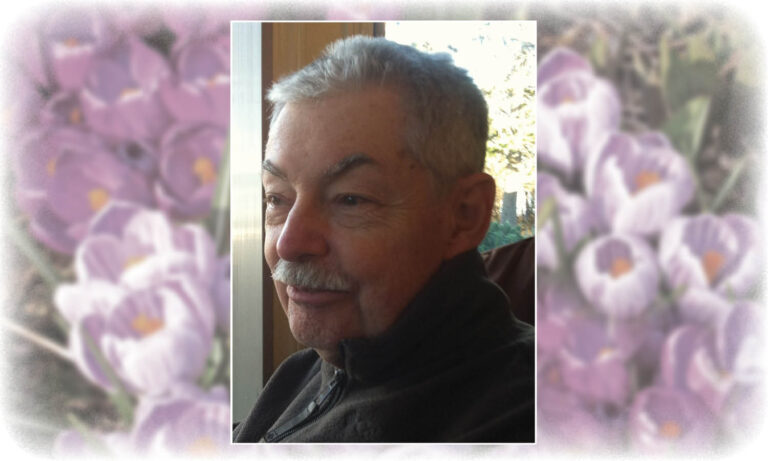
Ernst “Ernie” Göran Westlund passed away peacefully at Lady Minto Hospital on April 24th after a few weeks of serious illness and many years of physical decline. Ernie was a pioneer in computer programming, consulting, and technical writing in his homeland Sweden. He emigrated in 2004 and became a proud Canadian citizen and Salt Spring Island resident. He loved island life and with his camera captured many amazing flowers in the Brinkworthy neighbourhood. Ernie is survived by his wife Maria Westlund, his adoptive daughter Annika Lund with family Geoff and Kai Fishleigh, his former son-in-law David Norget with family Tisha Boulter, Simon Boulter and Amelia Norget and in Sweden his daughters Åsa Tamm and granddaughter Clara Tamm and Anna-Karin Rosman and grandson Todd Barker as well as his brothers Börje Westlund with wife Hedda Jonäng and Håkan Westlund with wife Marianne Westlund.
At Ernie’s request, there will be no service. In lieu of flowers please donate to the Lady Minto Hospital Foundation or to a charity of your choosing. The family would like to extend our warmest thanks to the whole staff team at the Lady Minto Hospital for their amazing care and kindness.
Fulford Harbour will see additional sailings — and some disruption from construction work — as BC Ferries rolls into summer.
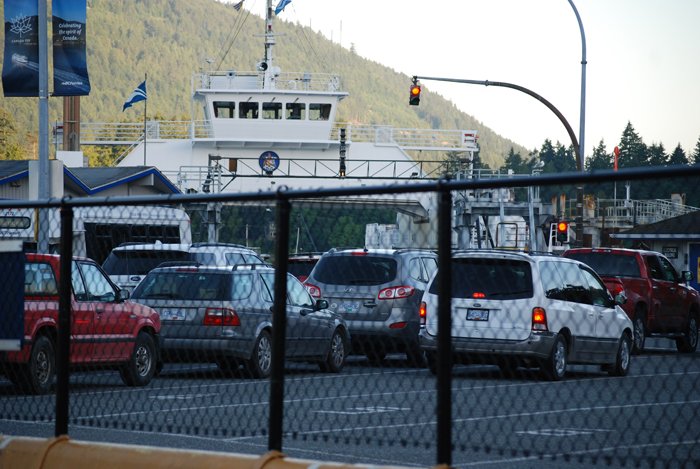
A new 10-sailing schedule between Fulford Harbour and Swartz Bay starts in late June and may overlap somewhat with urgent piling work, according to BC Ferries staff, who met with Salt Spring Island’s Ferry Advisory Committee (FAC) Monday, April 24. The usually biannual meeting finally took place after scheduling conflicts and weather-related postponements, giving commissioners their first chance this year to visit with ferry officials.
The 10-sailing plan — nine on Sundays — is an attempt to relieve strain during peak season, with the first sailings this summer departing Fulford at 6 a.m. and the last leaving Swartz Bay at 10 p.m. The structure builds five round trips into each crew shift, according to fleet deployment and scheduling manager Steve Anderson — a “tight fit” but vital to the schedule. BC Ferries hopes the additional sailings will relieve line-up congestion, and staff said they plan to monitor whether it works.
“We’ll certainly be looking at the on-time performance, as well as overload statistics and overall traffic volumes,” said Anderson, noting that adding what amounts to a 25 per cent capacity increase per shift most days should have a significant impact on service. “It will depend on how people adjust between different sailings. If people do spread out, there should be less congestion and more people getting where they want to go.”
Those extra sailings may be impacted by some urgent work under the trestle at Fulford, as several timber piles there need to be replaced. That work is scheduled to begin at the end of May, even as the current sewage system work currently snarling traffic at the terminal finishes up — but community relations manager Tamara Olson warned a start date may be pushed back.
“It might be postponed, just due to [difficulties with] getting the timber here,” said Olson. “Depending on when the supply chain issue is resolved — and that’s partly to do with the border and the strikes — we’ll have a better idea.”
The piling work needs to be done during very low tides, according to Olson, which restricts crews to the early summer season.
“In a perfect world, we wouldn’t be doing it at this time of year,” said Karen Johnston, executive director of communications and engagement. “But it’s a safety issue.”
In other news, BC Ferries announced the following morning that the provincial Travel Assistance Program (TAP), which covers transportation costs for residents travelling within the province for non-emergency medical services not available in their own communities, will no longer be subject to ferry booking fees — a cost not previously covered by the program.
Going forward, islanders travelling on reservable BC Ferries routes can provide their TAP confirmation number and book their ferry travel without the $18 fee. Johnston had told commissioners to expect an announcement about the program, and that staff were developing ways to prioritize and simplify loading for passengers travelling for medical reasons, which might include a dedicated lane for TAP or Medically Assured Loading customers at unstaffed terminals.
For information on TAP and how to make bookings, visit bcferries.com.
The candidate list for Salt Spring’s first Local Community Commission (LCC) election is complete, and it’s a long one.
As of the close of the nomination period at 4 p.m. on April 21, 15 candidates had been approved by the Capital Regional District to run for four available positions on the commission.
They are Gayle Baker, Jesse Brown, Kylie Coates, Benjamin Corno, David Courtney, Lloyd Cudmore, Nejmah Guermoudi, Jamie Harris, Jennifer Kerrigan, Jennifer Lannan, Eric March, Donald Marcotte, Jenny McClean, Earl Rook and Brian Webster.
Qualified residents and non-resident property electors may cast their vote on general voting day, Saturday, May 27, or at the advance voting opportunities on Wednesday, May 17 and 24.
Mail ballot voting is also available to all residents (including renters) and non-resident property electors in the Salt Spring Island Electoral Area. Electors must submit a completed mail ballot application form as early as possible and no later than May 5. Completed application forms may be submitted via email or to the addresses provided on the application form.
For more information on the available voting options, people can visit www.crd.bc.ca/ssi-vote.
Last October Salt Spring voters approved by referendum a change in governance to consolidate several CRD services under the umbrella of an LCC, with four elected individuals joining the electoral area director to form the LCC.
A manhunt ended this week for a man who had been thought to be on Salt Spring Island, as he was located — and subsequently arrested — in Parksville, B.C.
Jimmy Pieschke, who had been wanted by police on child pornography charges from Quebec, was arrested Wednesday, April 19, after a member of the public spotted him on Vancouver Island and alerted the RCMP, according to media relations officer Sgt. Shane Worth.
Sgt. Worth said Oceanside RCMP officers “quickly located and arrested” Pieschke, who is criminally charged in Quebec with making child pornography. He is being held in custody to be escorted to Quebec to appear in court.
The RCMP had asked for assistance from the public in locating Pieschke months ago, after Pieschke failed to appear for a court date. At the time, the RCMP said he had been seen on Salt Spring Island Feb. 10.
StageCoach Theatre School directors are pleased to be presenting a full production at ArtSpring next week after a pandemic hiatus, but that excitement is mixed with trepidation.
If the school doesn’t cover its costs through ticket sales, the non-profit organization that has provided a high-level performing arts experience for Salt Spring youth since 1999 could fold.
After 20 years of activity, said current artistic director Adina Hildebrandt, StageCoach had reached the point of being financially sustainable and offered three different programs. But as a result of COVID’s impacts, with only a small program offered last year, and none the year before, StageCoach lost the nest egg it had built up.
“We’re now teetering on the brink of failure, which, after so much work to get sustainable is really heartbreaking.”
One thing could easily shift that trajectory, however.
Having two solid houses at their upcoming Robyn Hood: Princess Outlaw show will bring the organization back to financial health and allow it to continue next year. The play runs at ArtSpring on Saturday, April 29 at 7 p.m., and on Sunday, April 30 at 2 p.m.
Hildebrandt and co-director Christina Penhale (of exitStageLeft Productions fame) are super excited to present this version of Robyn Hood, with 13 cast members and featuring an all-girl set of “merry men” who live in the forest.
“Robyn is a girl who was a princess and is fighting the Sheriff’s tyranny,” explains Hildebrandt.
It’s a “bold and cheeky” piece of fun musical theatre, which their students have embraced, including the hand combat aspects with training from Jeffrey Renn.
“They’re amazing,” said Hildebrandt of the cast. “They’re young, and incredibly talented and dedicated.”
Penhale observes that theatre arts “build so many different skills for you as a human other than just the art itself.” In the case of Robyn Hood, the actors are learning about tyranny and witnessing different kinds of characters.
“They have to learn empathy and compassion, and they step into the shoes of somebody who might not necessarily be very nice,” she said. “And then you start to see things from different perspectives, and it builds different tools that you might not necessarily get either at school or at home. Theatre is a very interesting medium for teamwork and compassion and listening.”
The school’s importance has been underscored for Hildebrandt by parents and young adults who have told her that Stagecoach was the best part of their schooling on the island, made them strong and confident and made a huge difference in their lives overall.
“I think the social kind of learning in theatre is so incredibly strong. We know this and we see it every day, but to have adults coming back in my life now and saying it is actually so gratifying.”
Hildebrandt and Penhale encourage everyone to come to the play next weekend, or if that’s not possible, to buy a ticket regardless, or otherwise donate to the school.
“If this doesn’t work, and we lose money on the show, we are in really big trouble,” said Hildebrandt.
After Salt Spring Arts’ 16th Annual Spring Art Show at Mahon Hall opened its Archipelago exhibition last Friday showcasing six Southern Gulf Islands artists, ArtSpring follows suit with its presentation of six San Juan artists this Friday. An opening reception welcomes the public for a first sneak peek from 5 to 7 p.m., with the American artists and special guests in attendance.
The exhibition, entitled Archipelago: Contemporary Art of the Salish Sea, is framed as “twelve artists, six mediums, three exhibitions, two countries, one sea.” A unique collaboration between the creators and communities of two of North America’s most feted art communities, it marks the first international exchange of this nature and scale on Salt Spring. Partnering organizations ArtSpring, Salt Spring Arts and the San Juan Islands Museum of Art are each hosting different elements of the exhibition.
An aspect about ArtSpring’s exhibition that local co-curators Richard Steel and Patrick McCallum are particularly excited about is Salt Spring Island can also claim another first with this extraordinary presentation.
“None of the San Juan artists has ever shown in the Gulf Islands before, or even in Canada to my knowledge,” says Steel. “This is a fantastic opportunity for everyone to see these remarkable artists’ work and explore how their approaches, viewpoints and techniques are different or similar to our own.”
The exchanges and presentations of international work is a development that Howard Jang, executive and artistic director of ArtSpring, is committed to supporting.
“This exhibition serves as an opportunity for artists, and we as art centres, to engage in meaningful cultural exchange, foster relationships, introduce our communities to world-class artistic excellence and form a bit of pride that for such a small specific region, we can celebrate something unique on the global stage,” he says.
ArtSpring will show the work of established San Juan stone sculptor Tom Small and painters Joe Miller and RaVae Luckhart, along with a younger generation of artists like printmaker Glenn Hendrick, photographer Danielle Dean and Indigenous glassworks artist Raven Skyriver.
As with the Southern Gulf Islands, the artists of the San Juans have been significantly impacted by their profound sense of place. From melancholy weather affecting their palettes to the desire for self-imposed isolation; from creating their work in old-growth forests and on mountaintops to focusing attention on the ocean and its creatures; from the Salish Sea being a location versus a state of mind, the artists have a shared ecosystem of inspiration.
Millennial Skyriver from Lopez Island grew up connected to the land and its surrounding waters. He was introduced to the artistry of glass at 16 and, through it, discovered a way to celebrate biodiversity and better understand his heritage.
Today his renderings of the aquatic life of the Pacific Northwest are created with such exquisite detail and sensitivity, he is widely collected in the U.S. His ability to recreate the features and hues of salmon, whales, seals and octopus and imbue them with life and movement has been reviewed as truly exceptional.
‘Chinook’ glasswork piece by Raven Skyriver.
“My work is almost exclusively derived from the marine ecosphere,” explains Skyriver. “Using earth tones and the natural translucent element, I love to capture the creatures’ fluid nature in molten glass and place them back into their environment, as if swimming weightlessly and suspended.”
From his remote home studio atop Cady Mountain, surrounded by old-growth forest, ravens and foxes, veteran artist Small practises his art and craft of stone sculpture. From rough-hewn and functional stone basins and benches to sensuous and futuristic pieces, architectural sculptures and monumental basalt forms bearing carved sketches from the natural world, Small is also a master of his medium.
With the two San Juan painters, Miller and Luckhart, the words “visual” and “visceral” have been aptly used to describe their work. Moving from the South Dakota plains to the atmospheric Pacific Northwest, Luckhart is a painter, print maker, but most of all a “mark maker,” who requires total immersion into her paintings.
In her challenging, large-scale collection of deer carcass paintings, she examines bold themes of love, terror, grief, redemption and culture, and invites viewers to do the same.
“This work is not about a deer on a hook,” she states. “Ultimately, I am expressing the human condition. Objects such as flesh and bone assume cultural and spiritual significance reflecting values and beliefs. Attempting to unearth the mystery, I represent the story with the mark, the colour and the composition with deer as the metaphor.”
Miller, on the other hand, is a painter of emotional landscapes, born from his desire to create “visual music.” He is described as bold, magical and rhythmic, with work fresh from his imagination inspired by the years and geography that have sustained him.
“Personally I find a real sense of joy in looking at Miller’s landscapes,” says Steel. “With the strong colours, his compositions and the unexpected interpretations of nature, it just makes the clouds part.”
San Juan Island artist Joe Miller’s Sea Plane – 55″X 49″ oil on linen.
Raised in the Midwest U.S.A. with flat topography, Hendrick found her move to the San Juans offered a stacked perspective as she moved between the sea islands. It would profoundly influence her woodblock work, as seen in her abstract landscape prints. She blends the Pacific Northwest with the sensibilities of ancient China and Japan, creating highly technical, layered, ghostly images that shift like the backdrops of a stage.
Photography lies at the core of Dean’s artistic practice, but her pieces are ultimately multidisciplinary. In her spiritual meditations of the Salish Sea, she uses charcoal and wax on her prints to accentuate textures and moods related to her images of, and submerged in, the ocean. Often, quietly, the pieces allude to the effects of climate change and human interference on the ocean.
“My goal for viewers is to be immersed in these meditations, finding connections to their own ecology and spirituality,” says Dean. “My work encourages an awareness of how the natural realm sustains us and what we can do to preserve the environment, both for our own well-being and for the future of our planet.”
With the theme of cross-border creativity, connection and cultural exchange at the forefront, the dialogue gets underway with two artist panels on Saturday, April 22. Mixing the Gulf Island and San Juan artists equally into different six-person panels, the first free public panel starts at 10:30 a.m. at ArtSpring and the second is at 2 p.m. at Mahon Hall, moderated by curators Steel and McCallum.
Volunteer opportunities at both exhibitions to be gallery ambassadors are still open.
The Southern Gulf Islands artists will be journeying down to the San Juan Islands Museum of Art for display from Sept. 22 to Dec. 4.
For more on the ArtSpring’s Archipelago exhibition, see artspring.ca.
Earth Day is our reminder to be aware of and to marvel at the remarkable natural environment that surrounds us.
It is also a reminder to think about ways we can support or repair our natural world.
For over 12 years, islanders have been engaged in removing Scotch broom from roadsides and properties. A non-native invasive shrub, broom (cytisus scoparius) out-competes native plants, toxifies the soil and spreads without limits in sunny, dry locations. It is also an extreme fire hazard.
Spring, with the CUT BROOM IN BLOOM signs going up along the roadways, is an ideal time to cut broom. Salt Spring’s Native Plant Stewardship Group has been asked to review steps for removing broom effectively. Here are some questions we are often asked.
Why should I cut broom plants, and not pull them?
The best advice is: don’t pull broom plants. Cut them. Pulling disturbs the broom seeds in the soil. The minute the seeds are exposed to light they will sprout. One plant can produce thousands of seeds which can last up to 30 years. But you can pull small plants with stems thinner than pencils.
How do I make sure the broom does not come back:?
Cut the stems as close to the ground as you can, even below the soil level if possible. If you leave part of the stem showing, it will resprout. Broom stems are photosynthetic. For a great video about removing broom, go to broombusters.org.
Can I cut broom any time?
Yes, you can cut broom any time. But cutting in the spring when the plant is in bloom and has no seeds makes it safer to transport without spreading the seeds. Also, spring cutting when the plant puts all its energies into producing blooms, means the plant doesn’t have the resources to survive the summer drought.
Can broom spread by runners?
No, broom is a member of the pea family and spreads by seeds.
How do I dispose of the broom I cut?
The stewardship group organizes annual drop-offs for non-native invasive plants. This year, the drop-offs are on Saturday, May 13, and Sunday, June 4, from 10 a.m. to 3 p.m. We may be able to add one more in later May. Dates and times will be posted in local media.
Drop-offs are by donation. Plants are either chipped or recycled. Supporters of these events include the Salt Spring fire department, Transition Salt Spring, the Salt Spring Island Conservancy and the CRD.
You can drop off broom, blackberry, spurge laurel, gorse, ivy, holly and other woody non-native invasives. To save the chipper blades, please remove any dirt or stones dirt from the roots. Giant hogweed is too toxic to accept.
Can I really get rid of broom permanently?
There are great success stories all over the island. Check out broombusters.org for Qualicum’s success. The broom removal site on Long Harbour Road demonstrates how little effort is required to monitor a hillside that was once choked with broom. And the native plants thank everyone who takes on their own small patch and keeps it broom-free!
Call 250-537-0880 to volunteer or for more details.
I am writing this to express my frustration with my 12 years spent on the Fulford Water Service board as a commissioner.
During that time the Capital Regional District (CRD) has mismanaged the ratepayers’ water system and violated the trust of the water board members through a process that totally disregards the role of the commissioners in providing guidance and ensuring the financial viability of the water system.
Almost 20 years ago there was a major project initiated to upgrade the plant and distribution system. During the construction process there were numerous actions taken that reduced the scope of the project that resulted in piping undersized to the needs of the system being installed, despite being specified in the contract as the correct size. Water meters were purchased but not installed, a large section of the distribution system not being installed resulted in a boil water advisory in place for those residents for four years until another referendum raised additional funds to complete what was contracted and promised as part of the original construction. That only occurred after direct action by the commissioners. It’s estimated that $250,000 in contract funding was mismanaged by the CRD on this as a cost to be borne by the 105 ratepayers.
As a commissioner trying to fulfill the role as an unpaid volunteer I have found that the commission has been treated indifferently by the CRD on a day-to-day basis with decisions overridden, funds expended without authority and a general lack of any respect for the endless hours that we spend trying to protect the ratepayers from the excesses of the CRD.
Currently this commission is being bullied into being part of an ill-defined project to replace both existing infrastructure that has been in place for years, along with the more recent piping that was installed that is undersized due to a site decision by the CRD manager of the time, despite a contract to install the correctly sized piping at the time. Our recent direction to the CRD was to survey the existing piping to determine the existing condition and remaining life span of the piping. We also have asked that isolating valves be installed on the main distribution branch lines to assist staff in determining and managing any current line issues with existing equipment. Those requests have been in our approved projects list for four years with no action.
Instead what we have received and are expected to rubber stamp is a full replacement of the Fulford distribution system, with both old and new lines to be replaced with new correctly sized piping with new water meters. The old meters purchased as part of the previous project were deemed obsolete — never installed — and surplussed for pennies on the dollar.
This just-received project brief is a very complex report that cost the ratepayers of Fulford tens of thousands of dollars and is not what was requested, approved or required until the current condition of the existing system is assessed. The attitude is that the existing piping is old and, due to CRD mismanagement, some of it is undersized, and even though less than 15 years old, the entire system will be replaced regardless of the wishes or concerns raised by the commission.
This project will dramatically raise the cost of the water system to the ratepayers, who already pay approximately $200 a month for water today.
I cannot consciously continue to be part of a system that demands there is a commission to monitor and advise the CRD, yet the CRD seems to have the ability to marginalize and ignore the very authority that is supposed to ensure that the system and the CRD are managed effectively and that the system is affordable to the ratepayers. I feel the disrespect shown the volunteers over the years has been shameful, yet nothing changes, and the high-handedness of the CRD means that I am not prepared to continue the fight when there is no point to the effort. There is enough frustration in life without this and I am convinced that regardless of what we do the CRD will do what they want, when they want and without any consideration to the commission or the ratepayers in Fulford.
For the users of the water system in Fulford, be aware that the CRD will cripple the ability of the residents and businesses to exist and there’s nothing you can do about it, but I for one will not facilitate or be part of that effort to legitimize the CRD’s actions.