Home Blog Page 204

Archipelago exhibitions open in April on Salt Spring

By KIRSTEN BOLTON

ArtSpring Communications Manager

How does a distinct island environment shape the artists who live there, or rather, is it the artists themselves who shape their environment?” asks Salt Spring-based Richard Steel, co-curator of the new international exhibition Archipelago: Contemporary Art of the Salish Sea, set to open April 14 at Mahon Hall and April 21 at ArtSpring.

Renowned painter John Macdonald, part of the Archipelago: Contemporary Art of the Salish Sea exhibition opening at Mahon Hall in Ganges on April 14. (David Borrowman photo)

He goes on to muse, “And how does an international border then further influence two groups of islands and artists who are less than 30 kilometres apart?”

These questions and more inform the foundation of the compelling new art exhibition and cultural exchange between two of North America’s most fêted art communities: the Southern Gulf Islands of British Columbia and the San Juan Islands of Washington state. In terms of scale, cross-border and cross-community collaboration, it marks the first showing of this nature on Salt Spring and within the greater region.

Memorably packaged as “12 artists, six mediums, three exhibitions, two countries, one sea,” the descriptor aptly captures the premise of the show. Twelve artists — six representing the Southern Gulf Islands and six from the San Juans — were meticulously curated by Steel and Patrick McCallum from Salt Spring Island, along with Peter Lane of San Juan Island. The 12 artists will be expressing their signature — often boundary-pushing — work across six mediums: sculpture/installation, glass, painting, photography, printmaking and tapestry/textiles.

“A lot of what we see with the Salish Sea artists is similar to what happened with 19th-century artist colonies in France and Denmark, eventually leading to American colonies like Woodstock in New York and Taos, New Mexico,” explains McCallum. “Artists seek out peace and quiet away from urban noise, and I think that’s what makes our region so rich with artists and creativity.”

The three venues and two countries include Salt Spring Arts hosting at Mahon Hall and ArtSpring with overlapping Canadian and American exhibitions respectively in April and May. The artists and works of the Southern Gulf Islands will then journey to the San Juan Islands Museum of Art this fall.

The one common lens is the Salish Sea. A shared body of water. A shared sense of place and spirit, tempo and lifestyle, nature and time — both now and historically. Steeped in this mutual sensibility, organizers have asked how individual experiences, politics or national identities play a role within the work. How do artists from the same geographical area creatively interpret the world around them, and why?

It is these potential commonalities and contrasts that spark conversation, a robust dialogue that Yael Wand, executive director of Salt Spring Arts, is keen to engage in.

“Those of us who live on islands have chosen to be a bit more distant, a bit more insular, if only by the separation of water. We do have to work a little harder to find new ways to expand our perspectives and seek out new ideas,” says Wand. “Art is the perfect catalyst for starting conversations, taking down walls and connecting with neighbours down the street or across the sea. Our communities need that connection now more than ever.”

Themes of isolation and connection also played out in the development of the exhibition. The concept for the cross-border Salish Sea collaboration has been years in the making, starting with Barbara Cox, an advisor to the San Juan Islands Museum of Art, wanting to explore a cultural exchange as she had once organized between Seattle and South America. Personal visits and interest between Cox, Salt Spring Arts and ArtSpring date back to early 2020, just prior to COVID being declared in March. With that, lockdowns, travel restrictions and isolation would prove to become major hurdles. Zoom meetings, provisional bookings and hope kept organizers afloat through 2021, but it became clear the opening they planned for 2022 was impossible. All parties and artists are now thrilled 2023 has finally allowed their efforts to be staged for the public.

Anna Gustafson in her Salt Spring studio. She is one of six artists representing the Southern Gulf Islands in Archipelago: Contemporary Art of the Salish Sea. (Sophia Burke photo)

None of this would have been possible without the spirit of cooperation between the major art organizations, and it remains a rare but encouraging example of mutual collaboration in a sector where that is not always the case.

“In the past few years, ArtSpring and Salt Spring Arts have found ways to connect and collaborate. Archipelago is very much a product of that,” Wand explains. “We are learning from one another. Our organizations have different histories and unique strengths, but in finding and flexing our shared creative muscles, the public will truly benefit from an expanded, enriched experience.”

“ArtSpring is welcoming the opportunity to present its first international visual art exhibition of San Juan artists and be part of the larger story that is Archipelago,” says Howard Jang, executive and artistic director of ArtSpring. “For us to extend beyond our reputation in the performing arts and to collaborate with such close creative neighbours and partners like Salt Spring Arts, it strengthens our island’s reputation and that of our whole community as being champions of arts and culture at a larger scale.”

What can people expect?

“All 12 artists differ widely in age, medium, background, ancestry and the scale of their work, yet all have forged a voice that makes them both individually unique, while still responding to their distinct geographical area,” explains Steel.

The exhibition includes massive, tempestuous paintings by Canadian John Macdonald and the visceral, provocative brushstrokes of American RaVae Luckhart; bold, spiritual landscapes by American painter Joe Miller and alternative landscapes of the mind captured by Canadian photographer Sam Montalbetti; haunting images from Canadian fabric artist Joanna Rogers and American printmaker Glenn Hendrick.

Many artists have chosen to make bold and beautifully crafted statements on the vulnerability of our environment, like Canadian tapestry artist Jane Kidd and installation artist Anna Gustafson, along with American photographer Danielle Dean. The voices of Indigenous artists are present in the exquisitely rendered glassworks of American Raven Skyriver and the nature-inspired carvings of Canadian Salish artist TEMOSENG Chazz Elliott. The list is rounded out by celebrated American sculptor in stone Tom Small, renowned for his skill and sensitive use of materials.

Lopez Island glass artist Raven Skyriver, who is one of six San Juan Islands artists in the Archipelago exhibition. (Peter Kuhnline photo)

The Archipelago exhibition opens with the Southern Gulf Islands artists at Mahon Hall on April 14 with a public opening reception. The exhibition, which runs to April 30, is complemented by a solid schedule of additional programming, including artist talks and a screening of Fellowship of the Sea, a short film and panel about the Salt Spring women called the Seals, who swim in the ocean year-round.

ArtSpring’s showcase of the San Juan exhibit kicks off with its opening reception April 21, with San Juan artists, museum board and dignitaries in attendance, as well as local artists and community members. On Saturday, April 22, ArtSpring hosts an artist panel at 10:30 a.m. and Salt Spring Arts hosts the second artist panel at 2 p.m., each with a mix of local and visiting American artists.

“I’m particularly looking forward to the panels,” says Wand. “To me, that’s a unique chance for audiences to listen in on how the artists relate, what are they experiencing and seeing in one another’s works. That’s the exciting thing — we don’t know where this Archipelago conversation will take us.”

ArtSpring’s exhibit continues through May 24. Organizers suggest that for the most complete experience, visitors plan to take in both exhibits either individually or during the time Mahon Hall and ArtSpring overlap from April 21 to April 30.

Pieces will be available for sale with many works of specific interest to collectors across North America.

“With the islands having one of the highest number of artists per capita in the greater region, the art is both intimate and grand,” concludes show co-curator Lane of the San Juan Islands Museum of Art. “Visitors will be surprised and inspired.”

The above article was first published in the March/April 2023 edition of Aqua – Gulf Islands Living magazine.
Ferry commission sets 9.2 per cent price cap

0

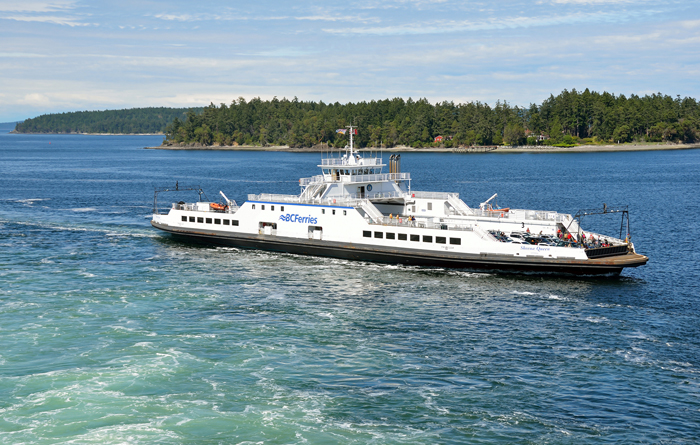
Provincial regulators announced a decision on how much ferry fares could be allowed to rise over the next four years — potentially as much as 9.2 per cent each year — while BC Ferries’ president rushed to assure customers prices were unlikely to go up that much.  

A preliminary decision by the B.C. Ferry Commission set a price cap for BC Ferries to raise its average fares annually from April 1, 2024 to March 31, 2028. A final decision will be confirmed on Sept. 30 of this year, according to commissioner Eva Hage. 

“Facing labour difficulties and high inflation, BC Ferries is emerging from the current performance term (PT5) in less-robust financial shape than initially expected,” said Hage. “And the next four years (PT6) will bring significant additional challenges.” 

The proposed maximum increase marks a sharp departure from the PT5 and PT4 price caps of 2.3 and 1.9 per cent, respectively. Hage said the higher price cap is contingent, however, on BC Ferries identifying $10 million in operating cost savings over the four-year term. Additionally, the commissioner said regulators have reduced BC Ferries’ proposed capital plan – the largest in the corporation’s history – by $330 million. 

“Continued labour supply issues, rising fuel prices, escalating costs associated with maintaining an aging fleet, and a 12-year, $5.2-billion proposed capital plan driven by a need to replace vessels will create substantial pressure,” said Hage. “Given this, we believe that a price cap of 9.2 per cent is appropriate and necessary to allow BC Ferries to meet the demands of the upcoming performance term.” 

Under the maximum allowable increase, a one-way fare for two adults in a vehicle for a Canada Day sailing from Tsawwassen to Long Harbour could rise from $114 to $162 four years from now. But BC Ferries president and CEO Nicolas Jimenez was quick to note the commissioner’s preliminary decision does not take into account the provincial government’s recently-announced $500 million in new funding, as the details as to how this funding will be applied have not yet been determined. 

“I want to assure our customers, employees and partners that ferry fares will not be going up 9.2 per cent per year for the next four years,” said Jimenez. “What the commission has signaled today is not a final outcome but rather one step in a much longer process that is ongoing and won’t culminate until September when a final price cap will be set by that independent office.” 

“Certainly the $500 million will help alleviate a significant amount of the pressure facing our ferry system,” said Hage, “and allow us to lower the final price cap accordingly.” 

Kings Lane water services extended for now

0

The temporary supportive housing complex at 154 Kings Lane will continue to receive water service from the North Salt Spring Waterworks District (NSSWD) for at least another month.

Trustees voted at their March 23 meeting to approve an extension until April 30, with further extensions being considered on a month-to-month basis, depending on district lake levels. Without access to NSSWD water service, BC Housing estimates trucking water in from off-island once a week would cost an estimated $8,000 per month. BC Housing development manager Kirsten Baille told the NSSWD in a letter that ideally they would like approval for potable water access until April of 2024.

BC Housing stated at a March 8 online info session about its proposed Drake Road supportive housing complex that 15 individuals were living at the site. That number was later clarified by BC Housing to be nine.

In other NSSWD news, operations manager Vaughn Figueira reported that water levels at St. Mary and Maxwell lakes are higher than they were at this time last year.

He said Environment Canada’s outlook is “for lower than normal temperatures in March, April and May, which is good in a way because it means evapotranspiration is going to be less. It’s going to mean that people are using less water to water their landscaping and whatnot. In terms of precipitation, though, Environment Canada is not predicting one way or the other. It’s equal probabilities for above, average or less than normal precipitation.”

The district will go to Stage 1 watering restrictions as of April 1 as normal, Figueira said.

Island Health launches mental health/substance use resource phone number 

0

Island Health announced a new centralized phone number this week, to access a broad array of community-based services focused on mental health and substance use. 

The Mental Health and Substance Use (MHSU) Service Link helps people throughout the Island Health region to connect with services in their community and get related information. Anyone can phone 1-888-885-8824 seven days a week to speak directly with a call taker. 

Health care plays a crucial role in connecting people who use substances with the resources they need to achieve better health outcomes, according to Island Health; the service helps people navigate and connect to the right resources — including harm reduction services, drug-poisoning prevention, addiction medicine (opioid agonist therapy, prescribed safer supply and other medication options), withdrawal management, and treatment and recovery services. 

Service Link is a navigation tool, according to Island Health. Call takers are not trained to provide emotional support or crisis intervention. If you are experiencing a mental health or substance use crisis, please call the Vancouver Island Crisis Line, available 24/7: 1-888-494-3888.

JM & Co present A Kaleidoscope of Love

SUBMITTED BY MUSIC MAKERS OF THE ANGLICAN PARISH

Spring is here and love is in the air!

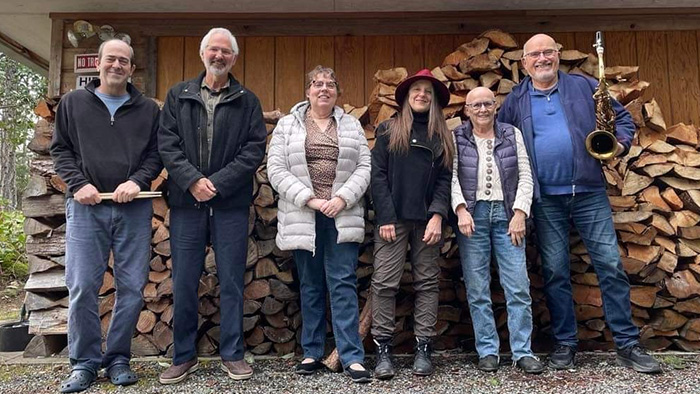
On Wednesday, April 5, in All Saints by-the Sea Anglican Church in downtown Ganges, Salt Spring Island’s JM & Co. jazz sextet will present A Kaleidoscope of Love, a musical tribute to love in all its glory: looking for love; finding, losing, living and affirming love. The band will play, and four of the group will sing, a set of beautiful love songs from the Great American Songbook.

JM & Co. is a collective of Salt Springers who have performed for over 20 years in various small jazz groups on this island, among them Quintessential, Sweetwater, Sky Valley and Sunny Siders. In different combinations they have entertained audiences at the Fall Fair, Tree House, Legion dances, Music and Munch, Tea à Tempo, birthday parties and Moby’s, among other venues. They share a love of classic jazz and the joy of playing together, improvising on old favourite songs and jazz standards.
Hannah Brown, our featured singer, studies with Suzanne Gay and is also an exponent of classic women blues singers. She is a beloved regular at Jazz and Blues Society jam sessions.
Grace McNab, our pianist, is a recent retiree from Capilano University where she taught music theory and mentored many students in their jazz program. Recently resident on Salt Spring, she also plays with Swing Shift Big Band.
Randall Miron, drummer, plays and rehearses with several small jazz groups; he founded Sky Valley jazz quartet and anchors the house band for the Jazz Jams at the Legion.
Jim Shultz, guitar, has been playing for 10 years on Salt Spring with a number of groups, including Swing Shift, and has accompanied several stage productions, one of which is a rock musical slated for this coming May.
Deb Smith, bass, was a proud member of the Mississauga Symphony for over 20 years. During her career as a secondary school music teacher, she led award-winning bands, concert and jazz choirs. She plays with Bach on the Rock and also sings with Salt Spring Singers and the All Saints choir.
John Moore (JM), leader and saxophonist, returned to playing jazz after he settled on Salt Spring 25 years ago. He feels privileged to play first tenor sax in Swing Shift, where he also is allowed to sing a few songs. He, too, performs in Salt Spring Singers, as well as Bach on the Rock Chamber Choir.

The April 5 concert begins at 2:10 p.m. Donations provide the honoraria for performers and contribute to the running of the Tea à Tempo series. 

Tea and treats, for $4, will be served immediately following the concert in the hall overlooking Ganges Harbour.

Little Pockets of Defiant Beauty opens at ArtSpring

A mixed-media exhibition featuring work of seven Salt Spring Island artists opens Saturday, April 1 in the ArtSpring gallery.

Through contemporary fine-art photography, digital art and paintings, the artists interpret the theme of Little Pockets of Defiant Beauty in different artistic styles.

Exhibiting artists are Seth Berkowitz, Stefanie Denz, April Mackey, Ella MacQueen-Denz, Robert Moss, Anette Schrage and Michela Sorrentino.

According to press material, “the show’s common thread is the defiant strength of beauty in various scenarios — from ordinary household items to cinematographic scenes, unusual spaces and social relationships. The exhibition challenges the way we define beauty and offers unexpected perspectives.”

An opening reception is on Saturday from 5 to 7 p.m. The show runs daily from 10 a.m. to 4 p.m. until April 10.

For more information about the artists and a sneak look at some of the show’s art work, people can visit defiantbeauty.ca.

Viewpoint: Survival of the Fittest

2

By MIKE STACEY

As I approached the bottom of Ganges hill the other night I strained my poor eyeballs trying to see the crosswalk through the rain and headlights pointed at me.

I knew that no one in their right mind would be wandering across the road through busy traffic in those conditions, but as a rule that does not apply around here. Sure enough, I detected the faint glow of a cell phone in the middle of the road, being the focus of attention of someone dressed all in black making his way through no man’s land, oblivious to his immediate surroundings. With my usual cat-like reflexes (okay, older cat, not overly frisky) I slammed on the brakes.

Now, don’t get me wrong, here, I did not give a rodent’s derriere if this clown survived long enough to reach the opposite curb, but I did not relish the thought of standing in the cold rain for hours speaking with the police while our first responders extricated his corpse from my radiator. Sliding to a stop, I asked myself, “At what point did an ever-expanding part of the population become no longer responsible for their own survival, passing that duty on to everyone else?”

I recalled the previous summer sitting at TJ’s and watching a woman march out in front of a car, then waving her arms when the car could not stop for her. A few days later, there she was again, same corner, and straight out into traffic, waving her arms again. Slow learner? I considered getting into my truck and finishing her off for the good of mankind, but there would probably have been repercussions, and my coffee wasn’t done yet.

There was a time when we all lived in trees and caves and had to contend with lions, tigers and, you guessed it, bears (OH MY!). In those days no one was going to appear suddenly to assure the attackee that none of this was his fault, he was a victim and he would be looked after, forever. Nature had a way of sorting things out, so to speak. Mr. Darwin explained it all years ago, but in recent times some well-meaning buffoon started throwing life preservers into the gene pool and natural selection thus lost its ability to cull the herd.

People walk behind trucks backing up, secure in the knowledge that the driver knows they are there, sees them clearly and will do everything possible to keep them safe. I have been driving trucks long enough to know that all the above ain’t so. When this sort of thing happens again and again, the driver will begin to entertain thoughts of plowing the pedestrian into the pavement. Call it a learning experience.

Another example of a person assuming I care was a guy on a bike riding on the sidewalk who decided to make a hard right turn onto the crosswalk directly in front of my truck. I opened the window and informed him politely that his cerebrum consisted of fecal matter.

Vehicle drivers are not exempt from my disdain, as stupidity is all-inclusive. I have lost count of the number of times I’ve witnessed a car passing a bicycle, then immediately making a right turn in front of it.

A form of entertainment I enjoy when driving on a busy highway is watching a car in front of me and figuring out when the driver is texting. The vehicle will proceed in a more or less normal fashion, then begin to wander into the other lane and/or off the road. I am easily amused.

The way I see it, human intelligence must have an upper limit. Stupidity knows no such bounds.

Randolph Parker’s sublime lake islands series at Gallery 8

BY ELIZABETH NOLAN

DRIFTWOOD CONTRIBUTOR

Post-Impressionist painter Paul Cézanne once wrote, “Painting from nature is not copying the object, it’s realizing one’s sensations.”

Cézanne meant for the painter, the value in interpreting that which exists in the world is more than its reproduction, it is the deeper understanding of the nature of seeing, feeling and interacting with the world around us.

The Cézanne quote very aptly appears in the new book called Islands – Lake of the Woods, featuring artwork by Randolph Parker. The Mayberry Fine Art publication — an oversize, lavishly printed full-colour hardcover in 230 pages — showcases a wonderful series of paintings from an iconic region. The book also places the nationally recognized, Salt Spring-based landscape painter squarely in the lineage of great Canadian artists who came before him.

From left, artist Randolph Parker, Gallery 8 owner Razali May and Mayberry Fine Art’s Bill Mayberry on the Grace Point Square boardwalk.

Speaking ahead of an exhibition and events taking place by special arrangement at Gallery 8 starting this Friday, Parker said landscape has always compelled and inspired his art.

“I’ve been connecting to the land ever since I was a kid. And it always fascinated me how complex it was. You can look at it from a distance, and it looks simplified, and then look at it up close — the complexity is staggering,” he said.

Islands – Lake of the Woods is both a collection of 220 paintings and the companion coffee-table book. It evolved from a five-year adventure that saw Parker and his long-time friend Bill Mayberry, owner of Winnipeg’s Mayberry Fine Art, travel 2,800 kilometres among the thousands of islands in one of Canada’s most magnificent lakes.

“It’s such a pleasure to be able to exhibit Islands in B.C. in collaboration with Gallery 8 and its owner, Razali May,” Mayberry said. “We’ve now come full circle with this magnificent artwork to be shown within walking distance of Randolph’s studio where he put years of work into making Islands a reality.”

Those who have never visited Lake of the Woods may nonetheless find its scenery familiar; Group of Seven cofounder Frank H. Johnston painted there in the 1920s while he was living in Winnipeg. But painter and printmaker Walter J. Phillips is perhaps most associated with the area. His most famous painting and woodblock print is Sunset, Lake of the Woods (1925). In fact, it’s this work that led to Parker and Mayberry’s most epic collaboration.

Mayberry represented Phillips for decades, and he has his own cabin on Lake of the Woods, but he never knew where precisely the islet portrayed in the famous artwork was located. He spent many years searching and only found it by chance one day during a painting trip for the artist Robert Genn. Mayberry had been fooled by the way Phillips added the sunset, which suggested the view was to the west of the scene when in reality the orientation is looking south. Reflecting on this story during a later visit to the scene with Parker, the two friends decided modern collectors would appreciate knowing exactly where their paintings’ locales could be found. This led to an innovation of the Islands series in that every painting includes latitude and longitude references on the back.

Along with the terrific artwork, one great feature is the maps showing the paintings’ original locations. The painting index is another, with GPS coordinates included along with the other specifications. The book also details five prospective boat routes around the lake, which would be essential for anyone hoping to replicate Parker and Mayberry’s journeys. Lake of the Woods has nearly 15,000 islands and a complicated coastline that twists and turns for nearly 105,000 kilometres.

Parker clearly had ample prospects for subject material there, with endless combinations of light reacting with water, rock and trees. Historian and curator Greg Humeniuk observes Parker uniquely expresses those views because he paints his island subjects like portraits.

“Like all great portraitists, Randolph draws essences of his subjects that the casual viewer might not see at a glance,” Humeniuk explains in the book. “Randolph learned from Rembrandt how great portraiture works by slyly extending highlights along near prominences and diminishing details into the distant margins in the same way our binocular vision emphasizes what is front and centre.”

Parker indeed has an involved process to get to his large paintings on canvas. He starts with a quick sketch on location in pen and ink and then fills in colour references afterwards from his notes. His intermediate step is to create a study painting on panel, where he works out how he wants to layer colour into the composition and possibly blend different observations and views. These studies have a faster, looser brush style on the smooth wood surface than the final complex works on canvas. His masterful treatment of colour is due to his art school training, topped with more than 30 years experience.

“It’s not an exact duplicate of the location, because then you get to think about it, you get to play with it, to think about how to make a work of art that works,” Parker said.

The Gallery 8 exhibition will showcase 40 acrylic paintings — 10 large-scale works on canvas and 30 smaller pieces on birchwood panel — from Parker’s Lake of the Woods series, plus his latest Salt Spring Island landscapes on panel and canvas.

Parker and Mayberry will talk about their nautical and artistic odyssey and sign copies of the Islands book at 7 p.m. during the 5 to 8 p.m. reception this Friday, March 31 and again at 1:30 p.m. on Saturday, April 8. The exhibition runs to April 17.

Nobody Asked Me But: Plethora of after-death choices confounds

2

Now that spring has sprung, I find myself surveying all the excess junk that has been accumulating around the casa over the winter, such as books, books and more books. As I ponder on how to deal with this interesting but excessive material, I find my mind doing a side-step over to the one bit of stuff that was thrust out into this world along with my own personal zeitgeist: my body.

It is said that the only two constants in life are death and taxes. Of the two, taxes seem to be a pretty sure thing, but death is inevitable. Or, as ‘60s rock icon of the Doors, Jim Morrison, put it: “No one here gets out alive.”

Now that I find myself getting to an age where that last long ride is just over the next hill, I am beginning to ruminate over what will become of my remains when my spirit departs for parts unknown. This is not just an intellectual exercise, as probably sooner than later, someone else will have to make this decision if I don’t make it myself beforehand.

There are a number of viable options available, but each one has its drawbacks. The first that springs to mind is that good old tried and true burial in a cemetery. This is the ultimate downsize: going from a lot of several acres to a two-metre plot. It does not come cheap, as it can cost me an arm and a leg (and probably the rest of my body) to secure a grave site. Add to that the price of a coffin or casket, the engraved headstone, and an annual upkeep fee for the burial plot, and I’m probably wishing that I could have hung on to life a bit longer, or at least until my investments show some sign of improvement.

There are additional downsides to burial. Most coffins are made of wood and that means a certain amount of deforestation. And as the cemeteries sprawl out to accommodate new tenants, they begin to eat away at the valuable surrounding farmland. As if our Agricultural Land Reserve wasn’t being threatened enough already!

Perhaps you’ve heard about the housing crisis just about everywhere. Don’t choke on this, but the crisis has spread all the way to cemeteries and grave sites. With all the urbanization going on, there is just no room to expand horizontally. Case in point: a burial plot in Burnaby which sold for $750 in 1998 is now going for a whopping price of $10,000. Forget about bitcoin; the real money lies underground. It can’t be long before we start seeing signs for the PostLife Realty Company at the entrances to cemeteries. Tiny home, anyone?

One of the more popular choices that has gathered steam in the western world is cremation. Basically, my body would be passed down a conveyor belt into an incinerator burning at a temperature that’s about twice as hot as the surface of the sun. By the time I’m done, I will be reduced to a couple of good-sized handfuls of ash. This residue of my former self could be kept in an attractive ceramic urn, which will gather dust indefinitely on some relative’s mantelpiece. Alternately, the ashes can be spread out over a favourite spot of land or scattered in waters along the shoreline.

Although this method solves the problem of land use, it does present a number of snags. Among these are the high energy needed to fuel the incinerators, possible air pollution leading to climate change and global warming, and probably even acid rain causing degradation of wetlands and marine environments. I’m sure you could probably throw in the destruction of the atmospheric ozone layer but don’t ask me how that would work unless the ashes were sprayed out from aerosol cans.

And as to a popular disposal site, the scattering of cremated ashes near the shoreline, this presents its own problems. Never mind the pollution it would cause to a very delicate environment, it would most likely lead to the absorption of the ash by many different forms of marine organisms. Seriously, when I’m gone, I’m certain that I don’t want to come back by being burped up after somebody chows down on some tasty mollusk or crustacean.

There has recently been a move afoot to “go green” when it comes to after-life body disposal. There is an outfit right here on Salt Spring that will allow its patrons to compost naturally (and legally) right into the soil of an ecologically designated forested parcel of land. And for those who choose to go the cremation route, the opportunity exists to have their ashes turned into concrete reef balls to be used to shore up or augment coral reefs and hence benefit the marine environment.

Another possibility for dealing with my remains is to freeze my body before I actually check out of this earthly realm. This is called cryogenic preservation and legend has it that Walt Disney’s body is being kept frozen in an airtight cylinder until some future technology can thaw him out and bring him back to life. As for me, I’m not too sure I want to put my faith in freezer technology. Have you ever had your freezer become unplugged accidentally and only discovered the malfunction weeks later? Especially if the freezer was chock full of frozen fish? No thanks.

Then again, I could donate my body to medical science, but the thought of some medical student pulling the sheet off my chilled remains and having to look at the sorry state my body is in (it’s a sad enough sight even while I’m still alive) is just too depressing.

Then again, I could go back to tried and true methods like Egyptian mummification. I just need to invest in a mid-size pyramid and ask for any volunteers among my many servants and cats who would like to be entombed with me. Of course, the whole procedure would probably be ruined by future archaeologists out to uncover the past, or by grave robbers hoping to find buried treasure (such as books, books and more books in my case).

Nobody asked me, but it’s almost as if there are too many choices open to me for when I’m finished with my body. The sardonic part of me wants me to be cut up into pieces so that I can try all the different options that are available. However, at this moment, I’m leaning towards the cryogenic freezing technology to provide my final resting place, just so I can finally tell Walt Disney what I truly think of the movie Frozen.

Salt Spring library hops on Fridays

0

When your children are grown up or you don’t have grandchildren or neighbours with kids, it’s easy to get out of the loop about what kids get up to on our island when they’re not in school.

Someone with intimate knowledge of how children spend their out-of-school time — especially on Fridays — is Salt Spring Public Library librarian Julia Wagner, and she wants to celebrate all the activity going on there.

“Friday at the library has become the kid-friendly family destination place we hoped it would be,” she told me in pitching a story about library activities for youth, especially on Fridays.

“Since the New Year we have weekly [Science, Technology, Engineering and Math] programming for three age groups, including Lego Robotics, BOTWARS and videogame coding and design. An early Story Time for the younger set runs in the morning, and then a popular afternoon board game drop-in for the tween set. There’s also a regular teen Dungeons & Dragons campaign that’s in full swing in a program room these days too. Add the Teen Zone being a popular unstructured hangout space, and there’s really something for everyone at the library!”

I was happy to drop by to get a peek at all the activity, and then Wagner threw in the ultimate carrot: she asked if I would be the Neighbourhood Story Time reader that Friday. Reading stories aloud was one of my favourite parts of being a mom, so I couldn’t say yes fast enough to being the guest reader for some eager young listeners and their caregivers. Wagner picked out a variety of fun books for me to read.

I came back later to check out the board game drop-in session from 2 to 4 p.m., where the island’s game aficionado Bryan Dubien of Foxes Board Game Shop and Core Inn youth programs had just dropped off a big pile of new games. He and Wagner explained that the idea is to have someone there regularly to help orient kids in the age eight to 13 group — even some of the older ones in the cohort — to new games.

Spring Break Art Camp, led by Wagner with volunteer helpers, was also in full swing when I was there on March 24, as well as a tech camp put on by Victoria-based LittlUniverse, where kids were making a 3D platform game using the Godot game engine, which they will post for people to use on either the Steam or Itch.io websites.

As well, machines were whirring away in the FabLab, which is coordinated by Matt Tong, and a young girl was using the Tinkercad program for a 3D-printing project. People can connect with Tong about using the FabLab via the Salt Spring library’s website.

For kids who’d rather be outside, the self-guided Story Walk begins at the library and goes through Mouat Park, page by page, with a new book every Friday.

See the events section of saltspringlibrary.com for the lowdown on all the activities taking place at the library.