Home Blog Page 209

Analysis: living costs on Salt Spring higher than Victoria, Metro Vancouver

0

The Salt Spring Island Foundation (SSIF) has released its report for 2022 analyzing living expenses, and working backwards has reached a number estimating a “living wage” for Salt Spring at an hourly amount of $24.36.   

That number is based on a hypothetical family of four — two parents, a four-year-old and a seven-year-old child — with both adults working full-time at 35 hours per week. Estimating expenses with these assumptions allows an apples-to-apples comparison with other municipalities. For example, a living wage in Metro Vancouver for this family would be $24.08, and in Greater Victoria $24.29.  

The basic expenses in SSIF’s analysis include a budget for food, clothing, rent, childcare, transportation and a small amount set aside for savings to cover illness or emergencies. The analysis also includes a modest amount for telecommunications — two cell-phone plans — and continuing education for the parents, the median cost of two online courses at Camosun College.  

The report notes that “Earning the living wage does not enable a family to put away savings for retirement or a down payment for secure housing, to make a student loan or other debt payments, or to save for their children’s education.” 

B.C.’s minimum wage currently sits at $15.65. In 2018, the last time the living wage number was calculated for Salt Spring, minimum wage was $12.65 and the living wage figure was $20.95.  

That represents an increase for both — the living wage has increased 15.1 per cent, and the minimum wage has increased 23.7 per cent — but also illustrates a gap that suggests affordability remains elusive for wage workers.  

“The high living wage rates highlight the need to simultaneously lift wages and lower the cost of living,” according to SSIF, “particularly the cost of housing.”  

The report concludes that, given a lack of “affordable and available” housing on-island, the cost of rent is likely to continue at a rate unaffordable to workers.  

Data was gathered from a number of government sources, as well as the foundation’s own Vital Signs survey done last year. 

The full report is available at the library, or can be accessed online at: ssifoundation.ca/livingwage2022

Watershed work aims to avoid ‘catastrophic’ wildfire, protect drinking water  

0

A collaboration between climate scientists and Salt Spring’s largest water utility is yielding data — and a plan to improve both forest health and drinking water security for the island.  

Trustees of the North Salt Spring Waterworks District (NSSWD) heard an update from Transition Salt Spring’s Climate Adaptation Research Lab (CARL) scientist Ruth Waldick at their monthly meeting Thursday, Feb. 23, covering information collected upon — and current plans for — the Maxwell Lake Watershed.   

NSSWD withdraws and treats water from Maxwell and St. Mary lakes, and has been partnered with CARL since early discussions with the water district’s staff and trustees in 2021.  

“At that time, I remember clearly,” said Waldick. “Vaughn [Figueira, NSSWD’s operations manager] said there were issues with sedimentation and nutrients — phosphorus in particular, we wanted to know where the sources were — and about the risk of fire.”  

So with data from public aerial imaging sources — and from small armies of volunteer scientists, often graduate students recruited for some on-the-ground learning — Waldick and CARL started cataloguing and mapping. The result is a living, often-updated picture — an increasingly precise understanding of the nature of the forest at every point on the watershed.   

An extensive water sampling project has been critical to planning as well; a healthy forest surrounding a lake has an outsized impact on improving water quality. The hydrology phrase is “residence time” — the longer it takes for that fallen raindrop to reach the lake, the less sediment it carries with it. Drained wetlands and a criss-crossing network of planned or unintentional roads, ditches and drains has led to a lot of fast, sediment-filled water coursing down hillsides — a less optimal situation for the trees, according to Waldick.  

“The faster the water moves through, the quicker the ground dries, adding another element of stress on the trees,” said Waldick. “If we want to have robust, healthy trees, we need to make sure they have as much moisture as long as possible.”  

Looking across the map, you can see places where the trees are taller, or older, spots where large swaths of fallen timber dominate the ground cover, or sections where the underbrush is stunted by lack of light, where tall, nearly branchless trees have created a high canopy far above the forest floor.  

The latter is cause for particular concern; there are many kinds of forest fires, of course, but few move as quickly as the kind that leap from one treetop to the next. So-called “crown fires” spread rapidly, largely due to their height. Well-exposed to winds, the flames and sparks jump between the tight and often interconnected branches uncontrollably.      

On the map, dark red patches show these areas around the lake — Waldick showed photos of tall trees that looked like hydro poles, except for high, bushy branches blocking out the sun. There are some breaks between the high-ignition-risk areas — along high-voltage power lines, for example, or some stands of Garry Oak that naturally keep their distance from one another — but not nearly enough.  

By way of comparison, within Mount Maxwell Provincial Park — where more natural growth has created distinct and separated patterns of disconnected canopies — there’s less danger of one tree igniting the next. That’s the model, according to Waldick — a forest that protects itself. In the watershed, it’s going to need some help in the form of forest modification.  

“What we want to do is create more ‘patchiness’ over time,” said Waldick. “It introduces some fire resistance that is natural to the forest, and reduces the potential for catastrophic spread of fire. With our thinning we’ll open gaps, which will also let more light in.”  

Left on their own, these high-canopy forests tend to eventually be out-competed by their neighbours; they are, arguably, dying. But waiting for the forest to heal itself means accepting that, sometimes, the natural process chooses fire — the worst outcome for nearby water users.  

A large wildfire around a drinking-water lake — even if it miraculously spared the utility’s equipment — would precipitate years of water too full of contaminants to effectively treat for drinking; when the vegetation holding soil in place burns, that soil flows downhill right alongside ash from the fire, contaminating the water and often contributing to harmful algae blooms.   

More than half of Salt Spring gets its drinking water from lakes and streams.  

Waldick said specifics vary, but the data show Salt Spring is getting more of our rain in the winter, and less of it in the summer — a shift that’s predicted to be about 20 to 25 per cent over the next few decades. The more data that can be collected, the more accurate these models become — so the CARL team has set up 10 long-term monitoring sites at several points on the watershed, including some on private land.  

“We have a commitment from Foxglove Farm, and sites on Greg Johnson’s property to the east of the watersheds,” said Waldick, “so we can understand the variety of things going on in the soils, the different forest types, why some areas look better than others.”  

The good news: more accurate data means CARL can target parts of the forest that really needs the work, and are more at more risk than others. Instead of changing the whole watershed, they could prioritize work, in manageable chunks.  

“We want to focus on areas around trails,” said Waldick, “because that is where people will be — and people start fires.”  

From there they analyzed fuel loads — the things that would take a careless spark and turn it into a disaster. The plan of attack begins with controlled thinning, and moves into some cutting-edge forest restoration and fuel management practices, working with graduate students — like bundling smaller downed timber and arranging it to mimic a fallen old-growth tree in how it holds moisture, accelerating decomposition and encouraging seedlings.  

All that starts to restore the soils, said Waldick. “And when we open those patches, the trees get more light, they’ll grow bigger, they’ll get to the ‘old growth’ stage faster. We get more understory that is fire resistant, instead of just logs on the ground.”  

Despite utilizing notoriously affordable grad student labour — and some grants from sources like Environment and Climate Change Canada, and local sources like Transition Salt Spring and NSSWD itself — securing funding is ongoing work, according to Waldick. One idea to augment extant and incoming grant money has been to raise funds selling off material harvested from the thinning work — think of a solid-sawn heavy timber beam, and a homeowner knowing it exists specifically because of watershed protection and forest restoration.  

Waldick is optimistic; grassroots support, particularly from neighbouring properties and an academic world eager for an outdoor laboratory, has been significant. NSSWD trustee Chris Dixon agreed, joining the rest of the board in gratitude.  

“And it important that people on Salt Spring understand the issues up there, what you people are doing, and how utterly critical it is,” said Dixon. “We’re undoing decades of poor forestry management.”  

“I think we’ve been very successful so far,” said Waldick. “The volunteerism, the community contribution has been massive.”  

And, she added, from a climate change perspective, protecting the health of these forests may be “the single most important thing we can do on Salt Spring.”  

Balancing the needs of businesses and workers

BY ADAM OLSEN 

SAANICH NORTH & THE ISLANDS MLA 

I keep a pulse on the local business community through regular meetings with business leaders. At the end of British Columbia Chamber of Commerce Week in February, I invited the chambers in Saanich North and the Islands to a video call to hear how I can better advocate for them with the provincial government. 

Our riding is diverse, as are the needs of the businesses. In addition to supporting the tourism economy with safer transportation routes and visitor friendly infrastructure, there was overwhelming agreement that workforce housing was the top priority across the peninsula and Southern Gulf Islands. 

We have a range of housing needs — for frontline workers, skilled trades, healthcare, the technology sector. The Sidney commercial centre, and the Keating and West Sidney/North Saanich business parks generate more than a billion dollars of activity annually, making them critical contributors to the local and regional economy. 

The enterprises in these commercial and industrial zones produce necessary tax revenue for our municipal governments, jobs for our community members and vibrant neighbourhoods for people of all ages. 

Currently, thousands of workers commute more than 40 kms to get to work each day. On the Southern Gulf Islands, businesses are struggling because their workers have been priced out of the real estate market, and many rental units have been turned into short-term vacation rentals. 

Add all the factors challenging local business competitiveness together and it poses a significant risk that I and my colleagues in elected office must understand and respond to. 

Earlier in the week, my BC Green Caucus colleague Sonia Furstenau and I met with the BC Chamber of Commerce board chair Greg Thomas, and president and CEO Fiona Famulak. They visited the legislature to meet with MLAs to advocate for businesses. 

Over the last few years, the resilience of businesses across the province has been tested with the global pandemic. The ensuing inflation and rising costs on business has added to their challenges. Many businesses have closed their doors, and many more are threatened. 

The BC Chamber pointed to increasing wages, the employer health tax, PST, mandatory benefits such as paid sick leave, and delays of project permitting. 

I left these meetings with a fresh reminder of the balance we must strike to ensure that both the workers get paid fairly and have the benefits they need to keep them safe and supported at work, with the reality of the entrepreneurs and investors in our communities who create the jobs, hopefully close to home. 

Lastly, a reminder of my upcoming Public Circle Community Meetings in March. Please join me to discuss topics relating to the provincial government. Community meetings are open to the public and completely non-partisan.  The Salt Spring Island meeting is on Friday, March 17 from 5:30 to 7 p.m. at Fulford Hall.  

Salt Spring’s CRD director Gary Holman will join me to highlight, update and answer questions on the work we do together to represent and support Gulf Islands communities. 

See saanichnorthandtheislands.com/events for other island meeting dates this month. 

Aid sought for former fire chief 

One of Salt Spring’s former fire officials could use some help from the community he served for more than 30 years.  

The family of Les Wagg, who served as Salt Spring Island’s fire chief until 1999, have started a GoFundMe page to raise funds on his behalf at: www.gofundme.com/f/help-get-retired-fire-chief-les-wagg-home.  

Wagg’s grandson Marquez Holtby said the former chief had suffered a stroke last year that left the left-hand-side of his body paralyzed. Holtby said the family started the GoFundMe to raise money for costs associated with his medical care, including a medical flight back home from Ontario where he had been spending some retirement time.  

According to family members, Wagg spent one month in the hospital there until he was stable enough for an air ambulance flight back to B.C. — a $58,000 flight, they said. After another two months in the hospital in Victoria, Wagg has entered rehab there and hopes to return to his Sooke home in the next several weeks — where the family plans to install several accessibility improvements for him, such as ramps and an accessible bathtub.  

Friends and former colleagues continue to ask the community to step up if they can. Another former chief, Arjuna George, said Wagg was his first chief back when he joined the department,  and called him “the definition of a true community fire chief,” dedicating countless hours to serving his community.  

“I only worked with him for a few years before he retired,” said George, “but I learned so much from him in that short time. Now it is time to support him in his recovery; if you can donate financially, fantastic, if not, sharing his family’s GoFundme page would be greatly appreciated.”

Indigenous issues spotlighted at film festival

BY STEVE MARTINDALE

Salt Spring Film Festival Society

Films by and about Indigenous people will be in the spotlight at this weekend’s Salt Spring Film Festival at Gulf Islands Secondary School.

Cowichan cultural worker and archaeology consultant Harold Joe from Duncan will be joined by his prolific co-director and co-producer Leslie Bland from Victoria to present two films at the festival: A Cedar Is Life features Indigenous Elders from Cowichan to Haida Gwaii exploring the centrality of the cedar tree to West Coast First Nations; while Tzouhalem brings to life the legendary Cowichan chief who became the most powerful 19th-century Indigenous leader in the Pacific Northwest.

Salt Spring filmmaker Ryan Haché will be joined by co-director Ritchie Hemphill from Victoria, who was raised on the Tsulquate reserve, to present their delightful film Tiny. Using stop-motion claymation, Tiny recounts the charming and occasionally harrowing stories of the unusual float-home childhood of Ritchie’s mother, Colleen Hemphill (AKA Cluya’gilakw), founder of the Indigenous newspaper Awa’kwis, who is now the chief negotiator for the Gwa’sala-‘Nakwaxda’xw Nations and who will join us from Port Hardy.

Tiny is part of the aquatic shorts program Salish Sea Stories, which also features Freshwater Salt Spring, directed by local photographer and filmmaker Alex Harris. Produced by John Millson of the Salt Spring Island Water Preservation Society, Freshwater Salt Spring features an interview with Xwaaqw’um land and water defender Sulatiye’ Maiya Modeste, project coordinator for the Stqeeye’ Learning Society, who was also an advisor to the film. This program concludes with Uncharted Waters, directed by Molly Dennis, which profiles environmentally conscious young people from the Squamish Nation (AKA Sḵwx̱wú7mesh Úxwumixw)and their non-Indigenous peers collaborating on a community-led mapping project to protect Howe Sound (AKA Atl’ka7tsem).

In Eric Janvier’s NFB short film Heartbeat of a Nation, a young Chipewyan Prairie Dene First Nation father patiently teaches his young son how to make a caribou-skin drum. Inter-generational sharing of traditional Indigenous knowledge is also depicted in Fritz Mueller’s Voices Across the Water, about the art and craft of canoe building, which will be presented by producer, writer and co-editor Teresa Earle from Whitehorse. Traditionally done only by men, such as Alaskan Tlingit master carver Wayne Price, canoe building is now also being taught to young women, including Inland Tlingit artist and apprentice Violet Gatensby from Carcross, Yukon, who is featured in this gorgeous NFB co-production which graces the cover of the festival’s program guide.

Declared extinct in the 1950s but still very much alive, the Sinixt Nation’s 65-year struggle for recognition is documented in Ali Kazimi’s Beyond Extinction: Sinixt Resurgence. Meanwhile, marginalized people from various communities seek recognition in B.C. museums and official archives in the NFB production Unarchived, which includes interviews with Kwagiulth artist Lou-ann Neel and Tahltan Central Government archivist Sandra Marion, and which will be presented by Vancouver filmmakers Hayley Gray and Elad Tzadok.

Sue Biely and Josli Rockafella from Vancouver’s Story Money Impact, which seeks to increase the impact of Canadian documentaries, will be on hand to highlight Tamo Campos and Jasper Snow-Rosen’s Klabona Keepers, about the Tahltan Nation’s struggle to protect the Klabona Sacred Headwaters from the mining industry in northern B.C.; as well as Cam MacArthur’s Before They Fall, about the Fairy Creek blockade to protect unceded Pacheedaht Territory from the logging industry on Vancouver Island, where a number of Salt Spring residents were arrested.

The Salt Spring Film Festival takes place this Friday through Sunday at Gulf Islands Secondary School. Passes are available at the ArtSpring box office (250-537-2102) or online at artspring.ca. Subsidized passes are available by request.

For the full screening schedule, pick up a program guide or visit www.saltspringfilmfestival.com.

Ferries get financial boost from province 

0

A weekend press conference heralded half a billion dollars in new ferry funding, but offered few specifics on how that money would be used to keep fares from potentially skyrocketing.  

Premier David Eby said the goal was to head off a likely increase in ticket prices, warning that recent submissions to the BC Ferries Commission had indicated a need for hikes of more than 10 per cent each year for four consecutive years — an unacceptable pressure on “families and small businesses who rely on BC Ferries,” he said.  

“People would of course be paying more to ride the ferry,” said Eby, “but we would also see other prices rise as a result.”   

Eby cited potential impacts to deliveries and increased costs for businesses, professional contractors and tradespeople who could in turn pass these costs on to consumers already hit hard by rising prices.  

But while Eby and Minister of Transportation and Infrastructure Rob Fleming were adamant the $500 million would be used to offset potential fare increases — possibly keeping them as low as three per cent, they said — questions about how much might be budgeted for fleet electrification or other specific cost-saving measures were skirted in favour of broad strokes. The final fares will, Fleming said, be determined by the ferry commissioner, not the province.  

“So I don’t have a breakdown,” said Fleming. “The capital side of BC Ferries operation is not the government of B.C.’s job, it’s an independent company. The commissioner has a very important role to play in overseeing the credibility and the importance of the investments that are planned to be made by BC Ferries, and that’s exactly what’s going on right now as they negotiate a new performance term.”  

The BC Ferries commissioner is expected to announce preliminary annual fare increases by the end of March, which will guide a four-year period beginning in April of next year; the final plan for increases will be published by Sept. 30.  

Gulf Islands buried in snow; power outages reported

0

A major snowstorm has walloped the south B.C. coast, including the Gulf Islands.

As of 9 a.m. Tuesday, precipitation had almost stopped after about 22 hours of continuous snowfall, with accumulations reported up to 50 centimetres (20 inches) at higher elevations on Salt Spring.

According to BC Hydro’s power outage website page at 9 a.m., all of the Pender Islands and many areas of Galiano, Pender, Mayne, Saturna and Salt Spring Island are without electrical service. Most of the Salt Spring outages have been in areas serving 10 to 100 homes, but the Pender outage was connected to one affecting the south-east side of Salt Spring from just south of Ganges to Beaver Point. More than 5,000 homes have been affected by power outages on the five islands.

All schools in the Gulf Islands are closed.

The ferry from Long Harbour was cancelled this morning, and the first Fulford Harbour-Swartz Bay and Crofton-Vesuvius sailings delayed due to crewing issues.

The Environment Canada forecast was for temperatures to rise to 5º Celsius today, and to 6º tomorrow, with rain.

Foundation’s mental health fund capacity expanded

0

By SSI FOUNDATION

Organizations working to improve mental health on Salt Spring Island can now benefit from an expanded fund designated for that purpose. 

The Salt Spring Island Foundation (SSIF) recently announced that it has designated $13,255 of foundation funding to the Devon James Bolton Mental Health Fund. The endowed fund is now at $35,000, in memory of the fund’s founder, Terry Bolton, who passed away in November 2022. 

Terry Bolton was a long-serving member of the SSIF board from 2007 to 2018, first as treasurer and then as chair of the foundation’s investment committee. 

Terry and Bev Bolton first established the Devon James Bolton Mental Health Fund after the tragic death of their only son in 2019. The Boltons and the foundation were keen to create a long-term, continued response to supporting mental health needs on Salt Spring. 

Statistics Canada reports that over the last three years, mental health issues in general are on the rise. Mental illness and disorders are statistically higher on Salt Spring than across the rest of British Columbia. Salt Spring’s 2022 Vital Signs Report highlights the multifaceted and tenacious challenges we face on our island. Although Island Health, Community Services and other organizations work to respond to these challenges, there is undeniably much more that can be done. 

In 2022, the Devon James Bolton Mental Health Fund contributed to the Salt Spring Community Health Society, partnering with the Salt Spring Health Advancement Network to continue work on the Mental Wellness Initiative project. Now in its third year, the funding focuses on expanding peer and volunteer counselling development. 

The foundation asks people to consider a contribution to mental wellness by donating to one of two endowed mental health funds held by SSIF. The other is the Brian Bleskie Memorial Fund for Mental Wellness. 

People can visit www.ssifoundation.ca, email operations director Shannon Cowan (shannon@ssifoundation.ca), or call the SSIF office for more information: 250-537-8305. 

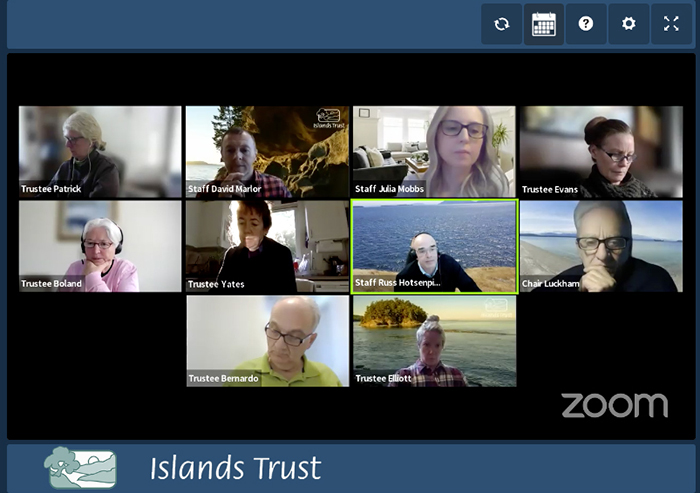
Trustees look to trim Islands Trust budget

0

If taxes can’t go down, they should at least go up by less. 

That’s the consensus among Islands Trust representatives who have been meeting to sort through that governing body’s budget — and corresponding taxation plan — for the coming year. And while a tax cut might not be in the cards, trustees seemed eager to find savings where they could. 

“The financial outlook for people in our communities is challenging,” said trustee Mairead Boland, addressing her colleagues serving on the Trust’s financial planning committee. “We need to look in the mirror and ask ourselves if this is a time to increase the financial burden on anyone living in the islands.” 

Boland suggested that, if anything, trustees should look for ways to reduce that burden, and she had. In January, the Saturna Island trustee brought the committee a list of possible budget reductions — opportunities to “slow down or pause” spending, given pressures of staffing and inflation. Boland’s ambitious target at the outset was to possibly obviate the need for any tax increase at all. After several days of meetings spanning two months, a more modest set of recommended reductions emerged and will be advanced to Trust Council for that wider body’s approval at a March 7 to 9 meeting.

Those recommendations, finalized through resolution last Wednesday, include suspending $10,000 in History and Heritage Conservation Grants in Aid; removing $27,500 in funding for one in-person Trust Council meeting, opting to meet electronically instead; and an additional draw from the general revenue surplus fund of $100,000 to allocate toward local trust committee projects — which on its own could reduce any potential tax increase by more than a full per cent, according to staff.

“Our trend at the Trust is to underspend against budget,” said CAO Russ Hotsenpiller, “and not draw all of the money out of surplus that we anticipate. Sometimes we actually do put money into surplus.” 

The committee worked under an assumption that, for particular budget items linked directly to islanders’ taxes, each $75,000 they could cut would reduce the currently planned LTA general tax increase by one per cent. That increase, while arguably still a moving target, had been shaping up to be in the neighbourhood of three to four-and-a-half per cent, according to draft budget documents. 

Opinion: Big job ahead for local community commission

1

BY BRIAN WEBSTER 

For many of us, it seems like last year’s local community commission (LCC) referendum was a long, long time ago. It’s been more than four months since the referendum, yet the establishment of the LCC still seems off in the distant future.

Yet it actually is not that far off, with the election scheduled for late May and a lot to be done before then. First and foremost, the community needs to elect four commissioners to sit with our electoral area director on the commission and get down to work.

In case you missed it or have forgotten, this new commission will be a locally elected body with authority over 14 of our current local government services. It will replace four existing unelected Capital Regional District (CRD) advisory commissions and will have full administrative powers over 11 of those services. That means the power to make all decisions up to — but not including — final approval of bylaws. 

For these services — everything from parks and transportation to economic development, recreation and more — the Salt Spring LCC will set priorities and policies. It will also establish the annual budget, which will then get sent on to the CRD board for its sign-off. 

In my view, for the LCC to succeed, five things need to happen in short order. 

First, we need to elect capable people who are motivated to make the commission a success. There may be candidates who are more interested in sabotaging the LCC in hopes of convincing the community to move in a different direction; I hope nobody with that motivation gets elected.

Second, we need the LCC to get right down to work, so it will be useful if at least some of those elected are already familiar with our local government system, as they will likely be launched right into budget discussions from their very first meeting. Hitting the ground running and all of that.

Third on the agenda will be working toward bringing more of our current CRD local services under the authority of the LCC. While the authority initially delegated to the LCC is significant, the CRD drafters of the bylaws left important services out. Until all local Salt Spring Island CRD services are under the purview of the LCC, we will continue to have a more scattered local government system than we should and too much authority will continue to rest with our electoral area director, the CRD board and staff.

Fourth, I hope, will be a start to discussions with Salt Spring’s two large improvement districts about the potential to streamline local government services by bringing governance of these services under the LCC umbrella. There are plenty of complications involved and a lot of history to put behind us if we are to accomplish this, but the time to start talking about it is fast approaching.

Fifth, the establishment of the LCC will be an opportunity to talk about whether our community needs any additional local government services. For example, there is a lot of talk about housing on Salt Spring; is it maybe time to consider taking bold action at a local level? Let’s have that discussion.

This is a lot to have on the Day One agenda of our new LCC — especially since it’s possible some in our community might have unrealistic expectations of what can be accomplished by an LCC made up of our electoral area director and four minimally compensated part-timers. 

But let’s get on it. I don’t think our community was looking for just more of the same when we voted to establish the LCC.

Brian Webster is a Salt Spring resident, orchardist and business owner who participated in efforts to establish a local community commission.