Home Blog Page 210

Marginalized people assert identities in Salt Spring Film Festival films

0

BY STEVE MARTINDALE

Salt Spring Film Festival Society

Everyone wants to be seen and heard, but some people are forced to assert their identity in the face of efforts to silence and erase them.

Several films at the upcoming Salt Spring Film Festival focus on people standing up for their right to exist, including Indigenous people who’ve been declared extinct but are still very much alive, female athletes denied the right to compete as women, and marginalized communities erased from history who are now filling in the blanks in the official records.

In a case of “bureaucratic genocide,” the Sinixt Nation in B.C.’s Slocan Valley was declared extinct in 1956 by the Indian Act in order to make way for the damming of the Columbia River. With the Supreme Court now ruling in their favour, this epic 65-year struggle for recognition has lead to a recent revival of Sinixt traditions, as depicted in Ali Kazimi’s Beyond Extinction: Sinixt Resurgence. A similar situation plays out on the other side of the world in Kasimir Burgess’s gorgeous film Franklin, in which the Palawa/Pakana people of Tasmania — declared extinct in the 19th century — join forces with environmentalists in the 1980s to resist a massive hydroelectric project on the Franklin River.

Iranian women forced to wear the hijab assert their right to exist in public with control over their own appearance in Nahid Perrson’s Be My Voice, which profiles courageous journalist Masih Alinejad’s U.S.-based social media campaign to amplify civil disobedience against Iran’s violent theocracy.

Denied the right to compete as women without medically unnecessary hormonal treatment, female athletes with naturally high androgen levels — most of them women of colour — fight back against male-dominated athletic organizations that question their gender in Category: Woman, directed by Phyllis Ellis, whose film Toxic Beauty screened here in 2020.

People of colour, including representatives of Asian, South Asian and Indigenous communities — as well as gay men and trans people — fill in the blanks in B.C.’s official historical records from which they’ve been omitted in Hayley Gray and Elad Tzadok’s illuminating NFB film Unarchived. Trans people also insist on their right to exist in trans filmmaker Chase Joynt’s award-winning film Framing Agnes, which features an all-trans cast, as well as in Daresha Kyi’s award-winning Mama Bears, in which evangelical Christians defy the Church to support and protect their children.

Lesbian visibility is proudly on display in Magnus Gertten’s award-winning Nelly & Nadine, in which two women meet in a Nazi death camp and remain together for decades, and Eva Vitija’s Loving Highsmith, about the groundbreaking author Patricia Highsmith, whose bestselling mid-century novels scandalously featured what Oscar Wilde called “the love that dare not speak its name.”

And here on Salt Spring, people experiencing homelessness and housing insecurity assert their right to exist on the island — despite having no place of their own to call home — in the world premiere of In From the Cold, co-directed by Gary McNutt, Kajin Goh and Rob Wiltzen.

The Salt Spring Film Festival take place from March 3 to 5 at Gulf Islands Secondary School, featuring local and visiting filmmakers and film guests. Festival passes now available at the ArtSpring box office (250-537-2102) or online at artspring.ca. Subsidized passes available by request. For the full screening schedule, pick up a program guide or visit www.saltspringfilmfestival.com.


Pink Shirt Day: Better ways to communicate

0

By LAURA DAFOE

Special to the Driftwood

Pink Shirt Day draws our attention to the uncomfortable reality of bullying. Each year we notice increasing participation in this event as more and more of us don pink shirts to speak up against bullying, and even more strongly, to speak up for a gentler world where diversity is celebrated and people treat one another with respect.

This day prompts us to explore current practices that are successful in reducing bullying and to consider what more we can do. Nonviolent Communication and Restorative Justice are two of many global movements that are proving effective.

The practice of Nonviolent Communication teaches us to view one another through a lens of understanding and compassion. We learn to appreciate that human beings share basic needs, values and common ambitions. We come to understand that the person bullying, and the person who is vulnerable to bullying, each want the same things in life, such as to belong, to be heard, to feel safe and to matter. Seeing our common humanity is what shifts us towards empathy for one another. Nonviolent Communication provides a concrete set of language skills to help us express what are often difficult and bewildering emotions. These skills make it possible to voice our viewpoints in ways that others will listen to and respond to constructively.

Restorative Justice is an approach that seeks to repair relationships when harm is done. The process encourages those who cause harm to take responsibility for their actions. They come to understand what motivated the harmful act, learn from their mistake, and discover how to make better choices. Restorative Justice is rooted in Indigenous practices where dialogues often take place in a circle format. Great care is taken to ensure all those involved feel safe, supported and, most importantly, everyone has a voice equal to others. This structure serves to diffuse the power differential which often enables bullying; whether it be in schools, in the workplace or in relationships between individuals.

Educators around the world are integrating the principles and practices of Nonviolent Communication and Restorative Justice into the school culture. Emotional intelligence and appropriate behaviour are viewed as life skills which are taught, developed and nurtured. Students and staff alike gain competence in discussing differences and resolving conflict peacefully. With these approaches we recognize our interconnection and see the wisdom of treating one other with kindness and respect.

For more information visit:

• Restorative Justice SSI at www.rjssi.org.

• The Center for Nonviolent Communication at

www.cnvc.org.

Or contact Laura at lauradafoe@gmail.com.

Laura Dafoe is a retired teacher living on Salt Spring and an advocate of peaceful communication practices.

Nobody Asked Me But: ‘Greys’ try to be useful, but more colours needed on Salt Spring

0

Have you noticed anything different about the island lately? If your answer is no, take a walk, ride or drive around the rock, especially concentrating on the commercial areas in and around Ganges, and keep your visual senses wide open. Surely you must see it now.

It’s the colour grey. It’s infiltrating the buildings and structures of our island. It’s advancing slowly but steadily. You can see it on the exterior walls of condos, banks, government offices, stores, supermarkets, and even park benches. You’ll look at some storefront that you’ve walked by a thousand times before and think to yourself that you don’t remember it being grey. That’s what I mean . . . it’s insidious. Grey. As if six months of rain and overcast, cloudy skies wasn’t enough. Just the thought of it makes you want to turn your collar up and point your body into the nearest warmth. I mean, why do so many of us leave the island in the winter and head for sunnier, vibrant climes? It’s to avoid the grey!

Yes, we are witnessing a sneaky transformation. It probably started a few years ago with that upscale condo development near the mouth of Ganges Harbour, named Grace Point (or perhaps we should call it Grey’s Point). That was the first volley in what we now call “the greying of Salt Spring.” It’s our own version of “50 shades of grey” but somewhat less titillating than the original. Whoever is responsible for this extreme makeover probably received their architecture design degree from the University of Ikea.

Remember when Salt Spring was full of colour? Do you recall the rich earthy tones? The warm terra cottas and soft salmony accents that transported you mentally to a small fishing village in Guatamala? Or perhaps the wild, crazy purples and oranges that psychedelicized you back to the Haight-Ashbury ‘60s?

It’s not that I have anything personally against the colour grey. I grew up in a little suburban grey stucco bungalow. I used to own a compact grey Renault station wagon. You can find me sometimes standing outside in a grey winter storm staring up at the steady grey drizzle. Maybe a cussword or two will escape from my moistened lips, but more often than not, I’m willing to forgive our forsaken skyscape.

Some people don’t have a problem with grey. It’s a nice, conservative colour. It has a calming, neutral effect on its surroundings. If grey was a country, it would be called Switzerland. But say, wasn’t The Wizard of Oz shot in black and white (meaning grey) until it turned a glorious technicolour when Dorothy landed in Oz? Colour equals magic!

There’s more to this story, however. When it comes to the greying of Salt Spring, it’s not just the colour of the buildings that is changing the identity of the island. No, it’s the aging population (of which yours truly is a prime example) that is adding to the greying hue. With the realization that people are living longer while the birth rate is in decline, our society has reached the tipping point where seniors now outnumber children. A walk down any aisle of your supermarket of choice will drive home the point: the hair colour you are most likely to encounter, if there is any hair at all, will be some shade of grey.

Those baby boomers among us are leading the procession. Gone are the mislaid fantasies of staying young and flexible by working out at the fitness centre. Most of us can’t even remember whether or not we’ve let our gym memberships expire. We’ve lowered our expectations to the point where, with telescopic walking poles firmly in hand, we shuffle forward in an attempt to meet our daily 10,000-step quota. As we carefully watch each footfall we remain focused and mindful of our mantra (Ow) which addresses the cosmic question as to whether or not we are likely to outlive our retirement savings.

Mind you, we the “greys” of Salt Spring, still endeavour to make ourselves useful. We may have become a drain on the medical resources here, but we still maintain that we are capable of some aspects of physical activity, such as gardening. Granted, the ground seems much farther away now than it did when we were younger, and getting back up on our feet from our knees requires the skill, balance and agility of the Flying Wallendas.

Not everything has changed though. Much of our conversations still revolve around drugs. Except instead of comparing our experiences with weed, stimulants and psychedelics, we now exchange anecdotal stories about statins, blood thinners, Advil and puffers for asthma.

The only part of us that isn’t getting any greyer is the grey matter in our brains. An MRI of the brain may show an encroaching white plaque taking over. I wish I could tell you which body functions might be affected by this whiteout, but I’m afraid that part of my memory has caught the last ferry off the island. Gone. Zippo.

There’s an old joke about a senior who was trying to straighten out the wrinkles in his stockings until he realized he wasn’t wearing any. If I had a dollar for every wrinkle on my skin and a nickel for each grey hair on my scalp and in my beard, I would buy a tanker load of the most cheerful rainbow colours and paint the town red and every other bright pigment that exists on this planet. You can bet that grey would not be one of my choices.

Nobody asked me, but there must be a way to halt this greying of Salt Spring. Even if we can’t stop it completely, maybe we can just slow it down enough so that we can still continue to use and appreciate all the other colours in the miraculous spectrum.

If you are one of those who will miss the poignant subtleties of the colour grey, take this bit of advice from a grey geezer: I love sour cream and I love gravy. But if you mix the two together, you will not like the resulting grey-vy.

Salt Spring Seedy Saturday weekend activities outlined

0

By CLAIRE SCHILLER

For Island Natural Growers

Island Natural Growers presents the 28th Annual Salt Spring Island Seedy Saturday weekend, running Feb. 24-26 at the Farmers’ Institute. 

The weekend’s events will commence on Friday, Feb. 24 at 7 p.m. with a guided panel discussion with experienced local growers. They will share their knowledge and answer questions on topics such as soil health, weed suppression, plant variety selection, and time management. 

On Saturday, Feb. 25, join in the main event, the Seed Swap & Sale, from 10 a.m. to 3 p.m. The vendors include regional seed producers, fruit and nut tree growers, community groups and agricultural advocates. There will also be a speakers series taking place in the afternoon. Speakers include Jane Squier on composting, Mitchell Sherrin on Fire Smart Gardening, Growing Nut Trees with Nick Montgomery and a tree pruning demo in the orchards with Krystal Saunders. Entry is a $5 donation. 

Finally, on Feb. 26, the Sunday workshop day will host two in-depth workshops from 10 a.m. to 3 p.m. The morning workshop will be hosted by David Catzell from Glorious Organics in Aldergrove. A passionate seed grower and co-founder of the BC Eco Seed Co-op, David will introduce gardeners and farmers to the planning, habits and tools that make increasing the amount and quality of seed they grow more comfortable and reliable. David will also be introducing the basics of Participatory Breeding and Variety Trials, an annual experience that happens throughout the province every season, pooling the information gleaned from farms across the province to learn more about varieties of interest. The cost is $15.

The afternoon workshop will be hosted by Nigel Kay. He is a certified permaculture designer and local edible landscape business operator. He will be instructing participants on when and how to propagate berry bushes at home. If you want to turn your favourite berry bush into 10 more plants for cheap, this hands-on will teach you how to multiply berry bushes through hardwood propagation. This workshop is for gardeners, farmers and growers who want to increase the number of berries they grow, without spending more on plants. These methods work with many edible and native shrubs such as currants, mulberries, goji berries, huckleberry, elderberry, figs, roses and more. The cost of this workshop is $25. Pre-registration is encouraged for the workshops, with a deal of $35 if you sign up for both.

Details for all of the weekends’ events, including sign-up information for the workshop series, can be found on the Salt Spring Seedy Saturday Facebook page, or by emailing ssiseedysaturday@gmail.com.

B4NF musicians fundraise at Legion for earthquake relief

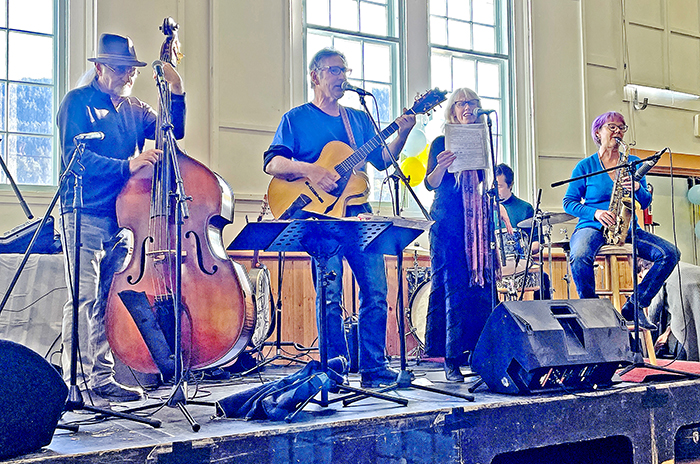
People wanting to help victims of the recent earthquake in Turkey and Syria can do so this Saturday night while enjoying some great music by Bruce Cobanli and fellow musicians.

Before Night Falls (B4NF), the musical collective led by Salt Spring singer-songwriter and guitarist Cobanli, whose late father Bas was Turkish, is hosting a Benefit for Turkish and Syrian Earthquake Relief at the Legion.

Cobanli and his band will play a collection of his songs he recently recorded at The Barn Studio on Hornby Island with the renowned Canadian jazz guitarist and multi-instrumentalist Marc Atkinson, who not only produced, engineered and mixed the sessions but also contributed various instruments and vocals.

Cobanli says a spring album release is imminent and this concert will give folks a chance to hear new arrangements and expanded versions of Cobanli’s songs.

To complement Cobanli’s acoustic and resophonic guitars and vocals, the band for this new iteration of B4NF includes: his old friend and former Gulf Islands Secondary School bandmaster Wilf Davies on Hammond organ and piano; Bruce Grey (Fabulous Flakes) on electric bass and vocals; Oliver Hodswood on drums; Wayne Marston (The Regulars) on the Telecaster; Craig McKerron (Barley Brothers) on mandolin; and Dave Rowse on all manner of saxophones.

After an opening set of R&B, swing, country blues and roots-flavoured Cobanli originals, the band will perform the suite of songs from his upcoming release, Before Night Falls. The third set will add further elements of ska, tango and waltz rhythms to Cobanli’s songs of love, loss, social justice, Turkish coffee and omelettes — “from the sublime to the cor’blimey,” he says.

He hopes the federal government, and perhaps even local businesses and service organizations, will match donations to create a more positive effect.

Last spring, Cobanli’s B4NF gigs raised several hundred dollars for Ukraine war relief efforts.

This Saturday’s show begins at 7:30 p.m. There is no cover charge, but donations will be accepted for Turkish and Syrian earthquake relief efforts.

Guest column: Salt Spring housing crisis — WHUs up for Ganges?

0

BY ERIC BOOTH

Second in a series

In Part One of this series I looked at the magnitude of our housing crisis and how many “workforce housing units” (WHUs) will be needed on Salt Spring Island to maintain existing services. Using my estimated WHU number of 3,900, let’s begin to look at the challenge of where WHUs can practically be located.

For years, the densification of Ganges has often been talked about as the “answer” to where to place more housing. The primary factors required to densify Ganges are (a) real estate values (REV) and availability, (b) servicing (water and sewer), (c) Agricultural Land Reserve limitations,  (d) OCP density and height limitations. Let’s look at each factor.

a. REVs. Current market values in Ganges indicate amalgamation of properties would be needed. For example, to create a reasonable-sized development of 30 WHUs would require two acres = $6-10 million = $200,000 to $330,000 per WHU land cost. A 600-square-foot apartment, at a modest $350-sf construction cost, would therefore range between $400,000 and $530,000 . . . a 1,000-sf apartment between $550,000 and $680,000. In that relatively simple scenario, it would require the acquisition, amalgamation and rezoning of six to 10 properties, which, I respectfully submit, would be extremely difficult due to the multiple factors involved in amalgamating properties.

b. Servicing. North Salt Spring Waterworks’ moratorium on water servicing in Ganges means any development, or redevelopment of property, resulting in a net increase in water use, is currently prohibited. Rainwater collection is not a viable option for high density development.

According to the 2019 engineering report to the Capital Regional District, the Ganges sewer system is currently at a maximum buildout capacity. That means that if every property in the area is built out to its current density potential, there is not enough capacity to handle the flow. Any increase in density in the area will require either an increase in plant size or an alternative way to deal with the effluent. Thus, both water and sewer are currently major challenges in the Ganges area. That having been said, solutions are available, including the lifting of the moratorium, recycling of water and expansion of sewer capability.

c. Agricultural Land Reserve. Ganges is surrounded by ALR properties. The Agricultural Land Commission is extremely reticent to allow any property to be removed from the reserve. Thus, most of the larger land parcels in the Ganges area would be unavailable for development, unless, as an example, the Province was prepared to overrule the ALC. See map at tinyurl.com/3mwdzx75.

d. OCP limitations on density of 15 units per acre could be increased. However, practically, there is only one way to accomplish that – by building up, not out. At the existing OCP maximum density per acre, 260 acres would be required to construct 3,900 WHUs, about the same size as the entire, current developed portion of Ganges village. Allowing mid-rise, five-storey apartments (as Duncan has done in one area) would help to efficiently use available land and reduce overall development footprint.

All of the above suggest that while Ganges could hold part of the potential solution to the housing crisis, it doesn’t hold the entire solution, which begs the question: Where else can WHUs be located?”

In Part Three I’ll explore long-term, viable solutions in other areas of the island.

Eric Booth is a long-time Salt Spring resident and island realtor. The above is the second piece in a series.

Survey opens for Portlock Park 

0

The first round of public engagement on the future of Portlock Park kicked off Friday with an online survey. 

Open for responses until March 6, Salt Spring’s Parks and Recreation Commission (PARC) project team is offering the Portlock survey as an initial step in developing an over-arching strategy for managing the island’s parks. Islanders have expressed interest in improvements to aging infrastructure at Portlock. Over the summer, commission members had looked at improvements to the baseball field, noting that Portlock was the only location that could accommodate a senior field, and other amenities might need to be relocated. 

The next step is developing a 20-year master plan for Portlock, which was identified as a priority in 2019 during PARC’s strategic planning process. CRD parks and recreation manager Dan Ovington has said existing facilities wouldn’t be removed or closed before a replacement for them was built, and a master plan would be necessary for Portlock before design and construction of facilities at other parks — relocating or adding tennis or pickleball courts, for example — should begin.  

To help guide that, island residents and visitors are invited to participate in the survey. As information-gathering progresses, the project team said it would be meeting with stakeholders and local First Nations for more input before preparing draft design concepts. 

A report on these findings will eventually be presented to PARC members — or, more likely, members of Salt Spring’s nascent Local Community Commission — for additional input, after which design plans will return to the public for another round of feedback. 

PARC staff said the survey should take no more than 10 minutes to complete, and is intended to be anonymous. To participate, visit getinvolved.crd.bc.ca/Portlock-Park

TREFRY, Allen Rae

3

1980 ~ 2023.

Allen Rae Trefry, Jr., born January 18, 1980 in Canada passed on to Glory at his home on Salt Spring Island, British Columbia on February 9, 2023.

Allen is survived by his life partner Sarah Nugent and daughter Desmia, daughter Cybil Wetherell, his mother Valerie Berthelot, his dad James Berthelot, and Allen’s siblings, Monica LeBlanc Prest, husband Jason and daughter Sophia, Michael Trefry, Sean Trefry, Mandy Berthelot Rivet, husband Chris and Joshua Berthelot, wife Kat and numerous aunts, uncle, nieces, nephews, cousins and friends.

He was preceded in death by his father, Allen Ray Trefry Sr., and brother Peter Jason LeBlanc. Grandparents on both sides and numerous aunts, uncles and cousins.

Allen grew up in Bayou Pigeon, Louisiana. He spent his first few years as an adult traveling the United States and Canada, making his home on Salt Spring Island, British Columbia.

His favourite pastime was camping and enjoying nature with Sarah and his daughter Desmia, whom he loved with all his heart.

Allen loved working with stone and made his profession as a stone mason. He was funny and quick-witted, loving and caring and well liked by everyone who met him. He will be greatly missed by all he encountered.

A memorial service was held at the Beam of Life Tabernacle in Bayou Sorrel, Louisiana on Friday, February 17, 2023 at 6:30pm.

A celebration of life will take place at Beaver Point Hall, February 24th from 3-6pm. Everyone is welcome.

In lieu of flowers, donation for his family are welcome.

HOLMES, Toni

6

1934 ~ 2023.

Toni Holmes passed away peacefully in his sleep February 5, 2023. Toni was born August 8, 1934, in Bexley Heath, England, to Samuel and Ellen Holmes. His early years were spent watching dogfights over south England during the Battle of Britain and working in his father’s bicycle manufacturing business. Some of his fondest memories were his time spent with his adoring sisters, Barbara and June, and his brief service in the RAF as a staff driver. He moved to Canada in 1957 and was soon followed by his future first wife, Jocelyn.

During a business trip to the west coast, Toni visited his lifelong friend, Peter Lake, on Salt Spring. After falling in love with the island, he gave up his promising banking career, bought a house, moved his family, and finally found home. He opened a very successful real estate office, Gulf Islands Realty, from which he eventually retired in the late 1990’s.

His time spent in the RAF fueled a love of flying, which was his greatest passion. He eventually ended up piloting his own Cessna into his beloved Cranfield Airstrip on North Salt Spring for many years. Toni’s other passions were his wine collection, sailing, travelling, designing, painting, and cars. The true English gentleman that he was, he had a brilliant sense of humour, was a gifted conversationalist, and was always immaculately dressed and well mannered; qualities which attracted a broad and varied circle of friends.

Toni was a very gifted, generous, and caring man who will be deeply missed by his three children, his many grandchildren and great grandchildren, friends, and his devoted and loving wife, Jackie. Upon Toni’s request, there will be no service. If, at some time, you find yourself enjoying a nice cup of tea, or a sipping glass of wine, think of him.

SMALL, Peter Edward

1

1952 ~ 2023.

Peter Edward Small, born March 15, 1952 in White Rock, BC, passed away peacefully at his Salt Spring Island home on February 10, 2023, in the loving care of his partner Karin.

From a young age Peter demonstrated an inquisitive mind constructing or deconstructing whatever came his way. He saw the potential in raw materials and had the ability to create functioning and beautifully crafted items. Peter spent many years in the White Rock area working as a finishing carpenter honing his skills with an eye for fine detail.

Peter’s curiosity led him to working on a cattle ranch in Hawaii, stints on commercial fishing boats, a caretaker on Russell Island, as well as varied experiences in carpentry, wood working and custom projects.

Peter had many long-time friends in the Salt Spring community who benefited from his helping hands or technical (free) advice.

He will be lovingly remembered and missed for his feisty spirit, insatiable quest to learn how things work or why they don’t, his love for his long-time partner Karin, his brothers: Jay, Chris and Matt, his extended family, friends and of course his beloved animals.
 
Heartfelt thanks to Dr. Ron Reznick and the medical staff at Lady Minto Hospital for their care and compassion for Peter. We are forever grateful.

A gathering to celebrate Peter’s life will be held at the Royal Canadian Legion Branch 92 on March 18, 2023, 12:30 – 3:00pm.