Home Blog Page 225

Viewpoint: Dec. 6 memorial returns to in-person format

0

SUBMITTED BY IWAV AND THE CIRCLE Education

The Dec. 6 Vigil, in memorial and solidarity of the National Day of Remembrance and Action on Violence Against Women in Canada, is returning to Centennial Park. Due to Covid restrictions, the memorial, hosted by The Circle Salt Spring Education Society and Islanders Working Against Violence (IWAV), was an online event for the past two years.

The National Day of Remembrance and Action on Violence Against Women in Canada was established in 1991 by the Parliament of Canada to commemorate the 14 young women who were murdered by a gunman on Dec. 6, 1989, at l’École Polytechnique in Montreal as a deliberate act of violence against women.

More than 30 years have passed since the École Polytechnique massacre, and gender-based violence continues to be a real and horrific issue in the world, in Canada, and in our own community.

In 2021, 173 women and girls in Canada were killed by violence (Canadian Women’s Foundation). The proportion of women killed by a spouse or intimate partner is over eight times greater than the proportion of men (Statistics Canada, 2020). Approximately every six days, a woman in Canada is killed by her intimate partner (Statistics Canada, 2019).

IWAV provides anti-violence services and housing to women (inclusive of cis, non-binary and trans women) and children in the Southern Gulf Islands. In 2021-22, IWAV received 517 crisis calls and served over 105 women and 28 children fleeing violence and abuse. These services include a 24-hour crisis line, outreach and advocacy, sexual assault response, counselling and transitional housing.

With the societal pressures and ongoing impact of the pandemic, there continues to be an increase in service demands, escalation in level of violence, and increased vulnerability of women, children and youth who experience violence and abuse. IWAV provides safe, confidential and compassionate services.

In honouring its roots, The Circle Education continues to provide education around gender-based violence. Currently, The Circle Education is partnered with Women and Gender Equality Canada to promote the “It’s Not Just” youth awareness campaign. This is also the Government of Canada’s theme for the 2022 16 Days of Activism Against Gender-based Violence Campaign. The theme is a double meaning: it reminds Canadians of the injustice of gender-based violence (GBV) and brings attention to how it is minimized and dismissed in society. It also highlights how GBV is not just a private issue, but a systemic cycle that all Canadians have a role in ending. The It’s Not Just campaign asks all Canadians to take action against GBV by addressing the beliefs and behaviours that perpetuate violence.

More broadly, the work of The Circle is to nurture healthy and respectful relationships along various dimensions. In their programs, The Circle Education encourages young people to develop their empathy muscles, challenge their assumptions and judgements, and dismantle unhealthy stereotypes that create division. With these tools, the programs help youth to be tolerant, inclusive and respectful of all forms of diversity.

Salt Spring islanders are invited to gather at 5 p.m. in Centennial Park for the Tuesday, Dec. 6 memorial.

Follow @TheCircleEducation on Facebook and Instagram.

Nobody Asked Me But: Happy birthday to Dave Beck while waiting for ‘Murphy’

4

By the time you read this, Dave Beck will be celebrating his 85th birthday. In case you don’t know of him, Dave has spent the last few decades as Salt Spring’s go-to appliance repairman/philosopher king while living off the grid in a log cabin deep in the heart of the south end on Ruckle Park property called “the pea-vine.”

Nobody asked me, but over 20 years ago I wrote a short piece about a fictional island character who may or may not have been modelled on Dave. With tongue firmly in cheek, I give you the following to honour Dave on his birthday.

•••••••••••••••••

They say there are three human-made phenomena on the face of the earth which are visible from outer space. One is the Great Wall of China. The second is the massive forest clear-cut in central British Columbia. The third is the collection of discarded stoves, fridges, washers, dryers and other broken appliances which are slowly rusting out in Murphy’s back orchard and which line both sides of the half-mile long logging road leading to his log cabin.

It seems strange that Murphy, who despises technology with all its trappings, and who will tell you (whether you’re interested or not) that “if you can’t do it by hand, it don’t need to be done,” has eked out a modest living as the island’s appliance repairman.

Oh yes, Murphy has the knack. He can fix just about anything. He just takes his time about it. Maybe he’ll show up today. Maybe not. Maybe tomorrow. Maybe not.

Martha had played the “waiting for Murphy” game for longer than she would like to remember. Calling his shop and not getting an answer. Leaving dozens of messages and no call-backs. Driving around the island, asking at all the coffee shops. Searching for where his pickup might be parked. Constantly asking, “Anybody see Murphy?”

And when she does find him, being assured that he will come round Tuesday morning and then Tuesday morning becomes Tuesday afternoon and then Wednesday and then the weekend for sure and pretty soon it’s next Tuesday and still no Murphy and doesn’t she know better and what IS the point, anyway?

And then there is the rare instance when he does show up and it’s always a bad time because she’s just going out the door or he forgot his tools or he needs to order a part from the city and yes, her washing machine is now in pieces but he’s just going back to his cabin because for sure he has the exact same model somewhere out in the yard and he can pull the timer switch out and it will be a lot cheaper than ordering a new part and, besides, they made them so much better in the old days, but you shouldn’t be using a machine anyway and that looks like mighty fine apple pie, Martha, don’t mind if I do and, by the way, would she mind if he left an old hot water tank on her deck for a couple of hours because he needs the room in the back of his truck to load a second-hand fridge from just down the road. And she knows if he walks out the door, that she might not live long enough to see him again but yet she believes him again and lets him go and now she will be cooking meals on the wood stove the whole sweltering summer or washing the diapers by hand in a plastic bucket or stringing fish line from nails pounded into the wooden posts and beams in the kitchen so she can hang laundry and she knows that next winter that goddam hot water tank will still be sitting out on her deck.

One day Martha’s ship came in. An old aunt she didn’t even know about had died in Arizona and left a little something for all her nieces and nephews. It was by no means a fortune you could retire on, but there was enough there to buy a fairly late model all-wheel-drive Toyota, some new clothes that actually had tags for you to cut off and labels you could read, and a brand new washer and dryer.

She ordered a matching Viking washer and dryer set by phone direct from Eaton’s in Victoria. The catalogue described them as top of the line with essential features such as “extra rinse cycles” and “automatic electrostatic inhibitors.” She agreed to the two-year extended warranty option which covered both parts and labour. The very next day the delivery truck backed down the driveway, and the two deliverymen wearing clean, blue, ironed coveralls unloaded the appliances from the truck.

They dollied them into the mudroom, removed the cardboard packaging, installed and tested the machines, and cleaned up after themselves. As they were leaving, the taller of the two handed her a clipboard and asked her to sign a form which stated that she had been satisfied with the “Eaton’s customer service.” As he waited for her to sign, he noticed the hot water tank sitting on the deck. “We’ve got a hot water tank sale at the warehouse this month, in case you’re interested.”

For 18 months all went well. Every time Martha threw a load into the washer, she thought of not having to find Murphy and a smile washed across her face. Then, one day, she heard a CLUNK and the machine would not spin. Where had she put that receipt with the date of purchase and the extended warranty? After nearly four hours of looking through every cupboard drawer, shelf and cabinet, she found the missing document covered in dust and cobwebs on the floor behind the fridge. She checked the date on the warranty and, yes, the machines were still covered.

She phoned the main Eaton’s store in Victoria and was put through to Appliances. The manager asked for her name and the date of purchase. She was put on hold and forced to listen to Herb Alpert music while he checked on the computer. What seemed like half an eternity later, he was back on the line.

“I’ve got you right here on the screen and everything looks in order.” he informed her.

“I’m so relieved,” Martha answered. “I was so sure that there would be a problem and I would have to wait. When can you send a repairman?”

“We’ll get somebody over right away. You won’t even have to wait for the ferry. We’ve got a man on contract over there who services all the Gulf Islands. Maybe you know him. The name’s Murphy.”

Banquo Folk Ensemble presents Gathered by the Fire concert with bonus instrument ‘petting zoo’

SUBMITTED BY SALT SPRING BAROQUE 

Salt Spring Baroque is pleased to welcome Banquo Folk Ensemble back to Salt Spring Island on Saturday, Dec. 3  at 2 p.m. at All Saints by-the-Sea Anglican Church.  

Banquo has been performing in and around Victoria and the Gulf Islands since 1998. Their music is from the written and oral traditions covering more than eight centuries, performed with voice and their collection of instruments that includes fiddles, recorders, hurdy gurdies, citterns, shawms, bagpipes, a battery of percussion instruments and more. With their own arrangements and interpretation of existing material, they attempt to bridge the gap between “art” music and the folk tradition, always bearing in mind the goal of minstrels throughout the centuries to please and entertain their audiences.

Banquo members are Penny Reiswig, Linda Donn, Amy Reiswig, Bill Jamieson and Gwendolyn Jamieson. 

Concert-goers can celebrate the beauty of the season with music from centuries gone by, harkening back to a time of wassails and yuletide traditions, all meant to evoke the warmth and camaraderie of a winter’s afternoon spent around the fire with friends and family.

This concert will feature lots of hurdy gurdy, and four different kinds of bagpipes including Banquo’s newly acquired set of Swedish traditional pipes. People won’t want to miss the “instrument petting zoo” following the concert. 

Editorial: Walk the talk on leaving cars behind

0

BC Ferries passengers are driving aboard more, and walking on less, and to hear it told from several local ferry users, it’s little wonder. 

As BC Ferries released its quarterly vehicle and passenger counts last week, the venerable Ask Salt Spring forum and its moderator Gayle Baker played host to a pair of BC Ferries officials, and heard questions and concerns from some two dozen islanders in attendance. The goal was to highlight and elucidate the BC Ferries Submission for Performance Term 6 document — a sort of “wish list” sent to the BC Ferries Commission in early October.  

Among improvements laid out within its 163 pages, that 12-year capital plan imagines two new Island Class ferries serving the Crofton-Vesuvius route by late 2026, as well as adding sailings and a second vessel on the Fulford-Swartz Bay route during the summer peak by 2027.  

Those parts of the plan are a response to growing demand being felt not only aboard vessels but also in and around terminals; peak-travel-time traffic lineups are common and increasingly disruptive on roadways in Vesuvius and Fulford. 

But while vehicle numbers have bounced back and even reached new highs since cratering at the start of the pandemic, passenger counts have stubbornly resisted. In the three months ending Sept. 30, 2022, BC Ferries said it carried 7.5 million passengers and 3.0 million vehicles; our reporting on the same quarter in 2019 counted 7.7 million passengers and 2.9 million vehicles.  

While pandemic considerations may have driven the initial downturn in numbers, several forum participants felt foot passengers just didn’t seem to be prioritized. Many brought up connectivity problems — vexing issues of ferry and bus schedules being poorly aligned, running to catch connecting vessels, and inadequate weather shelter for foot passengers waiting to walk (or bike) aboard. 

The province’s “CleanBC Roadmap to 2030” identifies emission reduction targets that include encouraging more walking and cycling, with a specific goal of increasing the share of trips made by “walking, cycling and transit” to 30 per cent by 2030 (from 24 per cent in 2019). 

That goal is admirable; we believe it may require making foot passengers less of an afterthought. In addition to solving vehicle overload issues, we remain hopeful for meaningful improvements in foot passenger connectivity and infrastructure. 

Overnight closures required for Isabella Point Road repairs 

0

Salt Spring Islanders who live in part of the Isabella Point Road neighbourhood will need to prepare for two periods of overnight closures in December. 

Crews will be working nights starting Dec. 5, according to the Ministry of Transportation and Infrastructure (MoTI), and will close the road overnight from Monday, Dec. 5 to Friday, Dec. 9, and possibly Monday, Dec. 12 to Friday, Dec. 16 between 10 p.m. and 6 a.m. Otherwise the road will remain open to single-lane alternating traffic. MoTI stressed emergency vehicles would have full access. 

Work taking place is part of an ongoing project to stabilize and strengthen the roadway after shoulder damage resulting from the atmospheric river storm this time last year. 

The overnight work is subject to favourable weather conditions, and should take five nights to complete, according to MoTI. In the event of heavy rain, the road will remain open to single-lane alternating traffic throughout.  

Electronic message signs located south of the intersection of Isabella Point Road and Musgrave Road will update drivers on closures. For the latest information about road conditions, follow @DriveBC on Twitter and visit the www.DriveBC.ca website.

Note: A Nov. 30 Driftwood print version of this story does not have the correct information about the closure dates.

Timothy Peterson to chair Salt Spring LTC

0

Salt Spring Island’s Local Trust Committee (LTC) will have a new chair — a 45-year resident of Lasqueti Island. 

Trustee Timothy Peterson, from the Lasqueti Island Local Trust Area, was appointed Thursday, Nov. 24 by Islands Trust Council (ITC) chair Peter Luckham, a Thetis Islander who had served the previous two terms as Salt Spring’s LTC chair. 

Peterson, who was also recently elected by fellow trustees to become ITC vice-chair, will join two Salt Spring Islanders voted in by public election in October — newly elected trustee Jamie Harris and re-elected trustee Laura Patrick — completing the three-person Salt Spring LTC in time for its first public meeting in December. 

The local trust committee chair position is, as part of the Islands Trust Act, appointed by the ITC chair for each of the 12 committees in the Islands Trust area. Peterson, a third-term trustee, was also appointed to chair Galiano and Hornby Islands’ LTCs.  

In his letter of interest submitted to ITC as part of his vice-chair appointment, Peterson describes himself as an artist, musician, gardener and cook.  

“I have been a small business owner, and have worked at a variety of island-based occupations,” reads the letter. “I value the natural environment of our islands and recognize the varied threats to our environment from increased development pressures and climate change. I also recognize the threats to our communities and rural lifestyle from the challenges of housing availability and affordability, reduced community diversity, and the increasing difficulties of maintaining local services. I believe that working together we can address these challenges in a meaningful and productive way.” 

The Trust press release with a full list of the chair appointments for each island is available here.

LTCs are responsible for land use planning and regulation, as laid out by the Islands Trust Act; their responsibilities include preparation and adoption of official community plans, zoning and subdivision bylaws, regulation of soil removal and deposit, and authorization of permits. 

Salt Spring Island’s newly formed LTC will hold its first meeting Tuesday, Dec. 13. 

Vulnerable section of Isabella Point Road gets pre-winter upgrade

0

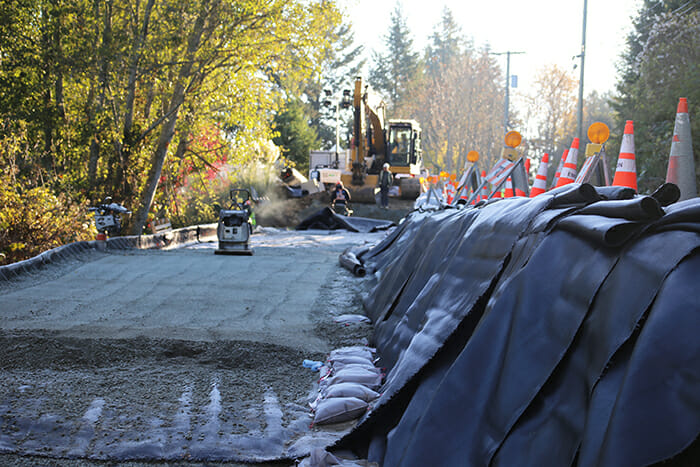
 A new road surface on Isabella Point Road may not look different to drivers once completed, but the below-asphalt improvements will be significant and will help keep that section of road protected during future flood events. 

“The real work is going to be underneath the pavement, where all the reinforcing has been done for the road base,” said Emcon South Island division operations manager Andrew Gaetz last week. “There’s quite a number of different engineering components going on there for water drainage.” 

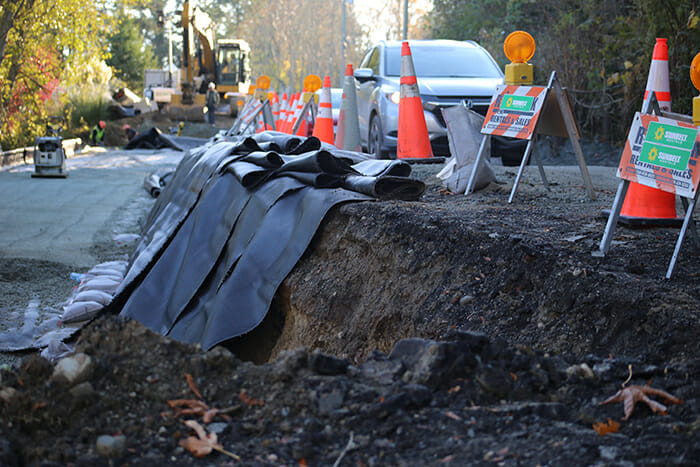
Gaetz said the process involves excavating the section of road two metres deep, then building the road base back up with an engineered geotextile, lifts and aggregate to firm support before the road surface is laid. The highly engineered road base technique is one that’s been used recently on several Gulf Islands, according to Gaetz, and has proven successful. It was also the method used on Walker’s Hook Road in 2018 after a large section there washed away. 

Roland Road resident Daniel Dickmeyer, who lives above the construction area, said while the work is appreciated, the lack of communication on the project was concerning for residents who use the road daily. 

“I just think an overall plan presented in public to the community, for a project this big, would be important,” said Dickmeyer, adding there had been no formal communication to residents about timeframes — or even why the road needed work.  

Gaetz said the Isabella Point Road section has been under monitoring since the atmospheric river event this time last year, and that the physical work being done now is the culmination of almost a year’s worth of engineering and studies to provide a more robust — and safer — roadway. 

“We saw a kind of a slow-moving slope failure,” said Gaetz, “where the side of the road was actually starting to drop, and the crew taking measurements noticed it starting to sag.” 

Gaetz said the section of roadway is very tight for crews to work in, and the “geography and topography” was one of the bigger challenges, and made the work take longer than it might elsewhere. In addition, maintaining access for the many residents up the road has meant workers needed to keep access open for them. 

“If we had an alternate route, we’d just close it, rip up the road, and lay everything in,” said Gaetz. “Instead, we’re working on one lane at a time.” 

Dickmeyer said some notice of timeframe would’ve given comfort to residents — and would still be appreciated. 

“We’re pretty laid back here on the island,” said Dickmeyer, “and you know, people are more like ‘Well, I hope they get it done in time for Christmas.’ People don’t like to complain. But we’re certainly curious. We don’t want to get in a situation where if we had an emergency, we couldn’t get to town in a hurry.” 

Gaetz said while a specific date for completion was difficult to pinpoint, he anticipated crews would be finished by winter’s start. 

“The process is pretty lengthy to do while keeping access open,” said Gaetz. “But we want to be finished and out of there before any kind of snow hits.” 

Editorial: New SIMS is a true community centre

0

Walking into the new SIMS these days, it’s hard to not anticipate the clamour of adolescent voices and energy, even though it’s no longer a middle school.

Excitement of a different sort has taken hold as the former Salt Spring Island Middle School has gradually transformed into the Salt Spring Island Multi-Space. It’s handy to be able to still call it “SIMS” and know the place we’re talking about, and its value as a community amenity is rapidly becoming clear.

As more and more groups set up in their allotted areas in the former school, the effect is not unlike the volume and harmonies rising as a stage fills with choir members arriving from all directions; and this new SIMS “choir” is wonderfully diverse.

Organizations and activities who have moved into the multi space represent vital aspects of island life: music, dance, visual arts, recreation, social services and more. Salt Spring Literacy is there; as is Transition Salt Spring and the SIMS Creator Space and Community Resilience Hub. ASK Salt Spring — the place to ask questions of local government and other agency officials — sets up in the lobby every Friday.

The Capital Regional District (CRD) emergency program now has a much more appropriate home. The Gulf Islands Community Radio Society has a new spot, and space is also available for by-the-hour or day meeting/workshop rental.

When the closure of SIMS was first announced, the future of the Tsunami Circus program was uncertain. But as our story in this week’s paper details, a partnership with Salt Spring Gymnastics in the gym is a boon for both groups.

While complaints will no doubt be heard at some point, for now it sounds like groups that have secured space at SIMS are just plain thrilled.

The CRD isn’t planning an open house at the facility for a few more months, but with so many activities and groups increasingly based there, a large number of islanders will no doubt see at least some part of SIMS before then, even if only to get a vaccination in a classroom currently dedicated for that purpose.

Thanks to School District 64, the CRD and its parks department, and enthusiastic community members for cooperating to fill a longstanding need of creating a true community centre for Salt Spring.

Viewpoint: Restorative Justice has many uses for building community

0

Submitted by Restorative Justice Salt Spring Island

It’s Restorative Justice (RJ) Week in B.C.: a time to recognize the alternatives to the criminal justice system that exist in communities across Canada, and also here on Salt Spring Island.

Most people think of RJ as doing “community service hours” instead of jail time – but the processes used in RJ can be applied in schools, during conflicts and to bring communities together across differences.

In criminal cases, either the person harmed or the person causing harm can ask the RCMP to refer the case to restorative justice. If everyone involved agrees, then trained volunteers work to ensure everyone understands the process and is ready to participate. The person responsible for causing harm is supported to take responsibility for their actions and offer ways to repair the harm. The person affected is supported to express the impacts of the incident and to get the help they need to heal.

Often, other people are impacted by crime besides those directly involved. Family, friends, observers, arresting officers and the community as a whole often feel the impacts indirectly, but unlike traditional justice processes, their perspectives are invited into the RJ process.

Facilitators treat everyone equally, and no one is made to feel shame or blame – but rather to focus on taking responsibility and healing the harm. Everyone is brought together for a dialogue to hear the perspectives of all involved in a respectful way. The results are almost always a better understanding of the impacts of crime and the unique people involved, and an agreement about how the harm will be repaired. Sometimes that looks like physical labour, or paying for the damage, and sometimes it’s a meaningful and authentic apology.

But it’s always up to those involved, and the facilitators are not judges. The process is not about punishment, and in essence, that is what makes it different from the criminal justice system. The Salt Spring RJ program has facilitated hundreds of criminal cases over the years and actively works with the local RCMP detachment.

This idea of repairing harm and rebuilding relationships carries over into how restorative processes can be used in schools, at work, in families and in neighbourhoods. The intent is not to lay blame, but rather to bring people back together so that they can continue to work, learn or live together. The tools of “peacemaking circles” and making agreements about behaviours are used in situations of conflict or harm. But more importantly, restorative processes can be used to build relationships of trust, respect and kindness before conflicts or harm occur.

Restorative schools show huge reductions in the number of critical incidences, student suspensions and absences, along with big increases in student and staff retention, satisfaction and engagement with the school community. RJ Salt Spring is working with SD64 to explore how schools in the district can bring more restorative practices into daily life at school.

To find out more, see www.rjssi.org.

Xwaaqw’um ecological restoration outlined

0

Patience will be a crucial component of an ambitious wetland restoration and carbon sequestration project on Salt Spring Island — for both organizers and park users. 

Over the next five years, some 20 hectares of field at Xwaaqw’um, also known as Burgoyne Bay Provincial Park, will be — slowly — transformed through restoration work, in partnership with Cowichan Tribes and BC Parks. The project is funded by Environment and Climate Change Canada through the Aboriginal Fund for Species at Risk Fund and Nature Smart Carbon Capture, and targets storing carbon naturally in forested areas — and improving habitat for the key species the Stqeeye’ Learning Society hopes to see thrive. 

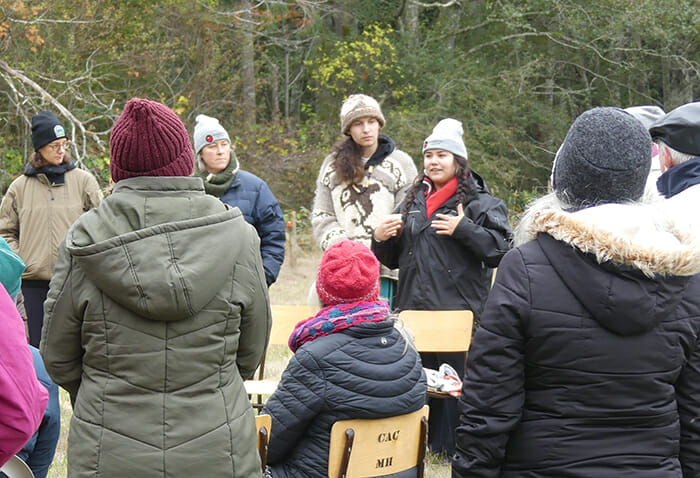
Critical to the restoration will be the planting of new native species wetland plants — and critical to their survival will be fencing to protect them from deer browsing. At a gathering of some 50 supporters and interested members of the public held at the restoration site Wednesday, Nov. 16, Stqeeye’ organizers laid out how the multi-year process would unfold.  

“Part of what we wanted to do today is explain the physical changes there will be at the park, and address questions,” said biologist and project coordinator Rachel Bevington. “A lot of people access the park right here, there’s a well-worn path; we want everyone to know it’s Stqeeye’ putting up a fence, not someone you don’t know — and it’s not permanent.” 

The project area is in the first open field on the left as you enter the park; organizers hope to see the return and recovery of several federally listed species at risk, including the western painted turtle, northern red-legged frog, western toad, dun skipper butterfly, and little brown myotis bat. Birders will be happy to learn several bird species will also benefit, including the peregrine falcon, band-tailed pigeon, barn owl, great blue heron, common nighthawk, western screech owl, black swift, horned grebe, Lewis’ woodpecker and the olive-sided flycatcher. 

“We want to take the water that’s going out into the ocean, and sequester it back into the land and into the aquifers that we’re taking from,” said water data technician Tyee Joseph. “We can do that with wetlands. We’re going to be taking out a lot of the invasive grasses and replacing them with native plants.” 

More wetlands mean more habitat, said Joseph, who highlighted the connection between the at-risk species and native plants with the example of the “green marble” butterfly. 

“It lived in relation with the First Nations women that collected camas,” said Joseph. “Camas is a flower, and the bulb has a starch that was traded as far north as Alaska and as far south as Mexico — an economic staple of the First Nations people.” 

The butterfly evolved alongside the flower and the people that harvested it, said Joseph. “So when there was a hole dug, the butterfly would actually go back into the hole and lay its larvae.”   

Joseph said the butterfly had found one interesting way to adapt — just barely — at a shooting range on San Juan Island. Holes in an earthen backstop made by bullets there were close enough in size to those left behind from harvesting camas that some of the butterfly larvae laid in the holes survived.  

Of course it wasn’t ideal, said Joseph, compared to the huge numbers that flourished alongside the camas in the past. “Hopefully we can actually collect camas in this area again,” he said. 

Most of the valley bottom at Xwaaqw’um would have been “massive, towering red cedar” at one point, according to Bevington, with the associated plants, understory, wetlands and pools.  

Native plants for the project are being grown with the help of Ken Eliot, a Cowichan elder partner and owner of a restoration nursery in Cowichan Bay. Stqeeye’ organizer Maiya Modeste said Eliot had jumped at the chance to be involved. 

“When we got to show him all the wonderful things that were happening here, he kept saying ‘My prayers have been answered!’” said Modeste. “He said he’d been waiting for the next generation to get passionate about being on the land, and to have our future land stewards. ‘It’s finally here, and I can help!’”  

Other funding partners include BC Parks, Indigenous Watershed Initiative, Habitat Conservation Trust Fund and community donors.  

“An important takeaway is to remember that when we do a small thing today, it creates a better tomorrow for our future generations,” said Modeste. “It all ripples, and it all has a greater effect that maybe we can’t see today. But tomorrow it can be meaningful.”