Home Blog Page 238

Firearms warrant brings heavy police presence to Salt Spring

0

An unusual number of police vehicles — including an armoured personnel carrier and a helicopter — descended on Salt Spring Tuesday, arresting one person and leaving an island scratching its collective head.

On Tuesday, Aug. 23, Salt Spring RCMP, along with officers from the Emergency Response Team (ERT) and Vancouver Island General Investigation Section executed a search warrant at a Stewart Road residence, according to District Advisory NCO Sgt. Chris Manseau. The search was part of a firearms investigation, Sgt.Manseau said, and while officers made a single arrest, that person has since been released.

No public alert was issued, and while islanders can expect to see an increased RCMP presence for the next few days as the investigation continues, Sgt. Manseau and Salt Spring RCMP Corp. Matthew Crist said there was no threat to the public — and that RCMP did not expect to release any further details, either on the warrant or on the individual who was arrested.

“For now, all I can say is that everyone is safe at this time,” said Corporal Crist, “both public and the police.”

Charges have not yet been recommended to the BC Prosecution office. In a post on social media, Beachside Cafe and kayak tours company owner Jason Watkin said he had been interrogated by RCMP.

In addition to more familiar police vehicles, an RCMP International MXT Armoured Personnel Carrier (APC) was on the morning ferry into Fulford Harbour, and was spotted by Driftwood staff leaving the detachment building for the evening sailing back to Swartz Bay in the late afternoon. The APC is commonly utilized by ERT deployments, although rarely seen in the Southern Gulf Islands.

The helicopter circled the area near the Stewart Road residence part of the morning, before powering down on the field in front of the Gulf Islands Secondary School. School is not currently in session.

Quick action quells Mount Maxwell fire

0

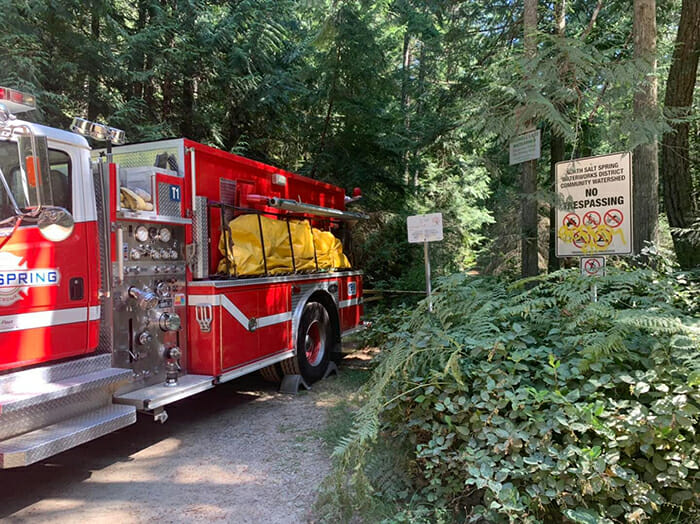
As “extreme” fire danger conditions persist, Salt Spring Island Fire Rescue (SSIFR) responded Sunday to an illegal fire up Mount Maxwell Road that officials say could have been a lot worse.

Assistant Fire Chief Mitchell Sherrin said three firefighters and two apparatus were dispatched up toward the provincial park after a passing cyclist reported an unattended campfire still smouldering in a meadow off the road. The cyclist rode quickly back to his truck, Sherrin said, grabbed a water can and sprayed it on the fire, before racing to a nearby house to call the fire department.

In a stroke of luck, according to Sherrin, it was the home of Greg Bellavance, who took his bobcat machine to the location and began turning the earth in search of embers that could have restarted the fire. When SSIFR arrived, they doused the ground with additional water and thoroughly extinguished the fire.

“It was really fortunate for us to have Greg there and his machine,” said Sherrin. “And I want to commend that cyclist for acting quickly and notifying us.”

Sherrin said since the fire was on North Salt Spring Waterworks District (NSSWD) property, they were notified and inspected the site, roughly in the 1200 block of Mount Maxwell Road. Sherrin also implored the public to exercise extreme caution in the woods while the fire danger is so high.

“People need to be extra safe,” said Sherrin. “We probably have another week of this weather before any hope of moisture.”

As of Monday the forest fire danger rating is at extreme. Campfires are banned as part of the regulations.

The NSSWD has been vocal in recent years about asking people to not trespass on their Mount Maxwell watershed property, with concerns about fire damaging the watershed and the potential for degrading drinking water quality.

Islanders speak up on housing bylaws

0

Supporters and opponents of housing-related bylaws were out in full force on Thursday, Aug. 18 at two Salt Spring Local Trust Committee (LTC) public hearings held at the Harbour House Hotel.

Proposed Bylaw 530 changes definitions to allow secondary suites and cottages — redefined as accessory dwelling units (ADUs) — in most zones on the island. It does not authorize residences in garages or recreational vehicles on a property, as some people have stated.

Proposed Bylaw 526 would allow properties zoned Agriculture 1 and 2 to have a secondary suite within a single-family dwelling as well as an accessory dwelling.

Among those speaking against Bylaw 530 was Ron Wright, who said it was actually “unlawful.” He cited an eight-page legal opinion from Tollefson Law of Victoria provided to a Keep Salt Spring Sustainable group Wright and others have formed to back up that claim.

Wright also observed that the word “affordability” doesn’t appear in the bylaw.

“This bylaw’s main thrust is to deregulate and let market forces rip,” Wright said. “The likeliest outcome will be skyrocketing land values for thousands of landowners and a massive increase in tourism and uncontrollable STVRs. Our island’s charm and natural beauty will be ruthlessly exploited until the very things that make this island so special are wrecked beyond repair.”

Michael Wall said his research found that legalizing ADUs raised property values, which made it more difficult for low-income people to buy homes.

“Giving a property owner permission to build an extra building on that land is going to raise the property value of that land. And that’s probably going to make it so that higher income people are going to buy those properties when they sell them. They’re probably not going to use those added buildings to rent out. They’re probably going to use it for family guests and Airbnb.”

Sharon Bywater said she felt a guarantee that created units would be rented to local workers would be required to make the bylaw effective.

“We want affordable housing. I think that’s something everybody in this room can agree on, but how do we get there? In this bylaw, I feel very strongly that there be a requirement that any ADU is rented affordably to a local worker. Without that requirement, I honestly do not see it happening.”

Elizabeth White said she did not support Bylaw 530 in its current form, without the speculation and vacancy tax applied to the island and adequate resources dedicated to bylaw enforcement to discourage STVR use.

“It will encourage everything that affordable housing advocates and climate and ecological activists alike have been working hard to avoid, namely more property speculation, more short-term vacation rentals and increased land clearing and estate development for absentee or part-time landowners,” said White. “Economic realities dictate these outcomes.”

Several people also spoke in favour of Bylaw 530.

Mairi Welman told trustees that only 54 per cent of Salt Spring’s population is of working age — 18 to 64 — which she said “is well below that required for a healthy functional community that is resilient in the face of the many challenges facing us and those to come.” Further, the number of people in that category of Salt Spring’s population had only grown by 160 between the 2016 and 2021 censuses while the 65-plus category had increased by more than 800 individuals.

“Current policies that favour new single family home development over long-term rental housing is driving a skewed population growth that is heavily service dependent and has a large environmental footprint,” she added. “We’re out of balance, and the wobble is only going to increase exponentially if we don’t make some changes. Please vote yes to Bylaw 530 and allow the incoming newly elected Trust committee to begin to restore the balance in our community. We need all ages and all incomes living here to truly call Salt Spring sustainable.”

Jessica Harkema also added her voice to those who support Bylaw 530.

“This is the first meaningful [housing] bylaw I’ve ever seen proposed, and I mean meaningful in that it could move us forward,” she said.

One way that could happen is if different members of a family could share two dwellings on a property, she explained. That would help her as a younger working person to remain on the island.

“My biggest worry is that this actually isn’t enough. We have to continue pushing Salt Spring to be a more livable community.”

Rhonan Heitzmann, who chairs the Salt Spring LTC’s Housing Action Program Task Force, stressed that affordable housing is defined as consuming up to 30 per cent of household income, which for many working families can be quite high.

“There’s a lot of people who can afford to pay market rents,” he said. “This bylaw isn’t supposed to imitate subsidized housing.”

Heitzmann also pointed out that the official community plan did not only contain statements about protecting the environment.

“We can’t just cherry pick a few sentences and focus only on that to support your points. You need to consider everything it says. The OCP is full of quotes to support a diverse and healthy community. It supports new dwellings for affordable housing.”

The Bylaw 530 hearing began in an unusual way, with Bill Henderson playing ukulele and singing a song that had lines like “Don’t try to change these islands; let these islands change you.”

“That has got to be a first for me,” said LTC chair Peter Luckham. “We could start a new thing here on Salt Spring.”

The hearing also heard from seven-year-old Meadow, who said she and her mom needed a home. Her mother then explained they have to be out of their current residence in a couple of weeks and have been unable to find new accommodation. She has skills in caregiving, business, construction and restaurant work, she added, “and if we find that we’re going to have to leave the island, it would be a loss because I will finally be able to go to work, and we were hoping to make this our longtime home.”

The LTC had also received 208 written submissions about Bylaw 530 before the cut-off on Aug. 17.

Several speakers had suggestions for improving the bylaw, including facilitating tiny home use, covenanting affordability in some way, and allowing a tourist accommodation unit as well as one for long-term rental on the same property to make the proposition more financially viable.

Earlier in the day the hearing on Bylaw 526 saw more than 20 provide their opinion, with only a couple of people not in support, citing concerns about environmental degradation.

Adam Gold of Golden Tree Farm was one of the people who talked about the various challenges of farming, including the need for housing.

“I think if we can offer good housing to our people, then we can maintain our staff. We can then maintain food, we can maintain a solid business and then offer food security to the community. If we don’t have that we can’t do it, and so it’s really important. Also, I have children that I’m bringing up on my farm, and I would love to be able to have housing for them in the future. I really don’t see how we can move forward without this. And I really thank you for for thinking about it right now.”

Both bylaws will be considered by LTC members at their Sept. 6 meeting.

Cupples Trail adds to north end hiking opportunities

By CHARLES KAHN

Salt Spring Trail and Nature Club

In June, Claire and Will Cupples contacted the Salt Spring Trail and Nature Club (SSTNC) and offered the club the opportunity to establish a public trail on their 38-acre property at the north end of the island. A very generous offer!

A few weeks later we signed a contract with the Cupples to use this trail. The contract gives the landowners a $2-million liability insurance policy through the Gulf Islands Trails Society.

The trail around the property is about a two-kilometre return round trip. It has been signed and cleared. The access is a farm driveway on the south side of North End Road and just east of the 2670 address. There is ample parking on the grassy shoulder near the trail sign. People should park perpendicular to the road to provide room for others to park.

This property adjoins the Salt Spring Island Conservancy’s North View Nature Reserve, so in the future it may be possible to connect the two trail systems. The Cupples Trail is also close to the Jack Foster Trail and could be combined with it for a day’s outing in the north end of the island.

The Cupples are retired scientists and academics who have worked in many institutions across Canada, most recently at Simon Fraser University. Will’s roots on Salt Spring go back many decades from the time his father bought North End Farm where Will, in part, grew up. The Cupples returned to Salt Spring and established their home here in the early 2000s.

It’s terrific when landowners like the Cupples are prepared to share their land in this way. We hope that other landowners will act similarly in the future. This is our second contract with private landowners to establish public trails on their land. For further information, contact Charles Kahn (charleskahn@shaw.ca) or Kees Ruurs (Keesruurs@hotmail.com).

The SSTNC helps develop and maintain most of the trails on the island. The club has signed agreements with BC Parks to work on the trails in the provincial parks. It also has an agreement with the Islands Trust Conservancy to maintain the trail in the Lower Mount Erskine Nature Reserve. Recently, volunteers worked with PARC to replace all the numbers on the posts in Channel Ridge with you-are-here maps so that it is now not necessary to carry a map to know where you are in the trail system.

Memberships for the 2022-23 SSTNC season can now be obtained. Go to saltspringtnc.ca/index.php/membership for further information. In addition to hikes, walks, and rambles, the club has regular presentations on interesting, related topics and is also allied with naturalist groups that organize birding and other outings. As you can see, the club provides an important service on the island and deserves your support even if you don’t attend all of its events.

FLOWERS, Adrian John

Adrian John Flowers
1963 ~ 2022

Adrian John Flowers of Tsawwassen and Salt Spring Island was born on August 17, 1963 and passed away at the age of 58 on September 3, 2022. He is survived by his parents Audrey and Roger and his brother Chris.

Adrian’s happiest moments were growing up in Tsawwassen and later living on Salt Spring Island. He touched the lives of so many people. It was easy to see why those who came in contact with him felt his big heart and giving nature. Adrian surrounded himself with good friends near and far, dogs especially his beloved Patches and a family that loved him so very much.

The family would like to thank all those who called Adrian a friend as well as his cousins in the United Kingdom for all their love and support.

BOOKER, Anthony Richards (Tony)

Anthony Richards (Tony) Booker
January 24, 1931 – August 3, 2022


It is with great sadness we announce the peaceful passing of Tony Booker on the morning of August 3rd 2022 at the age of 91. He was predeceased by his loving wife, Josephine Booker in 2012. Both are survived by their three sons Timothy (Zora), Patrick (Debbie) and Nicholas (Cherie) as well as five grandchildren (Natasha, Niki, Sydney, Morgan, Naila).


After meeting Tony in their native country of England, they left busy London and emigrated to Canada in 1958, were married and began married life in the tiny farming village of Markinch, Saskatchewan (where Tony had pre-secured a job as the village School Teacher). They moved west to BC a year later: first to Kamloops where they started their family and later to Vancouver and Ladner to raise their three boys. Here Tony enjoyed a lengthy career as an Art Teacher at Magee Secondary School in Vancouver.
A long love affair with the Gulf Islands, including a summer property on Mayne Island, led them to eventually retire to Salt Spring Island where they settled into a relaxed but vibrant retirement. A long-time member of the Salt Spring Sailing Club, Tony enjoyed sailing and generally messing-around in boats. In 2012, serious health concerns for Josephine forced a move back to Vancouver for the couple, and Tony began his ten year residence at the Independent Living community of Shannon Oaks in Vancouver.


Much appreciation to the friendly staff of Shannon Oaks for their many years creating a comfortable home and community that Tony greatly appreciated. Special thanks to Nursing staff at VGH and UBC Hospitals for their dedication, professionalism and thoughtful care.
As per Tony’s request, there will be no service. In lieu of flowers, donations in Tony’s (and Josephine’s) memory can be made to the Parkinson Society of BC.
https://www.canadahelps.org/en/charities/parkinson-society-british-columbia/

Liquor sales rationed in B.C.

0

The province is rationing alcohol sales at government-run liquor stores — and an industry group representing private outlets is warning of stock shortages ahead.

Effectively immediately upon the measure’s announcement Friday, Aug. 12, quantity limits at BC Liquor stores restrict all customers to three items per transaction — with the only exception being domestic and imported beer. Alcoholic beverage products sold in multiples, such as 4- or 6-packs, count as a single item.

The move is in response to a job action that shuttered BCL distribution centres this week. Members of the BC General Employees Union (BCGEU), one of the largest in the province, are picketing warehouses in an effort to persuade the provincial government to consider wage increases that are protected against rising inflation. Its contract with the Public Service Agency (PSA) officially expired April 1, and talks have been taking place since, but with desired outcomes several percentage points apart, the two sides were unable to reach agreement.

Notably, this includes “hospitality customers and retail customers,” according to a fact sheet from BC Liquor (BCL), adding strain to Salt Spring restaurants and bars preparing to feel the pinch of supply shock. Salt Spring Inn owner Jeremy Millsom said in-house operations there haven’t been affected yet — but if the parties don’t come together, it’s coming.

“We’re lucky in that we’re not as reliant on [revenue from] liquor sales as a pub or nightclub might be,” said Millsom. “We’re going to be impaired, and it’ll be a hardship, but it is what it is.”

“We are conscious of growing supply constraints,” read the statement from BCL, “and want to do what we can to ensure equal access to product for all customers during the BCGEU job action.”

While BCL characterized the restrictions as “modest quantity limits,” the Alliance of Beverage Licensees of BC (ABLE BC) issued its own statement Friday morning, warning its members of shortages, but stopping short of recommending privately owned liquor stores also enact limits.

“This extraordinary step is intended to curtail panic buying,” read ABLE’s statement. “While we understand why BC Liquor Stores is taking this extraordinary action, we are not recommending BC’s private liquor stores implement similar restrictions at this time.”

BCL says the restrictions will be in place until distribution centres return to normal operations.

Maliview sewer plant equipment failure prompts beach health advisory

0

A public health advisory has been issued for the shoreline near the Maliview Wastewater Treatment Plant off Walker’s Hook Road.

According to the Capital Regional District in a Thursday afternoon media release, an equipment failure at the Maliview Wastewater Treatment Plant occurred on Tuesday, Aug. 16 and extended into Wednesday, Aug. 17.

“This resulted in partially treated wastewater being discharged to the plant’s marine outfall during that period. The equipment has been repaired and the treatment plant is now operating normally.

“Out of an abundance of caution, in consultation with Island Health, the shoreline in the vicinity of the outfall will be posted with public health advisory signs. The shoreline impacted is at the intersection of Maliview Drive and Walker’s Hook Road on the northeast part of Salt Spring Island.”

As a result of these discharges, residents are advised to avoid entering the waters along the affected shoreline, as the wastewater may pose a health risk. The shorelines within the affected area will be posted until sampling results confirm there is no longer a health risk.

Local Community Commission Advisory Committee endorses LCC bylaws

0

Volunteer members of the Local Community Commission (LCC) Advisory Committee have taken a position on the proposed LCC bylaws, asking people to vote in favour of approving them in an Oct. 15 referendum.

Capital Regional District (CRD) bylaws 4507 and 4508 establish an LCC for Salt Spring and lay out the authority delegated to a commission by the CRD.

“These bylaws provide an excellent foundation for a locally elected council for Salt Spring,” the committee states in a press release. “A Salt Spring LCC will broaden elected CRD representation, confer authority over local services, allow more transparent decision-making and consolidate the siloed nature of CRD service delivery.”

The committee says it recommended a broader list of services be overseen by an LCC but is “confident that the creation of an LCC will significantly improve CRD service delivery and that its scope of authority can be increased over time as experience is gained.”

The group acknowledged the change has costs attached, including the 2023 election for commission members, annual stipends and additional costs to be determined by the LCC.

“We believe that the efficiency and governance benefits offered by an LCC justify these costs.”

The committee also notes that with dissolution of the transportation, parks and rec, economic sustainability and liquid waste commissions, the LCC needs to find a way to retain the expertise of citizens such as those who currently volunteer as commission members. A focused effort to create stronger volunteer/CRD partnerships is suggested.

“In summary, we are confident that an LCC will offer a significant improvement in CRD service delivery through increased elected representation, cost effectiveness and transparency in decision-making.” 

LCC Advisory Committee members are Gayle Baker, who currently chairs the transportation commission and the LCC committee, parks and recreation commission chair Sonja Collombin, liquid waste commission chair Mary Richardson (and alternate Peter Meyer), and members at large Darryl Martin and Kees Ruurs. Brian Webster is an advisory and primary author of the LCC discussion paper.

Gerard Zentner represents the Community Economic Sustainability Commission (CESC) on the LCC Advisory Committee. The CESC is discussing its position regarding the LCC proposal at its Sept. 12 meeting.

Representatives of Salt Spring Fire Protection District and North Salt Spring Waterworks District participated in the committee’s work but declined to take a public position.

Copies of the proposed bylaws, minutes of the LCC Advisory Committee meetings, the LCC discussion paper, an analysis of CRD response to committee recommendations, and more are available by emailing lccsaltspring@gmail.com. 

Al of the information will be available at a lccsaltspring.com website soon.

The referendum will be held in conjunction with local government elections on Oct. 15.

Galiano’s ecological impact measured in two-year study

0

The results are in: If everyone in the world lived like residents of Galiano Island, 4.3 Earths would be needed to sustain the global human population.

That conclusion comes from a two-year study done by the Galiano Conservancy Association together with partners, one of the first small island communities in the world to undergo an ecological footprint study. 

The footprint started at UBC in the 1990s as a tool to calculate “the amount of productive land and water required to produce the resources they consume and to absorb the wastes they generate,” the conservancy stated. Results are measured in global hectares, a “biologically productive hectare with globally average productivity for that year.” What this analysis demonstrates is that climate change is a symptom of overshoot, with human demands “outstripping the regenerative capacity of the biosphere.” 

Footprint calculations have been done for Victoria and Vancouver — which would need 3.5 Earths — and in smaller communities like Saanich and Powell River. The only other small island community that has done a footprint calculation is Helgoland, Germany, making this study the first of its kind for a small Canadian island, population 1,396.

The global average ecological footprint is 1.7 Earths, far lower than Galiano’s, yet Galiano’s footprint is lower than Canada’s average of 5.1 Earths. In some areas such as food, consumables and waste, Galiano is below the average for B.C. jurisdictions. In other areas, including developed area, electricity use and air travel, the island is above average.

The report’s intent, co-authors Michelle Thompson and Adam Huggins wrote, is not to “pressure or guilt individual island residents” but rather to “help inform conversations about community-scale responses to the climate, biodiversity and social crises that characterize this moment in time.”

While action at the provincial, federal and international level are outside the scope of the report and comprise around 40 per cent of the footprint, the other 60 per cent or 2.6 Earths can be influenced by local community action. The study outlines 10 recommendations for local action to reduce the footprint, which would require community consultation and setting goals together to start working on. 

Galiano has a long history of banding together for a cause, Thompson said, and many issues are already being tackled by local grassroots initiatives. One of the recommended actions is to support efforts like the Galiano Club’s community food programming and the Galiano Recycling Resources Society, which are “foundational” for meeting the one planet goal. According to a one planet scenario adapted to Galiano by the BCIT Centre for Ecocities, an 80 per cent reduction in food waste and a 50 per cent reduction in solid waste are required.

The study also looked at the biocapacity of the island, meaning the biological productivity of the terrestrial and marine ecosystems on the island.

“We were able to see that we are very biocapacity rich,” Thompson noted, adding that perhaps Galiano needs to be a “biocapacity steward” so that cities like Vancouver can exist into the future. 

To this end, the study suggested a new target of 50 per cent of the island’s biocapacity through “efforts to protect intact ecosystems, restore degraded areas, enhance productivity and apply ecosystem-based management” while ensuring Indigenous peoples and others can make “sustainable use of island resources.”

The largest contributor to the footprint was transportation, the area where the community can also make the most impact. The BCIT one planet scenario called for a 50 per cent decrease in the island’s vehicle fleet and 100 per cent electrification of all transport, including vehicles, boats and ferries. Actions suggested in the report included advocating to BC Ferries to electrify their fleet, “creating active transport infrastructure, supporting the adoption of electric vehicles, improving public transportation options, and experimenting with island-adapted transport solutions [for example] electric truck co-op, delivery services, vehicle sharing, revival of canoe culture.” 

One of the more shocking findings for Thompson was how much space the island’s built area took up. The community “claims a very large spatial area relative to its population for roads, structures, clearings and other infrastructure,” the report noted. This “rural sprawl” has negative impacts on “ecosystem connectivity, island biodiversity and access to harvest areas.” The report, and Thompson, acknowledged that there is no easy fix in this area and efforts at densification face hurdles such as groundwater availability.

The conservancy noted that part-time residents as well as tourists double the ecological footprint of the island.

“Interviewees associated this increased population with increased traffic and development, increased water use, decreased availability of housing, and decreased access to harvesting areas are associated with increased population; at the same time, interviewees recognized some economic and cultural benefits provided by the seasonal population,” the report stated.

The interviews were conducted as part of an “ecological fingerprint,” to evaluate attitudes, self-image and intrinsic values of the community with respect to resource use. 

Through interviews with older community members, Thompson noted the felt loss of the fishing and forestry trades. One recommended action is reviving the local economy for both forest and marine resources. 

Other recommended actions included investing in a Southern Gulf Island-wide circular economy and widening the use of technologies and practices such as composting toilets and rainwater harvesting. 

The report stated that all action should be guided by concepts of reconciliation, resurgence and landback and that “the Indigenous lifeways that were practised in the Salish Sea prior to colonization provide the ultimate, locally adapted example of ‘One Planet Living.’”

Having done the legwork adapting the footprint methodology to the island, finding data and filling data gaps through community surveys, Thompson said other islands who want to do such an analysis will be able to pull from their work. A spreadsheet will be posted on the project webpage that people can download and apply data to in order to get a rough estimate of biocapacity and consumption for their island. Thompson said other islands should also reach out to the conservancy if they are interested. 

The conservancy’s goal is to present their findings to the community and allow community members to let them know what their priorities are.

“We’re trying to throw it back to the community to say, “Do we want to focus on transportation? Do we want to rally for more bike lanes or electrification of ferries, or do we want to focus more on local food systems?,” Thompson said. 

A follow-up survey is open for residents to share their thoughts, and a podcast about the project is in the works. Visit galianoconservancy.ca/oneisland/ for more detail.

“A lot of people have climate anxiety and they feel like a lot of it is not in our own hands . . . but through this project we were trying to bring it to the community’s hands,” Thompson said. “If you’re getting discouraged in your individual actions . . . let’s join together as a community and try to do something together.”