
Home Blog Page 259

Opinion: Policy statement public engagement falls short

By MAIRI WELMAN

On the afternoon of Friday, Feb. 25, the Islands Trust launched the Policy Statement Review – Phase 3 Public Engagement program on their website with a link to a public opinion survey and an invitation to preregister for an online Q&A session, to be held on March 1.

In our opinion it borders on gaslighting to ask the public to participate and then make it incredibly difficult for them to do so. Here’s why :

The invitation to pre-register for the Q&A session was published on a Friday afternoon, for an event to be held the following Tuesday. Extremely short notice. Only those who pay close attention to Trust business would likely have noticed. The format of the so-called Q&A session, which began with a mind-numbing 40-minute presentation on the existing draft revised policy statement, did not allow participants to see each other or actually ask any questions during the session. The only questions that were answered during the session were written by the presenters. Questions pre-submitted by the participants are now going to be answered at another time in a yet to-be-determined format. How incredibly frustrating for the folks who took the time to register, submit queries and then sit through the online session!

The public opinion survey itself is astonishingly poorly designed and does not follow best practices of being clear, concise and comprehensible. The issues with the survey include pages of bureaucratic language, introductory and cautionary notes, vague question language, value-laden statements, subjective and/or leading language, conflation of issues that do not belong together, repetition of the same questions and limited space for open-ended question responses.

Some examples include:

“Marine dependent land uses should be directed away from eelgrass meadows, kelp forests, forage fish spawning areas, tidal salt marshes, mud flats and coastal wetlands, acknowledging the important roles they play in capturing and storing carbon, protecting shorelines, and supporting marine food webs and species at risk.”

What is a “marine dependent land use?” Would most lay people even understand what that phrase means?

“Neither the density nor intensity of land use should be increased in groundwater regions where the quality or quantity of freshwater is likely to be inadequate or unsustainable.”

What is the difference between density and intensity? What does intensity mean, in this instance?

“Harvesting practices (i.e. forestry, agriculture and aquaculture) should be small-scale, sustainable, regenerative, supportive of climate action, respectful of Indigenous harvesting areas and protective of the environmental integrity of the Islands Trust Area.”

There are six values-based phrases combined in this statement. What if I agree with all but one, or only half of them? How do I answer? What does “respectful of the environmental integrity of the Islands Trust Area” actually mean?

Section 21 asks for our opinion on an array of advocacy work the Trust could take on, but it does not tell the participants whether any of this work is already part of the Trust work plan and budget or whether it would require entirely new resources. Of course, it would be nice to have all the things, but we don’t even know if we can afford them.

Sections 22 through 26 ask open-ended questions about macro issues and then provide a mere 300 characters in which to answer. Three hundred characters is only 20 characters longer than a tweet and we all know how useful they are in addressing the subtleties of any complex issue.

The whole point of a survey is to gauge community sentiment and provide actionable information. But it is disingenuous in the extreme to survey the public with only half the information required to respond, while placing severe limits on possible responses by framing them within the very policy proposals that caused the process to literally fall apart in the first go-round.

Trust Council’s intent and direction to staff for the Phase 3 public engagement program, which was specifically added to the policy statement review process at an additional cost of approximately $140,000 to taxpayers, was to address the failings of the first engagement process; to be more inclusive, hear from more voices, broaden the input beyond the usual participants and ensure that groups who would otherwise not be heard from, such as youth, would be included.

The design and language of the survey, the short notice and non-inclusive format of the so-called Q&A session, and the scheduling of the other “upcoming Phase 3 engagement activities” over the two weeks of spring break, when families and local businesses are very busy, in fact accomplishes exactly the opposite. If this is the shape of things to come, Trust Council would be better off scrapping the Phase 3 engagement and saving taxpayers’ money, rather than executing a so blatantly obviously biased exercise.

The public is already on high alert. These Machiavellian manoeuvrings by the bureaucracy will only serve to trash what little public trust is left.

This opinion piece was submitted to the Islands Trust, and the Driftwood, on behalf of the Salt Spring Solutions community group.

Little Rainbows Early Learning centre needs community support

0

The excitement is palpable for Janice Shields as she prepares to open the Little Rainbows infant and toddler-care centre, as is the need for community support to help the centre succeed.

Shields as executive director and a board of directors are behind plans to open the Little Rainbows Early Learning Centre, to be housed in the recently completed 1,500-square-foot addition to the Rainbow Road Aquatic Centre. With housing and employment being major concerns on Salt Spring, the board is looking for community support as they recruit new early childhood educators (ECEs), find them housing and also equip the new centre with resources, books and playground equipment.

The new board formed to open Little Rainbows operates under the umbrella of the Gulf Islands Early Learning Society (GIELS), a society with charitable status that has been active on Salt Spring for close to 40 years and runs the Salt Spring Early Learning Centre. Two years ago, as the provincial government was making funding available for new early learning spaces, the board was initially working with the Gulf Islands School District to operate a future early learning space with the district. 

The board then found out the Capital Regional District (CRD) had received grants to construct an addition to the aquatic centre as well as a stand-alone purpose-built classroom — both meant to house early childhood education. The board was initially advising the CRD, including informing them about the very dire need for infant and toddler spaces. They later bid on the project with the CRD and were successful. Little Rainbows will be leasing the expanded multipurpose space at the aquatic centre daytime from Monday to Friday.

Tree Frog Daycare was the last space for infant and toddler care to open, in 1994, and closed in November 2021 due to the combined staffing and workforce housing shortage. 

“It had four infant toddler spaces, and there’s been no other childcare since then, for the infant age group,” Shields said. “So it’s well overdue.” 

Shields has been told by Salt Spring midwives that around 70 children are born to parents here every year. A fundraising letter from Little Rainbows also states that a recent needs survey showed 75 families are looking for infant and toddler care.

Since coming to Salt Spring to work for and manage Tree Frog in 1994, Shields has also worked in the school district with children with special needs, with StrongStart and most recently with the Seamless Day kindergarten pilot program at Fulford Community Elementary School.

The biggest hurdle Little Rainbows is facing currently is recruiting staff. Once it is up and running, Shields hopes to have four full-time staff in addition to herself as an administrator, or three-full time staff and a few working part-time. All educators working in the early childhood space need to be certified, and Little Rainbows will need ideally two ECEs with the infant and toddler certificate, as well as ECEs and ECE assistants. 

Part of the challenge is ECE salaries, which Shields noted haven’t grown with time and are quite different from a teacher’s wage despite the important service they provide. The province is working to attract people to this career through education grants for people certifying as ECEs and getting further qualifications. While this is great to see, Shields said, there also needs to be a focus on keeping people in the profession by making theirs a living wage.

There are ways to study for an ECE certificate remotely, and some on Salt Spring have done this, for example through Northern Lights College. High school students can also begin their education to be an ECE in their senior years. Shields hopes to see Little Rainbows offer practicum spaces down the road, as a practicum is a requirement for students to receive their certificate.

As businesses see staffing challenges across Salt Spring Island and Shields knows most ECEs and where they’re already employed here, Little Rainbows will likely need to recruit off-island ECEs. This means they will need a place to stay, so Shields is asking anyone who might have a suitable place to rent to get in touch.

The Little Rainbows board has also reached out to the community for financial support to purchase learning resources, books and playground equipment. 

“The grant was for the building and then a bit of equipment, but it doesn’t cover the finer resources,” Shields explained. 

There’s a lot of work ahead to get to opening Little Rainbows, something that hasn’t deterred the team behind making the centre a reality.

“The community has been needing infant care for so long. As a group of passionate ECEs that exist in the community, we couldn’t let the opportunity go by,” Shields said. “We figured we had to try and create the vision, so here we are. A lot of us are at the end of our careers, but it’s still fairly fitting to be a part of it.” 

Members of the Little Rainbows board are Kathryn Akehurst, Jaylene D’Amboise (Kaye), Janet Hoag, Trish Hoffman and Andrea Hollingsworth.

With licensing with Island Health done and staff hired, the centre will be able to open to 12 children up to age 36 months at a time. They will likely be serving more than 12 children as some may only come on certain days. There are already 20 on the waitlist.

To connect with the Little Rainbows board about employment, housing or donations, or to be added to the waitlist, email littlerainbows@giels.org.

TASK program keeps thriving with new home at SIMS

Entering the trades while in high school can set you up in multiple ways, says Nick Pringle. 

Being a skilled tradesperson on Salt Spring Island has allowed Pringle to stay here, work on unique projects and now own his own company with a crew of six, and it all started in high school. 

A fifth-generation Salt Spring Islander, Pringle went to work for Perry Booth and Lancer Contracting in 2014. School counsellors suggested he gain credits for that work through Camosun College.

“So I graduated first year of college prior to high school,” he laughed. 

Pringle went on to get his Red Seal qualification in carpentry and incorporated his company in 2020. 

Pringle has now brought on Finley Lesosky, a Grade 12 Gulf Islands Secondary School (GISS) student in the Trades, Awareness, Skills and Knowledge (TASK) program, who spends his Fridays on the job site. Lesosky has his sights set on getting his Red Seal in carpentry, but also wants to try out other trades to see if exposure to them changes his mind.

Grade 11 student Jahluca Grooms took the TASK program in Grade 10. This is when most students start the 20-week-long program, where they spend the semester building structures under 100 square feet in size and trying out electrical, welding, fabrication sheet metal, heavy duty mechanic and plumbing trades. 

It starts with the very basics, said Maggie Allison, who manages career development and community initiatives with the district, with students building their own sawhorses, then doing a concrete pour and continuing to assemble the buildings. The rest of the trades are learned either in 18-wheeler trucks carrying mobile classrooms that come to Salt Spring or with students going over to Camosun to learn. 

The program is run like a job site, Allison said. Students need to come on time, put their phones away and can’t be absent except in the case of “blood, bones, barf.” Now added to those three Bs is “C” for COVID-19 symptoms. 

This rigorous approach sets students up for Fridays, which they spend on real job sites. By the end of the school year or towards the next one, students can then sign up as youth apprentices with local companies. 

“What that does is springboard kids into Work In Trades, which is another [Industry Training Authority] program,” Allison said. 

As apprentices, students gain on-the-job training while earning up to 16 credits towards their high school diploma, and log those hours towards their trades credentials.

By the second semester of Grade 12, Allison said, students can take a first year in technical training in their chosen trade, tuition free, at Camosun or another college in a place where they have family members.

Grooms ended up doing his Friday work experience and spent the following summer working with Elevated Construction. He now wants to take woodwork and fine furniture courses at Camosun, which together with his carpentry and TASK experience will prepare him to set up a small business converting vans into tiny homes on wheels. 

“It’s been a lot of work, but it’s been a lot of fun and a lot of laughs. The people who run the program are really nice,” Grooms said of his TASK experience.  

“It’s really different. It’s a lot more physical work rather than mental work. We’re always outside, active rather than sitting inside and learning,” Lesosky said. “Both ways I get a lot of new information. I learn a lot.” 

Participating in high school trades training also has benefits outside of work. Pringle gutted and renovated a home he bought on his own, while Grooms has done mechanical work on a car he bought this summer, as well as helping his mom with some electrical problems in her house. 

For the past nine years TASK operated out of the poultry barn at the Farmers’ Institute, which meant instructors had to construct and then disassemble a warm classroom every year so it could be used for poultry. The program has now moved to a new home in the shop and grounds at Salt Spring Island Middle School (SIMS). 

Viewpoint: LCC no fix for Salt Spring governance issues

By BOB MOFFATT

Salt Spring Islanders are being asked to embrace another layer of government by a Capital Regional District (CRD) director after a scathing independent governance review and indictment of the existing Islands Trust and its dysfunctional record.

CRD director Gary Holman and his anti-incorporation supporters have decided after three and a half years, to embark on a poor substitute, a local community commission (LCC). As the adage goes, there’s nothing more terrifying than hearing “I’m from the government and I’m here to help.”

An LCC is a 30-year-old artifact in the Local Government Act not intended to be used in a community the size of Salt Spring. It’s impractical and rarely used, even in small communities.

The proponents believe it will avoid the more costly and complex issues like policing and roads. For most municipal councils, these two, along with water systems, fire/emergency services and land use, are typically the core functions. By ignoring these critical areas, it’s difficult to understand how that enhances the functionality of an LCC.

More serious is that the entity will not have explicit authority over legal affairs (bylaws, contracts etc.) or financial affairs (taxing, service fees, borrowing) and crucially, human resources (employees). Without access to a full complement of powers, its usefulness is crippled. However, taxes will escalate regardless.

Residents can expect to pay more taxes for endless meetings that have no measurable outcomes or benchmarks. In fact, meetings and higher costs are likely to be the principal product of an LCC.

An LCC is just like any commission where the real power and head office will remain in Victoria, regardless of what authority the CRD decides to delegate. The single elected CRD director from Salt Spring will be the sole representative on the 26-member CRD board. 

The last thing the island needs is another layer of government. Among other things, it will oversee some CRD services. However, we already pay taxes to the CRD, which oversees an extensive suite of services. There is no justification to elect four commissioners to oversee the overseers. It would be a surprise indeed if the CRD thinks this is a good idea.

The commissioners will supposedly have the same mandate as the CRD director. It’s been reported they will be paid according to a typical municipal grid where councillors might receive as much as $40,000 a year. There are also expenses, admin support, office space and benefit packages. It’s a shocking amount for a workload that is a shadow of a municipal councillor.

It’s not as if government is in short supply on the island. A resident could devote 24 hours a day following the activities of several commissions, government agencies, roads, policing, water and sewer systems, improvement districts, task forces, NGOs, the Islands Trust, and still not understand how local government works.

An LCC is another concoction in a seemingly inexhaustible list of government glut. 

The handful of LCCs that exist are in tiny rural communities. Salt Spring, with 12,000 residents, has far more at stake. I believe taxes will rise, multiple agencies will continue to exist and residents will be exasperated that there will still be no single governing authority to turn to. It should be rejected.

Paraphrasing Tolstoy for Today

By GREG SPENDJIAN

In my years working in international development, I often came across this quote by Leo Tolstoy: “I sit on a man’s back choking him and making him carry me, and yet assure myself and others that I am sorry for him and wish to lighten his load by all means possible . . . except by getting off his back.”

Tolstoy takes responsibility for not relieving his victim’s misery, which is good. However, the quote does not address the fact that he is assisted in his oppression by the system of power and privilege in which he exists, nor his sense of entitlement to do what he is doing. Even if Tolstoy decided to get off the victim’s back, or the victim succeeded in freeing himself from his burden, he remains in a feudal system of servitude, poverty, lack of opportunity and powerlessness.

I keep being reminded of this quote in the context of the biggest issue facing the world today: climate change. In today’s context, the equivalent to Tolstoy not getting off the man’s back to relieve his suffering is our societies not reducing dramatically the greenhouse gases we spew into the atmosphere.

Daily headlines prompt this reflection. Notwithstanding efforts of some to reduce carbon footprints, the U.S. Energy Information Administration projects nearly 50 per cent increase in world energy use by 2050. Even if much of this comes from renewables, the level of hydrocarbon use is not projected to decrease significantly.

Increases in energy consumption are due to many reasons: growing population, the rise in living standards leading to increased demand, changing consumption patterns globally, the limitless thirst for consumer goods and services.

Market-oriented private enterprise systems and planned economies share the same overarching goal: industrial growth and economic expansion from increased production and consumption of goods and services. This growth imperative cannot be squared with the need to reduce “throughputs of material and energy,” to use a term popularized by Herman Daly in his book Steady-State Economics: A New Paradigm.

A May 20, 2021 BBC article headline asks: “Could humans destroy all life on earth?” The article goes on to ask “The seemingly insatiable human tendency to consume is changing our planet and the life on it, but can we change our behaviour?”

Examples of over-indulgence are everywhere. At one extreme, if you ever wondered how many residences and vehicles are owned by ultra high-net worth individuals in the U.S., the answer, according to a 2016 Fortune article, is nine homes and 19 cars. Recently we have seen the rather repulsive sight of billionaires shooting into space, just because they can afford to.

The mega-rich are not the only ones with a high carbon footprint. A September 2020 Guardian headline reads “How SUVs conquered the world – at the expense of its climate.” The International Energy Agency determined that over the past 10 years “SUVs were the second largest cause of the global rise in carbon dioxide emissions, eclipsing all shipping, aviation, heavy industry and even trucks . . . .” A significant impact of a personal choice of transportation.

Even seemingly benign activities have serious energy consequences. In 2020 it was estimated that the carbon footprint of our gadgets, the internet and the systems which support them accounted for 3.7 per cent of global greenhouse emissions. This was projected to double by 2025. All that emailing, texting, zooming and streaming has consequences.

Then there is the current craze in cryptocurrencies and especially Bitcoin mining. The electricity required for the latter is more than the total electricity consumption of countries like Finland or Ecuador. For whose benefit, one might ask, other than money launderers, corrupt operatives and speculators?

Notwithstanding coal being the dirtiest fuel, the world still uses 8 billion tonnes. China’s coal production hit record levels of over 4 billion tonnes in 2021. A Nov. 13, 2021 headline in Forbes says: “Coal Is Out At Cop26 – Except For Countries Where It’s Still In!”, listing China, India, Australia and the U.S.A. as “still in coal.”

A recent Guardian headline claims “World’s militaries avoiding scrutiny over emissions . . . Countries do not have to include armed forces’ emissions in their targets despite estimates sector creates six per cent of greenhouse gases.”

Individual choices can reduce carbon footprints. But just as Tolstoy getting off his victim would not be enough to relieve his misery, personal lifestyle changes will be insufficient to alter the trajectory of global warming. So far governments, oil companies, the rich and the powerful have done everything they can first to deny or ignore the reality of climate change, then to take as little action as possible to confront it, while spending billions gaslighting growing public awareness. Without their commitment to be part of the solution, prospects for reducing greenhouse emissions sufficiently are virtually nil.

Concerns about climate change cannot be separated from growing inequality in wealth and economic opportunity. The top one per cent have appropriated almost all recent economic growth, now owning close to half of global wealth. Reductions in energy and material consumption need to be accompanied by redistribution of wealth and economic opportunity, a move strongly opposed by the political right.

The demands we place on the global commons will eventually have to differentiate between real material and service “needs” such as food, clothing, shelter, health care, education, and a sense of belonging and well-being, and mere entitlement “wants” for luxury goods and services. Gross and harmful patterns of over-consumption will at some point have to be labelled as unacceptable and inimical to a viable life for all. The strong value we place currently on individual freedoms and choices will have to be balanced by values of environmental responsibility and community welfare.

In today’s world, Tolstoy’s quote could be expanded and rephrased thus: “We indiscriminately exploit the resources provided by nature, producing by-products which damage the prospects of all life on the planet, while assuring ourselves that we are concerned for the welfare of the planet, its humans and its myriad species, and wish to lighten nature’s load by all means possible . . . except by reducing our level of material and energy consumption and redistributing more fairly the wealth our societies generate.”

It is difficult to be optimistic about the prospects for humans and other species, but such an admission may be a first step towards collectively searching for and implementing solutions to the mess we are in.

MATHIESON, Robert Napier Duncan, LCdr. RCN (Ret’d)

Robert Napier Duncan Mathieson, LCdr. RCN (Ret’d)
February 21, 1936 – March 11, 2022

Duncan passed away peacefully at Victoria General Hospital in BC. He was the son of the late Catherine Mathieson and the late Thomas Mathieson of Victoria.

Duncan attended St. Micheals University School in Victoria and Collège Royale Militaire in St Jean, Quebec. He joined the Royal Canadian Navy in 1957 and was stationed in Halifax where he met and married Shirley Ward (deceased). They had three daughters, Cynthia MacEachern (David) of Miami, Jill Mathieson (Ian) of Oakville & Sally Peters (Craig) of Oakville and 8 grandchildren, Alasdair, Madison, Chelsea, Aidan, Lily, Wil, Megan and Ethan.

His Navy career, took him and his family to Nova Scotia, Virginia Beach, Ottawa and London, England. He left the Navy in 1984 to work for Saint John Shipbuilding on the Frigate Program.

His daughters will lovingly remember him as being able to fix absolutely anything and their many adventures traveling and family camping trips.

In retirement he was an active member of the Navy League of Canada and the Naval Officers Association of Canada. While living in Ottawa he married again and with Sarah, returned to his West Coast roots settling on Salt Spring Island.

During these years, from 1998 until the present time, Duncan was involved in the life of the community. Together with Sarah, a garden was carved out of rock at their home and a small B&B was nurtured and enjoyed. Duncan became involved with All Saints Anglican Church, serving on several committees and as Warden. He spent six years sharing the role as Clubhouse Administrator at Blackburn Meadows Golf Club where he met and made many friends.

Duncan was always welcoming to Sarah’s three children: Tim (Dawna), Lindsey (Laura) and Christopher (Sally) and grand children, Meredith, Liam, and Hugh (and Kate their mother), Ben and Annie, and Molly and Gillian, and he will be remembered with love by them all.

Our thanks to the medical staff at Lady Minto Hospital, on Salt Spring Island and at the Victoria General Hospital in Victoria, and special thoughts to Duncan’s doctors, Anik Momsen-Smith and Stephane Voyer, whose kindness and support mean so much to his family.

Celebration of Life to be held at All Saints By The Sea on Salt Spring Island on June 2nd. In lieu of flowers, please consider donating to the Canadian Heart and Stroke Foundation or a charity of your choice.

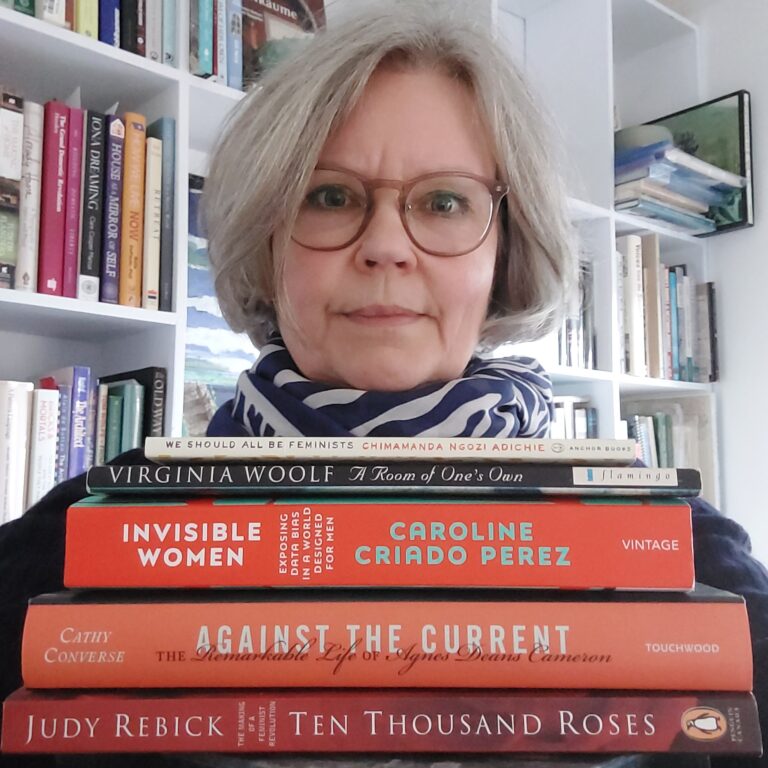
Inspiring reads, on International Women’s Day

International Women’s Day on March 8 is a global day celebrating the social, economic, cultural, and political achievements of women. 

Sophia vom Bauer Jackson, chair of Islanders Working Against Violence and former manager of Black Sheep Books on Salt Spring, shares her favourite books about, or by, women breaking the gender bias. Vom Bauer Jackson holds a master’s degree in North America studies and within this interdisciplinary field, Women’s and Gender Studies had the greatest impact on her. 

Virginia Woolf: A Room of One’s Own 

This is my personal favourite. Published in 1929 this essay is still well worth reading, not just for the beautiful language. Woolf touches on many topics that are still relevant today to all women who want to be creative — not just writers. It is a book that speaks to me through the divide of nearly a hundred years. 

Caroline Criado Peréz: Invisible Women – Data Bias in a World Designed for Men 

A really important read. Perez examines the bias against women in every kind of data collected, from health care to safety guidelines, from economic development to policy making. Easy to read science writing touching all aspects of women’s lives. It opens our eyes to how the exclusion of women from the data collected affects women’s health and wellbeing, their safety and economic prosperity, their ability to participate in the world. 

Chimamanda Ngozi Adichie: We Should All Be Feminists 

I chose this book because Ngozi Adichie challenges stereotypical notions of feminism in a very personal way and discusses in a clear argument why the gender divide is harmful to all — women and men. If you don’t have time to read, you can also listen to her TED Talk which she adapted into this essay. 

Cathy Converse: Against the Current – The Remarkable Life of Agnes Deans Cameron 

A Canadian author writing about an extraordinary British Columbian. Agnes Deans Cameron, who lived from 1863 to 1912, was born in Victoria and took a path in life highly unusual for a woman of her time. She was an educator (the first female principal in the province), writer, lecturer and adventurer, and worked tirelessly to achieve workplace equality and voting rights for women. 

Judy Rebick: Ten Thousand Roses – The Making of a Feminist Revolution 

Judy Rebick is another Canadian writer and activist. Rebick brought together the many stories that reflect the activism of Canadian women from the 1960s to the 1990s. I believe it is important to know and to understand what the women before us did to make a better world as well as to acknowledge what they achieved. Check out the Facebook and Instagram accounts of The Circle Education and Islanders Working Against Violence for more book and movie recommendations.

Mozart and Mendelssohn up next for Bach on the Rock

When Jean-Sébastien Lévesque was chosen as one of three artistic directors to work with the Bach on the Rock (BOTR) Chamber Orchestra and Choir for their 2021-22 season, he decided to jump on a ferry from Vancouver and see the group’s concert at Fulford Hall on Nov. 6.

Like everyone in the hall that night, he was surprised when the lights went out just as the choir and musicians, led by artistic director Marco Vitale, were set to sing and play their first notes.

“I secretly hope a power outage will happen again,” he told the Driftwood with a smile when asked how he would respond to that same situation.

Lévesque said he was impressed by how the group adapted to the sudden loss of electricity.

“Bach on the Rock members asking for help from the audience showed that there was a strong sense of community. And it surely added to the event: dimmed cellphone lights can be seen as a modern form of candles.”

Lévesque, who received his extensive musical training in Québec where he was artistic director of two choirs, now lives in Vancouver. He will be leading the BOTR concert titled A Tale of Two Prodigies at Fulford Hall on Saturday, March 19 at 7 p.m. and has chosen repertoire by Mozart and Mendelssohn, some of which illustrates how they were musical prodigies. One of the pieces — Mozart’s Missa brevis in d minor, K. 65 — was written when he was only 12 years old.

“Even if it is not as elaborate as some of his later works, this mass already shows an incredible mastery of composition,” said Lévesque.

The concert will also include Mozart’s Violin Concerto #5, K. 219, featuring soloist Victor Fournelle-Blain of the Montreal Symphony, who is Lévesque’s longtime friend and colleague.

“Victor has this ability to focus and this passion about music that seems to never fail to get everyone involved in the music with him,” Lévesque said.

Mendelssohn pieces in the concert are The Hebrides Overture, Op. 26, and the Psalm 42 cantata, which the composer considered his most accomplished sacred work. BOTR welcomes guest soprano soloist Gwen Jamieson from Victoria for the cantata.

Lévesque has enjoyed working with BOTR members and looks forward to sharing the magic of a live concert with a Salt Spring audience.

“An acoustic concert is something that we’re not used to anymore, with sounds created not by a digital recording but by actual voices of actual people, by bow hairs grinding on a string, by someone blowing into a wind instrument,” he said. “It’s also an experience that we share with the person seated next to us; something that is subject to the very moment, to the possibility of a power outage. That’s not a connection that we can experience through a TikTok video. That’s not something that we can experience even with the best sound system.”

Tickets for the concert are available on the bachontherock.com website or at the door.

Vaccine passports must be shown at the door and masks worn during the concert.

Ganges mural project gets provincial funding

Ganges will have four new murals gracing various walls around the village, thanks to a project geared at getting visitors to frequent places off the main drag. 

A joint Salt Spring Island Chamber of Commerce and Salt Spring Arts project was successful in receiving up to $50,000 to commission four murals in Ganges. The murals will serve as stops on a public art walking tour, meant to expose visitors to the less-visited shops and cafes on smaller side streets that feed into the oft-frequented waterfront area.

Salt Spring Arts will oversee the “rigorous design submission and jury selection processes,” a news release from funding organization Island Coastal Economic Trust stated.

Some prime locations for the murals have been identified, including the Visitor Information Centre on Lower Ganges Road, a bus shelter and downtown buildings. Canadian mural artists will be invited to submit mural concepts on the theme of “sustainability, reciprocity and creativity,” with special efforts to attract submissions from “members of Salt Spring’s youth, queer and BIPOC [Black, Indigenous, People of Colour] communities.”

“Salt Spring Island is already known for its vibrant arts scene, and is home to many arts organizations, galleries and studio tours, as well as a major national arts prize that attracts artists from across Canada,” stated Inga Michelson, of the chamber. “The Ganges village mural walking tour will facilitate stronger connectivity between these existing cultural assets.”

Funding comes from the THRIVE Small Capital Program, launched last May to help downtowns, main streets and business districts in the Vancouver Island and Sunshine Coast region. With support from regional tourism organizations, the program provides funding for up to 100 per cent of eligible project costs and is accepting applications on an ongoing basis until the program is fully subscribed.

For more on the mural project, see the March 16 edition of the Gulf Islands Driftwood.

Islands Trust Conservancy receives $100,000 Bloom contribution

0

Susan Bloom’s renowned support of conservation causes is continuing after her death.

The Islands Trust Conservancy (ITC) announced Wednesday that it has received $100,000 through the estate of long-time Salt Spring resident Bloom in support of its continued conservation efforts.

“[Bloom] was genuinely committed to the protection of wildlife, their habitats, and the protection of ancient forests and oceans, and is perhaps most well known for her donation and work to protect Clayoquot Island near Tofino with the Nature Conservancy of Canada,” states an ITC press release.

ITC was selected by Bloom’s estate trustees in her memory in recognition of the conservancy’s efforts to preserve the area’s natural heritage. 

Bloom passed away in December 2021.
“I feel sad that Susan Bloom, the epitome of quiet philanthropy, has passed away; and at the same moment, happy to discover that her legacy included Islands Trust Conservancy,” said Carla Funk, the ITC’s fund development specialist. “We are honoured to be entrusted with her bequest. Careful consideration will be made to ensure that use of these funds is in keeping with her lifelong passion for conservation on the islands.”
“Susan believed strongly in grassroots organizing and worked to help small groups of passionate people do extraordinary things,” said friend and estate trustee Janet Theunisz.