Home Blog Page 26

Canadian Christmas thrills the crowds

Salt Spring Singers community choir went (almost) all Canadian for its holiday concert this year, compiling an astonishing 95.8 per cent of content from Canadian composers or arrangers.

And as director Deborah Smith explained to the two sold-out audiences at All Saints church on Friday night and Saturday afternoon, even the remaining 4.2 per cent had a Canadian connection in a piece by renowned British choral composer John Rutter, “who says he ‘always feels at home in Canada’ and was patron of the Mendelssohn Youth Choir in Toronto.”

The concert, titled A Canadian Christmas, celebrated shared experiences even further through personal memories of the season told by several choir members.

Some other features were accompanist James Yi suddenly leading an impromptu guitar quartet, trumpet soloist Simon Millerd performing in two songs, and John Metzger playing flute on Joni Mitchell’s River.

But the element that has anyone who attended the show still talking days later is the all-original Salt Spring-centric version of The 12 Days of Christmas. Audience members were delighted with local lyrics everyone could relate to, with actions to match, such as four choir members with antlers prancing back and forth for the line “four deer a’crossing,” or others raising strings of Christmas lights for “seven lit-up farm stands.”

Most ingenious was choir member Ron Dyck holding and changing directions on a SLOW and STOP traffic sign to illustrate “12 months of road work” as the choir either slowed or halted the music in sync.

“The 12 Days of Salt Spring was always on my mind when I designed the program,” said Smith after the concert. “It seemed a natural thing to take the famous song and make it not only Canadian but local. The choir had a blast as we collectively chose each of the things for the days and the matching actions. We are very grateful to Dave Phillips of Dave’s Drilling and Blasting for lending us the stop sign for the ‘12 months of road work’ line. We’ll have to encourage the new director, Adam Dyjach, to make it an annual Salt Spring Singers tradition.”

Smith took on directorship for the fall term only as the choir completed its search for a permanent director to replace Don Conley, who retired this past summer.

Foundation Land Back campaign reaches goal

0

SUBMITTED BY SSI FOUNDATION

Just in time for the giving season, Salt Spring residents and donors from near and far have acted in reconciliation by raising the funds needed for SȾÁUTW̱ (Tsawout) First Nation to complete its Salt Spring Island Land Back campaign.

This campaign will reimburse them for their land purchase of Lot A Menhinick Drive on Salt Spring Island, which is adjacent to their 50-acre reserve in W̱ENÁ ̧NEĆ, or what is also known as Fulford Harbour.

After launching in June, the community rallied for seven solid months to raise the full $600,000 required to gift this property in their ancestral territory to SȾÁUTW̱ First Nation. The students at Fulford Elementary School got involved in the effort, hosting a popcorn fundraiser at the school and raising over $200 for the campaign.

This Land Back campaign was propelled by over 200 donations and buoyed by 13 donations, each over $10,000 from private and anonymous donors, as well as donor-advised funds, including the Artemis and Petunia Fund, the Salt Spring Island Foundation, and the Philip and Muriel Berman Foundation.

Additionally, The Land Conservancy of British Columbia (TLC) donated generously to the SȾÁUTW̱ Land Back fund held at the Salt Spring Island Foundation with funds received from the late Nancy (Grant) Braithwaite. In her lifetime, Braithwaite acted in support of several social and environmental causes, including land acquisition for conservation, and Indigenous reconciliation.

The SȾÁUTW̱ Land Back campaign team would like to acknowledge all donors for their extraordinary generosity, including TLC in carrying on Braithwaite’s legacy. And the foundation would like to thank campaign leaders Briony Penn, Ashley Hilliard, Brian Craig and SȾÁUTW̱ lead negotiator Chrissy Chen, for their vision and stewardship of this effort.

“We are grateful that this opportunity for a tangible act of reconciliation came up on Salt Spring, was embraced by the SȾÁUTW̱ First Nation, and then supported by the island. Working together has been joyful and brought the language and laughter back to W̱ENÁ ̧NEĆ,” said Hilliard.

For those wishing to contribute, the fund will remain open until Dec. 31. Any funds over the campaign target will go towards SȾÁUTW̱ activities on Salt Spring Island.

For more details about the campaign, visit ssifoundation.ca/tsawout-land-back-campaign/.

Salt Spring trail plan lands with CRD service

0

A Fulford-to-Vesuvius multi-use pathway plan is being readied for inclusion into the Capital Regional District (CRD)’s newest service, with the CRD board unanimously voting to refer planning for the Salt Spring Island Regional Trail (SSIRT) to the recently formed Transportation Committee.

“It’s an important first step,” said Salt Spring’s CRD director Gary Holman, who noted his opposition to the island joining the service last year. “But given that [service] has been established, this makes total sense.”

The proposed 21-kilometre SSIRT will join the Galloping Goose, Lochside and E&N Rail trails under the new service, part of a recent “decoupling” of trail responsibilities from parks to transportation. The shift preserves capital reserves and capital plan allocations, Holman said.a

Island Pathways representatives Robin Jenkinson and Simon Rompre had spoken earlier at the CRD board meeting Wednesday, Dec. 10, backed by about a dozen Salt Spring Islanders and once again advocating for the regional district to begin initial SSIRT design work in 2026. Holman supported a motion advancing that suggestion to the Transportation Committee, noting there should be no tax implication as money for that work is already designated from reserve funds.

Holman is not among directors sitting on the regional transportation committee, although separately there is an interagency transportation committee that includes one senior staff representative from each participating area — all 13 municipalities and three electoral areas — alongside representatives from the Ministry of Transportation and Transit, BC Ferries, ICBC and similar agencies. In Salt Spring’s case, senior manager Dan Ovington sits on that committee as a voting member.

The SSIRT has been described as the “last missing piece” in the 200-kilometre Salish Sea Trail network, with early construction cost estimates reaching over $100 million; a recently-completed feasibility study put that number lower, targeting potential savings through use of different surfacing materials and incorporating some on-road trail segments along “traffic calmed” side streets.

Island Pathways has said that starting design work in 2026 will help its efforts to engage potential donors.

SSHAN: Collective impact towards a healthier island

0

BY THE SALT SPRING ISLAND HEALTH ADVANCEMENT NETWORK

Salt Spring Island has always been a place where neighbours look out for neighbours, where care is woven into the rhythms of daily life and where community well-being is understood as a shared responsibility. The Salt Spring Health Advancement Network (SSHAN) takes that long-standing ethos and turns it into something even more powerful: a structured, community-driven system that strengthens health and wellness across the island.

Rooted in the collective impact model — a collaborative approach in which diverse organizations align their efforts around a shared vision — SSHAN is building a coordinated health ecosystem that is more connected, educational, resilient and responsive to local needs. Instead of relying on isolated services, the island benefits from a broader and more intentional network that amplifies the strengths of each partner. The result is a healthier community supported by collaboration rather than fragmentation.

Coordination Through a Shared Purpose

One of SSHAN’s clearest strengths is its ability to create stronger coordination among the many agencies, organizations, and groups already offering services on the island. Because Salt Spring is rural and geographically separated from major urban centres, effective communication is essential to ensure care remains accessible. SSHAN brings primary health care, mental-health supports, volunteer groups, first responders, and social-service organizations together under a common agenda — one of the five central pillars of the collective impact framework.

A shared purpose means providers don’t operate in silos. Instead, they gain a clearer understanding of how their work fits into the larger picture of community health. This alignment helps services adapt to one another’s needs and reduces the duplication or gaps that can frustrate both workers and residents. Salt Spring Islanders — particularly seniors, those managing chronic health conditions, insecurely housed and unhoused community members, BIPOC and LGBTQ2IA+ residents and families experiencing violence or poverty — benefit from a more welcoming and coordinated system. Whether someone needs help navigating appointments, access to basic needs like showers, culturally safe care or broader wrap-around supports, the network helps ensure that no one falls through the cracks.

Prevention Through Mutually Reinforcing Activities

Another foundational pillar of collective impact is mutually reinforcing activities — the idea that each organization contributes in different but complementary ways. SSHAN brings this principle into practice through its strong emphasis on prevention and community-wide wellness. Local partners coordinate around shared issues such as mental wellness, seniors’ care, housing needs, and the health impacts of being insecurely housed or unhoused. When these efforts are synchronized, the positive effects multiply.

Preventive approaches are especially important in small rural communities, where resources are limited and off-island travel is expensive and time-consuming. By addressing social determinants of health — including education, social connectedness and equitable access to care — the island reduces avoidable health crises, lowers emergency-room usage and improves long-term outcomes. SSHAN’s prevention-focused projects also build on Salt Spring’s strong culture of community activity. Organizations such as Transition Salt Spring, the Farmland Trust, farmers’ markets, neighbourhood POD workshops and various community forums naturally become health-promotion spaces when connected through a collective approach.

Strengthening Mental Health Support

Supporting mental wellness continues to be one of the island’s most pressing priorities, and SSHAN’s collaborative model strengthens the local system significantly. The network connects counselling providers, peer-support groups, crisis responders, social-service agencies and family-support organizations to create a more cohesive and accessible care pathway. Through shared training, coordinated outreach and cross-sector communication, the community’s capacity to recognize, respond to and prevent mental-health challenges grows stronger.

Shared measurement — another pillar of collective impact — ensures partners are not working blindly. By collecting and reviewing data together, SSHAN can spot emerging gaps, improve service coordination, and adjust programs based on real-time needs. This leads to reduced wait times, faster interventions, and mental-health support that is more culturally appropriate and locally grounded.

Attracting & Sustaining Local Health Providers

Rural communities everywhere struggle to recruit and retain health professionals. A well-coordinated network that demonstrates collaboration, stability and clarity is far more appealing to prospective providers. SSHAN helps create conditions in which health professionals feel supported rather than isolated, and where community partners are working together to solve challenges rather than operating independently. Efficient coordination also ensures public funding is used wisely, reducing duplication and allowing more resources to reach front-line needs.

Community Resilience in Emergencies

Another major benefit of SSHAN is its role in strengthening emergency preparedness. Salt Spring’s existing neighbourhood POD program provides an excellent foundation, and SSHAN builds on it by helping partners maintain communication channels, shared plans and trusting relationships. Whether responding to winter storms, prolonged power outages, wildfires or public-health emergencies, a collaborative network allows for faster mobilization, clearer information flow and targeted support for residents who are most vulnerable.

Empowerment & Equity Through Collective Action

Perhaps the most meaningful impact of SSHAN is the sense of empowerment it cultivates across the community. Collective impact requires ongoing communication and community involvement, ensuring that local voices help shape health priorities. Islanders see their ideas reflected in programs such as expanded community-care supports, stronger mental-health navigation tools, culturally safe practices or advocacy for patients during medical appointments. This strengthens trust and encourages more people to participate in preventive care.

Equity is at the heart of SSHAN’s work. By partnering closely with organizations serving isolated, low-income, and equity-deserving residents, the network helps ensure that resources reach all parts of the island — not only those who are already well-connected.

Current SSHAN projects include the Mental Wellness & Seniors Initiatives, a refreshed community health needs assessment, an emergency supplies project for insecurely housed and unhoused residents and ongoing network-table meetings where providers share updates, learning, and supports. SSHAN includes more than 40 organizations, spanning health and mental-health services, housing supports, seniors’ organizations, education, justice, public health, Indigenous and equity-deserving groups, and lived-experience participants.

In short, the Salt Spring Health Advancement Network demonstrates how the collective impact model can transform community health in a rural setting. By aligning organizations around a shared vision, coordinating services, building mental and physical wellness capacity, improving emergency readiness and empowering residents, SSHAN is helping Salt Spring Island move toward a healthier, more connected and more equitable future. The community health network model is proving its success in communities across Vancouver Island — and Salt Spring is proudly among them.

For more information or to connect over a cup of coffee, email sshealthadvancementnetwork@gmail.com. Info can also be found through our website (sshealthadvancemen.wixsite.com/sshan) and Facebook page.

“Collaborative and connected community working for the well-being of all. Nothing about the community without the community.”

New washout affects Channel Ridge

0

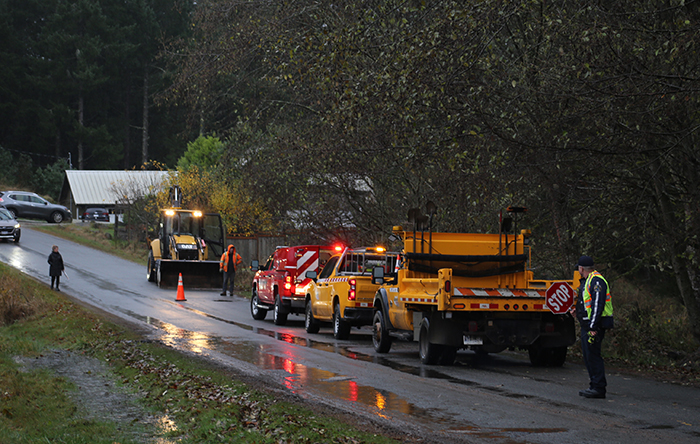
Heavy and prolonged rain Wednesday, Dec. 10 led to something of a washout on Channel Ridge Drive, briefly snarling the only remaining road to many houses as workers rushed to ensure it was safe to cross.

Salt Spring Island Fire Chief Jamie Holmes said responding fire crews found water had undermined a section of roadway and closed Channel Ridge Road to traffic for a little less than an hour, until road crews could assess the situation and make temporary repairs.

“It looked pretty good from the surface, but the road was just being held up by the asphalt,” said Holmes. “There wasn’t a lot of substance underneath.”

Emcon Services Inc. operations manager Andrew Gaetz said when road workers arrived they found another of the island’s aging culverts had failed. Firefighters helped control traffic while crews placed steel plating, allowing some traffic to flow through. 

Emcon crews returned later in the week, briefly re-opening the closed section of Broadwell Road to vehicles while the Channel Ridge Drive culvert was being replaced. Gaetz said they finished installing the new culvert there by 2 p.m. Friday, Dec. 12. 

Broadwell Road, which had been closed since an earlier washout at Duck Creek, is once more blocked off and will remain so until next year.

Northridge & ministry part ways on Alders Avenue work

In other roadwork news, Northridge Excavating Ltd.’s operators and flaggers were spotted pulling out of the ongoing excavation work on Alders Avenue Friday, Dec. 12, with new faces now assessing the project.

Northridge Excavating Ltd. project manager Bob Mitchell said the ministry and Northridge “could not agree on a few things,” and confirmed that while Northridge crews continued work elsewhere along Fulford-Ganges Road, the contractor had been released from obligations to complete the Alders Avenue work — now “safely handed over to the ministry,” he said.

Ministry of Transportation and Transit (MOTT) officials Tuesday characterized the additional crews as “reinforcements,” saying they would help ensure remaining tasks there were completed “safely and efficiently during the storm season.”

“Given the complexity of this project and recent challenging weather conditions, [MOTT] has brought in additional crews with specialized expertise to support the final drainage outfall stages of work,” according to a statement.

This story has been updated since publication to add comment from the ministry.

Santa Ship brings cheer

0

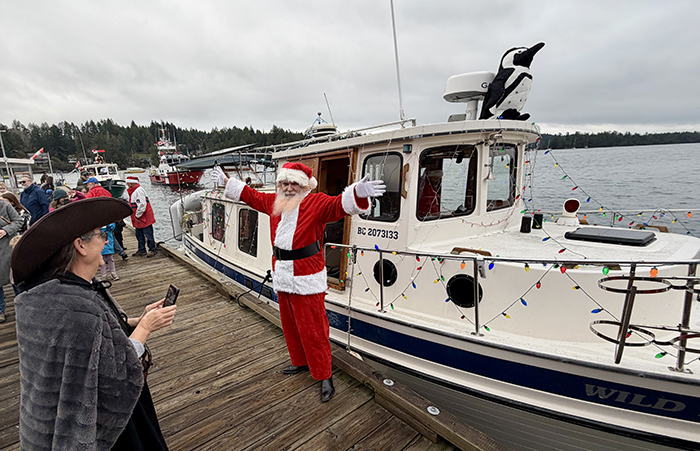
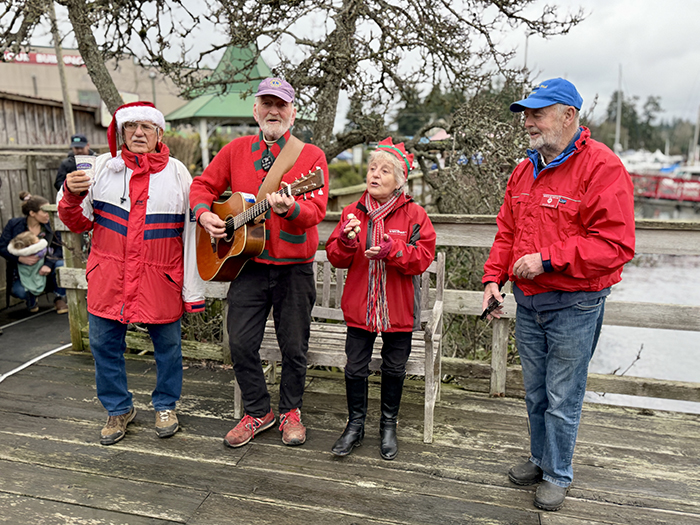
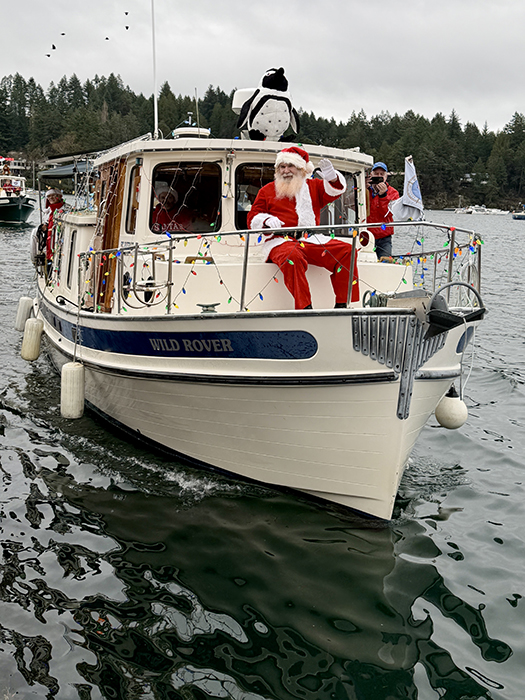
The Salt Spring and Mayne Island Lions Clubs teamed up for the second year to keep the Gulf Islands Santa Ship tradition alive.

Santa visited kids on Mayne and Saturna Islands on Sunday, Dec. 7 and then Salt Spring youngsters on Saturday, Dec. 13.

The first Santa Ship trip took place first just in Bellingham Bay, Washington in 1947 through a business group called the Bellingham Jaycees.

“In the beginning they just started running a small ship around Bellingham Bay,” Don Wight Jr. of the Bellingham Lions told Cherie Thiessen of Aqua magazine in 2019. “Then we started getting requests from many of the other islands and in the 1950s the Canadian Gulf Islands asked us if we could bring Santa up to see them too.”

Wight’s late father Don Wight Sr. had been the main initiator of the project in the 1940s.

In 1996 the Bellingham Lions took on the mission in cooperation with their Canadian counterparts.

The Covid pandemic and other challenges put an end to the cross-border Santa Ship after 2019, but Salt Spring and Mayne Island Lions Club members got together to revive the project last year.

Photos in the gallery below by Rob Lowrie.

Cats of Salt Spring reports on busy year; matching donors help raise funds

0

By JENNIFER MCMILLAN

Founder, Cats of Salt Spring Rescue Society

We are thrilled to have two individuals supporting us this December, both matching donations to our year-end campaign.

The first donor, who has pledged a matching donation of up to $4,000, has been our matching donor for our last four year-end campaigns. We are so grateful that our second matching donor from 2024 has also returned, pledging a matching donation of up to $10,000. This means that, with your support, we can raise up to $28,000 to help cats in need here on Salt Spring Island.

We are very proud to share these highlights of the first 11 months of 2025:

Total number of cats and kittens assisted: 136 (an 11.5 per cent increase from 2024)

Cats surrendered by owners/caretakers to our rescue: 26

Stray/trapped cats or kittens born in care: 72

Number of cats and kittens adopted to date in 2025: 81

Cats/kittens provided with medical care (spay/neuter, vaccinations or other medical services) as part of our Community Care program: 27

Cats currently in care as part of our Lifetime Foster Program: 14

We enthusiastically continued our colony management projects in 2025. We carried on with trapping a colony on Vesuvius Bay Road, a project which began in 2024. We also brought in eight cats from a colony on Upper Ganges Road, several of whom were pregnant.

Our most significant colony management project in 2025 centred around the large population of black cats in the North Beach/North End Road area. Between August and November, we brought in a total of 36 cats from this colony. Work on this north Salt Spring colony will continue in 2026, as there are still many more cats needing help.

When Salt Spring residents need assistance caring for their own cats, we are here for them. We provided veterinary assistance and/or microchipping to 27 owned cats in 2025. We have also had 26 cats/kittens surrendered to us this year by owners or caretakers who were no longer able to care for them. We provided food and litter free of charge to several Salt Spring residents throughout 2025.

We continue to expand our Lifetime Foster Program and currently have 14 cats placed in homes through this program (up from 10 at the end of 2024). Cats placed through this program live in long-term foster homes where they receive love and care from their foster families, while their medical needs are facilitated by the rescue. The benefits of this program are twofold:

• Homes are provided for cats and kittens who, due to their ages or underlying medical conditions, would not otherwise be “adoptable,”and

• Companion animals are provided for individuals and families who might not otherwise be able to afford pet ownership or to coordinate veterinary care on their own.

We need your support! Cats of Salt Spring Rescue Society relies on donations and monies that we fundraise (e.g., through our bottle drives and the Country Grocer Save-a-Tape program) to support our operations, including our work with feral colonies and programs like our Lifetime Foster Program. We charge adoption fees for our kitten and social adult cat adoptions; however, these adoption fees do not cover even our veterinary and food costs.

We are so grateful to have been awarded funds from the Salt Spring 100+ Women Who Care group in October of 2025. These funds have been allocated to some significant veterinary expenses incurred in the late fall of 2025.

We are a completely volunteer-run, foster-based organization, relying on donations from the public and fundraising events to sustain our programs and operations. We do not have any overhead or staffing costs, meaning that all funds received go directly toward assisting cats in our community.

We are a registered Canadian charity, issuing tax receipts for all donations of at least $20 received.

Donations to Cats of Salt Spring Rescue Society can be made in several ways:

1. Cheques can be mailed to us at the following address:

Cats of Salt Spring Rescue Society

PO Box 837 Ganges

Salt Spring Island, BC

V8K 2W3

2. Donations can be made through e-transfer to our email address – info@catsofsaltspring.com or by using our phone number: 236-508-2287.

3. Donations can be made through canadahelps.org. Although an administrative fee is deducted, tax receipts are provided directly to donors from Canada Helps.

Thanks to our dedicated supporters, we are making a tremendous difference in the lives of so many cats and kittens here on Salt Spring Island. None of this would be possible without our community’s support.

Fire hall on track for May 3 opening

0

“I mean, right now we wash our hoses out in the parking lot.”

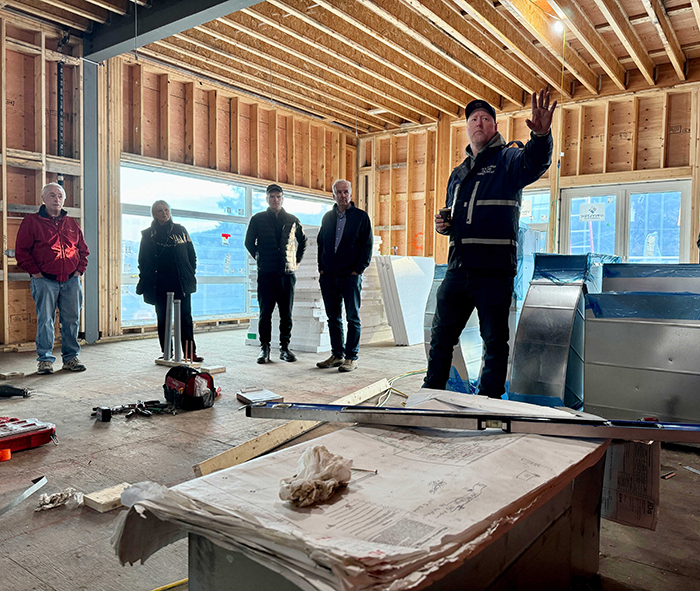
Salt Spring Island Fire Rescue (SSIFR) Chief Jamie Holmes was leading district trustees past an unassuming square hole, where he explained a modern hose washing system will soon be installed. Built into the side of the future hose tower at his department’s nearly complete new Fire Hall No. 1, it’s among several remarkable details highlighted during a tour for the fire board and a few other community members held Saturday, Dec. 6.

Holmes explained the washer can pressure-clean a fire hose immediately after firefighters return from a call, pulling it directly off the truck and through that small hole — after which a hoist raises lengths of hose straight up into the tower to dry. It’s the sort of thoughtful feature found throughout the new hall, extending the service life of valuable equipment and multiplying the efficiency of the structure.

Like a lot of things here, the hose tower isn’t just for hoses.

“There’s anchors all the way up, so we can rappel off the side, and we have openings on the front to practise laddering,” said Holmes. “Everything we could think of, if we could find room in the budget to ‘future-proof’ something, we took the opportunity.” 

The large central bay is being built with double doors at either end, potentially allowing four vehicles at a time to sit in a nose-out, ready-to-go configuration. Instead of attaching a ducting hose to each fire truck’s exhaust pipe, the climate-controlled and lightly pressurized space has central air scrubbers, allowing speedy flexibility if trucks need to be rearranged. 

The building reclaims waste heat from almost every process, to either warm the truck bay or help dry firefighters’ gear between calls. There’s a workshop space — think small engine repair and maintenance for things like chainsaws — well-removed from a clean room where breathing apparatus and personal safety equipment can be carefully decontaminated and maintained. 

The entire east side of the building was constructed to make future expansion in that direction easier, and the west side — where rainfall from a fire-engine-sized attached “carport” is directed into 30,000 gallons of underground water storage — can be “walled in” relatively quickly and at comparatively little expense, should the department find itself needing more indoor vehicle space. 

Every nook and cranny has at least one purpose, and usually several, Holmes said; from under-stair storage spaces to flexible meeting rooms that can be configured into different sizes — or repurposed in an instant into an extension of the building’s emergency operations centre, supporting multiple agencies in a disaster. Holmes said amongst the fire-resistant xeriscape planned for near the building — and inside a perimeter “foodscape” along the fences he said will include berry patches — they’re pouring a small RV pad, perfect for visiting training or maintenance contractors from off-island, or even staff.

“In the future we believe housing will continue to be an issue,” said Holmes. “So worst-case scenario, maybe somebody coming into a job here could at least park an RV in the back and have somewhere to lay their head while they were trying to find secure housing.”

The new hall is expected to be fully operational by an official opening on May 3. 

Raffi sings for protection of democracy

For Raffi Cavoukian, the internationally known children’s entertainer and Salt Spring Island resident, seeing recent chaos and erosion of freedom in the U.S. has been “the shock of my lifetime.”

For decades, he said last week, he has enjoyed sharing his music on tour in that country and considered the U.S. “a dear friend of Canada for a long time.”

“It’s just so sad that I wanted to write a song to help all of us remember why freedom is so precious to us,” he said.

The challenge was to write a song that would appeal to both young and old listeners, and “ABC Democracy,” released in late October, is the result.

Raffi said he’s happy with the strength of the song’s title and opening line, with the first verse being: “ABC Democracy / Young and old, standing free / Choosing well, you and me / ABC Democracy.”

The Good Lovelies trio of Caroline Brooks, Kerri Ough and Sue Passmore accompany Raffi on the song, as they did for his Penny Penguin album release last year and as special guests for recent concerts.

“I turned to them for their vocal charms on this and I think they really enlivened the recording,” he said.

Writing and recording an inspirational song is one thing. Getting it out into the world is another. But Raffi was thrilled that the song got more than 23,000 likes and 5,000 shares on Instagram in one day (Dec. 3).

“And the over 300 comments have been so positive, with parents and teachers saying they love it and their kids love it. I’m just saying to myself, ‘this is probably as important a song as any I’ve ever released.’”

Raffi and the song were also featured on a national CTV news segment on Dec. 3.

“It’s really important for families to be inspired to learn about a citizen’s duty to keep a democracy alive and strong,” he told CTV interviewer Omar Sachedina. “Democracy is not a spectator sport.”

Songs with social justice themes are not new for Raffi. He has tackled Indigenous rights as far back as 1994 (with “First Peoples”); “Turn This World Around,” inspired by Nelson Mandela in 2001; Middle East peace in 2004 (“Salaam Shalom”), an environmental anthem called “Green Dream” in 2016; and “Young People Marching” (2019), written in gratitude to Greta Thunberg.

“ABC Democracy” also has a study guide for parents and educators to help reinforce its message. It includes simple definitions for core concepts of democracy, emphasizing the importance of personal choice and voting but also creating a healthy society for everyone.

“Democracy is more than elections,” states the guide. “It’s a way of living together that respects each person’s dignity, rights, and voice. When we care for each other and make decisions together, we help create a fair and hopeful future for all, including the youngest among us.”

Raffi noted that “civics” was part of his education at school.

“I think we certainly need a revival of civics in our learning institutions so the kids really are informed and hopefully inspired about the only form of government that’s really worth having. Who would choose anything that takes our rights away? Nobody would choose that.”

“ABC Democracy” can be purchased or streamed through a variety of online platforms and raffistore.com.

In related news, Raffi recently participated in a two-day symposium called Music and the Mind: A Smart Start to Early Childhood Education, organized by the Royal Conservatory of Music on the benefits of music education for young children.

“That was a wonderful event to be part of and I was well received, and it really gave me a spring in my step to take part in that.”

He has also been thrilled to be working with Laurel Collins, the former Member of Parliament for Victoria, who is the new executive director for the Raffi Foundation for Child Honouring.

“So she now brings all her experience in Parliament and how things work, how change happens. She brings her amazing capacities, her clear communication, her heartfelt love and respect for children, and she loves the Child Honouring vision. So I feel very fortunate that the Raffi Foundation has an executive director of her calibre.”

Ferries round-up: terminal upgrades, thru fare price changes

0

Long-awaited terminal improvement work will affect Gulf Islands ferry travel this winter, but BC Ferries (BCF) said it aims to minimize impacts and give plenty of notice of schedule changes and berth closure times. 

Work to upgrade the vehicle ramp, marine structures and the electrical distribution system at Otter Bay on Pender Island has already begun, with an end-of-March 2026 completion date, according to a Nov. 26 BCF service notice. A five-day terminal closure from March 6 to 10 will be required, with water taxi service between Otter and Swartz bays and free parking at both ends set up for that period. 

Work scheduled for Berth 1 at Village Bay on Mayne Island will see it closed for eight weeks from Jan. 5 to March 1, but Berth 2 still available. A 16-week construction period is planned, with work expected to wrap up by the end of April 2026.

Revised schedules, with changes described as “minor” and designed to reduce congestion at other berths, will be posted once available.

Of more immediate concern for people travelling to and from Salt Spring via Fulford Harbour this weekend is cancellation of the last two sailings of the Skeena Queen on Saturday, Dec. 13 as the vessel undergoes repairs. The 5:50 p.m. departure from Fulford Harbour and the 7 p.m. from Swartz Bay will be the last sailings of the day. The 6:15 a.m. sailing departing Fulford and the 9 a.m. from Swartz Bay on Sunday are also at risk of cancellation. Water taxi service is in place for foot passengers on those sailings.

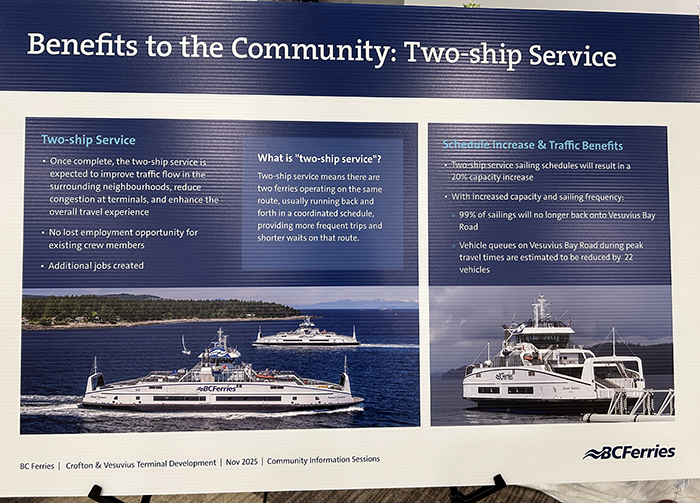
Meanwhile, a Dec. 2 open house event at the Harbour House Hotel brought people up to speed on planned work to both the Crofton and Vesuvius Bay terminals, for eventual two-ship service on the route beginning in the summer of 2027. 

BCF staff attending that session said service between Crofton and Vesuvius will be unavailable on some days as a result of the work, but plenty of notice — ideally two weeks — would be given in advance. At this point, construction to create a lay-by berth at Crofton for the second ferry is scheduled to occur in the spring and summer of 2026, and upgrades to the existing Vesuvius and Crofton trestles and berths will run from the fall of 2026 through early 2027. 

BCF advises that the best way to stay informed about the terminal projects and any closures/schedule changes is to subscribe to the appropriate project pages on the BCF website: bcferriesprojects.ca. Email messages will be sent to all subscribers. 

In other BCF news, Gulf Islands travellers going to or from Tsawwassen via Swartz Bay may have noticed a change in thru fare rates and longstanding policy that took effect without much notice on Oct. 15. 

For the past 10 years, passengers who requested the thru fare option have paid the same price as if travelling directly between Tsawwassen and the Gulf Islands (Route 9). That is no longer the case.

Ferry officials said a combination of increased and shifting demand for sailings and an effort to deter an arcane bit of fare cheating were behind the changes. 

“Thru fare travel is available when customers book a prepaid fare to Swartz Bay and request the thru fare at the Tsawwassen ticket booth,” said BCF senior communications advisor Sheila Reynolds. “No extra charges apply. Customers with a ‘reservation-only’ booking or travelling without a booking will pay the at-terminal rate.

“The at-terminal rate for Route 1 (Tsawwassen–Swartz Bay), Route 9 (Tsawwassen–Southern Gulf Islands), and the at-terminal thru fare are now aligned at $95. This prevents situations where customers travelling only to Swartz Bay could use the thru fare to pay less than the standard Route 1 at-terminal rate,” she said, adding that travelling thru fare from Tsawwassen-Swartz Bay-Fulford on the prepaid fare is $105, while travelling prebooked and prepaid off-peak from Tsawwassen to Long Harbour is $80.

“We know this is an adjustment for some travellers, but booking ahead helps ensure travel certainty and reduces the long road lineups and terminal congestion that have become more common as demand grows.” 

She said fare changes were outlined in a fare guide posted online April 1. 

For thru fare travel in the other direction, use of the existing voucher system continues, although at a slightly higher rate for those who haven’t pre-booked and paid for a reservation on the Swartz-to-Tsawwassen run.