Home Blog Page 291

Salt Spring Island RCMP release Second-Quarter Statistics

0

SUBMITTED BY SALT SPRING ISLAND RCMP DETACHMENT

The second quarter of 2021, April 1 to June 30, was a steady period for Salt Spring Island RCMP with 728 calls for police response and investigation. The types of reports included, among others, 123 mental health calls, 112 traffic-related calls, 12 firearms calls, seven sexual offence investigations and 20 COVID complaints. There were 439 foot patrols conducted and 97 bar walks done over this 91-day period. In total, SSI RCMP have now responded to over 1,400 calls since the beginning of 2021.

In the month of April 2021, there was a 200 per cent increase in traffic collisions when compared with April 2020, a 33 per cent increase over April 2019 and a 140 per cent increase over April 2018. In May 2021, motor vehicle collisions increased 50 per cent from 2020 and over 125 per cent from 2019. Single-vehicle collisions, multi-vehicle collisions and collisions involving pedestrians with injuries were all responded to during this quarter.

Some of the calls of the last few months included the following:

April 2021

• SSI RCMP were advised of a boat taking on water in Sansum Narrows with adults and a child on board; the boat made it to shore prior to fully sinking with no injuries.

• SSI RCMP assisted the BC Coroner’s Service on multiple investigations during April and throughout the quarter.

• After arresting a female for mischief and damage to downtown property, the female was subsequently arrested again weeks later for threatening a SSI RCMP member.

• Police responded to a downtown business where the owners and staff refused to wear masks in contradiction to current provincial guidelines. Education was given and a discussion was had regarding businesses operating legally on SSI.

• Police responded to multiple acts of graffiti in the downtown core; the investigation is continuing.

• SSI RCMP responded to a report of an intoxicated male at a downtown business. Because of the level of the male’s intoxication, he was transported by ambulance to hospital for assessment and treatment.

• Police were advised of a local resident who gave out credit card numbers to a phone scammer and subsequently had money withdrawn from their account. RCMP are reminding residents to not give out their credit card numbers, SIN card information, etc. over the phone to people alleging to be from Revenue Canada.

• Police were advised of a boat adrift in Ganges Harbour, without power, with multiple people on board; Coast Guard and RCMP attended on separate vessels and the boat was towed back to land.

May 2021

• SSI RCMP received a report of a male coming to SSI on the ferry with outstanding provincial warrants; pedestrian and vehicle traffic was screened and the incoming ferry was searched by police. It was determined that a wrongful ID of the male occurred and the male was still somewhere on Vancouver Island.

• Police responded to a report of a male who broke a downtown business window with a skateboard; the male was found, arrested and charges recommended to Crown.

• A drug investigation resulted in the laying of charges against a couple supplying drugs to minors.  

• Police assisted with multiple missing persons investigations throughout this quarter.

• SSI RCMP were advised of a positive COVID test of a person who had just returned to SSI after being out of country; the importance of quarantining and avoiding people was discussed, and the person agreed to quarantine for the required two weeks on SSI.

• A theft of produce from a local farm stand was reported to police; safety practices and surveillance was discussed.

• Police assisted the BC Sheriff’s office with the issuing of documents for family court.

• Police received a report of a male going to a house on Salt Spring to “exact payment.” Police intercepted the male and arrested him; the male has since left Salt Spring Island.

• SSI RCMP responded to a male who threatened to kill himself; the male was transported to hospital for assessment.

• SSI RCMP are investigating the deliberate sinking of a 42-foot boat in Ganges Harbour by an act of mischief; charges under the Criminal Code and the Shipping Act are being recommended to Crown.

• Duncan RCMP requested assistance locating a missing male; the male was found living in Ganges Harbour by SSI RCMP.

• A female was arrested by SSI RCMP after an SSI investigation into an alleged online request for the abduction of a child; the woman offered to pay $20,000 for a child’s abduction.

• Police were advised of a van parked outside a downtown business with the van’s residents using a bucket for human feces; the bucket was kept outside the van and passers-by could see the residents using the bucket for their toiletry needs. Police discussed other toiletry options with the residents and the van was encouraged to move along.

• A male who threatened to kill himself was apprehended by police and transported to hospital for assessment.

June 2021

• After a two-year investigation by SSI RCMP into an incident involving child pornography and exploitation that occurred on SSI, a male in the U.K. was arrested and charged this month.

• Police assisted with the removal of a child from the home of an intoxicated parent who was not able to provide the necessities of life for the child.

• SSI RCMP mediated an altercation between feuding neighbours.

• Police were advised of a set of car keys stolen from an unlocked, windows-down vehicle in downtown Ganges.

• Police responded to a male waving a knife in Centennial Park; the male was arrested and the 8” knife was taken from him. The male has since left SSI.

• SSI RCMP removed a burning garbage can from near the propane tanks in Ganges Alley; the SSI fire department extinguished the fire and then together with police extinguished a second fire on the nearby beach. The identity(ies) of the arsonist(s) is currently being investigated.

• SSI RCMP are reminding residents that with COVID restrictions relaxing and opportunities to travel becoming more available, there will be an increase in travel on Salt Spring. In this past quarter alone, SSI RCMP responded to 112 traffic-related incidents, including erratic driving, various parking complaints, impaired drivers and speeding. Multiple charges for impaired driving by alcohol and drugs were issued. SSI roadblocks are increasing in frequency and impaired drivers are being caught, including two impaired drivers caught within the first seven minutes of a roadblock being set up during the last week of June. 

• SSI RCMP are reminding residents to not drink and drive. You are risking your own life and the lives of others when you get behind the wheel impaired. Call a friend, call a taxi or sleep overnight if it’s an option. Do not drive impaired.

RCMP photos from some of the many motor vehicle incidents that occurred on Salt Spring Island from April 1 to June 30, 2021.

CUTTING, Dorothy

Dorothy Cutting

 
Dorothy Cutting, beloved mother, grandmother, great grandmother, and friend, passed away Monday, August 16, 2021. She celebrated her 90th birthday in March of this year. Dorothy is survived by her son Duncan, daughter-in-law Lai, daughter Melissa, son-in-law Steve, grandchildren Jeff, Ryan, David, and Ann, and great grandson Greyson.  

Dorothy was born in Denver, Colorado, and grew up in Warrenton, Virginia. She loved scuba diving, becoming the first female diving instructor in the State of Florida. In 1965, she took off from Fort Lauderdale, Florida on a cross-country camping trip with her children, discovering a passion for the outdoors that inspired her for the rest of her life. Dorothy loved sea kayaking and was completely fearless. She took many solo kayak tips to the Baja Peninsula, Costa Rica, Belize, and all around the San Juan Islands and Canadian Gulf Islands.  In 1990, at age 59, Dorothy won 3rd place in the Sound Rowers Race, Women’s Single Kayak division.  She was an avid sailor, discovering Salt Spring Island, which became her beloved home in 1992.  

Dorothy was catapulted into activism by the Chicago riots during the 1968 US Presidential election. Outraged by police violence against protestors, Dorothy became a Precinct Committee Person, and then a volunteer lobbyist for the Washington Environmental Council.  Dorothy was a champion for the environment, working tirelessly to protect the shorelines of Washington State, on initiatives to limit nuclear arms, to raise awareness of climate change and to preserve the beauty of Salt Spring Island. In 2002, she drove across Canada in her hybrid Honda to bring a copy of Bob Hunter’s book on climate change to every member of the Canadian Parliament. Island Trust recognized Dorothy in 2010 with the Community Stewardship Award for her West Coast Climate Equity website and climate change education work. Dorothy’s focus the last several years has been on her wonderful organic garden, a place of beauty and peace.

Dorothy became a Canadian citizen July 3, 1998, the greatest honour of her life.  One of her final wishes is to have the following language added back into the Certificate of Canadian Citizenship:

“As citizens, you must uphold the principles of democracy, freedom and compassion that are the foundation of a strong and united Canada” 

 Her family would like to extend their deepest thanks and appreciation for the loving kindness and care Dorothy received from her many wonderful nurses, as well as their gratitude to Dr. Slakov and Dr. Butcher for their loving ministrations at the end of her life. 

Donations in lieu of flowers can be sent to Dying With Dignity Canada, donations@dyingwithdignity.ca. 

Dragonfly Commons Proponents optimistic about progress

0

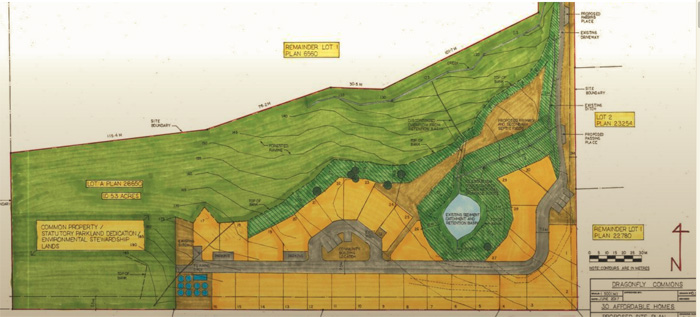
The proponents of an affordable housing development in Ganges are hopeful that significant progress is being made five years after they first announced their vision to the community.

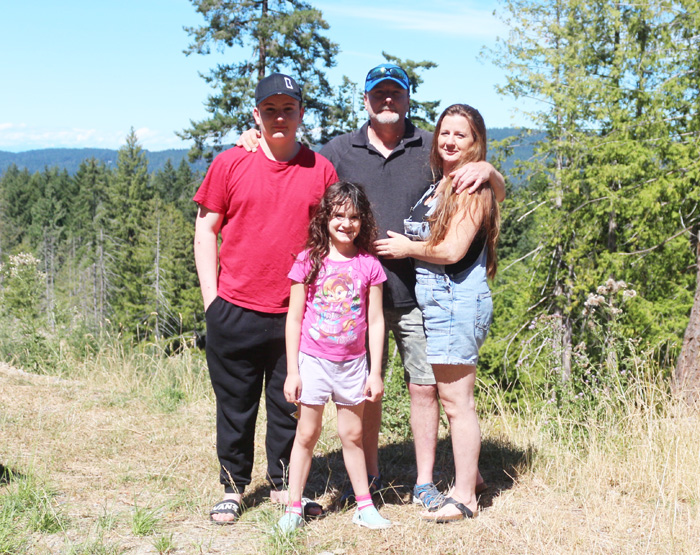
Tami and Fernando Dos Santos have been working to meet all the steps required to create the Dragonfly Commons community of 30 small homes since 2016. They recently announced they have received conditional approval for a groundwater use licence from the Ministry of Forests, Lands, Natural Resource Operations and Rural Development, which has triggered movement on other fronts. 

These include achieving first reading of a number of bylaws necessary for rezoning the property to add housing density, with full support of the Salt Spring Local Trust Committee.

“I really appreciate your dedication to hanging in there and trying to move this over the finish line, so thank you,” trustee Laura Patrick said during the July 27 LTC meeting. 

“I’m so pleased to see this where it’s at,” agreed her fellow trustee Peter Grove. “There’s so much energy and effort that’s gone into it by so many people, particularly by the Dos Santos family.” 

The LTC had also supported first reading of a different set of bylaws for a previous version of the project, which was designed as a bare land subdivision with smaller lot sizes than usually permitted. 

Speaking after the meeting, Fernando Dos Santos explained the new strata model will still allow people to own their homes, as well as a share of the common property. But the changed model will allow local government to guide more of the process, instead of needing to go through the Ministry of Transportation and Infrastructure (MoTI) as the provincial subdivision authority. 

“That puts the decision making in our local hands, and then we as a community can decide if it’s appropriate or not,” Dos Santos said. 

The current state of Drake Road makes the difference potentially a key factor in the project’s success. Dos Santos said MoTI could have required Dragonfly to fix the entire road as a condition of subdivision — which would not be possible to do and still offer affordable homes. Having more people living at the end of the road could meanwhile put pressure on MoTI to make repairs to the area it’s already responsible for.

The Dragonfly Commons Housing Society is currently consulting with a manufactured home company that could supply one- and three-bedroom homes at 430 and 860 square feet. If infrastructure costs can be kept low, Dos Santos is hopeful the cost to  buy in would be as low as $250,000 for the one-bedroom version and $375,000 to $400,000 for the three-bedroom.

The challenges involved with the water licence and being required to operate a water utility will hopefully be solved through a partnership with North Salt Spring Waterworks District. Since a legal opinion found no issue with the improvement district adding a groundwater source to its freshwater supply, as long as it updates its bylaws and protocols, the board has been open to investigating the idea further. 

Dos Santos noted making those changes would cost the district time and money, however, which would not be appropriate for its existing ratepayers to bear. A grant application for $75,000 submitted by Dragonfly and endorsed by NSSWD could bring the needed funds from the Canada Mortgage and Housing Corporation (CMHC) Housing Supply Challenge. Helpful support has come from Dragonfly board member Kisae Petersen, who has overseen the successful completion of new affordable housing units at Croftonbrook for Islanders Working Against Violence. 

Only 30 applicants will be successful with the CMHC grant, but those who are will share access to a $38-million fund to develop their projects. Dos Santos said Dragonfly’s share could pay for the water system and possibly the community’s roads, which would help keep home prices low. 

“This grant is a potential game-changer for Dragonfly Commons, NSSWD and affordable housing on the island,” Dos Santos said, noting once the water district has changed its bylaws, it could more easily take on other systems based on groundwater.

“That’s the sort of stuff we’re working on to try to make this work.”

Shakespeare inspires summer play program

ExitStageLeft and Graffiti Theatre will satisfy thirsty fans of the stage this summer with presentation of two original works at a custom-built outdoor venue. 

The team behind the gender-bending Taming of the Shrew and musicals Beauty and the Beast and Rent will feature a pared-down, COVID-friendly program inspired by Shakespeare in two weekly runs beginning on Wednesday, Aug. 18. Lend Me Your Ears by venerated stage actor Scott Hylands alternates with Besse’s Will, a new play by actor, director and teacher Jeffrey Renn. 

ExitStageLeft co-founders Christina Penhale and Jekka Mack had hoped to return their tradition of epic live theatre with a massive community production of Pericles, but many of the organizations were not operating during the pandemic and group restrictions were still in flux as of May. The company settled on a repertory program featuring their principal members, plus one very special guest in Hylands. 

“Being able to do something, even on a smaller scale, was important to keep our momentum and our presence in the community,” Penhale said. “And we’ve had people all the way through the pandemic saying, ‘What’s happening? When are you going to do the next show?’”

“Everyone we’ve talked to is so excited that something live is actually happening,” Mack said. 

This summer marks the sixth consecutive year the company has produced a Shakespeare play or related work outdoors. Renn noted exitStageLeft has aimed to lift the calibre of performance every year, and as a mentor he has encouraged Penhale and Mack to take on new challenges. 

“Bringing in Scott is a way to help us see mastery in the craft and help us to lift our game, too, to meet it,” Renn said. 

Hylands created Lend me Your Ears in 2002 when he was 60 and living for a time in Toronto. He recalls the city being a “zoo” that summer with an upcoming visit from the Pope, so it was hard to get in to any venues. He passed his time by picking up a used copy of the complete works of Shakespeare and drafting his own one-man show.

The original production of Lend Me Your Ears featured 17 selections of sonnets, songs and soliloquies, in an arrangement “reflecting a progression from youth to maturity to old age.”

Hylands toured the piece in community halls across the Gulf Islands during the “dead of winter” in early 2003, and despite the timing managed to attract healthy audiences. 

Two shows performed at ArtSpring in February 2003 were met with a “roar of applause and standing ovations,” according to the Driftwood and led to a reprise later that summer. 

In a newly updated version, Hylands still addresses the full array of questions and philosophies that follow human beings throughout their lives, but ties the relevant Shakespeare pieces together with a new narrative thread related to his own career on the stage. 

“I bashed away at it and it became leaner and leaner,” Hylands said, noting the list of selections is down to 12 and there have been a few replacements. “It’s not this old saw we’re bringing out; it’s a brand new effort with brand new muscles, in a way.” 

Hylands observed exitStageLeft is performing in pandemic times, just as Shakespeare’s company often was. Being on the move outside of the big cities, they were limited in costuming and props. 

“They were minimalists and our whole take is minimalist, too,” Hylands said. “All you can do is elicit the audience’s imagination — then and now. We’re relying entirely on the Bard’s poetry, and he’s been successful so far.”

Hylands does have the benefit of live musical accompaniment by Mack, who will be performing some sonnets and songs as well as sound effects. Instruments include guitar, ukelele, drum, wind machine and steel sheet.

“There are some really beautiful melodies that people have written and added to the sonnets, so we’ve picked some of those that we like, and there’s a couple of more contemporary pieces in there as well that fit the theme of what Scott’s talking about at the time,” Mack said. 

Besse’s Will grew in part out of a revue of Shakespeare’s love-themed writing that ArtSpring executive director Cicela Månsson commissioned from Renn and Penhale for the pandemic season, but which they never got to perform. They will instead appear together in Renn’s new two-hander portraying an imagined conversation between Shakespeare and Queen Elizabeth I. 

Although there are no historical records documenting any meeting between them, Renn said Elizabeth I and Shakespeare are known to have attended the same wedding in Southampton around 1594, at a time when the theatres were closed because of plague. The playwright’s work took a distinct turn after that.

“The idea for me has always been, ‘What happened during that conversation when Shakespeare and Elizabeth were alone together? What did she say to him?’” Renn explained. “Because if we look at his plays before that event, they’re sort of histories and they’re on the back of Marlowe’s writing … until he comes to Comedy of Errors, and Comedy of Errors is this explosion of him announcing his own genius. It’s the first existential moment in writing.”

Renn said that introspection made room for Hamlet and all of Shakespeare’s other classic plays, and indeed helped shaped modern thought ever since. 

“I’m purporting that Elizabeth put Shakespeare up to writing his next group of plays because whatever happened in that meeting, she said something to him that changed him as a writer, that made him all of a sudden start to examine the inner spiritual life of men.”

The two plays run on alternating nights Aug. 18 through 22 and Aug. 25 through 29, opening with Lend me Your Ears and Closing with Besse’s Will.

Performances are taking place outside at a private location close to Ganges dubbed Bard Owl Theatre. Tickets are advance purchase only. Audience members are asked to bring their own blanket or chairs and to arrive at least 15 minutes early to reach the location from the parking area. Masks are by preference, and there will be communicable disease protocols in place. 

See the company’s website at www.exitstageleftproductions.com for more information and to purchase tickets. 

One Cool Island — Freshwater is Life: Reconciliation and Restoring Island Wetlands

By ANDREA PALFRAMAN

TRANSITION SALT SPRING 

Robin Annschild’s love affair with the Burgoyne estuary started back in 2000 when she was part of the movement to protect 5,000 acres in the watershed from clearcut logging.

As conservation director with the Salt Spring Conservancy between 2000 and 2014, she facilitated the acquisition of conservation lands, including establishing B.C.’s first-ever watershed covenant in the Maxwell Lake area. Over the past eight years, she has built and restored over 250 wetlands in B.C., California, Arizona and South Carolina. 

The Burgoyne watershed — now known by its original Cowichan name, Xwaaqw’um — is one of the only places on the island where an entire stream system is protected parkland. Despite the changes wrought by early loggers and farmers, the valley’s waterways continue to provide homes for trout, salamanders, tree frogs, iridescent swallows and great blue herons. So, when the opportunity arose to use her expertise in wetlands restoration as part of a larger ecological and cultural revitalization in the park, Annschild jumped at the chance. 

In 2019, a partnership sprang up between BC Wildlife Federation, BC Parks and Stqeeye’ Learning Society, which leads an ecosystem and education project at Xwaaqw’um in collaboration with Cowichan Nation. 

Together, they came up with an overall conceptual plan looking at the potential for wetland restoration in the park, then set out to demonstrate what could be done. The first small Xwaaqw’um wetland was built in 2019. A year later, a bridge was removed and swales built around the Burgoyne Creek watershed, and more work is planned. 

Working closely with Cowichan community members has been a process of reconciliation: not just between settlers and Indigenous peoples but also with the land. This process, says Annschild, is both challenging and fundamental to shaping any meaningful response to climate change. 

“One of the amazing things about habitat and watershed restoration is that when you restore the cultural health of the people on the land, it is intrinsically connected to the health of the land itself,” says Annschild. “A kind of magic happens when the focus shifts from one person to another, and it becomes about the relationships between people and land. It takes focus away from individuals, and towards working together for a shared objective.” 

As a focus for cultural “re-presencing” and a return to Indigenous land management practices, we can see Xwaaqw’um as a microcosm of the shifting human geography of British Columbia. Countless generations of Indigenous stewardship delivered thriving biodiversity. That balance altered when settlers brought land-use patterns centred around field agriculture and deforested pasture-land. Yet, the Xwaaqw’um watershed provides an example of the resilience and adaptability of species. Despite being crisscrossed by eight logging roads, streams in the watershed still have coastal cutthroat trout and coho salmon running through them. 

Annschild’s work is informed first by developing an understanding of the disturbance history of a site. According to Annschild, the surprising, single most significant hydrological modification at Xwaaqw’um was the near-total eradication of beavers from the landscape. She remarks, “The presence of beaver in streams not only allows streams to flow year-round but buffers those streams against drought and wildfire.”

“Settlers in B.C. came after beaver populations had already been decimated; what is fascinating is that there is still active ongoing suppression of beaver in B.C., which is not acknowledged. It’s having a significant impact on our watersheds.” 

Restoring Relations Through Riparian Revitalization

Changing rainfall patterns, the risk of summer drought, and summer wildfires are all predicted by climate models. Xwaaqw’um is just one site on the island where wetland restoration is taking hold. According to the recently released Salt Spring Climate Action Plan, wetland restoration plays an integral part in adapting to mitigate climate change impacts.

Water shortages have profound social impacts and ecological consequences: witness the moratorium on new hook-ups to the North Salt Spring Waterworks District water system that exacerbates the island’s housing shortage. Ironically, Salt Spring Island doesn’t have a lack of fresh water — it’s our seasonal droughts that put us at risk. One solution? Restore healthy watersheds to keep water flowing year-round. 

Says Annschild, “We know boreal forest vegetation has a lot to do with generating moisture through taking water through roots and using what they need, then releasing water through transpiration, creating moisture in the air that can condense and fall as rain.” 

Healthy forests on Salt Spring Island are integral to that precarious water cycle.  

“It’s not enough to catch rainwater — we have to preserve the forests and ecosystems that bring the rain,” says Annschild. “To think of water as unrelated from trees is a defect of our thinking, of our cultural thinking.”

Annschild likens the draining of a wetland to that of taking out an organ from a healthy body. Wetlands provide so many critical ecosystem services: they filter and purify water, recharge groundwater and provide habitat. 

“When I read about climate change, I don’t know if I’ve ever seen the words ‘wetland drainage’ together with ‘wildfires and deforestation,’” says Annschild. “To me, we’re missing an ingredient in those models: we fail to calculate how we’ve already dramatically reduced the resilience of our watersheds.”

One way forward is to look to traditional ecological knowledge, held by elders like Tousilum, as a way to restore ecosystems and build resilience to weather the coming changes in climate. Understanding and responding to the intertwined dynamics of water, forest, human culture and habitat, require systems thinking — a mode of understanding that is expressed in Indigenous legal and cultural practices.  

Says Annschild, “When we go out to restore a wetland, we find that the productivity of those areas goes up tenfold in terms of habitat restoration — dragonflies, bats, herons, tree frogs. Species native to those ecosystems are adaptive and readily colonize new wetland habitats. You see an incredible response.”

“What if you could spend $1 on climate change mitigation and get $100 worth of value? If you invest in wetland and stream restoration, you get a long list of benefits,” enthuses Annschild. “What’s so exciting to me is that, while there are many places on Salt Spring Island where people are feeling those summer droughts, there are also just as many opportunities for wetland restoration on the island.”

For a deep dive into hands-on wetlands restoration instruction and learning, visit the Wetlands Institute’s online speaker series from the BC Wildlife Federation: https://bcwf.bc.ca/wetlands-program/wetlands-institute-speaker-series-webinars-2020/

You can also learn about freshwater conservation and riparian restoration in the Salt Spring Climate Action Plan from transitionsaltspring.com/climateactionplan where you will also find resources on what you can do as a land steward of property you own or care for. 

One Cool Island is a regular series produced by Transition Salt Spring (TSS) on how we can all respond to the climate crisis together.  Andrea Palframan is a member of TSS.  To support climate action on Salt Spring Island, go to transitionsaltspring.com.  

Viewpoint: What is rural sprawl?

7

BY MAXINE LEICHTER

Rural sprawl in the Gulf Islands is being wrongly used to justify higher densities. 

There is no universally accepted definition, but rural sprawl usually refers to houses on lots of one to five acres and commercial strips outside of town centres. Under that definition, much of the Gulf Islands could qualify. 

The problem is misapplying urban sprawl solutions to rural environments. A response to urban sprawl has been to redevelop and further densify city centres. This makes sense because urban centres have the infrastructure to support a high population density, such as paved roads, and community water and sewage systems. The high cost of operating such systems is spread over many ratepayers, thereby making them affordable. 

But applying the same principle to the Trust Area won’t work. Few islands have surface water sources or any sewage treatment plants. Even Ganges, with its community water and sewage systems, has a limited water supply and a sewage treatment plant that will eventually reach capacity. 

On other Gulf Islands, new high-density residential developments are being proposed and approved with groundwater and on-site septic fields. This is very risky because, under these circumstances, effluent from a septic field can pollute surrounding wells. Some neighbours to these types of projects are already plagued with wells that fail in the summer. Now they fear polluted water as well, and may have to install expensive treatment systems or rely on water delivery. 

This has not been an issue on Salt Spring yet because high-density developments are located in Ganges where there is a sewage treatment plant. But groundwater contamination on Gabriola, for example, is a warning about what can happen when densities are increased without city services. 

There are some people on Salt Spring advocating for high-density development in rural areas outside of Ganges to make housing more affordable. This is a dangerous, slippery slope. 

As it is we have septic systems on some one-acre parcels. Lots of this size are allowed because they have piped water from someplace else. But it’s not wise to risk polluting groundwater just because homes in the area are not using it. Septic effluent can travel to the ocean where high coliform levels cause shellfish harvesting closures, as in Fulford Harbour.

Yes, there are high-tech sewage treatment systems available, but they are costly, require proper operation and maintenance, and homeowners must adhere to warnings to shut down when there is a problem. Even normal community water treatment systems can be very expensive to build and maintain for a small number of users. 

Putting high-density development dependent on wells and septic systems in rural areas is a bad idea. Densities should be kept low for public-health reasons and because the rural character is one of the Gulf Islands’ unique amenities that require protection. The next time you hear the term “rural sprawl,” think about how it is being used and for what purpose.

Efforts to preserve Rural character and boost self-reliance needed

1

By MEROR KRAYENHOFF

The Islands Trust was launched in 1974 to preserve and protect, among other things, the rural character of this beautiful place. 

The date is very important as it indicates we are not trying to protect the islands as they were prior to white settlers’ arrival. Nor are we trying to protect the rural character in the latter half of the 19th century, when packs of wolves, cougars, elk and bears were commonplace, and First Nations people outnumbered the white people. 

The first 60 years of the 20th century featured an agrarian local economy, wherein there was broad agreement that self-reliance was important, both for individuals and  for Salt Spring Island as a community. That is what was to be preserved and protected.

My earliest memories, from the late ‘50s, is an island with only dirt roads except for the one paved a quarter mile up from the Fulford dock. Then in 1961, BC Ferries launched and Salt Spring became much more accessible.

In the next decade the roads were paved and the water system was expanded, both of which mimic urban development. People became very interested in all the Gulf Islands and there was development, some well thought out and some not. Property prices rose and large local landholders (including farmers) found it difficult to pay their taxes. Subdivisions became lucrative and commonplace. This is when the Islands Trust was created to deal with this urban expansion phenomenon.

What we have now is rural sprawl. Over 90 per cent of the population needs a car. The environmental goal of making it possible to live, work and play without a car has not been successful so far. We are a car-dependent community. The number of kilometers of road per person is way above average and the cost of that responsibility led, in part, to the defeat of the proposal to incorporate. Similarly, our water system aspires to the same level of service as a city, wherein the tax-funded portion is 33 feet between taxpayers. On Salt Spring Island it is often over 3,300 feet between taxpayers. Both road maintenance and water maintenance are issues that we have inherited from just before the days of the Islands Trust, and the sustainability of both have deteriorated since. The short-term benefit of having lots of roads per capita, and the urban water system making it all the way from Cusheon Lake to the top of the Cranberry Valley and out to Southey Point was great, but the bloom is off the rose. Short-term gain, long-term pain.

We really need to think beyond five-year plans!

In the ‘70s, the intention in creating the Islands Trust was not to protect rural sprawl but rather to protect the agrarian, self-reliant local culture valued at that time. The current direction of making and enforcing regulations that impede the ability of islanders to be self-reliant (individually and as a community) is in direct opposition to the initial intent of the Trust.

The good news is (ironically) that, because of climate change we will need to go back to being self-reliant to address new issues arising. We need to be smart. We need to think long term. Many of us have felt the supply-chain disruptions caused by COVID. These disruptions are a harbinger of what’s to come as climate change impacts progress. Whether it’s a heat dome, fire season, wind storms, or record rain, we need to begin preparations. We will be able to rely less and less on outside support. Let’s be smart and idealistic. 

The Trust could change course to support preparations, so that we are ready when the power goes out, when trees fall in record numbers, when the heat is lethal, and when flooding wipes out houses and roads. The worst case is where such events happen and we are isolated in a retirement community, reliant on outsiders who are dealing with their own issues. 

We still have some young people left here, who have the skills and energy to help us prepare. Let’s take care of them.

The writer is the president of SIREWALL Consulting Inc. and a member of the Islands Trust’s Housing Action Program Task Force.

Finding Home: Crunch time for BC Ferries family seeking accommodation

By AINA YASUÉ

SALT SPRING SOLUTIONS

What happens when your island’s essential workers can’t find a place to live? Salt Spring is about to find out. 

For Tammy Desjardins and her family of four, it’s crunch time to find a new home. Tammy, a BC Ferries employee, is recovering from an injury. Her partner is a marine engineer. 

In the few places they have lived over their four years on Salt Spring Island, their current home has been the best. Their past housing experiences include a winter in a trailer that wasn’t properly sealed, and living in a communal home where the sewer backed into the bath whenever they flushed the toilet, one of the walls was sinking, and where her daughter became ill due to mold in her bedroom. They stayed because “we simply couldn’t find anywhere else,” says Tammy. Ever since finding their current house 18 months ago they have been very grateful to live in a functional and well-maintained home. 

Earlier this year the owners of their rental property surprised Tammy by announcing they are retiring to the island a year earlier than previously planned. Now she must find a new place to live by Aug. 31. For nearly five months they have looked in the paper, networked, placed ads on social media, contacted low-income housing services and real estate companies. Even with early notice, she explains how hard it is to find a rental home on the island where, Tammy says, “there are no vacancies for five months, and it’s one house for 60 applicants.” She also observes that the prices have risen significantly in her time on the island. Says Tammy, “I don’t know what reasonable is in this market. It’s gone crazy.”

Faced with the distinct possibility that she won’t secure a rental home on the island in time, Tammy may be forced to return to work before her injury is completely healed, because her “back-to-work period” must be from the same terminal she worked out of before her injury occurred, which is Long Harbour. Her shift starts at 5:30 am, which makes commuting to work from off-island an impossibility. You can hear the frustration in her voice when she says, “They want people to work on the island but have no housing for the workers. It’s self-defeating.” 

Tammy’s family is still hoping to find a two or three bedroom detached house for rent, but at this point they are willing to consider all options. After doing everything they can to find a home for their fast-approaching deadline, they are starting to feel the stress. “We have good references; we just need somewhere to physically put our bodies.” 

The above piece is the third in a series of profiles of islanders  who are impacted by the lack of affordable housing, compiled and written by Aina Yasué of the Salt Spring Solutions community group.

Island girl pitches with B.C. champions

A 14-year-old Salt Spring athlete has had a taste of her future possibilities after being called up to help another team secure a provincial softball trophy. 

Salt Spring Storm pitcher Ryen Dunbar joined the Langford Lightning for total domination at the U16-C girls’ softball provincial championships, which were played at Kamloops’ Exhibition Park from July 16 to 18. Langford won every one of the eight games it played over the weekend, and Dunbar was a strong part of the package as a player in seven of those games.

“She pitched in most of them and pitched very well,” Ryen’s dad and regular coach Bruce Dunbar reported. “Langford had their own star pitcher finish with the last game, but Ryen was very instrumental in the other games, bringing runners in and getting last outs.”

Ryen has been involved in the world of minor baseball since starting T-ball around nine years ago, with plenty of coaching help from her dad along the way. While their Salt Spring U16 fastpitch team was defeated by Langford in the district finals during the heatwave in early July, Ryen’s skills did not go unnoticed by the other side. 

“It was really hot. We suffered a lot and didn’t play very well. But the coach on the other team recognized Ryen’s ability to pitch when we were warming up. He told me he thought his team might be in some trouble,” Dunbar said.

Following their Friday night loss, Dunbar took a few Salt Spring team members back to support Langford in the final at the end of the weekend and received an email of thanks from the coach. Then on the Monday night that coach contacted Dunbar to ask if Ryen would join the Langford team for the provincials in Kamloops — the catch being they needed to finalize their roster by noon the next day. 

“She thought about it overnight and then said yes, she would do it. Obviously it was a bit of a struggle for a new girl to join a team she didn’t know,” Dunbar said. 

Dunbar explained that teams can’t pick up just any player, but they can add a pitcher to round out a full roster of 14. It turned out several teams had their eye on Ryen. The Saanich Extreme contacted the Dunbars on Tuesday morning and they heard a third team was also interested. 

“If you can pick up a pitcher that’s pretty solid, that’s going to help you win,” Dunbar noted. 

The entire Dunbar family headed out to Kamloops on Thursday, July 15, arriving on a very smoky day when the air quality index was at its worst possible rating. Fortunately there was a shift the following day and the skies cleared so the tournament could go ahead.

Langford played two games on the Friday, three on Saturday and a final three on Sunday without suffering a single loss. 

The championships were located in a large stadium filled with cheering fans — a far cry from Salt Spring’s humble but beloved home field in Fulford. Dunbar said his daughter definitely rose to the occasion.

“It was very exciting for her. I asked if she was nervous at all but she was just excited to play at that high level,” Dunbar said. 

With that experience behind her and the Canadian women’s softball team winning a historic first with a bronze medal-finish at the Tokyo Olympics last week, Ryen is starting to realize there may be an exciting future ahead of her. 

She is clearly a very talented athlete, but also has strong leadership qualities. Dunbar described how his daughter and her teammate Miranda Bantel went out of their way to coach younger Salt Spring girls in pitching, which they did every Thursday of the past season on their own accord. They can take some credit for the U12 girls winning the bronze trophy in their finals, Dunbar said. Ryen also helped with T-ball on Sundays.

Dunbar said Ryen remembers the way older player Emma Hambrook used to help out with her team and took up the good example.

“She just wanted to give back; that was the real proud moment for me,” he said. 

Dunbar observed that girls’ fastpitch has grown over the past decade or so on Salt Spring. There are now six divisions just for girls, who proudly sport their bright-pink jerseys.

Pre-season training will start again this fall and girls are encouraged to sign up at saltspringbaseball.ca. For more information, contact Dunbar at Bruce@shaw.ca.

Walk to Mordor Challenge Underway

Island youth and anyone else interested in a fun challenge this summer can see how their walking abilities measure up to a hobbit’s.

If their legs and time allow, people who sign up at the Salt Spring Public Library can set off on a “Walk to Mordor” that covers the same distance as the fictional journey taken by Frodo and Sam in the Lord of the Rings. Progress can be tracked on an app and on a map created by teen program volunteers that’s displayed in the library. 

Teen volunteer Maia Cassie said the project was developed by the library’s youth coordinator Alyssa Andress and team, many of whom got involved through creating the large-scale map of Middle Earth. They also found the Walk to Mordor app, which was created by a fan of the book series, to facilitate a challenge that bridges reading and physical activity.

“I think it’s a great way of bringing people who are maybe more into fitness and moving around into the book world, and people who are more into the book world into walking around and seeing how far you can go in the world,” Cassie said. 

Those who know the books may be surprised to learn the scope of the journey as calculated by the app’s creator. It takes nearly 2,400 kilometres to reach the front gates of Mordor from the starting point at Bag End and 2,870 km to get to the top of Mount Doom. The app helpfully breaks down the trip with all the key stops taken by the hobbits along the way and shows the progress to the next stop as well as total progress made. Cassie noted she had made it as far as the hobbits’ first encounter with a Black Rider, which took place in the woods 51.5 km away from Bag End.

“I think what’s great about the app, and the challenge in general, is it has all these small milestones. There’s points for actions they took or things they saw along the way, so I think it’s motivating to see those milestones as you go,” Cassie said.

Even though completing the journey in a single summer might not be feasible, participants can still have fun imagining themselves reaching one of the book’s locations. The challenge could also potentially continue beyond the summer months.

“If we have people who are actively working on it and are getting there but it’s a slow process, we definitely might extend it so people have a better chance of actually getting to Mordor or at least a bit farther,” Cassie said. 

The challenge is just one of the projects on the go for the teen program. This summer the group has been hosting a webinar series, and they are working on a magazine of youth artwork. Cassie does a lot of the social media posts for the group on Instagram and the group also runs a blog, but teens can suggest their own initiatives as well. 

“There’s always things to get involved in, whether that be the Walk to Mordor or even just participating in our webinars, or signing up to be a teen volunteer, because there’s lots of different opportunities,” Cassie said. 

Anyone who would like to join the Walk to Mordor Challenge to see their progress recorded on the map and be eligible for a prize at the end (if they are a youth) can register in person at the library, or go to the teen group’s Instagram page at @ssiplteens to find the link to the online registration form in the bio.

More information about the teen program is available on the library’s website at https://saltspring.bc.libraries.coop/.