Home Blog Page 292

RCMP sergeant cites reasons to feel grateful

Editor’s note: The following is a submission requested by the Driftwood for a special Salute to RCMP page in the Aug. 4 issue of the newspaper. 

By SGT. CLIVE SEABROOK 

Salt Spring RCMP Detachment Commander

British Columbians are in the midst of some extraordinary times. 

In recent weeks, our province has experienced a record-breaking heatwave as many parts of the province are contending with serious wildfires. We have watched with concern as people in the Village of Lytton and neighbouring Indigenous communities were forced to evacuate. The images of the catastrophic damage to the village, including the Lytton RCMP detachment, and a nearby community were shocking. And, of course, all of this is happening against the backdrop of the ongoing opioid crisis and COVID-19 pandemic. 

As troubling as these times have been, I find myself feeling grateful for all that Salt Spring offers and the sense of community that living here provides. The RCMP officers and staff of the Salt Spring detachment continue to work hard to keep our community safe. Our officers regularly investigate alleged violations of the Criminal Code, Liquor Control and Licencing Act, Canada Shipping Act, Controlled Drugs and Substances Act, as well as many other provincial legislations. So far this year, Salt Spring’s RCMP detachment has received more than 1,600 calls for service. Those calls include motor vehicle collisions, mischief to property, assaults, drug trafficking, and incidents related to people suffering from mental health and addictions. 

I am grateful for the dedication of our officers. In the first two quarters of 2021 (January 1 through June 30), Salt Spring RCMP responded to 1,374 calls for service, including five child pornography investigations, 15 sexual assaults, 262 mental health occurrences, 12 firearms complaints, various traffic violations and multiple COVID-19 complaints. In addition, 750 foot patrols in Ganges and Centennial Park along with 175 licensed premises checks were conducted during this period. 

I would also say that I am grateful for the dedicated staff at BC Ambulance, Salt Spring Fire Department and Salt Spring Search and Rescue, as we frequently work side by side with them in difficult circumstances. 

I am grateful to see a sharp decline in calls for service to Ganges and Centennial Park. Specifically, complaints of yelling, swearing, public intoxication and assaults. This improvement has been the result of a community response, as Salt Spring RCMP has worked collaboratively with Island Health, staff at Lady Minto Hospital, Mental Health outreach workers, IWAV, Community Services, Salt Spring Health Advisory Network, CRD staff, and the people who live and work there every day (especially the merchants of Ganges Alley). I would also like to acknowledge CRD director Gary Holman’s contribution to this issue, as he continues to be engaged wherever possible. 

As we move forward, Salt Spring RCMP members look forward to getting back to a new normal. Some initiatives include going back into local schools to foster positive relationships with our young people, increased check-stops, as we continue to take impaired drivers off the road, and hopefully the start of a Speedwatch program in an attempt to make our roads safer. 

Back to Full Staffing in September 

As you may know, Salt Spring RCMP detachment is comprised of six constables, one corporal and one sergeant, for a total of eight officers. 

For a variety of reasons, the detachment has been short two members for a number of years. I am pleased to announce that one of our members is returning from paternity leave this August (2021) and another new member is transferring to Salt Spring Island in September. This means that the Salt Spring detachment will be fully staffed for the first time in recent memory. 

Our officers and staff are proud to live and work on Salt Spring Island and enjoy being part of the community. Although the detachment can be a busy place, that work is made easier by the unwavering support of the residents of Salt Spring Island we receive every day. 

Editorial: Three years later the housing crisis is worse than ever

1

When does a “crisis” demand an immediate response? 

More than three years ago, the following was written by Salt Spring Solutions, a community group created to address the acute housing shortage: “Our island is experiencing a severe housing crisis like we have never seen before, and it is rapidly getting worse. Working people are sleeping in cars, and in substandard shelter without running water. Ferries from Crofton are already overloaded with commuters from Vancouver Island. There are literally no vacancies. All renters are vulnerable to losing their home and not being able to find another one. This is affecting families, workers, seniors, artists, farmers, and businesses alike. The health of our community is seriously at risk.” 

It’s hard to imagine the situation could have worsened since those words were written, but by all accounts that is the case.

And that is true despite the fact that between the Croftonbrook expansion and the Salt Spring Commons development, a total of 78 units of affordable housing have already opened or will within the next year. That’s great news, but they only fill a portion of the 300 units that the 2020 Salt Spring Island Housing Needs Assessment report from the Capital Regional District said were needed at that time, with a further 300 projected to be required by 2025. 

A family representing one of those needed units is featured in this week’s Finding Home series piece provided to the Driftwood by Salt Spring Solutions. This time it’s a BC Ferries family who has been unable to find a rental home for the past five months. 

A Housing Action Program Task Force was recently created by the LTC as a response to the housing crisis, but whether any substantive actions arise from that process remains to be seen. So far the bureaucratic and resource constraints don’t bode well for tangible results, and certainly not in time to help people who need housing now. All eyes are on the Islands Trust and its Housing Action Program Task Force process to come up with a plan to address this long-simmering crisis and to follow through with bylaw amendments and lobbying efforts needed for real change. 

Some people will say “The housing shortage is being felt everywhere” as they retire to their comfortable homes. But with everyone on this island affected by the lack of workers and the loss of friends and family, which is undeniably attributable to the housing crisis, apathy is unaffordable.  

Viewpoint: Galiano is playing with fire

By CARMITA DE MENYHART

In 2006, Galiano Island experienced the biggest wildfire in modern history on the Gulf Islands. 

Sixty-one hectares of the 126-hectare Galiano Community Forest were burnt. The fire came dangerously close to hydro transmission lines, and many people were evacuated. There was even talk of evacuating the entire island.

The fire was caused by human carelessness, but there were many contributing factors: extremely hot weather, strong outflow winds and an abundance of ground fuel.

A 30-year resident of Galiano recently commented: “I was evacuated during the 2006 wildfire and still suffer PTSD as a result. I have witnessed first-hand the increasing fire hazard due to climate change. A wildfire today would travel much farther and faster than it did in 2006.”

Galiano’s Community Forest is now being proposed as the location of an affordable housing/marketplace development. Yet, this forest, which experienced a devastating wildfire in 2006, has “high-intensity wildfire conditions,” according to community forest management plans done in 2008 and 2020.

There are specific conditions that make the Community Forest a particularly dangerous site for this kind of human incursion. An arborist who lives nearby, wrote: “The Community Forest is what woodland firefighters call a ‘jackpot.’ Most of the area is thickly covered with dead cedars, grass, mature Scotch Broom, and dense third-growth conifers. There is also a heavy ground fuel load that combines with the layered brush canopy to create a volatile mix that would encourage several distinct types of fire behaviour. The grass creates a ground fire, the piles of dead cedar create durable fuel loads and the dense conifers can create crown fires, which are fast moving and extremely dangerous.

“Besides the fire danger rating, two other major factors are slope and wind. The Community Forest is on a substantial slope. Making the matter worse is that sunny and hot weather in this micro-climate is often associated with outflow winds, which are generally from the northeast and almost directly uphill. Dense vegetation, slope, and confluent wind conditions create the perfect conditions for extreme fire behaviour. Building numerous housing units in the middle of this ‘jackpot’ would add an undue amount of risk to an already tenuous situation.”

Up to 48 future tenants could be in danger, this project could go up in flames, adjacent properties could be destroyed, and great ecological damage could be done.

People living close to the Community Forest have sent letters to various agencies warning of the fire risk and asking for a wildfire hazard assessment by a qualified forester. It is the responsibility of the Galiano Island Local Trust Committee to ask for an assessment, but no decision has yet been made.

Why aren’t the elected officials responsible for giving approval striving to obtain the most accurate data? Why do they appear to be uninterested in knowing the wildfire risk in the Community Forest?

As I look out my window at Galiano’s browning fir trees and crackling dry undergrowth, I hope that common sense will prevail.

NSSWD moves to Stage 4 water restrictions

0

North Salt Spring Waterworks District is moving to its most extreme watering restrictions this afternoon as low precipitation and dropping lake levels have elevated drought conditions.

Under the Stage 4 restrictions, ratepayers with the district will be permitted to hand-water trees and gardens on alternate days for a maximum of two hours and to use microdrip irrigation of trees, shrubs and gardens during permitted hours. All other outdoor uses are now banned including sprinkler watering, car washing and the topping up or filling of pools and hot tubs.

“We’re in a very serious situation here. We’re taking some drastic measures to try to turn this around,” NSSWD operations manager Vaughn Figueira commented during the district’s July 29 board meeting.

Data on the district’s two water sources shared during the meeting shows levels at St. Mary Lake have dropped to below all other recent drought years on record dating back to 2009, except for a slightly lower drop in 2015. Maxwell Lake is now at its lowest compared to other drought years in that period.

Precipitation recorded at St. Mary Lake was slightly higher compared to the normal climate average during last fall and early winter, but the amount has been below average ever since February.

NSSWD financial officer Tammy Lannan reported that water consumption had increased by close to 30 per cent during May and June as a result. The district billed over $72,000 more than budgeted in water tolls in June alone.

“People started their gardens early because of COVID and because it was so hot they started watering earlier this year,” Lannan commented.

While the lakes typically reach their lowest point in either September or October, the district is already looking ahead to a potential situation where it might exceed the maximum draw allowed by the provincial government. Staff have submitted an application for short-term water use at St. Mary Lake that would allow NSSWD to go below the minimum fill line. Other license holders that draw water from the lake have been notified.

WAY, Donna Gail (nee Kirk)

Donna Gail Way (née Kirk)

Donna died on August 15, 2021, at Lady Minto Hospital on Salt Spring Island after a brief illness.  

She is survived by her loving husband, Paul Way;  her children Paul A. Way (Laura Way) and Cynthia Flett (Michael Flett);  her grandchildren, Quentin and Iain Flett and Johnathan and Abby Way; and her brother Bryan Kirk (Earl Goldstein). 

Donna was born on December 6, 1944 in Vancouver, BC where she raised her family and worked in the medical field. Upon her retirement, Donna and Paul fulfilled their dream of  moving full-time to Salt Spring Island where they built their new home on a long-term family property. She was very active in the Salt Spring community particularly the Lady Minto Hospital Auxiliary and the Fulford seniors.

Donna’s family and friends will dearly miss her quiet strong presence in their lives.

With thanks to Dr. Kalf and Lady Minto Nursing staff.

In lieu of flowers donations can be made to the charity of your choice or the Lady Minto Hospital Foundation.

CROSSLAND Josee

JOSÉE CROSSLAND

19 March 1938 – 16 August 2021

Funeral Mass to be arranged.

SSNAP Parallel Art Show artists named

Salt Spring National Art Prize coordinators have reached another milestone in the lead-up to this year’s biennial event with confirmation of the artists and artworks that will be featured at the Parallel Art Show. 

Jurors Margaret Day, Kegan McFadden and Deon Venter have selected 51 artworks from the southern Gulf Island artists who submitted to SSNAP for the Parallel Art Show. The artwork will be exhibited at ArtSpring from Sept. 26 to Oct. 17 and on the SSNAP website throughout the exhibition. The SSNAP Finalists’ Exhibition will meanwhile be running at Mahon Hall from Sept. 24 to Oct. 25.

SSNAP founding director Ronald T. Crawford said the Parallel Art Show is an integral part of the national prize program as a whole, and for many Gulf Islands artists, being part of it is just as thrilling as being named a SSNAP finalist. 

“There were 143 Gulf Islands artists who submitted, so it wasn’t an easy show to get into and it was not an easy show for the jurors, for sure,” Crawford said. 

“The Parallel Art Show is 100 per cent necessary,” he added. “We wanted to do it right from the beginning — we didn’t do it in 2015 because starting a national art show is such a big undertaking. [But] we know how good the artists here are, and we wanted people coming here and seeing it.”

New to the Parallel Art Show for 2021 is the three-member jury. In the past, curators invited artists to participate. The exact artworks being contributed were not known to the organizers until just before the show date. Crawford said the evolution to the jury format this year put the selection process in line with how the SSNAP finalists are chosen, and it gave the organizers the ability to plan and promote the Parallel Art Show much better. 

With so many artists submitting, the jury had plenty of choice to create a high-quality show. Salt Spring curator and gallery owner Margaret Day said she felt the level of work submitted this year was higher than ever before, and perhaps the competition aspect made the difference.

“Just measuring up against your peers is such a good thing, and this gives you the opportunity to do that,” Day said. “I think the standard was really high, so it was a pretty satisfying job.”

Crawford agrees, and said the SSNAP show and submission process allows Gulf Islands artists to see where their work sits within the larger sphere, which can cause them to step up their game.

“It’s an opportunity to consider how their work looks compared to other islanders and to other artists from all across Canada, which is a really positive thing, in my opinion,” Crawford said. 

The 2021 Parallel Art Show list of artists is a diverse one that include some new names as well as some Salt Spring heavy-weights, plus a contingent of artists from Pender and Mayne. A wide variety of mediums and techniques will also be on view.

“There is a lot of installation work, some great paintings and a few prints as well, which I was happy to see,” Crawford said. 

The Parallel Art Show artists will once again be eligible for viewers’ choice awards and the three finalists will have their work shown along with all the SSNAP prize winners in a special exhibition in Vancouver in 2022. At least three Parallel Art Show artists will also be included in the series of artist talks that runs throughout the SSNAP exhibition month. 

More details about opening reception times and events will be coming as COVID rules get settled, but Crawford said things appear to be coming together for another great SSNAP season this fall.

“We’re optimistic that we’re going to have good events and we’ll have people coming to the island to see the art,” he said.

Parallel Art Show artists by island are:

Mayne Island: April Winter   
Pender Island: Kenna Barradell, Frank Ducote, Mimi Fujino, Eve Pollard,  Judith Walker, Nancy Walker  
Salt Spring Island: Susan Benson, Terri Bibby, Judy Chappus, Leslie Corry, Stefanie Denz, Seb Evans, Sibéal Foyle, Anna Gustafson, Ute Hagen, Diana Hayes, Martin Herbert, John Hoyle, Susan Huber, Denys James, John James, Kazmear Johnston, Garry Kaye, Jane Kidd, Mimi Lamarre, Bob Leatherbarrow, Liljana Mead Martin, Heather Martin-McNab, Patrick McCallum, Gillian McConnell, Peter McFarlane, Amy Melious, Larry Melious, Bernadette Mertens-McAllister, Karin Millson, J Robert Moss, Carol Narod, Judit Navratil, Doreen Palme, Pamela Plumb, Elaine Potter, Karen Reiss, Rosie Schinners, Murray Siple, Michela Sorrentino, Kim Stewart, Melanie Thompson, Nicola Wheston, Mel Williamson, Dan Zak

Orca visit delays Fulford ferry

0

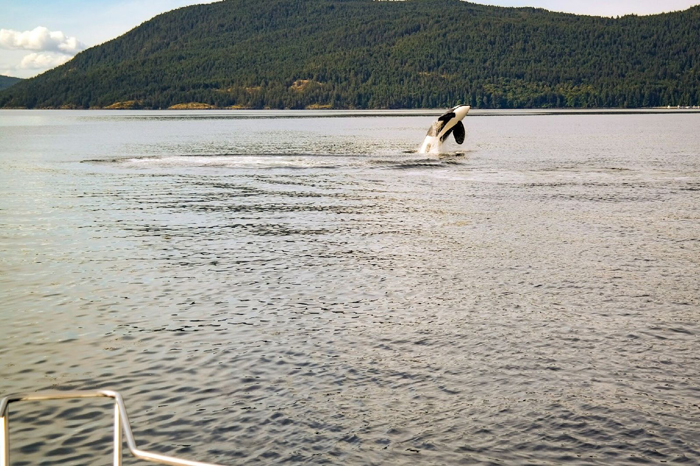
Passengers on the Skeena Queen’s 3 p.m. sailing to Fulford Harbour on Saturday were kept on board for longer than expected due to a visit from a half-dozen orcas. 

BC Ferries announced at 3:35 p.m. the ferry was holding off dock and unable to berth in order to give the animals space. 

“We are closely monitoring the situation and will not approach until the killer whales have safely swum away from our dock,” a message sent through Twitter stated. 

The company ended up cancelling the complete round-trip sailing scheduled to leave Fulford at 3:50 p.m. as the visit continued for around two hours before the whales headed out. An extra sailing was added at the end of the evening to deal with the overflow traffic.

Some passengers who were on the ferry while it was holding, as well as other observers located around the harbour, expressed concern about how close a group of about eight whale-watching boats were getting and whether they had prevented the killer whales from leaving. There was also speculation that one orca may have become entangled with a crab trap line and gear. 

Fisheries and Oceans Canada reported their marine mammal expert, Salt Spring-raised Paul Cottrell, confirmed the pod consisted of Bigg’s or transient killer whales, based on the number of animals and their location. Bigg’s whales feed on other marine mammals, unlike the southern resident killer whales that eat only fish.

DFO said Cottrell spoke with BC Ferries’ director of the environment on Monday morning. BC Ferries did not lodge any complaints about other vessels. However, fishery officers from the Whale Protection Unit are looking into the report of a potential disturbance event. 

There was a call to DFO’s marine mammal hotline with a report about one whale interacting with a rope and float, the agency confirmed.

“Paul believes that the animal was playing with the rope and float and not entangled as there were no subsequent reports of confirmed entanglement and the animals moved on and were clear of any gear,” an email from the federal department states.

DFO sent out a notice Friday reminding all boaters and drone operators that it is mandatory to respect the approach distances and other protective measures in place for marine mammals. The regulations require vessels to keep 400 metres away from killer whales in southern B.C. coastal waters between Campbell River and just north of Ucluelet, and 200 metres away from killer whales in all other Canadian Pacific waters. 

The restrictions apply to all types of watercraft, including motorboats, kayaks and paddleboards. Certain whale-watching and ecotourism companies that are able to identify the southern resident killer whales and agreed to stay away from them have received authorization from the Minister of Transport to view other killer whales up to 200 metres. These vessels fly a purple flag.

Drone operators are required to keep a 1,000-foot minimum altitude within a 0.5 nautical mile (approximately a 3,000-foot radius) of a marine mammal and to avoid flight maneuvers around marine mammals.

Reports of rule violations or marine mammals in distress can be made to DFO’s Observe, Record & Report Line at 1-800-465-4336 or by email to DFO.ORR-ONS.MPO@dfo-mpo.gc.ca. Penalties can reach as high as $1 million for corporations and $250,000 and/or up to five years’ jail time for individuals. 

Pender’s wheelchair basketball star ready for gold

0

The Gulf Islands may be boasting a gold-medal Paralympic athlete as one of their own later this summer, with wheelchair basketball star Kady Dandeneau determined to roll onto the podium at the Tokyo games. 

The 2020 Paralympic Games will take place from Aug. 24 to Sept. 5 following COVID disruptions last year. Judging by their last appearance on the world stage in 2019, Canada’s senior women’s wheelchair basketball team has an excellent chance of realizing their dreams. 

“It’s crazy, you know. Being a kid from Pender, who would have thought?” Dandeneau told the Driftwood during a short training break. “So it’s super exciting to represent everybody back home.”

Before taking up wheelchair basketball, Dandeneau was an all-star standup basketball player at the University of Northern British Columbia. She first started playing when she was around 12 and continued at Stelly’s Secondary School in Saanich before joining the Timberwolves. She graduated from UNBC with a degree in health sciences in 2013 and went on to study kinesiology at the University of Illinois at Urbana-Champaign. Before taking to the court for the Canadian national team, she played for the BC Breakers and BC Royals teams.

Dandeneau’s standup basketball dreams were dashed after she suffered a career-ending injury in 2010, eventually requiring four operations on her knee. She also developed a bone defect as a result of a fracture in her femur. Her change in paths came about because she had worked with fellow Pender Island native and former Team Canada coach Tim Frick at his kids’ program on Pender. 

Frick started suggesting Dandeneau try wheelchair basketball after her first surgery. After her third, he informed her he’d signed her up for a training camp. Another training camp followed after that.

“It’s kind of funny because it wasn’t really my decision, it was Tim pushing me. But I’m super grateful that he did it,” she said.

Dandeneau moved to Toronto to train full-time at the national facility in October 2016. The team had a disappointing fifth-place performance at the 2018 world championships but worked together to turn things around after that. They did that so successfully they won the gold medal at the Parapan Am Games in Lima the following year. This secured their berth at the 2020 Paralympics, while Dandeneau became the first wheelchair basketball athlete in Canadian history to record a “triple-double” point spread during Canada’s 67-64 victory over the United States. She was among the leaders in most offensive categories, including first in field goal percentage and free throws made, and she went on to be named Wheelchair Basketball Canada’s female athlete of the year.

Despite some key similarities, Dandeneau had a lot to learn when making the switch from standup to wheelchair basketball.

“Wheelchair basketball is very much a team sport — you can’t rely on a couple of players,” she explained. “The saying ‘You’re only as strong as your weakest link’ is bang-on for wheelchair basketball. You really need all five players to be working as a unit, to be sure.”

Dandeneau said she was lucky to benefit from the guidance provided by Mike Frogley, who was the national coach when she first arrived in Toronto. The national team had worked together for around a year and a half when COVID hit and group training was shut down. The athletes tried to keep up on their own as best they could, but Dandeneau said probably everyone had wondered if it was worth it at some point. Some training camps were permitted to resume in November and December 2020, and group practices went ahead after Christmas. 

National team members living all across Canada assembled in Toronto to begin their final training push in May, and they work at it full time. An average day starts with a two-hour practice in the morning, followed by an hour and a half of lifts and then another two-hour practice in the afternoon. In between, the players fit in other cardio and shooting work-outs as well as mental performance meetings and video study sessions. 

Dandeneau said she is extremely confident in the team’s mental state and their ability to reach their goal, which is firmly the gold medal.

“That’s what we’ve wanted, and that’s what I think we’re capable of,” she said.

The team will leave Canada on Aug. 13 and travel to Nagoya before they enter the athletes’ village in Tokyo. Basketball players are fortunate their games will be played in air-conditioned arenas, so they don’t have to do the same intense training for Tokyo’s heat and humidity as those playing outdoor sports must do. The wheelchair basketball team is training their sleep cycles and circadian rhythms to adjust to the eventual time change, as Tokyo is 13 hours ahead of Toronto. 

One of the common misconceptions about the Paralympics, Dandeneau said, is that they are recreational or somehow not as gruelling or high-level as the Olympic Games. In fact, the para-athletes are training just as long and as hard as able-bodied athletes, with the same will to excel, and often alongside the Olympians in the same facilities. Such commitment does not come easy, so Dandeneau has huge gratitude for the CAN Fund organization for providing some much-needed financial support to herself and most of her teammates. 

Home community support is also crucial, Dandeneau said. She’s extremely grateful for all the words of encouragement and congratulations that people have been sending her way.

“I get so many messages from everybody: friends, family and people I hardly know. I love all the little notes and shout-outs. It really does go a long way,” she said.

Interim rodenticide ban announced

0

Wildlife advocates who have been campaigning against anti-coagulant rodenticides received a win last week when the British Columbia government introduced an immediate 18-month ban on their widespread sale and usage, but professionals who deal with rodent infestations are already worried about what may result if one of their pest management tools is removed.

The B.C. Ministry of Environment and Climate Change Strategy announced the ban on second-generation anticoagulant rodenticides on July 21, noting it had heard from many citizens about the harmful effects on other wildlife not intended as targets, with recent owl deaths a particular concern. With some exemptions to allow rodenticide use at health services, food processing and storage facilities, restaurants and grocery stores and agricultural operations, the ban period is intended to provide time for a scientific review and recommendations for other options.

“We share the concerns of many British Columbians that rodenticide use is harming, and too often killing, birds, pets and other wildlife,” Environment Minister George Heyman stated in a news release. “That is why we are taking action to reduce risks, conduct a review and step up our efforts to reduce unnecessary pesticide use, rather than safer alternatives.”

The interim measure is supported by many of those in the region who have been calling for a complete ban, including Saanich resident Deanna Pfeifer. As an organizer of the Rodenticide Free B.C. campaign, Pfeifer made a delegation to Islands Trust Council in March asking for the local government’s support of a provincial ban.

The Trust then passed a resolution that echoed those made by multiple communities around the province and which were supported by the Union of B.C. Municipalities.

“Thousands of British Columbians have voiced their concerns over the use of rodenticides and the harmful impacts they have on owls and other animals,” Pfeifer said after the announcement. “I am pleased to know the minister is acknowledging the detrimental effects rodenticides can have on our ecosystem and look forward to an increased awareness of alternative pest management approaches that are safer, more humane and more effective in the long term.”

Taking a potentially dangerous chemical out of general public reach may be warranted, but those who are trained for responsible rodenticide use have some concerns.

Dave French of Salt Spring-based company Pest Control Services said Heyman’s order came as a surprise, with no advance notice given to industry that it might be coming.

“We are currently looking at how we can best move forward and continue to help people with their rodent problems. We are also in contact with the ministry for clarification as to what exactly will be exempt,” French said. “We fully understand and appreciate people’s concerns regarding rodenticide use, however, we maintain that it is a necessary component of integrated pest management. We will, of course, comply with the ruling.”

Pest control operators have noticed rodent populations have grown dramatically through the years, even with the concerted efforts of their companies and homeowners. Infestations can cause significant damage and health impacts, including harms to bird populations, major damage to homes and businesses through floods and fire, and the carrying of diseases.
French said his company expects to find that eliminating the use of rodenticides will cause a big upswing in infestations in local homes in the months to come, since the Gulf Islands region is perfectly suited to rodent needs.

“They have an abundance of easily available food and shelter. They have few predators. And, our behaviour, our composting and garbage disposal practices, our feeding of birds, our home and land maintenance practices, all make for a very rodent-friendly environment,” French explained.

PCS encourages homeowners and tenants to be vigilant, to increase their removal of garbage and recycling, to work on cleaning up homes and yards and, where possible, to work on sealing up homes to eliminate or at least minimize rodent incursions.

French said one of the most effective things people can do to prevent infestations is get rid of bird feeders, even those that promise to be “rodent proof,” because rats love birdseed and will go to incredible lengths to get it.
“I know everyone loves to feed the birds and watch them, but it’s a major attraction for rats and mice,” he said.