
After staying quiet in their home communities for many long months of the coronavirus pandemic, Gulf Islands residents and visitors are being offered a new opportunity for exploring nearby islands.
AquaLink is a pilot project funded by the Southern Gulf Islands Tourism Partnership (SGITP) via a Western Economic Diversification Canada grant. It will see scheduled runs on Gulf Islands Water Taxi vessels connecting all five of the southern Gulf Islands every Saturday and Sunday in September.
“This is meant to be not only for our visitor economy but our communities as well, which is one of the reasons we wanted to do this pilot in September,” said SGITP chair Randy Cunningham. “We think it will be more accessible [to them]. We think there will be some visitors on the islands at that time, but hopefully the community will use it as well.”
SGITP received $120,000 to finance the pilot in 2019, but negotiated with Western Economic Diversification Canada to extend the deadline since COVID restrictions meant they could not get started as intended in April 2020.
Chris Hall, a former general manager at Poet’s Cove Resort and the SGITP board member who is managing the project, worked over the winter to discuss options with local water taxi companies and to formalize the arrangement that now exists with Gulf Islands Water Taxi. He also consulted with the communities involved about what they might be interested in.
The project takes in some lessons learned from Tour Des Îles, the festival that connected the islands with multiple passenger ferries in several consecutive years (until COVID-19). Hall pointed out the AquaLink plan has some key differences to the festival, however. The pilot will feature just one return trip with stops to all islands and back in the morning and one in the afternoon/evening, starting from Gulf Islands Water Taxi’s home base in Ganges Harbour, and will seek to sustain travel throughout the entire month.
“Tour des Îles was a big event that took place over the course of a weekend, but I think for us it’s trying to determine the feasibility of whether people will use this over the course of the month, and eventually over the course of the year, with the end-goal of making this a permanent thing — probably not through the winter months, but especially through those shoulder seasons,” Hall said.
Hall said that would bolster local tourism and help locals explore the other islands as well. The project also supports car-free travel.
“I’m excited to come over and spend the day in Ganges at the farmers’ market and go for lunch and be able to come home in the evening,” Hall said. “I think with the feedback we received in just the first day, that a lot of people are looking forward to doing that.”
Part of the pilot will be to determine who will ride on the AquaLink and who will not, Cunningham added. That data will feed into the work the Capital Regional District’s Southern Gulf Islands electoral area and its elected rep Dave Howe have been doing to improve options for transportation on and between the islands.
Cunningham noted Salt Spring is a little better served than most, with its established transit system and three different ferry terminals, but connections to the other islands could definitely be improved.
Up to 40 people at one time can be on Gulf Islands Water Taxi’s largest boat. If there is less uptake for the pilot, they also have a small boat serving up to 10 passengers. Cost is $21 per adult per trip and $10.50 for children.
Fares would have to be quite a bit higher to run the system without any outside funding help, but the organization hopes to secure more grants and support from the Ministry of Transportation and Infrastructure after the initial pilot period. They also envision a new entity would be formed to run the service, since that is outside SGITP’s mandate.
Schedules are posted and bookings are being accepted now at aqualink.ca. The website also has a page for each island that describes amenities either within close reach of the docks or easily accessible to them.
AquaLink passenger ferry takes a run this fall

Nobody Asked Me But: Workerless society not so far-fetched

Imagine this. You pull into the Lady Minto Hospital parking lot, park your vehicle and proceed to the hospital screening hut to answer the inevitable Covid questionnaire checklist and be allowed through the automatic front doors into admissions. However, there is nobody doing the screening.
In fact, there is nobody in sight anywhere. You enter the building, splash a little antiseptic on your palms and proceed to the little machine that spits out numbered tickets which tell the staff at the front desk what order to admit patients.
After a couple of minutes go by, you look up at the overhead screen and notice that the numbers have not changed since you first tore off your ticket. You are still a long way from having your number called. It is at this point that you look through the glass partitions and notice that the usual admissions staff are not seated in their places. They are nowhere to be found.
You feel a weirdness settling in. Where is everybody? You wander down the deserted hallways, peeking occasionally through an open doorway or into an abandoned waiting room. No doctors, no nurses, no lab technicians. Even the hard-toiling cleaning staff have vanished into the ether. The building is so devoid of human activity that there might as well be tumbleweed blowing through the empty corridors.
Sound a little far-fetched? A bad dream, maybe? Well, yes, admittedly so. However, it is not so far off the mark as to be outside the realm of possibility. It was only a couple of weeks ago that a Driftwood website headline read, “Staff Shortage Closes Lady Minto Hospital Admissions.” According to the article, patients waiting for hospital beds apparently were being diverted to the Saanich Peninsula Hospital because of staff shortages at Lady Minto. Although this action was put in place as just a temporary measure and did not involve the emergency department, it might be a sign of the times for what might be awaiting us in the near future.
Only a few days earlier I had witnessed the effects of this worker shortage. I had arrived at Lady Minto for my regular blood work at the lab, but was surprised to see a fairly long line-up of people standing six feet apart while waiting to be screened. As I later learned, the bottleneck was caused by the absence of the regular staff in admissions. As a result of this understaffing, the person doing the screening was also in charge of admitting each person in the line, processing each requisition, and entering the information in the computer files. This required her having to go back and forth between the screening hut and the admissions office as the line-up continued to grow longer and longer. The added stress that this was causing to the task was certainly more than anything that would have appeared in the job description (for example, position offers excellent opportunities for career advancement and/or heart attack).
Later that same day, I pulled my vehicle up to one of the pumps at the Ganges Gas station. Although normally a full-service establishment, on this particular day there was a small, handmade sign taped to each pump informing customers that due to staff shortages, patrons would have to pump their own gas until more employees could be hired. I shuddered for a moment at the image being formed in my imagination of a gargantuan fireball visible from deep space that resulted from someone’s careless self-serve attempt to top up their barbecue bottle from the station’s propane tank.
Not that much later on the very same day I read a notice online that one of our favourite eateries was cutting hours of operation and shutting down its table service on Tuesdays because of — you guessed it — staff shortages. How long can it be before the term “counter service only” means you make your own sandwich, bus your own counter space, and wash all your dishes? And don’t even think about getting a share of the tip.
Why all this recent decrease in the work force? Much of the blame has to be laid on the COVID pandemic. So many in the labour pool, especially those in the non-essential service industry, were laid off or had their jobs disappear completely when government restrictions made it all but impossible for the industry to continue. Federal and provincial subsidies, the Canada Emergency Wage Subsidy and the Canada Recovery Benefit to name just a couple, helped ease the pain from loss of income while unemployed workers waited for the tide to shift as the economy rebooted itself. Many have taken the forced opportunity to retrain themselves or to initiate their own online businesses, which can be operated from the confines of their own homes.
Even essential services, such as health and medical-related fields, saw their employees leaving in droves due to a combination of low pay, overwork, high stress and dangerous working conditions. And this does not even address the huge issue of lack of housing.
The resulting work force shortage is not, as some economists claim, just a matter of people not wanting to go back to work. Rather, they are making the statement that they are no longer willing to put their health and safety on the line, especially if they are working at jobs that marginalize their value as human beings. Even better-paid skilled workers such as nurses are leaving the profession rather than accepting assigned double and sometimes triple shifts as well as being given forced overtime.
If this trend continues, we may find ourselves on the verge of a workerless society. Every business or government office could take on the look of those big box stores such as Home Depot or Walmart. Acres of merchandise but not a single soul to tell you where to find that vegetable peeler you’re looking to purchase.
Nobody asked me, but it’s quite possible that the future is going to be self-serve all the way. A debit card, a digital eye scan and a microchip implant may be all we need to open any door for us or fill any of our needs and wants. Just like the automated boarding pass dispensers and baggage check-in machines at the airport, or the self-check-out scanners at many supermarkets, we will be able to do it all ourselves without the assistance of any paid employees.
And instead of punching a button to get a number to get processed by the admitting department at Lady Minto Hospital, we just might be able to bypass all the red tape and be allowed to do the procedure ourselves. Hip replacement, anybody?
Finding Home: Island couple leaves due to housing shortage
By AINA YASUÉ
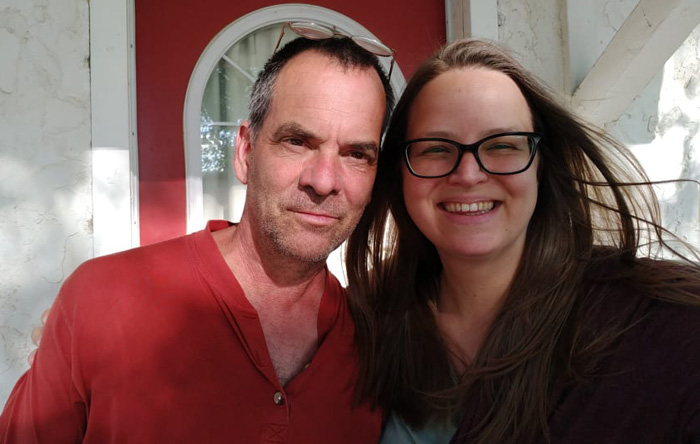
With a combined 30 years of residency on Salt Spring, Kate McWilliams and Laurent Boucher recently moved off-island, leaving behind their community, to ensure a more secure and affordable life.
Kate worked in office management for nearly a decade until a progressive illness forced her to rely on disability benefits. Laurent is a musician and teacher, who took on construction and carpentry work over the past few years as paying students and opportunities to play live music dried up.
Lack of accessible housing was a significant part of their decision to leave.
Kate notes, “The concept of being able to stay or buy anything was impossible. It was hard to imagine a real future, even though we’d been there for so long.” Here, 60 per cent of Kate’s income and over 40 per cent of Laurent’s income went to housing costs.
Not only were they faced with a lack of affordability, they were also making sacrifices when it came to health needs. Kate’s progressive illness will eventually lead her to be wheelchair dependent. She explains that there was no available accessible housing, or even housing that allowed for a service animal. “Long-term accessible housing for the disabled pretty much doesn’t exist. There are very few units. It’s impossible to get one.” Even with Laurent’s capacity to customize a home for Kate’s mobility needs, they couldn’t afford a patch of land.
Another reason for their departure is the decline in opportunities for musicians. Laurent says 20 years ago there were many more live music venues and studios, and musicians were paid more then. He played several nights a week in the summertime, with Sunyata and Acoustic Planet Music, which usually drew a crowd of locals. Laurent recalls how, moved by the live music, people of all ages danced, ate and socialized in true Salt Spring fashion. Only a few of the venues, including the Tree House, Moby’s and Shipstones, remain. As for teaching, Acoustic Planet Music as well as his own home studio drew many local students where Laurent taught about 25 hours a week. In recent years, as the cost of living increased, Kate and Laurent noticed Salt Springers couldn’t support the arts as readily as they had in the past.
They are concerned about younger folks who rely on intergenerational wealth to live here. Laurent feels this negatively impacts the community. “When young people have a future and can hope and dream, and think of buying a home . . . there is a certain energy that is generated that kind of infiltrates everything.”
At the end of May, Kate and Laurent said goodbye to their friends and family, including Laurent’s two adult children who are staying, despite precarious housing. For an island that prides itself on a thriving artistic community, their departure leaves an absence that will be profoundly felt by many.
The above piece is the second in a series of profiles of islanders who are impacted by the lack of affordable housing, compiled and written by Aina Yasué of Salt Spring Solutions.
Floatplanes tangle in harbour ‘fender-bender’

Ganges Harbour was the scene of an on-the-water rear-ending on Thursday when a Seair plane plowed into the back of a Harbour Air plane parked at the same dock.
The accident resulted in significant damage to both aircraft but caused no human injuries, said Meredith Moll, Harbour Air Group’s vice president of sales and marketing.
“We are working cooperatively to investigate and prevent any future incidents,” Moll said.
Jim Heath, harbour manager for the Harbour Authority of Salt Spring Island (HASSI), said he was informed of the accident after the fact and passed on the information to Transport Canada. The floatplane dock was also unaffected and remains in use.
“No one was hurt — just pride,” Heath said.
The independent Transportation Safety Board of Canada (TSB) said it had received a report of the incident and classified the occurrence as a Class-5 investigation, meaning there is little likelihood of identifying new safety lessons that will advance transportation safety. The Class-5 investigation consists of data gathering only, with no report produced following the investigation.
According to the information collected by TSB so far, the Seair Seaplanes Ltd. Cessna 208 was started at the dock at 12:55 p.m. for a flight to Vancouver International Airport (VIA). (The TSB said there were an “unknown number” of passengers on board, but no flight was scheduled from Ganges Harbour to VIA at that time.) When the engine was started, the aircraft propelled itself forward, colliding with the back end of a parked Harbour Air Seaplanes single-engine De Havilland Otter that had no passengers onboard.
The TSB said the Cessna’s propeller struck the Otter’s “flight control surfaces,” removing them from the aircraft. Both aircraft were disabled and will be towed or barged back to Vancouver for repairs, TSB said.
TSB’s mandate is to conduct investigations into marine, pipeline, rail and aviation occurrences, and to communicate risks in the transportation system. The board does not assign fault or determine civil or criminal liability,
The accident highlights an ongoing concern for at least one person familiar with the location. Bart Terwiel has done transportation safety consulting work for Transport Canada and was HASSI’s manager from 2003 to 2007. He said it’s not surprising the accident occurred because the dock in question was designed for use with Beaver aircraft, which are smaller than the two planes involved in Thursday’s incident.
“You can put one of those [large] planes on the dock at one time, but not two,” he said.
Terwiel feels that with the congestion and increased traffic in Ganges Harbour in recent years, a risk assessment and management review for the area needs to be done by an independent body.
“I’m just glad no one got hurt,” Terwiel said. “And it’s actually a miracle because there were bits of flying metal everywhere and there were people there. We were very lucky nobody got hurt.”
Appreciation for vaccine clinic workers expressed through Be Thankful program
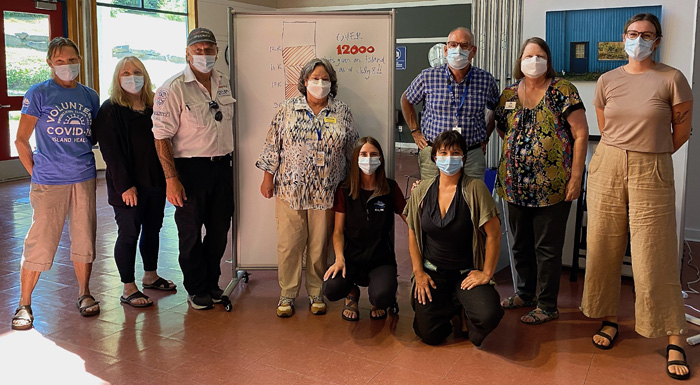
Salt Spring Islanders can show their appreciation to local vaccination clinic nurses and health-care workers through the Be Thankful program.
An ad hoc committee of islanders created the initiative, which will see gift certificates donated to the island’s vaccination clinic through the Island Comeback program and gifted to all of the people working on the front lines.
In order to contribute, people choose one of the businesses listed on islandcomeback.ca/islands/salt-spring/ and as directed in the shopping cart send a gift certificate of any amount to ssithankyou@islandcomeback.ca.
Island Comeback was set up to help residents of several Gulf Islands support local businesses and non-profits during the COVID shutdown period by facilitating online gift certificate purchases.
All gift certificates will be collected by Aug. 1 and distributed to the COVID vaccination clinic workers by Island Health COVID program manager Cali Chang.
David Norget, co-chair of the Salt Spring Island Health Network, explained the rationale for the program in a media release.
“Salt Spring COVID vaccination clinic workers have been willing to work long hours, outside of their regular duties,” he said. “They have listened to many islanders’ stories and have helped to promote a healthy resilience during these difficult times. I’m glad we have a positive way to show recognition of their care while also supporting local businesses.”
Kisae Petersen, executive director of Islanders Working Against Violence, added, “I’m deeply grateful to the Salt Spring vaccination team for their dedication and kindness to create a welcoming and efficient vaccination process for our community. Many thanks as well to all the health workers who reached out to connect with people at the food bank and in the park, to ensure access for all. The Be Thankful program is a great way to give back to the vaccination team for their impressive services.”
One Cool Island: Smoke sends clear signals about our forests

By ANDREA PALFRAMAN
In the midst of summer’s idyll, there is an ominous haze on the horizon. Clobbered by a record-smashing heatwave, and the tragic fire that destroyed Lytton, the spectre of forest fires looms large in the Gulf Islands. As we consult maps and scan the skies for signs of smoke, we’re all looking to avoid the tragedy unfolding in other B.C. communities.
Fire is the single biggest climate risk islanders face to their homes, infrastructure and economy. Years of wasteful logging practices, development and climate change have increased fire risk around our islands. Between the accumulation of slash and debris, dried-out soils, fire suppression and compromised watersheds, our forests are tinderboxes when drought and heat descend.
Native forests — like fire-resistant Coastal Douglas-fir — often fail to regenerate following forest clearing and are replaced in drier areas by highly flammable invasive plants. Just try taking a walk under power lines on Salt Spring and you’ll find deserts of broom and gorse edging out native shrubs and hedgerow species.
There are actions we can take to protect our island from fires, but they are more complex than the slogans Smokey the Bear taught us.
We are all very grateful to first-responders who put out fires at Mineral Springs Resort and Windsor Plywood. Quick action prevents small conflagrations from spreading and turning into large-scale fires, which, aside from the devastation they cause to people, pets and wildlife, quickly release decades of sequestered carbon into the atmosphere.
The biggest opportunity we have to mitigate climate change and reduce carbon emissions is to retain trees, especially mature trees, which store more carbon more quickly than their younger counterparts.
Fire prevention is just as important. We must move away from clearcutting immediately, in favour of selective thinning and other regenerative forestry practices. Forest canopies cool the air and the ground and retain moisture in watersheds, lakes and creeks. Facilitating natural decomposition — dead wet logs don’t burn — and restoring wetlands are critically important practices that are gaining traction.
To reduce slash — which serves as rocket fuel to hungry fires — chipping, composting, biochar and specially constructed berms known as “Hügelkultur” are smart steps to transform the dangerous dry fire fuel in our forests into moist enriched soils that build drought-resistant ecosystems that retain moisture in a warming climate. Together these practices restore and maintain our water resources to help us get through these periods of summer drought.
Indigenous-led climate adaptation and resilience strategies bring communities full circle, to consider forestry practices informed by the “seven generations” principle. The new reality of wildfires — both their increased magnitude and frequency — is seeing the pendulum swing away from complete fire suppression towards traditional First Nations practices like controlled burns.
Says MENELOT, knowledge keeper from the WSÁNEC First Nations, “Our people believed in controlled burns, either in early spring or in the late summer. It wasn’t just for the nutrients provided through the ash to feed the new growth in the springtime: it ensured that there would be no wildfires.” Prescribed fires are primarily lit to get rid of built-up tinder — from needles, grasses and twigs to shrubs and fallen branches — and reduce fire risk by depriving wildfires of fuel.
Native plants are not only beautiful and resilient, but they are also key to reducing wildfire risk. For the past 150 years in B.C., we’ve promoted a culture devoted to removing native plants and installing Kentucky bluegrass lawns, which often involve watering, mowing and herbicide application. These landscaping methods increase the amount of exposure of soils, which heats the ground and dries and compacts the soils, reducing their ability to absorb water. The result? Washouts, landslides, erosion and loss of groundwater recharge. Replacing thirsty plants with hardy locals and diligently eradicating invasive species is a patient practice of horticultural decolonization that mitigates risk while providing nourishment for wildlife and pollinators.
Salt Spring’s Climate Action Plan offers many such practical, actionable solutions, with a goal to reduce island emissions by 50 per cent by 2030. A key part of the plan is to develop, fund and implement a comprehensive, island-wide strategy for forest management to reduce forest fire risk. With one-third of forests on Salt Spring enjoying some form of protection, focusing on building up the fire resistance of those precious resources is a critical next step.
The cool thing is, as we increase our resilience, there are knock-on effects that benefit everyone. If we protect watersheds and enhance forest health, we enhance stream flows and groundwater recharge, leading to reduced fire risks and lessening the severity of drought. If we maintain strong forest canopies we also reduce evaporation from our lakes and streams, reducing lake temperatures (and algal blooms). As anyone who has walked the woods in hot weather can attest, they protect us from extreme heat. As we adopt practices to nurture forest health, we will see the understorey return, providing more nutrients and moisture for trees and leading to reduced vulnerability to fire.
Protecting our forests and watersheds while employing regenerative forestry practices has three other critical co-benefits: they provide jobs, reduce infrastructure replacement risks and decrease pressure on fire and water district budgets. Imagine the price of potable water if the forests surrounding Maxwell Lake went up in flames.
June’s unprecedented heatwave is consistent with climate change modelling, which promises many more such events and underscores the need for us to do a U-turn on almost everything we do in our forests.
Far from being a zero-sum game, we have a tremendous opportunity to come together to protect our communities from fire, protect and rebuild our ecosystems, and provide employment.
Transition Salt Spring’s brand-new website is bursting with resources and information for folks looking to make Salt Spring an even cooler place to live: for now, and for future generations. Check out the One Cool Island section to find a brand new library, produced in collaboration with the Islands Trust, of graphic and video resources to help us all better steward our forests in a changing climate.
One Cool Island is a regular series produced by Transition Salt Spring on how we can all respond to the climate crisis, together. Andrea Palframan is a TSS director and communications lead. To find out how you can help, people can visit transitionsaltspring.com.
Lack of housing a critical island issue

By TOBY FOUKS
I hope that people take Debbie Magnusson’s July 7 letter to heart and help raise money to support the Lady Minto Hospital Emergency Department initiative. Her recent visit for stitches in her finger increased her awareness of the need for expanded facilities.
Her description of a three-hour visit includes observations about the efficiency in the way in which medical personnel use the crowded facility, and the kinds of activities that take place. This included arrivals coming by helicopter to deal with serious situations. In fact, a second on-call doctor had to be brought in. As Magnusson says, privacy — which might be important to some — is not available. What compounds the problem is that people who are unable to get a family physician locally are forced to use the emergency department’s on-call doctors in lieu of a family physician.
Lady Minto’s emergency services are something that any of us might need, that many of us have needed, and when we require emergency care we need it here, right now, on Salt Spring Island. It’s a critical community facility.
However, no matter how wonderful the improved emergency area might be (and I do not doubt that it will be wonderful), unless the medical personnel the hospital requires are able to find affordable accommodation on the island, those long waits are going to continue, albeit in greatly improved surroundings.
How can we manage to acquire and keep medically trained individuals if they cannot find affordable housing on Salt Spring? Salt Spring Island is likely a very appealing choice for many such people, but affordable housing must first be found. What difference will the expanded, improved area make if the hospital cannot acquire such medically trained professionals?
There is always going to be attrition as people retire or move off-island. How will the hospital be able to replace the professionals we already have let alone increase staff numbers?
This is a significant aspect of the housing crisis on the island, a crisis which affects the entire community, not just people wanting to remain here or relocate here. We are all affected by this situation if the people we need to be here to help us in our lives either cannot live on the island or must leave to live elsewhere in order to find affordable housing.
One has only to follow posts for accommodation requirements to know that many people who have lived here in rental accommodation have had to go elsewhere because there is nothing affordable (or even not affordable) available for them to rent. Owners have sold properties, making it necessary for renters, often very long term, to vacate and search for alternative accommodation. Most of these people were highly desirable tenants. As well, short-term stays facilitated through the internet have meant accommodation formerly rented long term is out of that market.
There are great renters, fair renters and terrible renters. I can understand why someone would prefer to rent short term for the same amount of money (or almost as much) without the potential difficulty that comes with a difficult tenant, not just while the tenant occupies the space but afterwards when one must cover the cost of cleaning up what is left behind. However, there are many wonderful potential tenants searching for places to live in order to remain on or relocate to Salt Spring. Many of these people are already very integrated into the community.
Businesses can’t be viable without staff. It’s very hard for business owners to have to close up because potential employees can’t find living accommodation here. That leads to personal suffering and huge financial losses. The community misses those businesses. However, when our hospital can’t get the professionals it needs for the same reason, then it becomes a community crisis.
The expansion of the emergency area at Lady Minto needs our financial support, but it’s just one part of a larger, very disturbing picture. To my inexperienced eye it seems to me that the rental prices being asked are often extremely high, more than many of the people we need to have living here can afford. Property values have escalated, it has been a sellers’ market, and rental costs have increased hugely — but wages and salaries have not kept pace.
I suspect that if people with space to rent could be assured of an excellent tenant then more space would become available. I have no suggestions that will help to counteract the sometimes stratospheric prices being charged for accommodation. I do believe that the people we really need for the community’s well-being bring expertise with them rather than wealth.
The writer is a longtime Salt Spring Island resident.
HOWELL, Michael Edward

Michael Edward Howell
Nov. 14, 1970 – July 29, 2021
It is with great sadness that we announce the passing of our dearly loved son, Mike.
He lost his battle with cancer on July 29, 2021. Passing away in his sleep in the arms of his wife Myra.
Mike attended school on Salt Spring graduating from Gulf Islands Secondary School in 1988, where he met his life long friend Dean Ross and together they patched together and revamped a 1967 Dodge Van and set off to travel through Mexico and Central America for 6 months with so many adventures.
Michael then attended Camosun College for 1 year but decided he would rather enter the trades and settled on apprenticing as an electrician. Mike set high standards for his work which took place on Salt Spring, Edmonton and then the Vancouver area. This was augmented by a 1 year computer programming course which allowed him to work with the computerized controls used in industry. He was electrical foreman at Westshore Terminals at Roberts Bank.
Mike had booked off work in November complaining of loss of balance. After subsequent testing, a brain tumor was detected and biopsied Dec. 8th. He spent 2 months in Royal Columbian Hospital and 6 months at home with his family. Although he was confined to bed, he always kept his sense of humour and accepted his illness without complaint and with enviable grace. Mike always appreciated the help he received from care aides, family and friends.
Mike is lovingly remembered by his parents Les and Dale, his wife Myra and children Caden (17) and Alexandra (15), his older brother John (Kim) and children Dylan, Owen and Carter. He will also be remembered by many relatives, friends and co-workers.
We will love and miss you forever, dear Mikey.
SSNAP finalists announced

The 52 finalists for the 2021 Salt Spring National Art Prize competition have been announced.
“Drawing from every region across the country and Canadian citizens abroad, the SSNAP exhibition promises to be as inclusive, diverse and culturally rich as Canada itself,” states a July 13 SSNAP press release.
Connie Kuhns is the lone Salt Spring Island artist on the list this year. Joanna Rogers from Pender Island is also a finalist.
With artists eligible to win $41,000 in prizes, SSNAP is one of the largest contemporary visual art competitions in Canada.
SSNAP founding director Ron Crawford said SSNAP has not only provided artists with an outlet during COVID-19 but also the opportunity for Canadian creativity to flourish. “We are delighted to see the types of submissions and what artists have been focused on during the pandemic. We’ve noted how the lock-downs have directly or indirectly influenced the themes of many works, similar to artistic expression during times of war.” Crawford added, “Due to COVID-19 restrictions there’s been a lack of venues and places where artistic works can be showcased; we’re excited with the 40 per cent increase in submissions and the diversity of artists chosen in 2021.”
Finalists are eligible for 10 awards, six selected by the jury and four selected by public vote. The fourth biennial SSNAP Exhibition runs at Mahon Hall from Sept. 24 to Oct. 25, with the gala awards night on Oct. 23.
A biennial competition and exhibition, SSNAP was established in 2015 to recognize, showcase and publicize the accomplishments of Canadian visual artists.
A list of the finalists is on the SSNAP website.
Country Grocer donation boosts ER campaign

The Lady Minto Hospital Foundation says it is thrilled with islanders’ early enthusiasm for its emergency department fundraising campaign, which got a major boost with a $50,000 donation from Country Grocer last week.
“The community’s response has been terrific,” reported LMHF chair Dave Taylor. “We’re run off our feet keeping up with all the donations, but we love it when we’re kept busy like this.”
The foundation aims to raise the final $2 million required for the 240-square-metre (4,500-square-foot) $10.4-million project by early October.
Taylor said his group was “honoured and grateful” for Country Grocer’s generosity, but not surprised.
“Country Grocer is always there for Salt Spring Island. They want our community to thrive, and they recognize that excellent emergency health care is fundamental to a thriving community.”
In a press release issued Friday, Country Grocer said, “We hope that our $50,000 donation will help to ‘Strengthen the Lifeline’ by building a state-of-the-art facility that will serve us for years to come.”
The company said the health of the community has always been a priority for Country Grocer and it is pleased that islanders will receive even better care at Lady Minto Hospital when a new emergency department is built.
Leigh Large, owner of Country Grocer Salt Spring, Pharmacy and Upper Ganges Liquor Store, encourages Salt Springers to join the campaign to help the Lady Minto Hospital Foundation reach its fundraising goal.
“Similar to many others on Salt Spring, I have benefitted from excellent care during an unplanned visit to the emergency ward at Lady Minto,” said Large. “I recognize the value of our hospital and am grateful for the excellent treatment I received. However, it was also evident that our local hospital needed a new emergency ward.”
“We are delighted to welcome Country Grocer as our lead corporate donor to the new emergency department campaign,” said campaign chair Carol Biely. “Not only are they being generous with a donation and promotional support, they were amazing contributors to our very successful golf tournament this weekend. We so appreciate the Country Grocer team members and their commitment to our community, and especially the hospital.”
Some 152 golfers participated in the 30th annual LMHF charity tournament on Saturday.
People wanting to contribute to the new emergency department fund can visit ladymintofoundation.com/lifeline for details.