
Home Blog Page 297

On-island water and forest practices prove sound

By DIANNE CLEMENT

Over the last months we have been presented with many letters and opinions on water resources and forest practices, which I have read with interest and incredible distress. As a senior who has owned land on Salt Spring Island since the 1960s I feel I must comment on both the conclusions and lobbying that has taken place to reach these conclusions.

Several years ago, the Trust hired a well-respected consulting firm, Golder and Associates, to do a study of wells and water resources on Salt Spring Island. I sat in on several community information sessions and I was impressed with the organization and presentations. The impression I was left with was one of an island where the water resources were plentiful, and I believe they concluded that the water resources were sufficient to support a much larger population. They talked about recharge rates of existing wells, and overflow being much the same as it has been for years. 

At the conclusion of the study, I felt confidence in the water resources on Salt Spring, so imagine my surprise when I discovered that this was one of many water studies done since 1995. Many do not have definitive conclusions, but only suggest new things for the next study to investigate. It appeared to me that the Trust did not get the answer they wanted and went looking for a new consultant to tell them what they wanted to hear.

About the same time, I was contacted by the Ministry of Environment with a concern about a “pond” which my family had filled in the 1950s. Several dams throughout the province had ruptured, causing significant damage and resulting in the ministry looking at all ponds with the intention of getting rid of them or having them completely deconstructed and rebuilt at the owner’s cost. After hiring an engineer (as required by the province), who I must say concluded that our pond was one of the safest he had ever seen, I approached the Trust for support in keeping our pond. I was turned down and in short order decommissioned the pond, dumping an estimated five million gallons of water, destroying the habitat for a few beaver families and many owls who lived and bathed in the pond. It also affected the water table for all the surrounding homes and the community well for Scott Point as previously the seasonal stream would dry but the water continued to seep from the pond into the ground throughout the summer and fall.

But the most ridiculous water situation is very recent. A good friend, who lives close to but not adjacent to St. Mary Lake, applied to build a garage and harvest the rainwater. She was told that she could not harvest the water but must let the water run into a water garden, complete with swales, so that it will become “ground water.” Please explain how this is different than watering a vegetable garden and letting the water become “ground water.”

The same level of foolishness has infected discussion of our forests. Most Salt Spring residents are very protective of our forests. This is not to say that trees are not cut down for many reasons, but most of us want to be surrounded by the natural forest and the wildlife in it. Occasionally, we see a large clear cut, which many of us regret, but if you drive down any residential road on Salt Spring, you cannot help but be impressed by the towering trees, fir, hemlock, cedar, maple, arbutus and other varieties, which dwarf the homes built in the shadows of the trees. Most of these trees are second growth as the island was substantially logged in the early 1900s. We do not need to have endless regulations passed to protect these trees; the residents have demonstrated by their actions that they are up to the task. Some home builders remove the largest trees from a building site knowing that the smaller ones will fill in the gaps in a few years.

If it is necessary to prevent clearing a large acreage, develop a regulation which accomplishes that rather than the outrageous regulations suggested in the Douglas-fir ecosystem paper, which look like they could impact every homeowner on the island.

I wonder how many islanders realize that the Douglas-fir ecosystem covers a large portion of southwest British Columbia, including Vancouver Island, the Gulf Islands, much of the area around Whistler and Sechelt and Vancouver-Surrey-White Rock. I believe this zone also extends into the northwest United States. How many other areas are covered by this cut restriction? None that I am aware of!

I am concerned that many of the advisory groups are lobbies for a specific goal. Whether it is to diminish farming on the island, or to control the shared water supplies or simply gather power into the hands of a few non-elected bureaucrats I do not know.

What I do know is that Salt Spring Island is a community of approximately 12,000 persons situated in a world of almost eight billion. If you chase all the residents off the island and let it completely return to nature, it will have essentially no impact on climate change. We are already one of the spaces with a clean and green mentality. We are efficient recyclers and composters, have more green vehicles and heat pumps  per capita than almost anywhere in Canada and many of us try to practise a 100-mile diet or even Carolyn Herriot’s The Zero Mile Diet to support local growers and limit long-distance trucking.

I am a firm believer in the science behind climate change. Moreover, I believe that each one of us must do our part in fighting this climate war, but that we do not all have to make the same changes. Many small changes can have a large effect. For example, think how many shoppers now carry reusable bags, an idea which was unthinkable 20 years ago, but which has saved a lot of plastic from the streets and landfills, as well as saving many trees from becoming paper bags. Governments need to be encouraged to support the transition from fossil fuel heating systems and vehicle fuel in a timely manner, but equally we all need to buy fewer disposable clothes and electronics, and use less cement and asphalt, all high on the emissions scale. There are many actions that each one of us can take voluntarily which will aid in the fight far more effectively than passing more government regulations.

The Islands Trust was put in place with a mandate to “preserve and protect,” not to encourage extreme lobbies to overthrow the cherished way of life desired and protected by Salt Spring residents.

Island youth win big at American Poultry Association show

BY SSI POULTRY CLUB

The Salt Spring Island Poultry Club has continued to make an impact both on the island community and in the national poultry world with its engaged and growing club.  

With more than 100 paying members and almost 350 participants in its online group, the club supports, educates and encourages poultry enthusiasts on the island and across Canada. 

This past weekend the club was able to hold its second official American Poultry Association (APA) event where poultry of all shapes and sizes was brought to be judged by APA judge Ramona Tremblay.

With exhibitors from Kelowna, the Fraser Valley, Saanich, Coombs and Cobble Hill, Salt Spring was able to offer a competitive show, but it was an island teen who took the top title.  

Izzy Nowell is a Gulf Islands Secondary School Grade 9 student who won Champion Junior and Champion Bantam titles for her Rhode Island Red bantam pullet last year, but this year won the show with another RIR hen. Nowell first started entering poultry at the 2014 Salt Spring Fall Fair under the wise eye of Michael Hogan, and with support of judge Tremblay and over the years has continued to improve her flock and her knowledge of the breeds she shows.  

Nowell walked away with Grand Open Champion, Junior Champion, Champion Bantam and more for her one hen, and received Junior Reserve Champion honours for her white Serama pullet. 

It is not common for a junior to take the show, so this was a huge win for Nowell, who will go on to show her birds across B.C. as the events open up this year. 

Reserve Champion went to Bruce Bickle of Coombs with his white call duck, who also took the Champion Waterfowl prize. Bickle dominated the waterfowl category and took home Reserve Waterfowl with his East Indie drake. Bruce was also able to support some growing island poultry keepers by offering various show-quality birds to the community for sale and we are excited to see these birds back at the fall fair in September. 

The island’s juniors were welcomed, many as first-time entrants, and were supported throughout the event by the seasoned keepers. The Salt Spring Island school hatching program produced five champion birds from local juniors. The poultry club hopes to continue this program in the fall, hatching out more quality chickens, ducks and, new to the island, bronze turkeys. 

And no Salt Spring show would be the same without recognizing Best Pet or Best/Craziest Hair. The Best Hair award went to Anezka Sikora for her fabulous Silkie Frizzle. Sikora entered a great variety of Silkies as she continues to develop her flock.

The show was a success in inspiring juniors across the island, and spreading “poultry fever” to local families and farms.  

Windsor Plywood fire factors, implications reviewed

0

Investigation into cause ongoing

The Salt Spring Fire Protection District is re-examining potential risks and its ability to meet them following the massive fire at Windsor Plywood on June 1.

Acting Fire Chief Jamie Holmes provided a presentation on the fire during the district’s board of trustees meeting Monday night. Multiple photos taken over 14 hours of firefighting and overhaul operations revealed the fire’s rapid growth once smoke and flames had filled the plywood store’s vast interior.

Holmes described how crews focused at first on getting water inside the building but that did not help contain the blaze, because of the level of intensity it had reached on the bell curve.

“While initial efforts were focused on containing the fire to the area of origin, it became clear we were not gaining on the fire and tactics were changed to ensuring the fire did not spread beyond the main building,” Holmes said in his report.

Crews were ultimately successful at ensuring the fire did not leap to other structures or the surrounding supply yard.

Responding to questions from trustees, Holmes reported the cause of the fire was still under investigation by insurers, but he noted it started somewhere deep inside the building. Initial investigations suggest it did not start in the paint supply area, he said, nor in the section where new offices were under construction.

In response to questions about water supply and whether an aerial apparatus would have helped, Holmes agreed more resources are always useful, but the main factor in this fire probably was the length of time it had been permitted to grow unchecked before firefighters got to it.

Holmes said the Windsor Plywood building was not connected to a commercial alarm system, and smoke had probably triggered the intruder alarm that resulted in the first call to 911. Having sprinklers installed would have made the biggest difference to keeping the intensity level on the lower side of the bell curve, Holmes explained.

Trustee Rollie Cook joined with the rest of the board in commending the fire department for their efforts and their results. He wondered if the organization should create a new report on high risk buildings in Ganges before the next assessment by the Fire Underwriters Survey, and also whether the fire district could compel the use of sprinklers and alarms through bylaws. 

Holmes agreed it would be timely to get a legal opinion on what powers the district has under its letters patent. 

In other related business Monday night, the board agreed to support purchase of a new SCBA air compressor, to be installed at the Fulford Fire Hall. District CAO Andrew Peat noted Homes’ request was to create back-up support, since the only compressor they own was in fact out of service during the Windsor fire. That compressor is currently being repaired, but the addition was deemed important for emergency needs. The unit is expected to cost around $40,000 before taxes. 

Monday’s meeting was the first for two new members of the board. Winona Cook and John Wakefield were each acclaimed to their positions after a by-election nomination period last month. Cook will serve until the end of the 2021 annual general meeting and Wakefield’s term ends at the 2022 AGM. 

Draft Trust Policy Statement concerns aired on Salt Spring

4

Friday’s ASK Salt Spring session provided a chance for islanders to provide feedback about both items contained in the draft Islands Trust Policy Statement (TPS) and the process itself after calls of alarm went out on social media about a June 15 Trust Programs Committee meeting.

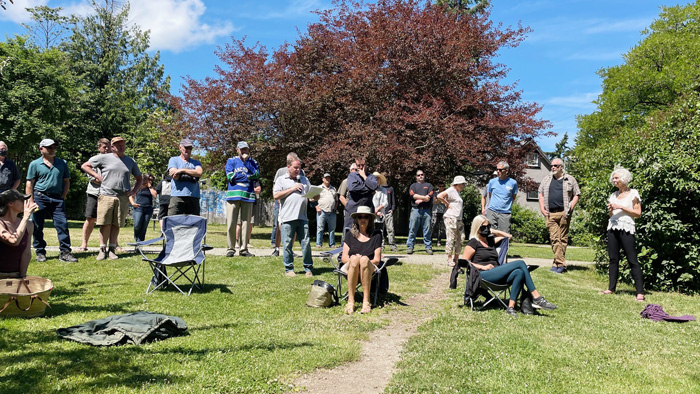
About 50 people came to the United Church meadow for the first ASK Salt Spring meeting held outdoors since last fall with Salt Spring trustee Laura Patrick as the guest. 

Their message to Patrick and trustee Peter Grove, who also attended but was not the scheduled ASK Salt Spring guest, was to tell Trust Council to not give first reading to a new Trust Policy Statement bylaw as scheduled for July 8.

People expressed concerns primarily about a proposed ban on future docks that has appeared in a draft TPS document, but also mentioned a policy that suggests desalination plants not be considered, and sections about agriculture and forestry uses. 

But feeling they had not been asked for specific input into the TPS revision and that the process was being rushed when no in-person public meetings could be held due to COVID-19 were also major concerns. 

“Zoom meetings — that’s not public at all,” commented one meeting attendee. “This sounds like a COVID push-through that nobody can have a say in.” 

A full Trust Council meeting to discuss a policy statement draft and consider giving it first reading has been set for Thursday, July 8 from 9 a.m. to 2 p.m. In addition to that meeting, Trust Council has set aside two hours the night before to gather public input. A June 18 press release outlines how individuals will be given two minutes to speak in a town hall meeting held via Zoom from 7 to 9 p.m. 

“Based on the feedback I am seeing from these people I would highly recommend that you take it back to your council and to your committees and suggest that you put a hold on first reading and get all of the feedback you need to make something effective and efficient and friendly and easy,” observed island resident Harry Poliak. “Start from there and then get the feedback and put your first reading in with the voice of the people. Otherwise what is happening is you’re bringing a lot of energy into your first reading and it’s going to be a kibosh.” 

Patrick sympathized with people’s concerns and said she would represent their views to Trust Council, but stressed that first reading is just the start of the process. 

“Some of the messages that are out there on social media are saying ‘First reading is it, you can’t change it again,’” she said. “That’s not true. First reading is the introduction. It’s the introduction for me. It’s the introduction for all of us. Then it’s fair. We are working on a draft that we can all see and we can all comment on. Peter [Grove] and I want to hear from all of you. We want to have in-depth conversations.” 

Gayle Baker, who organizes the weekly ASK Salt Spring events where the public can ask questions of officials from government or other agencies, also suggested Patrick and Grove advocate for first reading to be delayed. 

“It is a scary thing for people and it might not be that important,” said Baker.

A Trust Council timeline has also pointed to public consultation on the policy statement taking place in September. Further readings and bylaw adoption would follow after that process was complete.

Information about the Trust Policy Statement review process, which was initiated almost two years ago, is available at https://islandstrust.bc.ca/programs/islands-2050/

For more on this story, see the June 23 issue of the Driftwood or updates on this website.

Taggers bomb island surfaces

1

Graffiti artists looking to make a mark on their environment have reached out-of-control status on Salt Spring, where tags have been applied to public property from Ganges village to opposite ends of the island.

Salt Spring Parks and Rec manager Dan Ovington said parks maintenance staff are at their wits’ end after constantly removing graffiti from Centennial Park infrastructure over the past month or two. 

“This is happening daily. We’d go and remove the tags inside the park washroom and then we’d go back the next day and it had been tagged again,” Ovington said.

What started as tagging inside of the washroom has now spread to giant-sized letters covering that building’s exterior wall. The “Snop” and “Saf” tags found there appear to be competing for space along with “Bonk,” whose name most recently defaced a butterfly mural painted by Amarah Gabriel near Island Savings. Snop/Saf meanwhile hit numerous Ministry of Transportation and Infrastructure road signs just north of Central last week. Graffiti has also covered trash cans at Portlock Park and the wall of a downtown bus shelter. 

Ganges resident Sam FitzZaland posted a public message to the taggers this week condemning the damage to the butterfly mural and to a rammed earth planter that he and other community members made for Salt Spring Cooperative Preschool. 

“The preschool is meant to be a place that fosters community spirit. I imagine the parents and preschool children feel less pride in the preschool now that it is tagged. The disrespect shown by this vandalism brings down the school as well as the community,” FitzZaland said.

Both FitzZaland and Ovington point to the Kanaka skatepark as a place where graffiti art is permitted. PARC staff don’t remove artwork or tagging there unless there it is something offensive, Ovington said. 

“Take the time to plan out the piece and to execute it so that it looks good,” FitzZaland suggested. 

While Gabriel’s mural is a victim of the recent spree, graffiti artists traditionally respect other people’s artwork. Project for Public Spaces is a nonprofit organization based in New York dedicated to creating and sustaining public places that build communities. They list sponsoring murals as one possible graffiti deterrent.

“Research suggests that painting multi-coloured designs or murals on surfaces will discourage graffiti, since tagging is more difficult,” the organization explains on its website. “Such mural projects, especially when they involve local artists and high school students, have solved many graffiti problems. Furthermore, changing the mural a few times a year draws more community involvement.”

Artwork for the exterior of the Centennial Park washroom was part of the original design plan, and $10,000 was reserved in the construction budget for that purpose. PARC commissioners reconsidered the idea after the building was completed in 2019 and decided art was no longer a priority.

Ovington said Parks and Rec did consider involving community artists to create something inside the washroom after tagging started to occur there and the idea for artwork in general may still come back to the commission. Staff are additionally in the midst of investigating lighting and camera options for crime prevention in the park.

“We’ve spent a lot of time and dollars trying to revive Centennial Park and we’ve done some long-needed upgrades, so it’s disappointing to see it defaced,” Ovington said.

Salt Spring RCMP detachment head Sgt. Clive Seabrook said police have an active investigation open. They are seeking help from local business owners who may have security camera footage, and from witnesses who can share any information.

Anyone who can help should contact the local detachment office at 250-537-5555.

CRD advances livestock compensation bylaws

0

New bylaws that establish livestock compensation services for each of the Capital Regional District’s three unincorporated communities were approved at the CRD’s Electoral Areas Committee meeting last Wednesday. 

The bylaws, which must receive ministerial approval and then go through the CRD Board to be finalized, set up a funding mechanism to compensate farmers whose livestock has been killed by dogs when no specific dogs or owners can be confirmed to be responsible. The bylaws set a maximum annual compensation of $3,000 each for the Salt Spring, Southern Gulf Islands and Juan de Fuca areas, to be funded in each area through that community’s tax requisition. The new program will go into effect in 2022. 

“Basically it seems like a good approach,” Salt Spring director Gary Holman said at the EAC meeting. “We’re retaining the overhead aspects and still offering compensation, satisfying all concerns.”

Compensation previously came through the animal control/bylaw enforcement branch, which collects dog licensing fees in the electoral areas. Staff had recommended ending the program since there was no budget assigned to compensation funds. The farming communities in each of the electoral areas wished to continue the program, but there was some concern about the levels of compensation required by different areas, especially in Juan de Fuca.

“I felt that Juan de Fuca didn’t have any claims and we might be paying for others,” electoral area director Mike Hicks explained during the June 9 meeting.

Hicks suggested a maximum compensation amount of $1,000 would be more than enough for his community. 

The amount needed on Salt Spring was a more difficult question. Staff reported $3,000 would be sufficient for most years on record, although there have been “peak” kill years with higher amounts needed in the past. 

The Salt Spring Island Farmers’ Institute wrote a letter to Holman and CRD Bylaw Enforcement chief Don Brown earlier this month asking them to take action to prevent dog attacks on sheep, noting these had become particularly frequent and vicious over the past spring. The institute further requested the CRD address the compensation amount offered for livestock losses, which they say hasn’t kept up to market rates.

“There is no compensation offered to the farmer for veterinary fees, loss of future income, [or] time spent caring for injured animals, to say nothing of the mental anguish. There needs to be a review of this compensation to properly reflect today’s market value,” Farmers’ Institute president Marguerite Lee states in the letter.

The amount offered is 75 per cent of fair market value, up to a maximum $750 per animal. CRD staff confirmed that amount had not changed since the compensation program was introduced in the 1980s, but they felt it had always been sufficient except once, when a horse was killed. 

In response to Holman’s questions around the potential need to increase the maximum compensation level in a bad year, staff said the maximum amount could be changed by amending the bylaw if approved by the CRD Board. It would also be possible to run a deficit and recover that from the following year’s requisition. Any unspent funds would go into an operating surplus for the following year. 

From the perspective of farmers, there would be no need for compensation if there were no dog attacks, and for that to happen CRD animal control needs to be more effective. Lee said bylaw enforcement officers should be given more responsibility for follow-up and to deal with dogs that are known to be causing problems. 

The Farmers’ Institute letter concludes, “every effort must be made to prevent such attacks from occurring in the first place. Our members want concrete actions on your part to enforce existing policy and regulations. We would be more than happy to consult on policy changes that may be needed to resolve this problem.” 

Regenerative forest management should be goal

BY ANDREA PALFRAMAN

The old-growth conifers of B.C. are the botanical equivalent of iconic animals like the Bengal tiger, or closer to home, the humpback whale. It’s no wonder the charismatic “megaflora” found in ancient temperate rainforests get mystical sounding names like Cathedral Grove on the way to Port Alberni, or Eden Grove, west of Fairy Creek.

From a climate change perspective, all forests matter, but do some forests matter more than others? Simply put, the older the forest, the more substantial a role it plays in storing carbon and precious water. Next time you are standing on the Erskine trail (while trying to catch your breath!) consider for a moment that second-growth forests — which make up the majority of Salt Spring’s 14,000 forested hectares — sequester three to five times more carbon than newly planted forests. 

Big Lonely Doug, a 23-storey fir left standing in the midst of a clearcut, is emblematic of how we romanticize giant trees while matchsticking the rest of the system that fostered such magnificent growth. 

B.C.’s industrial silviculture promised that clearcuts could be simply replanted like corn in a field. Aside from the obvious irreparable damage to once salmon-bearing streams and soil health, replanting clearcuts with a monoculture will not come close to matching the carbon-sequestration services provided by mature mixed forests. Nor will it deliver the climate change protections we need, like reduced wildfire risk, and the water retention we get in healthy, diverse forests. Eliminating clear-cut logging, and incentivizing landowners to adopt regenerative forestry practices, will. 

“My mentor, Merv Wilkinson, sustainably logged his forested acreage for 60 years,” said Michael Nickels, owner of Seven Ravens Ecoforestry, in a recent interview from his home close to the Fulford Valley. “In the end, he was left with more standing timber than he started with.”

Regenerative forest management, which is the type of forestry practised by cutting-edge foresters like Nickels, involves the interplay between science and Indigenous knowledge, with the generation of rural livelihoods that actually build the land. This type of forestry nurtures human and non-human communities alike. 

Zooming out from our little island, a robust market in carbon offsets — worth $5 billion per year and growing — has emerged globally and is beginning to offer economic opportunities for carbon storage. Communities like Salt Spring where forests create many types of livelihoods — from hospitality to forestry — stand to benefit. 

When we start to think of standing forests as an investment with real monetary value, it changes the equations we use to weigh the benefits of keeping trees standing versus chopping them down. 

Ascribing value to the carbon that’s removed from the atmosphere and stored by standing trees, this new market makes preserving forests more economically viable. Says Katherine Bergeron, who works with the B.C.-based organization Taking Root, “People can earn money from planting trees, and if they are committed to long-term maintenance and monitoring of their forests they can also potentially earn money from the carbon these trees sequester over time.”

But paying for the future carbon that a tree stores over time requires a monitoring system to make sure the trees actually survive and thrive. Otherwise, it’s like having a bad inventory management system in a grocery store. Taking Root has developed a software system called FARM-TRACE that allows farming organizations around the world to collect the data required to facilitate the process of carbon certification.

“Our monitoring processes bring transparency to carbon markets while tying revenue to the health of forests. The emerging carbon market is as hungry for legitimate projects as farmers are eager to earn additional income streams from maintaining and building forests,” says Bergeron. 

According to the Salt Spring Island Climate Action Plan, keeping more forests standing is the number one priority to protect future generations from drought, fire and runaway climate change. To get there, we need to start deploying not only smarter forest stewardship practices, but also data solutions that can quantify the “worth more standing” claims made by environmentalists. 

Transition Salt Spring is advocating for the development of carbon revenue as a means of financing forest restoration on Salt Spring Island. With a federal carbon price slated to rise from $30/tonne this year, to $170/tonne in 2030, the financial feasibility of mass carbon storage projects in healthy forests and oceans is suddenly becoming more feasible. 

Says Nickels, “Almost nobody wants to cut old growth. So, we need to figure out a way to manage second-growth forests to allow for a real economic return that nourishes communities.”

Nickels believes that the right approach involves maximizing the value of every single tree. “Over 35 years, I’ve removed about 60 truckloads of logs from my 38-acre property. Every single piece of wood felled is milled on the property. The majority stays on Salt Spring and is used for edge-grain trim wood for baseboards, doors and windows, as wide plank slabs for furniture and flooring, and making posts and beams for houses. My forest today has a far greater volume of wood than when I acquired it.” 

With the right tools, islanders can balance private property entitlements with the urgent need to lower emissions and adapt to a hotter, drier future. To get there, islanders need to be rewarded for enhancing forest ecosystems through sustainable forest management practices.  

People are invited to check out this upcoming joint Transition Salt Spring and Salt Spring Island Conservancy fundraiser event: What’s Happening to Our Forests and Trees? It’s set for Wednesday, June 30, 7:30 p.m. Join acclaimed B.C. forest ecology scientists Andy MacKinnon and Richard Hebda for an engaging and timely discussion of forest ecology and the effects of climate change. 

Tickets are at www.tinyurl.com/SSForests. Students can participate free of charge.

One Cool Island is a regular series produced by Transition Salt Spring on how we can all respond to the climate crisis, together. Andrea Palframan is a TSS director and communications lead. For more information on how to support climate action on Salt Spring, visit transitionsaltspring.com.

SSNAP season kicks off with Exquisite Corpse

People getting excited about the return of the Salt Spring National Art Prize biennial this fall can enjoy a taste of the upcoming exhibit season and help support SSNAP at the same time during a special fundraising event this week. 

Launching this Thursday, June 17, the Exquisite Corpse Art Show & Auction runs for one week only upstairs at Gallery 8. The mixed live and online event features a selection of historical and contemporary works and a unique collection of 12 new collaborative pieces produced by 36 local artists.

It’s the latter element that gives its name to the show. Exquisite Corpse is a game or an exercise created by the Surrealists in 1920s Paris. It involves different artists working to create a single figure in individual sections, with each artist working blind to most of what the others have created. The exercise inspires a freeing up of usual techniques and often produces delightfully bizarre compilations once unveiled in their totality.

“They’re really a lot of fun. Some artists have stepped right out of character from what you’d expect from their traditional work,” said SSNAP’s founding director Ron Crawford, who coordinated this part of the show. 

While Exquisite Corpse often involves a large sheet of paper that gets folded over to cover each completed section, this version is based on a one-by-three foot panel. Each finished piece features three different artists who worked on a 12-by-12-inch area, and were assigned to create either head, body or legs/feet. They were able to see one inch at most of the adjacent section to flow their work from.

Crawford recruited some “big name” established island figures as well as members of the Salt Spring Painters Guild and several people who were part of SSNAP’s youth exhibition in 2019. The wide range of artists participating in turn employed a wide range of materials. In addition to painting they have applied collage, glasswork, sculptural pieces, weaving and encaustic wax to the panels. And while the works are nominally divided into sections of the body, what the artists chose to place there may not correspond to human bodies, or to bodies at all as normally understood.

Some artists thought it would be fun to work together on the same project and others were put together more randomly. In all cases, buyers will have the unique opportunity to own work by three different artists by purchasing one piece.

Exquisite Corpse pieces will be revealed live and online starting this Thursday. They will be available to purchase by non-live auction that closes with the show at the end of Thursday, June 24. Bids start at $150 each. 

SSNAP supporters will additionally have the opportunity to bid on a number of fine historical works donated by collectors and to purchase outright new works on consignment from local galleries. The collection of 25 pieces assembled by Anthony Matthews features artists such as Norval Morrisseau, Diana Thorneycroft, Diana Dean, Michael Robb and Hugh Leroy and includes a dynamic pair of prints by the Inuit artists Josie Papialuk and Paulosie Kanayook. 

What binds this collection together is Matthews’ keen eye for quality work, an eye he’s honed over many years as a curator, collector and collectors’ consultant. 

“I’ve chosen the art that really appeals to me, and I encourage people to come to the gallery and talk to me personally,” Matthews said, noting he will be on site each day of the show. 

Some of the works selected are those he felt would have broad appeal. There are also pieces by known artists that haven’t been seen before — such as a pure landscape without narrative elements by Diana Dean. 

“Something like that would be really exciting to collectors,” Matthews said. 

The Exquisite Corpse show is available for in-person viewing at Gallery 8 from 1 to 5 p.m. on June 17 and then from 10 a.m. to 5 p.m. daily through June 24. COVID safety protocols will be in effect. 

Find the link for online viewing starting at 1 p.m. this Thursday at www.saltspringartprize.ca

Humphreys goes noir with latest book release

People who are compiling summer reading lists should be sure to include the latest book by Salt Spring’s Chris Humphreys, whose new release One London Day is the ideal fast-paced crime adventure for the deck or the beach. 

Humphreys, who often writes as C.C. Humphreys, has brought to life wide-ranging subject matter from fantasy realms of his own invention to historical settings like Constantinople under seige and Vlad Tepe’s Romania. While he has veered into crime fiction in the past — Plague, set in 1665, won the 2015 Arthur Ellis award for best crime novel — this is the first time he’s set a story both in the present time and wholly in the known universe. 

One London Day revolves around a crime syndicate hit and begins on July 30, 2018, during the hottest summer in 50 years.

“I think it’s one of the best things I’ve written — partly because it’s so different,” said Humphreys, who now has 20 published novels under his belt along with a couple of plays. “It would make a cracking movie or a British crime series.”

Reviews that have come in to Good Reads so far agree, with one reviewer naming One London Day “a must-read of 2021.” Another notes the author’s wry wit and scabrous (read as salacious) plot line with great admiration.

Humphreys said the novel actually had a long gestation period before the writing began. The plot stems from a real incident a friend of his witnessed a couple of decades ago, during which her tenant was shot to death in the street before her eyes. The victim was a mild-mannered accountant and the event took place in a quiet, affluent neighbourhood. 

“This accountant turned out to be an accountant for a London crime family, and he’d been hit by the Yardies, who are a Jamaican crime syndicate,” Humphreys said. “So to me, [the fascinating part] was there’s a very ordinary street, and a very ordinary man. I was interested in who the person hit would be, what had led to his execution.”

The book is based in North London’s Finchley neighbourhood, where Humphreys used to live, with characters and places also based on those that he knew, brought up to date. After establishing a backstory in the five days before the hit, the second half of the novel is entirely set on the day that event takes place, beginning that morning in Finchley and ending “in violence and betrayal on the steamy night streets of Portobello.” 

Instead of London crime families, Humphreys has transferred the source of the action to a group of upper-class Oxford alumni who were recruited by MI5, became a rogue unit known as the Shadows, and use their spy knowledge for financial gain.

Unusual for a crime novel, the story is told from the perspective of five different characters impacted by or involved in the hit. As promotional material states, Humphreys’ treatment is a modern-day update of classic noir motifs: “Like that genre’s ‘40s origins, this story has its hood, its moll, its femme fatale, its fancy boy. Everyone is both protagonist and antagonist. No one gets out unharmed — and some don’t get out at all.”

One London Day is available at Salt Spring Books and Black Sheep Books and can also be ordered through Amazon. A book signing event will take place at Salt Spring Books starting at 1 p.m. on Saturday, June 19.

For more information, see Humphreys’ website at www.authorchrishumphreys.com.

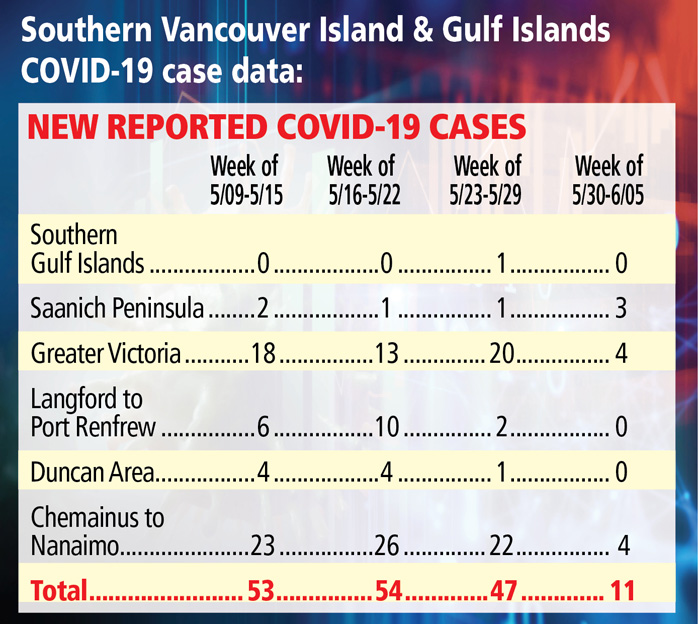
Region sees dramatic drop in new COVID cases

PREPARED BY CURT FIRESTONE & STAN DERELIAN

Let the drum beat roll, let the good times return, the light at the end of the tunnel is dazzling bright!

With the collective energy of public health safety; with a successful vaccination program underway, our Vancouver Island/Gulf Islands region is succeeding in stopping COVID. We have all made sacrifices for our community’s welfare and each one of us is thankful. The sign is out: no variants wanted.

Click on the chart above to see all of the latest available week’s data for the Gulf Islands and southern Vancouver Island.