Home Blog Page 300

Viewpoint: Trust issues illustrate conflict

By JENNIFER MARGISON

Anyone who wants the Gulf Islands to be protected from uncontrolled development should be very concerned about what happened at the March 9 meeting of Islands Trust Council.

 The meeting turned out to be a pivotal moment in the review of the Islands Trust Policy Statement, the umbrella document that determines land use policies for all of the islands.

A majority of trustees approved a motion to make protection of First Nations cultural heritage a top priority, but defeated a motion to do the same for the natural environment. It was a strange contradiction given how closely tied Indigenous interests are to the natural world. 

Furthermore, by failing to prioritize protection of the environment, community needs will be given equal standing when it comes to land use decisions. This is a worrisome trend for the future management of our fragile islands. Without strong, protective legislation, ecosystems, which have no voice of their own, are defenceless against human encroachment.

This broken system of governance has allowed Galiano’s Local Trust Committee to sidestep environmental protection policies when it suits their purpose. For instance, it is shocking to see how residents’ environmental concerns have been disregarded or downplayed in the shadow of a current rezoning application for affordable housing. The goal is laudable but the site problematic.

The proposed housing would require clear-cutting a two-hectare portion of the Galiano Heritage Forest. It is 4.7 kilometres from island services, which, in the absence of public transportation, means tenants with limited incomes will need a vehicle. Access to the site is 500 meters along an undeveloped road through a riparian area that, if developed, will see 50 to 60 new vehicle trips a day. Additionally, this development will add 48 new water consumers to an established neighbourhood that is less than 50 per cent built-out and already has documented water problems.

There are specific Trust policies on forest fragmentation, protection of water and climate change when it comes to land-use decisions. Nevertheless, this rezoning application is continuing through various stages of the approval process and we are being told it is “generally consistent” with official community plan and Trust policies.

Sadly, we are seeing two issues in conflict, both of which matter greatly to many islanders: the desire to preserve and protect our environment while building a healthy community. But we can’t build healthy communities without preserving and protecting the natural environment and resources upon which those communities depend. Last year’s State of the Islands Report showed that Gabriola, Hornby and Mayne are already at or near the “acceptable threshold for ecosystem health.”

If the needs of the community — which often result in increased density — are considered equally with environmental concerns and First Nations cultural heritage, my experience on Galiano foretells a future where Trust policies get lip service while development and ecosystem degradation march on.

The writer is a Galiano Island resident.

Editorial: Hugging trees

0

About 120 people lined the road in front of the Salt Spring RCMP station on Saturday to demand the halt to logging of old-growth forest on southern Vancouver Island. 

They also rallied to express support for the Rainforest Flying Squad, the name adopted by people who started making camps and blockades last summer in the Fairy Creek watershed near Port Renfrew, where some of the last three per cent of old-growth forest in B.C. is located. 

A number of Salt Spring Islanders have been participating in blockades, including Kim Murray, who updated Saturday’s crowd on what is happening at six sites. Because media have recently been denied access by the RCMP, she said, it’s impossible to get clear and unbiased information, but Murray described a “militarized” police presence and arrests of protesters taking place “as we speak.”

“There’s no legal support allowed in, so no lawyers, no police liaison. Nobody except a militarized police force, with helicopters — I don’t know how much we are spending on this as taxpayers — every camp is getting dive-bombed by helicopters. Right now there are people in tree platforms getting trees felled right beside them with no industry supervision, no RCMP supervision, and we are not allowed in to provide any support.”

On May 17, police began enforcing an April 1 B.C. Supreme Court injunction granted to Teal-Jones Group of Surrey, which has a provincial government licence to log in the area. 

Before last fall’s election, the B.C. government accepted 14 recommendations from a report it commissioned on managing old-growth forests called A New Future for Old Forests, suggesting the resource would be treated differently than in the past. But the Fairy Creek watershed area was not included among those whose old growth would be protected.

Much of the land in question is in unceded Pacheedaht First Nation territory, and some is in Ditidaht territory, which adds to questions about what should happen there. First Nations leadership is reportedly not united on the matter. 

Pacheedaht hereditary chief Frank Queesto Jones and chief councillor Jeff Jones said in a written statement on April 12 that they were concerned about “increasing polarization over forestry activities in our territory” and that “decisions about the use of our forestry resources in our territory need to be made by Pacheedaht.” 

Tom Mitchell has been to the blockade camps seven times in the past several months, camping on four occasions and doing day trips for the other three. He estimates about 60 Salt Spring individuals have participated in blockades at various times, with small camping pods created to minimize interactions due to COVID.  

“The Salt Springers are very well regarded as being creative and engaged,” Mitchell said.

Brian Smallshaw has also spent quite a bit of time at Fairy Creek in recent months. He pointed out that it’s less than an hour’s drive from Crofton, so people can even just go for a day to bring food or provide support.

“I urge you to go there,” he told Saturday’s rally. “It is really inspiring to go there.” 

Tim Kempe, whose wife Grace Jordan is in the area, said people who are willing to be arrested are needed. 

“I look forward to hearing more stories of Salt Springers standing up for what is right,” he said. 

Since the rally, carpooling is being arranged to make it easier for people to make the trip. 

Organizers also ask people to write letters to and phone the offices of Premier John Horgan, forests minister Katrine Conroy, environment minister George Heyman and Prime Minister Justin Trudeau. 

Islanders rally to protect old growth

0

About 120 people lined the road in front of the Salt Spring RCMP station on Saturday to demand the halt to logging of old-growth forest on southern Vancouver Island. 

They also rallied to express support for the Rainforest Flying Squad, the name adopted by people who started making camps and blockades last summer in the Fairy Creek watershed near Port Renfrew, where some of the last three per cent of old-growth forest in B.C. is located. 

A number of Salt Spring Islanders have been participating in blockades, including Kim Murray, who updated Saturday’s crowd on what is happening at six sites. Because media have recently been denied access by the RCMP, she said, it’s impossible to get clear and unbiased information, but Murray described a “militarized” police presence and arrests of protesters taking place “as we speak.”

“There’s no legal support allowed in, so no lawyers, no police liaison. Nobody except a militarized police force, with helicopters — I don’t know how much we are spending on this as taxpayers — every camp is getting dive-bombed by helicopters. Right now there are people in tree platforms getting trees felled right beside them with no industry supervision, no RCMP supervision, and we are not allowed in to provide any support.”

On May 17, police began enforcing an April 1 B.C. Supreme Court injunction granted to Teal-Jones Group of Surrey, which has a provincial government licence to log in the area. 

Tom Mitchell has been to the blockade camps seven times in the past several months, camping on four occasions and doing day trips for the other three. He estimates about 60 Salt Spring individuals have participated in blockades at various times, with small camping pods created to minimize interactions due to COVID.  

“The Salt Springers are very well regarded as being creative and engaged,” Mitchell said.

Since the rally, carpooling is being arranged to make it easier for people to make the trip. 

Organizers also ask people to write letters to and phone the offices of Premier John Horgan, forests minister Katrine Conroy, environment minister George Heyman and Prime Minister Justin Trudeau. 

For more on this story, see the May 26, 2021 issue of the Gulf Islands Driftwood newspaper, or subscribe online.

TURNBULL, James Donald

James Donald Turnbull
1932 ~ 2021

It is with heavy hearts that we say so long to Don Turnbull, husband of 65 years and best friend to his wife Joan.

Don passed away peacefully on April 23, 2021 at Lady Minto Hospital on Salt Spring Island, BC. Don was born in Springhill, Nova Scotia. Don was predeceased by his father Roderick Martin Turnbull and mother Elizabeth Turnbull. He leaves to mourn his niece Peggy Hewitt, Vernon, BC, brother-in-law Bill Phillips, Delta, BC and sister-in-law Wendy McDonald, Calgary Alta.

Don was loved by all who knew him. We can take comfort that those who lived in our hearts are never really gone and will be with us forever.

COBANLI, Leyla Rose

Leyla Rose Cobanli
2021

It is with deep sadness we announce the passing of
Leyla Rose Cobanli.


This beautiful soul will be forever in our hearts.

~ Gillian and the Cobanli Family near and far.

~ Gary and the Blake Family.

Don’t be sad for what you lost.
Be happy for what you had!
~ Dr. Seuss

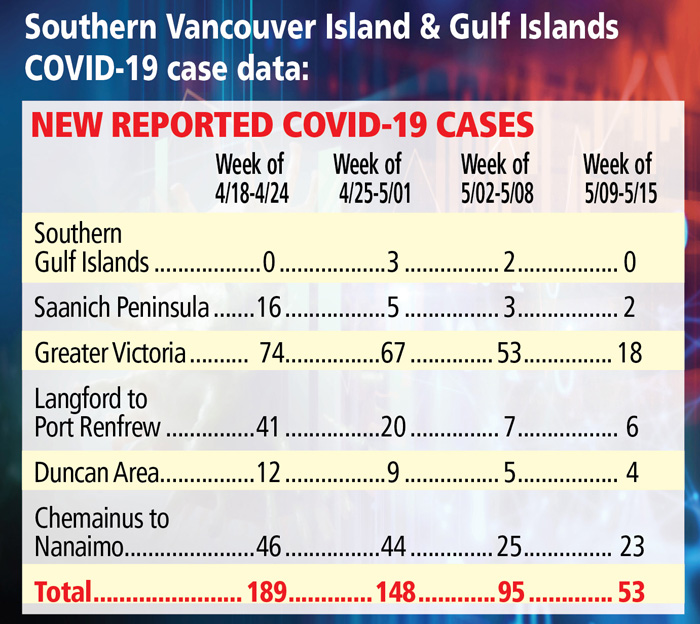
Latest Gulf Islands/Southern Vancouver Island COVID data promising

Click on the chart above to see the number of new COVID-19 cases reported by the BC Centre for Disease Control for the past four weeks. It shows the downward trend continuing in the May 9 to 15 week.

Cyanobacterial cell count prompts St. Mary Lake notice

0

A cyanobacterial bloom in St. Mary Lake has prompted a notice from the Capital Regional District Water Quality Division to the Salt Spring Island Watershed Protection Alliance. 

According to a May 19 SSIWPA news release, “The lake water showed 5,935 cyanobacterial cells per millilitre, which is above the trigger point for potential cyanotoxin production. However, the indicator for cyanotoxicity was not detected at this time (microcystin).”

There is currently no risk for people drinking treated water from the Fernwood, Highland or North Salt Spring Waterworks District systems. However, people should not consume raw or private-licensed home-treated water from St. Mary Lake at this time. 

The cyanobacterial cell level is well below the limits for recreational use, but “precaution is suggested with swimming,” states SSIWPA. 

“A toxin test on this water source will be performed weekly during the bloom. If microcystin is detected in the raw water, a toxin test will be performed on the treated water.”

Additional samples will be submitted weekly until two consecutive samples have a cell count below 2,000 cells/mL and no microcystin is detected. 

Search for Sinikka Elliott ends in tragedy

0

Salt Spring resident Sinikka Elliott is being remembered for her warm personality and her influential academic research following her disappearance and sudden death earlier this week.

Elliott, age 51, was an associate professor of sociology at the University of British Columbia and the mother of two adult children. A massive search and rescue operation that was triggered when she went missing on May 12 ended tragically with the discovery of her body on the south side of Mount Erskine on May 15.

Sarah Bowen was a colleague and friend of Elliott’s from North Carolina State University, where Elliott worked before UBC. Together with Josyln Brenton, they co-authored the book Pressure Cooker, which is about food systems and inequity in the United States. Elliott and Bowen had also worked together on a longitudinal project on food insecurity.

As Bowen wrote about Elliott on Twitter: “I can’t believe she is gone, and I will never forget her. Her mark on me is permanent.”

Sinikka Elliott, the Salt Spring Island resident who was reported missing by her family on the evening of May 12.


“We have been working on several projects together this semester and just met (by Zoom) a few weeks ago,” Bowen told the Driftwood on Monday. “I think that she was happy to return to Canada, where she had grown up, and happy to be building a home on Salt Spring Island with her partner. She often talked about how beautiful the island was.”

Guy Stecklov offered a statement of condolence on behalf of UBC’s Department of Sociology over the weekend. He noted Elliott had joined the department in 2017 and that her research concentrated on family, social inequality and social policy.

“As department head, I have had the honour of working with Sinikka and have gained, as have so many others, from her unwavering passion for both understanding and addressing longstanding systematic inequalities pervading society,” Stecklov wrote.

“Sinikka was an exceptionally skilled and deeply engaged scholar with a deep-felt commitment to social justice and equality for all.”

The University of Texas at Austin, where Elliott received her doctorate in 2008, similarly mourned her loss.

“A kind and generous person, Sinikka was a friend and mentor to many generations of UT students. She was deeply committed to social justice and brought empathy and sensitivity to everything she did,” a statement from the Department of Sociology reads.

The search for Elliott was initiated last Wednesday evening after she failed to come home from doing errands that morning. SAR members discovered her car that night at the end of Southern Way (previously reported as Juniper Place) near the Mount Erskine trailhead. The search continued until 11 p.m. that night without success.

Over the course of the next three days, a total 139 searchers from 21 search and rescue groups from Salt Spring, Vancouver Island and the Lower Mainland, plus four SAR canine teams, were on the ground trying to find her. Volunteers arrived from Juan de Fuca, Metchosin, Peninsula Emergency Measures Organization, Cowichan, Nanaimo, Ladysmith, Arrowsmith, Alberni Valley Rescue Squad, Westcoast Inland SAR, Comox Valley GSAR, Campbell River SAR, Powell River, Sunshine Coast, Squamish, Lions Bay, North Shore, Coquitlam, South Fraser, Mission, Ridge Meadows, Central Fraser Valley search and rescue groups.

Local RCMP, RCMP Police Dog Service, off-island RCMP support and RCMP air resources were also deployed each day.

Elliott’s body was eventually discovered by a civilian on Saturday morning. Police were called to the end of Toynbee Road around 11 a.m. and a helicopter crew was active on the mountain during the early afternoon.
RCMP do not believe Elliott’s death is a criminal matter. BC Coroners Service is now investigating to determine “how, where, when and by what means” she came to her death.

Searchers were supported by multiple island businesses and organizations, with local stores, restaurants and farms donating food and loaning or donating equipment, transportation and facilities. Commercial accommodations providers were flexible in housing all the off-island searchers for stays of unknown length.

“We are extremely grateful to the local community for all their support in our operations,” said Salt Spring SAR search manager Zeke Blazecka.

Salt Spring RCMP also extended their thanks to all the volunteers and community supporters.

Messages from Elliott’s colleagues hoping to spread the word during the search, and those expressing their love and condolences afterwards, are plentiful on Twitter. Many people spoke about Elliott’s positive influence on their academic careers as well as her personal character.

“This is so devastating. Sinikka Elliott has been a role model for me since I started grad school,” Katie Kaufman Rogers wrote in one tweet. “I did not know her well, but her approach to ethnographic research and feminist scholarship is an example for all of us. She will be missed.”

Organizations that donated items or otherwise aided the searchers were:
Food — Country Grocer, Harbour House Hotel, Embe Bakery, Switchboard Cafe, North End Farm and Laughing Daughters gluten-free bakery. Uptown Pizza, Salt Spring Pies, Thrifty Foods and Dos Amores, as organized by Corina Walde, were additionally committed to supplying dinner Saturday night if the search had continued.
Accommodation — The Cottages on Salt Spring, Harbour House Hotel, Seabreeze Motel, Salt Spring Inn
Equipment — Royal Canadian Legion Branch 92 and Tom Woods, Windsor Plywood, Mouat’s Home Hardware
Locations — Salt Spring Fire Rescue, Capital Regional District/Salt Spring Parks and Recreation
Transportation — Salt Spring Island Tours, Royal Canadian Marine SAR
Sanitation — Cal Mills 

Larmour Lands purchase deadline looms

0

An attempt to preserve a second 20-acre lot forming part of the “Larmour Lands” is coming down to the wire. 

A community-driven fundraising campaign saw Lot H secured last October with the Salt Spring Water Preservation Society agreeing to hold the land and place a conservation covenant on it. Efforts to also purchase nearby Lot F from the late Michael Larmour’s estate have continued, with a May 31 deadline to make an offer now looming. 

“We are hoping to have a purchase offer by the end of this month and we are hoping to bridge the gap in our funding, which is something like $100,000,” said Rodney Polden, who has been working on the conservation campaign in one way or another for well over a year.

One reason the goal is in sight is because of an offer from one generous donor to match funds up to $10,000. Charitable tax receipts are given for donations of $20 or more. 

Polden hopes islanders will be motivated to make a pledge for the purchase when they realize that it’s something they can do to help reduce the risk of wildfire. 

“Maintaining wetlands and forests are an excellent way to maintain the hydrology and level of moisture in the ground for the future,” he said.

Lot F has stunning mature forests, three separate wetlands and even an area zoned for agricultural use. It connects to Lot H to create a V-shaped 40-acre area, and adds to significant lands already protected privately by Natural Area Protection Tax Exemption Covenants through the Islands Trust. 

To donate to the Lot F purchase by etransfer or to get more information, contact ssiwps2020appeal@gmail.com. Polden can also answer any questions at penrod@saltspring.com or 250-537-5082.

Funds will be returned to donors if the purchase does not occur. 

Initiatives aim to reduce public harm

By ROBERT BIRCH

Back in March of 2020, I became increasingly aware of the fraying of our island’s social contract. A friend and long-time server who brought joy to morning commuters for over a decade bluntly stated, “I can’t take people’s entitled behaviour anymore. This is class-based violence. I quit.” 

Months later another waiter said he and his fellow workers were being verbally assaulted daily by challenging customers. “Not tourists, these are islanders, people I’ve known for years.” 

I next witnessed someone loudly demand the attention of three employees to explain why she should have paid full price for an organic grapefruit. (She had neglected to see the sticker on it.) Then I overheard an owner-receptionist at a health clinic explain to a peevish client, “I’m sick and tired of feeling like I’m being punched in the gut!” 

Eight of us gathered last week online to bear witness to stories about abusive behaviour toward public employees. A manager, care worker, social educator, therapist, activists and caring citizens showed up to acknowledge the extraordinary efforts of those working in the public and make a call for action. 

We’re all needing role relief from the pressures of these times. The concern is when we become one another’s threat. Domestic violence is skyrocketing. Abusive behaviour on Salt Spring has, for some, become a daily norm. This includes our publicly engaged workers.

“It helps when the boss defends me. But,  what boundaries are available to protect me and my fellow workers?”asked one person.

One owner said to my husband, “I’m not sure if we can handle this much longer. After 15 years in business we may have to close our doors.”

Many of us have what is known as “pandemic privilege,” while still feeling significant personal anxiety when we are often not in harm’s way. Part of this privilege is to bear witness and leverage resources toward actions identified by those harmed, such as hazard pay. 

“Many of us have been living so ‘big’ we have confused our privileges for our rights,” said one participant. “We’re in shock of losing these.”

A local manager regularly has to ask customers to return later. 

“I pride myself on helping someone having a bad day leave with a smile on their face. We used to have to ask someone to leave the premises once a year. Now, it’s every other day. The swearing and stomping out .. . We’re not here to police people’s choices or behaviours. We’re also not here to be your therapist. We just want to do our job and get home, too,” said a store manager. 

How we communicate influences outcomes. If someone sends out a childish message, many of us are conditioned to respond with a parentalizing message. Or vice versa. When working with youth I suggest, “If you want to borrow the car use adult-to-adult messaging.” (More 16-year-olds have thanked me for this tip than any other in my career). 

How well are Salt Springers communicating? Symptomatically, online hit and run belligerence has certainly infected social engagement. Given today’s overwhelming circumstances, however, it is important to distinguish between entitled behaviour, where people act out their pent-up frustrations on others at home and work, and a genuine mental health episode. 

We need more education to know how to be present and/or remove ourselves during unsettling moments. As a bystander, if possible, apply calm. Step out of the way, take a quick risk assessment for physical harm, and take several deep, slow breaths. Once the incident has passed, acknowledge the person harmed with a simple nod that says “I see you,” or, “I’m sorry that happened.” Please leave and process elsewhere.

Increasingly we may all need support with skills that can diffuse, protect or deflect harm. Many public workers are already experts on their own coping strategies. Perhaps with the help of the Chamber of Commerce, workers, business owners and mangers can think through more efficacious structural supports.

During our online forum, Restorative Justice volunteer and co-facilitator Laura Dafoe offered a brief meditation. “First, focus on our own anxiety and vulnerability. Listen to what is hard at this time, be it missing what fills us up — such as visiting family and friends or the pain of watching the news or social media. Notice how are we all sitting with collective grief.” 

How do we hold each other and ourselves with compassion? Laura invites us to imagine someone we see in public, say at the grocery store, and wonder what it might be like to be them, facing their own insecurities and anxieties, their own losses and struggles on top of their public service. Reflect on their capacity to show up, love. Be curious about what brings dignity and respect for them as well you. Also, extend care toward someone from a non-dominant group, someone likely experiencing significant added pressures. “While we can never fully know their pain, we can ask, ‘what are their fears and feelings, what are they needing during this time?’” suggests Laura. “Facing this together we are showing up to the suffering in a healthier way by cherishing the lives of everyone, including our own people, with presence and whole heartedness.” 

While mindfulness techniques have been shown to be very beneficial, our practices and policies need to be placed within broader social constructs, such as the social determinants of health, i.e. supporting greater access to helpful resources. 

“During crises, productive actions support wellness,” reminds community advocate Darlene Gage. As a community, let’s continue to discuss our collective mental health, acknowledging those of us at greater risk. Several new initiatives are in development. 

Over the coming weeks, one offering will coordinate online facilitator training to co-develop circles of support where people can meet across class and other social divisions to grow capacity for emergency preparedness and related coping skills. Encouragingly, society has become more educated about personal and collective trauma and how this impacts physical, mental as well as social, economic and ecological systems, in many cases for generations. Learning about harm reduction models helps society better understand compensatory processes for self-soothing to regulate anxiety. Tragically, for the thousands who have died due to poor substance use policy that chose policing over upstream interventions, we have moved far too slowly. Let’s advocate for change.

Humanity is pulling together. Salt Spring cares. Evidence of this is everywhere; people are making extraordinary efforts for us each day in many ways seen and unseen, cultivating grace under pressure. 

“We’re all undergoing a profound process. We’re all experiencing a death and are looking for a rebirth,” says Laura Dafoe.

The writer is a community counsellor and facilitator.